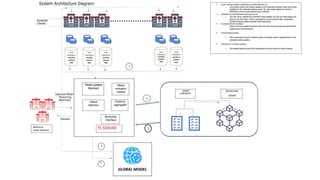
Combating Poisoning Attacks in
Blockchain - Enabled Federated Learning
in Healthcare
under the Guidance of
Mr K. Govindasamy
Department of Information Technology, MIT
Presented by
Krupa Janani G (2021506040)
Gowri R (2021506025)
Hemnath N M (2021506026)
Sasikala S (2021506324)
IT5712 PROJECT I
Literature Survey
S. No. Title Methodology Advantage Limitations
1
Blockchain for Federated
Learning Toward Secure
Distributed Machine
Learning Systems: A
Systemic Survey​
Presents an in-depth survey of Blockchain-based
Federated Learning (BCFL), covering its
architecture, structural design, and platform
deployment.
BCFL enhances privacy and
security in federated learning
by leveraging blockchain's
decentralized, transparent, and
tamper-proof characteristics.
The combination of blockchain
and federated learning
increases communication costs
and poses scalability
challenges in real-world
applications.
2
Defending Against Model
Poisoning Attacks in
Federated Learning: A
Variance-Minimization
Approach​
Proposes the MinVar algorithm, which assigns
different weights to local updates in federated
learning to defend against model poisoning attacks.
MinVar is effective in
minimizing the impact of
malicious updates, particularly
in non-I.I.D. data scenarios.
The computational complexity
of MinVar can be high, though
a data-sampling technique
helps reduce it.
3
When Machine Learning
Meets Blockchain: A
Decentralized, Privacy-
preserving, and Secure
Design​
(
Integrates decentralized machine learning with
blockchain, using a differential privacy scheme and
Byzantine attack-resilient mechanisms.
Provides strong privacy
preservation and security
against malicious participants
without the need for a central
server.
The computational overhead,
particularly due to
cryptographic methods and
consensus mechanisms, can
reduce system efficiency.
4
Blockchain-based Federated
Learning Framework with
Committee Consensus
Proposes a decentralized federated learning
framework using blockchain and committee
consensus mechanism
Reduces malicious attacks and
improves the stability of the
global model
High storage and
computational burden on
blockchain nodes​
(rf7)
5
Blockchain-Based Federated
Learning With SMPC Model
Verification Against
Poisoning Attack for
Healthcare Systems
Utilizes Secure Multi-Party Computation (SMPC)
for encrypted model verification and blockchain for
secure aggregation in healthcare systems.
Provides robust privacy and
security for federated learning
models, preventing poisoning
attacks.
The use of SMPC can lead to
increased computational
overhead and delays​
(rf2).
Literature Survey
S.No Title Methodology Advantage Limitations
6
PyTorch: An Imperative
Style, High-Performance
Deep Learning Library
Introduces a Pythonic deep learning library
focused on dynamic eager execution with GPU
acceleration
Combines ease of use and
performance, widely
adopted in research
May sacrifice some speed
for usability compared to
static graph libraries​
(rf6)
7
Privacy-Preserving
Byzantine-Robust
Federated Learning via
Blockchain Systems
Proposes a federated learning model using
blockchain and homomorphic encryption to resist
poisoning attacks
Enhances privacy and
robustness with Byzantine-
resilient and encrypted
gradients
Computational overhead due
to fully homomorphic
encryption​
(rf5)
8
FLDetector: Defending
Federated Learning Against
Model Poisoning Attacks
via Detecting Malicious
Clients
Detects malicious clients in Federated Learning
by checking the consistency of their model
updates across iterations.
Effectively detects malicious
clients without needing a
clean validation dataset.
Limited effectiveness if the
malicious clients' updates
are statistically similar to
benign clients' updates​
(rf4).
9
Incentive Mechanism for
Horizontal Federated
Learning Based on
Reputation and Reverse
Auction
Uses a reverse auction combined with reputation
to incentivize participants in federated learning
under budget constraints.
Ensures participants with
reliable data quality are
selected within budget
constraints.
Assumes honest reporting of
bids and data quality, which
may not always be true​
(rf3).
10
Data and Model Poisoning
Backdoor Attacks on
Wireless Federated
Learning, and the Defense
Mechanisms: A
Comprehensive Survey
Comprehensive analysis of attack and defense
strategies for data/model poisoning backdoor
attacks on wireless federated learning.
Provides a thorough review
of defense mechanisms to
counter backdoor attacks
Many existing defense
mechanisms are still
limited in addressing all
types of attacks effectively.
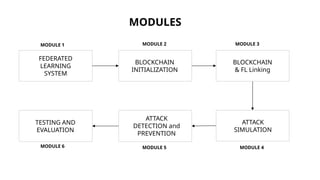
MODULES
FEDERATED
LEARNING
SYSTEM
BLOCKCHAIN
INITIALIZATION
BLOCKCHAIN
& FL Linking
TESTING AND
EVALUATION
ATTACK
DETECTION and
PREVENTION
ATTACK
SIMULATION
MODULE 1 MODULE 2 MODULE 3
MODULE 4
MODULE 5
MODULE 6
Federated Learning Module –Setup
Dataset used – Breast Tumour dataset
3 classes : normal , benign, malignant
CNN Model used – DenseNet121
Federated Learning algorithm used : FedAVG
INITIAL EXPERIMENTATION – Simple neural network IN FedAVG :
Algorithm :
global_model <- SimpleNN(input_shape=(128, 128, 1), num_classes=3)
for round in range(n_rounds):
client_models <- [Train_Model(Copy_Model(global_model), Get_Batches(Load_Dataset(data), batch_size=16))
for data in client_datasets]
client_data_sizes <- Get_Client_Data_Sizes(client_datasets)
global_model <- Σ (client_model_i * client_data_sizes[i]) / Σ client_data_sizes # Weighted FedAvg
return global_model
normal benign malignant
•Model Structure: 3 layers, 16384-
128-64-3 neurons.
•Weight Initialization: Random
initialization using PyTorch defaults.
•Forward Pass: Reshaped input
processed with ReLU.
DENSENET 121
IMPLEMENTATION :
10 clients – each run 4 epochs
Accuracy Range:
•Minimum Accuracy: 69.19%
•Maximum Accuracy: 87.26%
Global model’s accuracy after FedAVG :
79.88%
DenseNet121 Model Architecture
•ADVANTAGES :
• Efficient Feature Propagation: Better feature extraction
in grayscale.
• Fewer Parameters: Deep but with lower overfitting risk.
•Better Gradient Flow: Stabilizes training in deeper
networks.
• Feature Reuse: Maximizes use of limited features.
• Proven Success: Widely effective in medical imaging.
TOOLS USED :
Libraries : PyTorch, Torchvision, NumPy, Requests
•Flask: Backend API for communication.
•IPFS: Decentralized model and metadata storage.
Storing clients’ model and metadata files in
IPFS : Upload model and metadata files to IPFS
Get the CIDs (Content Identifiers) for the uploaded files
Store the CIDs in Blockchain Smart Contracts
Use the Smart Contracts to access the model and
metadata files using the stored CIDs
Clients or stakeholders can retrieve the models by
querying the smart contracts for the relevant CIDs
Retrieve the models and metadata from IPFS using the
CIDs for further use ( model aggregation , evaluation)
Currently has 20 files:
 10 clients’ metadata
files(reputation, stake,
model’s metrics –
accuracy,precision,recall,
f1-score)
 Model files (.pth)which
mainly have weights
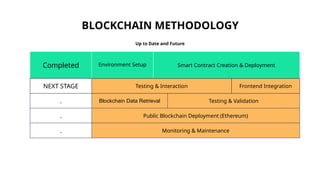
BLOCKCHAIN METHODOLOGY
Completed Environment Setup Smart Contract Creation & Deployment
NEXT STAGE Testing & Interaction Frontend Integration
. Blockchain Data Retrieval Testing & Validation
. Public Blockchain Deployment (Ethereum)
. Monitoring & Maintenance
Up to Date and Future
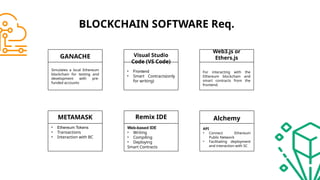
Simulates a local Ethereum
blockchain for testing and
development with pre-
funded accounts
BLOCKCHAIN SOFTWARE Req.
GANACHE
METAMASK
• Ethereum Tokens
• Transactions
• Interaction with BC
Visual Studio
Code (VS Code)
• Frontend
• Smart Contracts(only
for writing)
Remix IDE
Web-based IDE
• Writing
• Compiling
• Deploying
Smart Contracts
Web3.js or
Ethers.js
For interacting with the
Ethereum blockchain and
smart contracts from the
frontend.
Alchemy
API
• Connect Ethereum
Public Network
• Facilitating deployment
and interaction with SC
Blockchain Implemented Parts
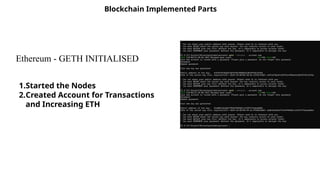
Ethereum - GETH INITIALISED
1.Started the Nodes
2.Created Account for Transactions
and Increasing ETH
Blockchain Implemented Parts
Ganachae - Initialised
1.Took One Address
and linked with MetaMask.
Blockchain Implemented Parts
Linked
METAMASK
1.Took the Private Key.
2.Added it to the MetaMask.
After Implementing Smart Contract
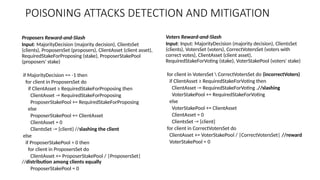
POISONING ATTACKS DETECTION AND MITIGATION
Proposers Reward-and-Slash
Input: MajorityDecision (majority decision), ClientsSet
(clients), ProposersSet (proposers), ClientAsset (client asset),
RequiredStakeForProposing (stake), ProposerStakePool
(proposers' stake)
if MajorityDecision == -1 then
for client in ProposersSet do
if ClientAsset ≥ RequiredStakeForProposing then
ClientAsset -= RequiredStakeForProposing
ProposerStakePool += RequiredStakeForProposing
else
ProposerStakePool += ClientAsset
ClientAsset = 0
ClientsSet -= {client} //slashing the client
else
if ProposerStakePool > 0 then
for client in ProposersSet do
ClientAsset += ProposerStakePool / |ProposersSet|
//distribution among clients equally
ProposerStakePool = 0
Voters Reward-and-Slash
Input: Input: MajorityDecision (majority decision), ClientsSet
(clients), VotersSet (voters), CorrectVotersSet (voters with
correct votes), ClientAsset (client asset),
RequiredStakeForVoting (stake), VoterStakePool (voters' stake)
for client in VotersSet  CorrectVotersSet do (incorrectVoters)
if ClientAsset ≥ RequiredStakeForVoting then
ClientAsset -= RequiredStakeForVoting .//slashing
VoterStakePool += RequiredStakeForVoting
else
VoterStakePool += ClientAsset
ClientAsset = 0
ClientsSet -= {client}
for client in CorrectVotersSet do
ClientAsset += VoterStakePool / |CorrectVotersSet| //reward
VoterStakePool = 0
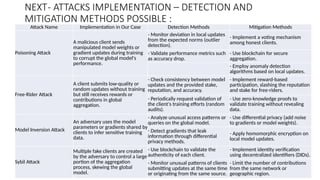
NEXT- ATTACKS IMPLEMENTATION – DETECTION AND
MITIGATION METHODS POSSIBLE :
Attack Name Implementation in Our Case Detection Methods Mitigation Methods
Poisoning Attack
A malicious client sends
manipulated model weights or
gradient updates during training
to corrupt the global model's
performance.
- Monitor deviation in local updates
from the expected norms (outlier
detection).
- Implement a voting mechanism
among honest clients.
- Validate performance metrics such
as accuracy drop.
- Use blockchain for secure
aggregation.
- Employ anomaly detection
algorithms based on local updates.
Free-Rider Attack
A client submits low-quality or
random updates without training
but still receives rewards or
contributions in global
aggregation.
- Check consistency between model
updates and the provided stake,
reputation, and accuracy.
- Implement reward-based
participation, slashing the reputation
and stake for free-riders.
- Periodically request validation of
the client's training efforts (random
audits).
- Use zero-knowledge proofs to
validate training without revealing
data.
Model Inversion Attack
An adversary uses the model
parameters or gradients shared by
clients to infer sensitive training
data.
- Analyze unusual access patterns or
queries on the global model.
- Use differential privacy (add noise
to gradients or model weights).
- Detect gradients that leak
information through differential
privacy methods.
- Apply homomorphic encryption on
local model updates.
Sybil Attack
Multiple fake clients are created
by the adversary to control a large
portion of the aggregation
process, skewing the global
model.
- Use blockchain to validate the
authenticity of each client.
- Implement identity verification
using decentralized identifiers (DIDs).
- Monitor unusual patterns of clients
submitting updates at the same time
or originating from the same source.
- Limit the number of contributions
from the same network or
geographic region.
Thank You.

BLOCKCHAIN FINAL YEAR PROJECT PRESENTATION

  • 1.
    Combating Poisoning Attacksin Blockchain - Enabled Federated Learning in Healthcare under the Guidance of Mr K. Govindasamy Department of Information Technology, MIT Presented by Krupa Janani G (2021506040) Gowri R (2021506025) Hemnath N M (2021506026) Sasikala S (2021506324) IT5712 PROJECT I
  • 2.
    Literature Survey S. No.Title Methodology Advantage Limitations 1 Blockchain for Federated Learning Toward Secure Distributed Machine Learning Systems: A Systemic Survey​ Presents an in-depth survey of Blockchain-based Federated Learning (BCFL), covering its architecture, structural design, and platform deployment. BCFL enhances privacy and security in federated learning by leveraging blockchain's decentralized, transparent, and tamper-proof characteristics. The combination of blockchain and federated learning increases communication costs and poses scalability challenges in real-world applications. 2 Defending Against Model Poisoning Attacks in Federated Learning: A Variance-Minimization Approach​ Proposes the MinVar algorithm, which assigns different weights to local updates in federated learning to defend against model poisoning attacks. MinVar is effective in minimizing the impact of malicious updates, particularly in non-I.I.D. data scenarios. The computational complexity of MinVar can be high, though a data-sampling technique helps reduce it. 3 When Machine Learning Meets Blockchain: A Decentralized, Privacy- preserving, and Secure Design​ ( Integrates decentralized machine learning with blockchain, using a differential privacy scheme and Byzantine attack-resilient mechanisms. Provides strong privacy preservation and security against malicious participants without the need for a central server. The computational overhead, particularly due to cryptographic methods and consensus mechanisms, can reduce system efficiency. 4 Blockchain-based Federated Learning Framework with Committee Consensus Proposes a decentralized federated learning framework using blockchain and committee consensus mechanism Reduces malicious attacks and improves the stability of the global model High storage and computational burden on blockchain nodes​ (rf7) 5 Blockchain-Based Federated Learning With SMPC Model Verification Against Poisoning Attack for Healthcare Systems Utilizes Secure Multi-Party Computation (SMPC) for encrypted model verification and blockchain for secure aggregation in healthcare systems. Provides robust privacy and security for federated learning models, preventing poisoning attacks. The use of SMPC can lead to increased computational overhead and delays​ (rf2).
  • 3.
    Literature Survey S.No TitleMethodology Advantage Limitations 6 PyTorch: An Imperative Style, High-Performance Deep Learning Library Introduces a Pythonic deep learning library focused on dynamic eager execution with GPU acceleration Combines ease of use and performance, widely adopted in research May sacrifice some speed for usability compared to static graph libraries​ (rf6) 7 Privacy-Preserving Byzantine-Robust Federated Learning via Blockchain Systems Proposes a federated learning model using blockchain and homomorphic encryption to resist poisoning attacks Enhances privacy and robustness with Byzantine- resilient and encrypted gradients Computational overhead due to fully homomorphic encryption​ (rf5) 8 FLDetector: Defending Federated Learning Against Model Poisoning Attacks via Detecting Malicious Clients Detects malicious clients in Federated Learning by checking the consistency of their model updates across iterations. Effectively detects malicious clients without needing a clean validation dataset. Limited effectiveness if the malicious clients' updates are statistically similar to benign clients' updates​ (rf4). 9 Incentive Mechanism for Horizontal Federated Learning Based on Reputation and Reverse Auction Uses a reverse auction combined with reputation to incentivize participants in federated learning under budget constraints. Ensures participants with reliable data quality are selected within budget constraints. Assumes honest reporting of bids and data quality, which may not always be true​ (rf3). 10 Data and Model Poisoning Backdoor Attacks on Wireless Federated Learning, and the Defense Mechanisms: A Comprehensive Survey Comprehensive analysis of attack and defense strategies for data/model poisoning backdoor attacks on wireless federated learning. Provides a thorough review of defense mechanisms to counter backdoor attacks Many existing defense mechanisms are still limited in addressing all types of attacks effectively.
  • 5.
    MODULES FEDERATED LEARNING SYSTEM BLOCKCHAIN INITIALIZATION BLOCKCHAIN & FL Linking TESTINGAND EVALUATION ATTACK DETECTION and PREVENTION ATTACK SIMULATION MODULE 1 MODULE 2 MODULE 3 MODULE 4 MODULE 5 MODULE 6
  • 6.
    Federated Learning Module–Setup Dataset used – Breast Tumour dataset 3 classes : normal , benign, malignant CNN Model used – DenseNet121 Federated Learning algorithm used : FedAVG INITIAL EXPERIMENTATION – Simple neural network IN FedAVG : Algorithm : global_model <- SimpleNN(input_shape=(128, 128, 1), num_classes=3) for round in range(n_rounds): client_models <- [Train_Model(Copy_Model(global_model), Get_Batches(Load_Dataset(data), batch_size=16)) for data in client_datasets] client_data_sizes <- Get_Client_Data_Sizes(client_datasets) global_model <- Σ (client_model_i * client_data_sizes[i]) / Σ client_data_sizes # Weighted FedAvg return global_model normal benign malignant •Model Structure: 3 layers, 16384- 128-64-3 neurons. •Weight Initialization: Random initialization using PyTorch defaults. •Forward Pass: Reshaped input processed with ReLU.
  • 7.
    DENSENET 121 IMPLEMENTATION : 10clients – each run 4 epochs Accuracy Range: •Minimum Accuracy: 69.19% •Maximum Accuracy: 87.26% Global model’s accuracy after FedAVG : 79.88% DenseNet121 Model Architecture •ADVANTAGES : • Efficient Feature Propagation: Better feature extraction in grayscale. • Fewer Parameters: Deep but with lower overfitting risk. •Better Gradient Flow: Stabilizes training in deeper networks. • Feature Reuse: Maximizes use of limited features. • Proven Success: Widely effective in medical imaging. TOOLS USED : Libraries : PyTorch, Torchvision, NumPy, Requests •Flask: Backend API for communication. •IPFS: Decentralized model and metadata storage.
  • 8.
    Storing clients’ modeland metadata files in IPFS : Upload model and metadata files to IPFS Get the CIDs (Content Identifiers) for the uploaded files Store the CIDs in Blockchain Smart Contracts Use the Smart Contracts to access the model and metadata files using the stored CIDs Clients or stakeholders can retrieve the models by querying the smart contracts for the relevant CIDs Retrieve the models and metadata from IPFS using the CIDs for further use ( model aggregation , evaluation) Currently has 20 files:  10 clients’ metadata files(reputation, stake, model’s metrics – accuracy,precision,recall, f1-score)  Model files (.pth)which mainly have weights
  • 9.
    BLOCKCHAIN METHODOLOGY Completed EnvironmentSetup Smart Contract Creation & Deployment NEXT STAGE Testing & Interaction Frontend Integration . Blockchain Data Retrieval Testing & Validation . Public Blockchain Deployment (Ethereum) . Monitoring & Maintenance Up to Date and Future
  • 10.
    Simulates a localEthereum blockchain for testing and development with pre- funded accounts BLOCKCHAIN SOFTWARE Req. GANACHE METAMASK • Ethereum Tokens • Transactions • Interaction with BC Visual Studio Code (VS Code) • Frontend • Smart Contracts(only for writing) Remix IDE Web-based IDE • Writing • Compiling • Deploying Smart Contracts Web3.js or Ethers.js For interacting with the Ethereum blockchain and smart contracts from the frontend. Alchemy API • Connect Ethereum Public Network • Facilitating deployment and interaction with SC
  • 11.
    Blockchain Implemented Parts Ethereum- GETH INITIALISED 1.Started the Nodes 2.Created Account for Transactions and Increasing ETH
  • 12.
    Blockchain Implemented Parts Ganachae- Initialised 1.Took One Address and linked with MetaMask.
  • 13.
    Blockchain Implemented Parts Linked METAMASK 1.Tookthe Private Key. 2.Added it to the MetaMask.
  • 14.
  • 15.
    POISONING ATTACKS DETECTIONAND MITIGATION Proposers Reward-and-Slash Input: MajorityDecision (majority decision), ClientsSet (clients), ProposersSet (proposers), ClientAsset (client asset), RequiredStakeForProposing (stake), ProposerStakePool (proposers' stake) if MajorityDecision == -1 then for client in ProposersSet do if ClientAsset ≥ RequiredStakeForProposing then ClientAsset -= RequiredStakeForProposing ProposerStakePool += RequiredStakeForProposing else ProposerStakePool += ClientAsset ClientAsset = 0 ClientsSet -= {client} //slashing the client else if ProposerStakePool > 0 then for client in ProposersSet do ClientAsset += ProposerStakePool / |ProposersSet| //distribution among clients equally ProposerStakePool = 0 Voters Reward-and-Slash Input: Input: MajorityDecision (majority decision), ClientsSet (clients), VotersSet (voters), CorrectVotersSet (voters with correct votes), ClientAsset (client asset), RequiredStakeForVoting (stake), VoterStakePool (voters' stake) for client in VotersSet CorrectVotersSet do (incorrectVoters) if ClientAsset ≥ RequiredStakeForVoting then ClientAsset -= RequiredStakeForVoting .//slashing VoterStakePool += RequiredStakeForVoting else VoterStakePool += ClientAsset ClientAsset = 0 ClientsSet -= {client} for client in CorrectVotersSet do ClientAsset += VoterStakePool / |CorrectVotersSet| //reward VoterStakePool = 0
  • 16.
    NEXT- ATTACKS IMPLEMENTATION– DETECTION AND MITIGATION METHODS POSSIBLE : Attack Name Implementation in Our Case Detection Methods Mitigation Methods Poisoning Attack A malicious client sends manipulated model weights or gradient updates during training to corrupt the global model's performance. - Monitor deviation in local updates from the expected norms (outlier detection). - Implement a voting mechanism among honest clients. - Validate performance metrics such as accuracy drop. - Use blockchain for secure aggregation. - Employ anomaly detection algorithms based on local updates. Free-Rider Attack A client submits low-quality or random updates without training but still receives rewards or contributions in global aggregation. - Check consistency between model updates and the provided stake, reputation, and accuracy. - Implement reward-based participation, slashing the reputation and stake for free-riders. - Periodically request validation of the client's training efforts (random audits). - Use zero-knowledge proofs to validate training without revealing data. Model Inversion Attack An adversary uses the model parameters or gradients shared by clients to infer sensitive training data. - Analyze unusual access patterns or queries on the global model. - Use differential privacy (add noise to gradients or model weights). - Detect gradients that leak information through differential privacy methods. - Apply homomorphic encryption on local model updates. Sybil Attack Multiple fake clients are created by the adversary to control a large portion of the aggregation process, skewing the global model. - Use blockchain to validate the authenticity of each client. - Implement identity verification using decentralized identifiers (DIDs). - Monitor unusual patterns of clients submitting updates at the same time or originating from the same source. - Limit the number of contributions from the same network or geographic region.
  • 17.