Blockchain Explained
A Brief Overviewand Introduction
What Is Blockchain
What Is Blockchain
• Blockchain was introduced to the world as the record-keepingmechanism for the cryptocurrency Bitcoin.
• Blockchain is a database distributed over thousands of computers that maintains the list of transactions
(called blocks) for eachBitcoin.
What Is BlockchainContinued
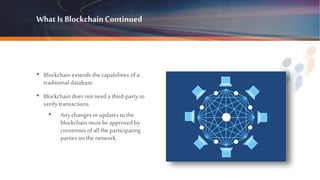
• Blockchain extends the capabilities of a
traditional database.
• Blockchain does not need a third-party to
verify transactions.
• Any changes orupdates to the
blockchain must beapproved by
consensus of all the participating
parties on thenetwork.
The Blockchain Ledger
The BlockchainLedger
• Theblockchain ledger maintains all the information and cannot be altered after the transaction is complete.
• It is also transparent. Changing a transaction requires changing the entire database and will be visible to
all users on the network.
• This transparency that allows you to seeyour transaction and anyone else’s transactions creates trust and
keepsthe system secure.
• Thetransactions are transparent, but the users can stay anonymous without paying a third-party.
• This combination of anonymity and savings is the main attraction to the businesses and governments.
How Does Blockchain Work
How Does BlockchainWork
• Blockchain architecture varies by project. Files containing all the transactions in eachperiod arecalled blocks.
Blocks are linked into chains.
• Newblocks are createdby mining. Each new block includes encrypted information from the previous block.
• If someonealters a block, then it will break the chain. The blockchain is stored onseveral nodes (computers)
by the block synchronization process.
How Does BlockchainWorkContinued
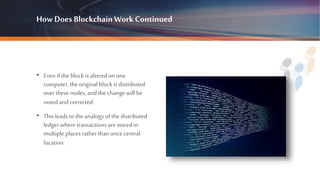
• Even if the block is altered on one
computer, the original block is distributed
overthese nodes, and the changewill be
noted and corrected.
• This leads to the analogy of the distributed
ledger where transactions are stored in
multiple places rather than oncecentral
location.
Smart Ledgers
Smart Contracts
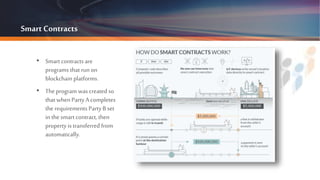
• Smart contracts are
programs that run on
blockchain platforms.
• Theprogram was createdso
that when Party A completes
the requirements Party B set
in the smart contract, then
property is transferred from
automatically.
Smart Contracts Continued
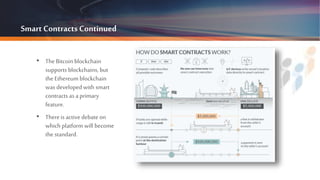
• TheBitcoin blockchain
supports blockchains, but
the Ethereum blockchain
was developed with smart
contracts as a primary
feature.
• There is active debate on
which platform will become
the standard.
Governmental Use
GovernmentalUse
• In the US, federal agencies arelooking at blockchain solutions for information sharing, financial management
transparency, procurement processes, andgovernment-issued credentials like social security cards, visas, and
passports.
• TheGSA Emerging Citizen Technology Office started the US Federal Blockchain program find ways for federal
agencies and US businesses to explore blockchain solutions.
GovernmentalUse Continued
• TheUS Department of Homeland Security is exploring ways to improve identification verifications.
• TheUS Treasury Department is piloting a supply chain management projectbased on blockchain
technologies.
• Arizona, Georgia, and Illinois areconsidering legislation toacceptcryptocurrencies for tax payments.
• Delaware is storing National Archive Records on a blockchain platform.
Summary
Summary
• Maybe it bestto think about blockchain like this… There will behuge failures and misspent money — and
yes, scams (the Securities and Exchange Commission can hardly keepup with the number of fraudulent
players outthere), buta decade from now, when you look back, it’s more likely than not that blockchain will
beembedded in ourday-to-day lives in ways that, today, we can’t evenimagine.
Thank You
AnthonyCecchini
Web: http://www.itpsap.com
E-Mail: ajcecchini@itpsap.com
Cell: (724)910-8982

Blockchain Explained by IT Partners, Inc

  • 1.
    Blockchain Explained A BriefOverviewand Introduction
  • 2.
  • 3.
    What Is Blockchain •Blockchain was introduced to the world as the record-keepingmechanism for the cryptocurrency Bitcoin. • Blockchain is a database distributed over thousands of computers that maintains the list of transactions (called blocks) for eachBitcoin.
  • 4.
    What Is BlockchainContinued •Blockchain extends the capabilities of a traditional database. • Blockchain does not need a third-party to verify transactions. • Any changes orupdates to the blockchain must beapproved by consensus of all the participating parties on thenetwork.
  • 5.
  • 6.
    The BlockchainLedger • Theblockchainledger maintains all the information and cannot be altered after the transaction is complete. • It is also transparent. Changing a transaction requires changing the entire database and will be visible to all users on the network. • This transparency that allows you to seeyour transaction and anyone else’s transactions creates trust and keepsthe system secure. • Thetransactions are transparent, but the users can stay anonymous without paying a third-party. • This combination of anonymity and savings is the main attraction to the businesses and governments.
  • 7.
  • 8.
    How Does BlockchainWork •Blockchain architecture varies by project. Files containing all the transactions in eachperiod arecalled blocks. Blocks are linked into chains. • Newblocks are createdby mining. Each new block includes encrypted information from the previous block. • If someonealters a block, then it will break the chain. The blockchain is stored onseveral nodes (computers) by the block synchronization process.
  • 9.
    How Does BlockchainWorkContinued •Even if the block is altered on one computer, the original block is distributed overthese nodes, and the changewill be noted and corrected. • This leads to the analogy of the distributed ledger where transactions are stored in multiple places rather than oncecentral location.
  • 10.
  • 11.
    Smart Contracts • Smartcontracts are programs that run on blockchain platforms. • Theprogram was createdso that when Party A completes the requirements Party B set in the smart contract, then property is transferred from automatically.
  • 12.
    Smart Contracts Continued •TheBitcoin blockchain supports blockchains, but the Ethereum blockchain was developed with smart contracts as a primary feature. • There is active debate on which platform will become the standard.
  • 13.
  • 14.
    GovernmentalUse • In theUS, federal agencies arelooking at blockchain solutions for information sharing, financial management transparency, procurement processes, andgovernment-issued credentials like social security cards, visas, and passports. • TheGSA Emerging Citizen Technology Office started the US Federal Blockchain program find ways for federal agencies and US businesses to explore blockchain solutions.
  • 15.
    GovernmentalUse Continued • TheUSDepartment of Homeland Security is exploring ways to improve identification verifications. • TheUS Treasury Department is piloting a supply chain management projectbased on blockchain technologies. • Arizona, Georgia, and Illinois areconsidering legislation toacceptcryptocurrencies for tax payments. • Delaware is storing National Archive Records on a blockchain platform.
  • 16.
  • 17.
    Summary • Maybe itbestto think about blockchain like this… There will behuge failures and misspent money — and yes, scams (the Securities and Exchange Commission can hardly keepup with the number of fraudulent players outthere), buta decade from now, when you look back, it’s more likely than not that blockchain will beembedded in ourday-to-day lives in ways that, today, we can’t evenimagine.
  • 18.
    Thank You AnthonyCecchini Web: http://www.itpsap.com E-Mail:ajcecchini@itpsap.com Cell: (724)910-8982

Editor's Notes

  • #2 To change the image on this slide, select the picture and delete it. Then click the Pictures icon in the placeholder to insert your own image.