Blockchain technology’s corecharacteristics include decentralization,
transparency, immutability, and automation. These elements can be
applied to various industries, creating a multitude of use cases. Here
are what we believe to be the most pertinent blockchain use cases for
enterprises, institutions, and governments.
3.
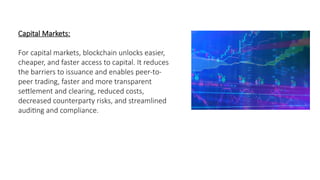
Capital Markets:
For capitalmarkets, blockchain unlocks easier,
cheaper, and faster access to capital. It reduces
the barriers to issuance and enables peer-to-
peer trading, faster and more transparent
settlement and clearing, reduced costs,
decreased counterparty risks, and streamlined
auditing and compliance.
4.
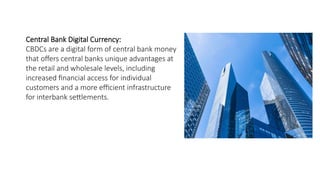
Central Bank DigitalCurrency:
CBDCs are a digital form of central bank money
that offers central banks unique advantages at
the retail and wholesale levels, including
increased financial access for individual
customers and a more efficient infrastructure
for interbank settlements.
5.
Decentralized finance—DeFi—refers tothe shift
from traditional, centralized financial systems to
peer-to-peer finance enabled by decentralized
technologies built on Ethereum. Millions are
building and participating in this new economic
system that is setting new standards for financial
access, opportunity, and trust.
6.
Digital Identity
A blockchain-baseddigital identity system
provides a unified, interoperable, and
tamper-proof infrastructure with key
benefits to enterprises, users, and IoT
management systems. The solution protects
against theft and provides individuals
greater sovereignty over their data.
7.
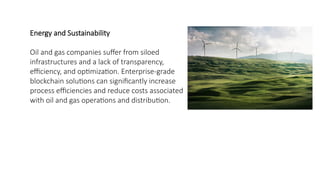
Energy and Sustainability
Oiland gas companies suffer from siloed
infrastructures and a lack of transparency,
efficiency, and optimization. Enterprise-grade
blockchain solutions can significantly increase
process efficiencies and reduce costs associated
with oil and gas operations and distribution.
8.
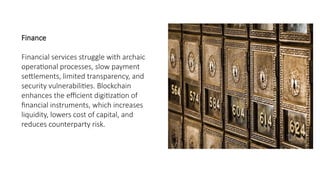
Finance
Financial services strugglewith archaic
operational processes, slow payment
settlements, limited transparency, and
security vulnerabilities. Blockchain
enhances the efficient digitization of
financial instruments, which increases
liquidity, lowers cost of capital, and
reduces counterparty risk.
9.
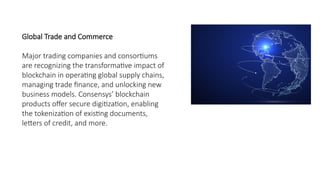
Global Trade andCommerce
Major trading companies and consortiums
are recognizing the transformative impact of
blockchain in operating global supply chains,
managing trade finance, and unlocking new
business models. Consensys’ blockchain
products offer secure digitization, enabling
the tokenization of existing documents,
letters of credit, and more.
10.
Government and PublicSector
Ethereum blockchain technology allows
governments to build trust, improve
accountability and responsiveness, increase
efficiency, reduce costs, and create high-
performing government functions with more
secure, agile, and cost-effective structures.
11.
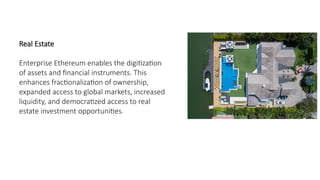
Real Estate
Enterprise Ethereumenables the digitization
of assets and financial instruments. This
enhances fractionalization of ownership,
expanded access to global markets, increased
liquidity, and democratized access to real
estate investment opportunities.
12.
Sports and esports
Ethereumenabled smart contracts can
streamline existing esports operations, provide
new revenue models, and enhance fan
engagement with enhanced loyalty programs
and incentives.
13.
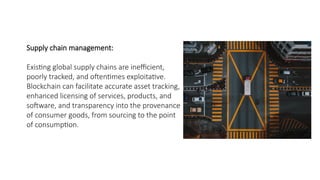
Supply chain management:
Existingglobal supply chains are inefficient,
poorly tracked, and oftentimes exploitative.
Blockchain can facilitate accurate asset tracking,
enhanced licensing of services, products, and
software, and transparency into the provenance
of consumer goods, from sourcing to the point
of consumption.



![AVG Internet Security Crack + [Activation] 2025](https://cdn.slidesharecdn.com/ss_thumbnails/understandingblockchain-250316100000-fcfb236d-thumbnail.jpg?width=640&height=640&fit=bounds)

![Adguard Premium Crack + License Key [Latest Version]](https://cdn.slidesharecdn.com/ss_thumbnails/understandingblockchain-250316100234-eef745e9-thumbnail.jpg?width=640&height=640&fit=bounds)


