How Blockchain Is Revolutionizing Industries Beyond Cryptocurrency.pdf
1.
How Blockchain IsRevolutionizing
Industries Beyond Cryptocurrency
Introduction: Defining Blockchain
To define blockchain, imagine a decentralized ledger that records transactions across a
network of computers. Originally conceived to power Bitcoin, blockchain technology now
underpins a growing array of use cases. In this article, we explore how blockchain
applications are disrupting traditional industries, why every blockchain developer should
broaden their horizons, and what the future holds for this groundbreaking innovation.
Understanding Blockchain Technology
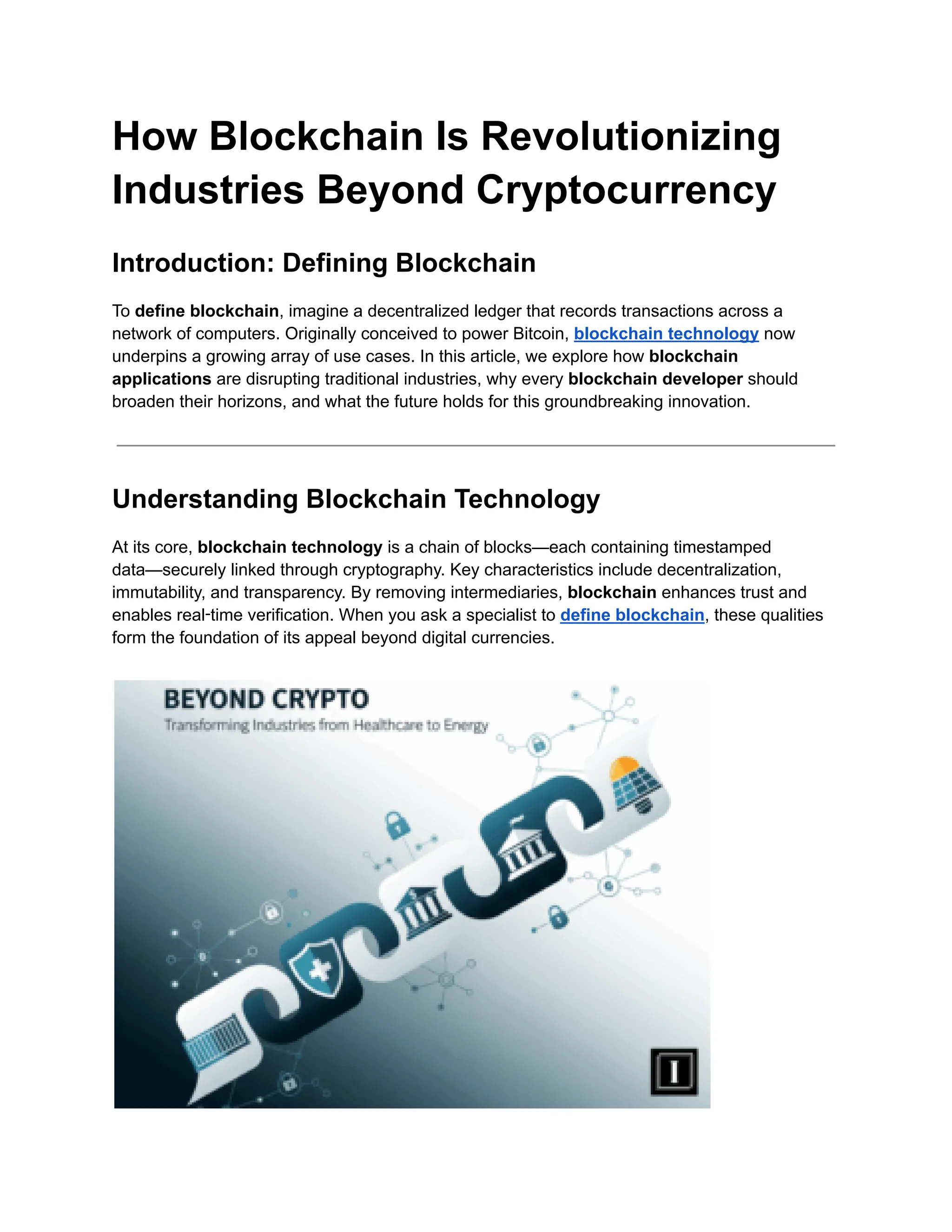
At its core, blockchain technology is a chain of blocks—each containing timestamped
data—securely linked through cryptography. Key characteristics include decentralization,
immutability, and transparency. By removing intermediaries, blockchain enhances trust and
enables real‑time verification. When you ask a specialist to define blockchain, these qualities
form the foundation of its appeal beyond digital currencies.
2.
Blockchain Applications inSupply Chain Management
One of the earliest non-crypto use cases, blockchain applications in supply chain, delivers
end‑to‑end traceability:
● Provenance Tracking: Consumers can scan QR codes to verify product origins,
reducing fraud.
● Smart Contracts: Automated agreements trigger payments when goods reach
checkpoints.
● Inventory Management: Real‑time ledger updates prevent stockouts and overstocks.
By leveraging blockchain, companies like Walmart and Maersk have cut costs, improved
efficiency, and boosted consumer trust—demonstrating the system’s enterprise value.
Blockchain for Healthcare Innovation
Healthcare’s complexity demands secure, interoperable data systems. Here, blockchain
technology shines by:
1. Patient Records: Immutable, auditable histories enhance safety and compliance.
2. Drug Traceability: From manufacturer to dispenser, pharmaceuticals are tracked to
prevent counterfeits.
3. Clinical Trials: Transparent data sharing accelerates research while preserving patient
privacy.
The integration of blockchain in healthcare not only streamlines operations but also safeguards
sensitive data against cyber threats.
Empowering the Blockchain Developer
As demand for blockchain applications grows, the role of the blockchain developer is more
crucial than ever. Core skills include:
● Smart Contract Programming: Languages like Solidity power platforms such as
Ethereum.
● Consensus Algorithms: Understanding Proof of Work, Proof of Stake, and beyond.
● Security Audits: Identifying vulnerabilities in distributed networks.
Aspiring blockchain developers should master these competencies to lead innovation in
finance, real estate, energy, and more.
3.
Blockchain in FinancialServices Beyond Crypto
While cryptocurrencies grab headlines, the finance sector’s adoption of blockchain technology
is broader:
● Cross‑Border Payments: Instant settlements reduce costs and counterparty risk.
● Trade Finance: Paperless letter‑of‑credit processes signed digitally by all parties.
● Tokenization of Assets: Real estate or art can be divided into tokens, enhancing
liquidity.
These blockchain applications are reshaping banking, investment, and insurance, paving the
way for more inclusive, efficient financial ecosystems.
Government and Public Sector Blockchain Use Cases
Governments worldwide are piloting blockchain to improve public services:
● Digital Identity: Citizens control their data, reducing fraud in elections and welfare
distribution.
● Land Registry: Immutable property records mitigate title disputes and corruption.
● Tax Collection: Transparent ledgers streamline audits and curb evasion.
By harnessing blockchain technology, public institutions can deliver services with
unprecedented accountability and efficiency.
Blockchain Applications in Energy and Sustainability
Energy providers are exploring blockchain for peer‑to‑peer power trading and carbon credit
tracking:
● Microgrids: Neighbors buy and sell surplus solar power without a central utility.
● Carbon Markets: Immutable records of emissions and offsets enhance credibility.
These initiatives show how blockchain can drive sustainable practices and democratize energy
access.
4.
Challenges and theRoad Ahead for Blockchain
Despite its promise, blockchain faces hurdles:
● Scalability: Many networks struggle with transaction throughput.
● Regulation: Legal frameworks lag behind technological advances.
● Interoperability: Fragmented platforms hinder seamless data exchange.
Ongoing research into layer‑2 solutions and cross‑chain protocols aims to overcome these
barriers, unlocking the full potential of blockchain technology.
Conclusion
From supply chain transparency to secure healthcare records, the revolutionary impact of
blockchain extends far beyond cryptocurrency. As enterprises and governments embrace
blockchain applications, the demand for skilled blockchain developers will soar.
Understanding how to define blockchain in practical terms is essential for any organization
looking to leverage this transformative technology.
For more in‑depth analysis and strategic insights, subscribe to IMPAAKT, your top business
magazine.