What is Blockchain
Blockchain is a secure, decentralized, and distributed
digital ledger that allows participants to share up-to-
date information simultaneously. It eliminates the need
for intermediaries by securely recording transactions
and data in blocks, which are linked together in a chain.
The network nodes maintain and update the
blockchain, ensuring trust and transparency through
cryptographic algorithms.
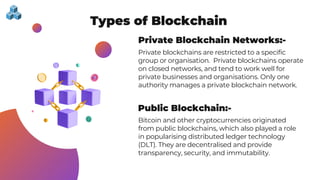
Types of Blockchain
Private Blockchain Networks:-
Private blockchains are restricted to a specific
group or organisation. Private blockchains operate
on closed networks, and tend to work well for
private businesses and organisations. Only one
authority manages a private blockchain network.
Public Blockchain:-
Bitcoin and other cryptocurrencies originated
from public blockchains, which also played a role
in popularising distributed ledger technology
(DLT). They are decentralised and provide
transparency, security, and immutability.
Consortium Blockchain:-
Consortium blockchains are a hybrid between public
and private blockchains. They are governed by a
group of organisations or entities that have agreed
to participate in the network. Consortium
blockchains offer a balance between
decentralisation and control, making them suitable
for collaborations among trusted entities.
Permissioned Blockchain:-
Permissioned blockchains impose restrictions on
who can participate and perform certain actions on
the network. They are typically used in enterprise
settings where trust and identity verification are
crucial.Participants must be granted permission to
join the network and carry out specific functions.
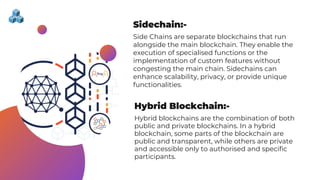
Sidechain:-
Side Chains are separate blockchains that run
alongside the main blockchain. They enable the
execution of specialised functions or the
implementation of custom features without
congesting the main chain. Sidechains can
enhance scalability, privacy, or provide unique
functionalities.
Hybrid Blockchain:-
Hybrid blockchains are the combination of both
public and private blockchains. In a hybrid
blockchain, some parts of the blockchain are
public and transparent, while others are private
and accessible only to authorised and specific
participants.
FOR INQUIRIES Connect US
EMAIL :- info@blockcoders.pro
https://blockcoders.pro/
WEBSITE :-
CALL :- 91-7888709549, +91-7087369445
ADDRESS :- C 177(A) Ind Area, Sector 74, Sahibzada
Ajit Singh Nagar, Punjab 160074

Blockchain

  • 1.
    What is Blockchain Blockchainis a secure, decentralized, and distributed digital ledger that allows participants to share up-to- date information simultaneously. It eliminates the need for intermediaries by securely recording transactions and data in blocks, which are linked together in a chain. The network nodes maintain and update the blockchain, ensuring trust and transparency through cryptographic algorithms.
  • 2.
    Types of Blockchain PrivateBlockchain Networks:- Private blockchains are restricted to a specific group or organisation. Private blockchains operate on closed networks, and tend to work well for private businesses and organisations. Only one authority manages a private blockchain network. Public Blockchain:- Bitcoin and other cryptocurrencies originated from public blockchains, which also played a role in popularising distributed ledger technology (DLT). They are decentralised and provide transparency, security, and immutability.
  • 3.
    Consortium Blockchain:- Consortium blockchainsare a hybrid between public and private blockchains. They are governed by a group of organisations or entities that have agreed to participate in the network. Consortium blockchains offer a balance between decentralisation and control, making them suitable for collaborations among trusted entities. Permissioned Blockchain:- Permissioned blockchains impose restrictions on who can participate and perform certain actions on the network. They are typically used in enterprise settings where trust and identity verification are crucial.Participants must be granted permission to join the network and carry out specific functions.
  • 4.
    Sidechain:- Side Chains areseparate blockchains that run alongside the main blockchain. They enable the execution of specialised functions or the implementation of custom features without congesting the main chain. Sidechains can enhance scalability, privacy, or provide unique functionalities. Hybrid Blockchain:- Hybrid blockchains are the combination of both public and private blockchains. In a hybrid blockchain, some parts of the blockchain are public and transparent, while others are private and accessible only to authorised and specific participants.
  • 5.
    FOR INQUIRIES ConnectUS EMAIL :- info@blockcoders.pro https://blockcoders.pro/ WEBSITE :- CALL :- 91-7888709549, +91-7087369445 ADDRESS :- C 177(A) Ind Area, Sector 74, Sahibzada Ajit Singh Nagar, Punjab 160074