SUMMER 2011 3NEWSLETTER OF THE NORTH AMERICAN NATIVE PLANT SOCIETY
Planned Subdivision Sparks a Wildlife Haven
by Patricia Baldwin
In 2005, my local municipality informed me of plans
for a new subdivision very close to my home.
Although it's located on .7 hectares (1.77 acres)
within the urban borders of Scugog Township, my
property is very close to the boundary line to rural
areas. The houses are custom-built and all have a
different landscape character, some rolling lawns with
high-maintenance landscaping, others with woodlot
remnants still standing from an old farm.
My main concern: to provide habitat for wildlife
which I knew would be displaced by further
construction. I suspected my neighbours would accept
my ecological restoration project but I wanted to
make it as neat and tidy as I could just to be safe.
My first project was to create a hedgerow along my
south property line. I wanted bird habitat and a visual
screen/sound barrier from homes destined to be built
to the south. I used the formula of one-third
evergreen, one-third flowering/fruit-bearing and one-
third thorny shrubs and trees. I began the row by adding
shrubs to pockets of existing native vegetation along the
property line. To replace a large stretch of lawn along the
back of my property I planted a composition of trees,
shrubs and flowers in a bed midway between those two
areas of vegetation. I planted a beautiful high-bush
cranberry (Viburnum trilobum) along with two white spruce
(Picea glauca) and three white birches (Betula papyrifera).
Forbs such as obedient plant (Physostegia virginiana) and
tickseed (Coreopsis spp.) completed the bed. I had a lot of
positive feedback from that combination.
Putting in this first native plant garden was an eye-opener.
I was shocked to find how difficult it was to dig a hole for
my large cranberry. Much of the topsoil in that section of
the yard had been removed. The sod had a surprising
number of grubs in it. The subsoil was hard and rocky. I
began to wonder if I could get anything to grow there.
However, I persisted, adding mulch around every newly
planted tree or shrub. I raided my husband's wood pile and
used the logs to border the new bed and to make trimming
the lawn easier. I found this helped protect my new trees
and shrubs from my teenage children as they learned to cut
grass as part of their summer chores. For a few years I
agreed to do the excessive trimming needed around my
shrubs until I had the time and materials to extend my
mulched area.
I asked neighbours for their bagged leaves or offered to
rake their leaves for them to use as mulch. As much as
possible, I get leaves, and wood chips too, from properties
with native species. Over the years, many logs have
decomposed into a source of humus for my substandard soil
enriching its fungal content. I confess to being as delighted
to find a beautiful fungus like Polyporus versicolor as any
blooming flower. Let me brag too that I have harvested a few
gourmet morels (Morchella spp.) and I'm as proud of my
giant puff balls (Calvatia gigantea) as a farmer of his giant
pumpkins at the county fair.
In the mixed forest region where I live, the usual pattern
is for fields to give way to shrubs and shrubs to trees. The
tree species change with the age of the forest. During that
succession, the plants that die and accumulate on the
ground provide nutrients for new growth. I was trying to
copy nature by adding the expected plant materials to my
soil. I was gratified in 2010 when I attended a lecture by Jeff
Lowenfels, co-author of Teaming with Microbes, a wonderful
book which outlines the importance of bacterial or fungal
content in the soil as it relates to the type of plant grown.
Basically, annuals and grasses prefer bacterially dominated
soils (encouraged by high nitrogen compost) while trees,
shrubs and perennials prefer fungally dominated soils
(encouraged by high carbon compost). By copying nature, I
had done what scientists are now showing to be the best
option.
A white elm (Ulmus americana) woodlot once dominated
the northeast corner of our property. Since we purchased
our house 13 years ago, many of those elms have succumbed
to Dutch Elm Disease. At least I'm providing a haven for
woodpeckers and flickers as they forage for insects in the
standing dead elm snags. But, that corner is now being taken
over by grasses, Virginia creeper (Parthenocissus
quinquefolia) and Canada goldenrod (Solidago canadensis).
I'd like to restore the woodlot with sugar maple (Acer
saccharum), yellow birch (Betula alleghaniensis), American
beech (Fagus grandifolia) and hemlock (Tsuga canadensis). I
know these trees commonly grow in association with each
other; I've even seen them together on surrounding
PHOTOGRAPHBYPATRICIABALDWIN
Continued on page 4
Patricia’s vernal pool garden with blue flag iris, marsh marigold,
dead elm tree, white cedar and other plants
SUMMER 2011
properties with intact native flora. I haven't had a lot of luck
with the beech and hemlock trees. While the hemlocks have
done much better in the woodlot than the ones I planted
elsewhere in my yard, probably due to the protection from
wind and the richer soil, the browse damage was very high
this past winter. At least the sugar maples and the few
remaining yellow birches have grown tall enough to put
them out of the reach of deer and rabbits.
When we had a survey done prior to planting the
hedgerow we discovered that neighbours on one side had
inadvertently extended their pond into the very corner of
our woodlot. When asked, they graciously filled in that
section of their pond but that left an open corner which
backed onto the field behind our house. I wondered what to
do. In the ended I decided to outline my property with
cedars to help distinguish it from adjacent lots. The area
that had been a pond was ideal for a wet meadow planting.
Because it was hidden from view by the woodlot I dubbed it
my secret garden. I put dense blazing star (Liatris spicata),
cup plant (Silphium perfoliatum), boneset (Eupatorium
perfoliatum), ironweed (Vernonia spp.), great blue lobelia
(Lobelia syphilitica) and others in this area and they thrived.
Professional landscapers have been surprised by the height
of my flowering plants. Most of my cup plants reached their
maximum height of three metres (10 feet) and are taller
than the cedar trees (Thuja spp.) along the property line.
In the summer, my secret garden hums with pollinators.
At times I have found dragonflies spread out on my cement
bench like university students on a Mexican beach during
spring break. How delightful to see their iridescent wings
sparkling in the sun. It's amazingly therapeutic to take my
morning cup of coffee and stroll down the woodlot trail
towards my garden. The springy ground feels so different
from sidewalks or grass. I know immediately I have entered
another world where rabbits or squirrels, tree frogs or
snakes may be hiding from me or just going about their
business, accepting of me as I am of them. New fungi may
have sprung up since the previous day. The trees are thick
with leaves, ferns gather in clumps along the forest floor
and, in mid-summer, the air is cooler and delightfully
refreshing in the forest shade. Then, around a bend in the
trail I find my wet meadow of flowers, the bright yellow cup
plants, the rich purple of ironweed and the white profusion
of boneset, all soaking up the sun. I feel wonderfully
refreshed and at peace.
Since my start in 2005, the elm trees have continued to
die, at first replaced by the invasive European buckthorn
(Rhamnus cathartica). Removing them had been my first
priority and the task continues even six years later. I find
that in the fall buckthorns retain their leaves longer than
many natives and are easier to spot and pull out. In the
spring I remove anything I can pull up and brush any
suckering stumps with the herbicide Roundup. I still find
hidden saplings to remove each year.
When we first moved here we shared a pond with our
other neighbours. They decided to fill in their half 10 years
ago. Green frogs, bullfrogs and leopard frogs had all been
common but I didn't see or hear much from them anymore.
Our half of the former pond had now changed to a vernal
pool as much of the fill used next door eroded into the
lower areas of our side of the pond. In the spring we still
had standing water but it was usually just wet mud by
summer's end. Last year I hired landscapers to deepen a
small section of this low-lying area.
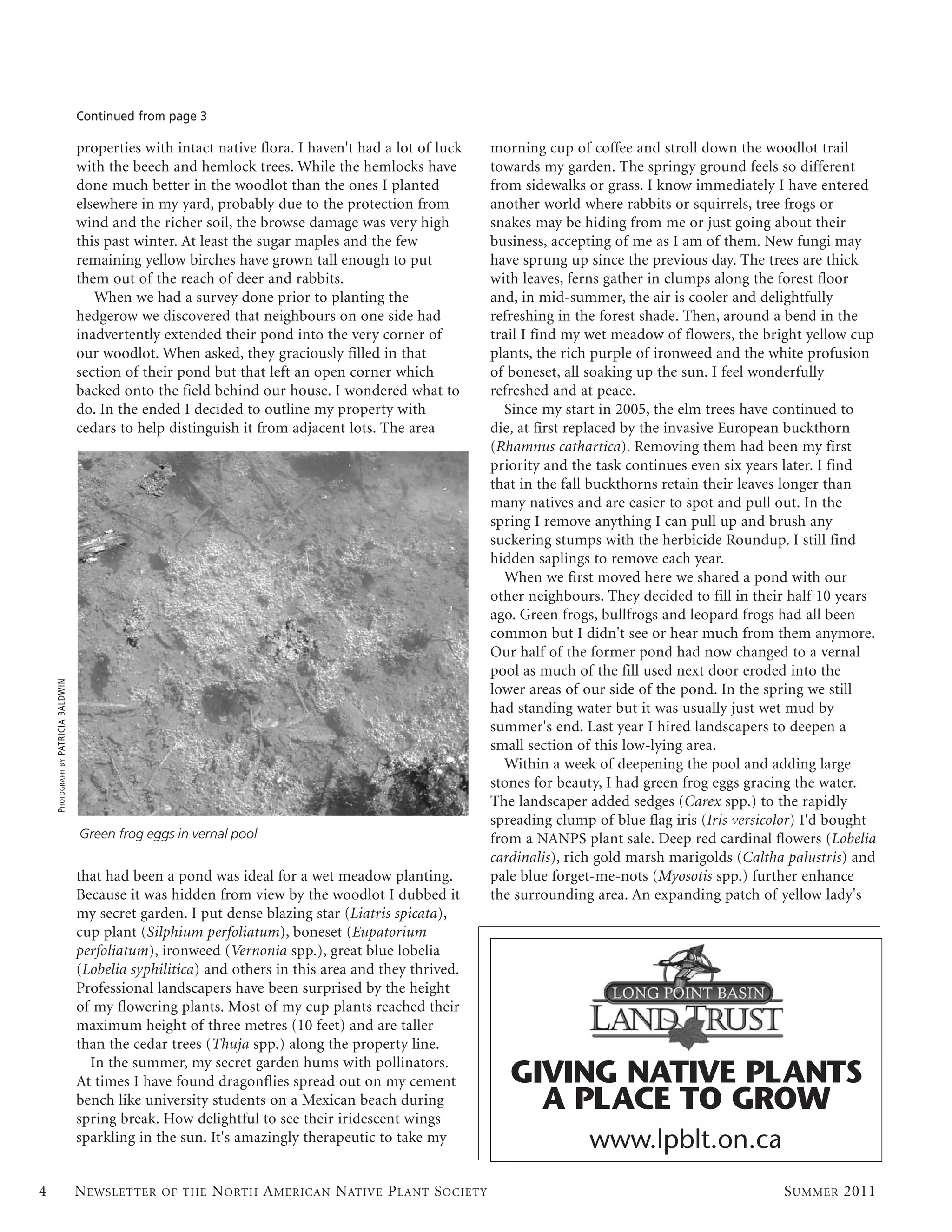
Within a week of deepening the pool and adding large
stones for beauty, I had green frog eggs gracing the water.
The landscaper added sedges (Carex spp.) to the rapidly
spreading clump of blue flag iris (Iris versicolor) I'd bought
from a NANPS plant sale. Deep red cardinal flowers (Lobelia
cardinalis), rich gold marsh marigolds (Caltha palustris) and
pale blue forget-me-nots (Myosotis spp.) further enhance
the surrounding area. An expanding patch of yellow lady's
4 NEWSLETTER OF THE NORTH AMERICAN NATIVE PLANT SOCIETY
Green frog eggs in vernal pool
PHOTOGRAPHBYPATRICIABALDWIN
www.lpblt.on.ca
GIVING NATIVE PLANTS
A PLACE TO GROW
Continued from page 3
slipper orchids (Cypripedium perviflorum) is hiding under a
cedar and likewise looks delightful with the forget-me-nots.
Pretty, this vernal pool also provides an important breeding
site for insects and amphibians.
The landscaper also expanded a prairie garden I had
started a year earlier. Prairies depend on occasional fires so
my husband burned some buckthorn branches in the site of
my future prairie garden to help prepare the soil for new
plantings. The garden was bordered by rocks to define it and
cedar rails were installed to give the area a purposeful look
and winter interest. We constructed a fire pit and patio area
on one side. Within the prairie, I added at least one
evergreen, Juniperus virginiana, a pasture rose (Rosa
carolina) and a snowberry shrub (Symphoricarpos albus) to
give it year-round appeal. Close to the fire pit, we put in
prairie smoke (Geum triflorum) as it could withstand the
high heat. More cup plants towered over the west side of the
garden, propped up by the cedar rail fence to prevent them
from spilling over onto the grassed pathway. Indian grass
(Sorghastrum nutans), prairie brome (Bromus kalmia),
hoary vervain (Verbena stricta), wild bergamont (Monarda
fistulosa), columbine (Aquilegia canadensis), black-eyed
Susan (Rudbeckia hirta) and pale purple coneflower
(Echinacea pallida) were some of the flowers and grasses
introduced into this garden.
My final project with my landscaper was a rock-faced
berm installed along my hedgerow border. When a mother
turtle laid her eggs in a pile of topsoil by my driveway in
June of last year, I read up about turtle nests on the Metro
Zoo Adopt-A-Pond website
(www.torontozoo.com/adoptapond/index.asp) and relocated
her eggs to the south-facing berm. Later in the summer I
noticed holes in the berm and hope that they were made by
emerging turtle hatchlings rather than egg predators. This
year I would like to install a more suitable turtle-nesting
zone.
It's been six years since I first received those letters from the
township regarding a new subdivision. It has yet to be built.
Maybe all those letters I wrote to various levels of
government had an effect?! In the meantime, I'm having far
too much fun constructing my own wildlife haven. Every year
I find myself dreaming of a new project to replace more lawn!
Patricia Baldwin of Port Perry, Ontario was a NANPS 2010
Garden Award winner.
SUMMER 2011 5NEWSLETTER OF THE NORTH AMERICAN NATIVE PLANT SOCIETY
Turtle eggs are relocated on the southern slope of a berm within
the hedgerow
PHOTOGRAPHBYPATRICIABALDWIN
Native plant nursery,
landscaping and
ecological services
Grow Wild!
www.grow-wild.com
4735 Durham/York 30
Claremont, Ontario
(by appointment only)
Home: 705.793.3136
(Paul Heydon)
Cell: 416.735.7490
info@grow-wild.com
Grow Wild!

BlazingSummer2011_v5_pg3-5

  • 1.
    SUMMER 2011 3NEWSLETTEROF THE NORTH AMERICAN NATIVE PLANT SOCIETY Planned Subdivision Sparks a Wildlife Haven by Patricia Baldwin In 2005, my local municipality informed me of plans for a new subdivision very close to my home. Although it's located on .7 hectares (1.77 acres) within the urban borders of Scugog Township, my property is very close to the boundary line to rural areas. The houses are custom-built and all have a different landscape character, some rolling lawns with high-maintenance landscaping, others with woodlot remnants still standing from an old farm. My main concern: to provide habitat for wildlife which I knew would be displaced by further construction. I suspected my neighbours would accept my ecological restoration project but I wanted to make it as neat and tidy as I could just to be safe. My first project was to create a hedgerow along my south property line. I wanted bird habitat and a visual screen/sound barrier from homes destined to be built to the south. I used the formula of one-third evergreen, one-third flowering/fruit-bearing and one- third thorny shrubs and trees. I began the row by adding shrubs to pockets of existing native vegetation along the property line. To replace a large stretch of lawn along the back of my property I planted a composition of trees, shrubs and flowers in a bed midway between those two areas of vegetation. I planted a beautiful high-bush cranberry (Viburnum trilobum) along with two white spruce (Picea glauca) and three white birches (Betula papyrifera). Forbs such as obedient plant (Physostegia virginiana) and tickseed (Coreopsis spp.) completed the bed. I had a lot of positive feedback from that combination. Putting in this first native plant garden was an eye-opener. I was shocked to find how difficult it was to dig a hole for my large cranberry. Much of the topsoil in that section of the yard had been removed. The sod had a surprising number of grubs in it. The subsoil was hard and rocky. I began to wonder if I could get anything to grow there. However, I persisted, adding mulch around every newly planted tree or shrub. I raided my husband's wood pile and used the logs to border the new bed and to make trimming the lawn easier. I found this helped protect my new trees and shrubs from my teenage children as they learned to cut grass as part of their summer chores. For a few years I agreed to do the excessive trimming needed around my shrubs until I had the time and materials to extend my mulched area. I asked neighbours for their bagged leaves or offered to rake their leaves for them to use as mulch. As much as possible, I get leaves, and wood chips too, from properties with native species. Over the years, many logs have decomposed into a source of humus for my substandard soil enriching its fungal content. I confess to being as delighted to find a beautiful fungus like Polyporus versicolor as any blooming flower. Let me brag too that I have harvested a few gourmet morels (Morchella spp.) and I'm as proud of my giant puff balls (Calvatia gigantea) as a farmer of his giant pumpkins at the county fair. In the mixed forest region where I live, the usual pattern is for fields to give way to shrubs and shrubs to trees. The tree species change with the age of the forest. During that succession, the plants that die and accumulate on the ground provide nutrients for new growth. I was trying to copy nature by adding the expected plant materials to my soil. I was gratified in 2010 when I attended a lecture by Jeff Lowenfels, co-author of Teaming with Microbes, a wonderful book which outlines the importance of bacterial or fungal content in the soil as it relates to the type of plant grown. Basically, annuals and grasses prefer bacterially dominated soils (encouraged by high nitrogen compost) while trees, shrubs and perennials prefer fungally dominated soils (encouraged by high carbon compost). By copying nature, I had done what scientists are now showing to be the best option. A white elm (Ulmus americana) woodlot once dominated the northeast corner of our property. Since we purchased our house 13 years ago, many of those elms have succumbed to Dutch Elm Disease. At least I'm providing a haven for woodpeckers and flickers as they forage for insects in the standing dead elm snags. But, that corner is now being taken over by grasses, Virginia creeper (Parthenocissus quinquefolia) and Canada goldenrod (Solidago canadensis). I'd like to restore the woodlot with sugar maple (Acer saccharum), yellow birch (Betula alleghaniensis), American beech (Fagus grandifolia) and hemlock (Tsuga canadensis). I know these trees commonly grow in association with each other; I've even seen them together on surrounding PHOTOGRAPHBYPATRICIABALDWIN Continued on page 4 Patricia’s vernal pool garden with blue flag iris, marsh marigold, dead elm tree, white cedar and other plants
  • 2.
    SUMMER 2011 properties withintact native flora. I haven't had a lot of luck with the beech and hemlock trees. While the hemlocks have done much better in the woodlot than the ones I planted elsewhere in my yard, probably due to the protection from wind and the richer soil, the browse damage was very high this past winter. At least the sugar maples and the few remaining yellow birches have grown tall enough to put them out of the reach of deer and rabbits. When we had a survey done prior to planting the hedgerow we discovered that neighbours on one side had inadvertently extended their pond into the very corner of our woodlot. When asked, they graciously filled in that section of their pond but that left an open corner which backed onto the field behind our house. I wondered what to do. In the ended I decided to outline my property with cedars to help distinguish it from adjacent lots. The area that had been a pond was ideal for a wet meadow planting. Because it was hidden from view by the woodlot I dubbed it my secret garden. I put dense blazing star (Liatris spicata), cup plant (Silphium perfoliatum), boneset (Eupatorium perfoliatum), ironweed (Vernonia spp.), great blue lobelia (Lobelia syphilitica) and others in this area and they thrived. Professional landscapers have been surprised by the height of my flowering plants. Most of my cup plants reached their maximum height of three metres (10 feet) and are taller than the cedar trees (Thuja spp.) along the property line. In the summer, my secret garden hums with pollinators. At times I have found dragonflies spread out on my cement bench like university students on a Mexican beach during spring break. How delightful to see their iridescent wings sparkling in the sun. It's amazingly therapeutic to take my morning cup of coffee and stroll down the woodlot trail towards my garden. The springy ground feels so different from sidewalks or grass. I know immediately I have entered another world where rabbits or squirrels, tree frogs or snakes may be hiding from me or just going about their business, accepting of me as I am of them. New fungi may have sprung up since the previous day. The trees are thick with leaves, ferns gather in clumps along the forest floor and, in mid-summer, the air is cooler and delightfully refreshing in the forest shade. Then, around a bend in the trail I find my wet meadow of flowers, the bright yellow cup plants, the rich purple of ironweed and the white profusion of boneset, all soaking up the sun. I feel wonderfully refreshed and at peace. Since my start in 2005, the elm trees have continued to die, at first replaced by the invasive European buckthorn (Rhamnus cathartica). Removing them had been my first priority and the task continues even six years later. I find that in the fall buckthorns retain their leaves longer than many natives and are easier to spot and pull out. In the spring I remove anything I can pull up and brush any suckering stumps with the herbicide Roundup. I still find hidden saplings to remove each year. When we first moved here we shared a pond with our other neighbours. They decided to fill in their half 10 years ago. Green frogs, bullfrogs and leopard frogs had all been common but I didn't see or hear much from them anymore. Our half of the former pond had now changed to a vernal pool as much of the fill used next door eroded into the lower areas of our side of the pond. In the spring we still had standing water but it was usually just wet mud by summer's end. Last year I hired landscapers to deepen a small section of this low-lying area. Within a week of deepening the pool and adding large stones for beauty, I had green frog eggs gracing the water. The landscaper added sedges (Carex spp.) to the rapidly spreading clump of blue flag iris (Iris versicolor) I'd bought from a NANPS plant sale. Deep red cardinal flowers (Lobelia cardinalis), rich gold marsh marigolds (Caltha palustris) and pale blue forget-me-nots (Myosotis spp.) further enhance the surrounding area. An expanding patch of yellow lady's 4 NEWSLETTER OF THE NORTH AMERICAN NATIVE PLANT SOCIETY Green frog eggs in vernal pool PHOTOGRAPHBYPATRICIABALDWIN www.lpblt.on.ca GIVING NATIVE PLANTS A PLACE TO GROW Continued from page 3
  • 3.
    slipper orchids (Cypripediumperviflorum) is hiding under a cedar and likewise looks delightful with the forget-me-nots. Pretty, this vernal pool also provides an important breeding site for insects and amphibians. The landscaper also expanded a prairie garden I had started a year earlier. Prairies depend on occasional fires so my husband burned some buckthorn branches in the site of my future prairie garden to help prepare the soil for new plantings. The garden was bordered by rocks to define it and cedar rails were installed to give the area a purposeful look and winter interest. We constructed a fire pit and patio area on one side. Within the prairie, I added at least one evergreen, Juniperus virginiana, a pasture rose (Rosa carolina) and a snowberry shrub (Symphoricarpos albus) to give it year-round appeal. Close to the fire pit, we put in prairie smoke (Geum triflorum) as it could withstand the high heat. More cup plants towered over the west side of the garden, propped up by the cedar rail fence to prevent them from spilling over onto the grassed pathway. Indian grass (Sorghastrum nutans), prairie brome (Bromus kalmia), hoary vervain (Verbena stricta), wild bergamont (Monarda fistulosa), columbine (Aquilegia canadensis), black-eyed Susan (Rudbeckia hirta) and pale purple coneflower (Echinacea pallida) were some of the flowers and grasses introduced into this garden. My final project with my landscaper was a rock-faced berm installed along my hedgerow border. When a mother turtle laid her eggs in a pile of topsoil by my driveway in June of last year, I read up about turtle nests on the Metro Zoo Adopt-A-Pond website (www.torontozoo.com/adoptapond/index.asp) and relocated her eggs to the south-facing berm. Later in the summer I noticed holes in the berm and hope that they were made by emerging turtle hatchlings rather than egg predators. This year I would like to install a more suitable turtle-nesting zone. It's been six years since I first received those letters from the township regarding a new subdivision. It has yet to be built. Maybe all those letters I wrote to various levels of government had an effect?! In the meantime, I'm having far too much fun constructing my own wildlife haven. Every year I find myself dreaming of a new project to replace more lawn! Patricia Baldwin of Port Perry, Ontario was a NANPS 2010 Garden Award winner. SUMMER 2011 5NEWSLETTER OF THE NORTH AMERICAN NATIVE PLANT SOCIETY Turtle eggs are relocated on the southern slope of a berm within the hedgerow PHOTOGRAPHBYPATRICIABALDWIN Native plant nursery, landscaping and ecological services Grow Wild! www.grow-wild.com 4735 Durham/York 30 Claremont, Ontario (by appointment only) Home: 705.793.3136 (Paul Heydon) Cell: 416.735.7490 info@grow-wild.com Grow Wild!