Learning from Public Attitudes to Science 2011 “ When you think about it,  everything’s  related to science” Sarah Castell Jayesh Navin Shah Marilyn Booth
Our session today What is Public Attitudes to Science 2011? What we found  What the research process taught us about engaging the public in science Any questions and over to you – how you can take the findings from the study forward
The study
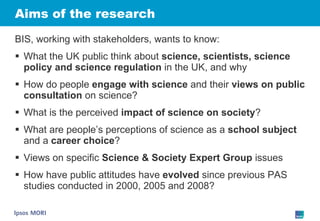
Aims of the research BIS, working with stakeholders, wants to know: What the UK public think about  science, scientists, science policy and science regulation  in the UK, and why How do people  engage with science  and their  views on public consultation  on science? What is the perceived  impact of science on society ? What are people’s perceptions of science as a  school subject  and a  career choice ? Views on specific  Science & Society Expert Group  issues How have public attitudes have  evolved  since previous PAS studies conducted in 2000, 2005 and 2008?
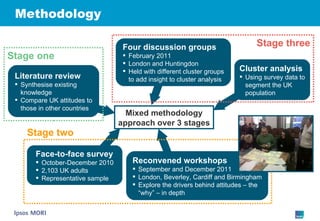
Methodology Mixed methodology approach over 3 stages Literature review Synthesise existing knowledge Compare UK attitudes to those in other countries Cluster analysis Using survey data to segment the UK population Face-to-face survey October-December 2010 2,103 UK adults Representative sample Four discussion groups February 2011 London and Huntingdon Held with different cluster groups to add insight to cluster analysis Stage one Stage three Stage two Reconvened workshops September and December 2011 London, Beverley, Cardiff and Birmingham Explore the drivers behind attitudes – the “why” – in depth
What we found
The UK public increasingly values science
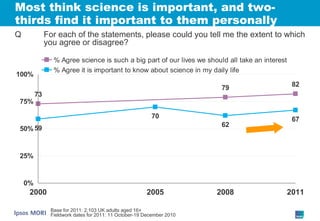
Most think science is important, and two-thirds find it important to them personally Q For each of the statements, please could you tell me the extent to which you agree or disagree? Base for 2011: 2,103 UK adults aged 16+ Fieldwork dates for 2011: 11 October-19 December 2010
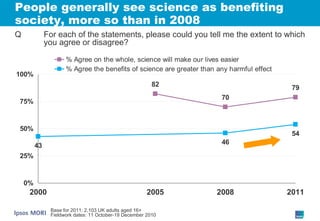
People generally see science as benefiting society, more so than in 2008 Base for 2011: 2,103 UK adults aged 16+ Fieldwork dates: 11 October-19 December 2010 Q For each of the statements, please could you tell me the extent to which you agree or disagree?
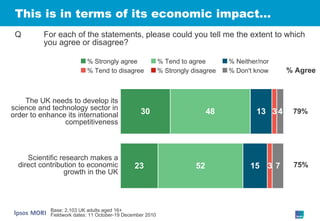
This is in terms of its economic impact… The UK needs to develop its science and technology sector in order to enhance its international competitiveness Scientific research makes a direct contribution to economic growth in the UK Base: 2,103 UK adults aged 16+ Fieldwork dates: 11 October-19 December 2010 Q For each of the statements, please could you tell me the extent to which you agree or disagree? % Agree 75% 79% % Strongly agree % Tend to agree % Neither/nor % Tend to disagree % Strongly disagree % Don't know
…  and also in terms of the wider cultural benefits of science “ I watched a science programme that shows how a microchip is made.  The programme is very interesting … It shows that science is not a dry stuffy subject and can have a lot of humour in it.” Birmingham participant “ Before, [I thought] science was the Bunsen burner, nothing else, and then I thought it’s everything: gardening, food, glasses.” Birmingham participant “ My son was thoroughly awestruck with the Launchpad section [of the Science Museum] … Showing children the effects of viscosity, light distortion, chemical reactions and much more elicited quite a few oohs and aaahs … whilst also teaching them why.” London participant Half the public (50%) have taken part in a science-related leisure activity in the past 12 months, e.g. a trip to a science museum
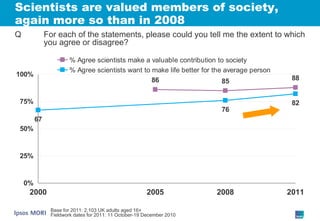
Scientists are valued members of society, again more so than in 2008 Base for 2011: 2,103 UK adults aged 16+ Fieldwork dates for 2011: 11 October-19 December 2010 Q For each of the statements, please could you tell me the extent to which you agree or disagree?
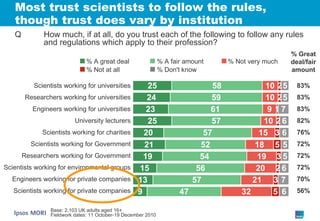
Most trust scientists to follow the rules, though trust does vary by institution Q How much, if at all, do you trust each of the following to follow any rules and regulations which apply to their profession? Scientists working for Government % A great deal % A fair amount % Not very much % Not at all % Don't know Scientists working for private companies Scientists working for universities Scientists working for charities Scientists working for environmental groups Base: 2,103 UK adults aged 16+ Fieldwork dates: 11 October-19 December 2010 Engineers working for universities University lecturers Engineers working for private companies Researchers working for Government Researchers working for universities % Great deal/fair amount 72% 56% 83% 76% 72% 83% 82% 70% 72% 83%
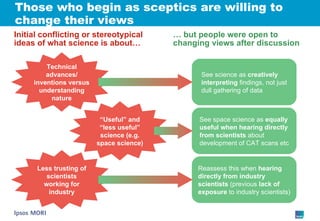
Those who begin as sceptics are willing to change their views Technical advances/ inventions versus understanding nature See science as  creatively interpreting  findings, not just dull gathering of data Initial conflicting or stereotypical ideas of what science is about… …  but people were open to changing views after discussion “ Useful” and “less useful” science (e.g. space science) See space science as  equally useful when hearing directly from scientists  about development of CAT scans etc Less trusting of scientists working for industry Reassess this when  hearing directly from industry scientists  (previous  lack of exposure  to industry scientists)
However, people still have concerns about science and scientists
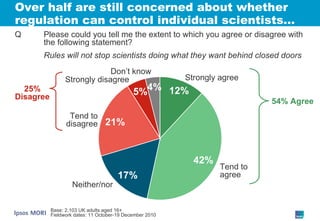
Over half are still concerned about whether regulation can control individual scientists… Neither/nor Strongly agree Don’t know Tend to disagree Tend to agree Strongly disagree Q Please could you tell me the extent to which you agree or disagree with the following statement? Rules will not stop scientists doing what they want behind closed doors Base: 2,103 UK adults aged 16+ Fieldwork dates: 11 October-19 December 2010 54% Agree 25% Disagree
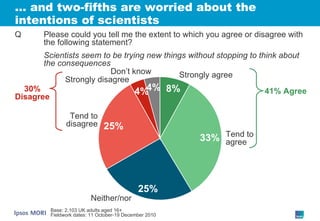
…  and two-fifths are worried about the intentions of scientists Q Please could you tell me the extent to which you agree or disagree with the following statement? Scientists seem to be trying new things without stopping to think about the consequences Neither/nor Strongly agree Don’t know Tend to disagree Tend to agree Strongly disagree Base: 2,103 UK adults aged 16+ Fieldwork dates: 11 October-19 December 2010 41% Agree 30% Disagree
Concerns often stem from a lack of understanding of how science is done
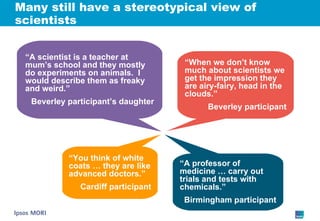
Many still have a stereotypical view of scientists “ A scientist is a teacher at mum’s school and they mostly do experiments on animals.  I would describe them as freaky and weird.” Beverley participant’s daughter “ You think of white coats … they are like advanced doctors.” Cardiff participant “ When we don’t know much about scientists we get the impression they are airy-fairy, head in the clouds.” Beverley participant “ A professor of medicine … carry out trials and tests with chemicals.” Birmingham participant
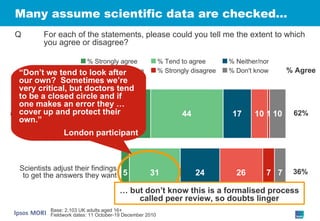
Many assume scientific data are checked… Before scientific findings are announced, other scientists have checked them Scientists adjust their findings to get the answers they want Base: 2,103 UK adults aged 16+ Fieldwork dates: 11 October-19 December 2010 Q For each of the statements, please could you tell me the extent to which you agree or disagree? % Agree % Strongly agree % Tend to agree % Neither/nor % Tend to disagree % Strongly disagree % Don't know 62% 36% …  but don’t know this is a formalised process called peer review, so doubts linger “ Don’t we tend to look after our own?  Sometimes we’re very critical, but doctors tend to be a closed circle and if one makes an error they … cover up and protect their own.” London participant
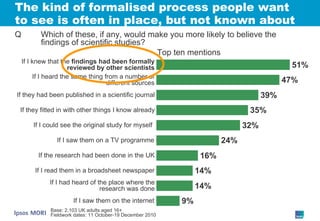
The kind of formalised process people want to see is often in place, but not known about If I knew that the  findings had been formally reviewed by other scientists If I heard the same thing from a number of different sources If they had been published in a scientific journal If they fitted in with other things I know already If I could see the original study for myself  If I saw them on a TV programme If the research had been done in the UK If I read them in a broadsheet newspaper If I had heard of the place where the research was done If I saw them on the internet Q Which of these, if any, would make you more likely to believe the findings of scientific studies? Base: 2,103 UK adults aged 16+ Fieldwork dates: 11 October-19 December 2010 Top ten mentions
But engaging with the public to improve this understanding is challenging
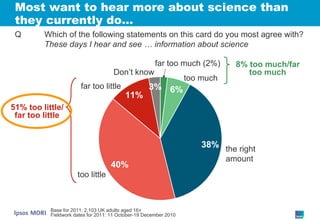
Most want to hear more about science than they currently do… far too much (2%) Don’t know the right amount too much too little Q Which of the following statements on this card do you most agree with? These days I hear and see … information about science far too little Base for 2011: 2,103 UK adults aged 16+ Fieldwork dates for 2011: 11 October-19 December 2010 8% too much/far too much 51% too little/ far too little
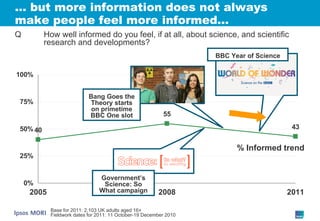
…  but more information does not always make people feel more informed… Base for 2011: 2,103 UK adults aged 16+ Fieldwork dates for 2011: 11 October-19 December 2010 Q How well informed do you feel, if at all, about science, and scientific research and developments? % Informed trend Bang Goes the Theory starts on primetime BBC One slot BBC Year of Science Government’s Science: So What campaign
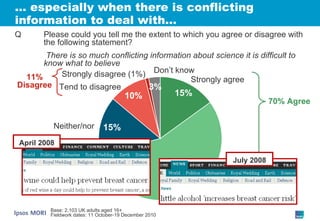
…  especially when there is conflicting information to deal with… Q Please could you tell me the extent to which you agree or disagree with the following statement?   There is so much conflicting information about science it is difficult to know what to believe Neither/nor Strongly agree Don’t know Tend to disagree Tend to agree Strongly disagree (1%) Base: 2,103 UK adults aged 16+ Fieldwork dates: 11 October-19 December 2010 70% Agree 11% Disagree April 2008 July 2008
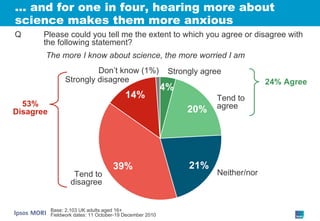
…  and for one in four, hearing more about science makes them more anxious Q Please could you tell me the extent to which you agree or disagree with the following statement?   The more I know about science, the more worried I am Neither/nor Strongly agree Don’t know (1%) Tend to disagree Tend to agree Strongly disagree Base: 2,103 UK adults aged 16+ Fieldwork dates: 11 October-19 December 2010 24% Agree 53% Disagree
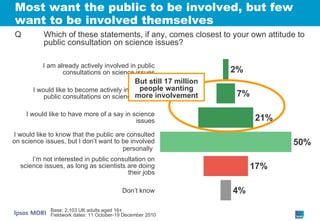
Most want the public to be involved, but few want to be involved themselves Don’t know I’m not interested in public consultation on science issues, as long as scientists are doing their jobs I would like to know that the public are consulted on science issues, but I don’t want to be involved personally   I would like to have more of a say in science issues I would like to become actively involved in public consultations on science issues I am already actively involved in public consultations on science issues Base: 2,103 UK adults aged 16+ Fieldwork dates: 11 October-19 December 2010 Q Which of these statements, if any, comes closest to your own attitude to public consultation on science issues? But still 17 million people wanting more involvement
So how do you engage these different groups in ways prefer and respond to? Segmentation holds the clues…
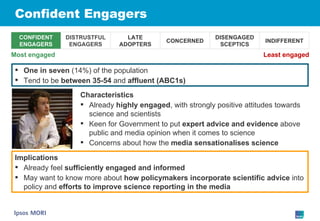
Confident Engagers Most engaged Least engaged One in seven  (14%) of the population Tend to be  between 35-54  and  affluent (ABC1s) Characteristics Already  highly engaged , with strongly positive attitudes towards science and scientists Keen for Government to put  expert advice and evidence  above public and media opinion when it comes to science Concerns about how the  media sensationalises science Implications Already feel  sufficiently engaged and informed May want to know more about  how policymakers incorporate scientific advice  into policy and  efforts to improve science reporting in the media CONFIDENT ENGAGERS DISTRUSTFUL ENGAGERS LATE ADOPTERS CONCERNED DISENGAGED SCEPTICS INDIFFERENT
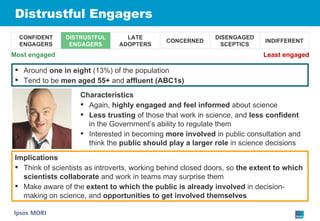
Distrustful Engagers Around  one in eight  (13%) of the population Tend to be  men   aged 55+  and  affluent (ABC1s) Characteristics Again,  highly engaged and feel informed  about science Less trusting  of those that work in science, and  less confident  in the Government’s ability to regulate them Interested in becoming  more involved  in public consultation and think the  public should play a larger role  in science decisions Implications Think of scientists as introverts, working behind closed doors, so  the extent to which scientists collaborate  and work in teams may surprise them Make aware of the  extent to which the public is already involved  in decision-making on science, and  opportunities to get involved themselves Most engaged Least engaged CONFIDENT ENGAGERS DISTRUSTFUL ENGAGERS LATE ADOPTERS CONCERNED DISENGAGED SCEPTICS INDIFFERENT
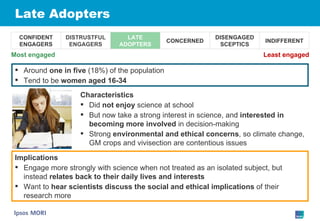
Late Adopters Characteristics Did  not enjoy  science at school But now take a strong interest in science, and  interested in becoming more involved  in decision-making Strong  environmental and ethical concerns , so climate change, GM crops and vivisection are contentious issues Around  one in five  (18%) of the population Tend to be  women   aged 16-34 Implications Engage more strongly with science when not treated as an isolated subject, but instead  relates back to their daily lives and interests Want to  hear scientists discuss the social and ethical implications  of their research more Most engaged Least engaged CONFIDENT ENGAGERS DISTRUSTFUL ENGAGERS LATE ADOPTERS CONCERNED DISENGAGED SCEPTICS INDIFFERENT
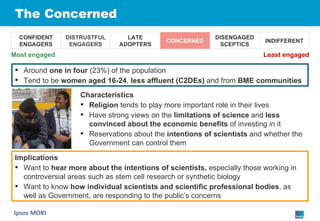
The Concerned Characteristics Religion  tends to play more important role in their lives Have strong views on the  limitations of science  and  less convinced about the economic benefits  of investing in it Reservations about the  intentions of scientists  and whether the Government can control them Around  one in four  (23%) of the population Tend to be  women aged 16-24 ,  less affluent (C2DEs)  and from  BME communities Implications Want to  hear more about the intentions of scientists,  especially those working in controversial areas such as stem cell research or synthetic biology Want to know  how individual scientists and scientific professional bodies , as well as Government, are responding to the public’s concerns Most engaged Least engaged CONFIDENT ENGAGERS DISTRUSTFUL ENGAGERS LATE ADOPTERS CONCERNED DISENGAGED SCEPTICS INDIFFERENT
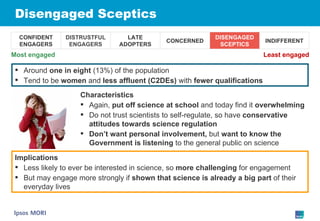
Disengaged Sceptics Characteristics Again,  put off science at school  and today find it  overwhelming Do not trust scientists to self-regulate, so have  conservative attitudes towards science regulation Don’t want personal involvement,  but  want to know the Government is listening  to the general public on science Around  one in eight  (13%) of the population Tend to be  women  and  less affluent (C2DEs)  with  fewer qualifications Implications Less likely to ever be interested in science, so  more challenging  for engagement But may engage more strongly if  shown that science is already a big part  of their everyday lives Most engaged Least engaged CONFIDENT ENGAGERS DISTRUSTFUL ENGAGERS LATE ADOPTERS CONCERNED DISENGAGED SCEPTICS INDIFFERENT
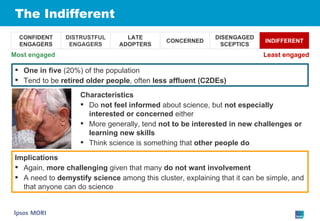
The Indifferent Characteristics Do  not feel informed  about science, but  not especially interested or concerned  either More generally, tend  not to be interested in new challenges or learning new skills Think science is something that  other people do One in five  (20%) of the population Tend to be  retired older people , often  less affluent (C2DEs) Implications Again,  more challenging  given that many  do not want involvement A need to  demystify science  among this cluster, explaining that it can be simple, and that anyone can do science Most engaged Least engaged CONFIDENT ENGAGERS DISTRUSTFUL ENGAGERS LATE ADOPTERS CONCERNED DISENGAGED SCEPTICS INDIFFERENT
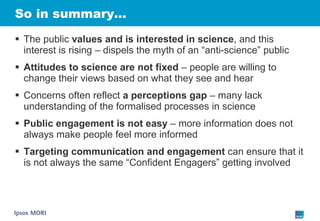
So in summary… The public  values and is interested in science , and this interest is rising – dispels the myth of an “anti-science” public Attitudes to science are not fixed  – people are willing to change their views based on what they see and hear Concerns often reflect  a perceptions gap  – many lack understanding of the formalised processes in science Public engagement is not easy  – more information does not always make people feel more informed Targeting communication and engagement  can ensure that it is not always the same “Confident Engagers” getting involved
What the research process taught us about engagement
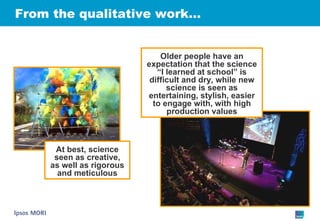
From the qualitative work… At best, science seen as creative, as well as rigorous and meticulous Older people have an expectation that the science “I learned at school” is difficult and dry, while new science is seen as entertaining, stylish, easier to engage with, with high production values
From the qualitative work… Participants didn’t know the process of doing science – how funding works and how science gets out into the world… …  but they loved talking to scientists!
Any questions?
Over to you! What are  the challenges of engaging our different segments  and how have you experienced this in the past? How does knowing about the different attitudinal groups  help you to take decisions  on communication in future? What does it mean when people say  they don’t feel informed ? Is it the  role of science communicators/public engagement  to make people feel informed?
Links added after presentation Link to main Public Attitudes to Science 2011 research report:  http://tiny.cc/0q752 Link to 14 – 16 attitudes survey:  http://tiny.cc/xd8l4   BIS project blog:  http://tiny.cc/yltje

BIS/Ipsos MORI: Learning From Public Attitudes to Science 2011

  • 1.
    Learning from PublicAttitudes to Science 2011 “ When you think about it, everything’s related to science” Sarah Castell Jayesh Navin Shah Marilyn Booth
  • 2.
    Our session todayWhat is Public Attitudes to Science 2011? What we found What the research process taught us about engaging the public in science Any questions and over to you – how you can take the findings from the study forward
  • 3.
  • 4.
    Aims of theresearch BIS, working with stakeholders, wants to know: What the UK public think about science, scientists, science policy and science regulation in the UK, and why How do people engage with science and their views on public consultation on science? What is the perceived impact of science on society ? What are people’s perceptions of science as a school subject and a career choice ? Views on specific Science & Society Expert Group issues How have public attitudes have evolved since previous PAS studies conducted in 2000, 2005 and 2008?
  • 5.
    Methodology Mixed methodologyapproach over 3 stages Literature review Synthesise existing knowledge Compare UK attitudes to those in other countries Cluster analysis Using survey data to segment the UK population Face-to-face survey October-December 2010 2,103 UK adults Representative sample Four discussion groups February 2011 London and Huntingdon Held with different cluster groups to add insight to cluster analysis Stage one Stage three Stage two Reconvened workshops September and December 2011 London, Beverley, Cardiff and Birmingham Explore the drivers behind attitudes – the “why” – in depth
  • 6.
  • 7.
    The UK publicincreasingly values science
  • 8.
    Most think scienceis important, and two-thirds find it important to them personally Q For each of the statements, please could you tell me the extent to which you agree or disagree? Base for 2011: 2,103 UK adults aged 16+ Fieldwork dates for 2011: 11 October-19 December 2010
  • 9.
    People generally seescience as benefiting society, more so than in 2008 Base for 2011: 2,103 UK adults aged 16+ Fieldwork dates: 11 October-19 December 2010 Q For each of the statements, please could you tell me the extent to which you agree or disagree?
  • 10.
    This is interms of its economic impact… The UK needs to develop its science and technology sector in order to enhance its international competitiveness Scientific research makes a direct contribution to economic growth in the UK Base: 2,103 UK adults aged 16+ Fieldwork dates: 11 October-19 December 2010 Q For each of the statements, please could you tell me the extent to which you agree or disagree? % Agree 75% 79% % Strongly agree % Tend to agree % Neither/nor % Tend to disagree % Strongly disagree % Don't know
  • 11.
    … andalso in terms of the wider cultural benefits of science “ I watched a science programme that shows how a microchip is made. The programme is very interesting … It shows that science is not a dry stuffy subject and can have a lot of humour in it.” Birmingham participant “ Before, [I thought] science was the Bunsen burner, nothing else, and then I thought it’s everything: gardening, food, glasses.” Birmingham participant “ My son was thoroughly awestruck with the Launchpad section [of the Science Museum] … Showing children the effects of viscosity, light distortion, chemical reactions and much more elicited quite a few oohs and aaahs … whilst also teaching them why.” London participant Half the public (50%) have taken part in a science-related leisure activity in the past 12 months, e.g. a trip to a science museum
  • 12.
    Scientists are valuedmembers of society, again more so than in 2008 Base for 2011: 2,103 UK adults aged 16+ Fieldwork dates for 2011: 11 October-19 December 2010 Q For each of the statements, please could you tell me the extent to which you agree or disagree?
  • 13.
    Most trust scientiststo follow the rules, though trust does vary by institution Q How much, if at all, do you trust each of the following to follow any rules and regulations which apply to their profession? Scientists working for Government % A great deal % A fair amount % Not very much % Not at all % Don't know Scientists working for private companies Scientists working for universities Scientists working for charities Scientists working for environmental groups Base: 2,103 UK adults aged 16+ Fieldwork dates: 11 October-19 December 2010 Engineers working for universities University lecturers Engineers working for private companies Researchers working for Government Researchers working for universities % Great deal/fair amount 72% 56% 83% 76% 72% 83% 82% 70% 72% 83%
  • 14.
    Those who beginas sceptics are willing to change their views Technical advances/ inventions versus understanding nature See science as creatively interpreting findings, not just dull gathering of data Initial conflicting or stereotypical ideas of what science is about… … but people were open to changing views after discussion “ Useful” and “less useful” science (e.g. space science) See space science as equally useful when hearing directly from scientists about development of CAT scans etc Less trusting of scientists working for industry Reassess this when hearing directly from industry scientists (previous lack of exposure to industry scientists)
  • 15.
    However, people stillhave concerns about science and scientists
  • 16.
    Over half arestill concerned about whether regulation can control individual scientists… Neither/nor Strongly agree Don’t know Tend to disagree Tend to agree Strongly disagree Q Please could you tell me the extent to which you agree or disagree with the following statement? Rules will not stop scientists doing what they want behind closed doors Base: 2,103 UK adults aged 16+ Fieldwork dates: 11 October-19 December 2010 54% Agree 25% Disagree
  • 17.
    … andtwo-fifths are worried about the intentions of scientists Q Please could you tell me the extent to which you agree or disagree with the following statement? Scientists seem to be trying new things without stopping to think about the consequences Neither/nor Strongly agree Don’t know Tend to disagree Tend to agree Strongly disagree Base: 2,103 UK adults aged 16+ Fieldwork dates: 11 October-19 December 2010 41% Agree 30% Disagree
  • 18.
    Concerns often stemfrom a lack of understanding of how science is done
  • 19.
    Many still havea stereotypical view of scientists “ A scientist is a teacher at mum’s school and they mostly do experiments on animals. I would describe them as freaky and weird.” Beverley participant’s daughter “ You think of white coats … they are like advanced doctors.” Cardiff participant “ When we don’t know much about scientists we get the impression they are airy-fairy, head in the clouds.” Beverley participant “ A professor of medicine … carry out trials and tests with chemicals.” Birmingham participant
  • 20.
    Many assume scientificdata are checked… Before scientific findings are announced, other scientists have checked them Scientists adjust their findings to get the answers they want Base: 2,103 UK adults aged 16+ Fieldwork dates: 11 October-19 December 2010 Q For each of the statements, please could you tell me the extent to which you agree or disagree? % Agree % Strongly agree % Tend to agree % Neither/nor % Tend to disagree % Strongly disagree % Don't know 62% 36% … but don’t know this is a formalised process called peer review, so doubts linger “ Don’t we tend to look after our own? Sometimes we’re very critical, but doctors tend to be a closed circle and if one makes an error they … cover up and protect their own.” London participant
  • 21.
    The kind offormalised process people want to see is often in place, but not known about If I knew that the findings had been formally reviewed by other scientists If I heard the same thing from a number of different sources If they had been published in a scientific journal If they fitted in with other things I know already If I could see the original study for myself If I saw them on a TV programme If the research had been done in the UK If I read them in a broadsheet newspaper If I had heard of the place where the research was done If I saw them on the internet Q Which of these, if any, would make you more likely to believe the findings of scientific studies? Base: 2,103 UK adults aged 16+ Fieldwork dates: 11 October-19 December 2010 Top ten mentions
  • 22.
    But engaging withthe public to improve this understanding is challenging
  • 23.
    Most want tohear more about science than they currently do… far too much (2%) Don’t know the right amount too much too little Q Which of the following statements on this card do you most agree with? These days I hear and see … information about science far too little Base for 2011: 2,103 UK adults aged 16+ Fieldwork dates for 2011: 11 October-19 December 2010 8% too much/far too much 51% too little/ far too little
  • 24.
    … butmore information does not always make people feel more informed… Base for 2011: 2,103 UK adults aged 16+ Fieldwork dates for 2011: 11 October-19 December 2010 Q How well informed do you feel, if at all, about science, and scientific research and developments? % Informed trend Bang Goes the Theory starts on primetime BBC One slot BBC Year of Science Government’s Science: So What campaign
  • 25.
    … especiallywhen there is conflicting information to deal with… Q Please could you tell me the extent to which you agree or disagree with the following statement? There is so much conflicting information about science it is difficult to know what to believe Neither/nor Strongly agree Don’t know Tend to disagree Tend to agree Strongly disagree (1%) Base: 2,103 UK adults aged 16+ Fieldwork dates: 11 October-19 December 2010 70% Agree 11% Disagree April 2008 July 2008
  • 26.
    … andfor one in four, hearing more about science makes them more anxious Q Please could you tell me the extent to which you agree or disagree with the following statement? The more I know about science, the more worried I am Neither/nor Strongly agree Don’t know (1%) Tend to disagree Tend to agree Strongly disagree Base: 2,103 UK adults aged 16+ Fieldwork dates: 11 October-19 December 2010 24% Agree 53% Disagree
  • 27.
    Most want thepublic to be involved, but few want to be involved themselves Don’t know I’m not interested in public consultation on science issues, as long as scientists are doing their jobs I would like to know that the public are consulted on science issues, but I don’t want to be involved personally I would like to have more of a say in science issues I would like to become actively involved in public consultations on science issues I am already actively involved in public consultations on science issues Base: 2,103 UK adults aged 16+ Fieldwork dates: 11 October-19 December 2010 Q Which of these statements, if any, comes closest to your own attitude to public consultation on science issues? But still 17 million people wanting more involvement
  • 28.
    So how doyou engage these different groups in ways prefer and respond to? Segmentation holds the clues…
  • 29.
    Confident Engagers Mostengaged Least engaged One in seven (14%) of the population Tend to be between 35-54 and affluent (ABC1s) Characteristics Already highly engaged , with strongly positive attitudes towards science and scientists Keen for Government to put expert advice and evidence above public and media opinion when it comes to science Concerns about how the media sensationalises science Implications Already feel sufficiently engaged and informed May want to know more about how policymakers incorporate scientific advice into policy and efforts to improve science reporting in the media CONFIDENT ENGAGERS DISTRUSTFUL ENGAGERS LATE ADOPTERS CONCERNED DISENGAGED SCEPTICS INDIFFERENT
  • 30.
    Distrustful Engagers Around one in eight (13%) of the population Tend to be men aged 55+ and affluent (ABC1s) Characteristics Again, highly engaged and feel informed about science Less trusting of those that work in science, and less confident in the Government’s ability to regulate them Interested in becoming more involved in public consultation and think the public should play a larger role in science decisions Implications Think of scientists as introverts, working behind closed doors, so the extent to which scientists collaborate and work in teams may surprise them Make aware of the extent to which the public is already involved in decision-making on science, and opportunities to get involved themselves Most engaged Least engaged CONFIDENT ENGAGERS DISTRUSTFUL ENGAGERS LATE ADOPTERS CONCERNED DISENGAGED SCEPTICS INDIFFERENT
  • 31.
    Late Adopters CharacteristicsDid not enjoy science at school But now take a strong interest in science, and interested in becoming more involved in decision-making Strong environmental and ethical concerns , so climate change, GM crops and vivisection are contentious issues Around one in five (18%) of the population Tend to be women aged 16-34 Implications Engage more strongly with science when not treated as an isolated subject, but instead relates back to their daily lives and interests Want to hear scientists discuss the social and ethical implications of their research more Most engaged Least engaged CONFIDENT ENGAGERS DISTRUSTFUL ENGAGERS LATE ADOPTERS CONCERNED DISENGAGED SCEPTICS INDIFFERENT
  • 32.
    The Concerned CharacteristicsReligion tends to play more important role in their lives Have strong views on the limitations of science and less convinced about the economic benefits of investing in it Reservations about the intentions of scientists and whether the Government can control them Around one in four (23%) of the population Tend to be women aged 16-24 , less affluent (C2DEs) and from BME communities Implications Want to hear more about the intentions of scientists, especially those working in controversial areas such as stem cell research or synthetic biology Want to know how individual scientists and scientific professional bodies , as well as Government, are responding to the public’s concerns Most engaged Least engaged CONFIDENT ENGAGERS DISTRUSTFUL ENGAGERS LATE ADOPTERS CONCERNED DISENGAGED SCEPTICS INDIFFERENT
  • 33.
    Disengaged Sceptics CharacteristicsAgain, put off science at school and today find it overwhelming Do not trust scientists to self-regulate, so have conservative attitudes towards science regulation Don’t want personal involvement, but want to know the Government is listening to the general public on science Around one in eight (13%) of the population Tend to be women and less affluent (C2DEs) with fewer qualifications Implications Less likely to ever be interested in science, so more challenging for engagement But may engage more strongly if shown that science is already a big part of their everyday lives Most engaged Least engaged CONFIDENT ENGAGERS DISTRUSTFUL ENGAGERS LATE ADOPTERS CONCERNED DISENGAGED SCEPTICS INDIFFERENT
  • 34.
    The Indifferent CharacteristicsDo not feel informed about science, but not especially interested or concerned either More generally, tend not to be interested in new challenges or learning new skills Think science is something that other people do One in five (20%) of the population Tend to be retired older people , often less affluent (C2DEs) Implications Again, more challenging given that many do not want involvement A need to demystify science among this cluster, explaining that it can be simple, and that anyone can do science Most engaged Least engaged CONFIDENT ENGAGERS DISTRUSTFUL ENGAGERS LATE ADOPTERS CONCERNED DISENGAGED SCEPTICS INDIFFERENT
  • 35.
    So in summary…The public values and is interested in science , and this interest is rising – dispels the myth of an “anti-science” public Attitudes to science are not fixed – people are willing to change their views based on what they see and hear Concerns often reflect a perceptions gap – many lack understanding of the formalised processes in science Public engagement is not easy – more information does not always make people feel more informed Targeting communication and engagement can ensure that it is not always the same “Confident Engagers” getting involved
  • 36.
    What the researchprocess taught us about engagement
  • 37.
    From the qualitativework… At best, science seen as creative, as well as rigorous and meticulous Older people have an expectation that the science “I learned at school” is difficult and dry, while new science is seen as entertaining, stylish, easier to engage with, with high production values
  • 38.
    From the qualitativework… Participants didn’t know the process of doing science – how funding works and how science gets out into the world… … but they loved talking to scientists!
  • 39.
  • 40.
    Over to you!What are the challenges of engaging our different segments and how have you experienced this in the past? How does knowing about the different attitudinal groups help you to take decisions on communication in future? What does it mean when people say they don’t feel informed ? Is it the role of science communicators/public engagement to make people feel informed?
  • 41.
    Links added afterpresentation Link to main Public Attitudes to Science 2011 research report: http://tiny.cc/0q752 Link to 14 – 16 attitudes survey: http://tiny.cc/xd8l4 BIS project blog: http://tiny.cc/yltje

Editor's Notes

  • #2 Ipsos MORI: Report Title
  • #3 Ipsos MORI: Report Title
  • #4 Ipsos MORI: Report Title Ipsos MORI: Report Title
  • #5 Ipsos MORI: Report Title
  • #6 Ipsos MORI: Report Title
  • #7 Ipsos MORI: Report Title Ipsos MORI: Report Title
  • #8 Ipsos MORI: Report Title Ipsos MORI: Report Title
  • #9 Ipsos MORI: Report Title
  • #10 Ipsos MORI: Report Title
  • #11 Ipsos MORI: Report Title
  • #12 Ipsos MORI: Report Title
  • #13 Ipsos MORI: Report Title
  • #14 Ipsos MORI: Report Title
  • #15 Ipsos MORI: Report Title
  • #16 Ipsos MORI: Report Title Ipsos MORI: Report Title
  • #17 Ipsos MORI: Report Title
  • #18 Ipsos MORI: Report Title
  • #19 Ipsos MORI: Report Title Ipsos MORI: Report Title
  • #20 Ipsos MORI: Report Title
  • #21 Ipsos MORI: Report Title
  • #22 Ipsos MORI: Report Title
  • #23 Ipsos MORI: Report Title Ipsos MORI: Report Title
  • #24 Ipsos MORI: Report Title
  • #25 Ipsos MORI: Report Title
  • #26 Ipsos MORI: Report Title
  • #27 Ipsos MORI: Report Title
  • #28 Ipsos MORI: Report Title
  • #29 Ipsos MORI: Report Title Ipsos MORI: Report Title
  • #30 Ipsos MORI: Report Title
  • #31 Ipsos MORI: Report Title
  • #32 Ipsos MORI: Report Title
  • #33 Ipsos MORI: Report Title
  • #34 Ipsos MORI: Report Title
  • #35 Ipsos MORI: Report Title
  • #36 Ipsos MORI: Report Title
  • #37 Ipsos MORI: Report Title Ipsos MORI: Report Title
  • #38 Ipsos MORI: Report Title
  • #39 Ipsos MORI: Report Title
  • #40 Ipsos MORI: Report Title Ipsos MORI: Report Title
  • #41 Ipsos MORI: Report Title