RELUCTANT GIANT: THE RISE OF JAPAN AND ITS ROLE

IN THE POST-COLD WAR ERA


Birol Akgün & Şaban H. Çalış

Drs Birol Akgün and Şaban H. Çalış are assistant professors at Selçuk University, Department
of International Relations


         INTRODUCTION


The rise of Japan as an economic power in the international political economy is one of the most spectacular
developments since the Second World War. It is not only the sheer size of the Japanese economy that illustrates
its success, but also the country’s technological innovations, quality of products and the prevalence of made-in-
Japan goods in every quarter of the globe that manifests the ever growing Japanese influence in the world. More
interesting still is that, despite its colossal economic power, second only to the United States, Japan has so far
demonstrated little desire to take responsibility for the conduct of world affairs. To put it another way: an
economic giant has behaved like a dwarf in international political affairs. Can or should Japan continue to
abstain from playing a major role in the new conditions of the post-Cold War world? We shall attempt to answer
this question.
JAPAN IN HISTORICAL PERSPECTIVE

        A relatively small country in terms of territory and population on the western edge of
the Pacific Ocean, Japan lacks many of the vital elements for economic development, such as
oil, coal, iron ore and other raw materials. Except for growing rice to feed its people, the
country in every sense depends on foreign resources for its highly complicated industrial
machine. Therefore, the model of economic growth that the country has pursued for over five
decades differs significantly from the experiences of Western Europe and North America –
both regions that by and large enjoy abundant raw materials. Japan, however, has to import
the wherewithal, process them at home and find markets to export them to. To survive and
progress, therefore, the country had no choice but to become a master of trade.
        The rise of Japan to such a prominent position, argues Jacques Attali, a former advisor
to French ex-President François Mitterand, is due in large part to cultural factors. He
maintains that the emergence of a new centre is most often the direct result of “a cultural
reaction to a geographic challenge or lack of an essential resource.”1 In the case of Japan, the
scarcity of land to reside in necessitated “miniaturizing objects”; its geographic detachment
encouraged the invention of means of communication, and its energy deficiency encouraged
research to find new alternatives for travel. Besides geo-cultural explanations, however, one
needs to look at other factors such as the structure of the post-Second World War international
order, Japan’s special relationship with America and its geographical proximity to the two
communist powers, which were deemed to be imminent menaces to the free world.
        Up to the second half of the nineteenth century, Japan remained isolated. Culturally
affected by the Confucian tradition, feudal rulers governed the people in absolute terms.
Sanctioned by the people’s belief in such social values as authority, hierarchy and loyalty, the
established system continued for a long time. Early meetings with some Christian

1
 Jacques Attali, Millennium: Winners and Losers in the Coming World Order, New York: New York Times
Books, 1991, p. 46.


                                                        1
missionaries in the sixteenth century created hostility toward foreigners and resulted in further
isolation with the introduction of a ban on contact with outsiders, an offence punishable by
death. Commodore Matthew Perry’s gunboat diplomacy opened Japanese doors to the
Western world in 1853.2
        In the following decades of Japanese confrontation with Western civilisation, the
nation underwent a period of transformation. The Meiji Restoration was undertaken in the
1860s by a group of young nationalists who launched a modernisation programme that gave a
special emphasis to industrialisation, centralisation and the creation of a strong military
capable of countering Western colonialist powers.3 Ironically, this powerful military later
turned out to be a reliable instrument to achieve Japanese imperialistic aims. In the first test of
strength, the military proved its ability by defeating Russia in 1905. It was a fascinating
victory for Japan, being the first time an Asian power had won a war against a Western
power. Now it was Japan’s turn to carve up some territories to supply its industry, which
relied heavily on imported raw materials and energy resources.
        Not surprisingly, therefore, Japan in the first half of the twentieth century pursued a
colonialist foreign policy. It gradually expanded its influence in the region by taking over
Taiwan, Korea and, later on, Manchuria with its surrounding Chinese territory. In the peak
years of the empire, during World War II, Japan also acquired many countries in Southeast
Asia. It needed oil and other resources to sustain its war machine. The legacy and memory of
Japanese domination and brutal ruling in the region still cause resentment and create hurdles
in Japan’s relations with these nations.4 Although the post-war Japanese constitution prohibits
it from using force outside its borders, the country’s defence spending – which, even with a
government-set limit of one per cent of GNP, ranks second in the world (totalling over $40
billion5) – is regarded by many as excessive and a threat. That Japan might turn to its past and
revive its role in the region again is an open question that cannot be ruled out.
        Looking at the nation’s historical record, one can find both pacifism and militarism.
As Field and Norville have observed, Japanese relations with the rest of the world display
several continuities.6 One of them is its capacity to imitate and adapt. In the past, Japan has
imported many ideas, ideologies, cultures and technologies if it viewed them superior to its
own. To name a few, Japan’s religion of Buddhism was taken from China via Korea, modern
science from the Dutch and, recently, high technology from America, such as VCRs and
computer products. Every time, however, Japan has been able to fit these innovations into its
society and developed its own models or patterns. A second feature is its perception of the
world in terms of hierarchy. Perhaps a reflection of its own structure of society, Japan sees
world actors as “ranked in stair-step fashion” and considered itself inferior to other powers
such as China, Russia, Britain and the Unites States. However, when the nation gained its own
strength and felt self-esteem, Japan altered its stance vis-à-vis these powers from admiration
to scorn. Japan’s final sustained characteristic is its “national corporatism.” The Japanese
identity is a factor determining its role in the world affairs. Its geographical isolation and the
feeling of being left out create an island mentality and reinforce national solidarity. This
characteristic leads Japanese rulers and its people to adopt a nationalistic view of the world,


2
  Steve Chan, East Asian Dynamism: Growth, Order and Security in the Pacific Region, Boulder: Westview
Press, 1993, p. 30.
3
  Ibid., p. 35.
4
  ‘Japan Rejects Calls for History Text Revisions’, New York Times (Web edition), 9 July 2001.
5
  This figure is taken from CIA’s Factbook-2001 published online at www.cia.gov (25 October 2002).
6
  Karl J Fields and Elizabeth Norville, ‘Japan and the International Political Economy’ in David N. Balaam and
Michael Vesth, Introduction to International Political Economy, New Jersey: Prentice-Hall, Inc., 1996, pp. 259-
282.


                                                       2
which manifested itself “in both former military exploits and more recent economic
campaigns.”7

         JAPAN IN THE COLD WAR


        Having set a historical view, let us now turn to what has happened in the post-Second
World War years in the pacific region. Japanese military imperialism lasted until the
explosion of the two atomic bombs on Hiroshima and Nagasaki, which proved that Western
technology was overwhelmingly superior to Japan’s. The country surrendered immediately.
Occupation forces under General Douglas MacArthur introduced a series of reforms, which
not only dramatically changed society but also redefined Japan’s role in the international
arena. Like the de-Nazification programme in Germany, MacArthur’s plan included purging
the army, bureaucracy and political life of ultra-nationalists. According to one source, two
hundred thousand people were purged from politics, business and the media for supposed
complicity during the war.8 While the infamous conservative business families, known as
zaibatsu, were broken up in the industrial sector, landless peasants were made landowners
through rural reform.9 Moreover, and more importantly, was the institution of a new
constitution that brought about a democratic parliamentary political system, open to
participation of all male and female citizens of majority.10 The emperor, once a worshipped
monarch, now became nothing more than a symbolic leader. Perhaps the most important
characteristic of Japan’s new constitution was that of its total renunciation of war as a means
of dispute resolution with other nations. Since the United States provided a security guarantee
against third states, Japan was to deal with only economic development and trade as a
peaceful country.11
        As mentioned above, one of the Japanese people’s enduring characteristics has been
their high capacity of adaptability to the new conditions. Therefore, as the tension between the
East and West increased in the 1950s and 1960s, many from the Japanese élite genuinely
sided with the US against communism. Consistent with the American strategy of containing
the spread of communism in the world, Japan turned out to be a reliable regional ally of the
Free World. It was treated not as a defeated enemy but as a friend in need of economic aid.
Japan had to be the Switzerland of East Asia: peaceful, stable and prosperous. Japan did not
make the rules of the international system, but it demonstrated remarkably well how to
prosper under them.12 During its late nineteenth century age of imperialism, Japan excelled in
military expansionism. Now it was time to explore new frontiers in the world of production
and trading.
            When the war ended the country was in shambles. In the words of Peter Duus, a
Stanford professor:
          “Tokyo, once a metropolis that rivaled London and New York, was a wasteland of
          rubble and ash, and Hiroshima and Nagasaki lay flattened by atomic blast. The
          country was prostrate economically, its factories at a standstill and its food supplies

7
  Ibid., p. 261.
8
  Hans Baerwald, The Purge of Japanese Leaders under the Occupation, Berkeley: University of California
Press, 1959.
9
  T. A. Bisson, Zaibatsu Dissolution in Japan, Berkeley: University of California Press, 1954.
10
   F. Rosenbuluth, and M. F. Thies, ‘Politics in Japan’ in Gabriel Almond, et al., Comparative Politics Today: a
World View, New York: Longman, 2000, pp. 327-370.
11
   John L. Gaddis, Strategies of Containment: a Critical Appraisal of Post-war American National Security
Policy, Oxford, UK: Oxford University Press, 1982, p. 75.
12
   Richard D. Leitch, Akira Kato and Martin E. Weinstein, Japan’s Role in the Post-Cold World, Westport, CT:
Greenwood Press, 1995, p. 6.


                                                        3
barely sufficient to keep its people alive. The mass of the population were
          exhausted, disillusioned, and apprehensive, glad that the suffering was at an end but
          fearful of what was to come next.”13

The nation’s productive capacities plummeted far below pre-war levels. In 1946, agricultural
output was 60 per cent of what it was in 1941, and industrial production had ended either
because of war damage or the Allied Power’s ban on strategic production.14
         The recovery of the economy was as quick as it was dramatic. In nine years, both GNP
and national income reached pre-war levels. In not more than two decades after invasion,
Japan became a leading country. And, in 1968, a remarkable economic upsurge put the
country in third place among industrial nations.15 The Japanese growth rate in this period was
without historical parallel. With a sustained 10 per cent annual growth rate, the performance
of the economy exceeded every country in the world.
         Japan’s miraculous economic development was helped by the availability of relatively
cheap energy before 1973, a favourable international order characterised by an exceptional
increase in trade and a huge always-ready-to-buy American market. Moreover, Japan did not
have to create a modern economy from scratch. The country inherited from the pre-war period
a highly skilled labour force, an infrastructure ready to be repaired and a widespread
achievement ethic, which was exaggerated by the defeat of the war.16 Professor Duus points
out, however, that Japan’s impressive growth rate must not be overstated simply because in
the same period all Western European economies remarkably outpaced their pre-war years’
performance. Perhaps Japan’s “miraculous growth” was merely “an extreme case of a general
phenomenon.”17
         The post-war international setting and Japan’s unique place in this arrangement
provided further advantages for its success. First, demilitarisation of the country and the
prohibition of rearmament diverted skills, capital and energy once spent on war preparations
to civilian sectors. While the US, Soviet Union and the European nations competed to
produce or acquire high-tech expensive weapon systems, Japan enjoyed investments directly
related to markets. Second, Japanese firms gained access to the most advanced technologies at
a limited cost by making licensing arrangements with American companies. Thus, without
making heavy investments in research and development, its industry caught up with new
technologies. Finally, Japan’s success in checking its population growth relieved the economy
of population pressure.18
         Apart from general observations on how Japan evolved to take second place in the
world among so many contending countries, some scholars tend to look at the domestic
structure of the Japan, especially the role of the state in economic management. Despite its
capitalistic economy and democratic polity, the government plays a significant role in running
economy. This has not been absolutist, as was the case in the communism, but Japanese
public authorities guide private enterprises through using a complex mixture of planning,
persuasion and control. Unlike laissez-faire capitalism, where the state functions as a referee
in the marketplace making sure players comply with the rules, in developmental capitalist
systems like Japan’s, the state is not just an observer but a player. It gets involved in
marketplace with substantive social goals such as promoting the international competitiveness

13
   Peter Duus, The Rise of Modern Japan, Boston: Houghton Mifflin Company, 1976, p. 238.
14
   Ibid., p. 248.
15
   Ibid., p. 255.
16
   William W. Lockwood, The Economic Development of Japan, Princeton, NJ: Princeton University Press,
1990, p. 25-28.
17
   Duus, op. cit. (fn. 13), p. 256.
18
   Duus, op. cit. (fn. 13), p. 257.


                                                    4
of industry and sustaining long-run growth.19 However, while co-ordinating policies, the state
does not repress market forces, rather it seeks to preserve competition and private enterprise.
Chalmers Johnson, a leading scholar on East Asia, described the Japanese style of state-
economy relations as being “soft authoritarianism” characterised by the existence of a strong
(if not absolutist) state and capitalist economy.20
         Its first model emerged during the Meiji Restoration and despite immense
transformation of the political system after World War II, the basic features of developmental
capitalism were retained. In explaining this mode of conduct and its features, Chalmers
Johnson argued that Japan’s success in becoming the second most productive economy that
ever existed is no longer simply an enigma; it is a challenge to the main political and
economic doctrines that currently dominate global thinking about human social organisation.
Japan’s performance also challenges the Anglo-American free enterprise economies because
it calls into question their theory that governmental intervention in the economy is inevitably
inefficient and distorting, and it also suggests that their faith in the market mechanism without
explicit political direction is misplaced.21
         In this model, while private enterprise remains the principal engine in the economy,
the government intervenes in the marketplace with administrative guidance without
distracting market forces. An indispensable element here is the existence of a developmentally
committed political élite. While day-to-day operations are left to the techno-bureaucrats, the
political élite maintain long-term political stability, set national goals and standards, prevent
class conflict and shield technocrats from political influence. The aim is to obtain maximum
growth, maintain international competitiveness, keep quality high and, in the end, increase
exports.
         This export-or-die strategy stems in part from Japan’s island nation status. “In Japan”,
James Fallows notes, “economics has in effect been considered a branch of geopolitics – that
is, as key to the nation’s strength or vulnerability in dealing with other powers.”22 This way of
thinking inspires the Japanese to great sacrifice on behalf of their nation. Families inculcate
their children with values favourable to national solidarity, households save a high proportion
of their incomes and educational institutions preach the virtues of quality, skills and work
discipline.
         In his famous book, Preparing for the 21st Century, Paul Kennedy finds some
common distinguishing characteristics with East Asia’s fast growing states for which Japan
serves a role model.23 Despite their differences, those states’ shared characteristics may
explain their decade-upon-decade growth. Their most well known feature is their commitment
to education. Based on Confucian traditions of competition through disciplined learning in
schools, the family and, later, in companies, the workforce is constantly prepared for higher
skills and new technologies. The second characteristic is a high level of national savings.
Employing several measures such as taxes, interest rates and import controls, the government
encourages personal savings so that the capital needed for continued investment in industry is
available. It is a sacrifice of the present for a more prosperous tomorrow. This is strikingly
illustrated by comparing the saving rates of the US and Japan: five per cent and 32 per cent in
1987. These rates remained the same in the 1990s. Other characteristics are a strong political

19
   Kent E. Calder, Strategic Capitalism: Private Business and Public Purpose in Japanese Industrial Finance,
Princeton, NJ: Princeton University Press, 1993, p. 130-135.
20
   Chalmers Johnson, ‘Political Institutions and Economic Performance: the Government-Business Relationships
in Japan, South Korea, and Taiwan’ in Frederic Deyo (ed.), The Political Economy of the New Asian
Industrialism, Ithaca: Cornell University Press, 1987, pp. 120-145.
21
   Ibid., p. 137.
22
   James Fallows, ‘How the World Works’, Atlantic Monthly, December 1993, p. 27.
23
   Paul Kennedy, Preparing for the Twenty-first Century, New York: Random House, 1993.


                                                     5
system with limited liberties and a commitment to exports, as opposed to the import
substation model that many developing countries employed in the post-war years.24

CHANGING ROLES

         One might accept one or more of the explanations of why Japan achieved such a
dynamic economy. Whether it is due to its unique culture, the post-war international
arrangement or an internal political structure of ‘soft authoritarianism’, it remains that
following World War II Japan excelled in economic growth and trade, becoming the second
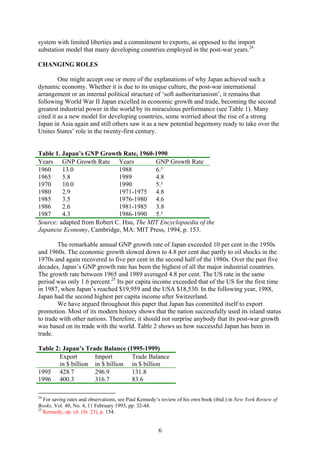
greatest industrial power in the world by its miraculous performance (see Table 1). Many
cited it as a new model for developing countries, some worried about the rise of a strong
Japan in Asia again and still others saw it as a new potential hegemony ready to take over the
Unites States’ role in the twenty-first century.


Table 1. Japan’s GNP Growth Rate, 1960-1990
Years GNP Growth Rate Years               GNP Growth Rate
1960     13.0                1988         6.²
1965     5.8                 1989         4.8
1970     10.0                1990         5.²
1980     2.9                 1971-1975 4.8
1985     3.5                 1976-1980 4.6
1986     2.6                 1981-1985 3.8
1987     4.3                 1986-1990 5.²
Source: adapted from Robert C. Hsu, The MIT Encyclopaedia of the
Japanese Economy, Cambridge, MA: MIT Press, 1994, p. 153.

        The remarkable annual GNP growth rate of Japan exceeded 10 per cent in the 1950s
and 1960s. The economic growth slowed down to 4.8 per cent due partly to oil shocks in the
1970s and again recovered to five per cent in the second half of the 1980s. Over the past five
decades, Japan’s GNP growth rate has been the highest of all the major industrial countries.
The growth rate between 1965 and 1989 averaged 4.8 per cent. The US rate in the same
period was only 1.6 percent.25 Its per capita income exceeded that of the US for the first time
in 1987, when Japan’s reached $19,959 and the USA $18,530. In the following year, 1988,
Japan had the second highest per capita income after Switzerland.
        We have argued throughout this paper that Japan has committed itself to export
promotion. Most of its modern history shows that the nation successfully used its island status
to trade with other nations. Therefore, it should not surprise anybody that its post-war growth
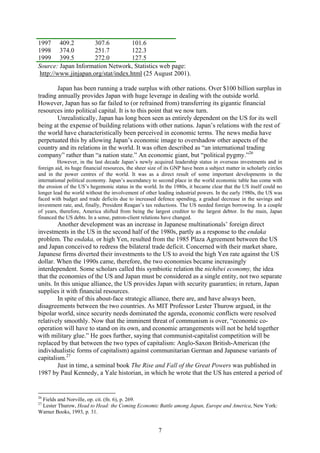
was based on its trade with the world. Table 2 shows us how successful Japan has been in
trade.

Table 2: Japan’s Trade Balance (1995-1999)
       Export       Import       Trade Balance
       in $ billion in $ billion in $ billion
1995 428.7          296.9        131.8
1996 400.3          316.7        83.6

24
   For saving rates and observations, see Paul Kennedy’s review of his own book (ibid.) in New York Review of
Books, Vol. 40, No. 4, 11 February 1993, pp. 32-44.
25
   Kennedy, op. cit. (fn. 23), p. 154.


                                                      6
1997 409.2            307.6          101.6
1998 374.0            251.7          122.3
1999 399.5            272.0          127.5
Source: Japan Information Network, Statistics web page:
 http://www.jinjapan.org/stat/index.html (25 August 2001).

        Japan has been running a trade surplus with other nations. Over $100 billion surplus in
trading annually provides Japan with huge leverage in dealing with the outside world.
However, Japan has so far failed to (or refrained from) transferring its gigantic financial
resources into political capital. It is to this point that we now turn.
        Unrealistically, Japan has long been seen as entirely dependent on the US for its well
being at the expense of building relations with other nations. Japan’s relations with the rest of
the world have characteristically been perceived in economic terms. The news media have
perpetuated this by allowing Japan’s economic image to overshadow other aspects of the
country and its relations in the world. It was often described as “an international trading
company” rather than “a nation state.” An economic giant, but “political pygmy.”26
         However, in the last decade Japan’s newly acquired leadership status in overseas investments and in
foreign aid, its huge financial resources, the sheer size of its GNP have been a subject matter in scholarly circles
and in the power centres of the world. It was as a direct result of some important developments in the
international political economy. Japan’s ascendancy to second place in the world economic table has come with
the erosion of the US’s hegemonic status in the world. In the 1980s, it became clear that the US itself could no
longer lead the world without the involvement of other leading industrial powers. In the early 1980s, the US was
faced with budget and trade deficits due to increased defence spending, a gradual decrease in the savings and
investment rate, and, finally, President Reagan’s tax reductions. The US needed foreign borrowing. In a couple
of years, therefore, America shifted from being the largest creditor to the largest debtor. In the main, Japan
financed the US debts. In a sense, patron-client relations have changed.
        Another development was an increase in Japanese multinationals’ foreign direct
investments in the US in the second half of the 1980s, partly as a response to the endaka
problem. The endaka, or high Yen, resulted from the 1985 Plaza Agreement between the US
and Japan conceived to redress the bilateral trade deficit. Concerned with their market share,
Japanese firms diverted their investments to the US to avoid the high Yen rate against the US
dollar. When the 1990s came, therefore, the two economies became increasingly
interdependent. Some scholars called this symbiotic relation the nichibei economy, the idea
that the economies of the US and Japan must be considered as a single entity, not two separate
units. In this unique alliance, the US provides Japan with security guaranties; in return, Japan
supplies it with financial resources.
        In spite of this about-face strategic alliance, there are, and have always been,
disagreements between the two countries. As MIT Professor Lester Thurow argued, in the
bipolar world, since security needs dominated the agenda, economic conflicts were resolved
relatively smoothly. Now that the imminent threat of communism is over, “economic co-
operation will have to stand on its own, and economic arrangements will not be held together
with military glue.” He goes further, saying that communist-capitalist competition will be
replaced by that between the two types of capitalism: Anglo-Saxon British-American (the
individualistic forms of capitalism) against communitarian German and Japanese variants of
capitalism.27
        Just in time, a seminal book The Rise and Fall of the Great Powers was published in
1987 by Paul Kennedy, a Yale historian, in which he wrote that the US has entered a period of


26
 Fields and Norville, op. cit. (fn. 6), p. 269.
27
 Lester Thurow, Head to Head: the Coming Economic Battle among Japan, Europe and America, New York:
Warner Books, 1993, p. 31.


                                                         7
decline due to imperial over-stretch, as was the case in the history of great powers such as
Spain, the Netherlands and Britain.28 He argued that:
        “[T]here is a dynamic for change, driven chiefly by economic and technological
        development, which then impacts upon social structures, political systems, military
        powers, and the position of individual states and empires. The speed of this global
        economic change has not been a uniform one...This uneven pace of economic growth
        has had crucial long term impacts upon the relative military power and strategic
        position of the members of the state system...Military power rests upon adequate
        supplies of wealth, which in turn derive from a flourishing productive base, from
        healthy finances, and from superior technology.”29

         The corollary of these arguments was as much a warning for policymakers in
Washington as it was a relief for Japanese politicians because for years Japan’s growth rate
and technological innovations have been far ahead of the US’s and everyone else’s.
Moreover, Kennedy was not the only one who heralded the emergence of a new hegemony.
While Ezra Vogel, a former state department official, saw Japan as number one, Attali
foresaw two-way competition between the EU and Japan. Thurow, on the other hand,
predicted that the European Union under German leadership had the best chance to be a New
World leader in the forthcoming decades. Joseph Nye, a Harvard professor, however,
criticised the declinist theorists and declared that the US was bound to lead.30 Whatever the
merit of these predictions, the bottom line is that in the past five decades Japan has evolved to
become one of the great powers among the nations of the world. Yet, the rise of Japan as an
economic power “has not been accompanied by a comparable rise in its international political
and strategic weight.”31 With US power declining, Russia having fallen and China on the rise,
however, Japan can no longer adhere to the Yoshida Doctrine, which holds that Japan should
avoid international disputes, keep a low profile on divisive global issues and concentrate on
economic gains.32 It succeeded as follower and now has to share the burden of the
international economic order and lead the world.

        REDEFINING JAPAN’S NEW FOREIGN POLICY


        It took a long time for Japanese politicians to take part in world affairs. Until the mid-
1980s, or even, some say, until the Gulf War, Japan’s foreign policy simply followed the
demands of the US, and displayed no desire to take initiative or a leadership role. This is
because of the demilitarised and pacifist status its American-made constitution imposed on it.
But this is only part of the story. As Kennedy maintained, economic prosperity does not
always and immediately translate into military effectiveness, but all the major shifts followed
alterations in the productive balances.33 Japan’s economy did not internationalise the
country’s foreign policy so deeply until recently. In the 1990s, however, as its foreign
investments and external assets increased, it had a huge stake in maintaining economic
security world wide, from Southeast Asia to Latin America to Eastern Europe. Japan no
longer should or could afford to stay indifferent to world affairs. It is a member of G-8 and

28
   Paul Kennedy, The Rise and Fall of the Great Powers, New York: Random House, 1987, p. 439.
29
   Ibid., p. 438..
30
   Joseph Nye, Jnr., Bound to Lead: the Changing Nature of American Power, Basic Book, 1992.
31
   Eugene Brown, ‘The Debate Over Japan’s Strategic Future’, Asian Survey, Vol. 33, No. 6, June 1993.
32
   Charles W. Kegley and Eugene R. Wittkopf, World politics: Trend and Transformation, Sixth Edition, New
York: St. Martin’s Press, 1997, pp. 410-411.
33
   Kennedy, op. cit. (fn. 28), p. 446.


                                                     8
showed willingness to co-operate and share some of the burden by signing the 1985 Plaza
Agreement. It helped to facilitate Third World debt relief in the 1980s, it contributed $11
billion to the Gulf War and, in the 1990s, after making constitutional changes, it participated
for the first time in UN peacekeeping operations, in Cambodia and Mozambique.
         For Japan’s foreign policy, the Gulf War became a turning point from several aspects.
Japan, which draws 70 per cent of its oil requirement from the Persian Gulf, was
conspicuously absent from the UN coalition of allied forces from 30 countries that the US
formed to repel the Iraqi army from Kuwait. Its financial contribution has been criticised as
“checkbook diplomacy, leaving the fighting to other nations.”34 The second and more
important lesson of from the Gulf War was that the course of diplomacy preceded the military
operation. Despite the United States’ determination to repel the aggressor, it displayed an
inability to take unilateral action for that end and largely utilised the United Nations to
legitimise its actions. In another words, the UN re-emerged as a vital organisation where
diplomacy and deliberations occur. Since Japan was left out of the debates, Japan’s politicians
and public were convinced that, in the post-Cold War world, the UN would play an important
role in international affairs and that Japan, therefore, had to have a seat on the UN Security
Council. Japanese government officials argued that since the country was the second largest
(12.5 per cent) payer to the UN budget (larger than France and Britain’s contribution
combined), it deserved a permanent seat. Otherwise, it would be unfair to pay tax without
representation. Although it is not yet certain, the Japanese dream seems to be coming true; a
panel set up to study UN reforms has already suggested that two more permanent seats be
created, apparently for Japan and Germany.35 If such a change is to ever occur, however, it
will take years to materialise and, so, Japan should work through diplomatic channels to
protect its interests in the world’s largest political organisation.

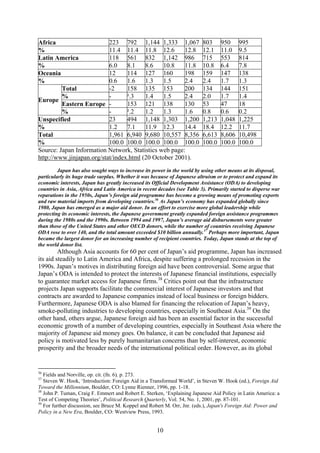
Table 3: Trend in Japan's Bilateral Official Development Assistance, 1980-1999 (million
dollars)
Region                           1980    1990    1994     1995    1996    1997    1998    1999
        Total                    1,383   4,117   5,544    5,745   4,145   3,076   5,372   6,631
        %                        70.5    59.3    57.3     54.4    49.6    46.5    62.4    63.2
        Northeast Asia           82      835     1,505    1,606   869     530     1,211   1,282
        %                        4.2     12.0    15.5     15.2    10.4    8.0     14.1    12.2
        Southeast Asia           861     2,379   2,223    2,592   1,858   1,416   2,438   3,921
        %                        43.9    34.3    23.0     24.6    22.2    21.4    28.3    37.3
        ASEAN                    703     2,299   1,884    2,229   1,694   1,354   2,356   -
        %                        35.8    33.1    19.5     21.1    20.3    20.5    27.4    -
Asia
        Southwest Asia           435     898     1,785    1,435   1,320   964     1,463   1,168
        %                        22.2    12.9    18.2     13.6    15.8    14.6    17.0    11.1
        Central Asia             -       -       49       67      80      145     228     215
        %                        -       -       0.5      0.6     0.9     2.2     2.7     2.0
        Caucasus                 -       -       0        0       0       12      14      25
        %                        -       -       0.0      0.0     0.0     0.2     0.2     0.2
        Other regions            5       4       9        44      18      9       19      21
        %                        0.3     0.1     0.1      0.4     0.2     0.1     0.2     0.2
Middle East                      204     705     751      721     561     513     392     544
%                                10.4    10.2    7.8      6.8     6.7     7.8     4.6     5.2

34
     Leitch, et al., op. cit. (fn. 12), p. 45.
35
     ‘UN Panel Proposes Expanding Security Council to 24 Members’, New York Times, 21 March 1997.


                                                      9
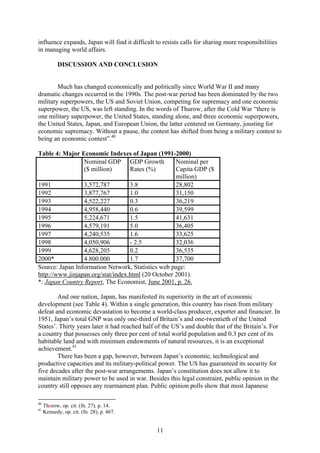
Africa                     223 792 1,144 1,333 1,067                      803      950     995
%                          11.4 11.4 11.8 12.6         12.8               12.1     11.0    9.5
Latin America              118 561 832 1,142 986                          715      553     814
%                          6.0    8.1    8.6   10.8    11.8               10.8     6.4     7.8
Oceania                    12     114 127 160          198                159      147     138
%                          0.6    1.6    1.3   1.5     2.4                2.4      1.7     1.3
         Total             -2     158 135 153          200                134      144     151
         %                 -      ².3    1.4   1.5     2.4                2.0      1.7     1.4
Europe
         Eastern Europe -         153 121 138          130                53       47      18
         %                 -      ².2    1.2   1.3     1.6                0.8      0.6     0.2
Unspecified                23     494 1,148 1,303 1,200                   1,213    1,048   1,225
%                          1.2    7.1    11.9 12.3     14.4               18.4     12.2    11.7
Total                      1,961 6,940 9,680 10,557 8,356                 6,613    8,606   10,498
%                          100.0 100.0 100.0 100.0 100.0                  100.0    100.0   100.0
Source: Japan Information Network, Statistics web page:
http://www.jinjapan.org/stat/index.html (20 October 2001).
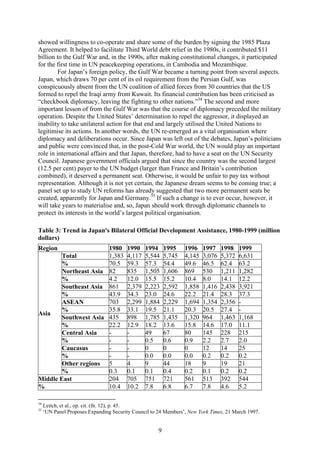
         Japan has also sought ways to increase its power in the world by using other means at its disposal,
particularly its huge trade surplus. Whether it was because of Japanese altruism or to protect and expand its
economic interests, Japan has greatly increased its Official Development Assistance (ODA) to developing
countries in Asia, Africa and Latin America in recent decades (see Table 3). Primarily started to disperse war
reparations in the 1950s, Japan’s foreign aid programme has become a growing means of promoting exports
and raw material imports from developing countries.36 As Japan’s economy has expanded globally since
1980, Japan has emerged as a major aid donor. In an effort to exercise more global leadership while
protecting its economic interests, the Japanese government greatly expanded foreign assistance programmes
during the 1980s and the 1990s. Between 1994 and 1997, Japan’s average aid disbursements were greater
than those of the United States and other OECD donors, while the number of countries receiving Japanese
ODA rose to over 140, and the total amount exceeded $10 billion annually.37 Perhaps more important, Japan
became the largest donor for an increasing number of recipient countries. Today, Japan stands at the top of
the world donor list.
         Although Asia accounts for 60 per cent of Japan’s aid programme, Japan has increased
its aid steadily to Latin America and Africa, despite suffering a prolonged recession in the
1990s. Japan’s motives in distributing foreign aid have been controversial. Some argue that
Japan’s ODA is intended to protect the interests of Japanese financial institutions, especially
to guarantee market access for Japanese firms.38 Critics point out that the infrastructure
projects Japan supports facilitate the commercial interest of Japanese investors and that
contracts are awarded to Japanese companies instead of local business or foreign bidders.
Furthermore, Japanese ODA is also blamed for financing the relocation of Japan’s heavy,
smoke-polluting industries to developing countries, especially in Southeast Asia.39 On the
other hand, others argue, Japanese foreign aid has been an essential factor in the successful
economic growth of a number of developing countries, especially in Southeast Asia where the
majority of Japanese aid money goes. On balance, it can be concluded that Japanese aid
policy is motivated less by purely humanitarian concerns than by self-interest, economic
prosperity and the broader needs of the international political order. However, as its global


36
   Fields and Norville, op. cit. (fn. 6), p. 273.
37
   Steven W. Hook, ‘Introduction: Foreign Aid in a Transformed World’, in Steven W. Hook (ed.), Foreign Aid
Toward the Millennium, Boulder, CO: Lynne Rienner, 1996, pp. 1-18.
38
   John P. Tuman, Craig F. Emmert and Robert E. Sterken, ‘Explaining Japanese Aid Policy in Latin America: a
Test of Competing Theories’, Political Research Quarterly, Vol. 54, No. 1, 2001, pp. 87-101.
39
   For further discussion, see Bruce M. Koppel and Robert M. Orr, Jnr. (eds.), Japan's Foreign Aid: Power and
Policy in a New Era, Boulder, CO: Westview Press, 1993.


                                                      10
influence expands, Japan will find it difficult to resists calls for sharing more responsibilities
in managing world affairs.

            DISCUSSION AND CONCLUSION


        Much has changed economically and politically since World War II and many
dramatic changes occurred in the 1990s. The post-war period has been dominated by the two
military superpowers, the US and Soviet Union, competing for supremacy and one economic
superpower, the US, was left standing. In the words of Thurow, after the Cold War “there is
one military superpower, the United States, standing alone, and three economic superpowers,
the United States, Japan, and European Union, the latter centered on Germany, jousting for
economic supremacy. Without a pause, the contest has shifted from being a military contest to
being an economic contest”.40

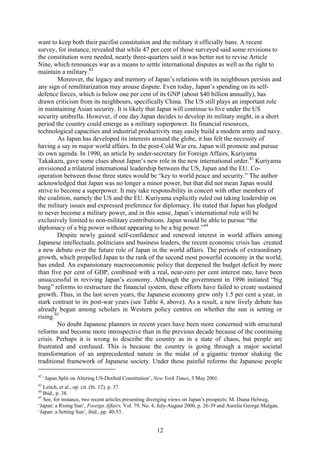
Table 4: Major Economic Indexes of Japan (1991-2000)
                 Nominal GDP GDP Growth             Nominal per
                 ($ million)       Rates (%)        Capita GDP ($
                                                    million)
1991             3,572,787         3.8              28,802
1992             3,877,767         1.0              31,150
1993             4,522,227         0.3              36,219
1994             4,958,440         0.6              39,599
1995             5,224,671         1.5              41,631
1996             4,579,191         5.0              36,405
1997             4,240,535         1.6              33,625
1998             4,050,906         - 2.5            32,036
1999             4,628,205         0.2              36,535
2000*            4.800.000         1.7              37,700
Source: Japan Information Network, Statistics web page:
http://www.jinjapan.org/stat/index.html (20 October 2001).
*: Japan Country Report, The Economist, June 2001, p. 26.

        And one nation, Japan, has manifested its superiority in the art of economic
development (see Table 4). Within a single generation, this country has risen from military
defeat and economic devastation to become a world-class producer, exporter and financier. In
1951, Japan’s total GNP was only one-third of Britain’s and one-twentieth of the United
States’. Thirty years later it had reached half of the US’s and double that of the Britain’s. For
a country that possesses only three per cent of total world population and 0.3 per cent of its
habitable land and with minimum endowments of natural resources, it is an exceptional
achievement.41
        There has been a gap, however, between Japan’s economic, technological and
productive capacities and its military-political power. The US has guaranteed its security for
five decades after the post-war arrangements. Japan’s constitution does not allow it to
maintain military power to be used in war. Besides this legal constraint, public opinion in the
country still opposes any rearmament plan. Public opinion polls show that most Japanese

40
     Thurow, op. cit. (fn. 27), p. 14.
41
     Kennedy, op. cit. (fn. 28), p. 467.


                                                11
want to keep both their pacifist constitution and the military it officially bans. A recent
survey, for instance, revealed that while 47 per cent of those surveyed said some revisions to
the constitution were needed, nearly three-quarters said it was better not to revise Article
Nine, which renounces war as a means to settle international disputes as well as the right to
maintain a military.42
        Moreover, the legacy and memory of Japan’s relations with its neighbours persists and
any sign of remilitarization may arouse dispute. Even today, Japan’s spending on its self-
defence forces, which is below one per cent of its GNP (about $40 billion annually), has
drawn criticism from its neighbours, specifically China. The US still plays an important role
in maintaining Asian security. It is likely that Japan will continue to live under the US
security umbrella. However, if one day Japan decides to develop its military might, in a short
period the country could emerge as a military superpower. Its financial resources,
technological capacities and industrial productivity may easily build a modern army and navy.
        As Japan has developed its interests around the globe, it has felt the necessity of
having a say in major world affairs. In the post-Cold War era, Japan will promote and pursue
its own agenda. In 1990, an article by under-secretary for Foreign Affairs, Kuriyama
Takakazu, gave some clues about Japan’s new role in the new international order.43 Kuriyama
envisioned a trilateral international leadership between the US, Japan and the EU. Co-
operation between those three states would be “key to world peace and security.” The author
acknowledged that Japan was no longer a minor power, but that did not mean Japan would
strive to become a superpower. It may take responsibility in concert with other members of
the coalition, namely the US and the EU. Kuriyama explicitly ruled out taking leadership on
the military issues and expressed preference for diplomacy. He stated that Japan has pledged
to never become a military power, and in this sense, Japan’s international role will be
exclusively limited to non-military contributions. Japan would be able to pursue “the
diplomacy of a big power without appearing to be a big power.”44
        Despite newly gained self-confidence and renewed interest in world affairs among
Japanese intellectuals, politicians and business leaders, the recent economic crisis has created
a new debate over the future role of Japan in the world affairs. The periods of extraordinary
growth, which propelled Japan to the rank of the second most powerful economy in the world,
has ended. An expansionary macroeconomic policy that deepened the budget deficit by more
than five per cent of GDP, combined with a real, near-zero per cent interest rate, have been
unsuccessful in reviving Japan’s economy. Although the government in 1996 initiated “big
bang” reforms to restructure the financial system, these efforts have failed to create sustained
growth. Thus, in the last seven years, the Japanese economy grew only 1.5 per cent a year, in
stark contrast to its post-war years (see Table 4, above). As a result, a new lively debate has
already begun among scholars in Western policy centres on whether the sun is setting or
rising.45
        No doubt Japanese planners in recent years have been more concerned with structural
reforms and become more introspective than in the previous decade because of the continuing
crisis. Perhaps it is wrong to describe the country as in a state of chaos, but people are
frustrated and confused. This is because the country is going through a major societal
transformation of an unprecedented nature in the midst of a gigantic tremor shaking the
traditional framework of Japanese society. Under these painful reforms the Japanese people

42
     ‘Japan Split on Altering US-Drafted Constitution’, New York Times, 3 May 2001.
43
   Leitch, et al., op. cit. (fn. 12), p. 37.
44
   Ibid., p. 38.
45
   See, for instance, two recent articles presenting diverging views on Japan’s prospects: M. Diana Helweg,
‘Japan: a Rising Sun’, Foreign Affairs, Vol. 79, No. 4, July-August 2000, p. 26-39 and Aurelia George Mulgan,
‘Japan: a Setting Sun’, ibid., pp. 40-53.


                                                       12
are shifting their view towards the world. To borrow from a senior officer at Japan’s Foreign
Ministry, “What was once a growing sense of eagerness to search for a constructive role for
Japan in the world, which marked the Japan of the 1980s and the early 1990s, is now being
replaced by an overly pessimistic outlook regarding Japan’s own future. This forms a hotbed
for an attitude of passive inaction and even of inward-looking-ness.”46 It seems that, despite
some disagreements between the two countries, US-Japan co-operation is more likely to
persist than any other scenario in the foreseeable future, as closer diplomatic and military
collaboration between the two countries against global terrorism has proved in the aftermath
of September 11. The European Union, though far from a full political consolidation, will
continue to be a second bloc. Since all of them share the same values of democracy, free trade
and a capitalist economy, in the post-Cold War era we may witness a more co-operative world
at least among the great powers.


46
  Hisashi Owada, ‘The Shaping of World Public Order and the Role of Japan’, Japan Review of International
Affairs, Vol. 15, No. 1, spring 2000.


                                                    13

Birol akgunsabancalis

  • 1.
    RELUCTANT GIANT: THERISE OF JAPAN AND ITS ROLE IN THE POST-COLD WAR ERA Birol Akgün & Şaban H. Çalış Drs Birol Akgün and Şaban H. Çalış are assistant professors at Selçuk University, Department of International Relations INTRODUCTION The rise of Japan as an economic power in the international political economy is one of the most spectacular developments since the Second World War. It is not only the sheer size of the Japanese economy that illustrates its success, but also the country’s technological innovations, quality of products and the prevalence of made-in- Japan goods in every quarter of the globe that manifests the ever growing Japanese influence in the world. More interesting still is that, despite its colossal economic power, second only to the United States, Japan has so far demonstrated little desire to take responsibility for the conduct of world affairs. To put it another way: an economic giant has behaved like a dwarf in international political affairs. Can or should Japan continue to abstain from playing a major role in the new conditions of the post-Cold War world? We shall attempt to answer this question. JAPAN IN HISTORICAL PERSPECTIVE A relatively small country in terms of territory and population on the western edge of the Pacific Ocean, Japan lacks many of the vital elements for economic development, such as oil, coal, iron ore and other raw materials. Except for growing rice to feed its people, the country in every sense depends on foreign resources for its highly complicated industrial machine. Therefore, the model of economic growth that the country has pursued for over five decades differs significantly from the experiences of Western Europe and North America – both regions that by and large enjoy abundant raw materials. Japan, however, has to import the wherewithal, process them at home and find markets to export them to. To survive and progress, therefore, the country had no choice but to become a master of trade. The rise of Japan to such a prominent position, argues Jacques Attali, a former advisor to French ex-President François Mitterand, is due in large part to cultural factors. He maintains that the emergence of a new centre is most often the direct result of “a cultural reaction to a geographic challenge or lack of an essential resource.”1 In the case of Japan, the scarcity of land to reside in necessitated “miniaturizing objects”; its geographic detachment encouraged the invention of means of communication, and its energy deficiency encouraged research to find new alternatives for travel. Besides geo-cultural explanations, however, one needs to look at other factors such as the structure of the post-Second World War international order, Japan’s special relationship with America and its geographical proximity to the two communist powers, which were deemed to be imminent menaces to the free world. Up to the second half of the nineteenth century, Japan remained isolated. Culturally affected by the Confucian tradition, feudal rulers governed the people in absolute terms. Sanctioned by the people’s belief in such social values as authority, hierarchy and loyalty, the established system continued for a long time. Early meetings with some Christian 1 Jacques Attali, Millennium: Winners and Losers in the Coming World Order, New York: New York Times Books, 1991, p. 46. 1
  • 2.
    missionaries in thesixteenth century created hostility toward foreigners and resulted in further isolation with the introduction of a ban on contact with outsiders, an offence punishable by death. Commodore Matthew Perry’s gunboat diplomacy opened Japanese doors to the Western world in 1853.2 In the following decades of Japanese confrontation with Western civilisation, the nation underwent a period of transformation. The Meiji Restoration was undertaken in the 1860s by a group of young nationalists who launched a modernisation programme that gave a special emphasis to industrialisation, centralisation and the creation of a strong military capable of countering Western colonialist powers.3 Ironically, this powerful military later turned out to be a reliable instrument to achieve Japanese imperialistic aims. In the first test of strength, the military proved its ability by defeating Russia in 1905. It was a fascinating victory for Japan, being the first time an Asian power had won a war against a Western power. Now it was Japan’s turn to carve up some territories to supply its industry, which relied heavily on imported raw materials and energy resources. Not surprisingly, therefore, Japan in the first half of the twentieth century pursued a colonialist foreign policy. It gradually expanded its influence in the region by taking over Taiwan, Korea and, later on, Manchuria with its surrounding Chinese territory. In the peak years of the empire, during World War II, Japan also acquired many countries in Southeast Asia. It needed oil and other resources to sustain its war machine. The legacy and memory of Japanese domination and brutal ruling in the region still cause resentment and create hurdles in Japan’s relations with these nations.4 Although the post-war Japanese constitution prohibits it from using force outside its borders, the country’s defence spending – which, even with a government-set limit of one per cent of GNP, ranks second in the world (totalling over $40 billion5) – is regarded by many as excessive and a threat. That Japan might turn to its past and revive its role in the region again is an open question that cannot be ruled out. Looking at the nation’s historical record, one can find both pacifism and militarism. As Field and Norville have observed, Japanese relations with the rest of the world display several continuities.6 One of them is its capacity to imitate and adapt. In the past, Japan has imported many ideas, ideologies, cultures and technologies if it viewed them superior to its own. To name a few, Japan’s religion of Buddhism was taken from China via Korea, modern science from the Dutch and, recently, high technology from America, such as VCRs and computer products. Every time, however, Japan has been able to fit these innovations into its society and developed its own models or patterns. A second feature is its perception of the world in terms of hierarchy. Perhaps a reflection of its own structure of society, Japan sees world actors as “ranked in stair-step fashion” and considered itself inferior to other powers such as China, Russia, Britain and the Unites States. However, when the nation gained its own strength and felt self-esteem, Japan altered its stance vis-à-vis these powers from admiration to scorn. Japan’s final sustained characteristic is its “national corporatism.” The Japanese identity is a factor determining its role in the world affairs. Its geographical isolation and the feeling of being left out create an island mentality and reinforce national solidarity. This characteristic leads Japanese rulers and its people to adopt a nationalistic view of the world, 2 Steve Chan, East Asian Dynamism: Growth, Order and Security in the Pacific Region, Boulder: Westview Press, 1993, p. 30. 3 Ibid., p. 35. 4 ‘Japan Rejects Calls for History Text Revisions’, New York Times (Web edition), 9 July 2001. 5 This figure is taken from CIA’s Factbook-2001 published online at www.cia.gov (25 October 2002). 6 Karl J Fields and Elizabeth Norville, ‘Japan and the International Political Economy’ in David N. Balaam and Michael Vesth, Introduction to International Political Economy, New Jersey: Prentice-Hall, Inc., 1996, pp. 259- 282. 2
  • 3.
    which manifested itself“in both former military exploits and more recent economic campaigns.”7 JAPAN IN THE COLD WAR Having set a historical view, let us now turn to what has happened in the post-Second World War years in the pacific region. Japanese military imperialism lasted until the explosion of the two atomic bombs on Hiroshima and Nagasaki, which proved that Western technology was overwhelmingly superior to Japan’s. The country surrendered immediately. Occupation forces under General Douglas MacArthur introduced a series of reforms, which not only dramatically changed society but also redefined Japan’s role in the international arena. Like the de-Nazification programme in Germany, MacArthur’s plan included purging the army, bureaucracy and political life of ultra-nationalists. According to one source, two hundred thousand people were purged from politics, business and the media for supposed complicity during the war.8 While the infamous conservative business families, known as zaibatsu, were broken up in the industrial sector, landless peasants were made landowners through rural reform.9 Moreover, and more importantly, was the institution of a new constitution that brought about a democratic parliamentary political system, open to participation of all male and female citizens of majority.10 The emperor, once a worshipped monarch, now became nothing more than a symbolic leader. Perhaps the most important characteristic of Japan’s new constitution was that of its total renunciation of war as a means of dispute resolution with other nations. Since the United States provided a security guarantee against third states, Japan was to deal with only economic development and trade as a peaceful country.11 As mentioned above, one of the Japanese people’s enduring characteristics has been their high capacity of adaptability to the new conditions. Therefore, as the tension between the East and West increased in the 1950s and 1960s, many from the Japanese élite genuinely sided with the US against communism. Consistent with the American strategy of containing the spread of communism in the world, Japan turned out to be a reliable regional ally of the Free World. It was treated not as a defeated enemy but as a friend in need of economic aid. Japan had to be the Switzerland of East Asia: peaceful, stable and prosperous. Japan did not make the rules of the international system, but it demonstrated remarkably well how to prosper under them.12 During its late nineteenth century age of imperialism, Japan excelled in military expansionism. Now it was time to explore new frontiers in the world of production and trading. When the war ended the country was in shambles. In the words of Peter Duus, a Stanford professor: “Tokyo, once a metropolis that rivaled London and New York, was a wasteland of rubble and ash, and Hiroshima and Nagasaki lay flattened by atomic blast. The country was prostrate economically, its factories at a standstill and its food supplies 7 Ibid., p. 261. 8 Hans Baerwald, The Purge of Japanese Leaders under the Occupation, Berkeley: University of California Press, 1959. 9 T. A. Bisson, Zaibatsu Dissolution in Japan, Berkeley: University of California Press, 1954. 10 F. Rosenbuluth, and M. F. Thies, ‘Politics in Japan’ in Gabriel Almond, et al., Comparative Politics Today: a World View, New York: Longman, 2000, pp. 327-370. 11 John L. Gaddis, Strategies of Containment: a Critical Appraisal of Post-war American National Security Policy, Oxford, UK: Oxford University Press, 1982, p. 75. 12 Richard D. Leitch, Akira Kato and Martin E. Weinstein, Japan’s Role in the Post-Cold World, Westport, CT: Greenwood Press, 1995, p. 6. 3
  • 4.
    barely sufficient tokeep its people alive. The mass of the population were exhausted, disillusioned, and apprehensive, glad that the suffering was at an end but fearful of what was to come next.”13 The nation’s productive capacities plummeted far below pre-war levels. In 1946, agricultural output was 60 per cent of what it was in 1941, and industrial production had ended either because of war damage or the Allied Power’s ban on strategic production.14 The recovery of the economy was as quick as it was dramatic. In nine years, both GNP and national income reached pre-war levels. In not more than two decades after invasion, Japan became a leading country. And, in 1968, a remarkable economic upsurge put the country in third place among industrial nations.15 The Japanese growth rate in this period was without historical parallel. With a sustained 10 per cent annual growth rate, the performance of the economy exceeded every country in the world. Japan’s miraculous economic development was helped by the availability of relatively cheap energy before 1973, a favourable international order characterised by an exceptional increase in trade and a huge always-ready-to-buy American market. Moreover, Japan did not have to create a modern economy from scratch. The country inherited from the pre-war period a highly skilled labour force, an infrastructure ready to be repaired and a widespread achievement ethic, which was exaggerated by the defeat of the war.16 Professor Duus points out, however, that Japan’s impressive growth rate must not be overstated simply because in the same period all Western European economies remarkably outpaced their pre-war years’ performance. Perhaps Japan’s “miraculous growth” was merely “an extreme case of a general phenomenon.”17 The post-war international setting and Japan’s unique place in this arrangement provided further advantages for its success. First, demilitarisation of the country and the prohibition of rearmament diverted skills, capital and energy once spent on war preparations to civilian sectors. While the US, Soviet Union and the European nations competed to produce or acquire high-tech expensive weapon systems, Japan enjoyed investments directly related to markets. Second, Japanese firms gained access to the most advanced technologies at a limited cost by making licensing arrangements with American companies. Thus, without making heavy investments in research and development, its industry caught up with new technologies. Finally, Japan’s success in checking its population growth relieved the economy of population pressure.18 Apart from general observations on how Japan evolved to take second place in the world among so many contending countries, some scholars tend to look at the domestic structure of the Japan, especially the role of the state in economic management. Despite its capitalistic economy and democratic polity, the government plays a significant role in running economy. This has not been absolutist, as was the case in the communism, but Japanese public authorities guide private enterprises through using a complex mixture of planning, persuasion and control. Unlike laissez-faire capitalism, where the state functions as a referee in the marketplace making sure players comply with the rules, in developmental capitalist systems like Japan’s, the state is not just an observer but a player. It gets involved in marketplace with substantive social goals such as promoting the international competitiveness 13 Peter Duus, The Rise of Modern Japan, Boston: Houghton Mifflin Company, 1976, p. 238. 14 Ibid., p. 248. 15 Ibid., p. 255. 16 William W. Lockwood, The Economic Development of Japan, Princeton, NJ: Princeton University Press, 1990, p. 25-28. 17 Duus, op. cit. (fn. 13), p. 256. 18 Duus, op. cit. (fn. 13), p. 257. 4
  • 5.
    of industry andsustaining long-run growth.19 However, while co-ordinating policies, the state does not repress market forces, rather it seeks to preserve competition and private enterprise. Chalmers Johnson, a leading scholar on East Asia, described the Japanese style of state- economy relations as being “soft authoritarianism” characterised by the existence of a strong (if not absolutist) state and capitalist economy.20 Its first model emerged during the Meiji Restoration and despite immense transformation of the political system after World War II, the basic features of developmental capitalism were retained. In explaining this mode of conduct and its features, Chalmers Johnson argued that Japan’s success in becoming the second most productive economy that ever existed is no longer simply an enigma; it is a challenge to the main political and economic doctrines that currently dominate global thinking about human social organisation. Japan’s performance also challenges the Anglo-American free enterprise economies because it calls into question their theory that governmental intervention in the economy is inevitably inefficient and distorting, and it also suggests that their faith in the market mechanism without explicit political direction is misplaced.21 In this model, while private enterprise remains the principal engine in the economy, the government intervenes in the marketplace with administrative guidance without distracting market forces. An indispensable element here is the existence of a developmentally committed political élite. While day-to-day operations are left to the techno-bureaucrats, the political élite maintain long-term political stability, set national goals and standards, prevent class conflict and shield technocrats from political influence. The aim is to obtain maximum growth, maintain international competitiveness, keep quality high and, in the end, increase exports. This export-or-die strategy stems in part from Japan’s island nation status. “In Japan”, James Fallows notes, “economics has in effect been considered a branch of geopolitics – that is, as key to the nation’s strength or vulnerability in dealing with other powers.”22 This way of thinking inspires the Japanese to great sacrifice on behalf of their nation. Families inculcate their children with values favourable to national solidarity, households save a high proportion of their incomes and educational institutions preach the virtues of quality, skills and work discipline. In his famous book, Preparing for the 21st Century, Paul Kennedy finds some common distinguishing characteristics with East Asia’s fast growing states for which Japan serves a role model.23 Despite their differences, those states’ shared characteristics may explain their decade-upon-decade growth. Their most well known feature is their commitment to education. Based on Confucian traditions of competition through disciplined learning in schools, the family and, later, in companies, the workforce is constantly prepared for higher skills and new technologies. The second characteristic is a high level of national savings. Employing several measures such as taxes, interest rates and import controls, the government encourages personal savings so that the capital needed for continued investment in industry is available. It is a sacrifice of the present for a more prosperous tomorrow. This is strikingly illustrated by comparing the saving rates of the US and Japan: five per cent and 32 per cent in 1987. These rates remained the same in the 1990s. Other characteristics are a strong political 19 Kent E. Calder, Strategic Capitalism: Private Business and Public Purpose in Japanese Industrial Finance, Princeton, NJ: Princeton University Press, 1993, p. 130-135. 20 Chalmers Johnson, ‘Political Institutions and Economic Performance: the Government-Business Relationships in Japan, South Korea, and Taiwan’ in Frederic Deyo (ed.), The Political Economy of the New Asian Industrialism, Ithaca: Cornell University Press, 1987, pp. 120-145. 21 Ibid., p. 137. 22 James Fallows, ‘How the World Works’, Atlantic Monthly, December 1993, p. 27. 23 Paul Kennedy, Preparing for the Twenty-first Century, New York: Random House, 1993. 5
  • 6.
    system with limitedliberties and a commitment to exports, as opposed to the import substation model that many developing countries employed in the post-war years.24 CHANGING ROLES One might accept one or more of the explanations of why Japan achieved such a dynamic economy. Whether it is due to its unique culture, the post-war international arrangement or an internal political structure of ‘soft authoritarianism’, it remains that following World War II Japan excelled in economic growth and trade, becoming the second greatest industrial power in the world by its miraculous performance (see Table 1). Many cited it as a new model for developing countries, some worried about the rise of a strong Japan in Asia again and still others saw it as a new potential hegemony ready to take over the Unites States’ role in the twenty-first century. Table 1. Japan’s GNP Growth Rate, 1960-1990 Years GNP Growth Rate Years GNP Growth Rate 1960 13.0 1988 6.² 1965 5.8 1989 4.8 1970 10.0 1990 5.² 1980 2.9 1971-1975 4.8 1985 3.5 1976-1980 4.6 1986 2.6 1981-1985 3.8 1987 4.3 1986-1990 5.² Source: adapted from Robert C. Hsu, The MIT Encyclopaedia of the Japanese Economy, Cambridge, MA: MIT Press, 1994, p. 153. The remarkable annual GNP growth rate of Japan exceeded 10 per cent in the 1950s and 1960s. The economic growth slowed down to 4.8 per cent due partly to oil shocks in the 1970s and again recovered to five per cent in the second half of the 1980s. Over the past five decades, Japan’s GNP growth rate has been the highest of all the major industrial countries. The growth rate between 1965 and 1989 averaged 4.8 per cent. The US rate in the same period was only 1.6 percent.25 Its per capita income exceeded that of the US for the first time in 1987, when Japan’s reached $19,959 and the USA $18,530. In the following year, 1988, Japan had the second highest per capita income after Switzerland. We have argued throughout this paper that Japan has committed itself to export promotion. Most of its modern history shows that the nation successfully used its island status to trade with other nations. Therefore, it should not surprise anybody that its post-war growth was based on its trade with the world. Table 2 shows us how successful Japan has been in trade. Table 2: Japan’s Trade Balance (1995-1999) Export Import Trade Balance in $ billion in $ billion in $ billion 1995 428.7 296.9 131.8 1996 400.3 316.7 83.6 24 For saving rates and observations, see Paul Kennedy’s review of his own book (ibid.) in New York Review of Books, Vol. 40, No. 4, 11 February 1993, pp. 32-44. 25 Kennedy, op. cit. (fn. 23), p. 154. 6
  • 7.
    1997 409.2 307.6 101.6 1998 374.0 251.7 122.3 1999 399.5 272.0 127.5 Source: Japan Information Network, Statistics web page: http://www.jinjapan.org/stat/index.html (25 August 2001). Japan has been running a trade surplus with other nations. Over $100 billion surplus in trading annually provides Japan with huge leverage in dealing with the outside world. However, Japan has so far failed to (or refrained from) transferring its gigantic financial resources into political capital. It is to this point that we now turn. Unrealistically, Japan has long been seen as entirely dependent on the US for its well being at the expense of building relations with other nations. Japan’s relations with the rest of the world have characteristically been perceived in economic terms. The news media have perpetuated this by allowing Japan’s economic image to overshadow other aspects of the country and its relations in the world. It was often described as “an international trading company” rather than “a nation state.” An economic giant, but “political pygmy.”26 However, in the last decade Japan’s newly acquired leadership status in overseas investments and in foreign aid, its huge financial resources, the sheer size of its GNP have been a subject matter in scholarly circles and in the power centres of the world. It was as a direct result of some important developments in the international political economy. Japan’s ascendancy to second place in the world economic table has come with the erosion of the US’s hegemonic status in the world. In the 1980s, it became clear that the US itself could no longer lead the world without the involvement of other leading industrial powers. In the early 1980s, the US was faced with budget and trade deficits due to increased defence spending, a gradual decrease in the savings and investment rate, and, finally, President Reagan’s tax reductions. The US needed foreign borrowing. In a couple of years, therefore, America shifted from being the largest creditor to the largest debtor. In the main, Japan financed the US debts. In a sense, patron-client relations have changed. Another development was an increase in Japanese multinationals’ foreign direct investments in the US in the second half of the 1980s, partly as a response to the endaka problem. The endaka, or high Yen, resulted from the 1985 Plaza Agreement between the US and Japan conceived to redress the bilateral trade deficit. Concerned with their market share, Japanese firms diverted their investments to the US to avoid the high Yen rate against the US dollar. When the 1990s came, therefore, the two economies became increasingly interdependent. Some scholars called this symbiotic relation the nichibei economy, the idea that the economies of the US and Japan must be considered as a single entity, not two separate units. In this unique alliance, the US provides Japan with security guaranties; in return, Japan supplies it with financial resources. In spite of this about-face strategic alliance, there are, and have always been, disagreements between the two countries. As MIT Professor Lester Thurow argued, in the bipolar world, since security needs dominated the agenda, economic conflicts were resolved relatively smoothly. Now that the imminent threat of communism is over, “economic co- operation will have to stand on its own, and economic arrangements will not be held together with military glue.” He goes further, saying that communist-capitalist competition will be replaced by that between the two types of capitalism: Anglo-Saxon British-American (the individualistic forms of capitalism) against communitarian German and Japanese variants of capitalism.27 Just in time, a seminal book The Rise and Fall of the Great Powers was published in 1987 by Paul Kennedy, a Yale historian, in which he wrote that the US has entered a period of 26 Fields and Norville, op. cit. (fn. 6), p. 269. 27 Lester Thurow, Head to Head: the Coming Economic Battle among Japan, Europe and America, New York: Warner Books, 1993, p. 31. 7
  • 8.
    decline due toimperial over-stretch, as was the case in the history of great powers such as Spain, the Netherlands and Britain.28 He argued that: “[T]here is a dynamic for change, driven chiefly by economic and technological development, which then impacts upon social structures, political systems, military powers, and the position of individual states and empires. The speed of this global economic change has not been a uniform one...This uneven pace of economic growth has had crucial long term impacts upon the relative military power and strategic position of the members of the state system...Military power rests upon adequate supplies of wealth, which in turn derive from a flourishing productive base, from healthy finances, and from superior technology.”29 The corollary of these arguments was as much a warning for policymakers in Washington as it was a relief for Japanese politicians because for years Japan’s growth rate and technological innovations have been far ahead of the US’s and everyone else’s. Moreover, Kennedy was not the only one who heralded the emergence of a new hegemony. While Ezra Vogel, a former state department official, saw Japan as number one, Attali foresaw two-way competition between the EU and Japan. Thurow, on the other hand, predicted that the European Union under German leadership had the best chance to be a New World leader in the forthcoming decades. Joseph Nye, a Harvard professor, however, criticised the declinist theorists and declared that the US was bound to lead.30 Whatever the merit of these predictions, the bottom line is that in the past five decades Japan has evolved to become one of the great powers among the nations of the world. Yet, the rise of Japan as an economic power “has not been accompanied by a comparable rise in its international political and strategic weight.”31 With US power declining, Russia having fallen and China on the rise, however, Japan can no longer adhere to the Yoshida Doctrine, which holds that Japan should avoid international disputes, keep a low profile on divisive global issues and concentrate on economic gains.32 It succeeded as follower and now has to share the burden of the international economic order and lead the world. REDEFINING JAPAN’S NEW FOREIGN POLICY It took a long time for Japanese politicians to take part in world affairs. Until the mid- 1980s, or even, some say, until the Gulf War, Japan’s foreign policy simply followed the demands of the US, and displayed no desire to take initiative or a leadership role. This is because of the demilitarised and pacifist status its American-made constitution imposed on it. But this is only part of the story. As Kennedy maintained, economic prosperity does not always and immediately translate into military effectiveness, but all the major shifts followed alterations in the productive balances.33 Japan’s economy did not internationalise the country’s foreign policy so deeply until recently. In the 1990s, however, as its foreign investments and external assets increased, it had a huge stake in maintaining economic security world wide, from Southeast Asia to Latin America to Eastern Europe. Japan no longer should or could afford to stay indifferent to world affairs. It is a member of G-8 and 28 Paul Kennedy, The Rise and Fall of the Great Powers, New York: Random House, 1987, p. 439. 29 Ibid., p. 438.. 30 Joseph Nye, Jnr., Bound to Lead: the Changing Nature of American Power, Basic Book, 1992. 31 Eugene Brown, ‘The Debate Over Japan’s Strategic Future’, Asian Survey, Vol. 33, No. 6, June 1993. 32 Charles W. Kegley and Eugene R. Wittkopf, World politics: Trend and Transformation, Sixth Edition, New York: St. Martin’s Press, 1997, pp. 410-411. 33 Kennedy, op. cit. (fn. 28), p. 446. 8
  • 9.
    showed willingness toco-operate and share some of the burden by signing the 1985 Plaza Agreement. It helped to facilitate Third World debt relief in the 1980s, it contributed $11 billion to the Gulf War and, in the 1990s, after making constitutional changes, it participated for the first time in UN peacekeeping operations, in Cambodia and Mozambique. For Japan’s foreign policy, the Gulf War became a turning point from several aspects. Japan, which draws 70 per cent of its oil requirement from the Persian Gulf, was conspicuously absent from the UN coalition of allied forces from 30 countries that the US formed to repel the Iraqi army from Kuwait. Its financial contribution has been criticised as “checkbook diplomacy, leaving the fighting to other nations.”34 The second and more important lesson of from the Gulf War was that the course of diplomacy preceded the military operation. Despite the United States’ determination to repel the aggressor, it displayed an inability to take unilateral action for that end and largely utilised the United Nations to legitimise its actions. In another words, the UN re-emerged as a vital organisation where diplomacy and deliberations occur. Since Japan was left out of the debates, Japan’s politicians and public were convinced that, in the post-Cold War world, the UN would play an important role in international affairs and that Japan, therefore, had to have a seat on the UN Security Council. Japanese government officials argued that since the country was the second largest (12.5 per cent) payer to the UN budget (larger than France and Britain’s contribution combined), it deserved a permanent seat. Otherwise, it would be unfair to pay tax without representation. Although it is not yet certain, the Japanese dream seems to be coming true; a panel set up to study UN reforms has already suggested that two more permanent seats be created, apparently for Japan and Germany.35 If such a change is to ever occur, however, it will take years to materialise and, so, Japan should work through diplomatic channels to protect its interests in the world’s largest political organisation. Table 3: Trend in Japan's Bilateral Official Development Assistance, 1980-1999 (million dollars) Region 1980 1990 1994 1995 1996 1997 1998 1999 Total 1,383 4,117 5,544 5,745 4,145 3,076 5,372 6,631 % 70.5 59.3 57.3 54.4 49.6 46.5 62.4 63.2 Northeast Asia 82 835 1,505 1,606 869 530 1,211 1,282 % 4.2 12.0 15.5 15.2 10.4 8.0 14.1 12.2 Southeast Asia 861 2,379 2,223 2,592 1,858 1,416 2,438 3,921 % 43.9 34.3 23.0 24.6 22.2 21.4 28.3 37.3 ASEAN 703 2,299 1,884 2,229 1,694 1,354 2,356 - % 35.8 33.1 19.5 21.1 20.3 20.5 27.4 - Asia Southwest Asia 435 898 1,785 1,435 1,320 964 1,463 1,168 % 22.2 12.9 18.2 13.6 15.8 14.6 17.0 11.1 Central Asia - - 49 67 80 145 228 215 % - - 0.5 0.6 0.9 2.2 2.7 2.0 Caucasus - - 0 0 0 12 14 25 % - - 0.0 0.0 0.0 0.2 0.2 0.2 Other regions 5 4 9 44 18 9 19 21 % 0.3 0.1 0.1 0.4 0.2 0.1 0.2 0.2 Middle East 204 705 751 721 561 513 392 544 % 10.4 10.2 7.8 6.8 6.7 7.8 4.6 5.2 34 Leitch, et al., op. cit. (fn. 12), p. 45. 35 ‘UN Panel Proposes Expanding Security Council to 24 Members’, New York Times, 21 March 1997. 9
  • 10.
    Africa 223 792 1,144 1,333 1,067 803 950 995 % 11.4 11.4 11.8 12.6 12.8 12.1 11.0 9.5 Latin America 118 561 832 1,142 986 715 553 814 % 6.0 8.1 8.6 10.8 11.8 10.8 6.4 7.8 Oceania 12 114 127 160 198 159 147 138 % 0.6 1.6 1.3 1.5 2.4 2.4 1.7 1.3 Total -2 158 135 153 200 134 144 151 % - ².3 1.4 1.5 2.4 2.0 1.7 1.4 Europe Eastern Europe - 153 121 138 130 53 47 18 % - ².2 1.2 1.3 1.6 0.8 0.6 0.2 Unspecified 23 494 1,148 1,303 1,200 1,213 1,048 1,225 % 1.2 7.1 11.9 12.3 14.4 18.4 12.2 11.7 Total 1,961 6,940 9,680 10,557 8,356 6,613 8,606 10,498 % 100.0 100.0 100.0 100.0 100.0 100.0 100.0 100.0 Source: Japan Information Network, Statistics web page: http://www.jinjapan.org/stat/index.html (20 October 2001). Japan has also sought ways to increase its power in the world by using other means at its disposal, particularly its huge trade surplus. Whether it was because of Japanese altruism or to protect and expand its economic interests, Japan has greatly increased its Official Development Assistance (ODA) to developing countries in Asia, Africa and Latin America in recent decades (see Table 3). Primarily started to disperse war reparations in the 1950s, Japan’s foreign aid programme has become a growing means of promoting exports and raw material imports from developing countries.36 As Japan’s economy has expanded globally since 1980, Japan has emerged as a major aid donor. In an effort to exercise more global leadership while protecting its economic interests, the Japanese government greatly expanded foreign assistance programmes during the 1980s and the 1990s. Between 1994 and 1997, Japan’s average aid disbursements were greater than those of the United States and other OECD donors, while the number of countries receiving Japanese ODA rose to over 140, and the total amount exceeded $10 billion annually.37 Perhaps more important, Japan became the largest donor for an increasing number of recipient countries. Today, Japan stands at the top of the world donor list. Although Asia accounts for 60 per cent of Japan’s aid programme, Japan has increased its aid steadily to Latin America and Africa, despite suffering a prolonged recession in the 1990s. Japan’s motives in distributing foreign aid have been controversial. Some argue that Japan’s ODA is intended to protect the interests of Japanese financial institutions, especially to guarantee market access for Japanese firms.38 Critics point out that the infrastructure projects Japan supports facilitate the commercial interest of Japanese investors and that contracts are awarded to Japanese companies instead of local business or foreign bidders. Furthermore, Japanese ODA is also blamed for financing the relocation of Japan’s heavy, smoke-polluting industries to developing countries, especially in Southeast Asia.39 On the other hand, others argue, Japanese foreign aid has been an essential factor in the successful economic growth of a number of developing countries, especially in Southeast Asia where the majority of Japanese aid money goes. On balance, it can be concluded that Japanese aid policy is motivated less by purely humanitarian concerns than by self-interest, economic prosperity and the broader needs of the international political order. However, as its global 36 Fields and Norville, op. cit. (fn. 6), p. 273. 37 Steven W. Hook, ‘Introduction: Foreign Aid in a Transformed World’, in Steven W. Hook (ed.), Foreign Aid Toward the Millennium, Boulder, CO: Lynne Rienner, 1996, pp. 1-18. 38 John P. Tuman, Craig F. Emmert and Robert E. Sterken, ‘Explaining Japanese Aid Policy in Latin America: a Test of Competing Theories’, Political Research Quarterly, Vol. 54, No. 1, 2001, pp. 87-101. 39 For further discussion, see Bruce M. Koppel and Robert M. Orr, Jnr. (eds.), Japan's Foreign Aid: Power and Policy in a New Era, Boulder, CO: Westview Press, 1993. 10
  • 11.
    influence expands, Japanwill find it difficult to resists calls for sharing more responsibilities in managing world affairs. DISCUSSION AND CONCLUSION Much has changed economically and politically since World War II and many dramatic changes occurred in the 1990s. The post-war period has been dominated by the two military superpowers, the US and Soviet Union, competing for supremacy and one economic superpower, the US, was left standing. In the words of Thurow, after the Cold War “there is one military superpower, the United States, standing alone, and three economic superpowers, the United States, Japan, and European Union, the latter centered on Germany, jousting for economic supremacy. Without a pause, the contest has shifted from being a military contest to being an economic contest”.40 Table 4: Major Economic Indexes of Japan (1991-2000) Nominal GDP GDP Growth Nominal per ($ million) Rates (%) Capita GDP ($ million) 1991 3,572,787 3.8 28,802 1992 3,877,767 1.0 31,150 1993 4,522,227 0.3 36,219 1994 4,958,440 0.6 39,599 1995 5,224,671 1.5 41,631 1996 4,579,191 5.0 36,405 1997 4,240,535 1.6 33,625 1998 4,050,906 - 2.5 32,036 1999 4,628,205 0.2 36,535 2000* 4.800.000 1.7 37,700 Source: Japan Information Network, Statistics web page: http://www.jinjapan.org/stat/index.html (20 October 2001). *: Japan Country Report, The Economist, June 2001, p. 26. And one nation, Japan, has manifested its superiority in the art of economic development (see Table 4). Within a single generation, this country has risen from military defeat and economic devastation to become a world-class producer, exporter and financier. In 1951, Japan’s total GNP was only one-third of Britain’s and one-twentieth of the United States’. Thirty years later it had reached half of the US’s and double that of the Britain’s. For a country that possesses only three per cent of total world population and 0.3 per cent of its habitable land and with minimum endowments of natural resources, it is an exceptional achievement.41 There has been a gap, however, between Japan’s economic, technological and productive capacities and its military-political power. The US has guaranteed its security for five decades after the post-war arrangements. Japan’s constitution does not allow it to maintain military power to be used in war. Besides this legal constraint, public opinion in the country still opposes any rearmament plan. Public opinion polls show that most Japanese 40 Thurow, op. cit. (fn. 27), p. 14. 41 Kennedy, op. cit. (fn. 28), p. 467. 11
  • 12.
    want to keepboth their pacifist constitution and the military it officially bans. A recent survey, for instance, revealed that while 47 per cent of those surveyed said some revisions to the constitution were needed, nearly three-quarters said it was better not to revise Article Nine, which renounces war as a means to settle international disputes as well as the right to maintain a military.42 Moreover, the legacy and memory of Japan’s relations with its neighbours persists and any sign of remilitarization may arouse dispute. Even today, Japan’s spending on its self- defence forces, which is below one per cent of its GNP (about $40 billion annually), has drawn criticism from its neighbours, specifically China. The US still plays an important role in maintaining Asian security. It is likely that Japan will continue to live under the US security umbrella. However, if one day Japan decides to develop its military might, in a short period the country could emerge as a military superpower. Its financial resources, technological capacities and industrial productivity may easily build a modern army and navy. As Japan has developed its interests around the globe, it has felt the necessity of having a say in major world affairs. In the post-Cold War era, Japan will promote and pursue its own agenda. In 1990, an article by under-secretary for Foreign Affairs, Kuriyama Takakazu, gave some clues about Japan’s new role in the new international order.43 Kuriyama envisioned a trilateral international leadership between the US, Japan and the EU. Co- operation between those three states would be “key to world peace and security.” The author acknowledged that Japan was no longer a minor power, but that did not mean Japan would strive to become a superpower. It may take responsibility in concert with other members of the coalition, namely the US and the EU. Kuriyama explicitly ruled out taking leadership on the military issues and expressed preference for diplomacy. He stated that Japan has pledged to never become a military power, and in this sense, Japan’s international role will be exclusively limited to non-military contributions. Japan would be able to pursue “the diplomacy of a big power without appearing to be a big power.”44 Despite newly gained self-confidence and renewed interest in world affairs among Japanese intellectuals, politicians and business leaders, the recent economic crisis has created a new debate over the future role of Japan in the world affairs. The periods of extraordinary growth, which propelled Japan to the rank of the second most powerful economy in the world, has ended. An expansionary macroeconomic policy that deepened the budget deficit by more than five per cent of GDP, combined with a real, near-zero per cent interest rate, have been unsuccessful in reviving Japan’s economy. Although the government in 1996 initiated “big bang” reforms to restructure the financial system, these efforts have failed to create sustained growth. Thus, in the last seven years, the Japanese economy grew only 1.5 per cent a year, in stark contrast to its post-war years (see Table 4, above). As a result, a new lively debate has already begun among scholars in Western policy centres on whether the sun is setting or rising.45 No doubt Japanese planners in recent years have been more concerned with structural reforms and become more introspective than in the previous decade because of the continuing crisis. Perhaps it is wrong to describe the country as in a state of chaos, but people are frustrated and confused. This is because the country is going through a major societal transformation of an unprecedented nature in the midst of a gigantic tremor shaking the traditional framework of Japanese society. Under these painful reforms the Japanese people 42 ‘Japan Split on Altering US-Drafted Constitution’, New York Times, 3 May 2001. 43 Leitch, et al., op. cit. (fn. 12), p. 37. 44 Ibid., p. 38. 45 See, for instance, two recent articles presenting diverging views on Japan’s prospects: M. Diana Helweg, ‘Japan: a Rising Sun’, Foreign Affairs, Vol. 79, No. 4, July-August 2000, p. 26-39 and Aurelia George Mulgan, ‘Japan: a Setting Sun’, ibid., pp. 40-53. 12
  • 13.
    are shifting theirview towards the world. To borrow from a senior officer at Japan’s Foreign Ministry, “What was once a growing sense of eagerness to search for a constructive role for Japan in the world, which marked the Japan of the 1980s and the early 1990s, is now being replaced by an overly pessimistic outlook regarding Japan’s own future. This forms a hotbed for an attitude of passive inaction and even of inward-looking-ness.”46 It seems that, despite some disagreements between the two countries, US-Japan co-operation is more likely to persist than any other scenario in the foreseeable future, as closer diplomatic and military collaboration between the two countries against global terrorism has proved in the aftermath of September 11. The European Union, though far from a full political consolidation, will continue to be a second bloc. Since all of them share the same values of democracy, free trade and a capitalist economy, in the post-Cold War era we may witness a more co-operative world at least among the great powers. 46 Hisashi Owada, ‘The Shaping of World Public Order and the Role of Japan’, Japan Review of International Affairs, Vol. 15, No. 1, spring 2000. 13