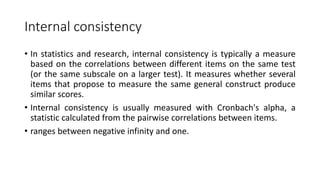
Internal consistency
• In statistics and research, internal consistency is typically a measure
based on the correlations between different items on the same test
(or the same subscale on a larger test). It measures whether several
items that propose to measure the same general construct produce
similar scores.
• Internal consistency is usually measured with Cronbach's alpha, a
statistic calculated from the pairwise correlations between items.
• ranges between negative infinity and one.
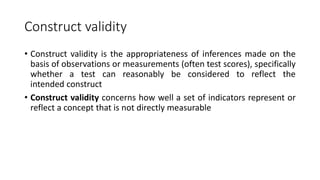
Construct validity
• Construct validity is the appropriateness of inferences made on the
basis of observations or measurements (often test scores), specifically
whether a test can reasonably be considered to reflect the
intended construct
• Construct validity concerns how well a set of indicators represent or
reflect a concept that is not directly measurable
Test-retest reliability
• Test-retest reliability is a measure of reliability obtained by
administering the same test twice over a period of time to a group of
individuals. The scores from Time 1 and Time 2 can then be
correlated in order to evaluate the test for stability over time
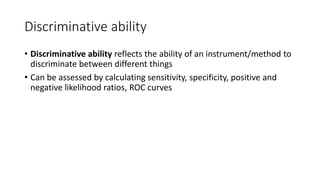
Discriminative ability
• Discriminative ability reflects the ability of an instrument/method to
discriminate between different things
• Can be assessed by calculating sensitivity, specificity, positive and
negative likelihood ratios, ROC curves

biostatics definitions.pptx

  • 1.
    Internal consistency • Instatistics and research, internal consistency is typically a measure based on the correlations between different items on the same test (or the same subscale on a larger test). It measures whether several items that propose to measure the same general construct produce similar scores. • Internal consistency is usually measured with Cronbach's alpha, a statistic calculated from the pairwise correlations between items. • ranges between negative infinity and one.
  • 3.
    Construct validity • Constructvalidity is the appropriateness of inferences made on the basis of observations or measurements (often test scores), specifically whether a test can reasonably be considered to reflect the intended construct • Construct validity concerns how well a set of indicators represent or reflect a concept that is not directly measurable
  • 4.
    Test-retest reliability • Test-retestreliability is a measure of reliability obtained by administering the same test twice over a period of time to a group of individuals. The scores from Time 1 and Time 2 can then be correlated in order to evaluate the test for stability over time
  • 5.
    Discriminative ability • Discriminativeability reflects the ability of an instrument/method to discriminate between different things • Can be assessed by calculating sensitivity, specificity, positive and negative likelihood ratios, ROC curves