Biomimetic Materials in
Pediatric Dentistry:
Innovations that Imitate
Nature
Dr. Harshada Lahori
Contents
Contents
• Biomaterials
• Biomimetic material
• Introduction
• Rationale
• Article discussion
• Resemblance to natural structures of tooth
• Connection with MID
Contents
• Application in pediatric dentistry
• Biomimetic restorative materials
• Novel Biomimetic restorative materials
• Advantages
• Disadvantages
• Challenges
• Implications in SHCN
• Future directions
Definition
● A biomaterial is defined as any
natural or synthetic
substance/combination of
substances (other than drugs)
which may be employed for any
length of time as a whole or part
of a system, to treat, augment, or
replace any tissue, organ or
function of the body, in order to
maintain or improve the quality
of life of the individual.
- American national institute of health
Classification of biomaterial
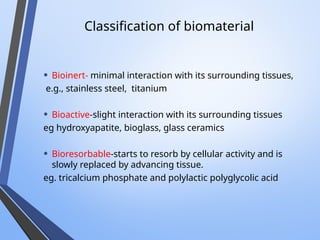
• Bioinert- minimal interaction with its surrounding tissues,
e.g., stainless steel, titanium
• Bioactive-slight interaction with its surrounding tissues
eg hydroxyapatite, bioglass, glass ceramics
• Bioresorbable-starts to resorb by cellular activity and is
slowly replaced by advancing tissue.
eg. tricalcium phosphate and polylactic polyglycolic acid
Biomaterials used in medical
and dental applications
1. Metals
2. Ceramics
3. Polymers
4. Natural materials
5. Reinforced materials
Biomimetic material
• Derived from the Greek words bios (life) and
mimesis (imitation)
• Biomimetics refers to the development of
materials and technologies that replicate the
structure and function of natural biological
systems.
History
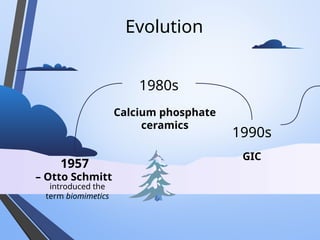
Evolution
– Otto Schmitt
introduced the
term biomimetics
1957
Calcium phosphate
ceramics
1980s
GIC
1990s
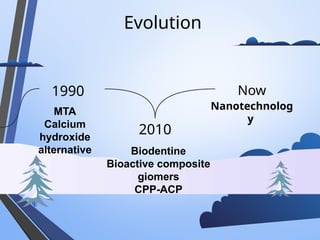
Evolution
MTA
Calcium
hydroxide
alternative
1990
Biodentine
Bioactive composite
giomers
CPP-ACP
Nanotechnolog
y
Now
2010
HISTORY OF BIOACTIVE
MATERIALS
The concept of bioactive materials originated in the late 1960s when
Hench developed Bioglass®, a silica-based glass capable of forming
a chemical bond with bone.
-Hench LL. The story of Bioglass®. J Mater Sci Mater Med. 2006;17(11):967–
978.
HISTORY OF BIOACTIVE
MATERIALS IN DENTISTRY
• In dentistry, the first bioactive restorative
materials were glass ionomer cements introduced
in the 1970s, primarily valued for their fluoride
release and chemical adhesion.
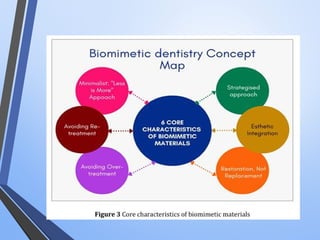
Concept of Biomimetics
•Biomimetics = imitation of natural
biological systems
In dentistry:
• Mimics enamel, dentin, pulp-dentin
complex
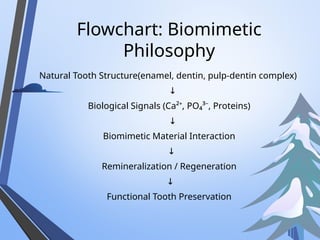
Flowchart: Biomimetic
Philosophy
Natural Tooth Structure(enamel, dentin, pulp-dentin complex)
↓
Biological Signals (Ca²⁺, PO₄³⁻, Proteins)
↓
Biomimetic Material Interaction
↓
Remineralization / Regeneration
↓
Functional Tooth Preservation
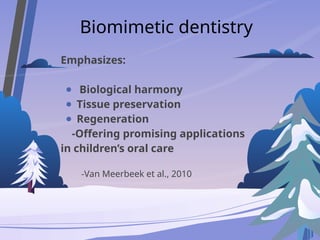
Biomimetic dentistry
Emphasizes:
● Biological harmony
● Tissue preservation
● Regeneration
-Offering promising applications
in children’s oral care
-Van Meerbeek et al., 2010
Journal Club Framework
• Study type: Narrative Review
• Journal: IJJRRD (International journal of
research and reports in dentistry)
• Databases: PubMed, Scopus, Web of Science
• Keywords & inclusion/exclusion criteria defined
• Clinical & translational relevance
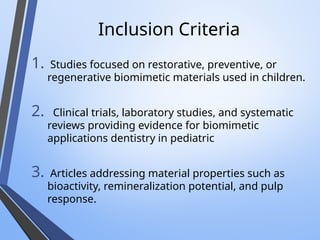
Inclusion Criteria
1. Studies focused on restorative, preventive, or
regenerative biomimetic materials used in children.
2. Clinical trials, laboratory studies, and systematic
reviews providing evidence for biomimetic
applications dentistry in pediatric
3. Articles addressing material properties such as
bioactivity, remineralization potential, and pulp
response.
Exclusion Criteria
1. Studies limited to adult populations
without relevance to children.
2. Articles not published in English.
3. Reports with insufficient methodological
detail or lacking peer review.
Introduction & Rationale
• Conventional materials = inert replacement
• Biomimetic dentistry = biologically interactive
materials
• Paradigm Shift from repair regeneration &
→
preservation
Why Biomimetics in Pediatric
Dentistry?
• Thin enamel & dentin
• Large pulp chambers
Hence high caries risk
• Need for minimally invasive strategies
• Long-term preservation of vitality
Concept of
Biomimetics
Mimicking Enamel
Mimicking Enamel
• Enamel = hydroxyapatite crystals
• Controlled by amelogenin proteins
• Amelogenin-guided crystal growth
Biomimetic peptides i.e self-assembling peptide P11-4 for the treatment of
initial carious lesions. & nano-HAp act as scaffolds
• Bioactive composites release Ca, PO₄, F ions
• Peptide nanospheres act as scaffolds
• Nano-hydroxyapatite deposition
• Acid resistance & translucency restoration
Alkilzy, M., Qadri, G., Splieth, C. H., & Santamaría, R. M. (2023). Biomimetic Enamel Regeneration Using Self-Assembling
Peptide P11-4. Biomimetics, 8(3), 290. https://doi.org/10.3390/biomimetics8030290
Mimicking Dentin
• Dentin = collagen + mineral
• Non-collagenous proteins regulate mineralization
• Biomimetic analogues: polyacrylic acid, chitosan
• Enables intrafibrillar remineralization
• Collagen-guided mineralization
• NCP analogues (PAA, PASP)-Dentin biomineralization is a:
gene-regulated, cytokine-mediated, programmed process by
mineralized cells to form highly ordered hydroxyapatite (HAP) crystals
encapsulating dentin matrix, ultimately creating a stable dentin
interface
• Intrafibrillar remineralization
• Hybrid layer stabilization
Chen, Ruhua & Xie, Yimeng & Ma, Liang & Li, Bing & Yao, Wei. (2024). Non-collagenous protein analog-induced biomimetic mineralization strategy to restore the dentin interface
Pulp–Dentin Complex
• Vital pulp = key for tooth development
• Calcium silicate materials:
Stimulate odontoblasts
Reparative dentin bridge
Vital pulp preservation
• Critical for immature permanent teeth
• Calcium silicate ion release
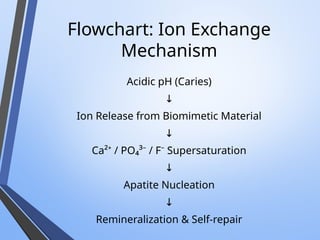
Flowchart: Ion Exchange
Mechanism
Acidic pH (Caries)
↓
Ion Release from Biomimetic Material
↓
Ca²⁺ / PO₄³⁻ / F⁻ Supersaturation
↓
Apatite Nucleation
↓
Remineralization & Self-repair
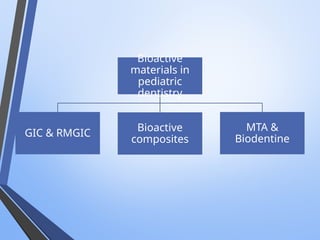
Bioactive
materials in
pediatric dentistry
Bioactive
materials in
pediatric
dentistry
GIC & RMGIC
Bioactive
composites
MTA &
Biodentine
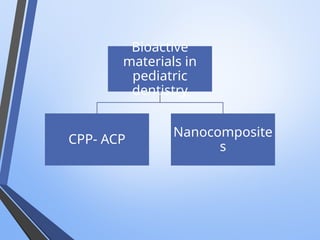
Bioactive
materials in
pediatric
dentistry
CPP- ACP
Nanocomposite
s
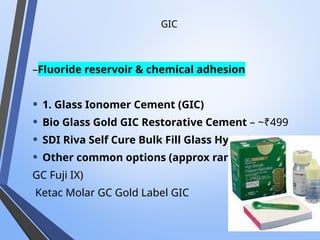
GIC
–Fluoride reservoir & chemical adhesion
• 1. Glass Ionomer Cement (GIC)
• Bio Glass Gold GIC Restorative Cement – ~₹499
• SDI Riva Self Cure Bulk Fill Glass Hybrid – ~₹1,750
• Other common options (approx ranges):
GC Fuji IX)
Ketac Molar GC Gold Label GIC
RMGIC
Resin added= Improved strength
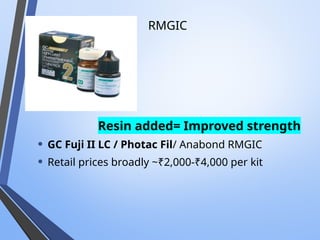
• GC Fuji II LC / Photac Fil/ Anabond RMGIC
• Retail prices broadly ~₹2,000-₹4,000 per kit
MTA
Pulp vitality preservation
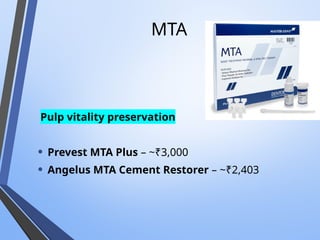
• Prevest MTA Plus – ~₹3,000
• Angelus MTA Cement Restorer – ~₹2,403
Composition
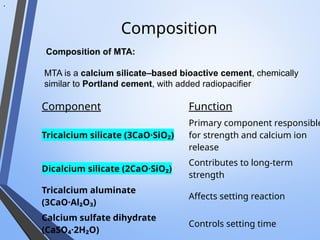
Component Function
Tricalcium silicate (3CaO·SiO₂)
Primary component responsible
for strength and calcium ion
release
Dicalcium silicate (2CaO·SiO₂)
Contributes to long-term
strength
Tricalcium aluminate
(3CaO·Al₂O₃)
Affects setting reaction
Calcium sulfate dihydrate
(CaSO₄·2H₂O)
Controls setting time
.
. Composition of MTA:
MTA is a calcium silicate–based bioactive cement, chemically
similar to Portland cement, with added radiopacifier
Mechanism of Action
• MTA exhibits its biological and clinical effects
through hydration, ion release, alkalinity, and
bioactivity.
• a. Hydration Reaction
On mixing with water, MTA undergoes hydration to form:
• Calcium silicate hydrate (C–S–H) gel
• Calcium hydroxide [Ca(OH)₂]
b. Alkaline pH
Initial pH ≈ 10.2, rising to 12.5
Leading to: Antibacterial effect
Neutralizes acidic inflammatory environment
Promotes hard tissue formation
Mechanism of Action
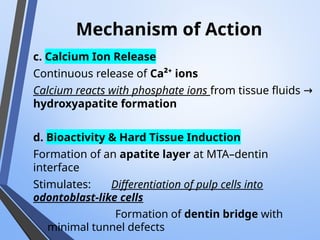
c. Calcium Ion Release
Continuous release of Ca²⁺ ions
Calcium reacts with phosphate ions from tissue fluids →
hydroxyapatite formation
d. Bioactivity & Hard Tissue Induction
Formation of an apatite layer at MTA–dentin
interface
Stimulates: Differentiation of pulp cells into
odontoblast-like cells
Formation of dentin bridge with
minimal tunnel defects
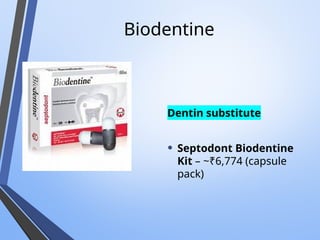
Biodentine
Dentin substitute
• Septodont Biodentine
Kit – ~₹6,774 (capsule
pack)
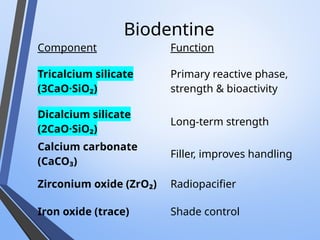
Biodentine
Component Function
Tricalcium silicate
(3CaO·SiO₂)
Primary reactive phase,
strength & bioactivity
Dicalcium silicate
(2CaO·SiO₂)
Long-term strength
Calcium carbonate
(CaCO₃)
Filler, improves handling
Zirconium oxide (ZrO₂) Radiopacifier
Iron oxide (trace) Shade control
Mechanism of Action (MOA)
A. Hydration Reaction
Tricalcium silicate reacts with water →
Calcium silicate hydrate (C–S–H) gel + Calcium hydroxide (Ca(OH)₂)
C–S–H gel provides
→ mechanical strength
Ca(OH)₂ increases
→ alkalinity (pH 12)
≈
B. Bioactivity & Dentin Bridge Formation
Release of Ca²⁺ ions stimulates:
Differentiation of pulp stem cells into odontoblast-like cells
Formation of reactionary and reparative dentin
Forms a thick, homogenous dentin bridge without tunnel defects (better than
Ca(OH)₂)
C. Apatite Formation
Ca²⁺ reacts with phosphate ions from tissue fluids →
Hydroxyapatite layer formation
Creates a chemical bond with dentin, improving marginal seal
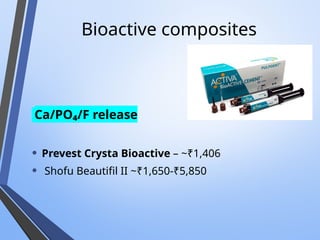
Bioactive composites
Ca/PO₄/F release
• Prevest Crysta Bioactive – ~₹1,406
• Shofu Beautifil II ~₹1,650-₹5,850
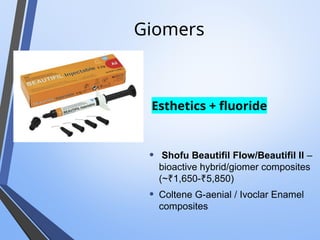
Giomers
Esthetics + fluoride
• Shofu Beautifil Flow/Beautifil II –
bioactive hybrid/giomer composites
(~ 1,650- 5,850)
₹ ₹
• Coltene G-aenial / Ivoclar Enamel
composites
Pre-Reacted Glass Ionomer (PRG) Fillers
📌 Ions released:
Fluoride (F⁻)
Strontium (Sr²⁺)
Sodium (Na⁺)
Aluminum (Al³⁺)
Silicate ions (SiO₄⁴⁻)
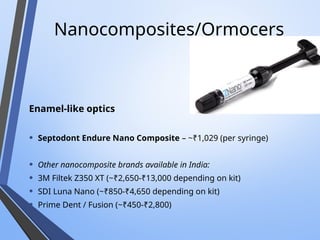
Nanocomposites/Ormocers
Enamel-like optics
• Septodont Endure Nano Composite – ~₹1,029 (per syringe)
• Other nanocomposite brands available in India:
• 3M Filtek Z350 XT (~₹2,650-₹13,000 depending on kit)
• SDI Luna Nano (~₹850-₹4,650 depending on kit)
• Prime Dent / Fusion (~₹450-₹2,800)
Definition
• Nanocomposites are resin-based restorative
materials in which the filler particles are in the
nanometer range (1–100 nm), either alone or
combined with conventional fillers, to improve
mechanical, esthetic, and biological properties.
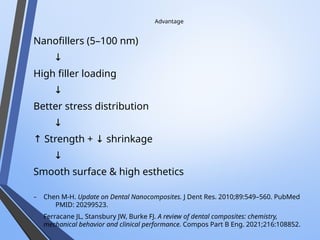
Advantage
Nanofillers (5–100 nm)
↓
High filler loading
↓
Better stress distribution
↓
↑ Strength + shrinkage
↓
↓
Smooth surface & high esthetics
- Chen M-H. Update on Dental Nanocomposites. J Dent Res. 2010;89:549–560. PubMed
PMID: 20299523.
- Ferracane JL, Stansbury JW, Burke FJ. A review of dental composites: chemistry,
mechanical behavior and clinical performance. Compos Part B Eng. 2021;216:108852.
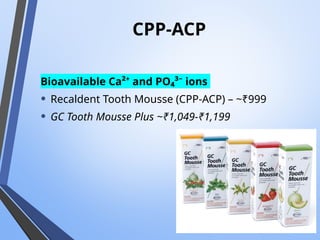
CPP‑ACP
Bioavailable Ca²⁺ and PO₄³⁻ ions
• Recaldent Tooth Mousse (CPP‑ACP) – ~₹999
• GC Tooth Mousse Plus ~₹1,049-₹1,199
• Components:
• Casein Phosphopeptide (CPP)
• Derived from α-casein (contains multiple phosphoseryl
residues – Ser(P)-Ser(P)-Ser(P))
• Acts as a carrier and stabilizer of calcium and phosphate ions
• Amorphous Calcium Phosphate (ACP)
• Non-crystalline, highly soluble form of calcium phosphate
• Provides bioavailable Ca²⁺ and PO₄³⁻ ions
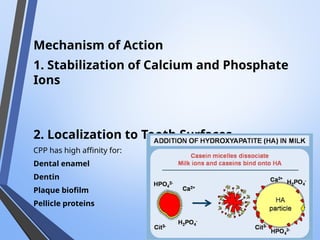
Mechanism of Action
1. Stabilization of Calcium and Phosphate
Ions
2. Localization to Tooth Surfaces
CPP has high affinity for:
Dental enamel
Dentin
Plaque biofilm
Pellicle proteins
Biomimetic Materials in Pulp
Therapy
• Indirect & direct pulp
capping
• Pulpotomy in primary teeth
• Regenerative endodontics
in immature teeth
• Shift: protection →
regeneration
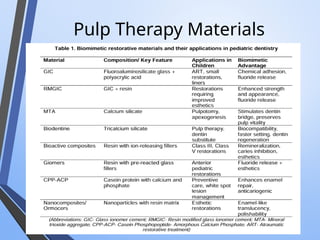
Pulp Therapy Materials
Preventive Biomimetic
Strategies
• CPP-ACP for white spot lesions
• Bioactive pit & fissure sealants
• Sustained fluoride systems
• Nano-hydroxyapatite technologies
Bishayi D, Srinivasan A, Mahabala KY, Natarajan S, Rao A, Nayak AP. A novel application of a bioactive material as a pit
and fissure sealant: in vitro pilot study evaluating the sealing ability and penetration. Eur Arch Paediatr Dent. 2023
Apr;24(2):195-201. doi: 10.1007/s40368-022-00773-z. Epub 2022 Dec 28. PMID: 36575275; PMCID: PMC10192183.
Relevance in Children with
SHCN
• Atraumatic placement
• Reduced chairside time
• Enhanced enamel repair
• Improved treatment
acceptance
Advantages
• Excellent biocompatibility
• Remineralization potential
• Superior esthetics
• Minimally invasive
• Long-term tooth preservation
• Reduced retreatment
Challenges &
Limitations
• Technique sensitivity
• High material cost
• Limited pediatric RCTs
• Limited pediatric long-term data
• Esthetic discoloration (MTA)
• Operator skill dependent
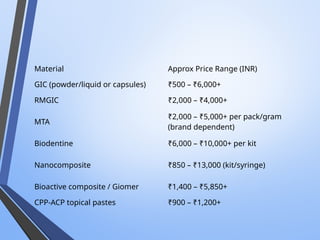
Material Approx Price Range (INR)
GIC (powder/liquid or capsules) ₹500 – ₹6,000+
RMGIC ₹2,000 – ₹4,000+
MTA
₹2,000 – ₹5,000+ per pack/gram
(brand dependent)
Biodentine ₹6,000 – ₹10,000+ per kit
Nanocomposite ₹850 – ₹13,000 (kit/syringe)
Bioactive composite / Giomer ₹1,400 – ₹5,850+
CPP-ACP topical pastes ₹900 – ₹1,200+
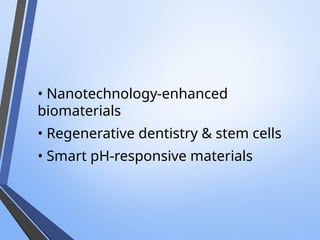
Future Perspectives
• Nanotechnology-enhanced
biomaterials
• Regenerative dentistry & stem cells
• Smart pH-responsive materials
Article review
Strengths:
• Comprehensive review
• Clear biological rationale
Identified Research Gaps:
• Need for pediatric RCTs
• Long-term survival analysis
• Cost-effectiveness studies
• Standardized outcome measures
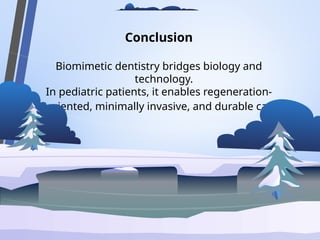
Conclusion
Biomimetic dentistry bridges biology and
technology.
In pediatric patients, it enables regeneration-
oriented, minimally invasive, and durable care.
Thank you!
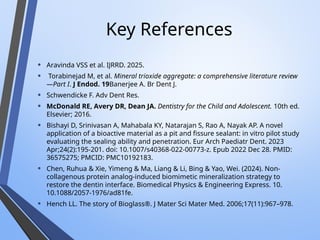
Key References
• Aravinda VSS et al. IJRRD. 2025.
• Torabinejad M, et al. Mineral trioxide aggregate: a comprehensive literature review
—Part I. J Endod. 19Banerjee A. Br Dent J.
• Schwendicke F. Adv Dent Res.
• McDonald RE, Avery DR, Dean JA. Dentistry for the Child and Adolescent. 10th ed.
Elsevier; 2016.
• Bishayi D, Srinivasan A, Mahabala KY, Natarajan S, Rao A, Nayak AP. A novel
application of a bioactive material as a pit and fissure sealant: in vitro pilot study
evaluating the sealing ability and penetration. Eur Arch Paediatr Dent. 2023
Apr;24(2):195-201. doi: 10.1007/s40368-022-00773-z. Epub 2022 Dec 28. PMID:
36575275; PMCID: PMC10192183.
• Chen, Ruhua & Xie, Yimeng & Ma, Liang & Li, Bing & Yao, Wei. (2024). Non-
collagenous protein analog-induced biomimetic mineralization strategy to
restore the dentin interface. Biomedical Physics & Engineering Express. 10.
10.1088/2057-1976/ad81fe.
• Hench LL. The story of Bioglass®. J Mater Sci Mater Med. 2006;17(11):967–978.

Biomimetic Materials in pediatric dentistry

  • 1.
    Biomimetic Materials in PediatricDentistry: Innovations that Imitate Nature Dr. Harshada Lahori
  • 2.
  • 3.
    Contents • Biomaterials • Biomimeticmaterial • Introduction • Rationale • Article discussion • Resemblance to natural structures of tooth • Connection with MID
  • 4.
    Contents • Application inpediatric dentistry • Biomimetic restorative materials • Novel Biomimetic restorative materials • Advantages • Disadvantages • Challenges • Implications in SHCN • Future directions
  • 5.
    Definition ● A biomaterialis defined as any natural or synthetic substance/combination of substances (other than drugs) which may be employed for any length of time as a whole or part of a system, to treat, augment, or replace any tissue, organ or function of the body, in order to maintain or improve the quality of life of the individual. - American national institute of health
  • 6.
    Classification of biomaterial •Bioinert- minimal interaction with its surrounding tissues, e.g., stainless steel, titanium • Bioactive-slight interaction with its surrounding tissues eg hydroxyapatite, bioglass, glass ceramics • Bioresorbable-starts to resorb by cellular activity and is slowly replaced by advancing tissue. eg. tricalcium phosphate and polylactic polyglycolic acid
  • 7.
    Biomaterials used inmedical and dental applications 1. Metals 2. Ceramics 3. Polymers 4. Natural materials 5. Reinforced materials
  • 9.
    Biomimetic material • Derivedfrom the Greek words bios (life) and mimesis (imitation) • Biomimetics refers to the development of materials and technologies that replicate the structure and function of natural biological systems.
  • 10.
  • 11.
    Evolution – Otto Schmitt introducedthe term biomimetics 1957 Calcium phosphate ceramics 1980s GIC 1990s
  • 12.
  • 13.
    HISTORY OF BIOACTIVE MATERIALS Theconcept of bioactive materials originated in the late 1960s when Hench developed Bioglass®, a silica-based glass capable of forming a chemical bond with bone. -Hench LL. The story of Bioglass®. J Mater Sci Mater Med. 2006;17(11):967– 978.
  • 14.
    HISTORY OF BIOACTIVE MATERIALSIN DENTISTRY • In dentistry, the first bioactive restorative materials were glass ionomer cements introduced in the 1970s, primarily valued for their fluoride release and chemical adhesion.
  • 15.
    Concept of Biomimetics •Biomimetics= imitation of natural biological systems In dentistry: • Mimics enamel, dentin, pulp-dentin complex
  • 16.
    Flowchart: Biomimetic Philosophy Natural ToothStructure(enamel, dentin, pulp-dentin complex) ↓ Biological Signals (Ca²⁺, PO₄³⁻, Proteins) ↓ Biomimetic Material Interaction ↓ Remineralization / Regeneration ↓ Functional Tooth Preservation
  • 18.
    Biomimetic dentistry Emphasizes: ● Biologicalharmony ● Tissue preservation ● Regeneration -Offering promising applications in children’s oral care -Van Meerbeek et al., 2010
  • 19.
    Journal Club Framework •Study type: Narrative Review • Journal: IJJRRD (International journal of research and reports in dentistry) • Databases: PubMed, Scopus, Web of Science • Keywords & inclusion/exclusion criteria defined • Clinical & translational relevance
  • 20.
    Inclusion Criteria 1. Studiesfocused on restorative, preventive, or regenerative biomimetic materials used in children. 2. Clinical trials, laboratory studies, and systematic reviews providing evidence for biomimetic applications dentistry in pediatric 3. Articles addressing material properties such as bioactivity, remineralization potential, and pulp response.
  • 21.
    Exclusion Criteria 1. Studieslimited to adult populations without relevance to children. 2. Articles not published in English. 3. Reports with insufficient methodological detail or lacking peer review.
  • 22.
    Introduction & Rationale •Conventional materials = inert replacement • Biomimetic dentistry = biologically interactive materials • Paradigm Shift from repair regeneration & → preservation
  • 23.
    Why Biomimetics inPediatric Dentistry? • Thin enamel & dentin • Large pulp chambers Hence high caries risk • Need for minimally invasive strategies • Long-term preservation of vitality
  • 24.
  • 25.
  • 26.
    Mimicking Enamel • Enamel= hydroxyapatite crystals • Controlled by amelogenin proteins • Amelogenin-guided crystal growth Biomimetic peptides i.e self-assembling peptide P11-4 for the treatment of initial carious lesions. & nano-HAp act as scaffolds • Bioactive composites release Ca, PO₄, F ions • Peptide nanospheres act as scaffolds • Nano-hydroxyapatite deposition • Acid resistance & translucency restoration Alkilzy, M., Qadri, G., Splieth, C. H., & Santamaría, R. M. (2023). Biomimetic Enamel Regeneration Using Self-Assembling Peptide P11-4. Biomimetics, 8(3), 290. https://doi.org/10.3390/biomimetics8030290
  • 27.
  • 28.
    • Dentin =collagen + mineral • Non-collagenous proteins regulate mineralization • Biomimetic analogues: polyacrylic acid, chitosan • Enables intrafibrillar remineralization • Collagen-guided mineralization • NCP analogues (PAA, PASP)-Dentin biomineralization is a: gene-regulated, cytokine-mediated, programmed process by mineralized cells to form highly ordered hydroxyapatite (HAP) crystals encapsulating dentin matrix, ultimately creating a stable dentin interface • Intrafibrillar remineralization • Hybrid layer stabilization Chen, Ruhua & Xie, Yimeng & Ma, Liang & Li, Bing & Yao, Wei. (2024). Non-collagenous protein analog-induced biomimetic mineralization strategy to restore the dentin interface
  • 29.
  • 30.
    • Vital pulp= key for tooth development • Calcium silicate materials: Stimulate odontoblasts Reparative dentin bridge Vital pulp preservation • Critical for immature permanent teeth • Calcium silicate ion release
  • 31.
    Flowchart: Ion Exchange Mechanism AcidicpH (Caries) ↓ Ion Release from Biomimetic Material ↓ Ca²⁺ / PO₄³⁻ / F⁻ Supersaturation ↓ Apatite Nucleation ↓ Remineralization & Self-repair
  • 32.
  • 33.
    Bioactive materials in pediatric dentistry GIC &RMGIC Bioactive composites MTA & Biodentine
  • 34.
  • 35.
    GIC –Fluoride reservoir &chemical adhesion • 1. Glass Ionomer Cement (GIC) • Bio Glass Gold GIC Restorative Cement – ~₹499 • SDI Riva Self Cure Bulk Fill Glass Hybrid – ~₹1,750 • Other common options (approx ranges): GC Fuji IX) Ketac Molar GC Gold Label GIC
  • 36.
    RMGIC Resin added= Improvedstrength • GC Fuji II LC / Photac Fil/ Anabond RMGIC • Retail prices broadly ~₹2,000-₹4,000 per kit
  • 37.
    MTA Pulp vitality preservation •Prevest MTA Plus – ~₹3,000 • Angelus MTA Cement Restorer – ~₹2,403
  • 38.
    Composition Component Function Tricalcium silicate(3CaO·SiO₂) Primary component responsible for strength and calcium ion release Dicalcium silicate (2CaO·SiO₂) Contributes to long-term strength Tricalcium aluminate (3CaO·Al₂O₃) Affects setting reaction Calcium sulfate dihydrate (CaSO₄·2H₂O) Controls setting time . . Composition of MTA: MTA is a calcium silicate–based bioactive cement, chemically similar to Portland cement, with added radiopacifier
  • 39.
  • 40.
    • MTA exhibitsits biological and clinical effects through hydration, ion release, alkalinity, and bioactivity. • a. Hydration Reaction On mixing with water, MTA undergoes hydration to form: • Calcium silicate hydrate (C–S–H) gel • Calcium hydroxide [Ca(OH)₂] b. Alkaline pH Initial pH ≈ 10.2, rising to 12.5 Leading to: Antibacterial effect Neutralizes acidic inflammatory environment Promotes hard tissue formation
  • 41.
    Mechanism of Action c.Calcium Ion Release Continuous release of Ca²⁺ ions Calcium reacts with phosphate ions from tissue fluids → hydroxyapatite formation d. Bioactivity & Hard Tissue Induction Formation of an apatite layer at MTA–dentin interface Stimulates: Differentiation of pulp cells into odontoblast-like cells Formation of dentin bridge with minimal tunnel defects
  • 42.
    Biodentine Dentin substitute • SeptodontBiodentine Kit – ~₹6,774 (capsule pack)
  • 43.
    Biodentine Component Function Tricalcium silicate (3CaO·SiO₂) Primaryreactive phase, strength & bioactivity Dicalcium silicate (2CaO·SiO₂) Long-term strength Calcium carbonate (CaCO₃) Filler, improves handling Zirconium oxide (ZrO₂) Radiopacifier Iron oxide (trace) Shade control
  • 44.
    Mechanism of Action(MOA) A. Hydration Reaction Tricalcium silicate reacts with water → Calcium silicate hydrate (C–S–H) gel + Calcium hydroxide (Ca(OH)₂) C–S–H gel provides → mechanical strength Ca(OH)₂ increases → alkalinity (pH 12) ≈ B. Bioactivity & Dentin Bridge Formation Release of Ca²⁺ ions stimulates: Differentiation of pulp stem cells into odontoblast-like cells Formation of reactionary and reparative dentin Forms a thick, homogenous dentin bridge without tunnel defects (better than Ca(OH)₂) C. Apatite Formation Ca²⁺ reacts with phosphate ions from tissue fluids → Hydroxyapatite layer formation Creates a chemical bond with dentin, improving marginal seal
  • 45.
    Bioactive composites Ca/PO₄/F release •Prevest Crysta Bioactive – ~₹1,406 • Shofu Beautifil II ~₹1,650-₹5,850
  • 46.
    Giomers Esthetics + fluoride •Shofu Beautifil Flow/Beautifil II – bioactive hybrid/giomer composites (~ 1,650- 5,850) ₹ ₹ • Coltene G-aenial / Ivoclar Enamel composites
  • 47.
    Pre-Reacted Glass Ionomer(PRG) Fillers 📌 Ions released: Fluoride (F⁻) Strontium (Sr²⁺) Sodium (Na⁺) Aluminum (Al³⁺) Silicate ions (SiO₄⁴⁻)
  • 48.
    Nanocomposites/Ormocers Enamel-like optics • SeptodontEndure Nano Composite – ~₹1,029 (per syringe) • Other nanocomposite brands available in India: • 3M Filtek Z350 XT (~₹2,650-₹13,000 depending on kit) • SDI Luna Nano (~₹850-₹4,650 depending on kit) • Prime Dent / Fusion (~₹450-₹2,800)
  • 49.
    Definition • Nanocomposites areresin-based restorative materials in which the filler particles are in the nanometer range (1–100 nm), either alone or combined with conventional fillers, to improve mechanical, esthetic, and biological properties.
  • 50.
    Advantage Nanofillers (5–100 nm) ↓ Highfiller loading ↓ Better stress distribution ↓ ↑ Strength + shrinkage ↓ ↓ Smooth surface & high esthetics - Chen M-H. Update on Dental Nanocomposites. J Dent Res. 2010;89:549–560. PubMed PMID: 20299523. - Ferracane JL, Stansbury JW, Burke FJ. A review of dental composites: chemistry, mechanical behavior and clinical performance. Compos Part B Eng. 2021;216:108852.
  • 51.
    CPP‑ACP Bioavailable Ca²⁺ andPO₄³⁻ ions • Recaldent Tooth Mousse (CPP‑ACP) – ~₹999 • GC Tooth Mousse Plus ~₹1,049-₹1,199
  • 52.
    • Components: • CaseinPhosphopeptide (CPP) • Derived from α-casein (contains multiple phosphoseryl residues – Ser(P)-Ser(P)-Ser(P)) • Acts as a carrier and stabilizer of calcium and phosphate ions • Amorphous Calcium Phosphate (ACP) • Non-crystalline, highly soluble form of calcium phosphate • Provides bioavailable Ca²⁺ and PO₄³⁻ ions
  • 53.
    Mechanism of Action 1.Stabilization of Calcium and Phosphate Ions 2. Localization to Tooth Surfaces CPP has high affinity for: Dental enamel Dentin Plaque biofilm Pellicle proteins
  • 54.
    Biomimetic Materials inPulp Therapy • Indirect & direct pulp capping • Pulpotomy in primary teeth • Regenerative endodontics in immature teeth • Shift: protection → regeneration
  • 55.
  • 56.
    Preventive Biomimetic Strategies • CPP-ACPfor white spot lesions • Bioactive pit & fissure sealants • Sustained fluoride systems • Nano-hydroxyapatite technologies Bishayi D, Srinivasan A, Mahabala KY, Natarajan S, Rao A, Nayak AP. A novel application of a bioactive material as a pit and fissure sealant: in vitro pilot study evaluating the sealing ability and penetration. Eur Arch Paediatr Dent. 2023 Apr;24(2):195-201. doi: 10.1007/s40368-022-00773-z. Epub 2022 Dec 28. PMID: 36575275; PMCID: PMC10192183.
  • 57.
    Relevance in Childrenwith SHCN • Atraumatic placement • Reduced chairside time • Enhanced enamel repair • Improved treatment acceptance
  • 58.
  • 59.
    • Excellent biocompatibility •Remineralization potential • Superior esthetics • Minimally invasive • Long-term tooth preservation • Reduced retreatment
  • 60.
  • 61.
    • Technique sensitivity •High material cost • Limited pediatric RCTs • Limited pediatric long-term data • Esthetic discoloration (MTA) • Operator skill dependent
  • 62.
    Material Approx PriceRange (INR) GIC (powder/liquid or capsules) ₹500 – ₹6,000+ RMGIC ₹2,000 – ₹4,000+ MTA ₹2,000 – ₹5,000+ per pack/gram (brand dependent) Biodentine ₹6,000 – ₹10,000+ per kit Nanocomposite ₹850 – ₹13,000 (kit/syringe) Bioactive composite / Giomer ₹1,400 – ₹5,850+ CPP-ACP topical pastes ₹900 – ₹1,200+
  • 63.
  • 64.
    • Nanotechnology-enhanced biomaterials • Regenerativedentistry & stem cells • Smart pH-responsive materials
  • 65.
    Article review Strengths: • Comprehensivereview • Clear biological rationale Identified Research Gaps: • Need for pediatric RCTs • Long-term survival analysis • Cost-effectiveness studies • Standardized outcome measures
  • 66.
    Conclusion Biomimetic dentistry bridgesbiology and technology. In pediatric patients, it enables regeneration- oriented, minimally invasive, and durable care.
  • 67.
  • 68.
    Key References • AravindaVSS et al. IJRRD. 2025. • Torabinejad M, et al. Mineral trioxide aggregate: a comprehensive literature review —Part I. J Endod. 19Banerjee A. Br Dent J. • Schwendicke F. Adv Dent Res. • McDonald RE, Avery DR, Dean JA. Dentistry for the Child and Adolescent. 10th ed. Elsevier; 2016. • Bishayi D, Srinivasan A, Mahabala KY, Natarajan S, Rao A, Nayak AP. A novel application of a bioactive material as a pit and fissure sealant: in vitro pilot study evaluating the sealing ability and penetration. Eur Arch Paediatr Dent. 2023 Apr;24(2):195-201. doi: 10.1007/s40368-022-00773-z. Epub 2022 Dec 28. PMID: 36575275; PMCID: PMC10192183. • Chen, Ruhua & Xie, Yimeng & Ma, Liang & Li, Bing & Yao, Wei. (2024). Non- collagenous protein analog-induced biomimetic mineralization strategy to restore the dentin interface. Biomedical Physics & Engineering Express. 10. 10.1088/2057-1976/ad81fe. • Hench LL. The story of Bioglass®. J Mater Sci Mater Med. 2006;17(11):967–978.

Editor's Notes

  • #54 Capping Pulpo- mta biomimetic bridge repair Regene- mta biodentine- stimu root format
  • #57 Enamel hypoplasia, caries susceptibility,xerostomia, medical and behavioural limitations