Bioclipse -An open source workbench for chemo- and bioinformatics Ola Spjuth Dept. Pharmaceutical Biosciences Uppsala University Sweden
What is Bioclipse? Workbench for life-science Chemo- and bioinformatics Integration platform Easy to integrate/extend functionality using powerful plugin architecture Development environment Inherit existing functionality Deployment framework Spread your algorithms
The Bioclipse project Objectives: Provide a free, open source platform for application development in life-science Integrate as much functionality as possible into a user-friendly workbench
Implementation Type of application: Rich client Responsive GUI Make use of desktop computer Main programming language: Java Platform independence Existing components in bioinformatics Release for Windows, Linux, and Mac OS X
Background: Eclipse Originally designed as an IDE Java C++ Web etc… Today: Universal tool platform Plugin architecture Everything is a plugin, even core modules
Eclipse: screenshot
Bioclipse architecture Built on Eclipse Rich Client Platform (RCP) Minimal set of Eclipse plugins to develop a complete software application Powerful plugin-architecture Everything is a plugin Extension points Points that plugins can extend Exist for almost anything You can define new points
Architecture Access data from a variety of sources
Basic features Load, retrieve, edit, convert, analyze, visualize, and save biological entities Small molecules Proteins Sequences Spectra Scripts Reactions Many more…
Bioclipse basics View View Editor Console Properties
View Display information to user User might interact
Editor Load/Save life cycle Undo/redo Cut and paste Text-based Syntax highlighting Code completion Graphical objects
PDB Editor
2D Editor
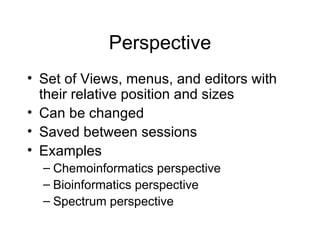
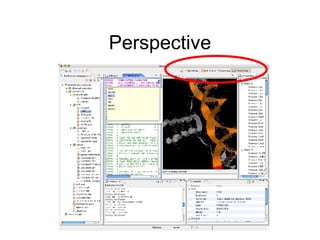
Perspective Set of Views, menus, and editors with their relative position and sizes Can be changed Saved between sessions Examples Chemoinformatics perspective Bioinformatics perspective Spectrum perspective
Perspective
Wizard Ordered set of dialogs
Menus Menus Context menus
Work with molecules in 2D: JChemPaint plugin
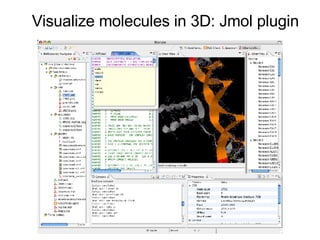
Visualize molecules in 3D: Jmol plugin
Work with spectra: Spectrum plugin
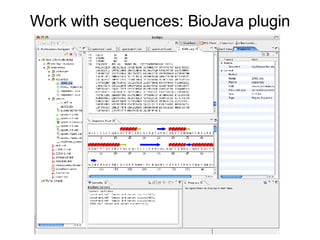
Work with sequences: BioJava plugin
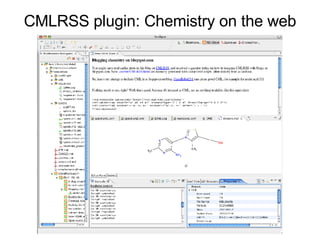
CMLRSS plugin: Chemistry on the web Reader for chemical information in feeds using CML (Chemical Markup Language) Supports the formats: RSS 1.0, RSS 2.0, Atom 0.3, Atom 1.0 Access structures/spectra/sequences published on the web Blogs, databases etc.
CMLRSS plugin: Chemistry on the web
Web service support General Web service mechanism Example of Web services WSDBFetch at EBI for retrieving proteins, sequences from various databases SubLoc for subcellular predictions Alignments (BLAST, ClustalW)
The WSDbfetch Web Service in Bioclipse Supported Databases: embl emblsva emblcon emblanncon emblcds medline pdb refseq refseqp hgbase interpro uniprot uniparc uniref100 uniref90 uniref50 jpo_prt epo_prt uspto_prt ipi
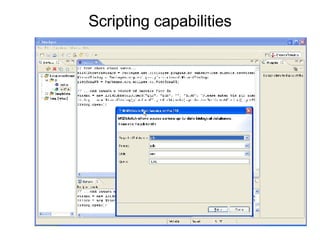
Scripting capabilities Javascript-based (Mozilla Rhino) Write scripts for anything! Open wizards Calculations Pipelining tasks Web services
Scripting capabilities
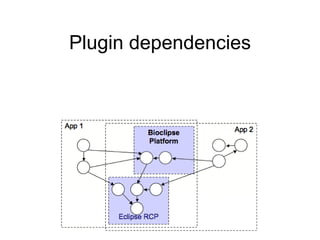
Plugging into Bioclipse Add functionality via plugins Visualizations Algorithms Interfaces Plugins can interact! User may select what plugins to install
Plugin dependencies
Current development Maintain and develop Bioclipse core Increase basic features Support more file formats Online update function
Ongoing projects Structure-activity analysis Descriptor calculation Dataset/matrix editing Interface with R for analysis Taverna interoperability Run workflows from within Bioclipse Visualize results from Taverna Computer aided structure elucidation
Ongoing projects Local database persistence Molecular libraries Substructure searching Virtual screening Pharmacology Drug screening data management Interaction modeling New asynchronous Web services (XMPP) Microarrays (Base 2.0)
Ongoing projects Molecular dynamics (Ghemical, using JNI) Systems biology (SBML) Text mining (Oscar3) Mass spectrometry (Mascot, other) Reaction modeling Semantic publishing (SciML) Data analysis (R, Matlab, Java, 3’rd party) More Web services
Future projects Integrate more tools and features! Find areas where plugin interaction lead to new possibilities Connect to GRID services
Major back-ends Chemoinformatics: Chemistry Development Kit (CDK) Bioinformatics: BioJava
Licensing Bioclipse: EPL - Eclipse public license Flexible open source license Plugins: Any license, even commercial All plugins packaged with Bioclipse are free and open source
Bioclipse Workshop 2007 May 23-25, 2007, BMC, Uppsala Lectures and hands-on labs to demonstrate the features of Bioclipse, the power of the plugin architecture, and how to integrate new features into the framework. Participation in the workshop is free of charge. Workshop homepage: http://teacher. bmc . uu .se/BioclipseWS07
Acknowledgements Dept. Pharmaceutical Biosciences, Uppsala University, Sweden Prof. Jarl E. S. Wikberg Martin Eklund Jonathan Alvarsson Dept of Chemistry, Molecular Informatics, Cambridge University Prof. Peter Murray-Rust et al (CML) Linnaeus Centre for Bioinformatics, Uppsala University and SLU, Sweden Dr. Eric Bongcam-Rudloff Sofia Burvall Cologne University Bioinformatics Centre (CUBIC), Germany Prof. Christoph Steinbeck Egon Willighagen Tobias Helmus Stefan Kuhn Miguel Rojas Thomas Kuhn Others Johannes Wagener (Web services, scripting) Jerome Pansanel (Chemical structures) Rob Schellhorn (Ghemical) …  and all others for contributing code, feature requests, bug reports, proposals, and comments
Bioclipse www.bioclipse.net Bioclipse: An open source workbench for chemo- and bioinformatics Ola Spjuth, Tobias Helmus, Egon L Willighagen, Stefan Kuhn, Martin Eklund, Johannes Wagener, Peter Murray-Rust, Christoph Steinbeck, Jarl E.S. Wikberg BMC Bioinformatics 2007, 8:59

Bioclipse

  • 1.
    Bioclipse -An opensource workbench for chemo- and bioinformatics Ola Spjuth Dept. Pharmaceutical Biosciences Uppsala University Sweden
  • 2.
    What is Bioclipse?Workbench for life-science Chemo- and bioinformatics Integration platform Easy to integrate/extend functionality using powerful plugin architecture Development environment Inherit existing functionality Deployment framework Spread your algorithms
  • 3.
    The Bioclipse projectObjectives: Provide a free, open source platform for application development in life-science Integrate as much functionality as possible into a user-friendly workbench
  • 4.
    Implementation Type ofapplication: Rich client Responsive GUI Make use of desktop computer Main programming language: Java Platform independence Existing components in bioinformatics Release for Windows, Linux, and Mac OS X
  • 5.
    Background: Eclipse Originallydesigned as an IDE Java C++ Web etc… Today: Universal tool platform Plugin architecture Everything is a plugin, even core modules
  • 6.
  • 7.
    Bioclipse architecture Builton Eclipse Rich Client Platform (RCP) Minimal set of Eclipse plugins to develop a complete software application Powerful plugin-architecture Everything is a plugin Extension points Points that plugins can extend Exist for almost anything You can define new points
  • 8.
    Architecture Access datafrom a variety of sources
  • 9.
    Basic features Load,retrieve, edit, convert, analyze, visualize, and save biological entities Small molecules Proteins Sequences Spectra Scripts Reactions Many more…
  • 10.
    Bioclipse basics ViewView Editor Console Properties
  • 11.
    View Display informationto user User might interact
  • 12.
    Editor Load/Save lifecycle Undo/redo Cut and paste Text-based Syntax highlighting Code completion Graphical objects
  • 13.
  • 14.
  • 15.
    Perspective Set ofViews, menus, and editors with their relative position and sizes Can be changed Saved between sessions Examples Chemoinformatics perspective Bioinformatics perspective Spectrum perspective
  • 16.
  • 17.
  • 18.
  • 19.
    Work with moleculesin 2D: JChemPaint plugin
  • 20.
    Visualize molecules in3D: Jmol plugin
  • 21.
    Work with spectra:Spectrum plugin
  • 22.
    Work with sequences:BioJava plugin
  • 23.
    CMLRSS plugin: Chemistryon the web Reader for chemical information in feeds using CML (Chemical Markup Language) Supports the formats: RSS 1.0, RSS 2.0, Atom 0.3, Atom 1.0 Access structures/spectra/sequences published on the web Blogs, databases etc.
  • 24.
  • 25.
    Web service supportGeneral Web service mechanism Example of Web services WSDBFetch at EBI for retrieving proteins, sequences from various databases SubLoc for subcellular predictions Alignments (BLAST, ClustalW)
  • 26.
    The WSDbfetch WebService in Bioclipse Supported Databases: embl emblsva emblcon emblanncon emblcds medline pdb refseq refseqp hgbase interpro uniprot uniparc uniref100 uniref90 uniref50 jpo_prt epo_prt uspto_prt ipi
  • 27.
    Scripting capabilities Javascript-based(Mozilla Rhino) Write scripts for anything! Open wizards Calculations Pipelining tasks Web services
  • 28.
  • 29.
    Plugging into BioclipseAdd functionality via plugins Visualizations Algorithms Interfaces Plugins can interact! User may select what plugins to install
  • 30.
  • 31.
    Current development Maintainand develop Bioclipse core Increase basic features Support more file formats Online update function
  • 32.
    Ongoing projects Structure-activityanalysis Descriptor calculation Dataset/matrix editing Interface with R for analysis Taverna interoperability Run workflows from within Bioclipse Visualize results from Taverna Computer aided structure elucidation
  • 33.
    Ongoing projects Localdatabase persistence Molecular libraries Substructure searching Virtual screening Pharmacology Drug screening data management Interaction modeling New asynchronous Web services (XMPP) Microarrays (Base 2.0)
  • 34.
    Ongoing projects Moleculardynamics (Ghemical, using JNI) Systems biology (SBML) Text mining (Oscar3) Mass spectrometry (Mascot, other) Reaction modeling Semantic publishing (SciML) Data analysis (R, Matlab, Java, 3’rd party) More Web services
  • 35.
    Future projects Integratemore tools and features! Find areas where plugin interaction lead to new possibilities Connect to GRID services
  • 36.
    Major back-ends Chemoinformatics:Chemistry Development Kit (CDK) Bioinformatics: BioJava
  • 37.
    Licensing Bioclipse: EPL- Eclipse public license Flexible open source license Plugins: Any license, even commercial All plugins packaged with Bioclipse are free and open source
  • 38.
    Bioclipse Workshop 2007May 23-25, 2007, BMC, Uppsala Lectures and hands-on labs to demonstrate the features of Bioclipse, the power of the plugin architecture, and how to integrate new features into the framework. Participation in the workshop is free of charge. Workshop homepage: http://teacher. bmc . uu .se/BioclipseWS07
  • 39.
    Acknowledgements Dept. PharmaceuticalBiosciences, Uppsala University, Sweden Prof. Jarl E. S. Wikberg Martin Eklund Jonathan Alvarsson Dept of Chemistry, Molecular Informatics, Cambridge University Prof. Peter Murray-Rust et al (CML) Linnaeus Centre for Bioinformatics, Uppsala University and SLU, Sweden Dr. Eric Bongcam-Rudloff Sofia Burvall Cologne University Bioinformatics Centre (CUBIC), Germany Prof. Christoph Steinbeck Egon Willighagen Tobias Helmus Stefan Kuhn Miguel Rojas Thomas Kuhn Others Johannes Wagener (Web services, scripting) Jerome Pansanel (Chemical structures) Rob Schellhorn (Ghemical) … and all others for contributing code, feature requests, bug reports, proposals, and comments
  • 40.
    Bioclipse www.bioclipse.net Bioclipse:An open source workbench for chemo- and bioinformatics Ola Spjuth, Tobias Helmus, Egon L Willighagen, Stefan Kuhn, Martin Eklund, Johannes Wagener, Peter Murray-Rust, Christoph Steinbeck, Jarl E.S. Wikberg BMC Bioinformatics 2007, 8:59