Level of Development
LOD 100, 200, 300, 350, 400, 500
Level of Development (LOD) specification allows professionals in the
industry to clearly articulate how an element’s geometry and
associated information has evolved throughout the entire process. It
signifies the degree to which different members of the team can rely
on information associated with an element.
The LOD specification helps designers define the inherent
characteristics of the elements in a model at different stages of
development. The clarity in illustration gives depth to a model,
signifying how much and at which level someone should rely on a
model’s element.
Using LOD, designers and engineers can clearly communicate with
other professionals who will be using the model further about the
usability and limitations of a model. LOD specifications were
designed to standardize the use of the LOD framework and use it as
an efficient and collaborative communication tool.
What is
Level of Development (LOD)?
3
www.united-bim.com
Level of development (LOD) is a set of
specifications that gives professionals in the
AEC industry the power to document,
articulate and specify the content of BIM
effectively and clearly. Serving as an
industry standard, LOD defines the
development stages of different systems in
BIM. By using LOD specifications, architects,
engineers and other professionals can
clearly communicate with each other
without confusion for faster execution.
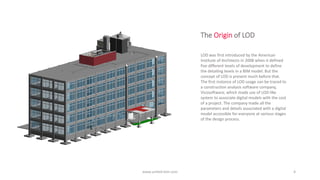
The Origin of LOD
LOD was first introduced by the American
Institute of Architects in 2008 when it defined
five different levels of development to define
the detailing levels in a BIM model. But the
concept of LOD is present much before that.
The first instance of LOD usage can be traced to
a construction analysis software company,
Vicosoftware, which made use of LOD-like
system to associate digital models with the cost
of a project. The company made all the
parameters and details associated with a digital
model accessible for everyone at various stages
of the design process.
4
www.united-bim.com
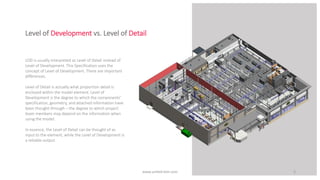
LOD is usually interpreted as Level of Detail instead of
Level of Development. This Specification uses the
concept of Level of Development. There are important
differences.
Level of Detail is actually what proportion detail is
enclosed within the model element. Level of
Development is the degree to which the components’
specification, geometry, and attached information have
been thought through – the degree to which project
team members may depend on the information when
using the model.
In essence, the Level of Detail can be thought of as
input to the element, while the Level of Development is
a reliable output.
Level of Development vs. Level of Detail
5
www.united-bim.com
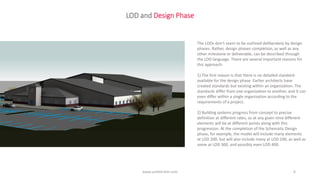
LOD and Design Phase
The LODs don’t seem to be outlined deliberately by design
phases. Rather, design phases completion, as well as any
other milestone or deliverable, can be described through
the LOD language. There are several important reasons for
this approach:
1) The first reason is that there is no detailed standard
available for the design phase. Earlier architects have
created standards but existing within an organization. The
standards differ from one organization to another, and it can
even differ within a single organization according to the
requirements of a project.
2) Building systems progress from concept to precise
definition at different rates, so at any given time different
elements will be at different points along with this
progression. At the completion of the Schematic Design
phase, for example, the model will include many elements
at LOD 200, but will also include many at LOD 100, as well as
some at LOD 300, and possibly even LOD 400.
6
www.united-bim.com
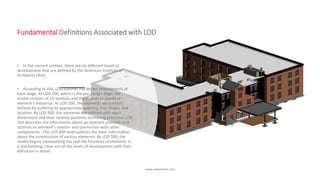
Fundamental Definitions Associated with LOD
• In the current context, there are six different levels of
development that are defined by the American Institute of
Architects (AIA).
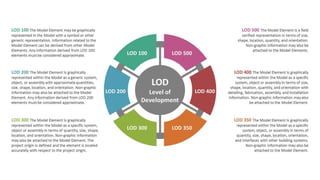
• According to AIA, LOD outlines the design requirements at
each stage. At LOD 100, which is the pre-design stage, the
model consists of 2D symbols and the masses to signify an
element’s existence. At LOD 200, the elements are partially
defined by outlining its approximate quantity, size, shape, and
location. By LOD 300, the elements are defined with exact
dimensions and their relative positions bolstering precision. LOD
350 describes the information about an element precisely and
outlines an element’s relation and connection with other
components. The LOD 400 level outlines the basic information
about the construction of various elements. By LOD 500, the
model begins representing the real-life functions of elements in
a real building. Here are all the levels of development with their
definition in detail.
www.united-bim.com
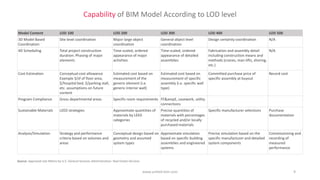
Capability of BIM Model According to LOD level
9
www.united-bim.com
Model Content LOD 100 LOD 200 LOD 300 LOD 400 LOD 500
3D Model Based
Coordination
Site level coordination Major large object
coordination
General object level
coordination
Design certainty coordination N/A
4D Scheduling Total project construction
duration. Phasing of major
elements
Time-scaled, ordered
appearance of major
activities
Time-scaled, ordered
appearance of detailed
assemblies
Fabrication and assembly detail
including construction means and
methods (cranes, man-lifts, shoring,
etc.)
N/A
Cost Estimation Conceptual cost allowance
Example $/sf of floor area,
$/hospital bed, $/parking stall,
etc. assumptions on future
content
Estimated cost based on
measurement of the
generic element (i.e.
generic interior wall)
Estimated cost based on
measurement of specific
assembly (i.e. specific wall
type)
Committed purchase price of
specific assembly at buyout
Record cost
Program Compliance Gross departmental areas Specific room requirements FF&ampE, casework, utility
connections
Sustainable Materials LEED strategies Approximate quantities of
materials by LEED
categories
Precise quantities of
materials with percentages
of recycled and/or locally
purchased materials
Specific manufacturer selections Purchase
documentation
Analysis/Simulation Strategy and performance
criteria based on volumes and
areas
Conceptual design based on
geometry and assumed
system types
Approximate simulation
based on specific building
assemblies and engineered
systems
Precise simulation based on the
specific manufacturer and detailed
system components
Commissioning and
recording of
measured
performance
Source: Approved Use Metrix by U.S. General Services Administration- Real Estate Services
Level of development is an extremely
important element of the entire BIM process.
Without LOD, it can become hard for everyone
to work on the same page, creating
inconsistencies that can hamper a project’s
prospects. With the help of LOD specifications,
communication and collaboration can become
easier and faster, making room for efficient
deployment of resources at all levels of design
and construction. Here are some of the
benefits of the level of development
specifications in the design process:
• Better collaboration and communication between different teams
With the help of standardized specification and detailed information about all
the elements, designers can provide guidelines and data for people working
downstream to ensure zero lapses in execution and maintenance. LOD makes it
easier to define a standard for contractors who must take care of BIM
execution. At the same time, design managers can explain the requirements at
various levels of the design process to the teams in a better way.
• Articulated Scope associated with a BIM deliverable
With the help of LOD, BIM models become more accurate. At the same time,
all the teams including the owners can precisely specify the level of detail they
want from a BIM model and get clarity on the scope of the final BIM
deliverable.
Advantages of LOD in Design
10
www.united-bim.com
In an era where everything is handled digitally and all critical projects make use
of 3D model, it becomes hard for designers to make other teams understand
the project expectations. Most often, handling a BIM model comes with a
unique challenge- different people perceive different definitions of completion.
LOD creates a standardized definition of what completion means and eliminates
chances of discrepancies associated with project completion. Using LOD, teams
working under different disciplines can communicate with each other in a better
way with greater clarity. LOD enhances clarity in design by making use of
advanced techniques and technology.
The Benefit of Clarity Due to
LOD for an AEC Project
11
If used without standardization, 3D BIM models can
cause massive blunders owing to the difference in
precision and accuracy definitions between two
teams. LOD is structured to minimize errors with the
help of a numerical lexicon which the designers and
the end-users of a BIM model share for common
understanding.
LOD is just like a key to a lock which can open the
right gate for project completion. In other words,
it’s a way to accurately execute various elements in
a model. With LOD, design, and execution teams
can come at the same page and see that a model’s
elements with clarity and understand when an
element reaches desired level of maturity that can
be called as completion.
Overcoming the
LOD Lexicon
12
www.united-bim.com
Guidelines for Outsourcing BIM
Key Takeaways for AEC Professionals
FEATURED BLOGS
What is COBie?
How it is streamlining data collaboration
between AEC professionals
What is Clash Detection in BIM?
Process, Benefits and Future Scope in Modern
Day AEC industry
13
www.united-bim.com
Review your design drawings to perfection with this easy to use
drawing checklist, made for Architects and Engineers.
REVIEW CHECKLIST
FOR PERFECT DESIGN DRAWINGS
14
www.united-bim.com
www.united-bim.com info@united-bim.com
+1 (954) 537-9137

BIM-Level-of-Development-Explained-LOD-100-200-300-400-500.pdf

  • 1.
    Level of Development LOD100, 200, 300, 350, 400, 500
  • 2.
    Level of Development(LOD) specification allows professionals in the industry to clearly articulate how an element’s geometry and associated information has evolved throughout the entire process. It signifies the degree to which different members of the team can rely on information associated with an element. The LOD specification helps designers define the inherent characteristics of the elements in a model at different stages of development. The clarity in illustration gives depth to a model, signifying how much and at which level someone should rely on a model’s element. Using LOD, designers and engineers can clearly communicate with other professionals who will be using the model further about the usability and limitations of a model. LOD specifications were designed to standardize the use of the LOD framework and use it as an efficient and collaborative communication tool. What is Level of Development (LOD)? 3 www.united-bim.com Level of development (LOD) is a set of specifications that gives professionals in the AEC industry the power to document, articulate and specify the content of BIM effectively and clearly. Serving as an industry standard, LOD defines the development stages of different systems in BIM. By using LOD specifications, architects, engineers and other professionals can clearly communicate with each other without confusion for faster execution.
  • 3.
    The Origin ofLOD LOD was first introduced by the American Institute of Architects in 2008 when it defined five different levels of development to define the detailing levels in a BIM model. But the concept of LOD is present much before that. The first instance of LOD usage can be traced to a construction analysis software company, Vicosoftware, which made use of LOD-like system to associate digital models with the cost of a project. The company made all the parameters and details associated with a digital model accessible for everyone at various stages of the design process. 4 www.united-bim.com
  • 4.
    LOD is usuallyinterpreted as Level of Detail instead of Level of Development. This Specification uses the concept of Level of Development. There are important differences. Level of Detail is actually what proportion detail is enclosed within the model element. Level of Development is the degree to which the components’ specification, geometry, and attached information have been thought through – the degree to which project team members may depend on the information when using the model. In essence, the Level of Detail can be thought of as input to the element, while the Level of Development is a reliable output. Level of Development vs. Level of Detail 5 www.united-bim.com
  • 5.
    LOD and DesignPhase The LODs don’t seem to be outlined deliberately by design phases. Rather, design phases completion, as well as any other milestone or deliverable, can be described through the LOD language. There are several important reasons for this approach: 1) The first reason is that there is no detailed standard available for the design phase. Earlier architects have created standards but existing within an organization. The standards differ from one organization to another, and it can even differ within a single organization according to the requirements of a project. 2) Building systems progress from concept to precise definition at different rates, so at any given time different elements will be at different points along with this progression. At the completion of the Schematic Design phase, for example, the model will include many elements at LOD 200, but will also include many at LOD 100, as well as some at LOD 300, and possibly even LOD 400. 6 www.united-bim.com
  • 6.
    Fundamental Definitions Associatedwith LOD • In the current context, there are six different levels of development that are defined by the American Institute of Architects (AIA). • According to AIA, LOD outlines the design requirements at each stage. At LOD 100, which is the pre-design stage, the model consists of 2D symbols and the masses to signify an element’s existence. At LOD 200, the elements are partially defined by outlining its approximate quantity, size, shape, and location. By LOD 300, the elements are defined with exact dimensions and their relative positions bolstering precision. LOD 350 describes the information about an element precisely and outlines an element’s relation and connection with other components. The LOD 400 level outlines the basic information about the construction of various elements. By LOD 500, the model begins representing the real-life functions of elements in a real building. Here are all the levels of development with their definition in detail. www.united-bim.com
  • 8.
    Capability of BIMModel According to LOD level 9 www.united-bim.com Model Content LOD 100 LOD 200 LOD 300 LOD 400 LOD 500 3D Model Based Coordination Site level coordination Major large object coordination General object level coordination Design certainty coordination N/A 4D Scheduling Total project construction duration. Phasing of major elements Time-scaled, ordered appearance of major activities Time-scaled, ordered appearance of detailed assemblies Fabrication and assembly detail including construction means and methods (cranes, man-lifts, shoring, etc.) N/A Cost Estimation Conceptual cost allowance Example $/sf of floor area, $/hospital bed, $/parking stall, etc. assumptions on future content Estimated cost based on measurement of the generic element (i.e. generic interior wall) Estimated cost based on measurement of specific assembly (i.e. specific wall type) Committed purchase price of specific assembly at buyout Record cost Program Compliance Gross departmental areas Specific room requirements FF&ampE, casework, utility connections Sustainable Materials LEED strategies Approximate quantities of materials by LEED categories Precise quantities of materials with percentages of recycled and/or locally purchased materials Specific manufacturer selections Purchase documentation Analysis/Simulation Strategy and performance criteria based on volumes and areas Conceptual design based on geometry and assumed system types Approximate simulation based on specific building assemblies and engineered systems Precise simulation based on the specific manufacturer and detailed system components Commissioning and recording of measured performance Source: Approved Use Metrix by U.S. General Services Administration- Real Estate Services
  • 9.
    Level of developmentis an extremely important element of the entire BIM process. Without LOD, it can become hard for everyone to work on the same page, creating inconsistencies that can hamper a project’s prospects. With the help of LOD specifications, communication and collaboration can become easier and faster, making room for efficient deployment of resources at all levels of design and construction. Here are some of the benefits of the level of development specifications in the design process: • Better collaboration and communication between different teams With the help of standardized specification and detailed information about all the elements, designers can provide guidelines and data for people working downstream to ensure zero lapses in execution and maintenance. LOD makes it easier to define a standard for contractors who must take care of BIM execution. At the same time, design managers can explain the requirements at various levels of the design process to the teams in a better way. • Articulated Scope associated with a BIM deliverable With the help of LOD, BIM models become more accurate. At the same time, all the teams including the owners can precisely specify the level of detail they want from a BIM model and get clarity on the scope of the final BIM deliverable. Advantages of LOD in Design 10 www.united-bim.com
  • 10.
    In an erawhere everything is handled digitally and all critical projects make use of 3D model, it becomes hard for designers to make other teams understand the project expectations. Most often, handling a BIM model comes with a unique challenge- different people perceive different definitions of completion. LOD creates a standardized definition of what completion means and eliminates chances of discrepancies associated with project completion. Using LOD, teams working under different disciplines can communicate with each other in a better way with greater clarity. LOD enhances clarity in design by making use of advanced techniques and technology. The Benefit of Clarity Due to LOD for an AEC Project 11
  • 11.
    If used withoutstandardization, 3D BIM models can cause massive blunders owing to the difference in precision and accuracy definitions between two teams. LOD is structured to minimize errors with the help of a numerical lexicon which the designers and the end-users of a BIM model share for common understanding. LOD is just like a key to a lock which can open the right gate for project completion. In other words, it’s a way to accurately execute various elements in a model. With LOD, design, and execution teams can come at the same page and see that a model’s elements with clarity and understand when an element reaches desired level of maturity that can be called as completion. Overcoming the LOD Lexicon 12 www.united-bim.com
  • 12.
    Guidelines for OutsourcingBIM Key Takeaways for AEC Professionals FEATURED BLOGS What is COBie? How it is streamlining data collaboration between AEC professionals What is Clash Detection in BIM? Process, Benefits and Future Scope in Modern Day AEC industry 13 www.united-bim.com
  • 13.
    Review your designdrawings to perfection with this easy to use drawing checklist, made for Architects and Engineers. REVIEW CHECKLIST FOR PERFECT DESIGN DRAWINGS 14 www.united-bim.com
  • 14.