Big Data in Stock
Exchange
DMYTRO MELNYCHUK
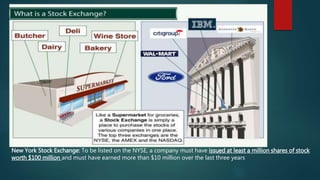
New York Stock Exchange: To be listed on the NYSE, a company must have issued at least a million shares of stock
worth $100 million and must have earned more than $10 million over the last three years
Who is stockbroker?
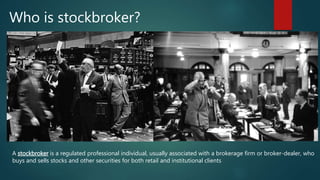
A stockbroker is a regulated professional individual, usually associated with a brokerage firm or broker-dealer, who
buys and sells stocks and other securities for both retail and institutional clients
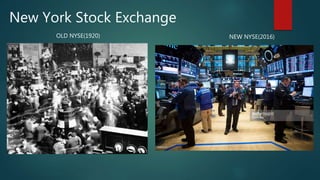
New York Stock Exchange
OLD NYSE(1920) NEW NYSE(2016)
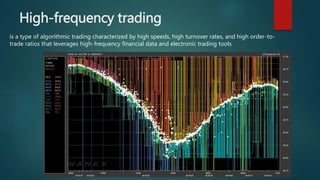
High-frequency trading
is a type of algorithmic trading characterized by high speeds, high turnover rates, and high order-to-
trade ratios that leverages high-frequency financial data and electronic trading tools
High-frequency trading is trading that leverages
high-frequency financial data
and electronic trading tools
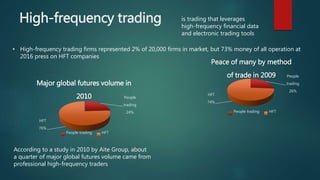
• High-frequency trading firms represented 2% of 20,000 firms in market, but 73% money of all operation at
2016 press on HFT companies
People
trading
26%
HFT
74%
Peace of many by method
of trade in 2009
People trading HFT
According to a study in 2010 by Aite Group, about
a quarter of major global futures volume came from
professional high-frequency traders
People
trading
24%
HFT
76%
Major global futures volume in
2010
People trading HFT
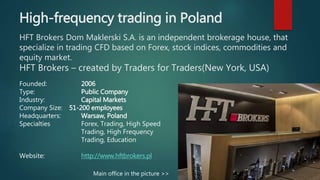
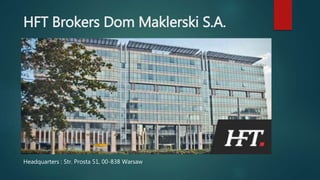
HFT Brokers Dom Maklerski S.A. is an independent brokerage house, that
specialize in trading CFD based on Forex, stock indices, commodities and
equity market.
HFT Brokers – created by Traders for Traders(New York, USA)
Founded: 2006
Type: Public Company
Industry: Capital Markets
Company Size: 51-200 employees
Headquarters: Warsaw, Poland
Specialties Forex, Trading, High Speed
Trading, High Frequency
Trading, Education
Website: http://www.hftbrokers.pl
High-frequency trading in Poland
Main office in the picture >>
HFT Brokers Dom Maklerski S.A.
Headquarters : Str. Prosta 51, 00-838 Warsaw
Nanex is one of the best firm that offers streaming data on all market
transactions and distributes the data in real-time to clients (typically,
traders and financial analysis firms) and allows them to do analysis and
visualization in real-time
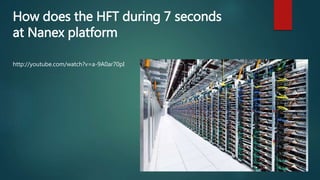
How does the HFT during 7 seconds
at Nanex platform
http://youtube.com/watch?v=a-9A0ar70pI
https://www.youtube.com/watch?v=6f486Qg4Fis
High-frequency Trading Model
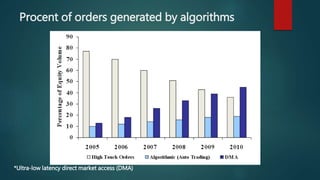
Procent of orders generated by algorithms
*Ultra-low latency direct market access (DMA)
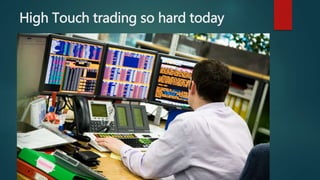
High Touch trading so hard today
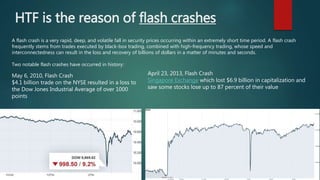
HFT is the reason of flash crashes
A flash crash is a very rapid, deep, and volatile fall in security prices occurring within an extremely short time period. A flash crash
frequently stems from trades executed by black-box trading, combined with high-frequency trading, whose speed and
interconnectedness can result in the loss and recovery of billions of dollars in a matter of minutes and seconds.
Two notable flash crashes have occurred in history:
April 23, 2013, Flash Crash
Singapore Exchange which lost $6.9 billion in capitalization and
saw some stocks lose up to 87 percent of their value
May 6, 2010, Flash Crash
$4.1 billion trade on the NYSE resulted in a loss to
the Dow Jones Industrial Average of over 1000
points
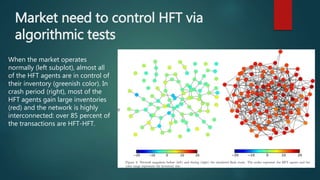
Market need to control HFT via
algorithmic tests
When the market operates
normally (left subplot), almost all
of the HFT agents are in control of
their inventory (greenish color). In
crash period (right), most of the
HFT agents gain large inventories
(red) and the network is highly
interconnected: over 85 percent of
the transactions are HFT-HFT.
Despite the problems, but
high-frequency trading is
our future

Big Data in Stock Exchange( HFT, Forex, Flash Crashes)

  • 1.
    Big Data inStock Exchange DMYTRO MELNYCHUK
  • 2.
    New York StockExchange: To be listed on the NYSE, a company must have issued at least a million shares of stock worth $100 million and must have earned more than $10 million over the last three years
  • 3.
    Who is stockbroker? Astockbroker is a regulated professional individual, usually associated with a brokerage firm or broker-dealer, who buys and sells stocks and other securities for both retail and institutional clients
  • 4.
    New York StockExchange OLD NYSE(1920) NEW NYSE(2016)
  • 5.
    High-frequency trading is atype of algorithmic trading characterized by high speeds, high turnover rates, and high order-to- trade ratios that leverages high-frequency financial data and electronic trading tools
  • 6.
    High-frequency trading istrading that leverages high-frequency financial data and electronic trading tools • High-frequency trading firms represented 2% of 20,000 firms in market, but 73% money of all operation at 2016 press on HFT companies People trading 26% HFT 74% Peace of many by method of trade in 2009 People trading HFT According to a study in 2010 by Aite Group, about a quarter of major global futures volume came from professional high-frequency traders People trading 24% HFT 76% Major global futures volume in 2010 People trading HFT
  • 7.
    HFT Brokers DomMaklerski S.A. is an independent brokerage house, that specialize in trading CFD based on Forex, stock indices, commodities and equity market. HFT Brokers – created by Traders for Traders(New York, USA) Founded: 2006 Type: Public Company Industry: Capital Markets Company Size: 51-200 employees Headquarters: Warsaw, Poland Specialties Forex, Trading, High Speed Trading, High Frequency Trading, Education Website: http://www.hftbrokers.pl High-frequency trading in Poland Main office in the picture >>
  • 8.
    HFT Brokers DomMaklerski S.A. Headquarters : Str. Prosta 51, 00-838 Warsaw
  • 9.
    Nanex is oneof the best firm that offers streaming data on all market transactions and distributes the data in real-time to clients (typically, traders and financial analysis firms) and allows them to do analysis and visualization in real-time
  • 10.
    How does theHFT during 7 seconds at Nanex platform http://youtube.com/watch?v=a-9A0ar70pI
  • 11.
  • 12.
    Procent of ordersgenerated by algorithms *Ultra-low latency direct market access (DMA)
  • 13.
    High Touch tradingso hard today
  • 14.
    HFT is thereason of flash crashes A flash crash is a very rapid, deep, and volatile fall in security prices occurring within an extremely short time period. A flash crash frequently stems from trades executed by black-box trading, combined with high-frequency trading, whose speed and interconnectedness can result in the loss and recovery of billions of dollars in a matter of minutes and seconds. Two notable flash crashes have occurred in history: April 23, 2013, Flash Crash Singapore Exchange which lost $6.9 billion in capitalization and saw some stocks lose up to 87 percent of their value May 6, 2010, Flash Crash $4.1 billion trade on the NYSE resulted in a loss to the Dow Jones Industrial Average of over 1000 points
  • 15.
    Market need tocontrol HFT via algorithmic tests When the market operates normally (left subplot), almost all of the HFT agents are in control of their inventory (greenish color). In crash period (right), most of the HFT agents gain large inventories (red) and the network is highly interconnected: over 85 percent of the transactions are HFT-HFT.
  • 16.
    Despite the problems,but high-frequency trading is our future