Von Thunen’s Model
of Agricultural
Land Use
Land rent
 The main concept is land rent or land
value, which will decrease as one gets
farther away from central markets.
 Rent is highest in the closest proximity to
urban markets. (Bid-Rent Theory)
 Thus, agricultural products that have
intensive land use, have high transportation
costs and were in great demand would be
located close to urban markets.
Bid-Rent Theory
 Hard concept!!
 The further you are from the “best
location” the more the rent is
 So, beach front hotels cost more than hotels
2 blocks from the beach
 Retail locations close to Hanes Mall are
more expensive
 Distribution centers close to the airport have
higher rent
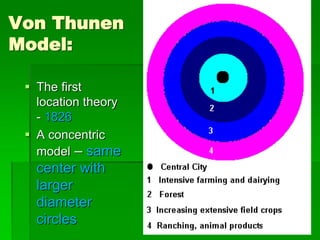
Von Thunen
Model:
 The first
location theory
- 1826
 A concentric
model – same
center with
larger
diameter
circles
Contains six assumptions
1. There is only one market available, self-
sufficient with no outside influence.
2. All farmers are market oriented, producing
goods for sale. (Not subsistence.)
3. The physical environment is uniform; there
are no rivers or mountains.
4. All points at equal distances from the
market have equal access to the market.
5. All farmers act to maximize profits.
6. The dietary preferences of the population
are those of Germanic Europeans.
Contains six assumptions
By definition – models are simplified to illustrate a
concept. Most models make assume certain
factors to be uniform.
1. There is only one market available – which
is the city (defined as center of trade)
2. All farmers are market oriented – selling
their goods in the one market
3. The physical environment is uniform – no
rivers or mountains to disrupt trade. Later is a
drawing showing the effect of rivers and a 2nd
market
Contains six assumptions
By definition – models are simplified to illustrate a
concept. Most models make assume certain
factors to be uniform.
4. All points at equal distances to make
condition equal for everyone
5. All farmers act to maximize profits. – no
morals or values difference
6. The dietary preferences of the population
are those of Germanic Europeans. – von
Thunen was German. The model doesn’t account
for non-German diets or customs
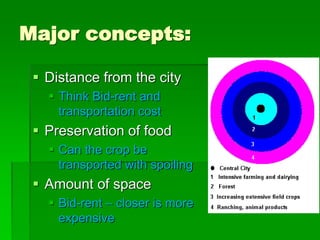
Major concepts:
 Distance from the city
 Think Bid-rent and
transportation cost
 Preservation of food
 Can the crop be
transported with spoiling
 Amount of space
 Bid-rent – closer is more
expensive
So……….
1. Dairying and gardening of fruits and
vegetables would be closer to the urban
market while…
2. Timber and firewood for fuel and building
materials would be in the second zone. 1826
– wood is needed constantly for warmth and
cooking
3. Mixed farming, commercial grain and
orchards and
4. Extensive cattle ranching would be located
farther away. Transportation is cheap: the
animals can walk to the city for butchering.
Why?
 Some products spoiled more quickly,
needed more sensitive transportation, or
generate higher prices at market
 These products mean the farmer can
afford higher land rent.
 How does relative location affect land-use
patterns
Von Thunen
Effect Explanation
Intensive land – use near market High Profit needed to pay rent
Wood and perishable / fragile products
near market
High (Frequent) transportation to nearby
market
Extensive agriculture (grain / grazing
land) at the periphery
Low land rent or low transportation costs
Reasons
 Profitable options decrease with
distance from the market
 Rent differences reflects different
values of distance
 Production Costs + Transportation
Costs = economic margin for a crop
 Greater the transport cost the less rent
a farmer can afford
Contemporary Variables
 More efficient transportation
 Transportation cost no longer
proportional to costs
 Firewood not a factor for heating
 Technology has reduced perish-
ability refrigeration
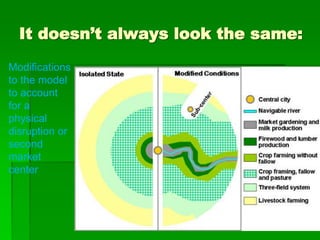
It doesn’t always look the same:
Modifications
to the model
to account
for a
physical
disruption or
second
market
center
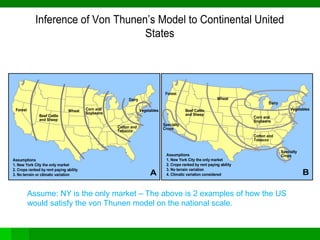
Inference of Von Thunen’s Model to Continental United
States
Vegetables
Dairy
Cotton and
Tobacco
Corn and
Soybeans
Wheat
Beef Cattle
and Sheep
Forest
Corn and
Soybeans
Wheat
Beef Cattle
and Sheep
Cotton and
Tobacco
Forest
Specialty
Crops
Specialty
Crops
Dairy
Vegetables
Assumptions
1. New York City the only market
2. Crops ranked by rent paying ability
3. No terrain or climatic variation
Assumptions
1. New York City the only market
2. Crops ranked by rent paying ability
3. No terrain variation
4. Climatic variation considered
A B
Assume: NY is the only market – The above is 2 examples of how the US
would satisfy the von Thunen model on the national scale.
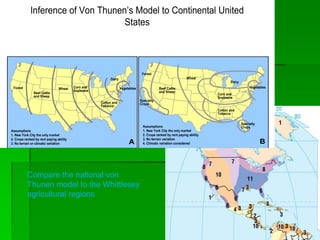
Inference of Von Thunen’s Model to Continental United
States
Vegetables
Dairy
Cotton and
Tobacco
Corn and
Soybeans
Wheat
Beef Cattle
and Sheep
Forest
Corn and
Soybeans
Wheat
Beef Cattle
and Sheep
Cotton and
Tobacco
Forest
Specialty
Crops
Specialty
Crops
Dairy
Vegetables
Assumptions
1. New York City the only market
2. Crops ranked by rent paying ability
3. No terrain or climatic variation
Assumptions
1. New York City the only market
2. Crops ranked by rent paying ability
3. No terrain variation
4. Climatic variation considered
A B
Compare the national von
Thunen model to the Whittlesey
agricultural regions
How would this look for
Europe?
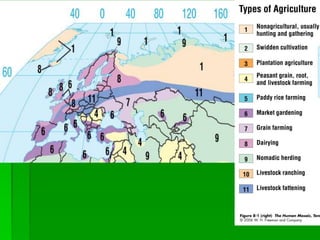
 If London was the only market, what
crops would be grown in which
countries? – see Whittlesey’s regions on
the next slide
BID RENT THEORY SAMPLE 1

BID RENT THEORY SAMPLE 1

  • 1.
    Von Thunen’s Model ofAgricultural Land Use
  • 2.
    Land rent  Themain concept is land rent or land value, which will decrease as one gets farther away from central markets.  Rent is highest in the closest proximity to urban markets. (Bid-Rent Theory)  Thus, agricultural products that have intensive land use, have high transportation costs and were in great demand would be located close to urban markets.
  • 3.
    Bid-Rent Theory  Hardconcept!!  The further you are from the “best location” the more the rent is  So, beach front hotels cost more than hotels 2 blocks from the beach  Retail locations close to Hanes Mall are more expensive  Distribution centers close to the airport have higher rent
  • 4.
    Von Thunen Model:  Thefirst location theory - 1826  A concentric model – same center with larger diameter circles
  • 5.
    Contains six assumptions 1.There is only one market available, self- sufficient with no outside influence. 2. All farmers are market oriented, producing goods for sale. (Not subsistence.) 3. The physical environment is uniform; there are no rivers or mountains. 4. All points at equal distances from the market have equal access to the market. 5. All farmers act to maximize profits. 6. The dietary preferences of the population are those of Germanic Europeans.
  • 6.
    Contains six assumptions Bydefinition – models are simplified to illustrate a concept. Most models make assume certain factors to be uniform. 1. There is only one market available – which is the city (defined as center of trade) 2. All farmers are market oriented – selling their goods in the one market 3. The physical environment is uniform – no rivers or mountains to disrupt trade. Later is a drawing showing the effect of rivers and a 2nd market
  • 7.
    Contains six assumptions Bydefinition – models are simplified to illustrate a concept. Most models make assume certain factors to be uniform. 4. All points at equal distances to make condition equal for everyone 5. All farmers act to maximize profits. – no morals or values difference 6. The dietary preferences of the population are those of Germanic Europeans. – von Thunen was German. The model doesn’t account for non-German diets or customs
  • 8.
    Major concepts:  Distancefrom the city  Think Bid-rent and transportation cost  Preservation of food  Can the crop be transported with spoiling  Amount of space  Bid-rent – closer is more expensive
  • 9.
    So………. 1. Dairying andgardening of fruits and vegetables would be closer to the urban market while… 2. Timber and firewood for fuel and building materials would be in the second zone. 1826 – wood is needed constantly for warmth and cooking 3. Mixed farming, commercial grain and orchards and 4. Extensive cattle ranching would be located farther away. Transportation is cheap: the animals can walk to the city for butchering.
  • 10.
    Why?  Some productsspoiled more quickly, needed more sensitive transportation, or generate higher prices at market  These products mean the farmer can afford higher land rent.
  • 11.
     How doesrelative location affect land-use patterns Von Thunen Effect Explanation Intensive land – use near market High Profit needed to pay rent Wood and perishable / fragile products near market High (Frequent) transportation to nearby market Extensive agriculture (grain / grazing land) at the periphery Low land rent or low transportation costs
  • 12.
    Reasons  Profitable optionsdecrease with distance from the market  Rent differences reflects different values of distance  Production Costs + Transportation Costs = economic margin for a crop  Greater the transport cost the less rent a farmer can afford
  • 13.
    Contemporary Variables  Moreefficient transportation  Transportation cost no longer proportional to costs  Firewood not a factor for heating  Technology has reduced perish- ability refrigeration
  • 14.
    It doesn’t alwayslook the same: Modifications to the model to account for a physical disruption or second market center
  • 15.
    Inference of VonThunen’s Model to Continental United States Vegetables Dairy Cotton and Tobacco Corn and Soybeans Wheat Beef Cattle and Sheep Forest Corn and Soybeans Wheat Beef Cattle and Sheep Cotton and Tobacco Forest Specialty Crops Specialty Crops Dairy Vegetables Assumptions 1. New York City the only market 2. Crops ranked by rent paying ability 3. No terrain or climatic variation Assumptions 1. New York City the only market 2. Crops ranked by rent paying ability 3. No terrain variation 4. Climatic variation considered A B Assume: NY is the only market – The above is 2 examples of how the US would satisfy the von Thunen model on the national scale.
  • 16.
    Inference of VonThunen’s Model to Continental United States Vegetables Dairy Cotton and Tobacco Corn and Soybeans Wheat Beef Cattle and Sheep Forest Corn and Soybeans Wheat Beef Cattle and Sheep Cotton and Tobacco Forest Specialty Crops Specialty Crops Dairy Vegetables Assumptions 1. New York City the only market 2. Crops ranked by rent paying ability 3. No terrain or climatic variation Assumptions 1. New York City the only market 2. Crops ranked by rent paying ability 3. No terrain variation 4. Climatic variation considered A B Compare the national von Thunen model to the Whittlesey agricultural regions
  • 17.
    How would thislook for Europe?  If London was the only market, what crops would be grown in which countries? – see Whittlesey’s regions on the next slide