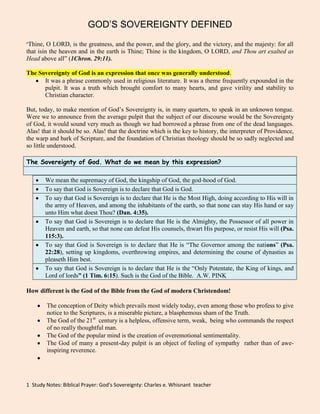
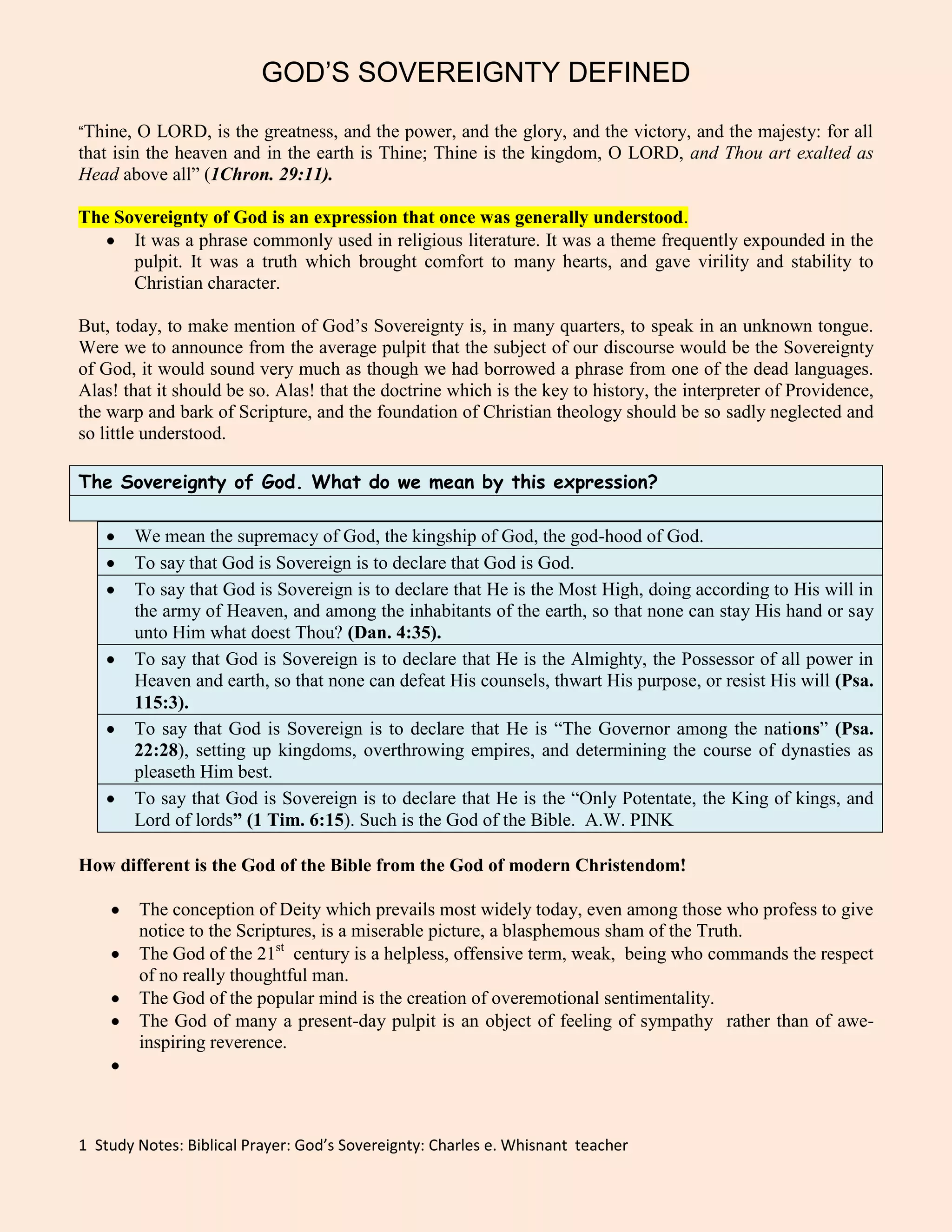
GOD’S SOVEREIGNTY DEFINED<br />“Thine, O LORD, is the greatness, and the power, and the glory, and the victory, and the majesty: for all that isin the heaven and in the earth is Thine; Thine is the kingdom, O LORD, and Thou art exalted as Head above all” (1Chron. 29:11). <br />The Sovereignty of God is an expression that once was generally understood. <br />It was a phrase commonly used in religious literature. It was a theme frequently expounded in the pulpit. It was a truth which brought comfort to many hearts, and gave virility and stability to Christian character. But, today, to make mention of God’s Sovereignty is, in many quarters, to speak in an unknown tongue. Were we to announce from the average pulpit that the subject of our discourse would be the Sovereignty of God, it would sound very much as though we had borrowed a phrase from one of the dead languages. Alas! that it should be so. Alas! that the doctrine which is the key to history, the interpreter of Providence, the warp and bark of Scripture, and the foundation of Christian theology should be so sadly neglected and so little understood.<br />The Sovereignty of God. What do we mean by this expression? <br />We mean the supremacy of God, the kingship of God, the god-hood of God.
To say that God is Sovereign is to declare that God is God.
To say that God is Sovereign is to declare that He is the Most High, doing according to His will in the army of Heaven, and among the inhabitants of the earth, so that none can stay His hand or say unto Him what doest Thou? (Dan. 4:35).
To say that God is Sovereign is to declare that He is the Almighty, the Possessor of all power in Heaven and earth, so that none can defeat His counsels, thwart His purpose, or resist His will (Psa. 115:3).
To say that God is Sovereign is to declare that He is “The Governor among the nations” (Psa. 22:28), setting up kingdoms, overthrowing empires, and determining the course of dynasties as pleaseth Him best.
To say that God is Sovereign is to declare that He is the “Only Potentate, the King of kings, and Lord of lords” (1 Tim. 6:15). Such is the God of the Bible.  A.W. PINKHow different is the God of the Bible from the God of modern Christendom!<br />The conception of Deity which prevails most widely today, even among those who profess to give notice to the Scriptures, is a miserable picture, a blasphemous sham of the Truth.
The God of the 21st  century is a helpless, offensive term, weak,  being who commands the respect of no really thoughtful man.
The God of the popular mind is the creation of overemotional sentimentality.
The God of many a present-day pulpit is an object of feeling of sympathy  rather than of awe-inspiring reverence. To say that God the Father has purposed the salvation of all mankind, that God the Son died with the express intention of saving the whole human race, and that God the Holy Spirit is now seeking to win the world to Christ<br />When, as a matter of common observation, it is apparent that the great majority of our fellowmen are dying in sin, and passing into a hopeless eternity; is to say that
God the Father is disappointed, that
God the Son is dissatisfied, and that
God the Holy Spirit is defeated. We have stated the issue baldly, but there is no escaping the conclusion.  As Charity as said, “Charles it is so clear if you see the Scripture.” <br />To argue that God is “trying His best” to save all mankind, but that the majority of men will not let Him save them,
 is to insist that the will of the Creator is powerless, and that the will of the creature is omnipotent.
To throw the blame, as many do, upon the Devil, does not remove the difficulty, for if Satan is defeating the purpose of God, then, Satan is Almighty and God is no longer the Supreme Being. Satan from the beginning as tried to defeat God plan. He has always failed.To declare that the Creator’s original plan has been frustrated by sin, is to dethrone God.<br />To suggest that God was taken by surprise in Eden and that He is now attempting to remedy an unforeseen calamity, is to degrade the Most High to the level of a finite, make a mistake mortal.
To argue that man is a free moral agent and the determiner of his own destiny, and that therefore he has the power to checkmate his Maker, is to strip God of the attribute of Omnipotence.
To say that the creature has fracture the bounds assigned by his Creator, and that God is now practically a helpless Spectator before the sin and suffering entailed by Adam’s fall, is to renounce the express declaration of Holy Bible, namely,
 “Surely the wrath of man shall praise Thee: the remainder of wrath shalt Thou restrain” (Psa. 76:10).
In a word, to deny the Sovereignty of God is to enter upon a path which, if followed to its logical terminus, is to arrive at blank atheism.The Sovereignty of the God of Scripture is absolute, irresistible, infinite. <br />When we say that God is Sovereign we affirm His right to govern the universe which He has made for His own glory, just as He pleases.
We affirm that His right is the right of the Potter over the clay, i. e., that He may mold that clay into whatsoever form He chooses, fashioning out of the same lump one vessel unto honor and another unto dishonor.  Isa. 45:9; Jeremiah 18:5-12; Romans 9:20-25
We affirm that He is under no rule or law outside of His own will and nature, that God is a law unto Himself, and that He is under no obligation to give an account of His matters to any.Sovereignty characterizes the whole Being of God. He is Sovereign in all His attributes.<br />He is Sovereign in the exercise of His power.
His power is exercised as He wills, when He wills, where He wills.
This fact is evidenced on every page of Scripture.
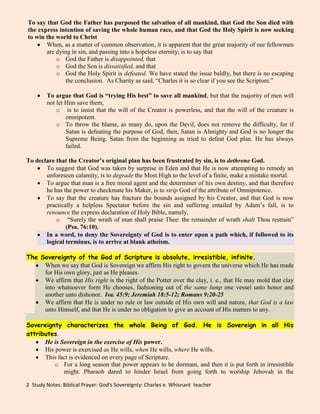
For a long season that power appears to be dormant, and then it is put forth in irresistible might. Pharaoh dared to hinder Israel from going forth to worship Jehovah in the wilderness—what happened? God exercised His power, His people were delivered and their cruel task-masters slain.
 But a little later, the Amalekites dared to attack these same Israelites in the wilderness, and what happened? Did God put forth His power on this occasion and display His hand as He did at the Red Sea? Were these enemies of His people promptly overthrown and destroyed? No, on the contrary, the Lord swore that He would “have war with Amalek from generation to generation” (Exo. 17:16).
Again, when Israel entered the land of Canaan, God’s power was signally displayed. The city of Jericho barred their progress—what happened? Israel did not draw a bow nor strike a blow: the Lord stretched forth His hand and the walls fell down flat. But the miracle was never repeated! No other city fell after this manner. Every other city had to be captured by the sword!Many other instances might be adduced illustrating the Sovereign exercise of God’s power. <br />Take one other example. God put forth His power and David was delivered from Goliath, the giant; the mouths of the lions were closed and Daniel escaped unhurt; the three Hebrew children were cast into the burning fiery furnace and came forth unharmed and unscorched.
 But God’s power did not always interpose for the deliverance of His people, for we read:
“And others had trial of cruel mockings and scourgings, yea, moreover of bonds and imprisonment: they were stoned, they were sawn asunder, were tempted, were slain with the sword; they wandered about in sheepskins and goatskins; being destitute, afflicted, tormented” (Heb. 11:36, 37). But why?
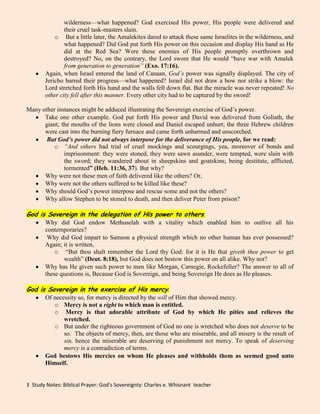
Why were not these men of faith delivered like the others? Or,

Biblical prayer gods sovereignty study notes 10 20

  • 1.
    GOD’S SOVEREIGNTY DEFINED<br/>“Thine, O LORD, is the greatness, and the power, and the glory, and the victory, and the majesty: for all that isin the heaven and in the earth is Thine; Thine is the kingdom, O LORD, and Thou art exalted as Head above all” (1Chron. 29:11). <br />The Sovereignty of God is an expression that once was generally understood. <br />It was a phrase commonly used in religious literature. It was a theme frequently expounded in the pulpit. It was a truth which brought comfort to many hearts, and gave virility and stability to Christian character. But, today, to make mention of God’s Sovereignty is, in many quarters, to speak in an unknown tongue. Were we to announce from the average pulpit that the subject of our discourse would be the Sovereignty of God, it would sound very much as though we had borrowed a phrase from one of the dead languages. Alas! that it should be so. Alas! that the doctrine which is the key to history, the interpreter of Providence, the warp and bark of Scripture, and the foundation of Christian theology should be so sadly neglected and so little understood.<br />The Sovereignty of God. What do we mean by this expression? <br />We mean the supremacy of God, the kingship of God, the god-hood of God.
  • 2.
    To say thatGod is Sovereign is to declare that God is God.
  • 3.
    To say thatGod is Sovereign is to declare that He is the Most High, doing according to His will in the army of Heaven, and among the inhabitants of the earth, so that none can stay His hand or say unto Him what doest Thou? (Dan. 4:35).
  • 4.
    To say thatGod is Sovereign is to declare that He is the Almighty, the Possessor of all power in Heaven and earth, so that none can defeat His counsels, thwart His purpose, or resist His will (Psa. 115:3).
  • 5.
    To say thatGod is Sovereign is to declare that He is “The Governor among the nations” (Psa. 22:28), setting up kingdoms, overthrowing empires, and determining the course of dynasties as pleaseth Him best.
  • 6.
    To say thatGod is Sovereign is to declare that He is the “Only Potentate, the King of kings, and Lord of lords” (1 Tim. 6:15). Such is the God of the Bible. A.W. PINKHow different is the God of the Bible from the God of modern Christendom!<br />The conception of Deity which prevails most widely today, even among those who profess to give notice to the Scriptures, is a miserable picture, a blasphemous sham of the Truth.
  • 7.
    The God ofthe 21st century is a helpless, offensive term, weak, being who commands the respect of no really thoughtful man.
  • 8.
    The God ofthe popular mind is the creation of overemotional sentimentality.
  • 9.
    The God ofmany a present-day pulpit is an object of feeling of sympathy rather than of awe-inspiring reverence. To say that God the Father has purposed the salvation of all mankind, that God the Son died with the express intention of saving the whole human race, and that God the Holy Spirit is now seeking to win the world to Christ<br />When, as a matter of common observation, it is apparent that the great majority of our fellowmen are dying in sin, and passing into a hopeless eternity; is to say that
  • 10.
    God the Fatheris disappointed, that
  • 11.
    God the Sonis dissatisfied, and that
  • 12.
    God the HolySpirit is defeated. We have stated the issue baldly, but there is no escaping the conclusion. As Charity as said, “Charles it is so clear if you see the Scripture.” <br />To argue that God is “trying His best” to save all mankind, but that the majority of men will not let Him save them,
  • 13.
    is toinsist that the will of the Creator is powerless, and that the will of the creature is omnipotent.
  • 14.
    To throw theblame, as many do, upon the Devil, does not remove the difficulty, for if Satan is defeating the purpose of God, then, Satan is Almighty and God is no longer the Supreme Being. Satan from the beginning as tried to defeat God plan. He has always failed.To declare that the Creator’s original plan has been frustrated by sin, is to dethrone God.<br />To suggest that God was taken by surprise in Eden and that He is now attempting to remedy an unforeseen calamity, is to degrade the Most High to the level of a finite, make a mistake mortal.
  • 15.
    To argue thatman is a free moral agent and the determiner of his own destiny, and that therefore he has the power to checkmate his Maker, is to strip God of the attribute of Omnipotence.
  • 16.
    To say thatthe creature has fracture the bounds assigned by his Creator, and that God is now practically a helpless Spectator before the sin and suffering entailed by Adam’s fall, is to renounce the express declaration of Holy Bible, namely,
  • 17.
    “Surely thewrath of man shall praise Thee: the remainder of wrath shalt Thou restrain” (Psa. 76:10).
  • 18.
    In a word,to deny the Sovereignty of God is to enter upon a path which, if followed to its logical terminus, is to arrive at blank atheism.The Sovereignty of the God of Scripture is absolute, irresistible, infinite. <br />When we say that God is Sovereign we affirm His right to govern the universe which He has made for His own glory, just as He pleases.
  • 19.
    We affirm thatHis right is the right of the Potter over the clay, i. e., that He may mold that clay into whatsoever form He chooses, fashioning out of the same lump one vessel unto honor and another unto dishonor. Isa. 45:9; Jeremiah 18:5-12; Romans 9:20-25
  • 20.
    We affirm thatHe is under no rule or law outside of His own will and nature, that God is a law unto Himself, and that He is under no obligation to give an account of His matters to any.Sovereignty characterizes the whole Being of God. He is Sovereign in all His attributes.<br />He is Sovereign in the exercise of His power.
  • 21.
    His power isexercised as He wills, when He wills, where He wills.
  • 22.
    This fact isevidenced on every page of Scripture.
  • 23.
    For a longseason that power appears to be dormant, and then it is put forth in irresistible might. Pharaoh dared to hinder Israel from going forth to worship Jehovah in the wilderness—what happened? God exercised His power, His people were delivered and their cruel task-masters slain.
  • 24.
    But alittle later, the Amalekites dared to attack these same Israelites in the wilderness, and what happened? Did God put forth His power on this occasion and display His hand as He did at the Red Sea? Were these enemies of His people promptly overthrown and destroyed? No, on the contrary, the Lord swore that He would “have war with Amalek from generation to generation” (Exo. 17:16).
  • 25.
    Again, when Israelentered the land of Canaan, God’s power was signally displayed. The city of Jericho barred their progress—what happened? Israel did not draw a bow nor strike a blow: the Lord stretched forth His hand and the walls fell down flat. But the miracle was never repeated! No other city fell after this manner. Every other city had to be captured by the sword!Many other instances might be adduced illustrating the Sovereign exercise of God’s power. <br />Take one other example. God put forth His power and David was delivered from Goliath, the giant; the mouths of the lions were closed and Daniel escaped unhurt; the three Hebrew children were cast into the burning fiery furnace and came forth unharmed and unscorched.
  • 26.
    But God’spower did not always interpose for the deliverance of His people, for we read:
  • 27.
    “And others hadtrial of cruel mockings and scourgings, yea, moreover of bonds and imprisonment: they were stoned, they were sawn asunder, were tempted, were slain with the sword; they wandered about in sheepskins and goatskins; being destitute, afflicted, tormented” (Heb. 11:36, 37). But why?
  • 28.
    Why were notthese men of faith delivered like the others? Or,