WHATOUR
STUDENTS SAY
"Thank you for giving me the privilege of receiv-
ing such a wonderful Bible course. It has opened
my eyes to so many things. At first I just could not
accept what I read. But when I began to search the
Scriptures and found what the course said was
there, I started to really read the Bible."
- R.W., Huntsville, Texas
"I think you can expect several new enrollments
for the Bible correspondence course very shortly.
Several friends came over while I was completing a
lesson, and after looking at what I had they asked
what to do to get the same!"
- T.N., Panama City, Florida
"I'm really glad I started taking your course. I've
taken other Bible courses, but they don't encour-
age you to read the Bible and write the verses so
you would remember it for a longer time. They
don't supply supplementary reading, either."
- S.S., Jacksonville, Florida
"When I received my latest lesson of your Bible
correspondence course, I was delighted as always.
As an educator I can say in all candor that this has
been the finest course I have ever taken, and far
superior to any I have ever taught. Please use the
enclosed donation any way the Church sees fit."
- T.S., Huntington Station, New York
"When I was first being called by God, I studied
my Bible with the course. Now after being in God's
Church for six years, I'm doing the course once
again. This time it is just as exciting and seems to
have deeper meaning. Thank you for extending the
lessons beyond Lesson 12 so we can have a guide
for our Bible study."
- J.J., Sterling, Alaska
How your enrollment
has been paid
Your enrollment is provided free of charge by the Worldwide Church of
God. It is made possible by the voluntary. freely given tithes and
offerings of the membership of the Church and others who have
elected to support the work of the Church. Those who wish to volun-
tarily aid and support this worldwide work of God are gladly welcomed
as co-workers in this major effort to preach and publish the Gospel to
all nations.
2
DENCE COURSE
Lesson 17
An international course of Biblical understanding published by the World-
wide Church of God in cooperation will1 Ambassador College, Pasa-
dena , California. Copyright © 1983 Worldwide Church of God for the
entire contents of this publication. All rights reserved .
Editor-In-Chief: HERBERT W. ARMSTRONG
Managing Editor: Richard H. Sedliacik
Editorial Staff: Michael D. Morrison, Maryann Pirog, Elva
Sedliacik, Marci Sidars, Richard A. Sedliacik
Graphics: Bill Wilson
Circulation Manager: Boyd Leeson
CORRESPONDENCE COURSE OFFICE ADDRESSES WORLDWIDE
Canada: P.O. Box 44 , Station A, Vancouver, B.C. V6C 2M2
Mexico: Institucion Ambassador, Apartado Postal 5-595, 06500 Mexico OF.
Uniled Siales: Pasadena, California 91123
Bahamas: P.O. Box N3934, Nassau NP
Barbados: P.O. Box 1021, Bridgetown
Bermuda: P.O. Box 908, Hamilton 5-24
Guyana: P.O. Box 10907, Georgetown
Jamaica: P.O. Box 544, Kingston 5
Puerlo Rico: P.O. Box 6063, San Juan 00936
Trinidad.' P.O. Bag 114, Port of Spain
Colombia: Apartado Aereo 11430, Bogota 1, D.E.
Uniled Kingdom, Europe and Middle Easl: P.O. Box Ill , Borehamwood,
Herts., England W06 1LU
Ghana: P.O. Box 96 17, Kotoka Int. Airport, Accra
Kenya and the resl of Easl and Central Africa: P.O Box 47135, Nairobi
Nigeria. P.M.B. 21006, Ikeja, Lagos State
South Africa: P.O. Box 5644, Capetown 8000, Republic of South Africa
Zambia: P.O. Box 50177, Lusaka
Zimbabwe: P.O. Box U.A.30, Union Ave., Harare
India: PO. Box 6727, Bombay 400 052
MalaYSia: P.O. Box 430, Jalan Sultan, Petaling Jaya, Selangor
Mauritius and other Indian Ocean Isles: P.O. Box 888, Port Louis, Mauritius
Singapore: P.O. Box 1f I , Farrer Road Post Office, Singapore 9128
Sri Lanka: P.O. Box 1824, Colombo
Australia: G.P.O. Box 345, Sydney, NSW, Australia 2001
New Zealand and Pacific Isles: P.O. Box 2709, Auckland 1
The Philippines: P.O. Box 1111, Makati, Metro Manila, 3117
For addilional addresses, see inside fronl cover of your PLAIN TRUTH.
Be sure to notify us immediately of any change in your address. Please
include your old mailing label and your new address.
About
Our
Cover.
When a bride and groom per-
form t heir marriage vows, they
enter into a marriage covenant.
She promises to love and obey him; he agrees to provide for,
protect and love her. These are the terms or conditions of a
marriage covenant. And that's exactly what the Old Covenant
was-a marriage agreement! This study reveals who the "mar-
riage" par tners were, the terms agreed upon, and the vi tal lessons
the Old Covenant teaches us today. W e'll also learn why a New
Covenant is necessary. with whom and when it will be made.
Glayton
Ambassador College Bible Correspondence Course
THE PLAIN TRUTH
ABOUT THE
OLD AND NEW COVENANTS
Exactly what are the Old and New Covenants? And what do
these covenants have to do with Spirit-begotten Christians
today?
A
COMMON belief today is that the Ten Com-
mandments did not exist until Moses at Mt.
Sinai and that they lasted only until Jesus
Christ's death.
According to this teaching, Jesus came to estab-
lish a New Covenant containing only grace and
promises-but certainly no law.
Surprising as it may seem to many professing
Christians, God's Law did not begin when God
made the covenant at Mt. Sinai with ancient Israel.
The law of God had been in full force and effect
since before Adam!
God's Law Before Adam
To fully understand the truth about the Old and
New Covenants, we need to be reminded of a very
basic fact: God's law of love existed long before
Adam and Eve!
We learned in a previous lesson that the way of
life by which the two members of the God family
have always lived is the way of love. God has always
loved the Word and the Word has always loved
God. The two have lived in perfect harmony from
eternity (John 10:30). The love they have for each
other-this way of life-is the attitude motivating
all that the God family does.
The love of God is outflowing toward others.
God is concerned about the welfare of all His
created beings. God's love is the attitude of cooper-
ation, serving, helping. It is the way of "give"
instead of "get."
The eternal God has ordained that we all learn to
live His way of love. And how is God's love
defined? "For this is the love of God, that we keep
his commandments: and his commandments are
not grievous" (1 John 5:3).
Lesson 17
But to what commandments is the apostle John
referring?
When the Word was the human Jesus Christ
nearly 2,000 years ago, someone asked Him a simi-
lar question. Christ answered, "Thou shalt do no
murder, Thou shalt not commit adultery, Thou
shalt not steal, Thou shalt not bear false witness,
Honour thy father and thy mother: and, Thou shalt
love thy neighbour as thyself" (Matt. 19:18-19).
Jesus obviously was talking about the Ten Com-
mandments.
The Ten Commandments constitute a spiritual
law that is inexorable and eternal-a law that is
love and the fulfillment of which is love (Rom.
13:10). The essence of God's spiritual law is love
toward God and love toward fellowman (Matt.
22:36-40). The first four of the Ten Command-
ments teach us how to love God. And the last six
teach us how to love our fellowman.
Since God's very nature is love (I John 4:16), His
law reflects His nature, describing His loving char-
acter. And since God's character will never change
(Mal. 3:6; Heb. 13:8), His spiritual law will never
change or be done away! (Ps. 111:7-8.)
Results of Sin
Why don't we have universal peace, harmony
and cooperation in the world today? Because of the
transgression of God's law of love! Disobedience to
the Ten Commandments has produced all the dis-
cord, unhappiness, suffering and death the world
has experienced since Adam!
Our previous lessons revealed that the govern-
ment of God was established on earth when God
placed angels here to finish its creation. God's gov-
ernment, which is based on His law of love, regu-
3
lated the angels' activities. It regulated their rela-
tionship with God and with each other.
There was peace, harmony, joy and accomplish-
ment on earth-until the anointed cherub Lucifer
rebelled against the government of God and sinned
(II Peter 2:4). A third of the angels followed him in
this rebellion. Paul said sin cannot be imputed if
there is no law to transgress! (Rom. 5:13.) Since
Lucifer and the angels sinned, there had to be a law
they transgressed! That law was God's law of love.
The faithful angels have continued to live by God's
commandments (Ps. 103:20-21).
Much later, God created the first man and
woman. He instructed them in His way. God
revealed that living by His law of love would result
in happiness, joy and material abundance. Thus
God taught the Ten Commandments to Adam and
Eve. He also revealed the results of disobeying that
law.
After instructing the first man and woman in His
way, God required them to make a choice. Adam,
in order to receive God's Holy Spirit (symbolized
by the "tree of life") and restore the government of
God to earth, would have to reject Satan's way of
"get" and follow God's way of "give"-the way of
His law of love. At that time the former Lucifer,
now Satan the devil, was there in the garden of
Eden to tempt the first humans.
Adam chose to reject God. He made this fateful
decision for himself and the whole world, which has
descended from him. God therefore drove our first
parents out of the garden of Eden and shut man-
kind off from access to the Holy Spirit. From then
on, God would reveal the true knowledge and
understanding of His spiritual law and plan only to
those of His choosing (John 6:44; I Peter 1:10-12).
Man would not have free access to God's Holy
Spirit and spiritual understanding again until
Christ's return to put an end to Satan's reign (Rev.
20:1-3).
During the succeeding nearly six millennial
"days" of Satan's rule, those relatively few whom
God has called-His "firstfruits"-have indeed
received His Holy Spirit and been begotten spiri-
tually. They have the opportunity to enter into a
special covenant relationship with God!
God's Covenants With Man
God has made a number of covenants with
humans. There were the covenants with the
patriarchs Noah and Abraham and with King David.
CONSEQUENCES OF SIN-Though God instructed Adam and Eve in His commandments, they chose to
follow the way of Satan, thus cutting themselves and their descendants off from access to God's Holy Spirit,
symbolized by the "tree of life."
4 Ambassador College Bible Correspondence Course
God also made a covenant with the ancient nation of
Israel, which was later called the "Old Covenant."
But the most important covenant-the "New Cove-
nant"-is yet to be made in the future!
Exactly what are the Old and New Covenants?
What does the Bible say was the fault of the Old
and why is the New necessary? How can we enter
into a New Covenant relationship with God and
when will the New Covenant be made?
Before you begin this study, be sure to get your
Bible so you can turn to and read all the verses
given in answer to the questions in this lesson.
You will also find it very profitable to copy these
verses in a notebook. This will not only enable
you to easily review your studies at any time in
the future, it will also help you to remember
these important scriptures.
Now let's begin another fascinating study!
LESSON 17
Difference Between a Covenant
and a Testament
One of the most important doctrines the living
Christ has revealed to His Church is that of the Old
and New Covenants. Unfortunately, many care-
lessly confuse the word "covenant" with "testa-
ment."
A testament is not a covenant, and a covenant is
not a testament. Yet common religious usage seems
to confuse them. It is important, at the outset, to
understand the difference.
A testament is an act or written instrument by
which a person bequeaths or wills certain of his
possessions to another. It usually is not a payment
or reward for work or obligation performed.
But a covenant, comments Webster, is "a mutual
agreement, a legal undertaking to do or to refrain
from some act; a document containing the terms of
agreement." In biblical usage a covenant is a con-
tract, or agreement, by which one party promises
certain rewards or payments in return for certain
stipulated performance by the other party.
Let's notice now the covenant God made with
one of the patriarchs.
1. What was the covenant God made with Abra-
ham? Gen. 12:1-7; 15:18. What were the terms or
conditions Abraham had to fulfill in order that he
and his descendants might receive the promises of
God's covenant with him? Gen. 12:1; 17:1-9.
COMMENT: Notice that Abraham was to depart
the land of his birth for the territory of Canaan.
Another requirement Abraham had to fulfill as his
part of the covenant was to walk before God and be
"perfect" or upright. If Abraham would comply,
then God, in turn, bound Himself to fulfill the
specific promises in His covenant with Abraham.
Notice that no death had to take place to make
this covenant binding, as would have been neces-
sary if this were a testament.
Lesson 17
2. Did God establish the same covenant with
Abraham's son Isaac? Gen. 17:19. To which of
Isaac's sons was the covenant later passed? Gen.
27:27-30.
COMMENT: God's covenant with Abraham was
confirmed to Isaac and to his son Jacob, whose
name was changed to Israel.
Years later, because of a great famine in the land
of Canaan where Israel lived, the patriarch and his
family moved to Goshen in Egypt. There, his
descendants grew into a large nation. Through cir-
cumstances beyond their control, they eventually
became enslaved to the Egyptians.
3. Did God look down upon the captive children
of Israel and remember His covenant with their
forefathers? Ex. 2:23-25.
COMMENT: Through a series of miracles God
released the children of Israel from bondage and
led them out of Egypt.
God's Covenant With Ancient Israel
1. Where did God lead the Israelites on their
way from Egypt to the Promised Land? Ex.
19:1-2.
2. Did God propose to make a covenant with the
children of Israel? Verses 3-6. What would be the
peoples' part of the agreement? Verse 5. What
would be God's part of the agreement? Verses
5-6.
COMMENT: Through Moses, God proposed a cov-
enant with the Israelites. In it God promised to
make them a great nation if they would obey Him.
Notice the very large IF in this covenant agree-
ment.
3. Did the people agree to God's condition?
Verse 8.
COMMENT: The people glibly agreed. "All that
the LORD hath spoken we will do," they promised.
They were so certain of their own ability to obey
5
6
WHAT IS A
COVENANT?
Marriage is a mutual agreement or
covenant confirmed by a ceremony.
Business deals are sealed with
written contracts. Binding
agreements are made every day
between individuals, corporations
and nations. The Bible shows God
also has made covenants with
men.
Photos top, rf IIrms/rang Roberts
bottom, Ambassador College
Ambassador College Bible Correspondence Course
God that they readily affirmed they would abide by
the covenant.
4. Since the Israelites expressed their desire to
enter into a covenant with God, what did He
inform Moses He would do on the third day? Verse
11. How does the Bible describe this awesome
event? Verses 16-20.
5. Exactly what did God tell the people they
had to do to obey Him-to fulfill their part of
the covenant with God? Ex. 20:1-17; Deut. 5:6-
21.
COMMENT: On the third day, amid an awesome
display of lightning, thunder and thick clouds
swirling over the mountain, God's powerful voice
thundered in their ears the basic law of His govern-
ment-the great spiritual law defining, in princi-
ple, God's way of life.
This covenant made at Mt. Sinai-called the
"Old Covenant" today-imposed upon the people
of Israel certain terms and conditions to be per-
formed. The people were to keep the Ten Com-
mandments. And the reward for obedience would
be to make Israel a nation "above all people."
Notice that the promises were purely national and
material. There was no mention of spiritual bless-
ings.
6. Did God, with His own finger, write these
commandments on tables of stone? Deut. 5:22;
4:13.
7. After God had given the Ten Commandments
to the Israelites, what did He instruct Moses to set
before the people? Deut. 6:1; 4:5.
COMMENT: God revealed to Moses additional
laws-various applications of the Ten Command-
ments in the form of civil statutes and judgments
(detailed in Exodus 20:22 through chapter 23). God
instructed Moses to write these statutes and judg-
ments in a book called the "Book of the Covenant"
(Ex. 24:4, 7). These additional laws thus became a
part of the covenant God made with Israel.
8. Did the Israelites formally agree before God
that they would obey all the laws of His covenant?
Ex. 24:3, 7.
9. Was the covenant then ratified, or sealed-
made binding-with blood? Verses 6-8.
COMMENT: Once a covenant is signed, sealed or
ratified-confirmed-it cannot be added to (Gal.
3:15). Anything appearing "beneath the signa-
ture," so to speak, is not legally any part of the
covenant. Notice the words "the covenant, which
the LORD hath made with you" (Ex. 24:8). It was
then already made-completed! This is very
important to note, as we will see later.
If the Israelites would keep the law in the letter,
God would keep His part of the covenant. He
Lesson 17
would fulfill all the material promises of this mate-
rial covenant (Lev. 26:3-13; Deut. 28:1-14).
A Marriage Covenant
When the Word (John 1:1-3), who later became
the human Jesus Christ (verse 14), made the first
man and woman, He established the marriage rela-
tionship (Gen. 2:21-25). Centuries later, this same
divine Personage entered into a "marriage" rela-
tionship with the nation of Israel! Few understand
this important fact.
1. When and how did the One who later became
Jesus Christ become Israel's husband? Jer. 31:31-
32; Ezek. 16:8. Also notice in Exodus 19:8 and 24:7
the "I do" agreement made by the "wife"-
Israel-to her "Husband," Yahweh, the LORD-the
One who became Christ.
COMMENT: The covenant made at Mt. Sinai was
typical of a marriage contract between a man and
woman. It was, symbolically speaking, a "mar-
riage" agreement between the Word (Christ) and
the nation of Israel.
As the LORD who dealt with Old Testament
Israel, Christ-the Husband-promised to materi-
ally provide for and protect the nation or congrega-
tion of Israel. The nation, as the wife, in turn
agreed to remain faithful to Him-to refrain from
any adulterous or whorish relations with the pagan
gods of other nations (Ex. 34:12-17). Israel, as a
nation, accepted the role of a wife, to obey her
Husband.
2. What were the blessings Israel's Husband
would provide His wife if she would live by the laws
she agreed to keep? Review Leviticus 26:3-13 and
Deuteronomy 28:1-14.
COMMENT: Recall that in Lesson 16 we covered
the great material blessings the children of Israel
would receive if they obeyed God's laws. We also
saw what curses would result if they disobeyed
(Lev. 26:14-39; Deut. 28:15-68).
Based on God's Eternal Law
God's eternal, spiritual law existed long before
Adam and Eve were created. Recall that immedi-
ately after the creation of the first human beings,
God taught them His commandments. But our
first parents quickly disobeyed their Creator and
cut themselves and their descendants off from
access to God's Holy Spirit.
The biblical record shows that God's law was
known by only a special few in ancient times.
Those whom the Eternal individually called to per-
form a special work in His service-the patriarchs
7
LAWMAKING BODY-Joint session of the United States Congress is typical of assemblies of legislators
who formulate the fallible laws of man. By contrast, the laws of God, the Supreme Lawmaker, are perfect and
designed to produce happy and abundant lives for those who follow them.
and prophets of old- knew and kept God's Ten
Commandments, statutes and other laws. It is
important that we fully understand this fact as we
proceed in our study of the Old and New Cove-
nants in the Bible.
1. As we learned in Lesson 16, the patriarch
Abraham was called by God for a special purpose.
God made a covenant with Abraham and revealed
to him a special understanding of His eternal, spir-
ituallaw. Are we clearly told that Abraham obeyed
God's commandments and laws? Gen. 26:5. What
else did he obey? Same verse.
COMMENT: Abraham knew about and kept the
Ten Commandments. He also kept God's statutes
and laws. What were these statutes and laws?
These statutes are expressions of the Great Law-
maker, usually commanding or forbidding certain
matters of lesser significance than the ten great
commandments. Thus the statutes and other laws
of God actually magnify, or reveal specific applica-
tions of, the Ten Commandments.
Along with the statutes, God also gave the
patriarchs His judgments for the protection of
everyone's legal rights. The judgments are binding
decisions based on God's previously revealed law.
8
These decisions are used to settle similar future
disputes and to render a sentence or verdict.
2. What other examples clearly illustrate that
God revealed to the people of Israel laws which
were already in force? Ex. 16:28; 18:16.
COMMENT: Israel could not refuse to obey laws
that did not exist! Both these instances occurred
before the nation reached Mt. Sinai- before the
covenant was made through Moses.
Thus the Bible shows that the commandments,
statutes and judgments- all based on the princi-
ples of love toward God and love toward man-
were in force prior to the establishment of God's
covenant with the nation Israel!
Then why did God have to reveal His law to the
children of Israel when establishing His covenant
with them?
Simply because the people had strayed so far from
the truth by the time ofMoses that God had to reveal
His laws and statutes anew to the Israelites. Ancient
Israel had lost much, ifnot most, ofthe knowledge of
God's ways while in Egyptian bondage. Since the
Ten Commandments were already in force, the only
thing new about them at Mt. Sinai was the written,
codified form in which God presented them to the
Ambassador College Bible Correspondence Course
people after stating them with His own voice. The
civil statutes and judgments were also revealed to
Israel to show how the Ten Commandments should
be applied to the physical nation. (Recall that these
civil laws were written in the "Book of the Cove-
nant"- Ex. 24:3-4,7).
In general, the Ten Commandments apply to
individual conduct, the statutes to national or
church affairs, and the judgments to legal decisions
rendered according to the principles of the Ten
Commandments and the statutes.
Let's notice an example of how the statutes
amplify the Ten Commandments.
3. What is the First Commandment? Ex. 20:3.
What statute magnifies this command, or describes
one aspect of how to keep it? Ex. 23:14.
COMMENT: The First Commandment says,
"Thou shalt have no other gods before me." The
statutes regarding annual festivals magnify the
First Commandment-explain how, in a positive
way, to ensure that one worships the one true God:
"Three times [in the year] thou shalt keep a feast
unto me ..." (Ex. 23:14). Those who obey this stat-
ute keep in special contact with the Creator God
and in the knowledge of His great plan for man-
kind.
Many additional laws- such as Exodus 22:16,
19, for example- specify in greater detail how the
Seventh Commandment, "Thou shalt not commit
adultery," is to be applied.
So not only are the statutes based on the Ten
Commandments, they spell out in detail how to
keep God's spiritual law as codified in the Ten
Commandments.
An important point to remember in what we
have just studied is this: since God's Ten Com-
mandments, statutes and judgments existed before
the covenant was made with Israel, they were not
abolished in A.D. 31 at the crucifixion of Jesus
Christ. The cessation of the need of a covenant now
made old could not render null and void what that
first covenant did not bring into force! God's Com-
mandments are eternal! (Psalm 111:7-8.)
Sacrificial Laws Added Later
When God brought Israel to Mt. Sinai, He gave
the Ten Commandments to them. He allowed
Moses to declare to Israel the statutes and judg-
ments because the people didn't want to hear them
personally delivered by God (Exodus chapters 20-
24). These statutes and judgments, as we have just
seen, magnify the Ten Commandments.
But when did the physical ceremonies and sacri-
fices begin? When did they cease to have force and
Lesson 17
r;' .,0j>
,..,",-::~" :
.-'"
11:" 1"": ..~ ...:-
., '.~
Magnifying
the Law
......~ .
. ...
God's statutes enlarge upon and
show us how to apply His basic
law- the Ten Commandments.
The magnifying glass is focused
on the Fifth through Tenth
Commandments in a
Hebrew Bible.
9
effect? And how can we distinguish them from the
statutes and laws of the Old Covenant?
1. Notice that there is only one sacrifice men-
tioned in the Book of the Covenant. What is it? Ex.
23:18.
COMMENT: God called it "MY sacrifice." The
Passover was instituted in Egypt (Ex. 12:1-14),
weeks before Sinai. It was repeated in the covenant
made at Sinai, but it was not instituted by that
covenant! (Remember, a covenant is an agreement
between two parties that may involve previously
existing matters.)
2. When God spoke the terms of His covenant to
the Israelites after they were brought out of Egypt,
did He also give instructions for a sacrificial system
of laws? Jer. 7:22-23.
COMMENT: God did not originally command sac-
rifices to be offered. This explains why the tempo-
rary sacrifices-instituted after the first covenant
was made and ratified at Sinai- were NOT perpet-
uated by different symbols in the New Testament
Church. Only the Passover is continued- with the
different New Testament SYMBOLS of unleavened
bread and wine. Why is the Passover continued
today? Because it began before the covenant was
made at Sinai!
The very fact that Jesus substituted unleavened
bread and wine for the Passover lamb only, and not
for the Levitical offerings, is a PROOF that the cere-
monial offerings were temporary and not binding
today. But the Passover, in its New Testament
form, is binding!
Now notice further proof of these facts.
3. When and why did God command the Israel-
ites to perform physical ceremonies and sacrifices?
Gal. 3:19.
COMMENT: Paul explains that the temporary
rituals and sacrifices were afterward "added
because of transgressions"- because God's spiri-
tual law was being broken by the Israelites.
When God made His covenant with ancient
Israel, He wrote the Ten Commandments on two
tables of stone. At that time He also had Moses
write His civil statutes and judgments in a book.
But this book did not, at first, contain the laws of
burnt offerings, sacrifices and washings. God had
these added later-within a year- as a separate
part of the civil statutes because the Israelites had
transgressed His laws.
The keeping of these ritualistic laws required
much laborious work, as can be seen by the first
seven chapters of Leviticus. That is why it came to
be known as the "works of the law" in New Testa-
ment times (Gal. 2:16).
4. How long was this additional law to last? Gal.
10
THE PASSOVER predated the Old Covenant and
was instituted forever. It is now kept with the New
Testament symbols of bread and wine as Christ,
"our passover" (I Cor. 5:7), commanded .
3:19. Notice the words "till the seed [Christ] should
come." What was the purpose of this law of
"works"? Verse 24; Heb. 10:1-12.
COMMENT: These physical laws foreshadowed
the sacrifice of Christ and were a "reminder of sin"
to teach the people the need of the Messiah- the
true Passover Lamb (I Cor. 5:7)- who would pay
the penalty of human transgression for all mankind
(Heb. 10), at which time these sacrificial laws
would cease.
Notice that these temporary ritualistic laws did
not define sin. They were "reminders" of sin. God's
spiritual laws define sin. The laws which explain
what sin is are the ones we are to keep in the spirit
as well as in the letter today.
The principle of voluntary offering of sacrifices
existed, of course, before Moses. From the begin-
ning Christ volunteered to offer Himself to pay for
the sins of mankind (Rev. 13:8). Cain and Abel
made voluntary offerings to God (Gen. 4:3-4). But
in the period from Moses to Christ, the practice of
giving offerings was commanded, made ritualistic
and regulated in great detail.
Why?
Simply because, as we learned in Lesson 16, the
Ambassador College Bible Correspondence Course
children of Israel were a physical, carnal people
without the Holy Spirit. They could not offer
themselves in spiritual obedience to God (Deut.
29:4), so God gave them ritualistic washings to
perform and had them offer animals and other
physical types as substitutes. They needed to be
reminded of Jesus' then-future sacrifice and of the
Holy Spirit, pictured by the various washings,
which cleanses us from sin.
These laws had no further use when the Lamb of
God died for the sins of the world, and when the
Holy Spirit became available for those God would
call. But note that the ritualistic laws did not cease
because they were part of the Old Covenant. They
were added after the covenant or marriage agree-
ment between Christ and Israel was ratified (Exo-
dus 24). These laws ceased to be necessary only
because the true sacrifice for sin-Christ-had
been offered!
Israel Breaks the Agreement
1. Recall that the covenant made at Sinai was a
marriage agreement between ancient Israel and the
member of the God family who became Jesus
Christ. Did Israel break that marriage contract?
Jer. 3:6-7; 11:10.
COMMENT: Ancient Israel became two nations-
the House of Israel in the north and the House of
Judah in the south. The House of Israel was not
faithful to her part of the marriage agreement. The
people turned from worshipping God and followed
the customs of the heathen, serving their false
gods. They broke their part of the marriage cove-
nant by committing spiritual "adultery."
2. Since God is holy, He does not "co-exist" with
sin. Was He therefore forced to separate from His
"wife"? Isa. 59:1-2. Did Christ "divorce" the House
of Israel? Jer. 3:8; Isa. 50:1.
COMMENT: The relationship became so bad that
the Eternal was finally forced into divorcing His
own people-the ten northern tribes of the House
of Israel. It was the House of Israel's grievous sins
that separated her from God. God punished the
nation by sending the people out of Palestine into
Assyrian captivity (II Kings 17:6-19).
God did not, however, send the House of Judah
permanently away-He sent them into temporary
captivity to Babylon for their sins (II Chronicles
36:14-21). Many in Judah repented, after separa-
tion from God, and returned to the land under the
terms of the covenant made at Mt. Sinai. But
Judah became a self-righteous nation, as illus-
trated by the Pharisees of Jesus' day.
The Word, the One who became Jesus Christ,
Lesson 17
had drawn up terms for a new marriage agreement.
Later, the human Jesus Christ, Judah's Husband,
died, and the last remnant of the marriage estab-
lished at Mt. Sinai ended. His death freed Him from
His marriage contract. Christ, the LORD or Yahweh
of the Old Testament era-God in the flesh-had
died! Now He is free to enter into a new marriage
agreement with a repentant, forgiven, sin-free
"spiritual Israel"-the New Testament Church,
which will be born of God when Christ returns!
We'll learn more about this shortly. But first,
let's understand exactly why a New Covenant is
necessary.
A NEW Marriage Covenant Proposed
1. Did the Word promise that He would make a
NEW covenant-a new marriage agreement-with
Israel and Judah even before Old Covenant Judah
had gone into captivity for disobeying His law? Jer.
31:31.
2. In speaking of Christ's spiritual office of High
Priest today, did Paul plainly state that Christ will
establish a New Covenant with His people? Heb.
8:6-8.
3. Does the reason that a New Covenant must be
made lie in the fact that there was a fault with the
Old Covenant? Verse 7. Was the fault with the
law? Ps. 19:7; Rom. 7:12.
4. Since the fault was not with the law, which is
perfect, nor with God, who was able to keep His
part of the covenant, who was at fault? Heb. 8:8.
Notice especially the first five and last ten words.
What, specifically, was that fault? Deut. 5:29.
COMMENT: The weakness of the Old Covenant
was not in the laws, but in the people with whom it
was made. Why? It was not possible for them to be
faithful to the righteous conditions God prescribed
in His covenant because there was no promise of
receiving the Holy Spirit, which would have
enabled them to obey! Since Israel did not have a
God-fearing nature within them, they did not keep
their part of the marriage agreement. This condi-
tion will be changed when the New Covenant is
made.
God, of course, knew ancient Israel would break
the covenant He made with them. He wanted to
teach mankind valuable lessons through Israel's
examples of flagrant disobedience!
5. Under the terms of the New Covenant, what
does God propose to do? Heb. 8:9-10; Jer. 31:33. By
what power are those laws written? II Cor. 3:3.
COMMENT: Under the first marriage covenant
made at Sinai, God wrote the Ten Commandments
on two tables of stone. The people could see the law
11
with their eyes, but the law was not within their
hearts and minds. The law was not a part of them.
But under the terms of the New Covenant, Christ
has promised that He will make a marriage agree-
ment ONLY with those who have had the principles
of His law indelibly written in their hearts and
minds by the Holy Spirit!
The New Covenant will not be made with flesh-
ly, carnal Israelites who can still sin- it will correct
that fault. This time it will be made with Spirit-
born Israelites who have been forgiven their sins
and who have God's laws written in their minds
and hearts so they can't sin and break the cove-
nant. The apostle John reveals that it is only at the
resurrection when we are "born again"- composed
of spirit- that we won't be able to sin because we
will have God's holy, righteous nature- His divine
character- permanently implanted in us (I John
3:9; II Peter 1:4).
The New Covenant will not be made with Gen-
tiles, as many people falsely assume. The cove-
nants and the promises pertain to Israel (Rom.
9:4). So what about the Gentiles? Will they be
totally left out?
6. Do Gentiles have any hope of ever being par-
takers of the promises God made to Abraham, as
well as the promises of the New Covenant? Eph.
2:11-13, 19; Gal. 3:29; Rom. 11:11-25.
COMMENT: In Lesson 16 we learned the details of
how men and women of all races, nationalities and
languages on earth, through Christ, can enter into
the New Covenant relationship with Him- by
becoming "spiritual Israelites"! Through Christ,
who died to set in motion His irrevocable will or
testament, it is possible for people of all nations to
become heirs "according to the promise" God
made to Abraham and eventually to enter into the
New Covenant marriage.
Terms of the New Covenant
A prevalent teaching within professing Chris-
tianity today claims that the fault with the Old
Covenant was God's law- that as the Old had law,
the New abolishes the Ten Commandments and is
based wholly on PROMISES. Let's understand just
how false this teaching really is!
1. Is the "LORD" (Christ) the Messenger of the
New Covenant? Mal. 3:1, last part. What message
did Christ preach during His ministry? Mark
1:14.
COMMENT: Jesus Christ was prophesied to come
as the Messenger of the New Covenant. And the
terms of the New Covenant are part of the Gospel
of the Kingdom of God He preached!
12
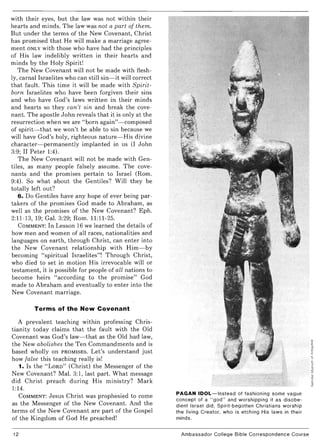
PAGAN IDOL-Instead of fashioning some vague
concept of a "god" and worshipping it as disobe-
dient Israel did, Spirit-begotten Christians worship
the living Creator, who is etching His laws in their
minds.
Ambassador College Bible Correspondence Course
Just as Moses was the mediator of the Old Cove-
nant made at Mt. Sinai, so Christ is the mediator of
the New Covenant. And just as His marriage with
Israel at Mt. Sinai set up the physical kingdom of
Israel, so the marriage ofthe Church to Christ will set
up the spiritual Kingdom of God. Thus the good
news of that coming marriage actually is the Gospel
Jesus preached-the coming Kingdom ofGod!
2. Are repentance and belief in the Gospel part
of the terms of the New Covenant? Mark 1:15. Did
Christ later instruct His disciples to teach the
terms of the New Covenant to all the world? Matt.
28:19-20.
COMMENT: The Gospel of the Kingdom of God
contains the terms and conditions for entering into
the New Covenant agreement with Jesus Christ.
And Jesus' teachings to His disciples explain the
terms of the New Covenant. But exactly what are
the rest of the terms we must strive to abide by to
enter into the new marriage covenant with Christ?
3. Is obedience to the Ten Commandments a
requirement ofthe New Covenant? Matt. 19:17-19.
COMMENT: Keeping God's spiritual law as
defined in the Ten Commandments is one of the
conditions of the New Covenant.
4. There are those who claim Jesus came to do
away with all the laws of God, including the stat-
utes and judgments which were part of the terms of
the first covenant. What does Christ say about
this? Matt. 5:17-20.
COMMENT: In the days of Jesus' ministry, the
writings we now call "the Old Testament" were not
called that. Those writings were then called "the
Law, and the Prophets, and the Writings." So
Jesus plainly said He did not come to destroy, or do
away with the laws of God contained in those
Scriptures, but to "fulfill"-oBEy-them!
God's Church, says Paul, is built on the very
FOUNDATION of the apostles and prophets, with
Jesus Christ being the chief cornerstone (Eph.
2:20). Much of the doctrine and teaching of God's
New Testament Church comes from the prophets
whose writings are recorded in what we call Old
Testament Scriptures!
5. Was Jesus prophesied to magnify the law?
Isa. 42:21.
COMMENT: Just as the Old Covenant statutes and
judgments magnified the Ten Commandments, so
Christ amplified the Ten Commandments in the
New Covenant to include obedience to them in
their spiritual intent. Notice now the full intent of
the law which Spirit-begotten, "spiritual Israel-
ites" should be striving to obey today.
6. Did Christ show it was not enough to keep
God's law in the letter, but that it must now be
Lesson 17
kept in its full spiritual intent as well? Matt.
5:21-22, 27-28.
COMMENT: Under the terms and conditions of
the New Covenant, we are to keep God's Ten Com-
mandments in their full spiritual intent. Not only
are we to refrain from committing the physical acts
of adultery and murder (the letter of the law), we
are also to avoid committing them in our
thoughts!
7. Did Christ also magnify, or spell out the spir-
itual intent of, certain statutes and judgments?
Verses 38-42. What is the intended purpose of
keeping the laws of God according to their spiritual
intent? Verse 48. ("Be ye" is more correctly trans-
lated "Become ye.")
COMMENT: Remember that Jesus was giving
instructions, not for a civil government such as
ancient Israel's, but for a spiritual CHURCH.
In verses 38-42, Christ quoted from the Old Cov-
enant-from Exodus 21:24. He revealed that a true
Christian should be willing, if necessary, to suffer
wrong done to him (see also I Peter 2:19-20; Rom.
13:1-7). Jesus was magnifying, for the New Testa-
ment Church, the APPLICATION of the civil laws
given to ancient Israel-not abolishing them, but
magnifying them and making them more honor-
able (Isa. 42:21).
He raised them from narrow, national laws-
given to a carnal nation to be administered accord-
ing to the strict letter-to a spiritual plane regulat-
ing, ultimately, the whole of human society. Six
times Jesus said: "Ye have heard that it was said by
them of old time ... But I say unto you...." And
then He proceeded to expound the spiritual prin-
ciples underlying the civil laws given to ancient
Israel.
8. As we learned earlier in this lesson, the sacri-
ficiallaws of ancient Israel pointed to the supreme
sacrifice of Christ. Since His sacrifice has occurred,
are there any "sacrifices" to be offered today? I
Peter 2:5; Rom. 12:1.
COMMENT: To offer animal sacrifices as
reminders of sins already paid for by Jesus, who
gave His life in full payment for all sins that man-
kind would ever commit, became needless after He
died in A.D. 31. However, today Christians are to
offer spiritual sacrifices. It is a spiritual principle
to offer one's self in living obedience-to "sacri-
fice" the self-to God.
Preparation of
the Prospective Bride
The Old Covenant was made with a people upon
their promise to obey. They disobeyed. The New
13
Prepared for
MARRIAGE?
As a bride prepares herself for marriage,
so Spirit-begotten Christians must be
preparing for their soon-coming
"marriage" to Christ.
Covenant shall be made only with a Spirit-born
Church-a people who, during their mortal lives,
will have been begotten by God's Spirit and
already PROVED their willingness to obey God! The
Old was made with sinning mortals. The New will
be made with righteous immortals.
It is very important that we understand!
1. Are we plainly told in the Scriptures that
Spirit-begotten Christians are to "marry" Jesus
Christ? Rom. 7:4. Is the Church now engaged, or
betrothed, to Christ? II Cor. 11:2. But before
Christ marries His Church, what does He intend to
do with her? Read Ephesians 5:22-32, noticing
especially verses 26-27.
COMMENT: The one and only Church of God is
now the affianced Bride of Christ-destined to
marry Christ after being made spirit at the resur-
rection, which will occur at His coming. Jesus
Christ and the Church will be bound together in
marriage for ETERNITY by the terms and conditions
of the New Covenant!
But before Christ marries the Church, He
intends to "cleanse" it from sin by the power of the
Holy Spirit (verse 26). Finally, at the resurrection,
when born of the Spirit of God, she will be truly
"spotless"-free from a sinning nature, now pos-
sessing the holy, sinless nature of the God family
(II Peter 1:4; I John 3:9), capable of perfect obe-
dience to Christ for eternity. It is then that Christ
will MARRY His perfectly obedient Church.
2. Why is the New Covenant called a "better
covenant"? Heb. 8:6. Notice especially the last four
words. Is the Holy Spirit one of the better prom-
ises? Verse 10; II Cor. 3:3.
COMMENT: Recall that the Old Covenant was
based on the birthright promise God had made to
Abraham. It was made with only one nation-
Israel. It promised only temporary material, earth-
ly blessings. The Old Covenant Israelites had no
promise of receiving the Holy Spirit then, which
could have begun to write God's laws in their
hearts and minds. But we can, as God calls and
begets us with His Holy Spirit!
Even though the New Covenant has not yet been
made-that is, in contract language, "signed,
sealed and delivered"-those whom God calls are
privileged to begin having God's law written in
their hearts by the Holy Spirit. They can now have
the life-begetting, sin-overcoming Spirit of God to
open their minds to spiritual understanding and
guide them in living God's way. God's Spirit can be
within to empower them to overcome Satan and do
the work of God's Church!
3. How does one receive the Holy Spirit? Acts
2:38. Does he or she then become a member of the
Lesson 17
body, or Church, of Christ? I Cor. 12:12-13. What
are Spirit-begotten Christians to do once they
become a part of God's Church-the future wife of
Christ? II Peter 3:18; Rev. 21:7; Matt. 24:13.
COMMENT: Having God's Spirit dwelling within
us is not enough. We must use it to begin growing
in the knowledge and spiritual understanding of
God's Word, increasing in the attributes of God's
spiritual character (Gal. 5:22-23). We must also
overcome the devil's attitudes, which he broadcasts
to our minds (Eph. 2:2). And we must endure until
death or the return of Christ.
These are the prior requirements for entering
into the New Covenant marriage relationship with
Christ at the soon-coming resurrection. It is then
Abraham's spiritual seed-heirs through Christ-
will inherit all the other marvelous things promised
in the New Covenant-eternal life, sonship in the
Kingdom of God, rulership over the nations with
Christ, and the earth as an everlasting possession.
Those God has called to enter into the New
Covenant marriage with Christ at His soon return
are now preparing to become the wife of Christ.
Others in past ages who were called, chosen and
faithful to God's way until death have already been
prepared by God. They are awaiting the resur-
rection from the dead when they, too, will enter
into the New Covenant marriage with Christ along
with those who will still be alive at Christ's com-
ing.
After His return, Christ will continue to propose
the New Covenant with humans who are born dur-
ing the Millennium, as well as with those who are
resurrected during the Great White Throne judg-
ment period after the Millennium. It is during the
latter period when all of ancient Israel will be given
their opportunity to enter into the New Covenant
with Christ.
4. How is the glorious marriage of Christ, the
"Lamb," described in Revelation 19:6-9? Will
Christ's Church be ready to marry Him at His
return? Verse 7. Will she indeed be purified and
sinless then? Verse 8. Is it clearly the resurrected
saints who will marry Christ? Same verse.
COMMENT: At the time of the first resurrection,
when Christ comes in supreme power and glory, He
will marry a repentant, forgiven, sin-free "spiritual
Israel"-the New Testament Church born into the
Kingdom of God! The New Covenant will have
been made with them.
The time of this wedding is very soon indeed! As
John wrote, "Blessed are they which are called
unto the marriage supper of the Lamb" (Rev.
19:9).
Will YOU be among them?
15
Supplementary Reading
for all our
Students
Send for your
free subscription to
the GOOD NEWS
The GOOD NEWS is a unique magazine!
Published without cost or obligation to you,
it is a full-color, top quality, superbly
written monthly publication for those who
seek true understanding of God's Word.
You'll read articles about God's glorious
purpose for mankind, on Christian living,
prophecy and much more. No vague
theories are expounded-only the inspiring
TRUTH of the Bible! How about some
"good news" for a change?
Use the convenient coupon
and envelope in this lesson
16
ADDITIONAL READING
FOR THIS LESSON
The above literature is related to the
subject of this lesson and is highly
recommended reading. Use the enclosed
coupon and envelope to request
your free copies.
2282 1/ 8505
GAC

Bible Correspondence Course 17

  • 2.
    WHATOUR STUDENTS SAY "Thank youfor giving me the privilege of receiv- ing such a wonderful Bible course. It has opened my eyes to so many things. At first I just could not accept what I read. But when I began to search the Scriptures and found what the course said was there, I started to really read the Bible." - R.W., Huntsville, Texas "I think you can expect several new enrollments for the Bible correspondence course very shortly. Several friends came over while I was completing a lesson, and after looking at what I had they asked what to do to get the same!" - T.N., Panama City, Florida "I'm really glad I started taking your course. I've taken other Bible courses, but they don't encour- age you to read the Bible and write the verses so you would remember it for a longer time. They don't supply supplementary reading, either." - S.S., Jacksonville, Florida "When I received my latest lesson of your Bible correspondence course, I was delighted as always. As an educator I can say in all candor that this has been the finest course I have ever taken, and far superior to any I have ever taught. Please use the enclosed donation any way the Church sees fit." - T.S., Huntington Station, New York "When I was first being called by God, I studied my Bible with the course. Now after being in God's Church for six years, I'm doing the course once again. This time it is just as exciting and seems to have deeper meaning. Thank you for extending the lessons beyond Lesson 12 so we can have a guide for our Bible study." - J.J., Sterling, Alaska How your enrollment has been paid Your enrollment is provided free of charge by the Worldwide Church of God. It is made possible by the voluntary. freely given tithes and offerings of the membership of the Church and others who have elected to support the work of the Church. Those who wish to volun- tarily aid and support this worldwide work of God are gladly welcomed as co-workers in this major effort to preach and publish the Gospel to all nations. 2 DENCE COURSE Lesson 17 An international course of Biblical understanding published by the World- wide Church of God in cooperation will1 Ambassador College, Pasa- dena , California. Copyright © 1983 Worldwide Church of God for the entire contents of this publication. All rights reserved . Editor-In-Chief: HERBERT W. ARMSTRONG Managing Editor: Richard H. Sedliacik Editorial Staff: Michael D. Morrison, Maryann Pirog, Elva Sedliacik, Marci Sidars, Richard A. Sedliacik Graphics: Bill Wilson Circulation Manager: Boyd Leeson CORRESPONDENCE COURSE OFFICE ADDRESSES WORLDWIDE Canada: P.O. Box 44 , Station A, Vancouver, B.C. V6C 2M2 Mexico: Institucion Ambassador, Apartado Postal 5-595, 06500 Mexico OF. Uniled Siales: Pasadena, California 91123 Bahamas: P.O. Box N3934, Nassau NP Barbados: P.O. Box 1021, Bridgetown Bermuda: P.O. Box 908, Hamilton 5-24 Guyana: P.O. Box 10907, Georgetown Jamaica: P.O. Box 544, Kingston 5 Puerlo Rico: P.O. Box 6063, San Juan 00936 Trinidad.' P.O. Bag 114, Port of Spain Colombia: Apartado Aereo 11430, Bogota 1, D.E. Uniled Kingdom, Europe and Middle Easl: P.O. Box Ill , Borehamwood, Herts., England W06 1LU Ghana: P.O. Box 96 17, Kotoka Int. Airport, Accra Kenya and the resl of Easl and Central Africa: P.O Box 47135, Nairobi Nigeria. P.M.B. 21006, Ikeja, Lagos State South Africa: P.O. Box 5644, Capetown 8000, Republic of South Africa Zambia: P.O. Box 50177, Lusaka Zimbabwe: P.O. Box U.A.30, Union Ave., Harare India: PO. Box 6727, Bombay 400 052 MalaYSia: P.O. Box 430, Jalan Sultan, Petaling Jaya, Selangor Mauritius and other Indian Ocean Isles: P.O. Box 888, Port Louis, Mauritius Singapore: P.O. Box 1f I , Farrer Road Post Office, Singapore 9128 Sri Lanka: P.O. Box 1824, Colombo Australia: G.P.O. Box 345, Sydney, NSW, Australia 2001 New Zealand and Pacific Isles: P.O. Box 2709, Auckland 1 The Philippines: P.O. Box 1111, Makati, Metro Manila, 3117 For addilional addresses, see inside fronl cover of your PLAIN TRUTH. Be sure to notify us immediately of any change in your address. Please include your old mailing label and your new address. About Our Cover. When a bride and groom per- form t heir marriage vows, they enter into a marriage covenant. She promises to love and obey him; he agrees to provide for, protect and love her. These are the terms or conditions of a marriage covenant. And that's exactly what the Old Covenant was-a marriage agreement! This study reveals who the "mar- riage" par tners were, the terms agreed upon, and the vi tal lessons the Old Covenant teaches us today. W e'll also learn why a New Covenant is necessary. with whom and when it will be made. Glayton Ambassador College Bible Correspondence Course
  • 3.
    THE PLAIN TRUTH ABOUTTHE OLD AND NEW COVENANTS Exactly what are the Old and New Covenants? And what do these covenants have to do with Spirit-begotten Christians today? A COMMON belief today is that the Ten Com- mandments did not exist until Moses at Mt. Sinai and that they lasted only until Jesus Christ's death. According to this teaching, Jesus came to estab- lish a New Covenant containing only grace and promises-but certainly no law. Surprising as it may seem to many professing Christians, God's Law did not begin when God made the covenant at Mt. Sinai with ancient Israel. The law of God had been in full force and effect since before Adam! God's Law Before Adam To fully understand the truth about the Old and New Covenants, we need to be reminded of a very basic fact: God's law of love existed long before Adam and Eve! We learned in a previous lesson that the way of life by which the two members of the God family have always lived is the way of love. God has always loved the Word and the Word has always loved God. The two have lived in perfect harmony from eternity (John 10:30). The love they have for each other-this way of life-is the attitude motivating all that the God family does. The love of God is outflowing toward others. God is concerned about the welfare of all His created beings. God's love is the attitude of cooper- ation, serving, helping. It is the way of "give" instead of "get." The eternal God has ordained that we all learn to live His way of love. And how is God's love defined? "For this is the love of God, that we keep his commandments: and his commandments are not grievous" (1 John 5:3). Lesson 17 But to what commandments is the apostle John referring? When the Word was the human Jesus Christ nearly 2,000 years ago, someone asked Him a simi- lar question. Christ answered, "Thou shalt do no murder, Thou shalt not commit adultery, Thou shalt not steal, Thou shalt not bear false witness, Honour thy father and thy mother: and, Thou shalt love thy neighbour as thyself" (Matt. 19:18-19). Jesus obviously was talking about the Ten Com- mandments. The Ten Commandments constitute a spiritual law that is inexorable and eternal-a law that is love and the fulfillment of which is love (Rom. 13:10). The essence of God's spiritual law is love toward God and love toward fellowman (Matt. 22:36-40). The first four of the Ten Command- ments teach us how to love God. And the last six teach us how to love our fellowman. Since God's very nature is love (I John 4:16), His law reflects His nature, describing His loving char- acter. And since God's character will never change (Mal. 3:6; Heb. 13:8), His spiritual law will never change or be done away! (Ps. 111:7-8.) Results of Sin Why don't we have universal peace, harmony and cooperation in the world today? Because of the transgression of God's law of love! Disobedience to the Ten Commandments has produced all the dis- cord, unhappiness, suffering and death the world has experienced since Adam! Our previous lessons revealed that the govern- ment of God was established on earth when God placed angels here to finish its creation. God's gov- ernment, which is based on His law of love, regu- 3
  • 4.
    lated the angels'activities. It regulated their rela- tionship with God and with each other. There was peace, harmony, joy and accomplish- ment on earth-until the anointed cherub Lucifer rebelled against the government of God and sinned (II Peter 2:4). A third of the angels followed him in this rebellion. Paul said sin cannot be imputed if there is no law to transgress! (Rom. 5:13.) Since Lucifer and the angels sinned, there had to be a law they transgressed! That law was God's law of love. The faithful angels have continued to live by God's commandments (Ps. 103:20-21). Much later, God created the first man and woman. He instructed them in His way. God revealed that living by His law of love would result in happiness, joy and material abundance. Thus God taught the Ten Commandments to Adam and Eve. He also revealed the results of disobeying that law. After instructing the first man and woman in His way, God required them to make a choice. Adam, in order to receive God's Holy Spirit (symbolized by the "tree of life") and restore the government of God to earth, would have to reject Satan's way of "get" and follow God's way of "give"-the way of His law of love. At that time the former Lucifer, now Satan the devil, was there in the garden of Eden to tempt the first humans. Adam chose to reject God. He made this fateful decision for himself and the whole world, which has descended from him. God therefore drove our first parents out of the garden of Eden and shut man- kind off from access to the Holy Spirit. From then on, God would reveal the true knowledge and understanding of His spiritual law and plan only to those of His choosing (John 6:44; I Peter 1:10-12). Man would not have free access to God's Holy Spirit and spiritual understanding again until Christ's return to put an end to Satan's reign (Rev. 20:1-3). During the succeeding nearly six millennial "days" of Satan's rule, those relatively few whom God has called-His "firstfruits"-have indeed received His Holy Spirit and been begotten spiri- tually. They have the opportunity to enter into a special covenant relationship with God! God's Covenants With Man God has made a number of covenants with humans. There were the covenants with the patriarchs Noah and Abraham and with King David. CONSEQUENCES OF SIN-Though God instructed Adam and Eve in His commandments, they chose to follow the way of Satan, thus cutting themselves and their descendants off from access to God's Holy Spirit, symbolized by the "tree of life." 4 Ambassador College Bible Correspondence Course
  • 5.
    God also madea covenant with the ancient nation of Israel, which was later called the "Old Covenant." But the most important covenant-the "New Cove- nant"-is yet to be made in the future! Exactly what are the Old and New Covenants? What does the Bible say was the fault of the Old and why is the New necessary? How can we enter into a New Covenant relationship with God and when will the New Covenant be made? Before you begin this study, be sure to get your Bible so you can turn to and read all the verses given in answer to the questions in this lesson. You will also find it very profitable to copy these verses in a notebook. This will not only enable you to easily review your studies at any time in the future, it will also help you to remember these important scriptures. Now let's begin another fascinating study! LESSON 17 Difference Between a Covenant and a Testament One of the most important doctrines the living Christ has revealed to His Church is that of the Old and New Covenants. Unfortunately, many care- lessly confuse the word "covenant" with "testa- ment." A testament is not a covenant, and a covenant is not a testament. Yet common religious usage seems to confuse them. It is important, at the outset, to understand the difference. A testament is an act or written instrument by which a person bequeaths or wills certain of his possessions to another. It usually is not a payment or reward for work or obligation performed. But a covenant, comments Webster, is "a mutual agreement, a legal undertaking to do or to refrain from some act; a document containing the terms of agreement." In biblical usage a covenant is a con- tract, or agreement, by which one party promises certain rewards or payments in return for certain stipulated performance by the other party. Let's notice now the covenant God made with one of the patriarchs. 1. What was the covenant God made with Abra- ham? Gen. 12:1-7; 15:18. What were the terms or conditions Abraham had to fulfill in order that he and his descendants might receive the promises of God's covenant with him? Gen. 12:1; 17:1-9. COMMENT: Notice that Abraham was to depart the land of his birth for the territory of Canaan. Another requirement Abraham had to fulfill as his part of the covenant was to walk before God and be "perfect" or upright. If Abraham would comply, then God, in turn, bound Himself to fulfill the specific promises in His covenant with Abraham. Notice that no death had to take place to make this covenant binding, as would have been neces- sary if this were a testament. Lesson 17 2. Did God establish the same covenant with Abraham's son Isaac? Gen. 17:19. To which of Isaac's sons was the covenant later passed? Gen. 27:27-30. COMMENT: God's covenant with Abraham was confirmed to Isaac and to his son Jacob, whose name was changed to Israel. Years later, because of a great famine in the land of Canaan where Israel lived, the patriarch and his family moved to Goshen in Egypt. There, his descendants grew into a large nation. Through cir- cumstances beyond their control, they eventually became enslaved to the Egyptians. 3. Did God look down upon the captive children of Israel and remember His covenant with their forefathers? Ex. 2:23-25. COMMENT: Through a series of miracles God released the children of Israel from bondage and led them out of Egypt. God's Covenant With Ancient Israel 1. Where did God lead the Israelites on their way from Egypt to the Promised Land? Ex. 19:1-2. 2. Did God propose to make a covenant with the children of Israel? Verses 3-6. What would be the peoples' part of the agreement? Verse 5. What would be God's part of the agreement? Verses 5-6. COMMENT: Through Moses, God proposed a cov- enant with the Israelites. In it God promised to make them a great nation if they would obey Him. Notice the very large IF in this covenant agree- ment. 3. Did the people agree to God's condition? Verse 8. COMMENT: The people glibly agreed. "All that the LORD hath spoken we will do," they promised. They were so certain of their own ability to obey 5
  • 6.
    6 WHAT IS A COVENANT? Marriageis a mutual agreement or covenant confirmed by a ceremony. Business deals are sealed with written contracts. Binding agreements are made every day between individuals, corporations and nations. The Bible shows God also has made covenants with men. Photos top, rf IIrms/rang Roberts bottom, Ambassador College Ambassador College Bible Correspondence Course
  • 7.
    God that theyreadily affirmed they would abide by the covenant. 4. Since the Israelites expressed their desire to enter into a covenant with God, what did He inform Moses He would do on the third day? Verse 11. How does the Bible describe this awesome event? Verses 16-20. 5. Exactly what did God tell the people they had to do to obey Him-to fulfill their part of the covenant with God? Ex. 20:1-17; Deut. 5:6- 21. COMMENT: On the third day, amid an awesome display of lightning, thunder and thick clouds swirling over the mountain, God's powerful voice thundered in their ears the basic law of His govern- ment-the great spiritual law defining, in princi- ple, God's way of life. This covenant made at Mt. Sinai-called the "Old Covenant" today-imposed upon the people of Israel certain terms and conditions to be per- formed. The people were to keep the Ten Com- mandments. And the reward for obedience would be to make Israel a nation "above all people." Notice that the promises were purely national and material. There was no mention of spiritual bless- ings. 6. Did God, with His own finger, write these commandments on tables of stone? Deut. 5:22; 4:13. 7. After God had given the Ten Commandments to the Israelites, what did He instruct Moses to set before the people? Deut. 6:1; 4:5. COMMENT: God revealed to Moses additional laws-various applications of the Ten Command- ments in the form of civil statutes and judgments (detailed in Exodus 20:22 through chapter 23). God instructed Moses to write these statutes and judg- ments in a book called the "Book of the Covenant" (Ex. 24:4, 7). These additional laws thus became a part of the covenant God made with Israel. 8. Did the Israelites formally agree before God that they would obey all the laws of His covenant? Ex. 24:3, 7. 9. Was the covenant then ratified, or sealed- made binding-with blood? Verses 6-8. COMMENT: Once a covenant is signed, sealed or ratified-confirmed-it cannot be added to (Gal. 3:15). Anything appearing "beneath the signa- ture," so to speak, is not legally any part of the covenant. Notice the words "the covenant, which the LORD hath made with you" (Ex. 24:8). It was then already made-completed! This is very important to note, as we will see later. If the Israelites would keep the law in the letter, God would keep His part of the covenant. He Lesson 17 would fulfill all the material promises of this mate- rial covenant (Lev. 26:3-13; Deut. 28:1-14). A Marriage Covenant When the Word (John 1:1-3), who later became the human Jesus Christ (verse 14), made the first man and woman, He established the marriage rela- tionship (Gen. 2:21-25). Centuries later, this same divine Personage entered into a "marriage" rela- tionship with the nation of Israel! Few understand this important fact. 1. When and how did the One who later became Jesus Christ become Israel's husband? Jer. 31:31- 32; Ezek. 16:8. Also notice in Exodus 19:8 and 24:7 the "I do" agreement made by the "wife"- Israel-to her "Husband," Yahweh, the LORD-the One who became Christ. COMMENT: The covenant made at Mt. Sinai was typical of a marriage contract between a man and woman. It was, symbolically speaking, a "mar- riage" agreement between the Word (Christ) and the nation of Israel. As the LORD who dealt with Old Testament Israel, Christ-the Husband-promised to materi- ally provide for and protect the nation or congrega- tion of Israel. The nation, as the wife, in turn agreed to remain faithful to Him-to refrain from any adulterous or whorish relations with the pagan gods of other nations (Ex. 34:12-17). Israel, as a nation, accepted the role of a wife, to obey her Husband. 2. What were the blessings Israel's Husband would provide His wife if she would live by the laws she agreed to keep? Review Leviticus 26:3-13 and Deuteronomy 28:1-14. COMMENT: Recall that in Lesson 16 we covered the great material blessings the children of Israel would receive if they obeyed God's laws. We also saw what curses would result if they disobeyed (Lev. 26:14-39; Deut. 28:15-68). Based on God's Eternal Law God's eternal, spiritual law existed long before Adam and Eve were created. Recall that immedi- ately after the creation of the first human beings, God taught them His commandments. But our first parents quickly disobeyed their Creator and cut themselves and their descendants off from access to God's Holy Spirit. The biblical record shows that God's law was known by only a special few in ancient times. Those whom the Eternal individually called to per- form a special work in His service-the patriarchs 7
  • 8.
    LAWMAKING BODY-Joint sessionof the United States Congress is typical of assemblies of legislators who formulate the fallible laws of man. By contrast, the laws of God, the Supreme Lawmaker, are perfect and designed to produce happy and abundant lives for those who follow them. and prophets of old- knew and kept God's Ten Commandments, statutes and other laws. It is important that we fully understand this fact as we proceed in our study of the Old and New Cove- nants in the Bible. 1. As we learned in Lesson 16, the patriarch Abraham was called by God for a special purpose. God made a covenant with Abraham and revealed to him a special understanding of His eternal, spir- ituallaw. Are we clearly told that Abraham obeyed God's commandments and laws? Gen. 26:5. What else did he obey? Same verse. COMMENT: Abraham knew about and kept the Ten Commandments. He also kept God's statutes and laws. What were these statutes and laws? These statutes are expressions of the Great Law- maker, usually commanding or forbidding certain matters of lesser significance than the ten great commandments. Thus the statutes and other laws of God actually magnify, or reveal specific applica- tions of, the Ten Commandments. Along with the statutes, God also gave the patriarchs His judgments for the protection of everyone's legal rights. The judgments are binding decisions based on God's previously revealed law. 8 These decisions are used to settle similar future disputes and to render a sentence or verdict. 2. What other examples clearly illustrate that God revealed to the people of Israel laws which were already in force? Ex. 16:28; 18:16. COMMENT: Israel could not refuse to obey laws that did not exist! Both these instances occurred before the nation reached Mt. Sinai- before the covenant was made through Moses. Thus the Bible shows that the commandments, statutes and judgments- all based on the princi- ples of love toward God and love toward man- were in force prior to the establishment of God's covenant with the nation Israel! Then why did God have to reveal His law to the children of Israel when establishing His covenant with them? Simply because the people had strayed so far from the truth by the time ofMoses that God had to reveal His laws and statutes anew to the Israelites. Ancient Israel had lost much, ifnot most, ofthe knowledge of God's ways while in Egyptian bondage. Since the Ten Commandments were already in force, the only thing new about them at Mt. Sinai was the written, codified form in which God presented them to the Ambassador College Bible Correspondence Course
  • 9.
    people after statingthem with His own voice. The civil statutes and judgments were also revealed to Israel to show how the Ten Commandments should be applied to the physical nation. (Recall that these civil laws were written in the "Book of the Cove- nant"- Ex. 24:3-4,7). In general, the Ten Commandments apply to individual conduct, the statutes to national or church affairs, and the judgments to legal decisions rendered according to the principles of the Ten Commandments and the statutes. Let's notice an example of how the statutes amplify the Ten Commandments. 3. What is the First Commandment? Ex. 20:3. What statute magnifies this command, or describes one aspect of how to keep it? Ex. 23:14. COMMENT: The First Commandment says, "Thou shalt have no other gods before me." The statutes regarding annual festivals magnify the First Commandment-explain how, in a positive way, to ensure that one worships the one true God: "Three times [in the year] thou shalt keep a feast unto me ..." (Ex. 23:14). Those who obey this stat- ute keep in special contact with the Creator God and in the knowledge of His great plan for man- kind. Many additional laws- such as Exodus 22:16, 19, for example- specify in greater detail how the Seventh Commandment, "Thou shalt not commit adultery," is to be applied. So not only are the statutes based on the Ten Commandments, they spell out in detail how to keep God's spiritual law as codified in the Ten Commandments. An important point to remember in what we have just studied is this: since God's Ten Com- mandments, statutes and judgments existed before the covenant was made with Israel, they were not abolished in A.D. 31 at the crucifixion of Jesus Christ. The cessation of the need of a covenant now made old could not render null and void what that first covenant did not bring into force! God's Com- mandments are eternal! (Psalm 111:7-8.) Sacrificial Laws Added Later When God brought Israel to Mt. Sinai, He gave the Ten Commandments to them. He allowed Moses to declare to Israel the statutes and judg- ments because the people didn't want to hear them personally delivered by God (Exodus chapters 20- 24). These statutes and judgments, as we have just seen, magnify the Ten Commandments. But when did the physical ceremonies and sacri- fices begin? When did they cease to have force and Lesson 17 r;' .,0j> ,..,",-::~" : .-'" 11:" 1"": ..~ ...:- ., '.~ Magnifying the Law ......~ . . ... God's statutes enlarge upon and show us how to apply His basic law- the Ten Commandments. The magnifying glass is focused on the Fifth through Tenth Commandments in a Hebrew Bible. 9
  • 10.
    effect? And howcan we distinguish them from the statutes and laws of the Old Covenant? 1. Notice that there is only one sacrifice men- tioned in the Book of the Covenant. What is it? Ex. 23:18. COMMENT: God called it "MY sacrifice." The Passover was instituted in Egypt (Ex. 12:1-14), weeks before Sinai. It was repeated in the covenant made at Sinai, but it was not instituted by that covenant! (Remember, a covenant is an agreement between two parties that may involve previously existing matters.) 2. When God spoke the terms of His covenant to the Israelites after they were brought out of Egypt, did He also give instructions for a sacrificial system of laws? Jer. 7:22-23. COMMENT: God did not originally command sac- rifices to be offered. This explains why the tempo- rary sacrifices-instituted after the first covenant was made and ratified at Sinai- were NOT perpet- uated by different symbols in the New Testament Church. Only the Passover is continued- with the different New Testament SYMBOLS of unleavened bread and wine. Why is the Passover continued today? Because it began before the covenant was made at Sinai! The very fact that Jesus substituted unleavened bread and wine for the Passover lamb only, and not for the Levitical offerings, is a PROOF that the cere- monial offerings were temporary and not binding today. But the Passover, in its New Testament form, is binding! Now notice further proof of these facts. 3. When and why did God command the Israel- ites to perform physical ceremonies and sacrifices? Gal. 3:19. COMMENT: Paul explains that the temporary rituals and sacrifices were afterward "added because of transgressions"- because God's spiri- tual law was being broken by the Israelites. When God made His covenant with ancient Israel, He wrote the Ten Commandments on two tables of stone. At that time He also had Moses write His civil statutes and judgments in a book. But this book did not, at first, contain the laws of burnt offerings, sacrifices and washings. God had these added later-within a year- as a separate part of the civil statutes because the Israelites had transgressed His laws. The keeping of these ritualistic laws required much laborious work, as can be seen by the first seven chapters of Leviticus. That is why it came to be known as the "works of the law" in New Testa- ment times (Gal. 2:16). 4. How long was this additional law to last? Gal. 10 THE PASSOVER predated the Old Covenant and was instituted forever. It is now kept with the New Testament symbols of bread and wine as Christ, "our passover" (I Cor. 5:7), commanded . 3:19. Notice the words "till the seed [Christ] should come." What was the purpose of this law of "works"? Verse 24; Heb. 10:1-12. COMMENT: These physical laws foreshadowed the sacrifice of Christ and were a "reminder of sin" to teach the people the need of the Messiah- the true Passover Lamb (I Cor. 5:7)- who would pay the penalty of human transgression for all mankind (Heb. 10), at which time these sacrificial laws would cease. Notice that these temporary ritualistic laws did not define sin. They were "reminders" of sin. God's spiritual laws define sin. The laws which explain what sin is are the ones we are to keep in the spirit as well as in the letter today. The principle of voluntary offering of sacrifices existed, of course, before Moses. From the begin- ning Christ volunteered to offer Himself to pay for the sins of mankind (Rev. 13:8). Cain and Abel made voluntary offerings to God (Gen. 4:3-4). But in the period from Moses to Christ, the practice of giving offerings was commanded, made ritualistic and regulated in great detail. Why? Simply because, as we learned in Lesson 16, the Ambassador College Bible Correspondence Course
  • 11.
    children of Israelwere a physical, carnal people without the Holy Spirit. They could not offer themselves in spiritual obedience to God (Deut. 29:4), so God gave them ritualistic washings to perform and had them offer animals and other physical types as substitutes. They needed to be reminded of Jesus' then-future sacrifice and of the Holy Spirit, pictured by the various washings, which cleanses us from sin. These laws had no further use when the Lamb of God died for the sins of the world, and when the Holy Spirit became available for those God would call. But note that the ritualistic laws did not cease because they were part of the Old Covenant. They were added after the covenant or marriage agree- ment between Christ and Israel was ratified (Exo- dus 24). These laws ceased to be necessary only because the true sacrifice for sin-Christ-had been offered! Israel Breaks the Agreement 1. Recall that the covenant made at Sinai was a marriage agreement between ancient Israel and the member of the God family who became Jesus Christ. Did Israel break that marriage contract? Jer. 3:6-7; 11:10. COMMENT: Ancient Israel became two nations- the House of Israel in the north and the House of Judah in the south. The House of Israel was not faithful to her part of the marriage agreement. The people turned from worshipping God and followed the customs of the heathen, serving their false gods. They broke their part of the marriage cove- nant by committing spiritual "adultery." 2. Since God is holy, He does not "co-exist" with sin. Was He therefore forced to separate from His "wife"? Isa. 59:1-2. Did Christ "divorce" the House of Israel? Jer. 3:8; Isa. 50:1. COMMENT: The relationship became so bad that the Eternal was finally forced into divorcing His own people-the ten northern tribes of the House of Israel. It was the House of Israel's grievous sins that separated her from God. God punished the nation by sending the people out of Palestine into Assyrian captivity (II Kings 17:6-19). God did not, however, send the House of Judah permanently away-He sent them into temporary captivity to Babylon for their sins (II Chronicles 36:14-21). Many in Judah repented, after separa- tion from God, and returned to the land under the terms of the covenant made at Mt. Sinai. But Judah became a self-righteous nation, as illus- trated by the Pharisees of Jesus' day. The Word, the One who became Jesus Christ, Lesson 17 had drawn up terms for a new marriage agreement. Later, the human Jesus Christ, Judah's Husband, died, and the last remnant of the marriage estab- lished at Mt. Sinai ended. His death freed Him from His marriage contract. Christ, the LORD or Yahweh of the Old Testament era-God in the flesh-had died! Now He is free to enter into a new marriage agreement with a repentant, forgiven, sin-free "spiritual Israel"-the New Testament Church, which will be born of God when Christ returns! We'll learn more about this shortly. But first, let's understand exactly why a New Covenant is necessary. A NEW Marriage Covenant Proposed 1. Did the Word promise that He would make a NEW covenant-a new marriage agreement-with Israel and Judah even before Old Covenant Judah had gone into captivity for disobeying His law? Jer. 31:31. 2. In speaking of Christ's spiritual office of High Priest today, did Paul plainly state that Christ will establish a New Covenant with His people? Heb. 8:6-8. 3. Does the reason that a New Covenant must be made lie in the fact that there was a fault with the Old Covenant? Verse 7. Was the fault with the law? Ps. 19:7; Rom. 7:12. 4. Since the fault was not with the law, which is perfect, nor with God, who was able to keep His part of the covenant, who was at fault? Heb. 8:8. Notice especially the first five and last ten words. What, specifically, was that fault? Deut. 5:29. COMMENT: The weakness of the Old Covenant was not in the laws, but in the people with whom it was made. Why? It was not possible for them to be faithful to the righteous conditions God prescribed in His covenant because there was no promise of receiving the Holy Spirit, which would have enabled them to obey! Since Israel did not have a God-fearing nature within them, they did not keep their part of the marriage agreement. This condi- tion will be changed when the New Covenant is made. God, of course, knew ancient Israel would break the covenant He made with them. He wanted to teach mankind valuable lessons through Israel's examples of flagrant disobedience! 5. Under the terms of the New Covenant, what does God propose to do? Heb. 8:9-10; Jer. 31:33. By what power are those laws written? II Cor. 3:3. COMMENT: Under the first marriage covenant made at Sinai, God wrote the Ten Commandments on two tables of stone. The people could see the law 11
  • 12.
    with their eyes,but the law was not within their hearts and minds. The law was not a part of them. But under the terms of the New Covenant, Christ has promised that He will make a marriage agree- ment ONLY with those who have had the principles of His law indelibly written in their hearts and minds by the Holy Spirit! The New Covenant will not be made with flesh- ly, carnal Israelites who can still sin- it will correct that fault. This time it will be made with Spirit- born Israelites who have been forgiven their sins and who have God's laws written in their minds and hearts so they can't sin and break the cove- nant. The apostle John reveals that it is only at the resurrection when we are "born again"- composed of spirit- that we won't be able to sin because we will have God's holy, righteous nature- His divine character- permanently implanted in us (I John 3:9; II Peter 1:4). The New Covenant will not be made with Gen- tiles, as many people falsely assume. The cove- nants and the promises pertain to Israel (Rom. 9:4). So what about the Gentiles? Will they be totally left out? 6. Do Gentiles have any hope of ever being par- takers of the promises God made to Abraham, as well as the promises of the New Covenant? Eph. 2:11-13, 19; Gal. 3:29; Rom. 11:11-25. COMMENT: In Lesson 16 we learned the details of how men and women of all races, nationalities and languages on earth, through Christ, can enter into the New Covenant relationship with Him- by becoming "spiritual Israelites"! Through Christ, who died to set in motion His irrevocable will or testament, it is possible for people of all nations to become heirs "according to the promise" God made to Abraham and eventually to enter into the New Covenant marriage. Terms of the New Covenant A prevalent teaching within professing Chris- tianity today claims that the fault with the Old Covenant was God's law- that as the Old had law, the New abolishes the Ten Commandments and is based wholly on PROMISES. Let's understand just how false this teaching really is! 1. Is the "LORD" (Christ) the Messenger of the New Covenant? Mal. 3:1, last part. What message did Christ preach during His ministry? Mark 1:14. COMMENT: Jesus Christ was prophesied to come as the Messenger of the New Covenant. And the terms of the New Covenant are part of the Gospel of the Kingdom of God He preached! 12 PAGAN IDOL-Instead of fashioning some vague concept of a "god" and worshipping it as disobe- dient Israel did, Spirit-begotten Christians worship the living Creator, who is etching His laws in their minds. Ambassador College Bible Correspondence Course
  • 13.
    Just as Moseswas the mediator of the Old Cove- nant made at Mt. Sinai, so Christ is the mediator of the New Covenant. And just as His marriage with Israel at Mt. Sinai set up the physical kingdom of Israel, so the marriage ofthe Church to Christ will set up the spiritual Kingdom of God. Thus the good news of that coming marriage actually is the Gospel Jesus preached-the coming Kingdom ofGod! 2. Are repentance and belief in the Gospel part of the terms of the New Covenant? Mark 1:15. Did Christ later instruct His disciples to teach the terms of the New Covenant to all the world? Matt. 28:19-20. COMMENT: The Gospel of the Kingdom of God contains the terms and conditions for entering into the New Covenant agreement with Jesus Christ. And Jesus' teachings to His disciples explain the terms of the New Covenant. But exactly what are the rest of the terms we must strive to abide by to enter into the new marriage covenant with Christ? 3. Is obedience to the Ten Commandments a requirement ofthe New Covenant? Matt. 19:17-19. COMMENT: Keeping God's spiritual law as defined in the Ten Commandments is one of the conditions of the New Covenant. 4. There are those who claim Jesus came to do away with all the laws of God, including the stat- utes and judgments which were part of the terms of the first covenant. What does Christ say about this? Matt. 5:17-20. COMMENT: In the days of Jesus' ministry, the writings we now call "the Old Testament" were not called that. Those writings were then called "the Law, and the Prophets, and the Writings." So Jesus plainly said He did not come to destroy, or do away with the laws of God contained in those Scriptures, but to "fulfill"-oBEy-them! God's Church, says Paul, is built on the very FOUNDATION of the apostles and prophets, with Jesus Christ being the chief cornerstone (Eph. 2:20). Much of the doctrine and teaching of God's New Testament Church comes from the prophets whose writings are recorded in what we call Old Testament Scriptures! 5. Was Jesus prophesied to magnify the law? Isa. 42:21. COMMENT: Just as the Old Covenant statutes and judgments magnified the Ten Commandments, so Christ amplified the Ten Commandments in the New Covenant to include obedience to them in their spiritual intent. Notice now the full intent of the law which Spirit-begotten, "spiritual Israel- ites" should be striving to obey today. 6. Did Christ show it was not enough to keep God's law in the letter, but that it must now be Lesson 17 kept in its full spiritual intent as well? Matt. 5:21-22, 27-28. COMMENT: Under the terms and conditions of the New Covenant, we are to keep God's Ten Com- mandments in their full spiritual intent. Not only are we to refrain from committing the physical acts of adultery and murder (the letter of the law), we are also to avoid committing them in our thoughts! 7. Did Christ also magnify, or spell out the spir- itual intent of, certain statutes and judgments? Verses 38-42. What is the intended purpose of keeping the laws of God according to their spiritual intent? Verse 48. ("Be ye" is more correctly trans- lated "Become ye.") COMMENT: Remember that Jesus was giving instructions, not for a civil government such as ancient Israel's, but for a spiritual CHURCH. In verses 38-42, Christ quoted from the Old Cov- enant-from Exodus 21:24. He revealed that a true Christian should be willing, if necessary, to suffer wrong done to him (see also I Peter 2:19-20; Rom. 13:1-7). Jesus was magnifying, for the New Testa- ment Church, the APPLICATION of the civil laws given to ancient Israel-not abolishing them, but magnifying them and making them more honor- able (Isa. 42:21). He raised them from narrow, national laws- given to a carnal nation to be administered accord- ing to the strict letter-to a spiritual plane regulat- ing, ultimately, the whole of human society. Six times Jesus said: "Ye have heard that it was said by them of old time ... But I say unto you...." And then He proceeded to expound the spiritual prin- ciples underlying the civil laws given to ancient Israel. 8. As we learned earlier in this lesson, the sacri- ficiallaws of ancient Israel pointed to the supreme sacrifice of Christ. Since His sacrifice has occurred, are there any "sacrifices" to be offered today? I Peter 2:5; Rom. 12:1. COMMENT: To offer animal sacrifices as reminders of sins already paid for by Jesus, who gave His life in full payment for all sins that man- kind would ever commit, became needless after He died in A.D. 31. However, today Christians are to offer spiritual sacrifices. It is a spiritual principle to offer one's self in living obedience-to "sacri- fice" the self-to God. Preparation of the Prospective Bride The Old Covenant was made with a people upon their promise to obey. They disobeyed. The New 13
  • 14.
    Prepared for MARRIAGE? As abride prepares herself for marriage, so Spirit-begotten Christians must be preparing for their soon-coming "marriage" to Christ.
  • 15.
    Covenant shall bemade only with a Spirit-born Church-a people who, during their mortal lives, will have been begotten by God's Spirit and already PROVED their willingness to obey God! The Old was made with sinning mortals. The New will be made with righteous immortals. It is very important that we understand! 1. Are we plainly told in the Scriptures that Spirit-begotten Christians are to "marry" Jesus Christ? Rom. 7:4. Is the Church now engaged, or betrothed, to Christ? II Cor. 11:2. But before Christ marries His Church, what does He intend to do with her? Read Ephesians 5:22-32, noticing especially verses 26-27. COMMENT: The one and only Church of God is now the affianced Bride of Christ-destined to marry Christ after being made spirit at the resur- rection, which will occur at His coming. Jesus Christ and the Church will be bound together in marriage for ETERNITY by the terms and conditions of the New Covenant! But before Christ marries the Church, He intends to "cleanse" it from sin by the power of the Holy Spirit (verse 26). Finally, at the resurrection, when born of the Spirit of God, she will be truly "spotless"-free from a sinning nature, now pos- sessing the holy, sinless nature of the God family (II Peter 1:4; I John 3:9), capable of perfect obe- dience to Christ for eternity. It is then that Christ will MARRY His perfectly obedient Church. 2. Why is the New Covenant called a "better covenant"? Heb. 8:6. Notice especially the last four words. Is the Holy Spirit one of the better prom- ises? Verse 10; II Cor. 3:3. COMMENT: Recall that the Old Covenant was based on the birthright promise God had made to Abraham. It was made with only one nation- Israel. It promised only temporary material, earth- ly blessings. The Old Covenant Israelites had no promise of receiving the Holy Spirit then, which could have begun to write God's laws in their hearts and minds. But we can, as God calls and begets us with His Holy Spirit! Even though the New Covenant has not yet been made-that is, in contract language, "signed, sealed and delivered"-those whom God calls are privileged to begin having God's law written in their hearts by the Holy Spirit. They can now have the life-begetting, sin-overcoming Spirit of God to open their minds to spiritual understanding and guide them in living God's way. God's Spirit can be within to empower them to overcome Satan and do the work of God's Church! 3. How does one receive the Holy Spirit? Acts 2:38. Does he or she then become a member of the Lesson 17 body, or Church, of Christ? I Cor. 12:12-13. What are Spirit-begotten Christians to do once they become a part of God's Church-the future wife of Christ? II Peter 3:18; Rev. 21:7; Matt. 24:13. COMMENT: Having God's Spirit dwelling within us is not enough. We must use it to begin growing in the knowledge and spiritual understanding of God's Word, increasing in the attributes of God's spiritual character (Gal. 5:22-23). We must also overcome the devil's attitudes, which he broadcasts to our minds (Eph. 2:2). And we must endure until death or the return of Christ. These are the prior requirements for entering into the New Covenant marriage relationship with Christ at the soon-coming resurrection. It is then Abraham's spiritual seed-heirs through Christ- will inherit all the other marvelous things promised in the New Covenant-eternal life, sonship in the Kingdom of God, rulership over the nations with Christ, and the earth as an everlasting possession. Those God has called to enter into the New Covenant marriage with Christ at His soon return are now preparing to become the wife of Christ. Others in past ages who were called, chosen and faithful to God's way until death have already been prepared by God. They are awaiting the resur- rection from the dead when they, too, will enter into the New Covenant marriage with Christ along with those who will still be alive at Christ's com- ing. After His return, Christ will continue to propose the New Covenant with humans who are born dur- ing the Millennium, as well as with those who are resurrected during the Great White Throne judg- ment period after the Millennium. It is during the latter period when all of ancient Israel will be given their opportunity to enter into the New Covenant with Christ. 4. How is the glorious marriage of Christ, the "Lamb," described in Revelation 19:6-9? Will Christ's Church be ready to marry Him at His return? Verse 7. Will she indeed be purified and sinless then? Verse 8. Is it clearly the resurrected saints who will marry Christ? Same verse. COMMENT: At the time of the first resurrection, when Christ comes in supreme power and glory, He will marry a repentant, forgiven, sin-free "spiritual Israel"-the New Testament Church born into the Kingdom of God! The New Covenant will have been made with them. The time of this wedding is very soon indeed! As John wrote, "Blessed are they which are called unto the marriage supper of the Lamb" (Rev. 19:9). Will YOU be among them? 15
  • 16.
    Supplementary Reading for allour Students Send for your free subscription to the GOOD NEWS The GOOD NEWS is a unique magazine! Published without cost or obligation to you, it is a full-color, top quality, superbly written monthly publication for those who seek true understanding of God's Word. You'll read articles about God's glorious purpose for mankind, on Christian living, prophecy and much more. No vague theories are expounded-only the inspiring TRUTH of the Bible! How about some "good news" for a change? Use the convenient coupon and envelope in this lesson 16 ADDITIONAL READING FOR THIS LESSON The above literature is related to the subject of this lesson and is highly recommended reading. Use the enclosed coupon and envelope to request your free copies. 2282 1/ 8505 GAC