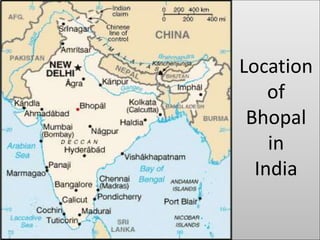
Location
of
Bhopal
in
India
BACKGROUND INFORMATION
The Bhopal disaster, also referred to as
the Bhopal gas tragedy, was a gas leak
incident in India, considered to be the
world's worst industrial disaster.
Monday, December 3rd, 1984. (28 years ago)
BACKGROUND INFORMATION
• One of Union Carbide’s Pesticide factories was
located in Bhopal, India.
• Union Carbide of India Limited (UCIL) was a
subsidiary of The Union Carbide Corporation
(UCC).
• The Factory produced carbanate pesticides. One
Component was Methyl Isocyanate (MIC).
• A rapidly growing community of roughly 900,000
people.
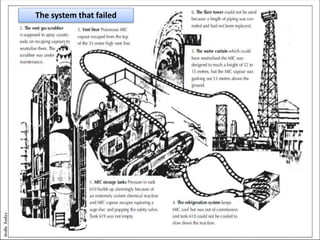
The system that failed
The Bhopal Disaster!
• 40 tons of deadly gases suddenly burst out into the
atmosphere.
• Workers fled in panic.
• People woke up coughing violently and with eyes
burning as if chilli powder had been flung into them.
• Neighbouring communities fled in panic
• The streets were foul with vomit. Those who fell were
trampled by the crowd.
• The worst affected were the children: unable to walk
and breathe, they simply suffocated and died.
The Bhopal Disaster!
• Ashay Chitre film maker and wife in Bhopal:
• Chaos at 3am , opened the window, they got a
whiff of gas. They immediately felt breathless
and their eyes and noses began to stream with
a yellow fluid.
• Local hospitals were soon overwhelmed with
the injured
• Over 500,000 people were exposed to methyl
isocyanate gas and other chemicals.
Contributing Factors
Factors leading to the magnitude of the gas leak
mainly included problems such as:
• storing MIC in large tanks and filling beyond
recommended levels, poor maintenance after the
plant ceased MIC production at the end of 1984,
• safety systems being switched off to save
money— including the MIC tank refrigeration
system which could have mitigated the disaster
severity.
• shortcomings in health care and socio-economic
rehabilitation.
Contributing Factors
• use of a more dangerous pesticide manufacturing
method,
• plant location close to a densely populated area,
• undersized safety devices,
• Plant management deficiencies were also
identified – lack of skilled operators, reduction of
safety management, insufficient maintenance,
and inadequate emergency action plans.
AFTERMATH OF IT ALL
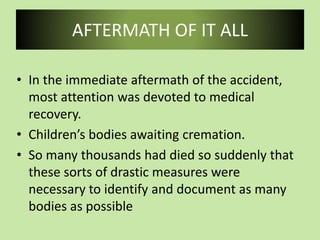
• In the immediate aftermath of the accident,
most attention was devoted to medical
recovery.
• Children’s bodies awaiting cremation.
• So many thousands had died so suddenly that
these sorts of drastic measures were
necessary to identify and document as many
bodies as possible
AFTERMATH OF IT ALL
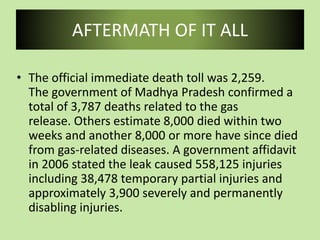
• The official immediate death toll was 2,259.
The government of Madhya Pradesh confirmed a
total of 3,787 deaths related to the gas
release. Others estimate 8,000 died within two
weeks and another 8,000 or more have since died
from gas-related diseases. A government affidavit
in 2006 stated the leak caused 558,125 injuries
including 38,478 temporary partial injuries and
approximately 3,900 severely and permanently
disabling injuries.
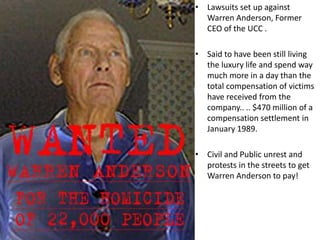
• Lawsuits set up against
Warren Anderson, Former
CEO of the UCC .
• Said to have been still living
the luxury life and spend way
much more in a day than the
total compensation of victims
have received from the
company.. .. $470 million of a
compensation settlement in
January 1989.
• Civil and Public unrest and
protests in the streets to get
Warren Anderson to pay!
Victims Remain Victims
• >Resident Leela was one of those caught by
Union Carbide’s cloud of poison gas.
• >Her family of six survived, but ever since
they have suffered from breathlessness and
spells of vomiting. One of her sons has gone
blind. All six family members suffer from
breathlessness and spells of vomiting.
• >Burdened by injury they cannot earn well.
The family’s joint income is $30 a month.
• For the gas victims of Bhopal every day of the
Victims Remain Victims
• 90% got less than $500.
• Leela got just $208. “No one in my family received more than
that”, she told us. “The money went on medicines as soon as
it came to our hands.”
• Over eighteen years $208 works out at just 3 cents a day and
with each day that passes, its value dwindles.
• Carbide's compensation will barely buy one glass of tea a day
Economic Effects
• loss of jobs (650 permanent jobs were lost)
• loss of earning capacity of victims
• business disruptions
• cost of compensation
• rehabilitation, and legal costs.
• "Investment hasn't been coming to Bhopal
because of the stigma."
NOW
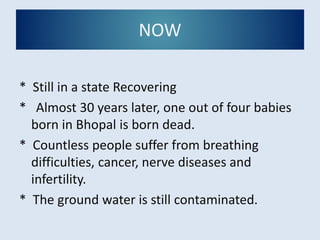
* Still in a state Recovering
* Almost 30 years later, one out of four babies
born in Bhopal is born dead.
* Countless people suffer from breathing
difficulties, cancer, nerve diseases and
infertility.
* The ground water is still contaminated.
NOW
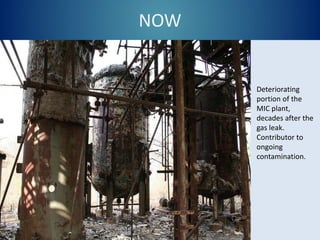
Deteriorating
portion of the
MIC plant,
decades after the
gas leak.
Contributor to
ongoing
contamination.
NOW
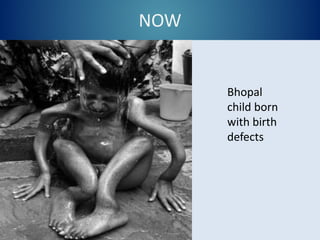
Bhopal
child born
with birth
defects
Lessons Learned/ Causal responses
• Had the safety systems been in working order, the
leak would not have been as damaging.
• $2.2 Million grant to Arizona State University for new
vocational-technical training facility for the citizens of
Bhopal.
• Emergency Planning and Community Right To
Know Act which Provides information to local
communities and individuals about hazardous
materials in their local areas.
• Location of plants away from densely populated
areas

Bhopal_Presentation_Barker. the gas and issue

  • 2.
  • 3.
    BACKGROUND INFORMATION The Bhopaldisaster, also referred to as the Bhopal gas tragedy, was a gas leak incident in India, considered to be the world's worst industrial disaster. Monday, December 3rd, 1984. (28 years ago)
  • 4.
    BACKGROUND INFORMATION • Oneof Union Carbide’s Pesticide factories was located in Bhopal, India. • Union Carbide of India Limited (UCIL) was a subsidiary of The Union Carbide Corporation (UCC). • The Factory produced carbanate pesticides. One Component was Methyl Isocyanate (MIC). • A rapidly growing community of roughly 900,000 people.
  • 5.
  • 6.
    The Bhopal Disaster! •40 tons of deadly gases suddenly burst out into the atmosphere. • Workers fled in panic. • People woke up coughing violently and with eyes burning as if chilli powder had been flung into them. • Neighbouring communities fled in panic • The streets were foul with vomit. Those who fell were trampled by the crowd. • The worst affected were the children: unable to walk and breathe, they simply suffocated and died.
  • 7.
    The Bhopal Disaster! •Ashay Chitre film maker and wife in Bhopal: • Chaos at 3am , opened the window, they got a whiff of gas. They immediately felt breathless and their eyes and noses began to stream with a yellow fluid. • Local hospitals were soon overwhelmed with the injured • Over 500,000 people were exposed to methyl isocyanate gas and other chemicals.
  • 8.
    Contributing Factors Factors leadingto the magnitude of the gas leak mainly included problems such as: • storing MIC in large tanks and filling beyond recommended levels, poor maintenance after the plant ceased MIC production at the end of 1984, • safety systems being switched off to save money— including the MIC tank refrigeration system which could have mitigated the disaster severity. • shortcomings in health care and socio-economic rehabilitation.
  • 9.
    Contributing Factors • useof a more dangerous pesticide manufacturing method, • plant location close to a densely populated area, • undersized safety devices, • Plant management deficiencies were also identified – lack of skilled operators, reduction of safety management, insufficient maintenance, and inadequate emergency action plans.
  • 10.
    AFTERMATH OF ITALL • In the immediate aftermath of the accident, most attention was devoted to medical recovery. • Children’s bodies awaiting cremation. • So many thousands had died so suddenly that these sorts of drastic measures were necessary to identify and document as many bodies as possible
  • 11.
    AFTERMATH OF ITALL • The official immediate death toll was 2,259. The government of Madhya Pradesh confirmed a total of 3,787 deaths related to the gas release. Others estimate 8,000 died within two weeks and another 8,000 or more have since died from gas-related diseases. A government affidavit in 2006 stated the leak caused 558,125 injuries including 38,478 temporary partial injuries and approximately 3,900 severely and permanently disabling injuries.
  • 12.
    • Lawsuits setup against Warren Anderson, Former CEO of the UCC . • Said to have been still living the luxury life and spend way much more in a day than the total compensation of victims have received from the company.. .. $470 million of a compensation settlement in January 1989. • Civil and Public unrest and protests in the streets to get Warren Anderson to pay!
  • 13.
    Victims Remain Victims •>Resident Leela was one of those caught by Union Carbide’s cloud of poison gas. • >Her family of six survived, but ever since they have suffered from breathlessness and spells of vomiting. One of her sons has gone blind. All six family members suffer from breathlessness and spells of vomiting. • >Burdened by injury they cannot earn well. The family’s joint income is $30 a month. • For the gas victims of Bhopal every day of the
  • 14.
    Victims Remain Victims •90% got less than $500. • Leela got just $208. “No one in my family received more than that”, she told us. “The money went on medicines as soon as it came to our hands.” • Over eighteen years $208 works out at just 3 cents a day and with each day that passes, its value dwindles. • Carbide's compensation will barely buy one glass of tea a day
  • 15.
    Economic Effects • lossof jobs (650 permanent jobs were lost) • loss of earning capacity of victims • business disruptions • cost of compensation • rehabilitation, and legal costs. • "Investment hasn't been coming to Bhopal because of the stigma."
  • 17.
    NOW * Still ina state Recovering * Almost 30 years later, one out of four babies born in Bhopal is born dead. * Countless people suffer from breathing difficulties, cancer, nerve diseases and infertility. * The ground water is still contaminated.
  • 18.
    NOW Deteriorating portion of the MICplant, decades after the gas leak. Contributor to ongoing contamination.
  • 19.
  • 20.
    Lessons Learned/ Causalresponses • Had the safety systems been in working order, the leak would not have been as damaging. • $2.2 Million grant to Arizona State University for new vocational-technical training facility for the citizens of Bhopal. • Emergency Planning and Community Right To Know Act which Provides information to local communities and individuals about hazardous materials in their local areas. • Location of plants away from densely populated areas