1
CASE STUDY
How Brown & Holmes reduced non-productive time and
saved over £67,000 per year!
“In pursuit of opportunities to achieve sustainable performance
improvements, Brown & Holmes engaged AIM Professional Services Ltd
to engender a climate of high performance management in the
workplace that would transform efficiencies and reduce cost”
2
INTRODUCTION
Jeffrey Pfeffer1
(Professor of Organizational Behaviour at the Graduate School of Business, Stanford
University USA) has commented:-
“Achieving competitive success through motivating people involves fundamentally altering
how we think about the workforce and the employment relationship. It means achieving
success by working with people, not by replacing them or limiting the scope of their activities.
It entails seeing the workforce as a source of strategic advantage, not just as a cost to be
minimized or avoided. Firms that take this different perspective are often able to successfully
outmanoeuvre and outperform their rivals”.
So to achieve success by working with people the AIM approach is focused on work-based
learning where employees gain specialist knowledge and build their confidence,
communication skills and motivation. In this High Performance Management programme,
participants are encouraged to assess existing business practices and alternative
approaches which will help in meeting the organisation's needs and benefit profitability.
A study by McKinsey & Co
2
(the highly respected global management consultancy) of over
4000 medium sized companies conclusively showed that there is a strong correlation
between improved management practices and improved business performance. Improving
management practice is also associated with large increases in productivity and output. Yet
surprisingly few firms have made any attempt to gain an insight into the quality of their
management behaviours. Those that do so give themselves the opportunity to access rapid,
cost-effective and sustainable competitive advantage.
1
Jeffrey Pfeffer, Competitive Advantage through People, Harvard Business School Press
2
Management Practice & Productivity: Why they matter
3
Kevin Ward, Managing Director, commented:-
“A great deal of our success can be attributed to our commitment to
training and we have been delighted with the outcomes we have gained
so far from the AIM business improvement and leadership programme.
This case study illustrates how a well-motivated and engaged
management team can dramatically improve productivity in a sustainable
and financially beneficial way.
Adding to our core competencies has strengthened our all-round
business capability”.
For more information contact:-
AIM Professional Services Ltd, enquiries@aimproserv.co.uk
Tel: - Glyn Jenks 07860 919296
Ron Mackrell 07967 394938
4
BROWN & HOLMES (TAMWORTH) LTD Apollo Park, Lichfield Road Industrial Estate, Tamworth,
B79 7TA
http://www.brownandholmes.co.uk/
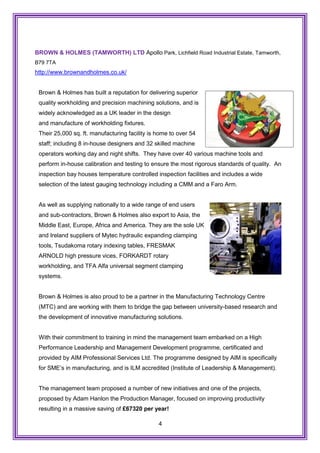
Brown & Holmes has built a reputation for delivering superior
quality workholding and precision machining solutions, and is
widely acknowledged as a UK leader in the design
and manufacture of workholding fixtures.
Their 25,000 sq. ft. manufacturing facility is home to over 54
staff; including 8 in-house designers and 32 skilled machine
operators working day and night shifts. They have over 40 various machine tools and
perform in-house calibration and testing to ensure the most rigorous standards of quality. An
inspection bay houses temperature controlled inspection facilities and includes a wide
selection of the latest gauging technology including a CMM and a Faro Arm.
As well as supplying nationally to a wide range of end users
and sub-contractors, Brown & Holmes also export to Asia, the
Middle East, Europe, Africa and America. They are the sole UK
and Ireland suppliers of Mytec hydraulic expanding clamping
tools, Tsudakoma rotary indexing tables, FRESMAK
ARNOLD high pressure vices, FORKARDT rotary
workholding, and TFA Alfa universal segment clamping
systems.
Brown & Holmes is also proud to be a partner in the Manufacturing Technology Centre
(MTC) and are working with them to bridge the gap between university-based research and
the development of innovative manufacturing solutions.
With their commitment to training in mind the management team embarked on a High
Performance Leadership and Management Development programme, certificated and
provided by AIM Professional Services Ltd. The programme designed by AIM is specifically
for SME’s in manufacturing, and is ILM accredited (Institute of Leadership & Management).
The management team proposed a number of new initiatives and one of the projects,
proposed by Adam Hanlon the Production Manager, focused on improving productivity
resulting in a massive saving of £67320 per year!
5
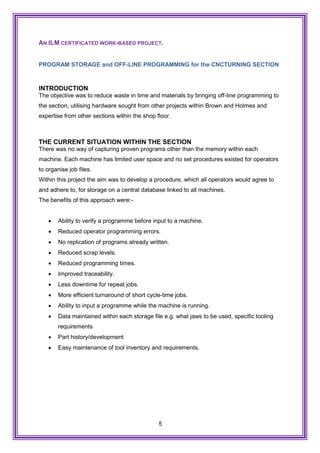
AN ILM CERTIFICATED WORK-BASED PROJECT.
PROGRAM STORAGE and OFF-LINE PROGRAMMING for the CNCTURNING SECTION
INTRODUCTION
The objective was to reduce waste in time and materials by bringing off-line programming to
the section, utilising hardware sought from other projects within Brown and Holmes and
expertise from other sections within the shop floor.
THE CURRENT SITUATION WITHIN THE SECTION
There was no way of capturing proven programs other than the memory within each
machine. Each machine has limited user space and no set procedures existed for operators
to organise job files.
Within this project the aim was to develop a procedure, which all operators would agree to
and adhere to, for storage on a central database linked to all machines.
The benefits of this approach were:-
 Ability to verify a programme before input to a machine.
 Reduced operator programming errors.
 No replication of programs already written.
 Reduced scrap levels.
 Reduced programming times.
 Improved traceability.
 Less downtime for repeat jobs.
 More efficient turnaround of short cycle-time jobs.
 Ability to input a programme while the machine is running.
 Data maintained within each storage file e.g. what jaws to be used, specific tooling
requirements
 Part history/development
 Easy maintenance of tool inventory and requirements.
6
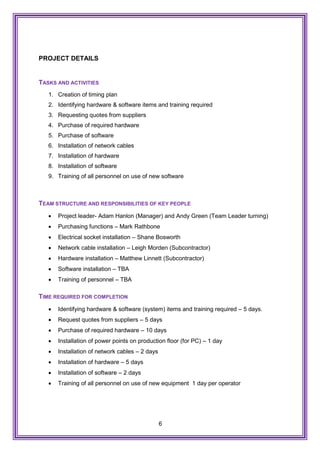
PROJECT DETAILS
TASKS AND ACTIVITIES
1. Creation of timing plan
2. Identifying hardware & software items and training required
3. Requesting quotes from suppliers
4. Purchase of required hardware
5. Purchase of software
6. Installation of network cables
7. Installation of hardware
8. Installation of software
9. Training of all personnel on use of new software
TEAM STRUCTURE AND RESPONSIBILITIES OF KEY PEOPLE
 Project leader- Adam Hanlon (Manager) and Andy Green (Team Leader turning)
 Purchasing functions – Mark Rathbone
 Electrical socket installation – Shane Bosworth
 Network cable installation – Leigh Morden (Subcontractor)
 Hardware installation – Matthew Linnett (Subcontractor)
 Software installation – TBA
 Training of personnel – TBA
TIME REQUIRED FOR COMPLETION
 Identifying hardware & software (system) items and training required – 5 days.
 Request quotes from suppliers – 5 days
 Purchase of required hardware – 10 days
 Installation of power points on production floor (for PC) – 1 day
 Installation of network cables – 2 days
 Installation of hardware – 5 days
 Installation of software – 2 days
 Training of all personnel on use of new equipment 1 day per operator
7
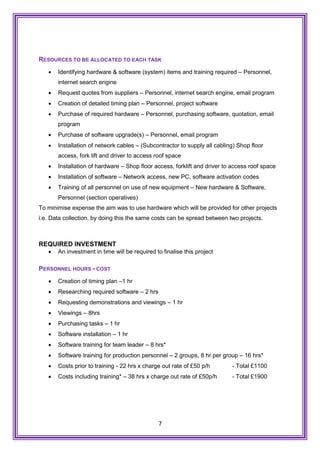
RESOURCES TO BE ALLOCATED TO EACH TASK
 Identifying hardware & software (system) items and training required – Personnel,
internet search engine
 Request quotes from suppliers – Personnel, internet search engine, email program
 Creation of detailed timing plan – Personnel, project software
 Purchase of required hardware – Personnel, purchasing software, quotation, email
program
 Purchase of software upgrade(s) – Personnel, email program
 Installation of network cables – (Subcontractor to supply all cabling) Shop floor
access, fork lift and driver to access roof space
 Installation of hardware – Shop floor access, forklift and driver to access roof space
 Installation of software – Network access, new PC, software activation codes
 Training of all personnel on use of new equipment – New hardware & Software,
Personnel (section operatives)
To minimise expense the aim was to use hardware which will be provided for other projects
i.e. Data collection, by doing this the same costs can be spread between two projects.
REQUIRED INVESTMENT
 An investment in time will be required to finalise this project
PERSONNEL HOURS - COST
 Creation of timing plan –1 hr
 Researching required software – 2 hrs
 Requesting demonstrations and viewings – 1 hr
 Viewings – 8hrs
 Purchasing tasks – 1 hr
 Software installation – 1 hr
 Software training for team leader – 8 hrs*
 Software training for production personnel – 2 groups, 8 hr per group – 16 hrs*
 Costs prior to training - 22 hrs x charge out rate of £50 p/h - Total £1100
 Costs including training* – 38 hrs x charge out rate of £50p/h - Total £1900
8
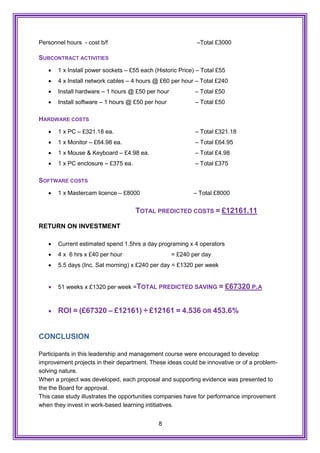
Personnel hours - cost b/f –Total £3000
SUBCONTRACT ACTIVITIES
 1 x Install power sockets – £55 each (Historic Price) – Total £55
 4 x Install network cables – 4 hours @ £60 per hour – Total £240
 Install hardware – 1 hours @ £50 per hour – Total £50
 Install software – 1 hours @ £50 per hour – Total £50
HARDWARE COSTS
 1 x PC – £321.18 ea. – Total £321.18
 1 x Monitor – £64.98 ea. – Total £64.95
 1 x Mouse & Keyboard – £4.98 ea. – Total £4.98
 1 x PC enclosure – £375 ea. – Total £375
SOFTWARE COSTS
 1 x Mastercam licence – £8000 – Total £8000
TOTAL PREDICTED COSTS = £12161.11
RETURN ON INVESTMENT
 Current estimated spend 1.5hrs a day programing x 4 operators
 4 x 6 hrs x £40 per hour = £240 per day
 5.5 days (Inc. Sat morning) x £240 per day = £1320 per week
 51 weeks x £1320 per week =TOTAL PREDICTED SAVING = £67320 P.A
 ROI = (£67320 – £12161) ÷ £12161 = 4.536 OR 453.6%
CONCLUSION
Participants in this leadership and management course were encouraged to develop
improvement projects in their department. These ideas could be innovative or of a problem-
solving nature.
When a project was developed, each proposal and supporting evidence was presented to
the the Board for approval.
This case study illustrates the opportunities companies have for performance improvement
when they invest in work-based learning intitiatives.

B&H case study Sept16

  • 1.
    1 CASE STUDY How Brown& Holmes reduced non-productive time and saved over £67,000 per year! “In pursuit of opportunities to achieve sustainable performance improvements, Brown & Holmes engaged AIM Professional Services Ltd to engender a climate of high performance management in the workplace that would transform efficiencies and reduce cost”
  • 2.
    2 INTRODUCTION Jeffrey Pfeffer1 (Professor ofOrganizational Behaviour at the Graduate School of Business, Stanford University USA) has commented:- “Achieving competitive success through motivating people involves fundamentally altering how we think about the workforce and the employment relationship. It means achieving success by working with people, not by replacing them or limiting the scope of their activities. It entails seeing the workforce as a source of strategic advantage, not just as a cost to be minimized or avoided. Firms that take this different perspective are often able to successfully outmanoeuvre and outperform their rivals”. So to achieve success by working with people the AIM approach is focused on work-based learning where employees gain specialist knowledge and build their confidence, communication skills and motivation. In this High Performance Management programme, participants are encouraged to assess existing business practices and alternative approaches which will help in meeting the organisation's needs and benefit profitability. A study by McKinsey & Co 2 (the highly respected global management consultancy) of over 4000 medium sized companies conclusively showed that there is a strong correlation between improved management practices and improved business performance. Improving management practice is also associated with large increases in productivity and output. Yet surprisingly few firms have made any attempt to gain an insight into the quality of their management behaviours. Those that do so give themselves the opportunity to access rapid, cost-effective and sustainable competitive advantage. 1 Jeffrey Pfeffer, Competitive Advantage through People, Harvard Business School Press 2 Management Practice & Productivity: Why they matter
  • 3.
    3 Kevin Ward, ManagingDirector, commented:- “A great deal of our success can be attributed to our commitment to training and we have been delighted with the outcomes we have gained so far from the AIM business improvement and leadership programme. This case study illustrates how a well-motivated and engaged management team can dramatically improve productivity in a sustainable and financially beneficial way. Adding to our core competencies has strengthened our all-round business capability”. For more information contact:- AIM Professional Services Ltd, enquiries@aimproserv.co.uk Tel: - Glyn Jenks 07860 919296 Ron Mackrell 07967 394938
  • 4.
    4 BROWN & HOLMES(TAMWORTH) LTD Apollo Park, Lichfield Road Industrial Estate, Tamworth, B79 7TA http://www.brownandholmes.co.uk/ Brown & Holmes has built a reputation for delivering superior quality workholding and precision machining solutions, and is widely acknowledged as a UK leader in the design and manufacture of workholding fixtures. Their 25,000 sq. ft. manufacturing facility is home to over 54 staff; including 8 in-house designers and 32 skilled machine operators working day and night shifts. They have over 40 various machine tools and perform in-house calibration and testing to ensure the most rigorous standards of quality. An inspection bay houses temperature controlled inspection facilities and includes a wide selection of the latest gauging technology including a CMM and a Faro Arm. As well as supplying nationally to a wide range of end users and sub-contractors, Brown & Holmes also export to Asia, the Middle East, Europe, Africa and America. They are the sole UK and Ireland suppliers of Mytec hydraulic expanding clamping tools, Tsudakoma rotary indexing tables, FRESMAK ARNOLD high pressure vices, FORKARDT rotary workholding, and TFA Alfa universal segment clamping systems. Brown & Holmes is also proud to be a partner in the Manufacturing Technology Centre (MTC) and are working with them to bridge the gap between university-based research and the development of innovative manufacturing solutions. With their commitment to training in mind the management team embarked on a High Performance Leadership and Management Development programme, certificated and provided by AIM Professional Services Ltd. The programme designed by AIM is specifically for SME’s in manufacturing, and is ILM accredited (Institute of Leadership & Management). The management team proposed a number of new initiatives and one of the projects, proposed by Adam Hanlon the Production Manager, focused on improving productivity resulting in a massive saving of £67320 per year!
  • 5.
    5 AN ILM CERTIFICATEDWORK-BASED PROJECT. PROGRAM STORAGE and OFF-LINE PROGRAMMING for the CNCTURNING SECTION INTRODUCTION The objective was to reduce waste in time and materials by bringing off-line programming to the section, utilising hardware sought from other projects within Brown and Holmes and expertise from other sections within the shop floor. THE CURRENT SITUATION WITHIN THE SECTION There was no way of capturing proven programs other than the memory within each machine. Each machine has limited user space and no set procedures existed for operators to organise job files. Within this project the aim was to develop a procedure, which all operators would agree to and adhere to, for storage on a central database linked to all machines. The benefits of this approach were:-  Ability to verify a programme before input to a machine.  Reduced operator programming errors.  No replication of programs already written.  Reduced scrap levels.  Reduced programming times.  Improved traceability.  Less downtime for repeat jobs.  More efficient turnaround of short cycle-time jobs.  Ability to input a programme while the machine is running.  Data maintained within each storage file e.g. what jaws to be used, specific tooling requirements  Part history/development  Easy maintenance of tool inventory and requirements.
  • 6.
    6 PROJECT DETAILS TASKS ANDACTIVITIES 1. Creation of timing plan 2. Identifying hardware & software items and training required 3. Requesting quotes from suppliers 4. Purchase of required hardware 5. Purchase of software 6. Installation of network cables 7. Installation of hardware 8. Installation of software 9. Training of all personnel on use of new software TEAM STRUCTURE AND RESPONSIBILITIES OF KEY PEOPLE  Project leader- Adam Hanlon (Manager) and Andy Green (Team Leader turning)  Purchasing functions – Mark Rathbone  Electrical socket installation – Shane Bosworth  Network cable installation – Leigh Morden (Subcontractor)  Hardware installation – Matthew Linnett (Subcontractor)  Software installation – TBA  Training of personnel – TBA TIME REQUIRED FOR COMPLETION  Identifying hardware & software (system) items and training required – 5 days.  Request quotes from suppliers – 5 days  Purchase of required hardware – 10 days  Installation of power points on production floor (for PC) – 1 day  Installation of network cables – 2 days  Installation of hardware – 5 days  Installation of software – 2 days  Training of all personnel on use of new equipment 1 day per operator
  • 7.
    7 RESOURCES TO BEALLOCATED TO EACH TASK  Identifying hardware & software (system) items and training required – Personnel, internet search engine  Request quotes from suppliers – Personnel, internet search engine, email program  Creation of detailed timing plan – Personnel, project software  Purchase of required hardware – Personnel, purchasing software, quotation, email program  Purchase of software upgrade(s) – Personnel, email program  Installation of network cables – (Subcontractor to supply all cabling) Shop floor access, fork lift and driver to access roof space  Installation of hardware – Shop floor access, forklift and driver to access roof space  Installation of software – Network access, new PC, software activation codes  Training of all personnel on use of new equipment – New hardware & Software, Personnel (section operatives) To minimise expense the aim was to use hardware which will be provided for other projects i.e. Data collection, by doing this the same costs can be spread between two projects. REQUIRED INVESTMENT  An investment in time will be required to finalise this project PERSONNEL HOURS - COST  Creation of timing plan –1 hr  Researching required software – 2 hrs  Requesting demonstrations and viewings – 1 hr  Viewings – 8hrs  Purchasing tasks – 1 hr  Software installation – 1 hr  Software training for team leader – 8 hrs*  Software training for production personnel – 2 groups, 8 hr per group – 16 hrs*  Costs prior to training - 22 hrs x charge out rate of £50 p/h - Total £1100  Costs including training* – 38 hrs x charge out rate of £50p/h - Total £1900
  • 8.
    8 Personnel hours -cost b/f –Total £3000 SUBCONTRACT ACTIVITIES  1 x Install power sockets – £55 each (Historic Price) – Total £55  4 x Install network cables – 4 hours @ £60 per hour – Total £240  Install hardware – 1 hours @ £50 per hour – Total £50  Install software – 1 hours @ £50 per hour – Total £50 HARDWARE COSTS  1 x PC – £321.18 ea. – Total £321.18  1 x Monitor – £64.98 ea. – Total £64.95  1 x Mouse & Keyboard – £4.98 ea. – Total £4.98  1 x PC enclosure – £375 ea. – Total £375 SOFTWARE COSTS  1 x Mastercam licence – £8000 – Total £8000 TOTAL PREDICTED COSTS = £12161.11 RETURN ON INVESTMENT  Current estimated spend 1.5hrs a day programing x 4 operators  4 x 6 hrs x £40 per hour = £240 per day  5.5 days (Inc. Sat morning) x £240 per day = £1320 per week  51 weeks x £1320 per week =TOTAL PREDICTED SAVING = £67320 P.A  ROI = (£67320 – £12161) ÷ £12161 = 4.536 OR 453.6% CONCLUSION Participants in this leadership and management course were encouraged to develop improvement projects in their department. These ideas could be innovative or of a problem- solving nature. When a project was developed, each proposal and supporting evidence was presented to the the Board for approval. This case study illustrates the opportunities companies have for performance improvement when they invest in work-based learning intitiatives.