























Beyond The Web: Drupal Meets The Desktop (And Mobile)

Editor's Notes

  • #2 - how many people -- first time drupalcon? - how many people -- new to drupal? - how many people -- new to integrating with drupal?
  • #3 - Portland, Oregon - Started using Drupal here in DC about five years ago - Drupal & web developer, sysadmin, and Mac/iPhone developer - Interested in how these areas converge -- whole stack -- datacenter to client app
  • #4 - Portland, Oregon - Started using Drupal here in DC about five years ago - Drupal & web developer, sysadmin, and Mac/iPhone developer - Interested in how these areas converge -- whole stack -- datacenter to client app
  • #5 - Portland, Oregon - Started using Drupal here in DC about five years ago - Drupal & web developer, sysadmin, and Mac/iPhone developer - Interested in how these areas converge -- whole stack -- datacenter to client app
  • #6 - Portland, Oregon - Started using Drupal here in DC about five years ago - Drupal & web developer, sysadmin, and Mac/iPhone developer - Interested in how these areas converge -- whole stack -- datacenter to client app
  • #7 - Portland, Oregon - Started using Drupal here in DC about five years ago - Drupal & web developer, sysadmin, and Mac/iPhone developer - Interested in how these areas converge -- whole stack -- datacenter to client app
  • #8 - Portland, Oregon - Started using Drupal here in DC about five years ago - Drupal & web developer, sysadmin, and Mac/iPhone developer - Interested in how these areas converge -- whole stack -- datacenter to client app
  • #9 - Portland, Oregon - Started using Drupal here in DC about five years ago - Drupal & web developer, sysadmin, and Mac/iPhone developer - Interested in how these areas converge -- whole stack -- datacenter to client app
  • #10 - Portland, Oregon - Started using Drupal here in DC about five years ago - Drupal & web developer, sysadmin, and Mac/iPhone developer - Interested in how these areas converge -- whole stack -- datacenter to client app
  • #11 - Portland, Oregon - Started using Drupal here in DC about five years ago - Drupal & web developer, sysadmin, and Mac/iPhone developer - Interested in how these areas converge -- whole stack -- datacenter to client app
  • #12 - What kinds of things can I use? - What kinds of things am I already using that could be used for integration?
  • #13 - What kinds of things can I use? - What kinds of things am I already using that could be used for integration?
  • #14 - What kinds of things can I use? - What kinds of things am I already using that could be used for integration?
  • #15 - Standards that are open -- fully buzzword compliant - Keeping things secure and leveraging Drupal’s built-in security model - Finding jumping off points for future building
  • #16 - Standards that are open -- fully buzzword compliant - Keeping things secure and leveraging Drupal’s built-in security model - Finding jumping off points for future building
  • #17 - Standards that are open -- fully buzzword compliant - Keeping things secure and leveraging Drupal’s built-in security model - Finding jumping off points for future building
  • #18 - Standards that are open -- fully buzzword compliant - Keeping things secure and leveraging Drupal’s built-in security model - Finding jumping off points for future building
  • #19 - Standards that are open -- fully buzzword compliant - Keeping things secure and leveraging Drupal’s built-in security model - Finding jumping off points for future building
  • #20 - Putting data in -- collecting mobile user data points, taking user document submissions, finding a place to store your data. - Getting data out -- getting raw data for use on other platforms, having flexibility in the formats. - Authentication -- keeping it all secure, finding creative & flexible ways to let users in. - Advanced interop -- how to go about building up a full-blown (often) two-way API.
  • #21 - Putting data in -- collecting mobile user data points, taking user document submissions, finding a place to store your data. - Getting data out -- getting raw data for use on other platforms, having flexibility in the formats. - Authentication -- keeping it all secure, finding creative & flexible ways to let users in. - Advanced interop -- how to go about building up a full-blown (often) two-way API.
  • #22 - Putting data in -- collecting mobile user data points, taking user document submissions, finding a place to store your data. - Getting data out -- getting raw data for use on other platforms, having flexibility in the formats. - Authentication -- keeping it all secure, finding creative & flexible ways to let users in. - Advanced interop -- how to go about building up a full-blown (often) two-way API.
  • #23 - Putting data in -- collecting mobile user data points, taking user document submissions, finding a place to store your data. - Getting data out -- getting raw data for use on other platforms, having flexibility in the formats. - Authentication -- keeping it all secure, finding creative & flexible ways to let users in. - Advanced interop -- how to go about building up a full-blown (often) two-way API.
  • #24 - Putting data in -- collecting mobile user data points, taking user document submissions, finding a place to store your data. - Getting data out -- getting raw data for use on other platforms, having flexibility in the formats. - Authentication -- keeping it all secure, finding creative & flexible ways to let users in. - Advanced interop -- how to go about building up a full-blown (often) two-way API.
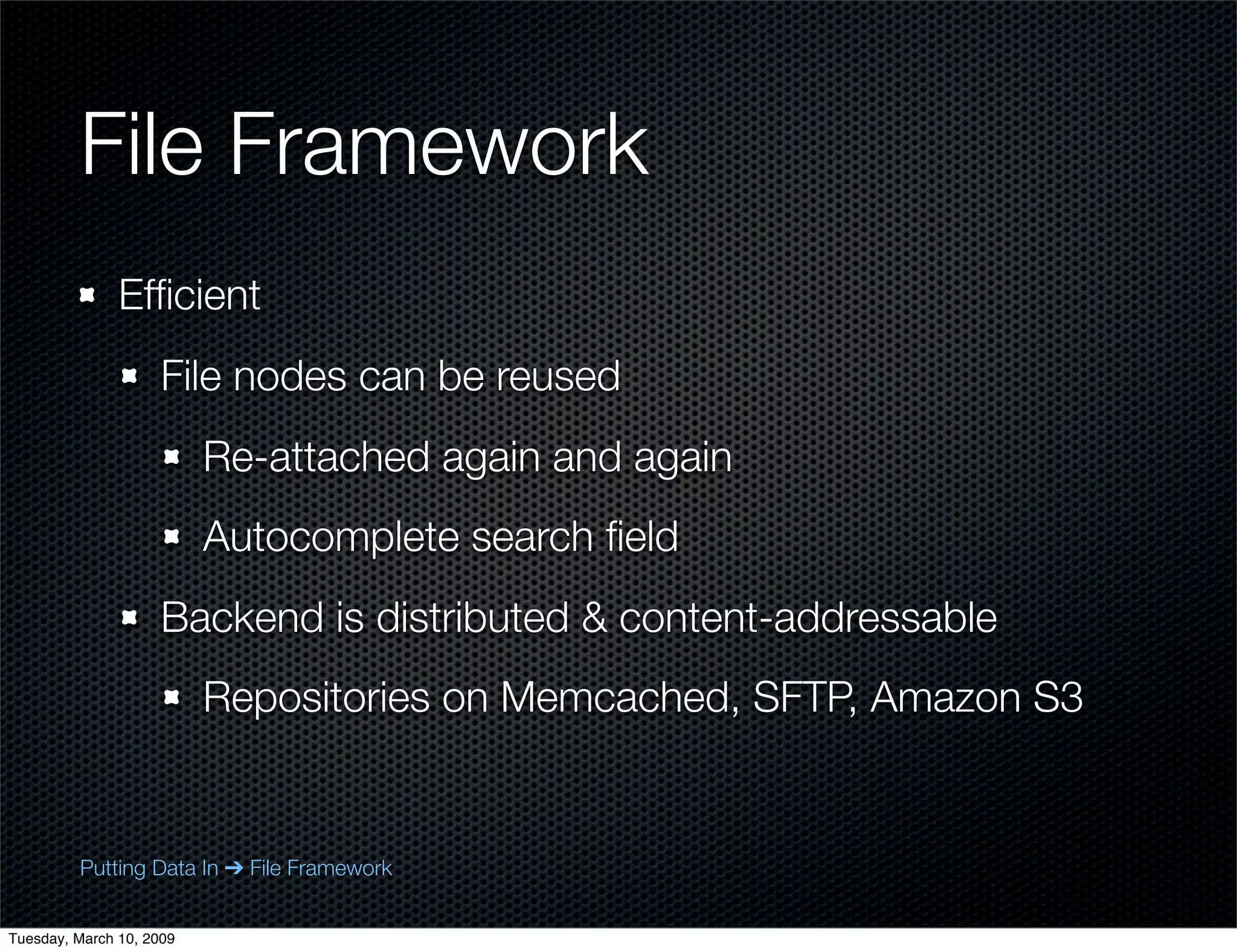
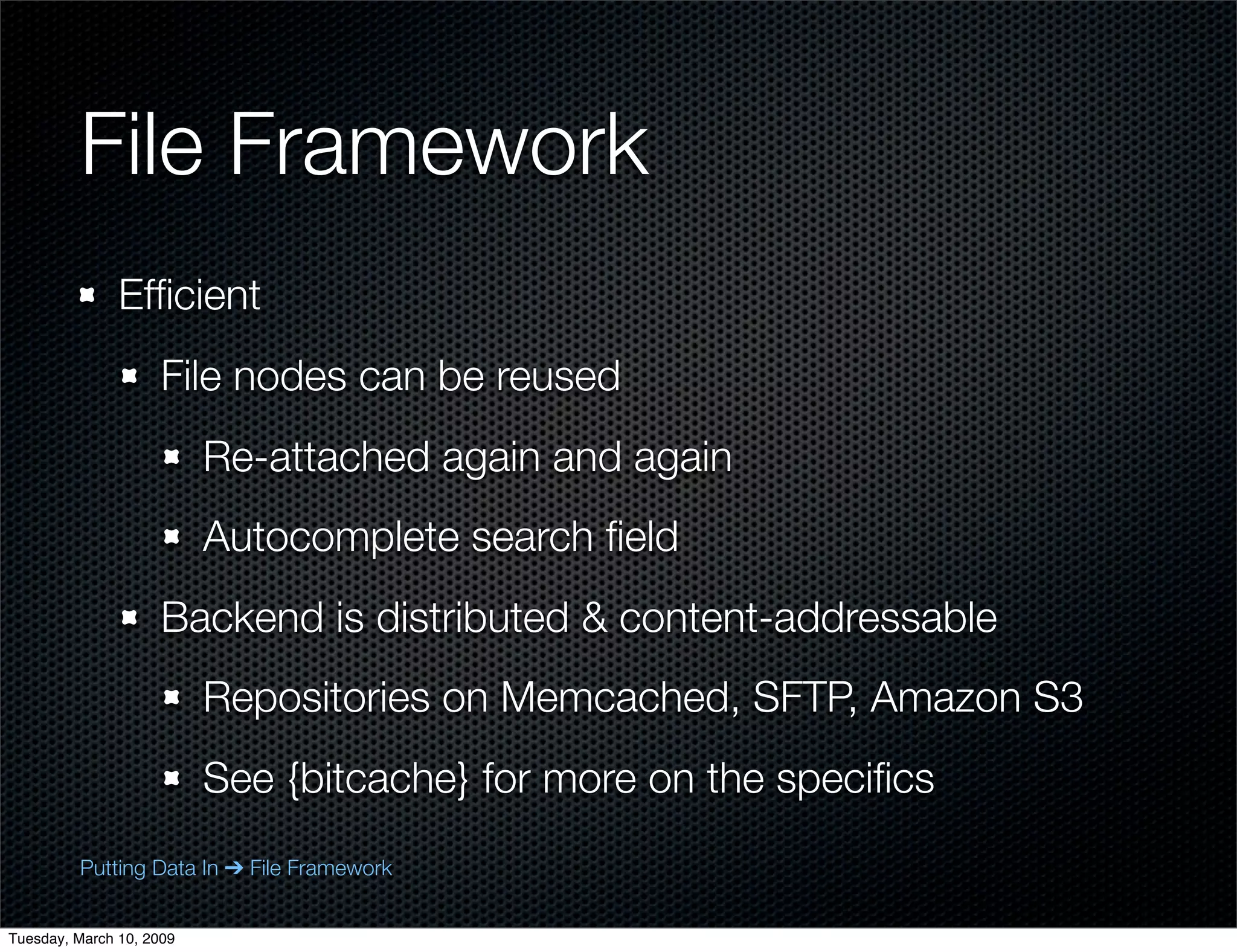
  • #25 - Desktop publishing -- getting content, often blog posts, into Drupal. - File uploads -- focusing on the mechanics, not the UX (sorry). - File Framework -- an advanced framework that greatly augments what’s in core. - WebDAV -- I’ve done a lot of work here -- using clients built into every OS to act in a file metaphor. Builds upon File Framework.
  • #26 - Desktop publishing -- getting content, often blog posts, into Drupal. - File uploads -- focusing on the mechanics, not the UX (sorry). - File Framework -- an advanced framework that greatly augments what’s in core. - WebDAV -- I’ve done a lot of work here -- using clients built into every OS to act in a file metaphor. Builds upon File Framework.
  • #27 - Desktop publishing -- getting content, often blog posts, into Drupal. - File uploads -- focusing on the mechanics, not the UX (sorry). - File Framework -- an advanced framework that greatly augments what’s in core. - WebDAV -- I’ve done a lot of work here -- using clients built into every OS to act in a file metaphor. Builds upon File Framework.
  • #28 - Desktop publishing -- getting content, often blog posts, into Drupal. - File uploads -- focusing on the mechanics, not the UX (sorry). - File Framework -- an advanced framework that greatly augments what’s in core. - WebDAV -- I’ve done a lot of work here -- using clients built into every OS to act in a file metaphor. Builds upon File Framework.
  • #29 - Desktop publishing -- getting content, often blog posts, into Drupal. - File uploads -- focusing on the mechanics, not the UX (sorry). - File Framework -- an advanced framework that greatly augments what’s in core. - WebDAV -- I’ve done a lot of work here -- using clients built into every OS to act in a file metaphor. Builds upon File Framework.
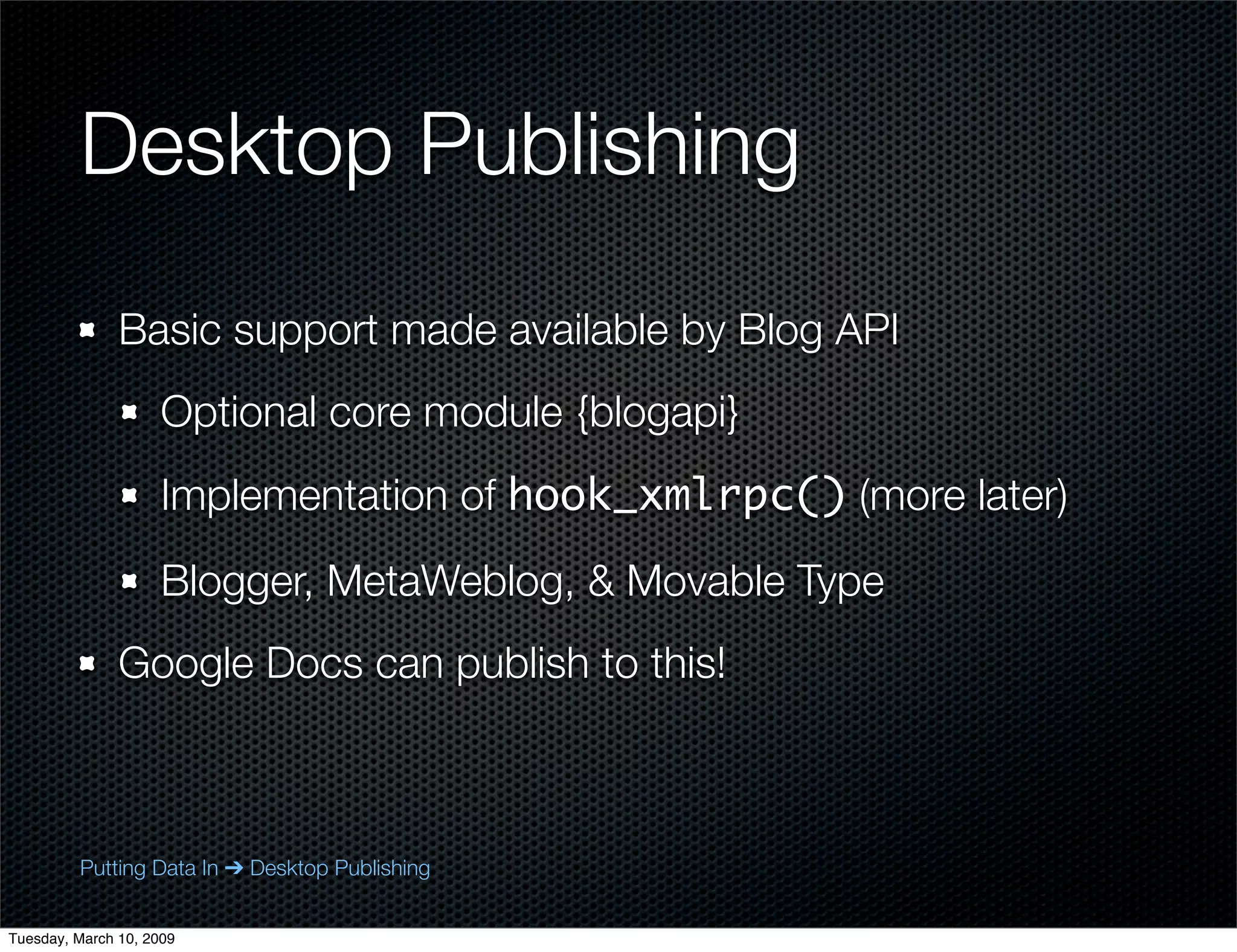
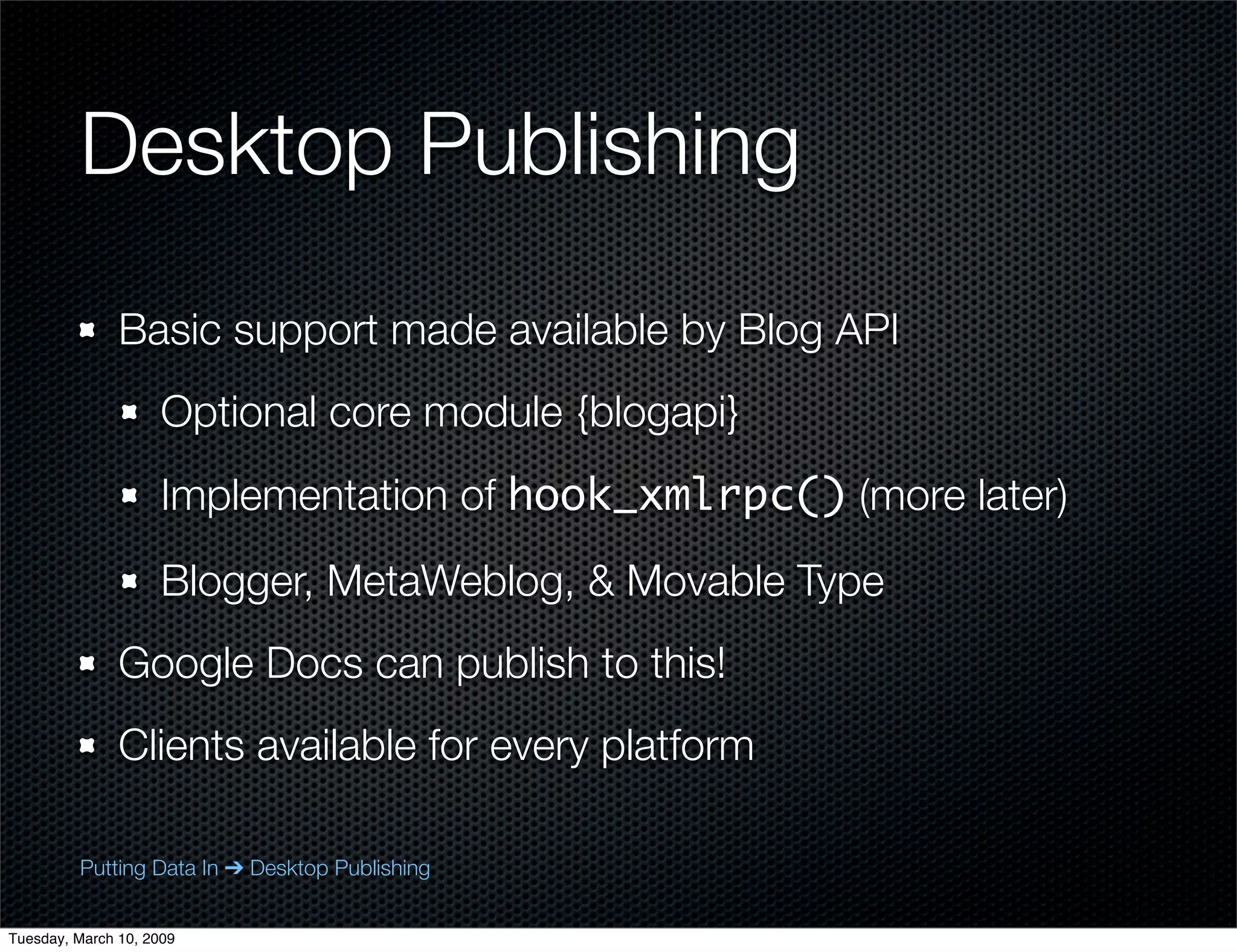
  • #30 - Popular -- this is what Wordpress, MT, etc. are doing too. - This has been in Drupal from the beginning. - Mac: MarsEdit, Ecto, Blogo Windows: Qumana, Windows Live Writer Linux/BSD: Flock, Kblogger, ScribeFire for Firefox, Sun Weblog Publisher for OpenOffice
  • #31 - Popular -- this is what Wordpress, MT, etc. are doing too. - This has been in Drupal from the beginning. - Mac: MarsEdit, Ecto, Blogo Windows: Qumana, Windows Live Writer Linux/BSD: Flock, Kblogger, ScribeFire for Firefox, Sun Weblog Publisher for OpenOffice
  • #32 - Popular -- this is what Wordpress, MT, etc. are doing too. - This has been in Drupal from the beginning. - Mac: MarsEdit, Ecto, Blogo Windows: Qumana, Windows Live Writer Linux/BSD: Flock, Kblogger, ScribeFire for Firefox, Sun Weblog Publisher for OpenOffice
  • #33 - Popular -- this is what Wordpress, MT, etc. are doing too. - This has been in Drupal from the beginning. - Mac: MarsEdit, Ecto, Blogo Windows: Qumana, Windows Live Writer Linux/BSD: Flock, Kblogger, ScribeFire for Firefox, Sun Weblog Publisher for OpenOffice
  • #34 - Popular -- this is what Wordpress, MT, etc. are doing too. - This has been in Drupal from the beginning. - Mac: MarsEdit, Ecto, Blogo Windows: Qumana, Windows Live Writer Linux/BSD: Flock, Kblogger, ScribeFire for Firefox, Sun Weblog Publisher for OpenOffice
  • #35 - Popular -- this is what Wordpress, MT, etc. are doing too. - This has been in Drupal from the beginning. - Mac: MarsEdit, Ecto, Blogo Windows: Qumana, Windows Live Writer Linux/BSD: Flock, Kblogger, ScribeFire for Firefox, Sun Weblog Publisher for OpenOffice
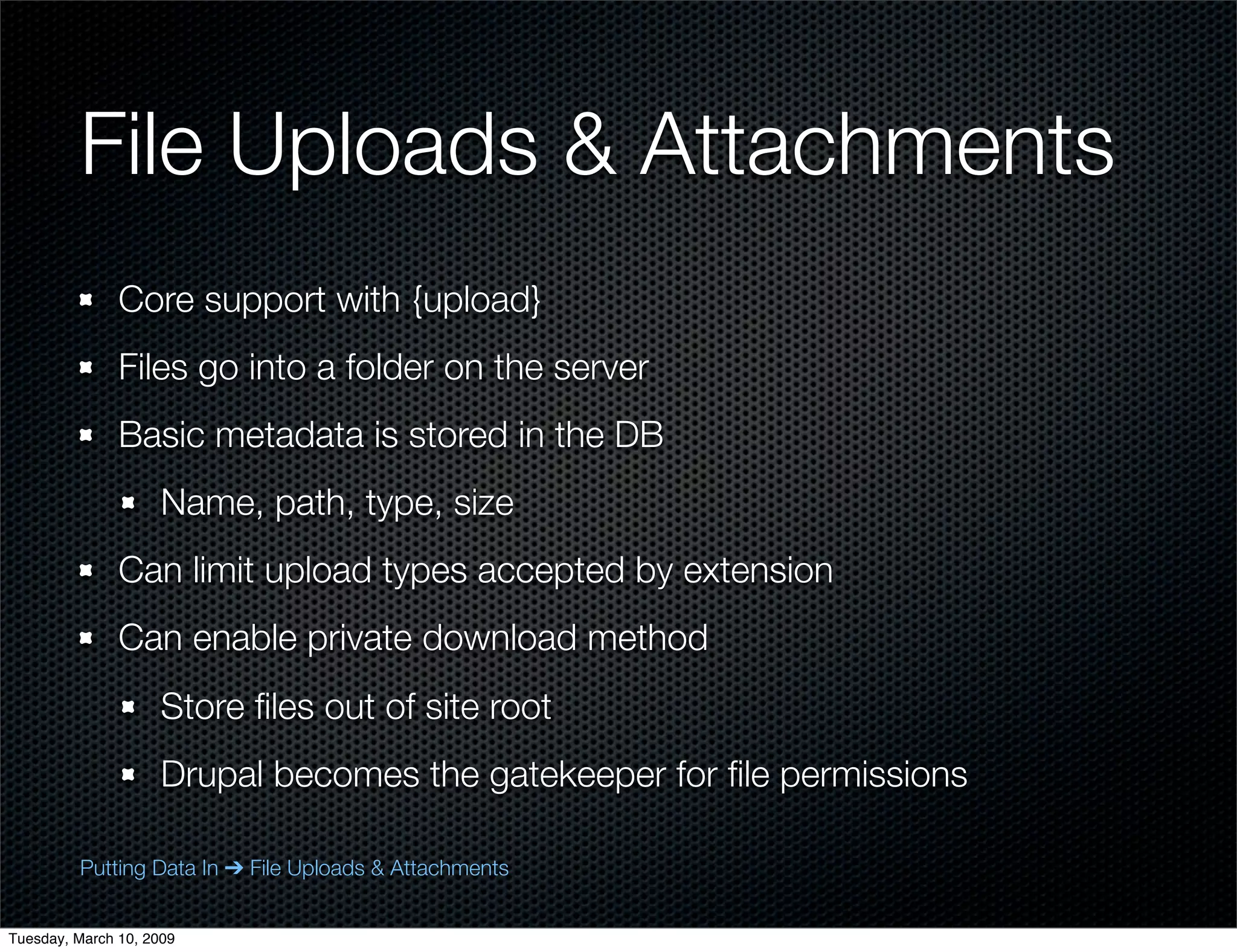
  • #36 - common need when integrating with desktop or mobile clients -- FILES - going to go over the basics of what is in core - this could be useful if you are taking user data and need a place to put it -- will this work for me?
  • #37 - common need when integrating with desktop or mobile clients -- FILES - going to go over the basics of what is in core - this could be useful if you are taking user data and need a place to put it -- will this work for me?
  • #38 - common need when integrating with desktop or mobile clients -- FILES - going to go over the basics of what is in core - this could be useful if you are taking user data and need a place to put it -- will this work for me?
  • #39 - common need when integrating with desktop or mobile clients -- FILES - going to go over the basics of what is in core - this could be useful if you are taking user data and need a place to put it -- will this work for me?
  • #40 - common need when integrating with desktop or mobile clients -- FILES - going to go over the basics of what is in core - this could be useful if you are taking user data and need a place to put it -- will this work for me?
  • #43 - Mention that all of those is great, but see how it can be built upon in a minute...
  • #44 - Mention that all of those is great, but see how it can be built upon in a minute...
  • #45 - Mention that all of those is great, but see how it can be built upon in a minute...
  • #46 - Mention that all of those is great, but see how it can be built upon in a minute...
  • #47 - Mention that all of those is great, but see how it can be built upon in a minute...
  • #48 - Mention that all of those is great, but see how it can be built upon in a minute...
  • #49 - Mention that all of those is great, but see how it can be built upon in a minute...
  • #50 - Mention that all of those is great, but see how it can be built upon in a minute...
  • #51 - Mention that all of those is great, but see how it can be built upon in a minute...
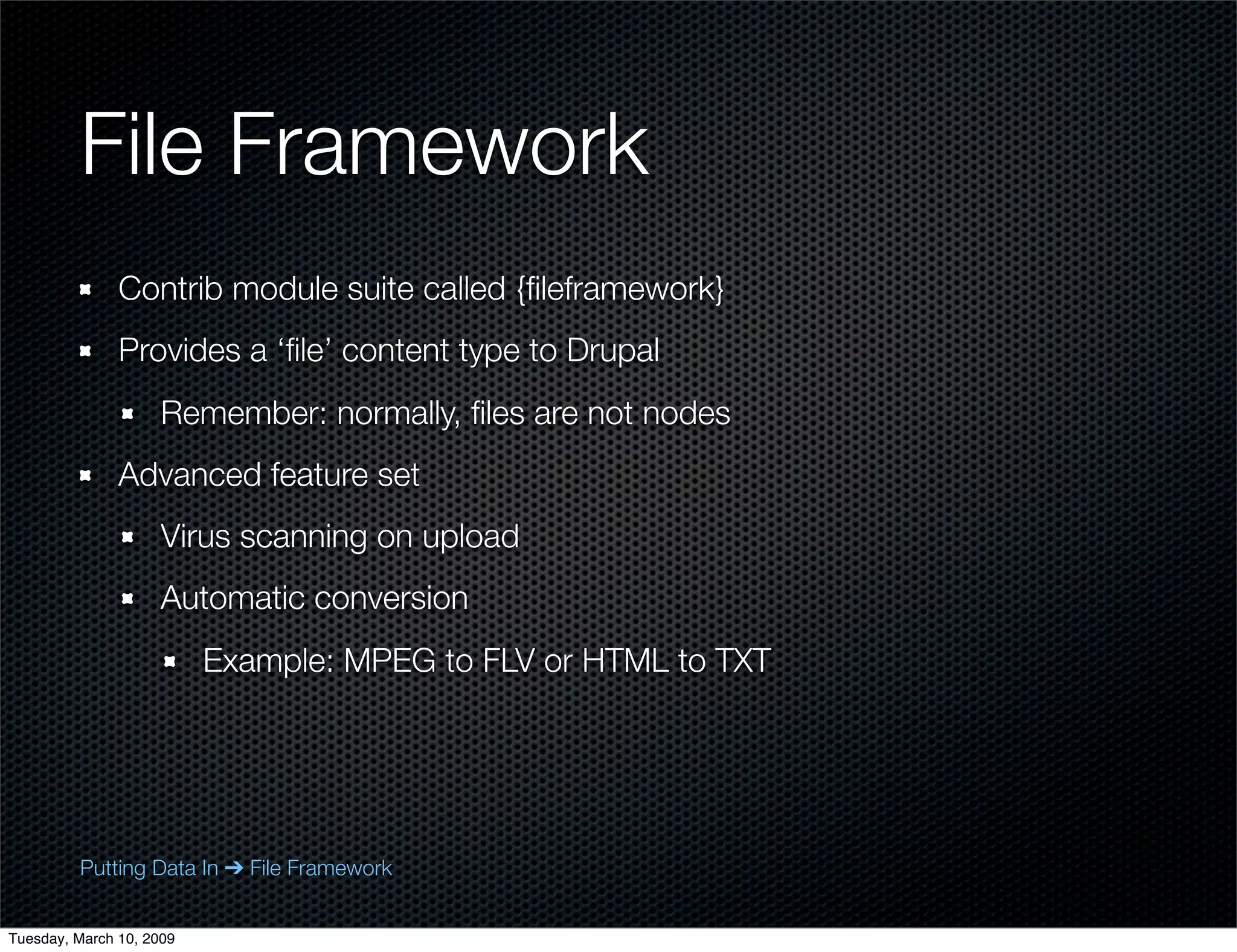
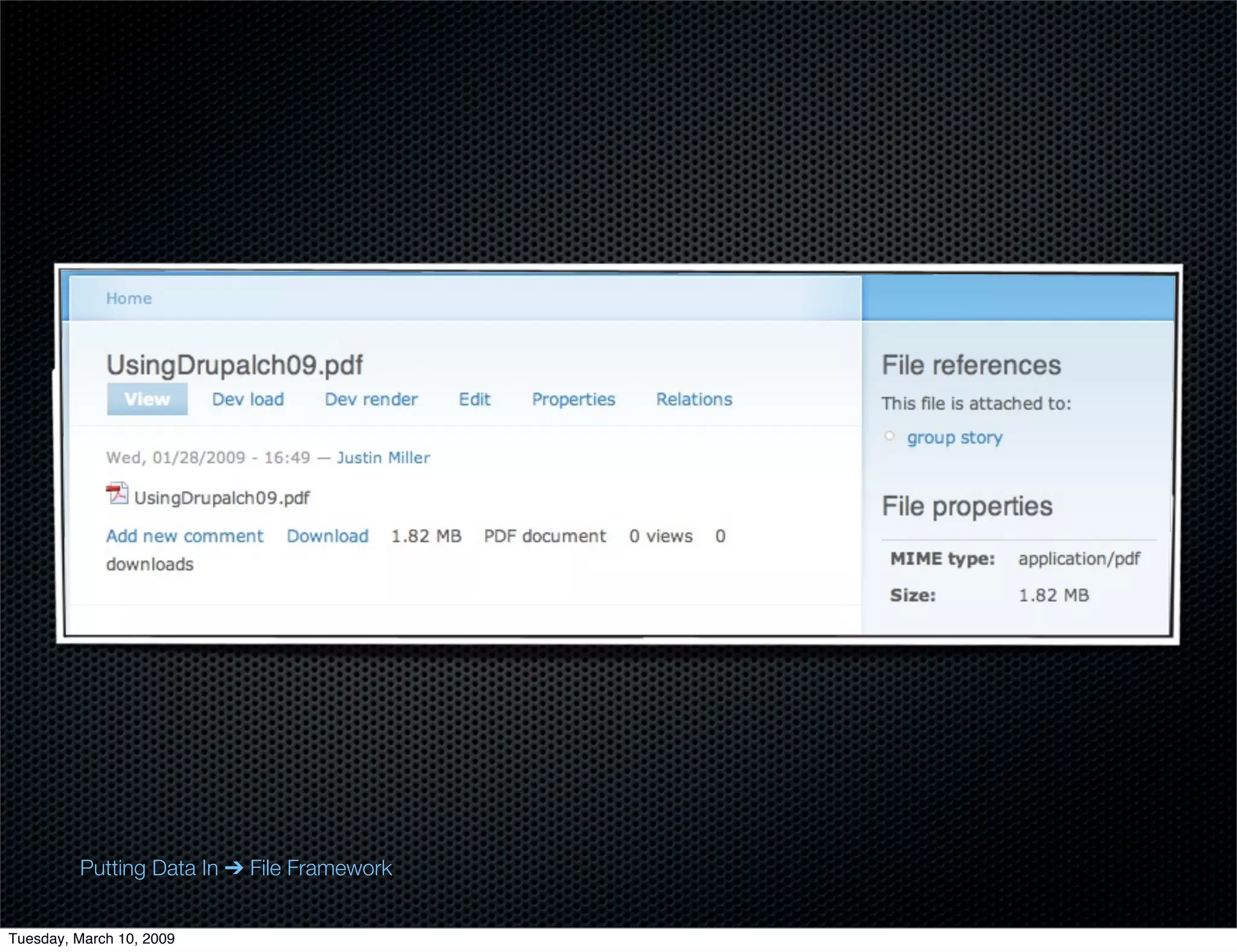
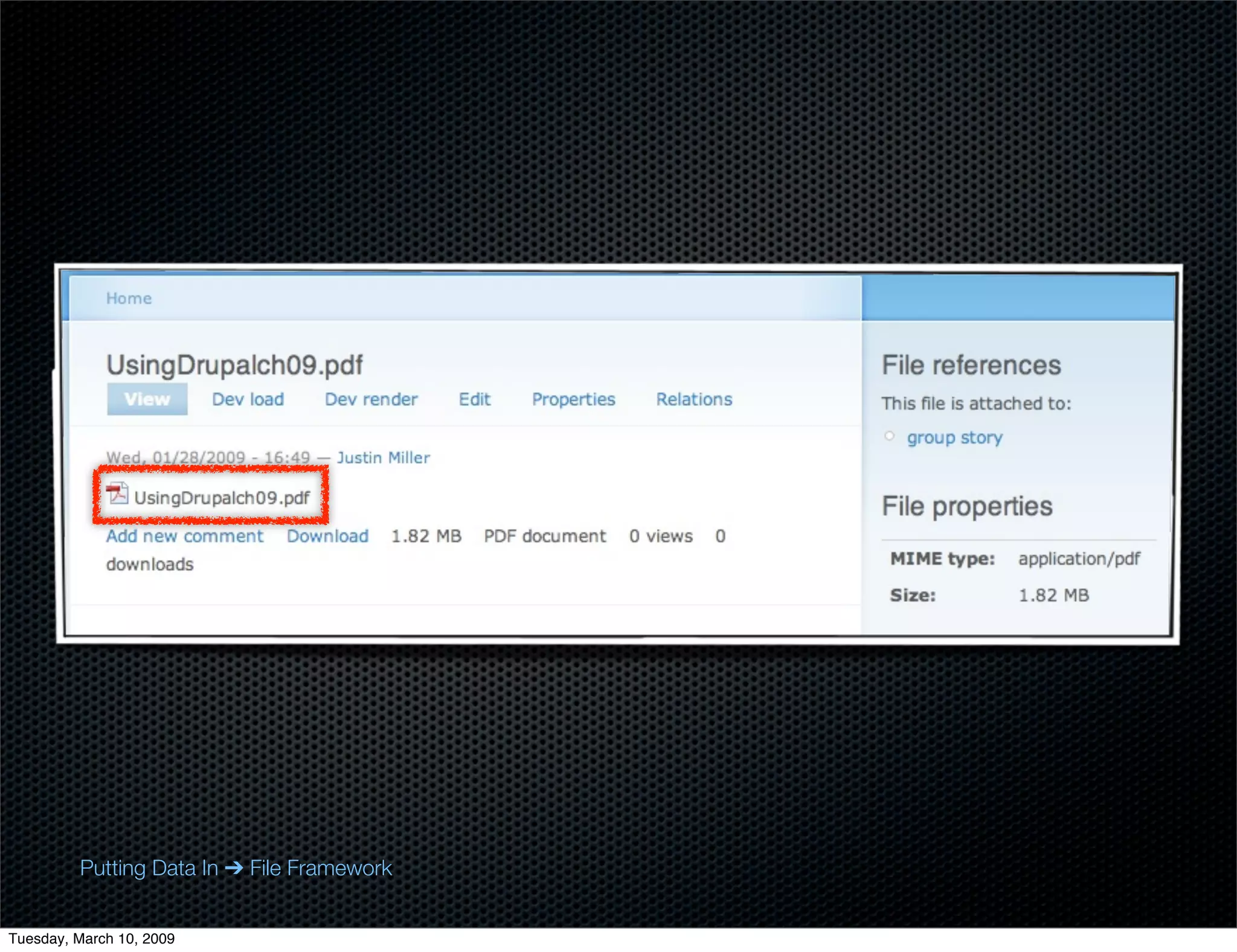
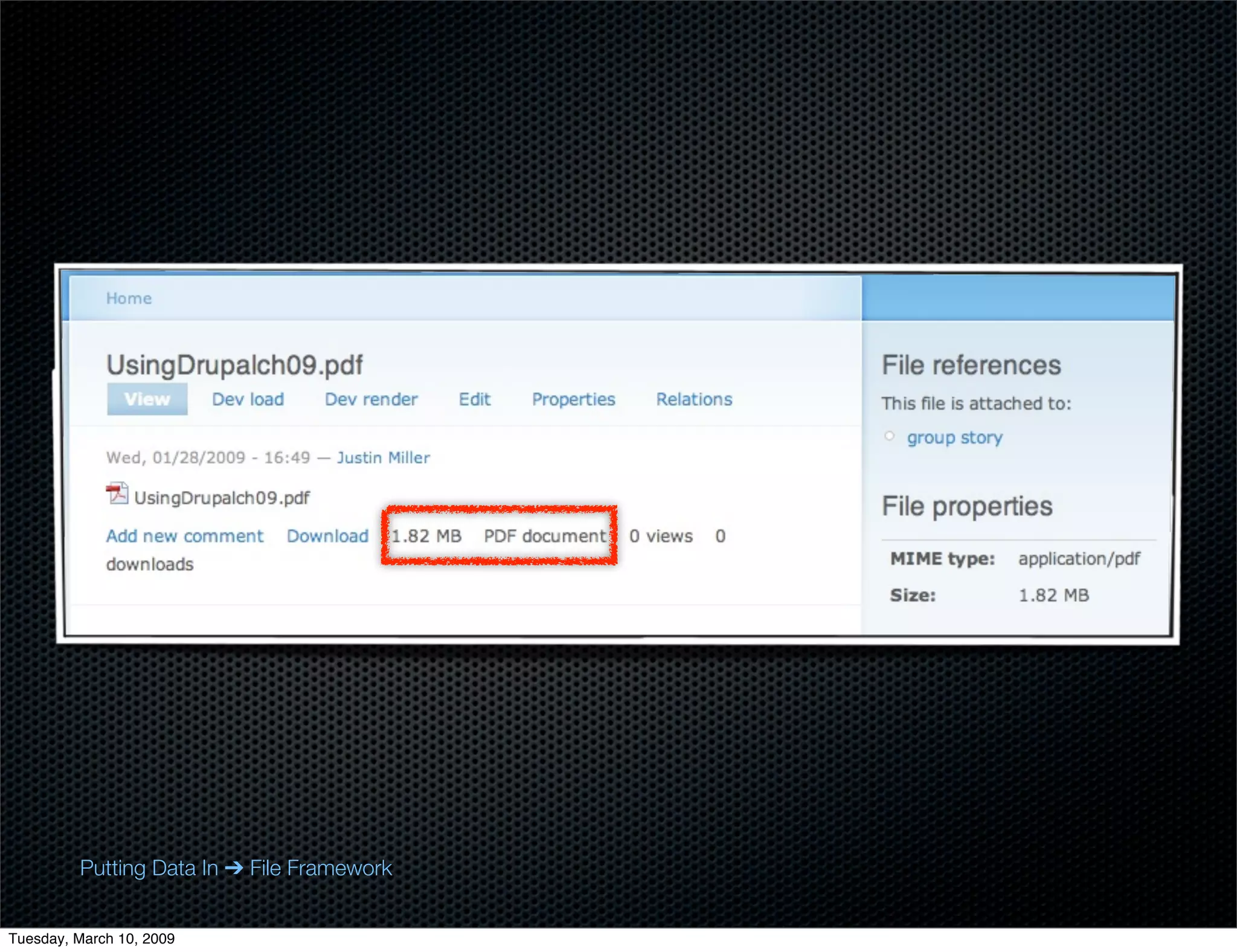
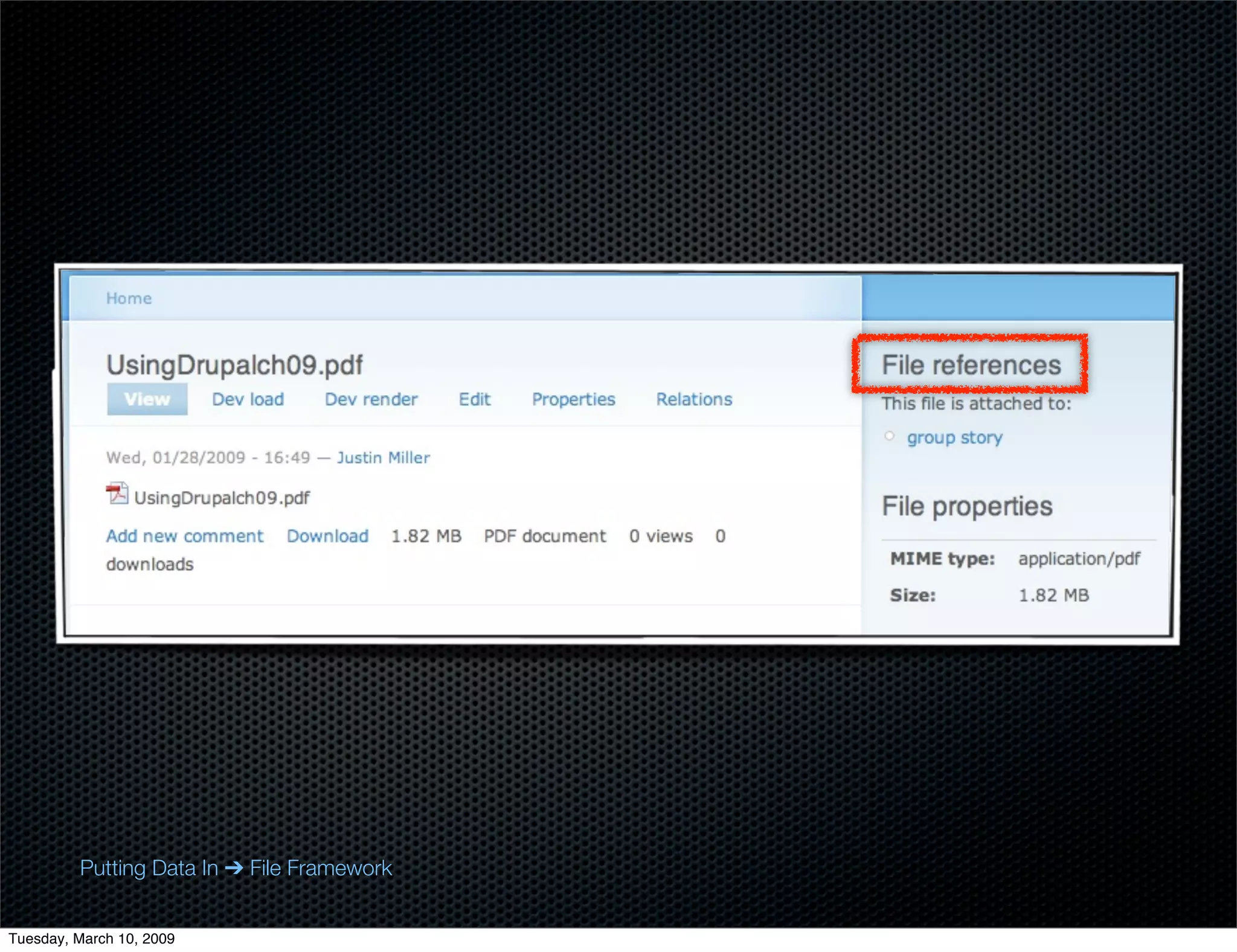
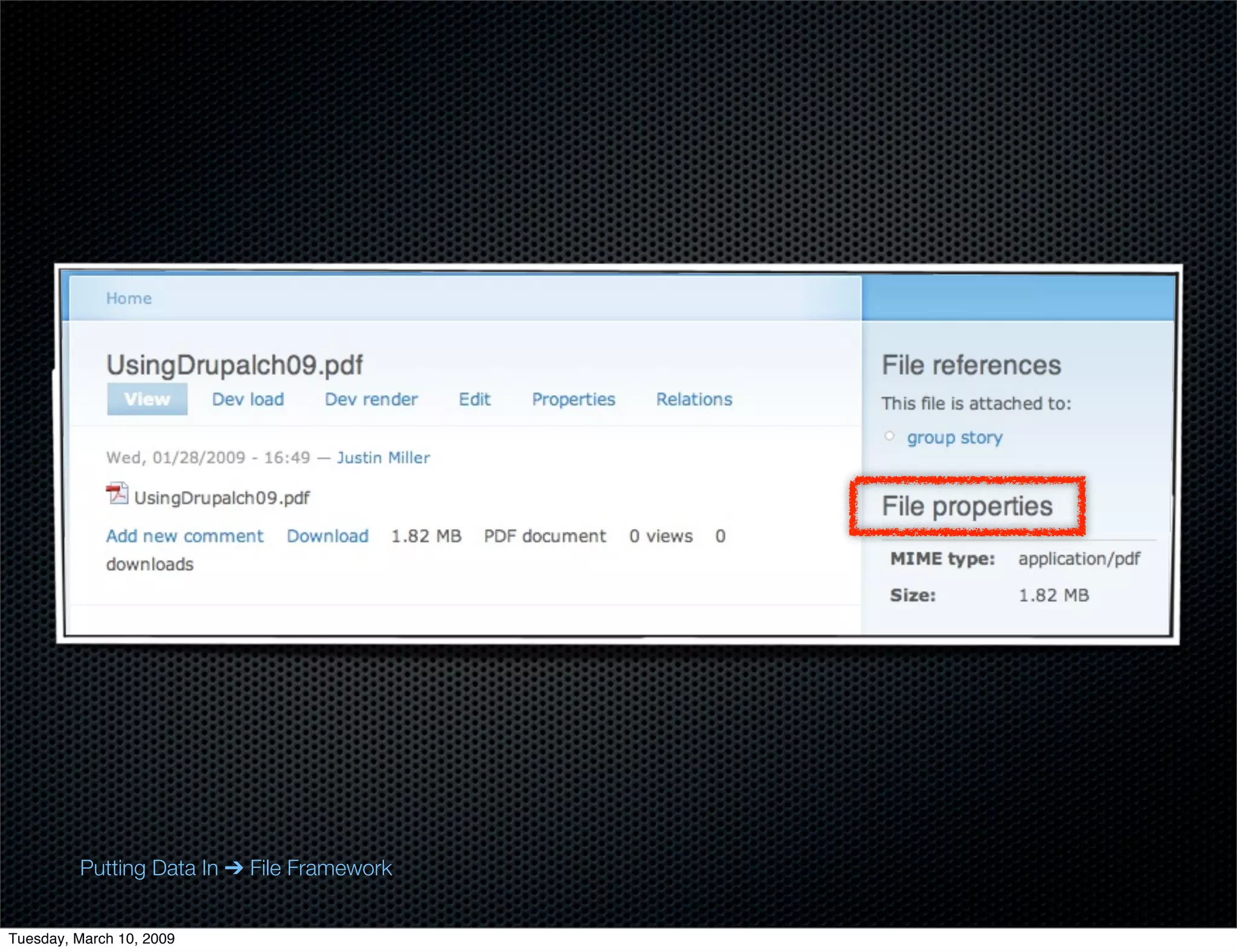
  • #52 - visual indication of type - size and type info - blocks are available for attachment/relationship status - as well as all properties (more on next slide)
  • #53 - visual indication of type - size and type info - blocks are available for attachment/relationship status - as well as all properties (more on next slide)
  • #54 - visual indication of type - size and type info - blocks are available for attachment/relationship status - as well as all properties (more on next slide)
  • #55 - visual indication of type - size and type info - blocks are available for attachment/relationship status - as well as all properties (more on next slide)
  • #56 - visual indication of type - size and type info - blocks are available for attachment/relationship status - as well as all properties (more on next slide)
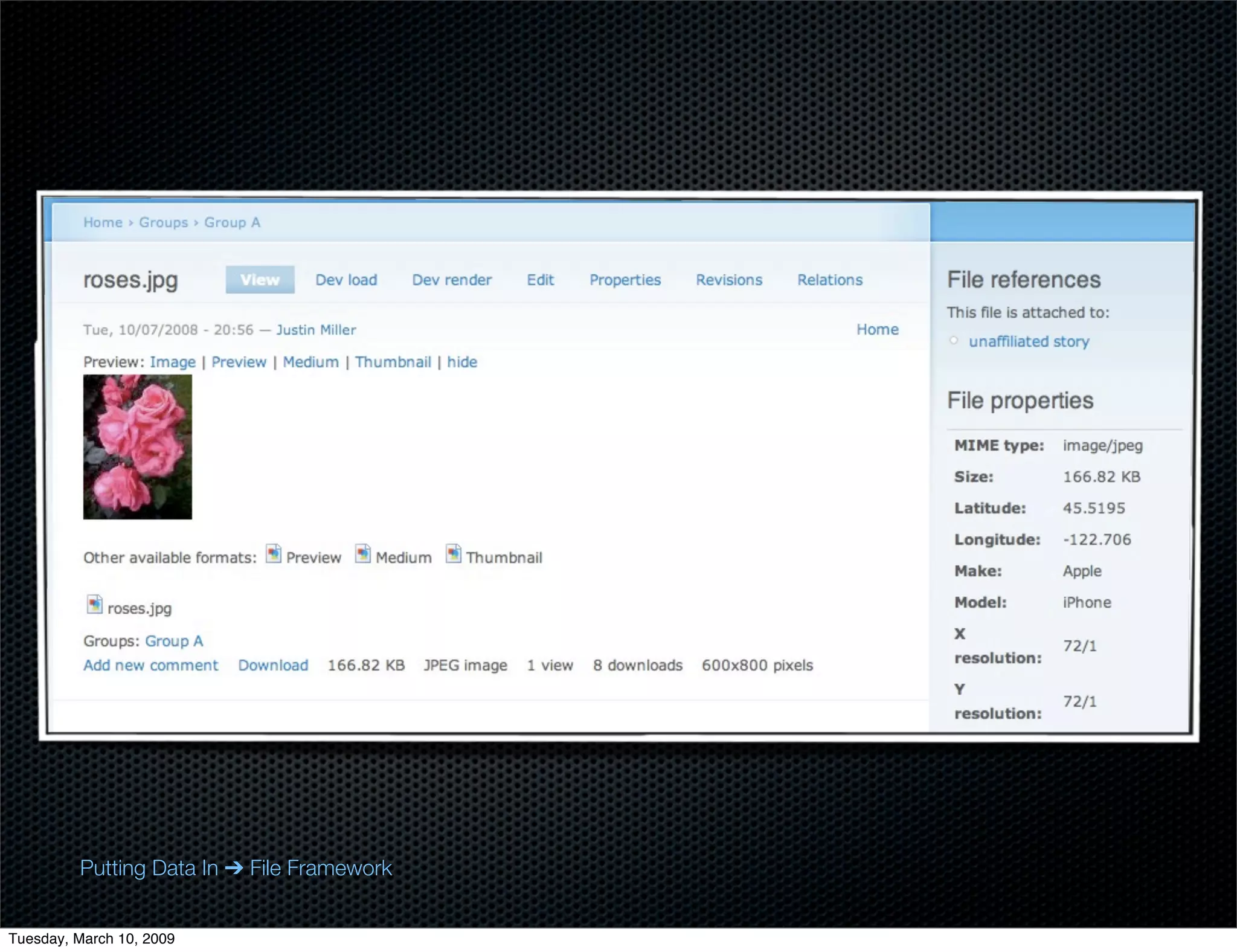
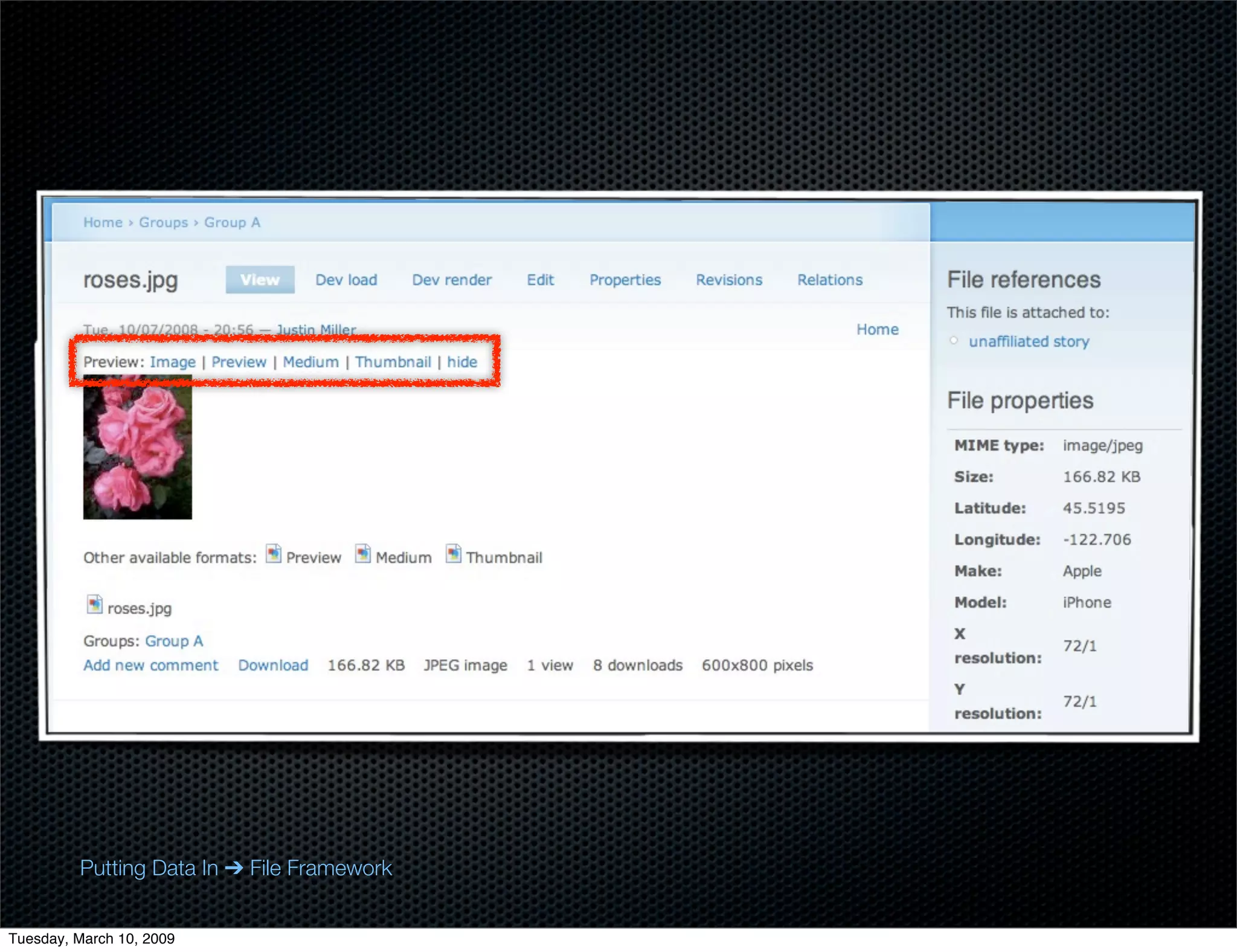
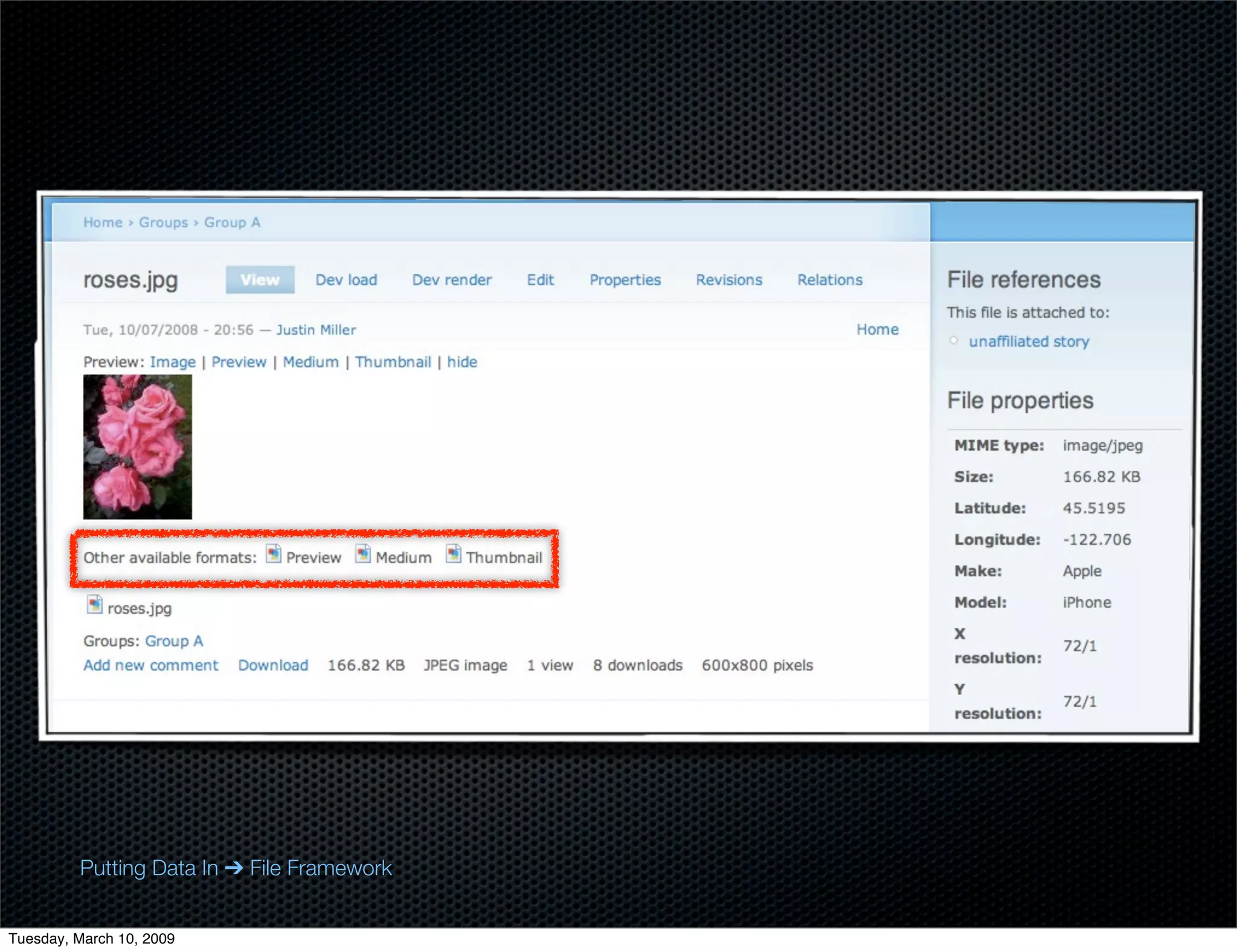
  • #57 - here’s an example of ahah-based previews - multiple sizes for images - other formats available -- large pdf also available as zip archive - also make note of extended metadata extracted from this file -- location, camera (all exif data)
  • #58 - here’s an example of ahah-based previews - multiple sizes for images - other formats available -- large pdf also available as zip archive - also make note of extended metadata extracted from this file -- location, camera (all exif data)
  • #59 - here’s an example of ahah-based previews - multiple sizes for images - other formats available -- large pdf also available as zip archive - also make note of extended metadata extracted from this file -- location, camera (all exif data)
  • #60 - makes a lot of sense if files are your “unit of content” - really gives remote clients a base to work with & makes your social site more friendly & robust
  • #61 - makes a lot of sense if files are your “unit of content” - really gives remote clients a base to work with & makes your social site more friendly & robust
  • #62 - makes a lot of sense if files are your “unit of content” - really gives remote clients a base to work with & makes your social site more friendly & robust
  • #63 - makes a lot of sense if files are your “unit of content” - really gives remote clients a base to work with & makes your social site more friendly & robust
  • #64 - makes a lot of sense if files are your “unit of content” - really gives remote clients a base to work with & makes your social site more friendly & robust
  • #65 - makes a lot of sense if files are your “unit of content” - really gives remote clients a base to work with & makes your social site more friendly & robust
  • #66 - makes a lot of sense if files are your “unit of content” - really gives remote clients a base to work with & makes your social site more friendly & robust
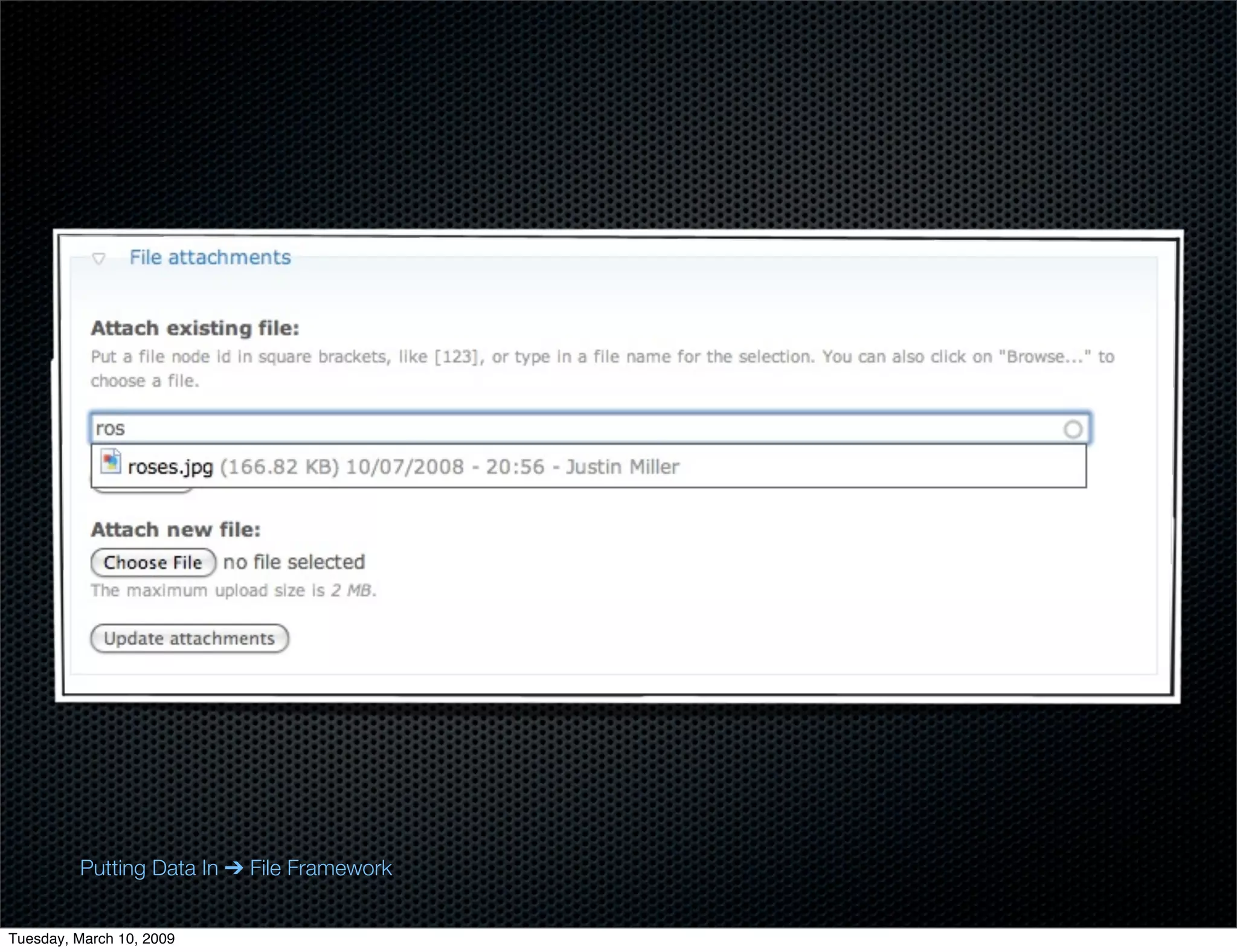
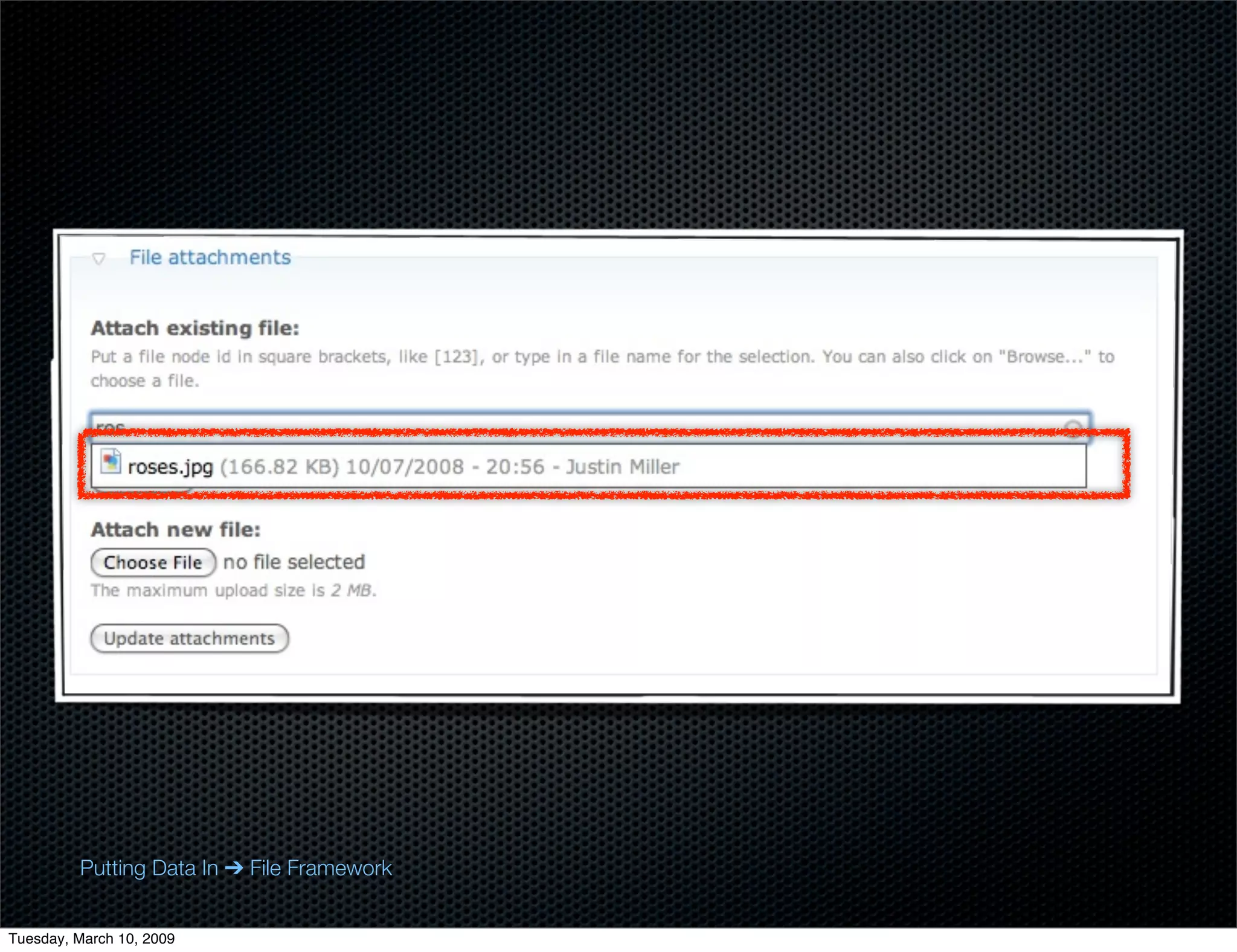
  • #67 - here’s a good example of attachment reuse - if you know the node id, enter it - or else autocomplete by node title (i.e., file name)
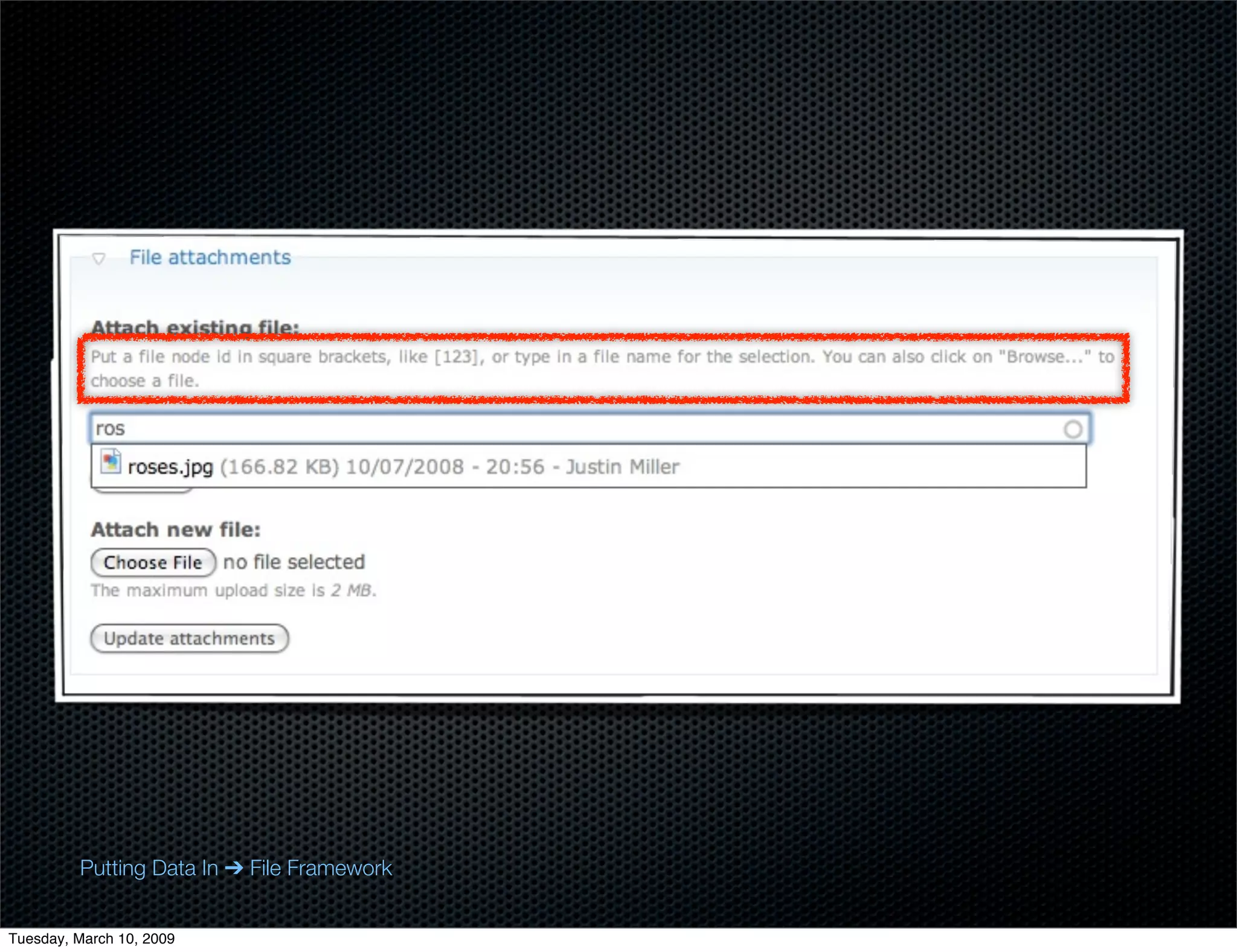
  • #68 - here’s a good example of attachment reuse - if you know the node id, enter it - or else autocomplete by node title (i.e., file name)
  • #69 - one more mention in the area of files - lends itself nicely to more complex layering with things like webdav - distributed authoring & versioning - like ftp but on the web server - this is great if you already are talking webdav or have libraries for your apps - also available on many platforms -- explorer on windows, finder on mac, kde/gnome file managers - for people familiar with apple, mobile me / .mac idisk is based on webdav - MENTION DAV API
  • #70 - one more mention in the area of files - lends itself nicely to more complex layering with things like webdav - distributed authoring & versioning - like ftp but on the web server - this is great if you already are talking webdav or have libraries for your apps - also available on many platforms -- explorer on windows, finder on mac, kde/gnome file managers - for people familiar with apple, mobile me / .mac idisk is based on webdav - MENTION DAV API
  • #71 - one more mention in the area of files - lends itself nicely to more complex layering with things like webdav - distributed authoring & versioning - like ftp but on the web server - this is great if you already are talking webdav or have libraries for your apps - also available on many platforms -- explorer on windows, finder on mac, kde/gnome file managers - for people familiar with apple, mobile me / .mac idisk is based on webdav - MENTION DAV API
  • #72 - one more mention in the area of files - lends itself nicely to more complex layering with things like webdav - distributed authoring & versioning - like ftp but on the web server - this is great if you already are talking webdav or have libraries for your apps - also available on many platforms -- explorer on windows, finder on mac, kde/gnome file managers - for people familiar with apple, mobile me / .mac idisk is based on webdav - MENTION DAV API
  • #73 - one more mention in the area of files - lends itself nicely to more complex layering with things like webdav - distributed authoring & versioning - like ftp but on the web server - this is great if you already are talking webdav or have libraries for your apps - also available on many platforms -- explorer on windows, finder on mac, kde/gnome file managers - for people familiar with apple, mobile me / .mac idisk is based on webdav - MENTION DAV API
  • #74 - one more mention in the area of files - lends itself nicely to more complex layering with things like webdav - distributed authoring & versioning - like ftp but on the web server - this is great if you already are talking webdav or have libraries for your apps - also available on many platforms -- explorer on windows, finder on mac, kde/gnome file managers - for people familiar with apple, mobile me / .mac idisk is based on webdav - MENTION DAV API
  • #75 - one more mention in the area of files - lends itself nicely to more complex layering with things like webdav - distributed authoring & versioning - like ftp but on the web server - this is great if you already are talking webdav or have libraries for your apps - also available on many platforms -- explorer on windows, finder on mac, kde/gnome file managers - for people familiar with apple, mobile me / .mac idisk is based on webdav - MENTION DAV API
  • #76 - one more mention in the area of files - lends itself nicely to more complex layering with things like webdav - distributed authoring & versioning - like ftp but on the web server - this is great if you already are talking webdav or have libraries for your apps - also available on many platforms -- explorer on windows, finder on mac, kde/gnome file managers - for people familiar with apple, mobile me / .mac idisk is based on webdav - MENTION DAV API
  • #77 - one more mention in the area of files - lends itself nicely to more complex layering with things like webdav - distributed authoring & versioning - like ftp but on the web server - this is great if you already are talking webdav or have libraries for your apps - also available on many platforms -- explorer on windows, finder on mac, kde/gnome file managers - for people familiar with apple, mobile me / .mac idisk is based on webdav - MENTION DAV API
  • #78 - one more mention in the area of files - lends itself nicely to more complex layering with things like webdav - distributed authoring & versioning - like ftp but on the web server - this is great if you already are talking webdav or have libraries for your apps - also available on many platforms -- explorer on windows, finder on mac, kde/gnome file managers - for people familiar with apple, mobile me / .mac idisk is based on webdav - MENTION DAV API
  • #79 - one more mention in the area of files - lends itself nicely to more complex layering with things like webdav - distributed authoring & versioning - like ftp but on the web server - this is great if you already are talking webdav or have libraries for your apps - also available on many platforms -- explorer on windows, finder on mac, kde/gnome file managers - for people familiar with apple, mobile me / .mac idisk is based on webdav - MENTION DAV API
  • #80 - one more mention in the area of files - lends itself nicely to more complex layering with things like webdav - distributed authoring & versioning - like ftp but on the web server - this is great if you already are talking webdav or have libraries for your apps - also available on many platforms -- explorer on windows, finder on mac, kde/gnome file managers - for people familiar with apple, mobile me / .mac idisk is based on webdav - MENTION DAV API
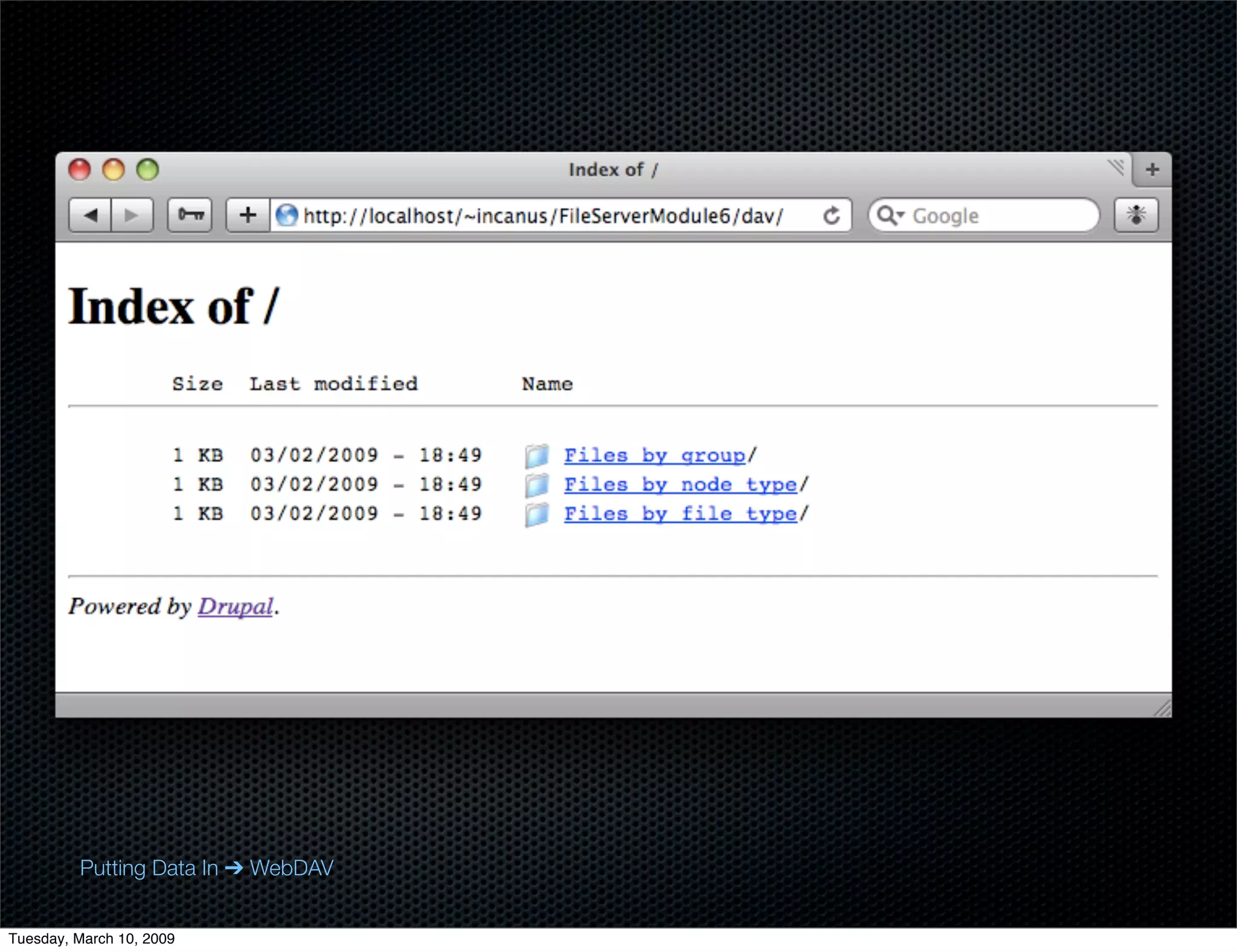
  • #81 - example of web-based browsing of file nodes in a system
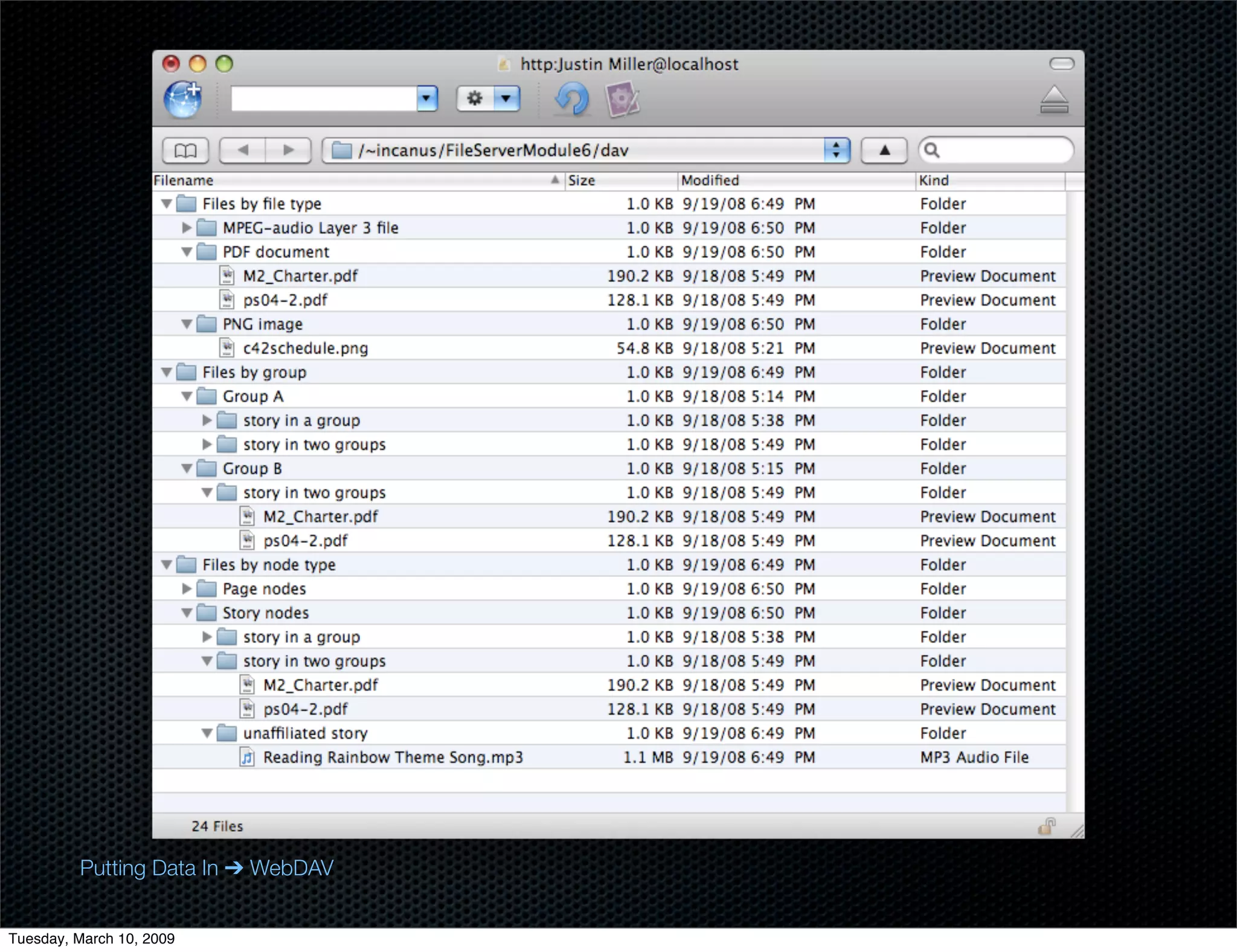
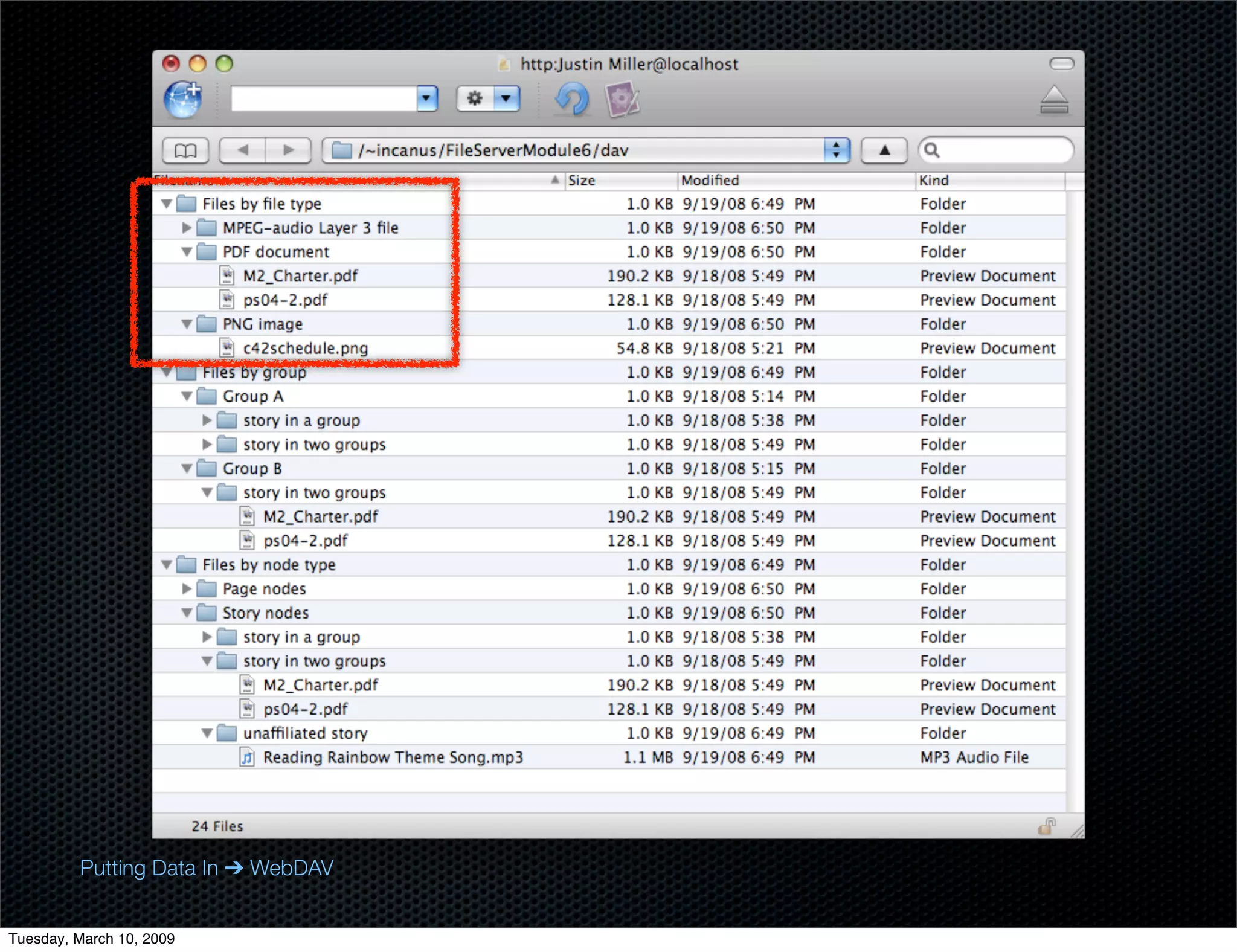
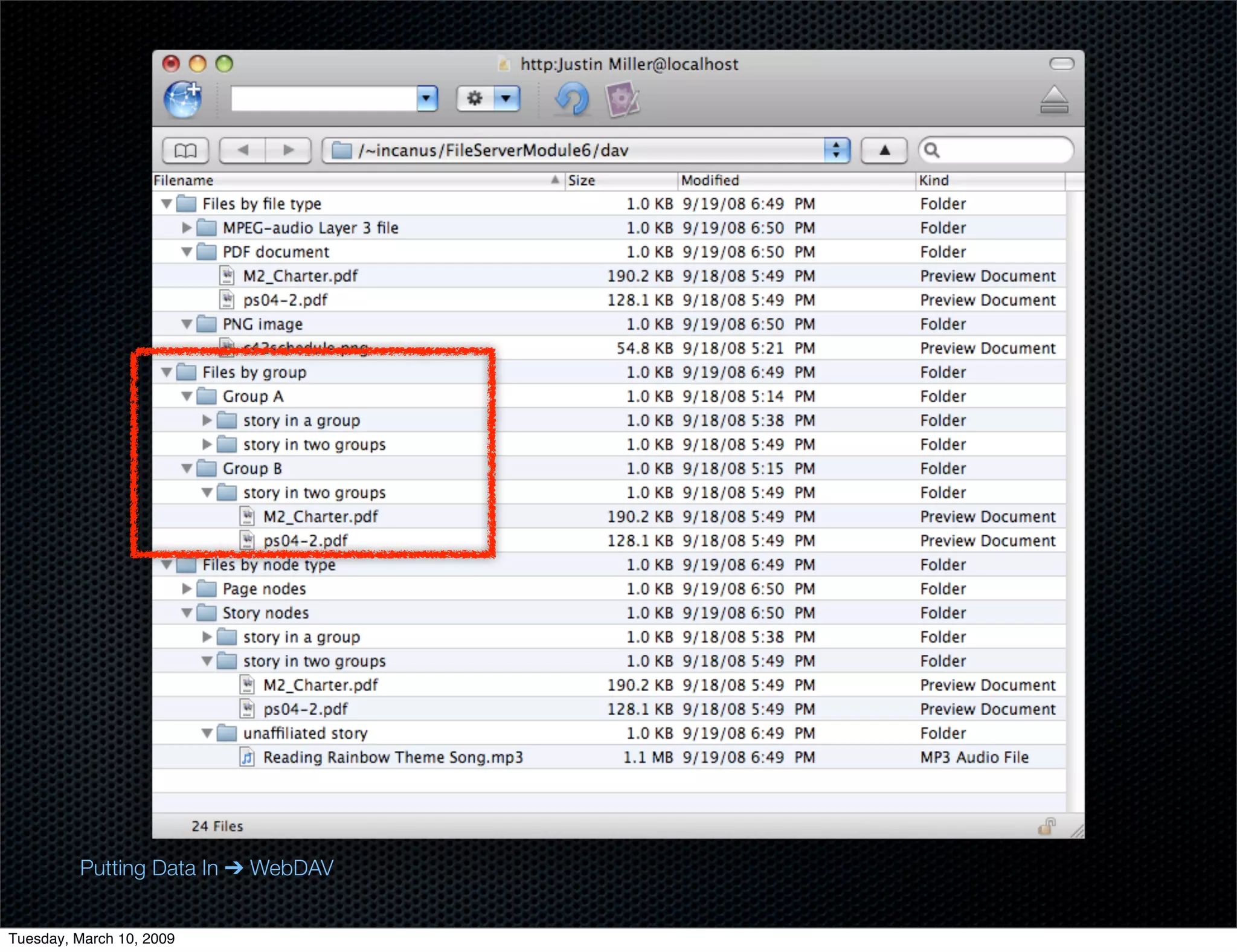
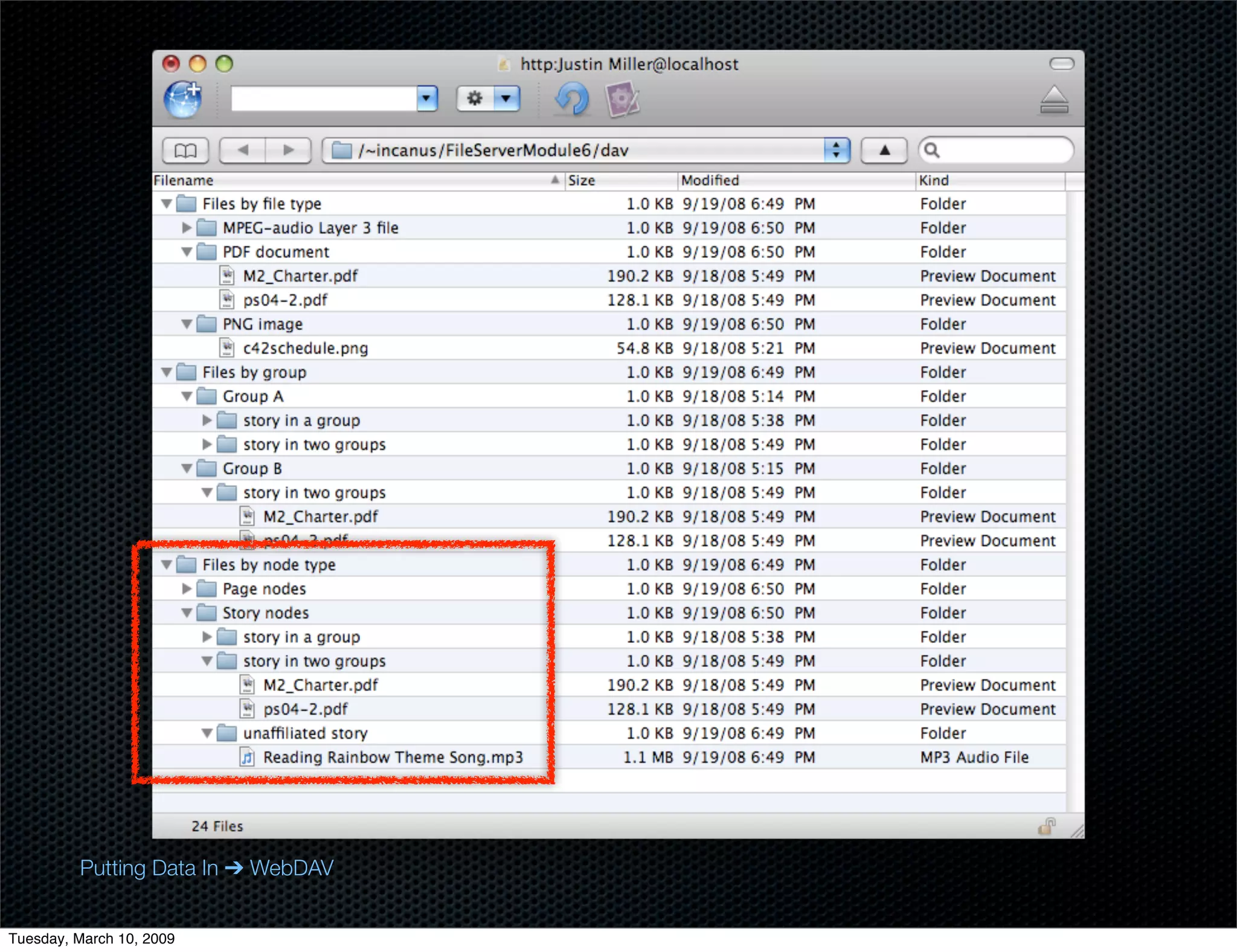
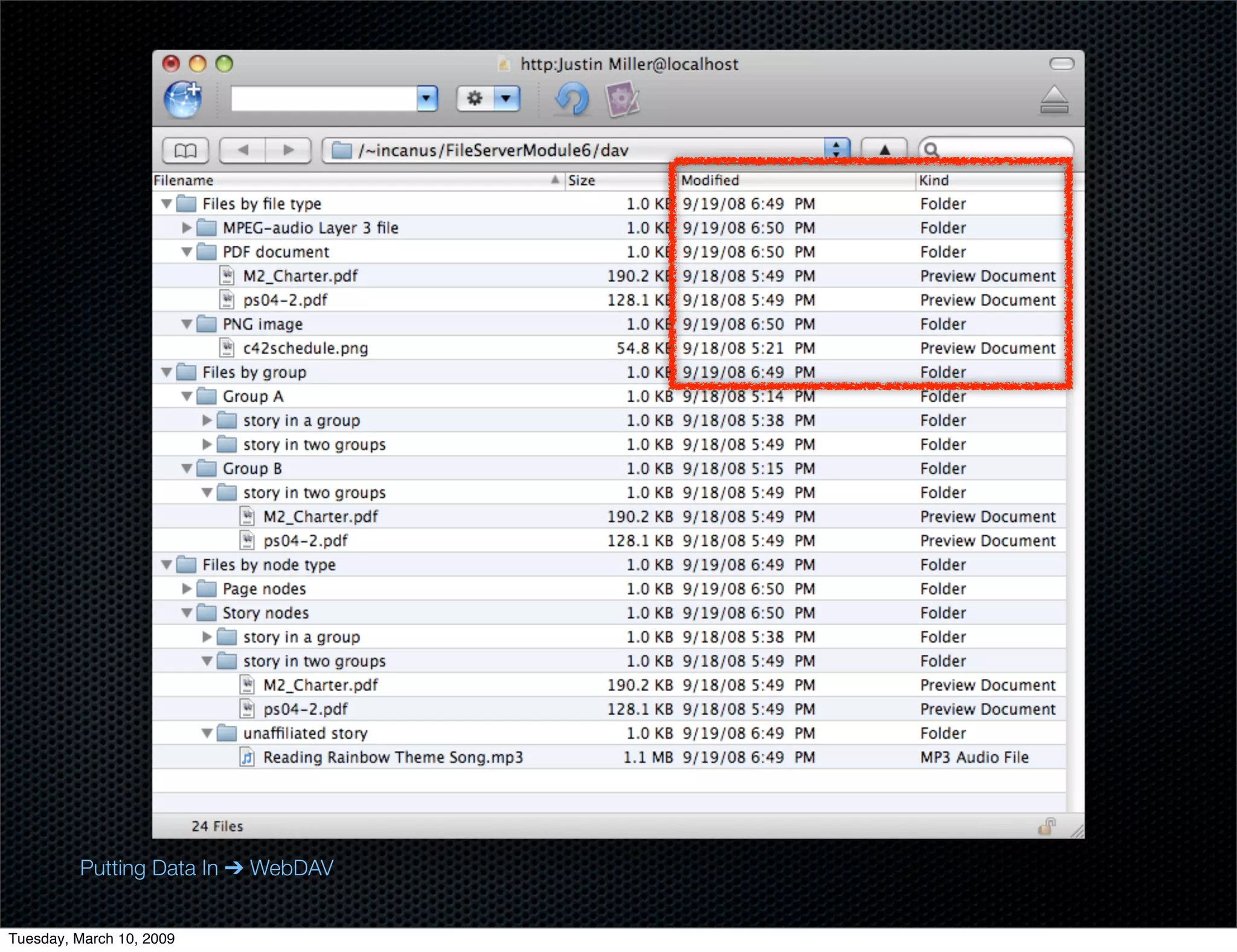
  • #82 - file transfer client example - this is two-way communication - everything is revisioned in the nodes -- attachment status, filename, organic group - rather than build a custom api, you could use existing webdav client libraries to work with this sort of platform -- client doesn’t even have to know that it’s drupal
  • #83 - file transfer client example - this is two-way communication - everything is revisioned in the nodes -- attachment status, filename, organic group - rather than build a custom api, you could use existing webdav client libraries to work with this sort of platform -- client doesn’t even have to know that it’s drupal
  • #84 - file transfer client example - this is two-way communication - everything is revisioned in the nodes -- attachment status, filename, organic group - rather than build a custom api, you could use existing webdav client libraries to work with this sort of platform -- client doesn’t even have to know that it’s drupal
  • #85 - file transfer client example - this is two-way communication - everything is revisioned in the nodes -- attachment status, filename, organic group - rather than build a custom api, you could use existing webdav client libraries to work with this sort of platform -- client doesn’t even have to know that it’s drupal
  • #86 - file transfer client example - this is two-way communication - everything is revisioned in the nodes -- attachment status, filename, organic group - rather than build a custom api, you could use existing webdav client libraries to work with this sort of platform -- client doesn’t even have to know that it’s drupal
  • #87 - file transfer client example - this is two-way communication - everything is revisioned in the nodes -- attachment status, filename, organic group - rather than build a custom api, you could use existing webdav client libraries to work with this sort of platform -- client doesn’t even have to know that it’s drupal
  • #88 - file transfer client example - this is two-way communication - everything is revisioned in the nodes -- attachment status, filename, organic group - rather than build a custom api, you could use existing webdav client libraries to work with this sort of platform -- client doesn’t even have to know that it’s drupal
  • #89 many people are on board with feedapi not mentioning it in detail here since it’s typically web-to-web
  • #90 many people are on board with feedapi not mentioning it in detail here since it’s typically web-to-web
  • #91 many people are on board with feedapi not mentioning it in detail here since it’s typically web-to-web
  • #92 many people are on board with feedapi not mentioning it in detail here since it’s typically web-to-web
  • #93 many people are on board with feedapi not mentioning it in detail here since it’s typically web-to-web
  • #94 many people are on board with feedapi not mentioning it in detail here since it’s typically web-to-web
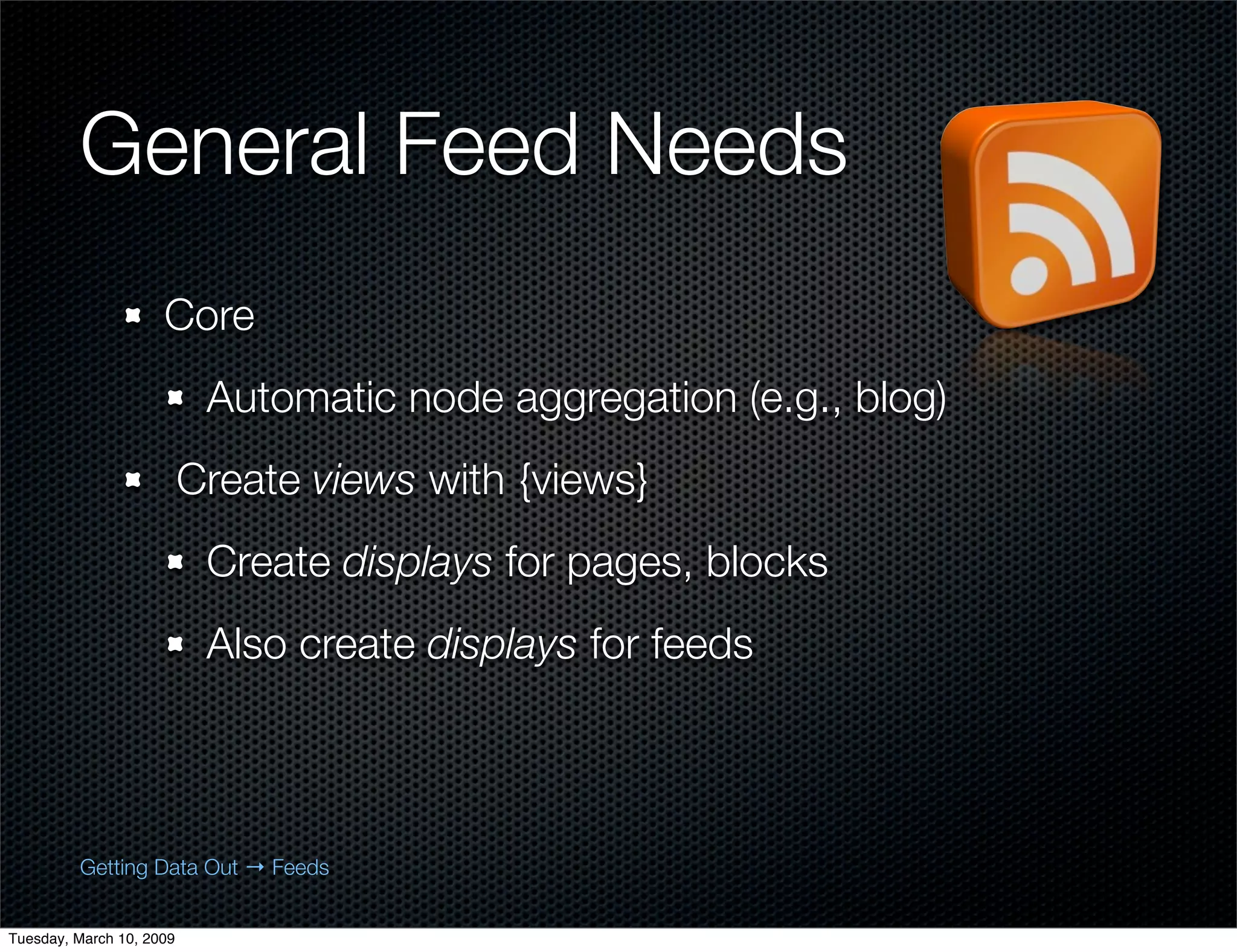
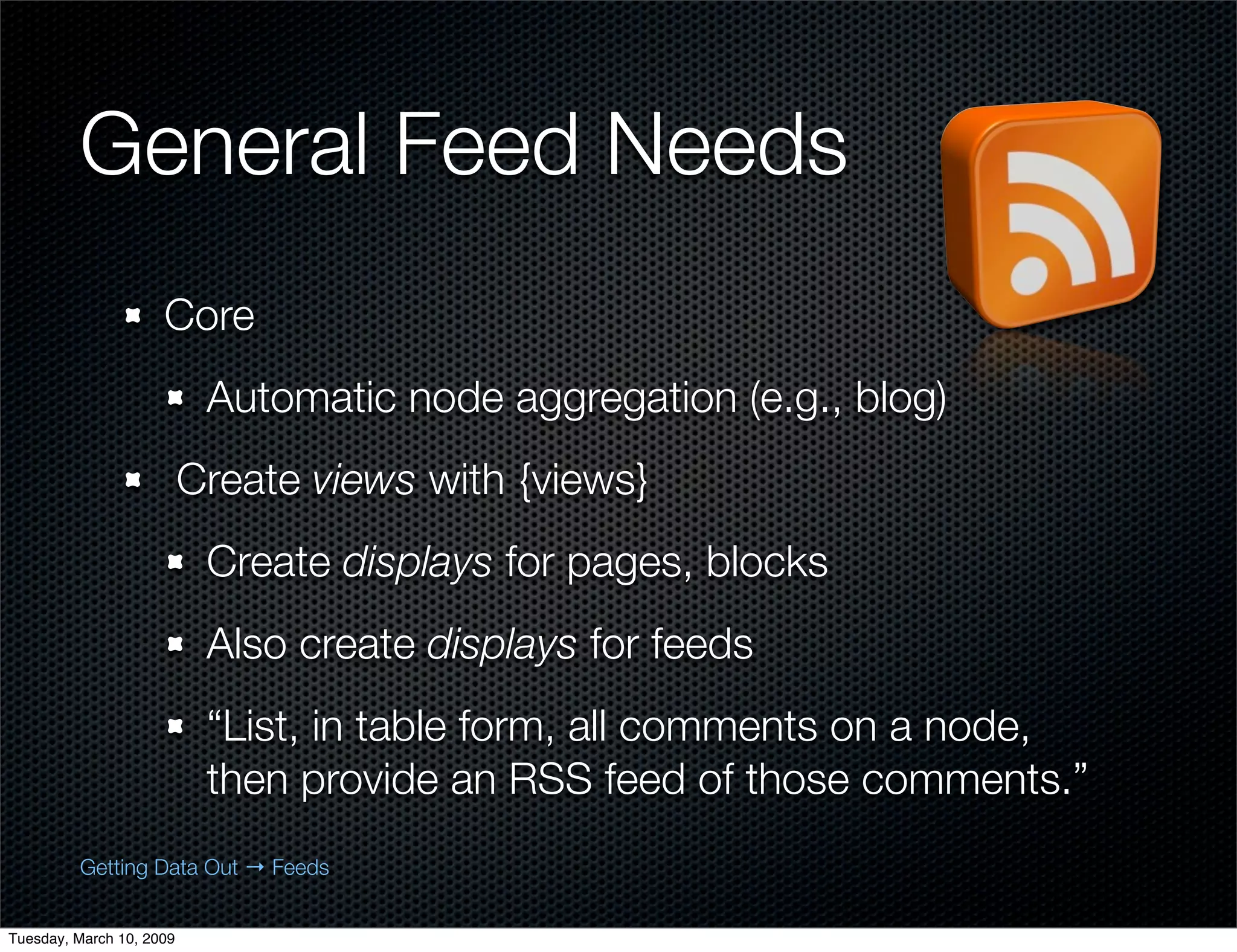
  • #100 - core has this concept of ‘promote to front page’ - automatically published at /node - automatically sent out to rss feed - views is your swiss army knife -- worth the time invested to learn the api and/or the ui
  • #101 - core has this concept of ‘promote to front page’ - automatically published at /node - automatically sent out to rss feed - views is your swiss army knife -- worth the time invested to learn the api and/or the ui
  • #102 - core has this concept of ‘promote to front page’ - automatically published at /node - automatically sent out to rss feed - views is your swiss army knife -- worth the time invested to learn the api and/or the ui
  • #103 - core has this concept of ‘promote to front page’ - automatically published at /node - automatically sent out to rss feed - views is your swiss army knife -- worth the time invested to learn the api and/or the ui
  • #104 - core has this concept of ‘promote to front page’ - automatically published at /node - automatically sent out to rss feed - views is your swiss army knife -- worth the time invested to learn the api and/or the ui
  • #105 - core has this concept of ‘promote to front page’ - automatically published at /node - automatically sent out to rss feed - views is your swiss army knife -- worth the time invested to learn the api and/or the ui
  • #106 - core has this concept of ‘promote to front page’ - automatically published at /node - automatically sent out to rss feed - views is your swiss army knife -- worth the time invested to learn the api and/or the ui
  • #107 if podcasting is more your thing, drupal has you covered here too some modules you’ll find interesting are...
  • #108 if podcasting is more your thing, drupal has you covered here too some modules you’ll find interesting are...
  • #109 if podcasting is more your thing, drupal has you covered here too some modules you’ll find interesting are...
  • #110 if podcasting is more your thing, drupal has you covered here too some modules you’ll find interesting are...
  • #111 if podcasting is more your thing, drupal has you covered here too some modules you’ll find interesting are...
  • #112 if podcasting is more your thing, drupal has you covered here too some modules you’ll find interesting are...
  • #113 if podcasting is more your thing, drupal has you covered here too some modules you’ll find interesting are...
  • #114 - how to keep anonymous users out, but also maybe not inconvenience users with user/pass - could possibly generate a token client-side using a known algorithm, update the server, then use that to pull data
  • #115 - how to keep anonymous users out, but also maybe not inconvenience users with user/pass - could possibly generate a token client-side using a known algorithm, update the server, then use that to pull data
  • #116 - how to keep anonymous users out, but also maybe not inconvenience users with user/pass - could possibly generate a token client-side using a known algorithm, update the server, then use that to pull data
  • #117 - how to keep anonymous users out, but also maybe not inconvenience users with user/pass - could possibly generate a token client-side using a known algorithm, update the server, then use that to pull data
  • #118 - how to keep anonymous users out, but also maybe not inconvenience users with user/pass - could possibly generate a token client-side using a known algorithm, update the server, then use that to pull data
  • #119 - how to keep anonymous users out, but also maybe not inconvenience users with user/pass - could possibly generate a token client-side using a known algorithm, update the server, then use that to pull data
  • #120 - how to keep anonymous users out, but also maybe not inconvenience users with user/pass - could possibly generate a token client-side using a known algorithm, update the server, then use that to pull data
  • #121 - how to keep anonymous users out, but also maybe not inconvenience users with user/pass - could possibly generate a token client-side using a known algorithm, update the server, then use that to pull data
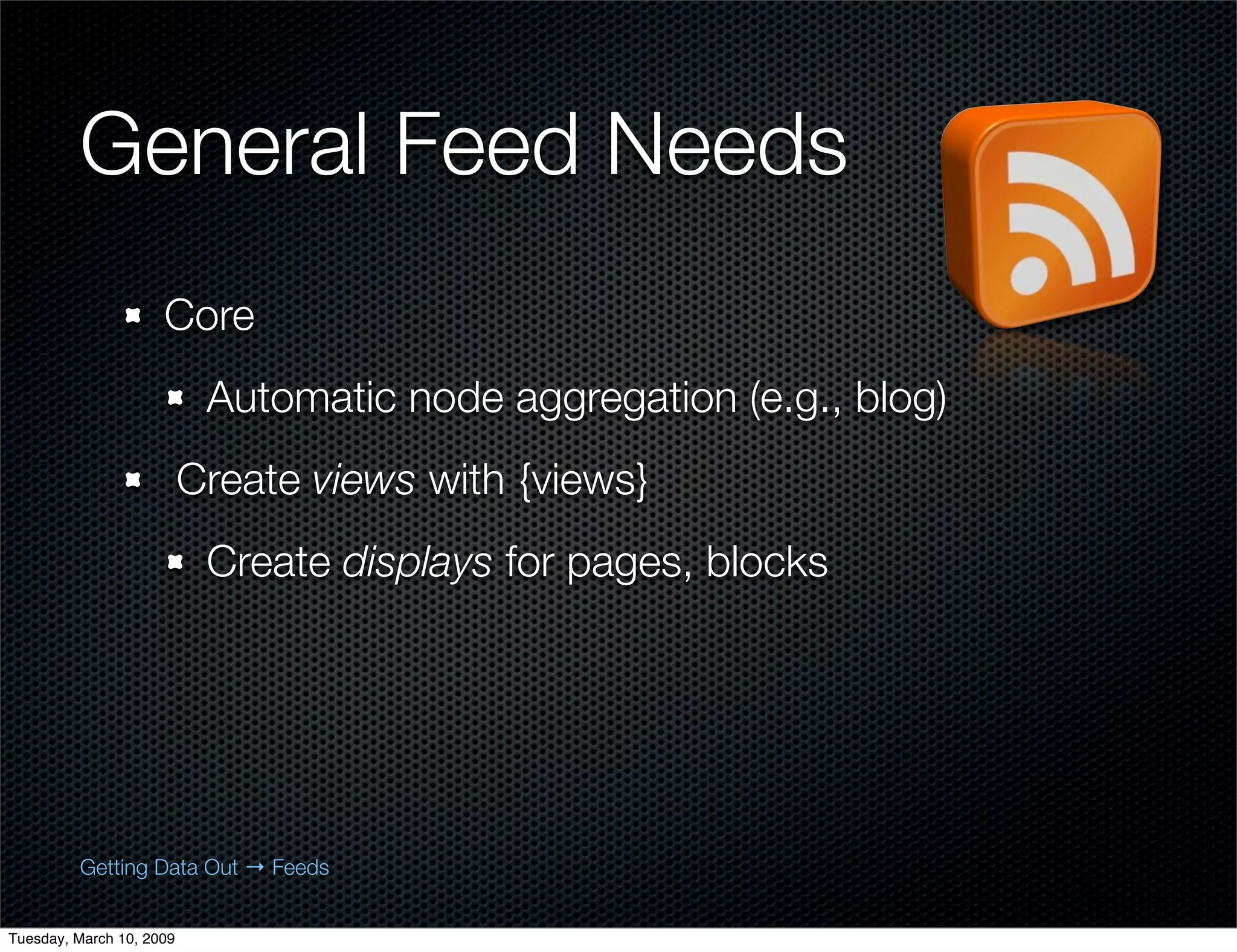
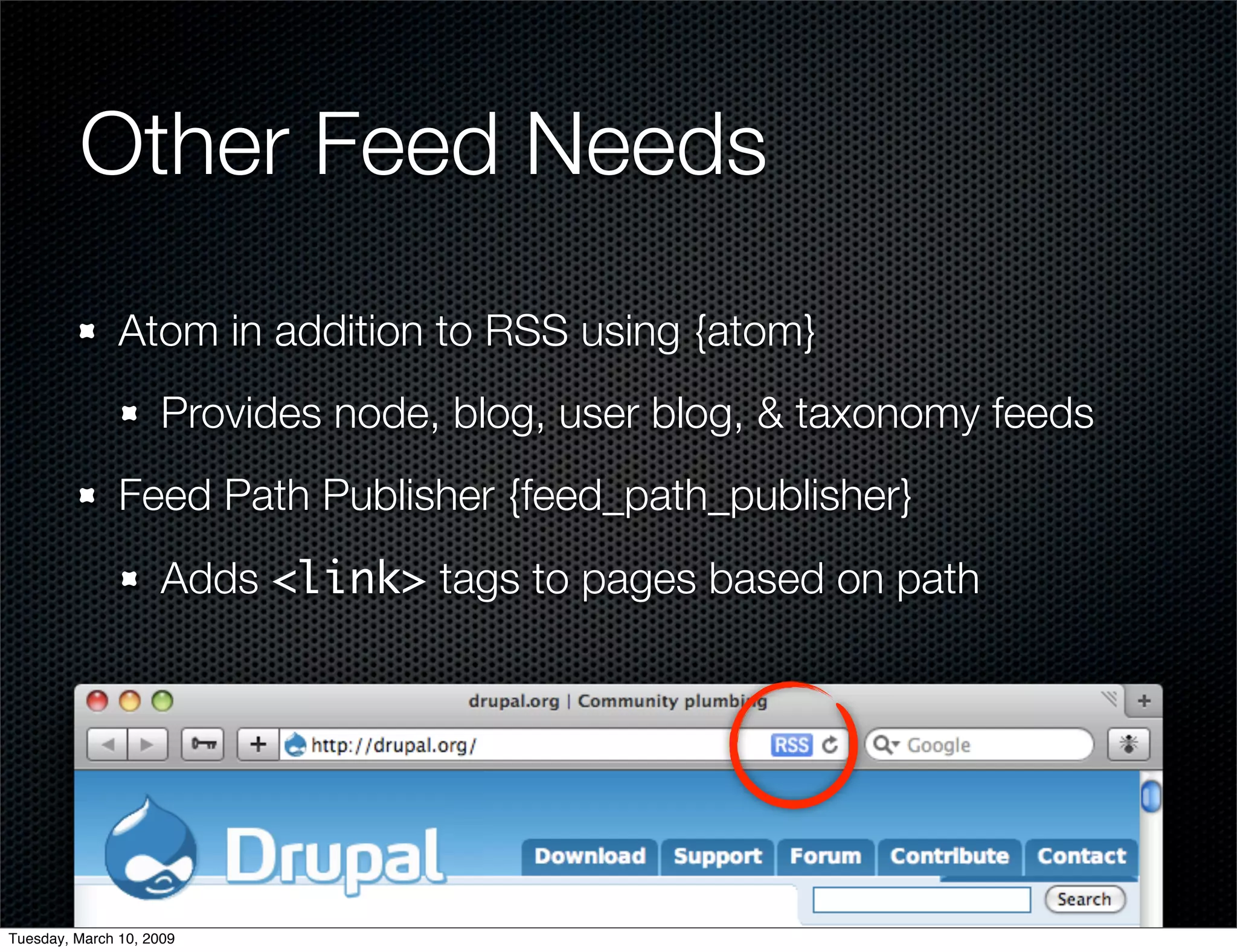
  • #122 - node -- all nodes - blog -- all blog nodes - user blog -- all blog posts for a user - taxonomy feeds -- all content published under a certain tag
  • #123 - node -- all nodes - blog -- all blog nodes - user blog -- all blog posts for a user - taxonomy feeds -- all content published under a certain tag
  • #124 - node -- all nodes - blog -- all blog nodes - user blog -- all blog posts for a user - taxonomy feeds -- all content published under a certain tag
  • #125 - node -- all nodes - blog -- all blog nodes - user blog -- all blog posts for a user - taxonomy feeds -- all content published under a certain tag
  • #126 - node -- all nodes - blog -- all blog nodes - user blog -- all blog posts for a user - taxonomy feeds -- all content published under a certain tag
  • #127 - node -- all nodes - blog -- all blog nodes - user blog -- all blog posts for a user - taxonomy feeds -- all content published under a certain tag
  • #128 - important factor, esp. for iphone, is backend mailing - smtp -- more useful from remote clients - able to centralize your mail, even using another isp
  • #129 - important factor, esp. for iphone, is backend mailing - smtp -- more useful from remote clients - able to centralize your mail, even using another isp
  • #130 - important factor, esp. for iphone, is backend mailing - smtp -- more useful from remote clients - able to centralize your mail, even using another isp
  • #131 - important factor, esp. for iphone, is backend mailing - smtp -- more useful from remote clients - able to centralize your mail, even using another isp
  • #132 - important factor, esp. for iphone, is backend mailing - smtp -- more useful from remote clients - able to centralize your mail, even using another isp
  • #133 - important factor, esp. for iphone, is backend mailing - smtp -- more useful from remote clients - able to centralize your mail, even using another isp
  • #134 - important factor, esp. for iphone, is backend mailing - smtp -- more useful from remote clients - able to centralize your mail, even using another isp
  • #135 - important factor, esp. for iphone, is backend mailing - smtp -- more useful from remote clients - able to centralize your mail, even using another isp
  • #136 - important factor, esp. for iphone, is backend mailing - smtp -- more useful from remote clients - able to centralize your mail, even using another isp
  • #137 - important factor, esp. for iphone, is backend mailing - smtp -- more useful from remote clients - able to centralize your mail, even using another isp
  • #138 - simple office file format exporting - json useful for read-only data -- latest content, popular content, new users
  • #139 - simple office file format exporting - json useful for read-only data -- latest content, popular content, new users
  • #140 - simple office file format exporting - json useful for read-only data -- latest content, popular content, new users
  • #141 - easily export to pdf print view - force file downloads -- example, make people download media to disk, make it easy for users to save files locally - mention backup/migrate just out of ease of use - not ideal for data transfer, but might fit your project
  • #142 - easily export to pdf print view - force file downloads -- example, make people download media to disk, make it easy for users to save files locally - mention backup/migrate just out of ease of use - not ideal for data transfer, but might fit your project
  • #143 - easily export to pdf print view - force file downloads -- example, make people download media to disk, make it easy for users to save files locally - mention backup/migrate just out of ease of use - not ideal for data transfer, but might fit your project
  • #148 - just going to touch on this to mention that drupal support is there
  • #149 - just going to touch on this to mention that drupal support is there
  • #150 - just going to touch on this to mention that drupal support is there
  • #151 - just going to touch on this to mention that drupal support is there
  • #152 - just going to touch on this to mention that drupal support is there
  • #153 - just going to touch on this to mention that drupal support is there
  • #154 - just going to touch on this to mention that drupal support is there
  • #155 - just going to touch on this to mention that drupal support is there
  • #156 - just going to touch on this to mention that drupal support is there
  • #157 - just going to touch on this to mention that drupal support is there
  • #158 - just going to touch on this to mention that drupal support is there
  • #159 - just going to touch on this to mention that drupal support is there
  • #160 - just going to touch on this to mention that drupal support is there
  • #182 - enterprise print job reporting: cck type for ‘print job’, implement client reporting after print - hardware tracking: track battery life in the field, gps reporting of client location - high scores for mobile games, with a social element on the website
  • #183 - enterprise print job reporting: cck type for ‘print job’, implement client reporting after print - hardware tracking: track battery life in the field, gps reporting of client location - high scores for mobile games, with a social element on the website
  • #184 - enterprise print job reporting: cck type for ‘print job’, implement client reporting after print - hardware tracking: track battery life in the field, gps reporting of client location - high scores for mobile games, with a social element on the website
  • #185 - good place to start if you need a quick and dirty proof of concept with minimal code - that’s not to say it’s not powerful, but it’s low barrier to entry - problem is, a lot of people don’t know about it or have misconceptions...
  • #186 - good place to start if you need a quick and dirty proof of concept with minimal code - that’s not to say it’s not powerful, but it’s low barrier to entry - problem is, a lot of people don’t know about it or have misconceptions...
  • #187 - good place to start if you need a quick and dirty proof of concept with minimal code - that’s not to say it’s not powerful, but it’s low barrier to entry - problem is, a lot of people don’t know about it or have misconceptions...
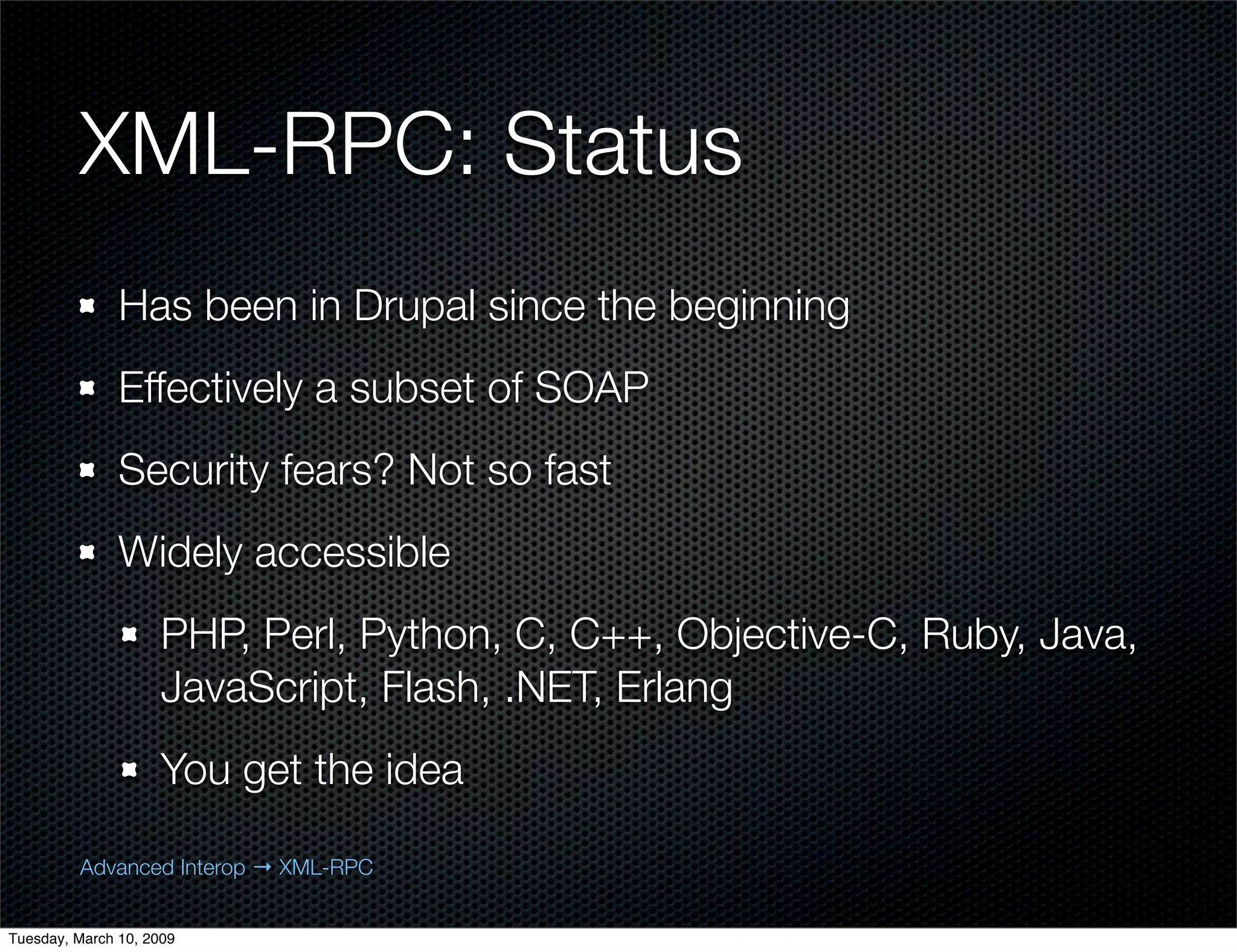
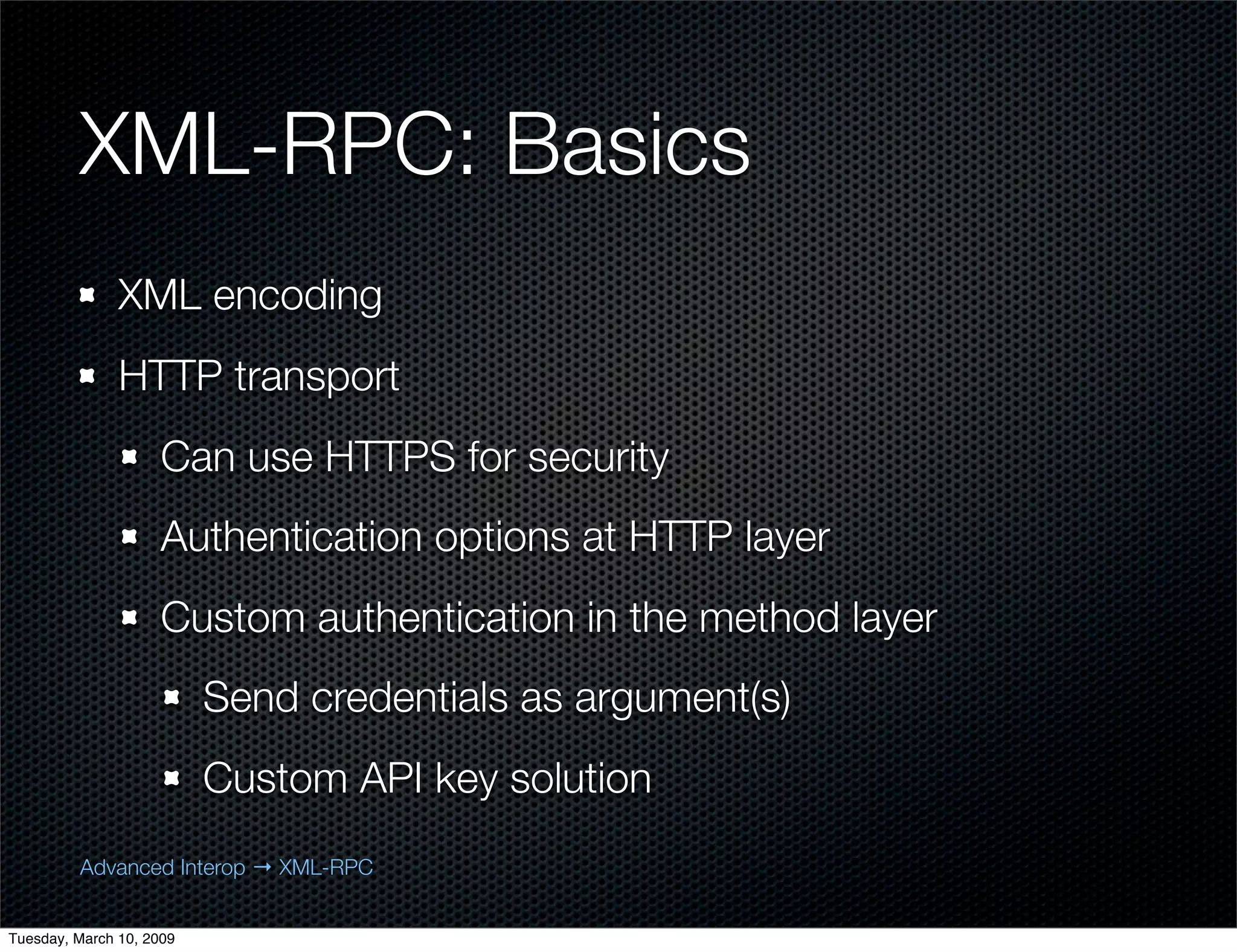
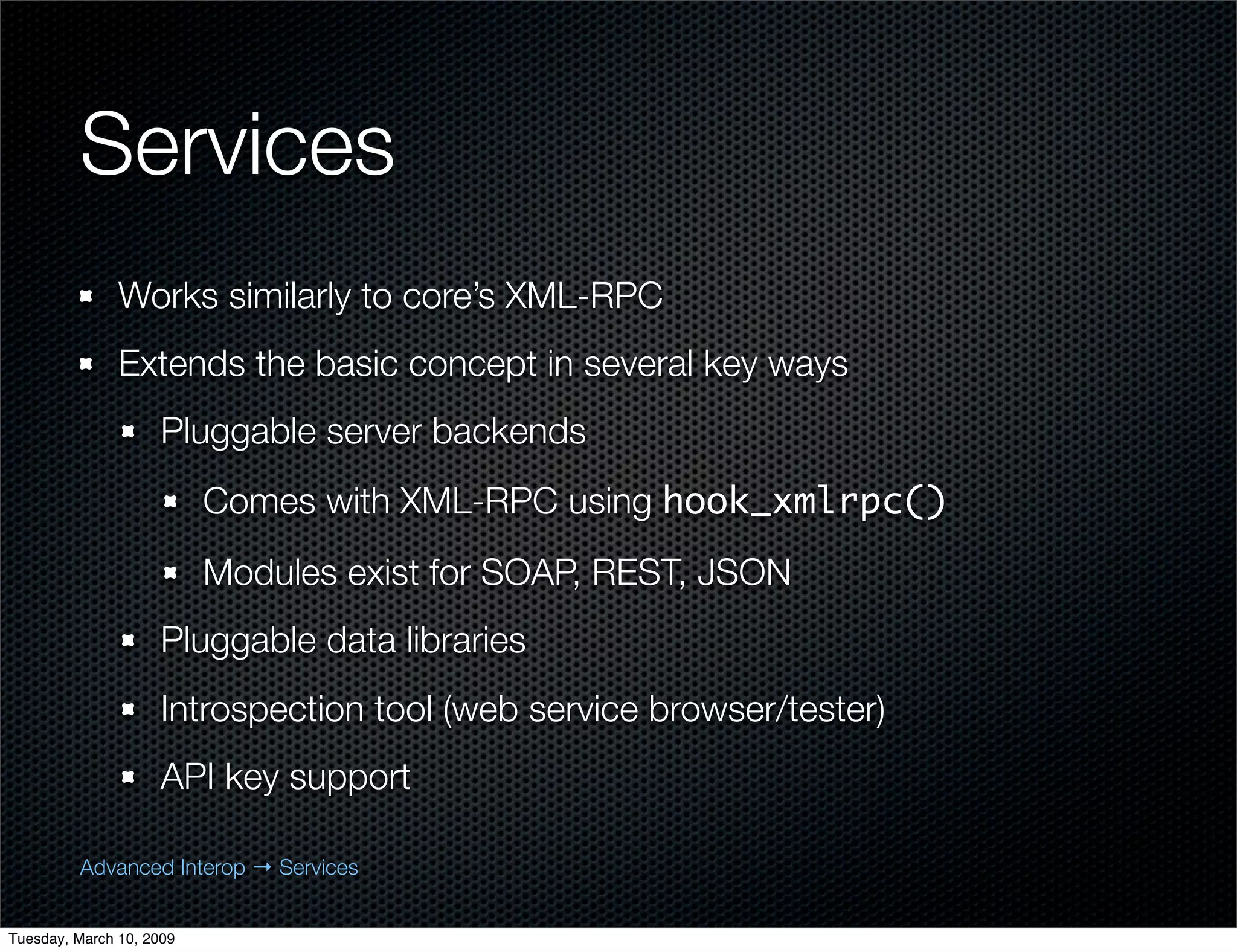
  • #188 - Dries: “It was added because I liked adding new and promising technologies.” - Mollom uses XML-RPC today to talk to its servers - KDE using this for app scripting
  • #189 - Dries: “It was added because I liked adding new and promising technologies.” - Mollom uses XML-RPC today to talk to its servers - KDE using this for app scripting
  • #190 - Dries: “It was added because I liked adding new and promising technologies.” - Mollom uses XML-RPC today to talk to its servers - KDE using this for app scripting
  • #191 - Dries: “It was added because I liked adding new and promising technologies.” - Mollom uses XML-RPC today to talk to its servers - KDE using this for app scripting
  • #192 - Dries: “It was added because I liked adding new and promising technologies.” - Mollom uses XML-RPC today to talk to its servers - KDE using this for app scripting
  • #193 - Dries: “It was added because I liked adding new and promising technologies.” - Mollom uses XML-RPC today to talk to its servers - KDE using this for app scripting
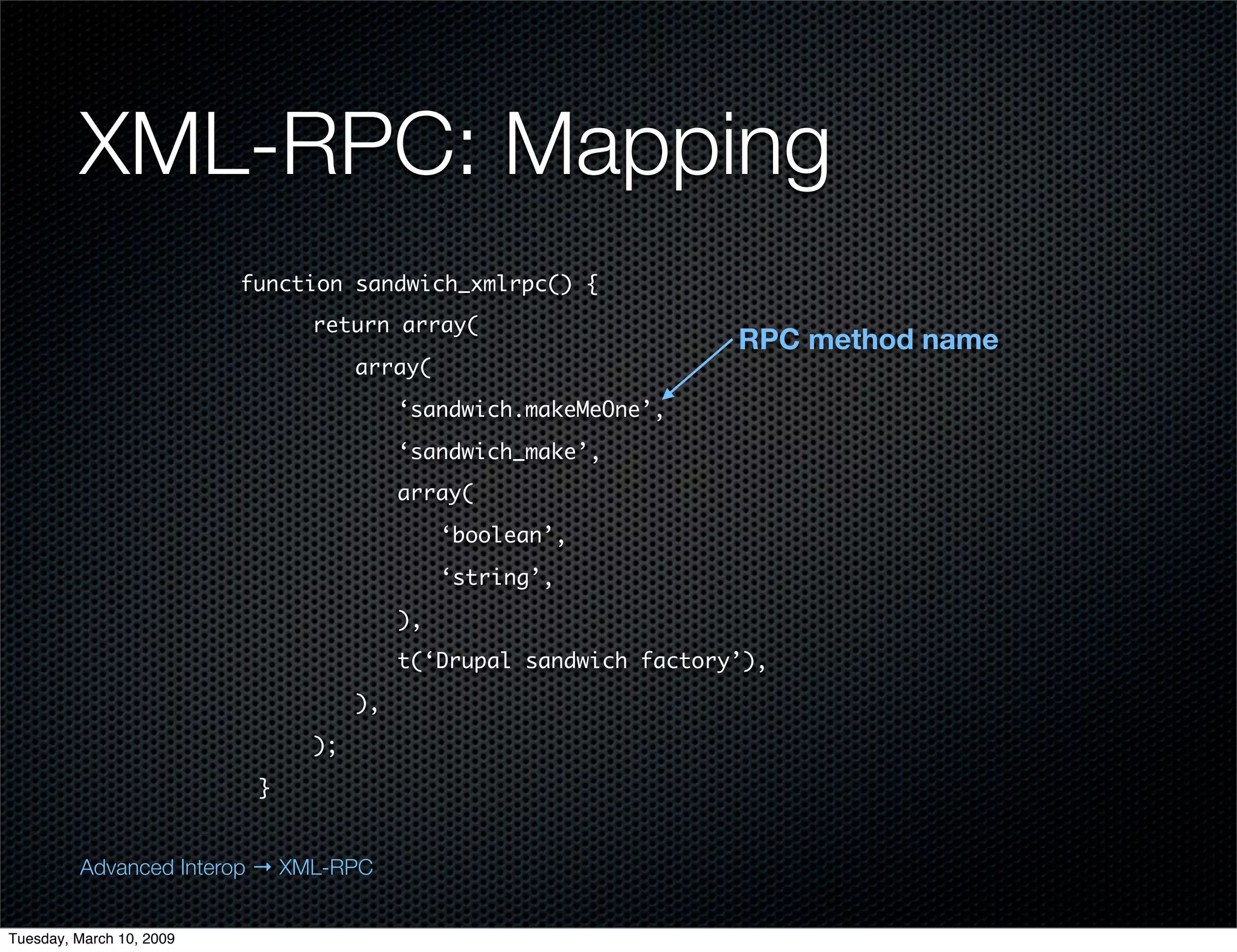
  • #194 - very important to understand how access works - just as you could write a module that dumps private content whenever you go to /private - you could also write an xml-rpc service that gives free access - i’ve done api key before by storing a key in the user profile data
  • #195 - very important to understand how access works - just as you could write a module that dumps private content whenever you go to /private - you could also write an xml-rpc service that gives free access - i’ve done api key before by storing a key in the user profile data
  • #196 - very important to understand how access works - just as you could write a module that dumps private content whenever you go to /private - you could also write an xml-rpc service that gives free access - i’ve done api key before by storing a key in the user profile data
  • #197 - very important to understand how access works - just as you could write a module that dumps private content whenever you go to /private - you could also write an xml-rpc service that gives free access - i’ve done api key before by storing a key in the user profile data
  • #198 - very important to understand how access works - just as you could write a module that dumps private content whenever you go to /private - you could also write an xml-rpc service that gives free access - i’ve done api key before by storing a key in the user profile data
  • #199 - very important to understand how access works - just as you could write a module that dumps private content whenever you go to /private - you could also write an xml-rpc service that gives free access - i’ve done api key before by storing a key in the user profile data
  • #200 - very important to understand how access works - just as you could write a module that dumps private content whenever you go to /private - you could also write an xml-rpc service that gives free access - i’ve done api key before by storing a key in the user profile data
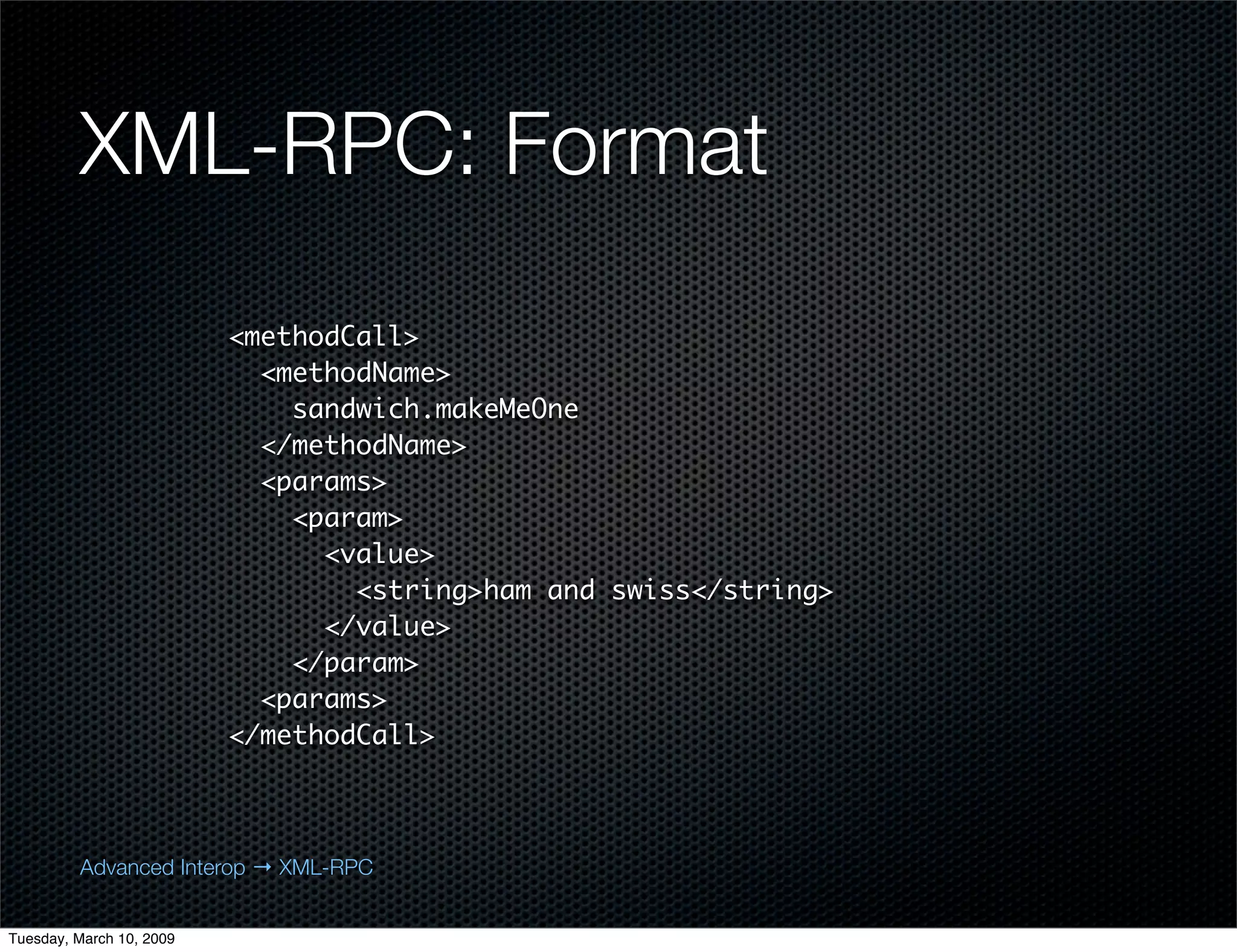
  • #201 - lightweight, reasonably easy to understand what’s going on
  • #202 - this is a core hook just like menu, access, nodeapi, etc.
  • #203 - this is a core hook just like menu, access, nodeapi, etc.
  • #204 - this is a core hook just like menu, access, nodeapi, etc.
  • #205 - this is a core hook just like menu, access, nodeapi, etc.
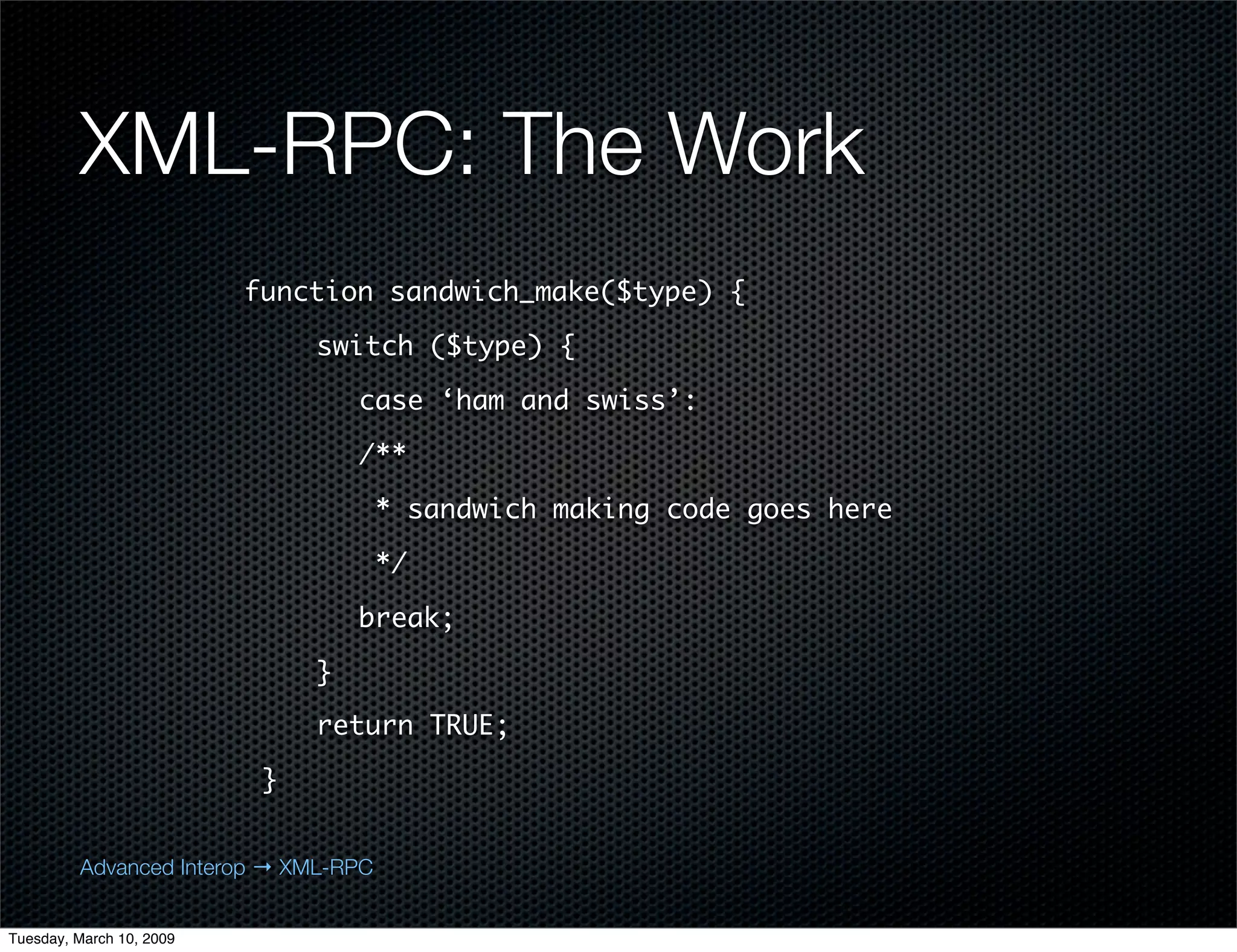
  • #206 - here’s the code you’re already writing
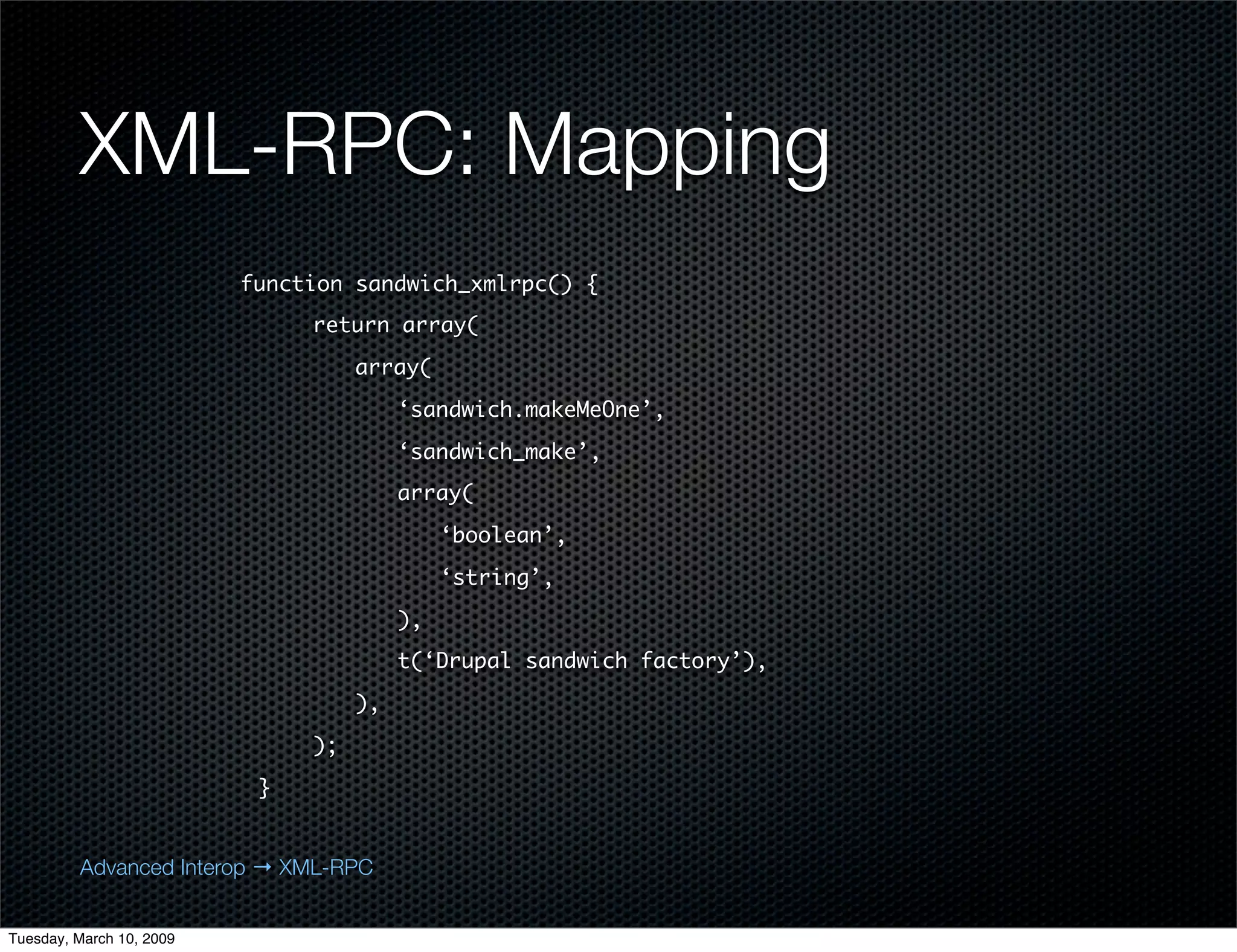
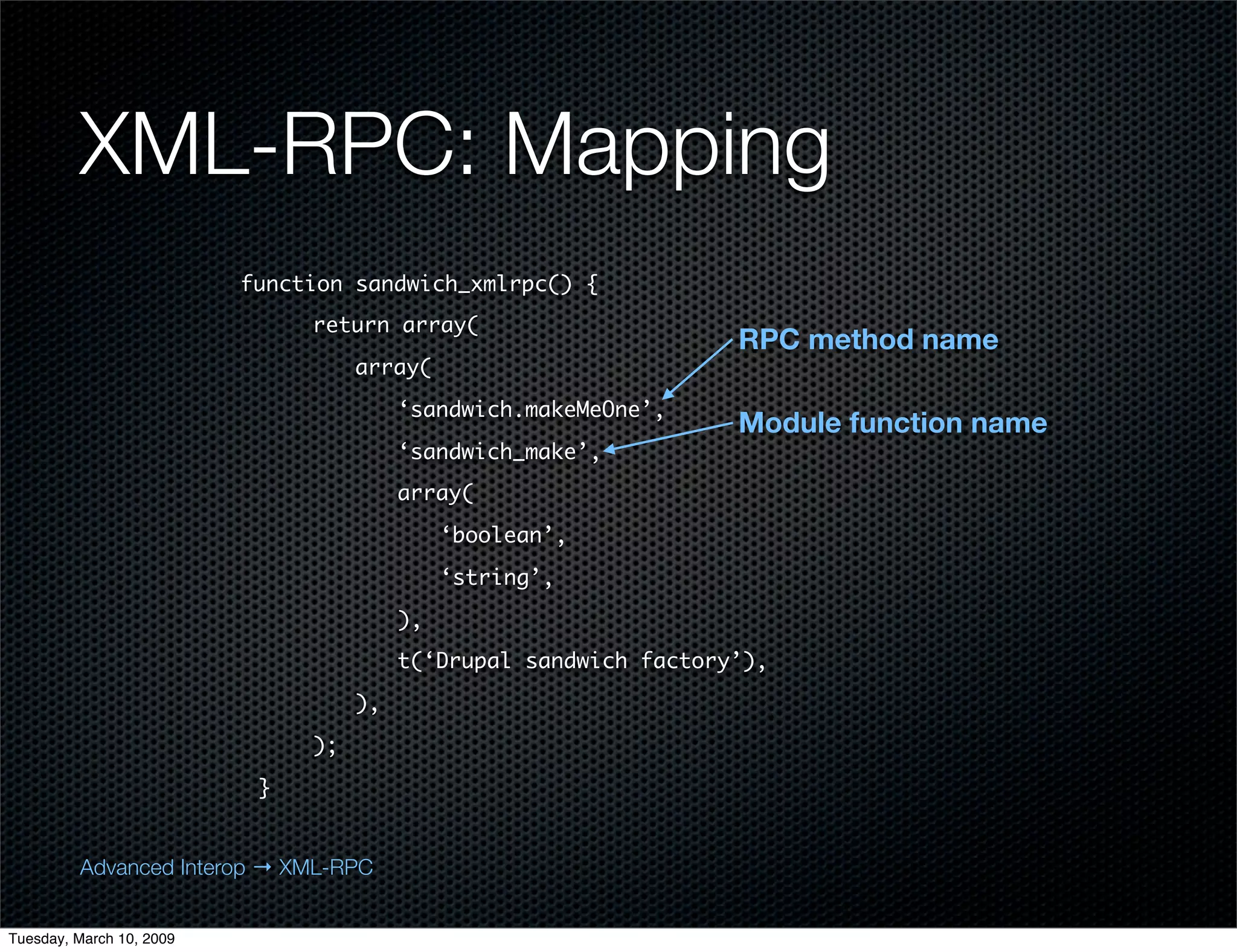
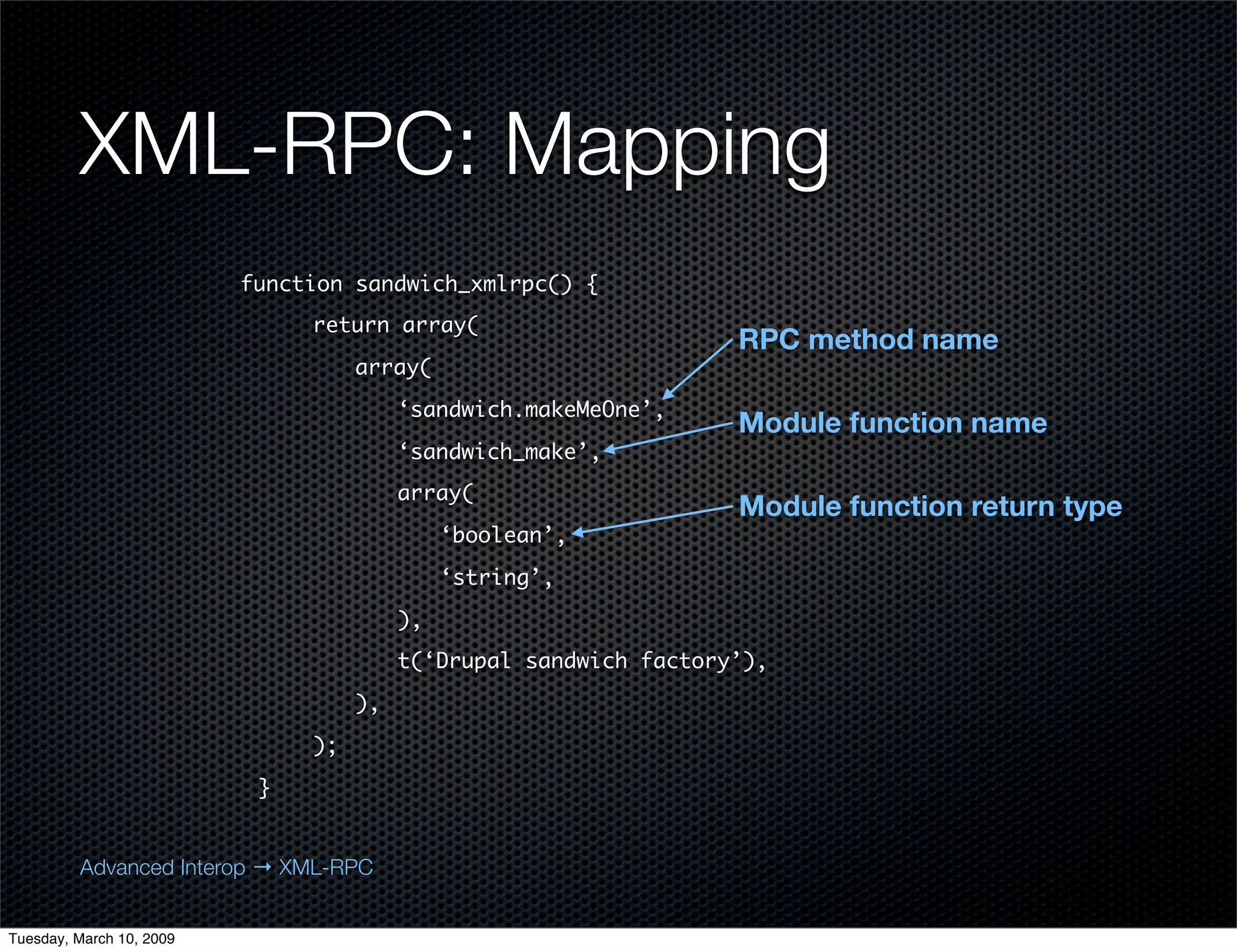
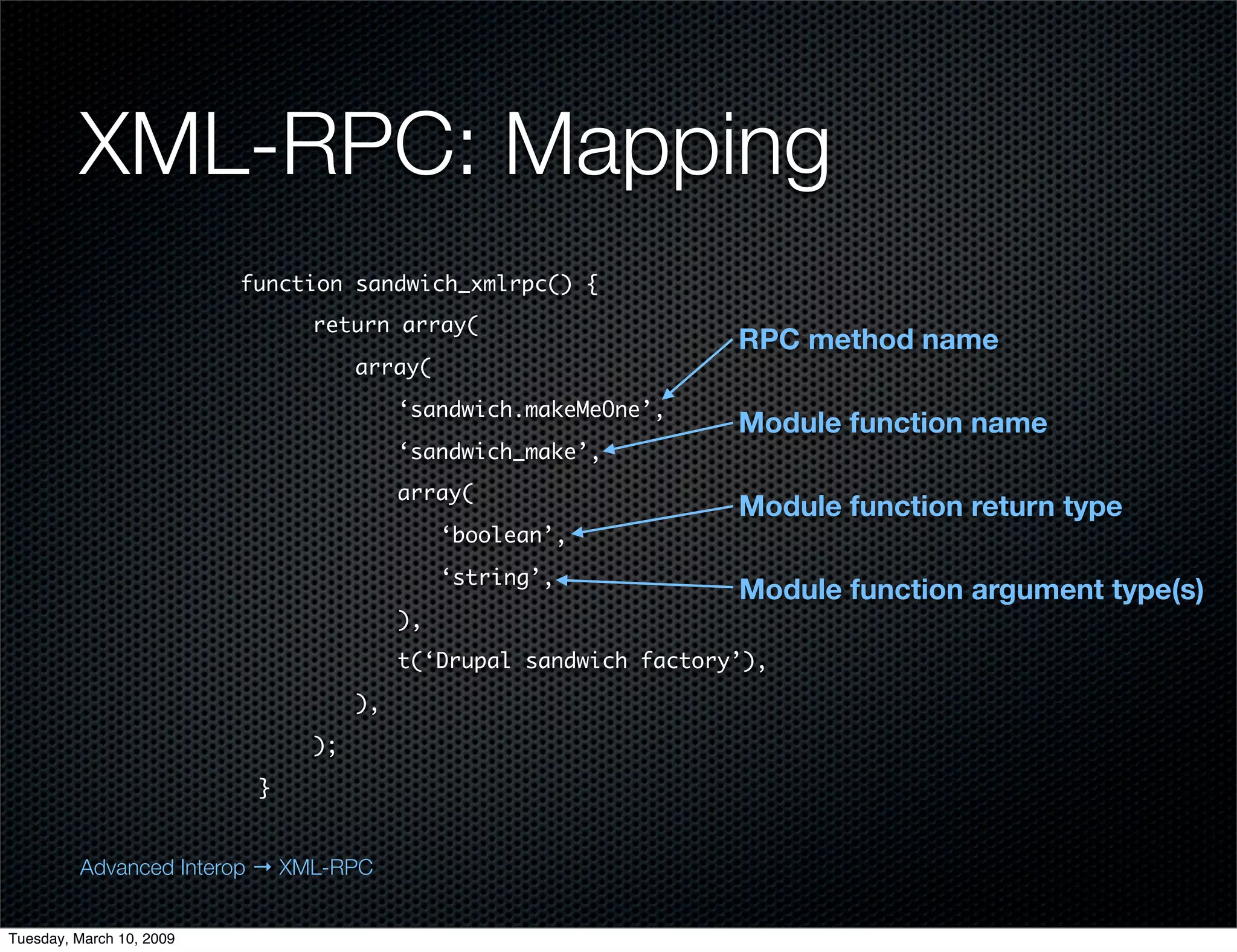
  • #207 - here’s how you connect drupal’s xml-rpc stack to your existing code
  • #208 - here’s how you connect drupal’s xml-rpc stack to your existing code
  • #209 - here’s how you connect drupal’s xml-rpc stack to your existing code
  • #210 - here’s how you connect drupal’s xml-rpc stack to your existing code
  • #211 - here’s how you connect drupal’s xml-rpc stack to your existing code
  • #212 - very robust - more upfront work to understand it - if included libraries meet your needs, faster startup - otherwise, need to learn the api
  • #213 - very robust - more upfront work to understand it - if included libraries meet your needs, faster startup - otherwise, need to learn the api
  • #214 - very robust - more upfront work to understand it - if included libraries meet your needs, faster startup - otherwise, need to learn the api
  • #215 - very robust - more upfront work to understand it - if included libraries meet your needs, faster startup - otherwise, need to learn the api
  • #216 - very robust - more upfront work to understand it - if included libraries meet your needs, faster startup - otherwise, need to learn the api
  • #217 - very robust - more upfront work to understand it - if included libraries meet your needs, faster startup - otherwise, need to learn the api
  • #218 - very robust - more upfront work to understand it - if included libraries meet your needs, faster startup - otherwise, need to learn the api
  • #219 - very robust - more upfront work to understand it - if included libraries meet your needs, faster startup - otherwise, need to learn the api
  • #220 - plus, of course, your own libraries
  • #221 - plus, of course, your own libraries
  • #222 - plus, of course, your own libraries
  • #223 - plus, of course, your own libraries
  • #224 - plus, of course, your own libraries
  • #225 - plus, of course, your own libraries
  • #226 - plus, of course, your own libraries
  • #227 - plus, of course, your own libraries
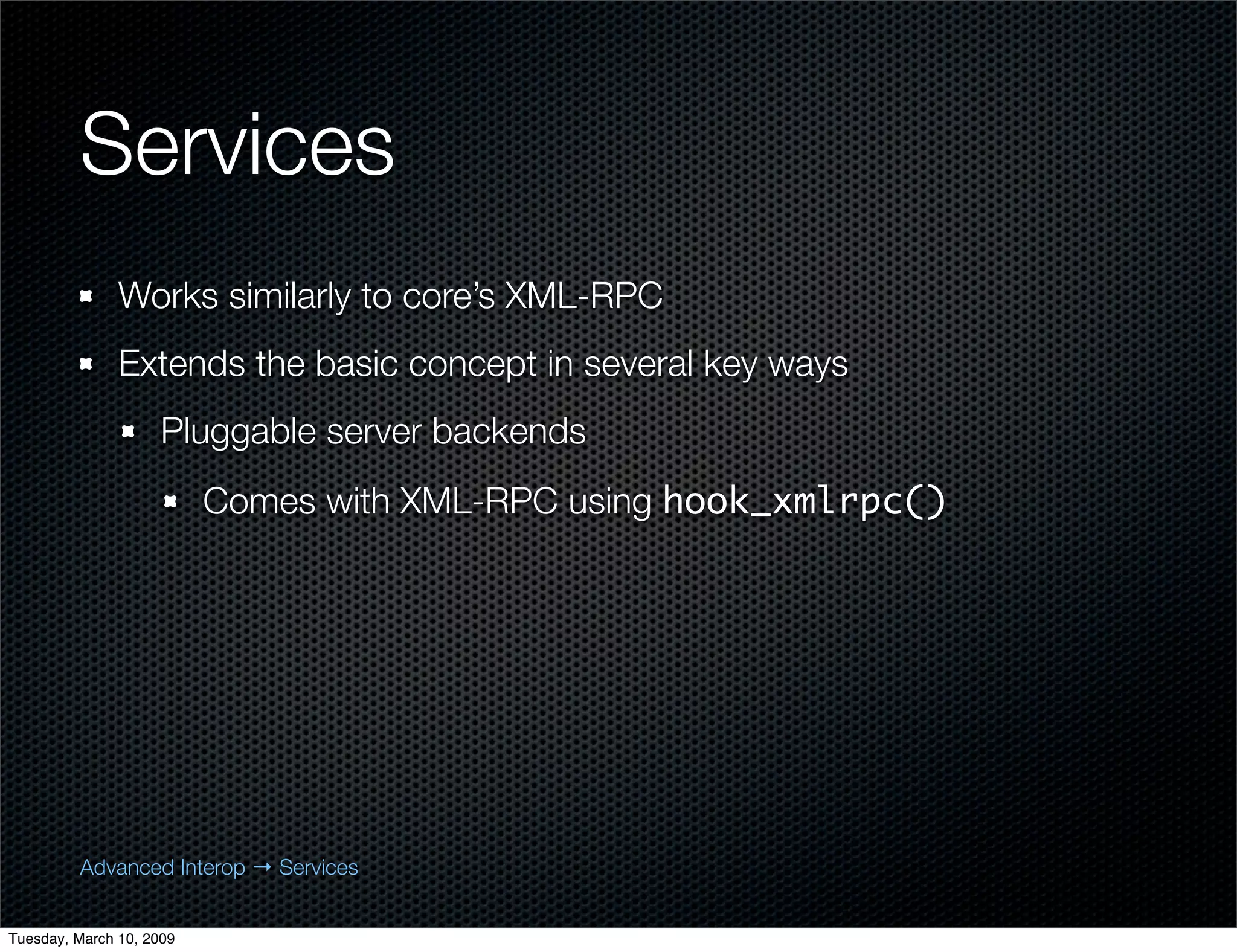
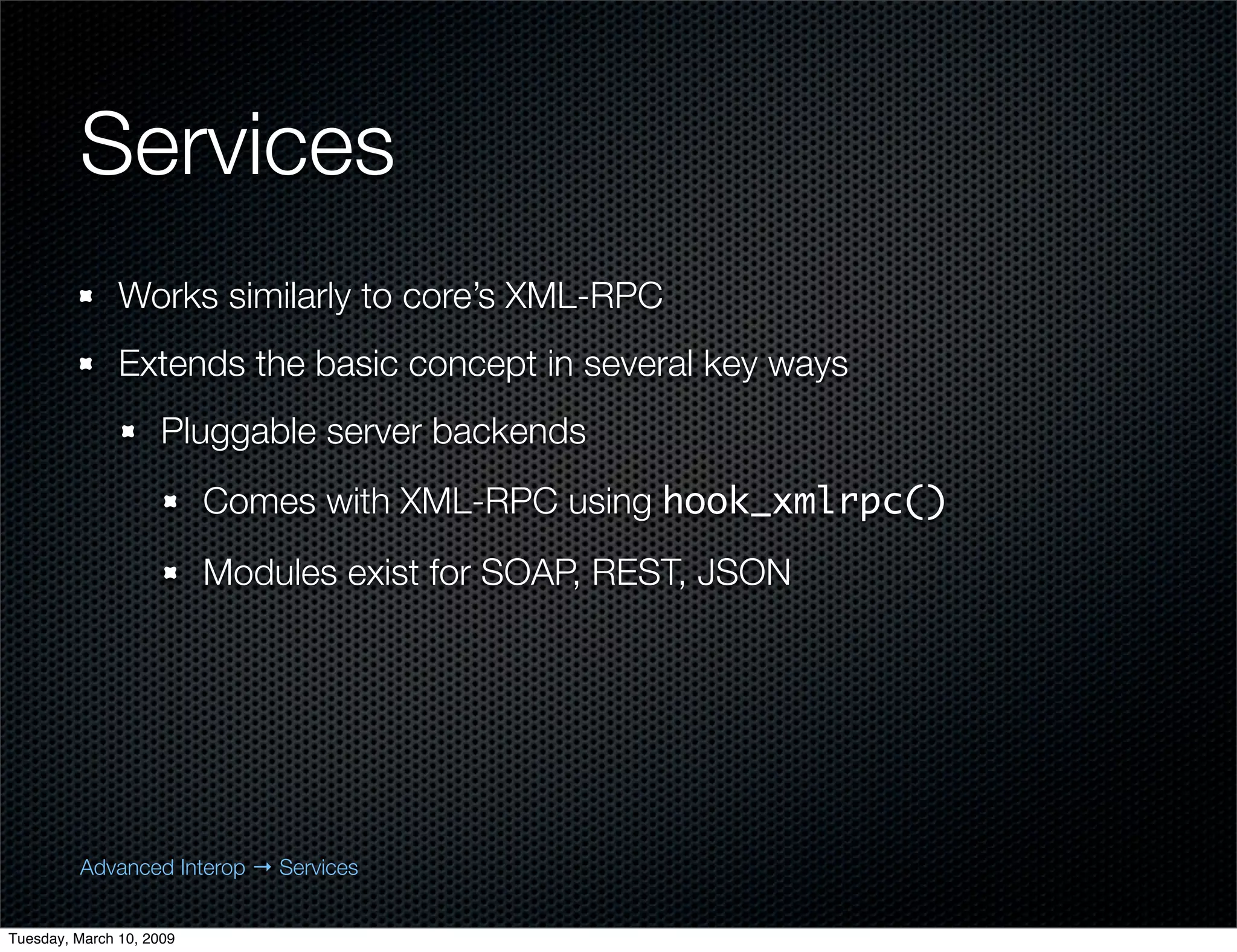
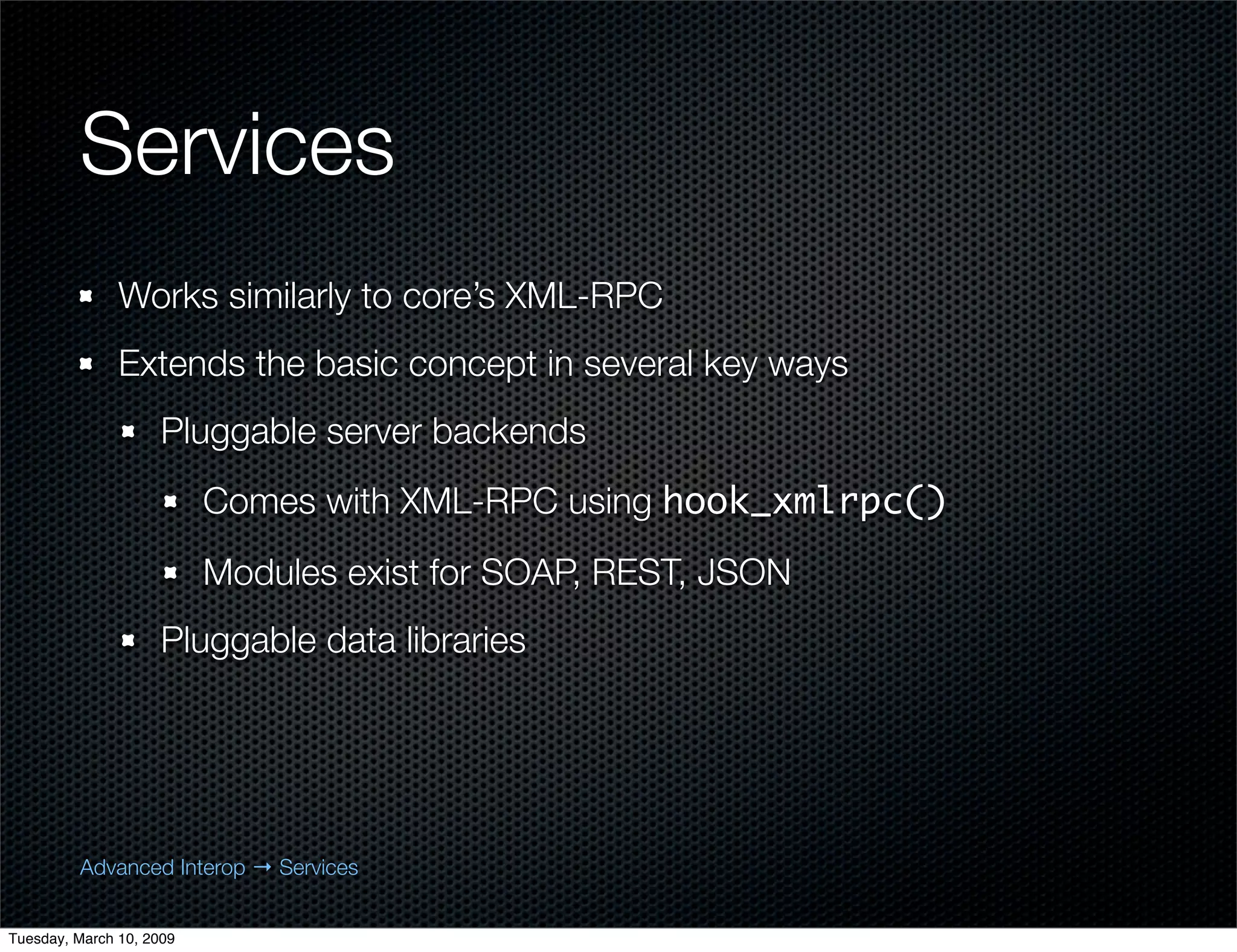
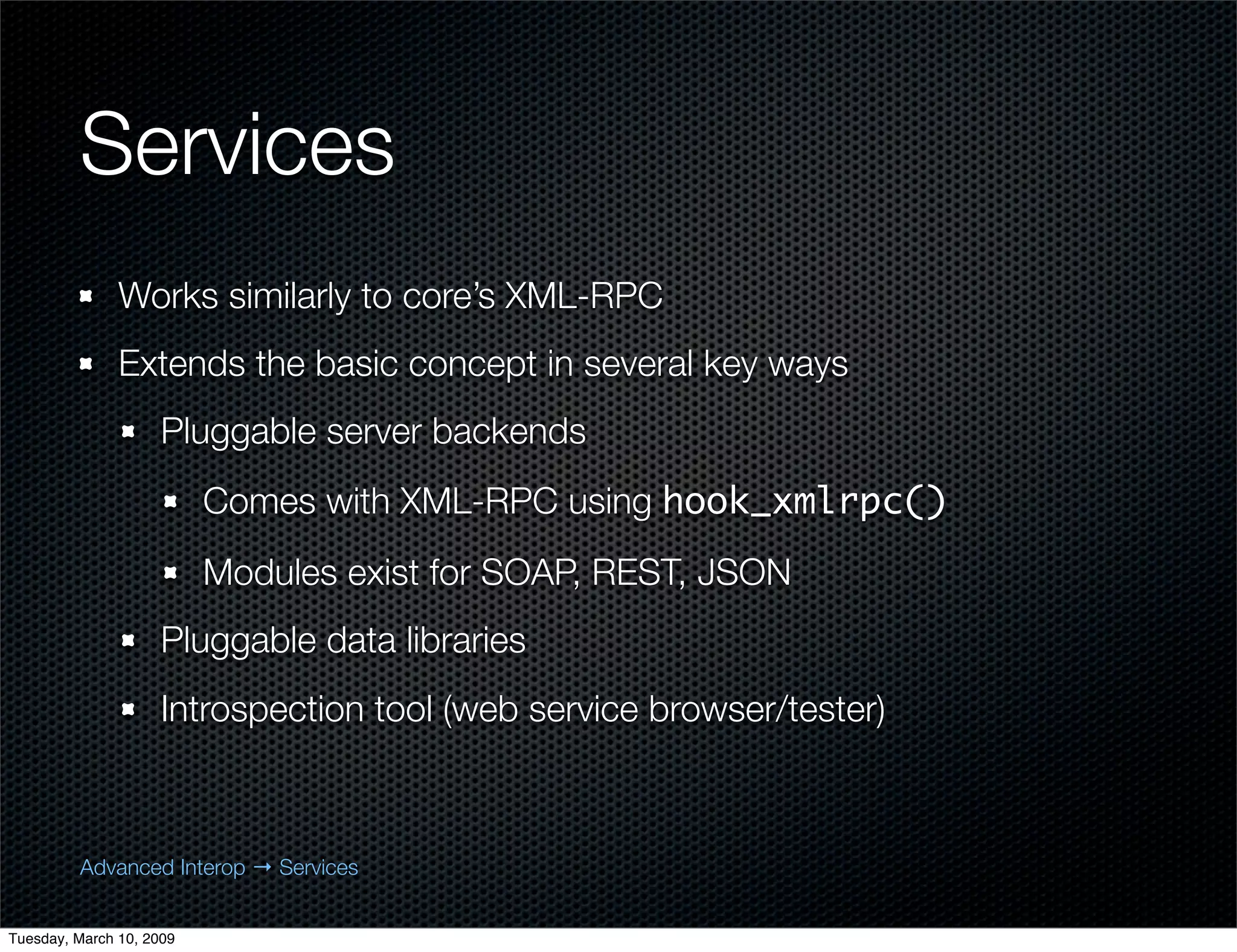
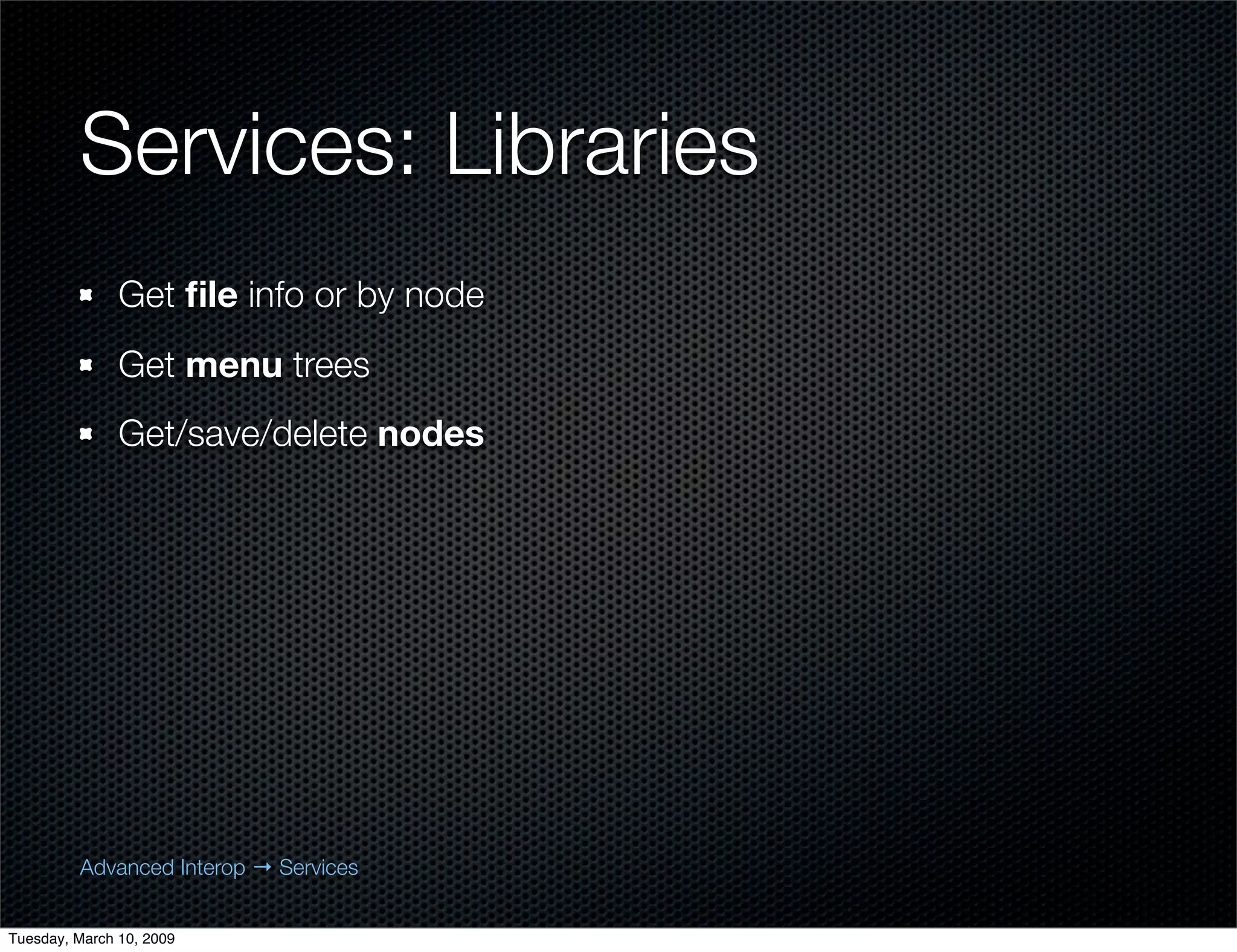
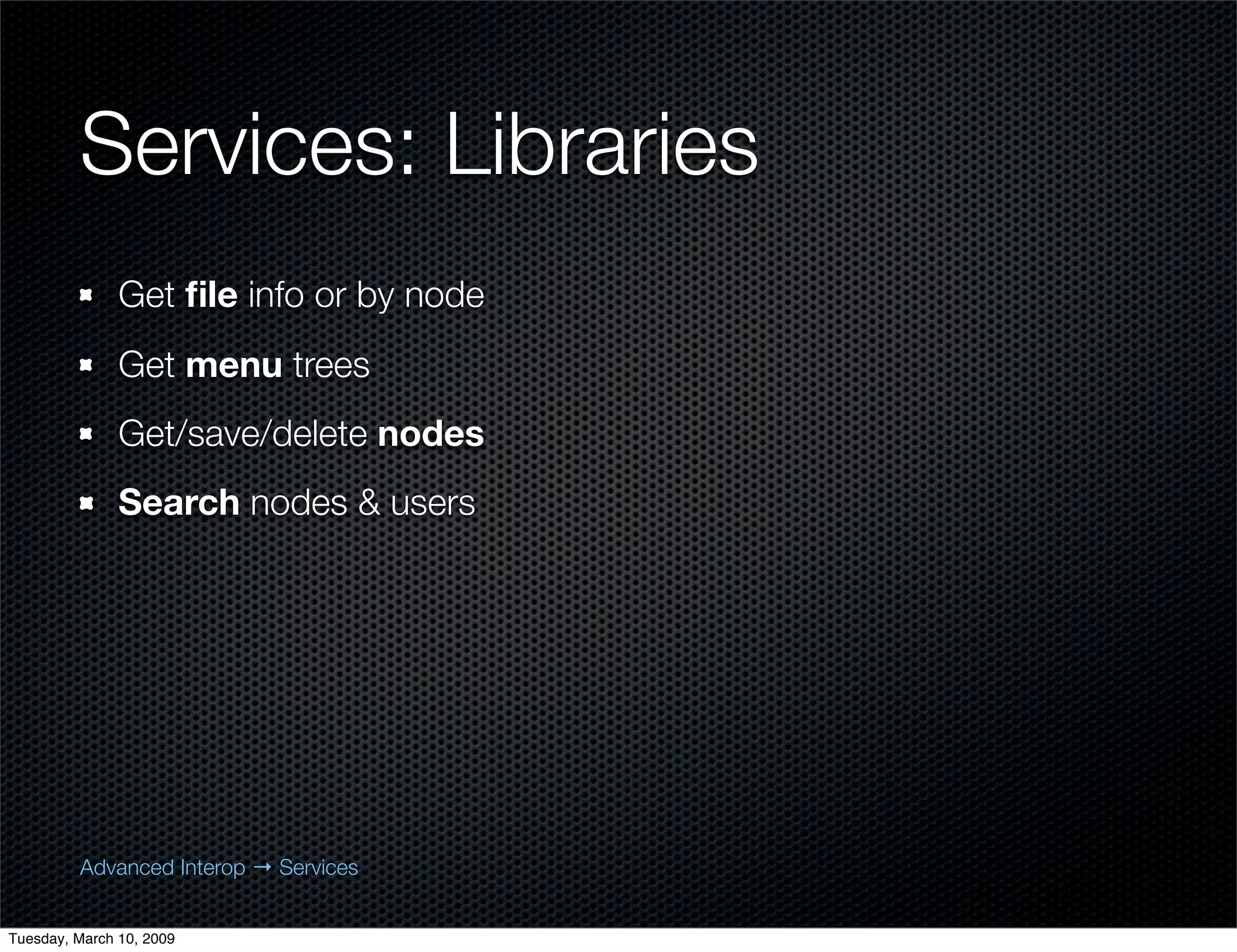
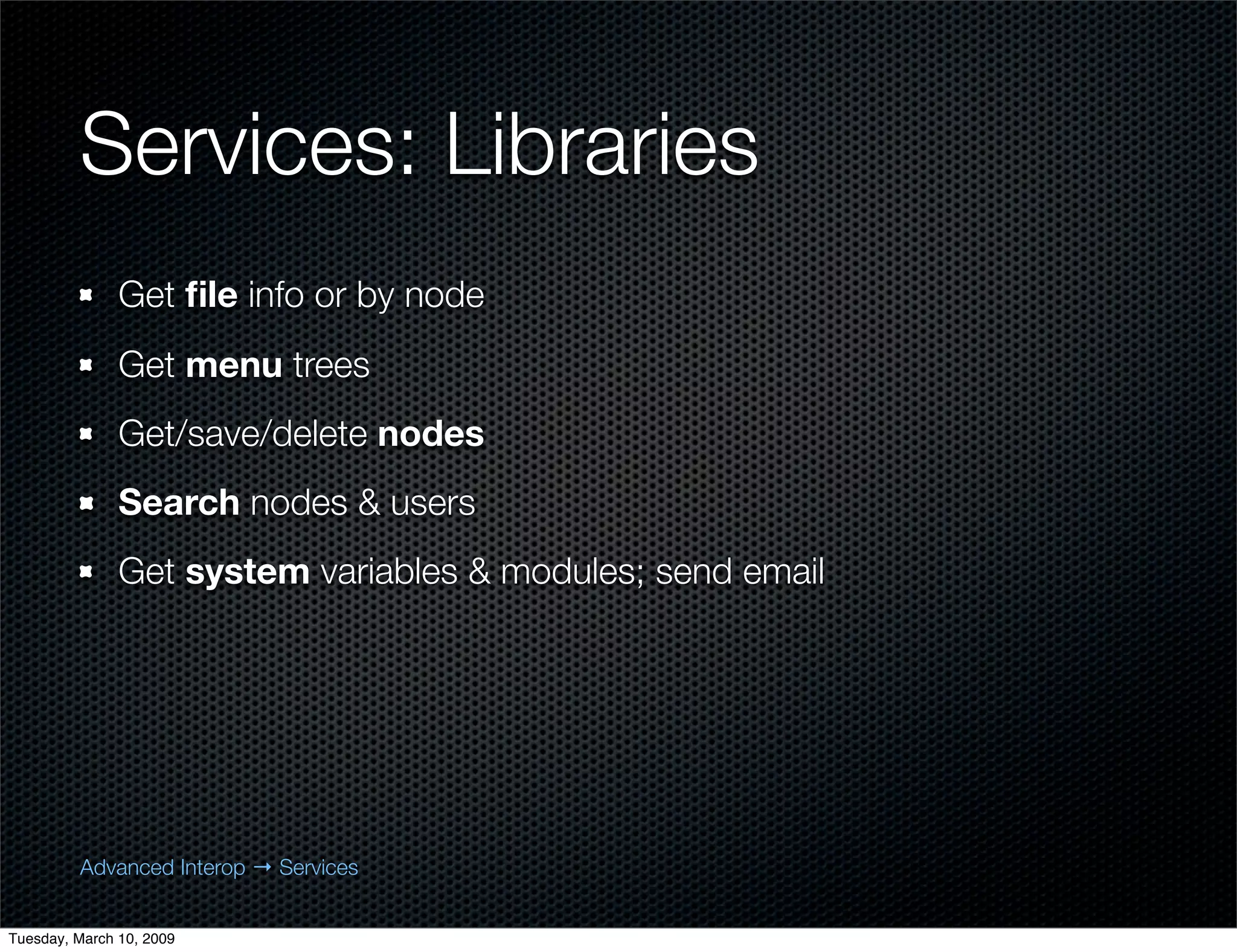
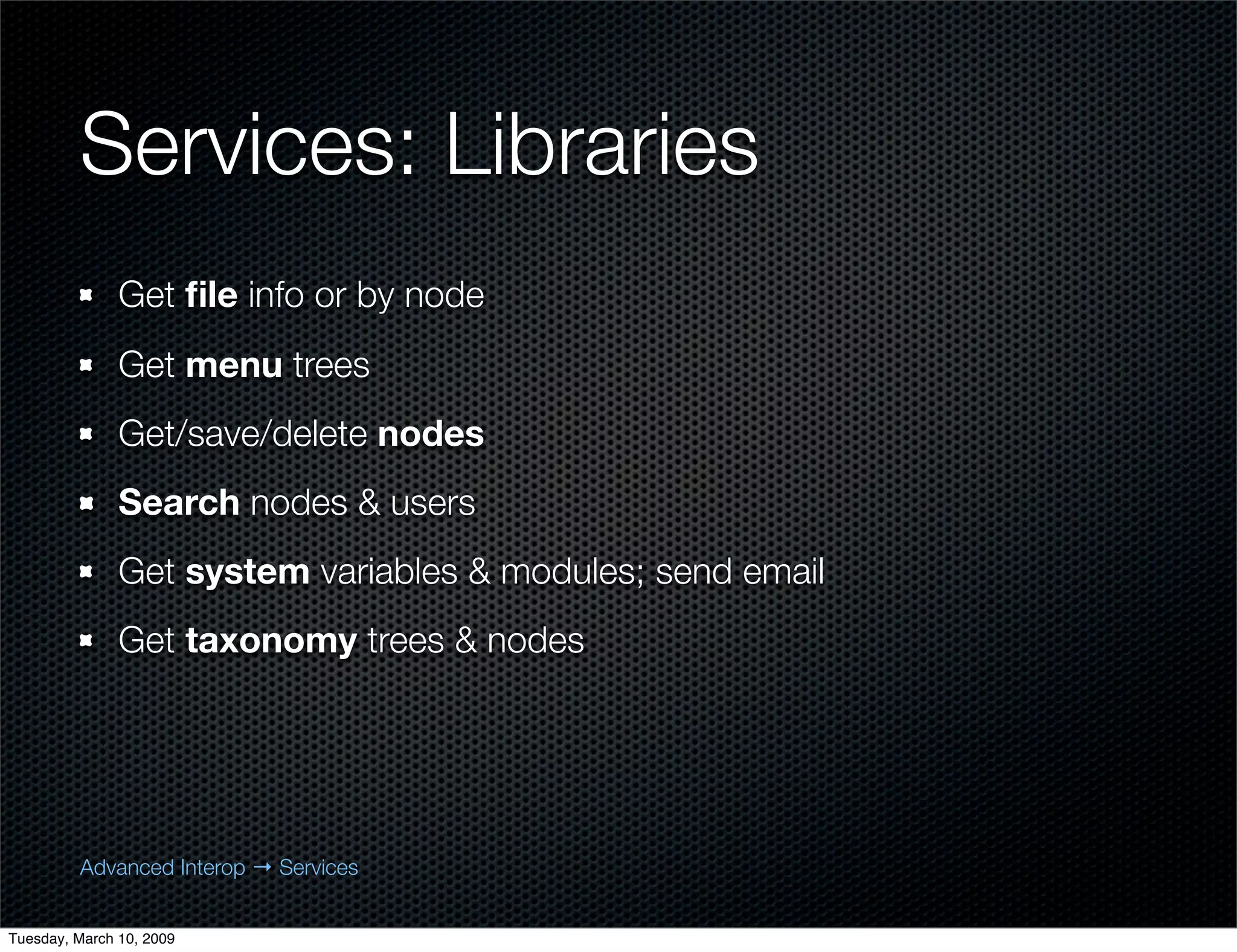
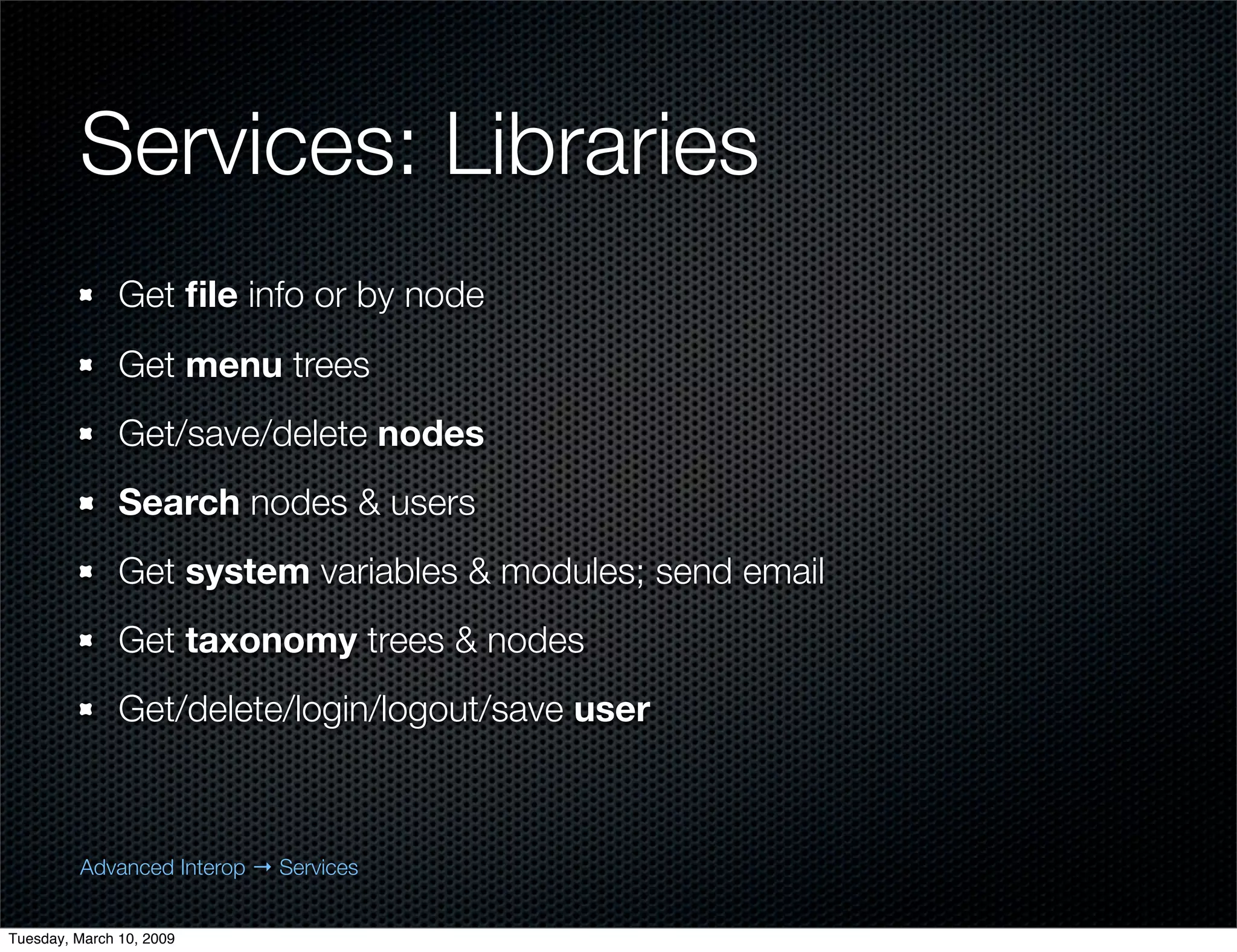
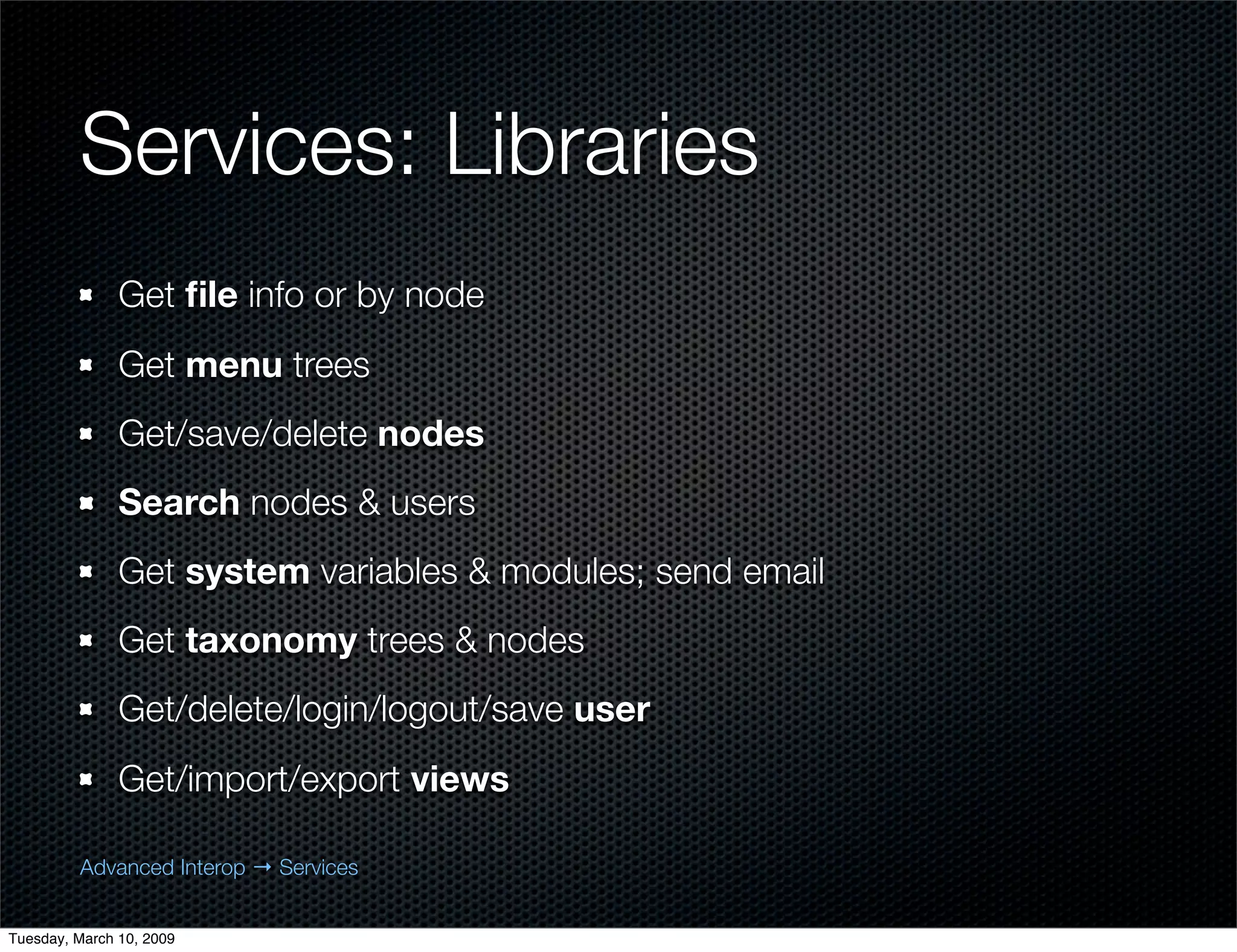
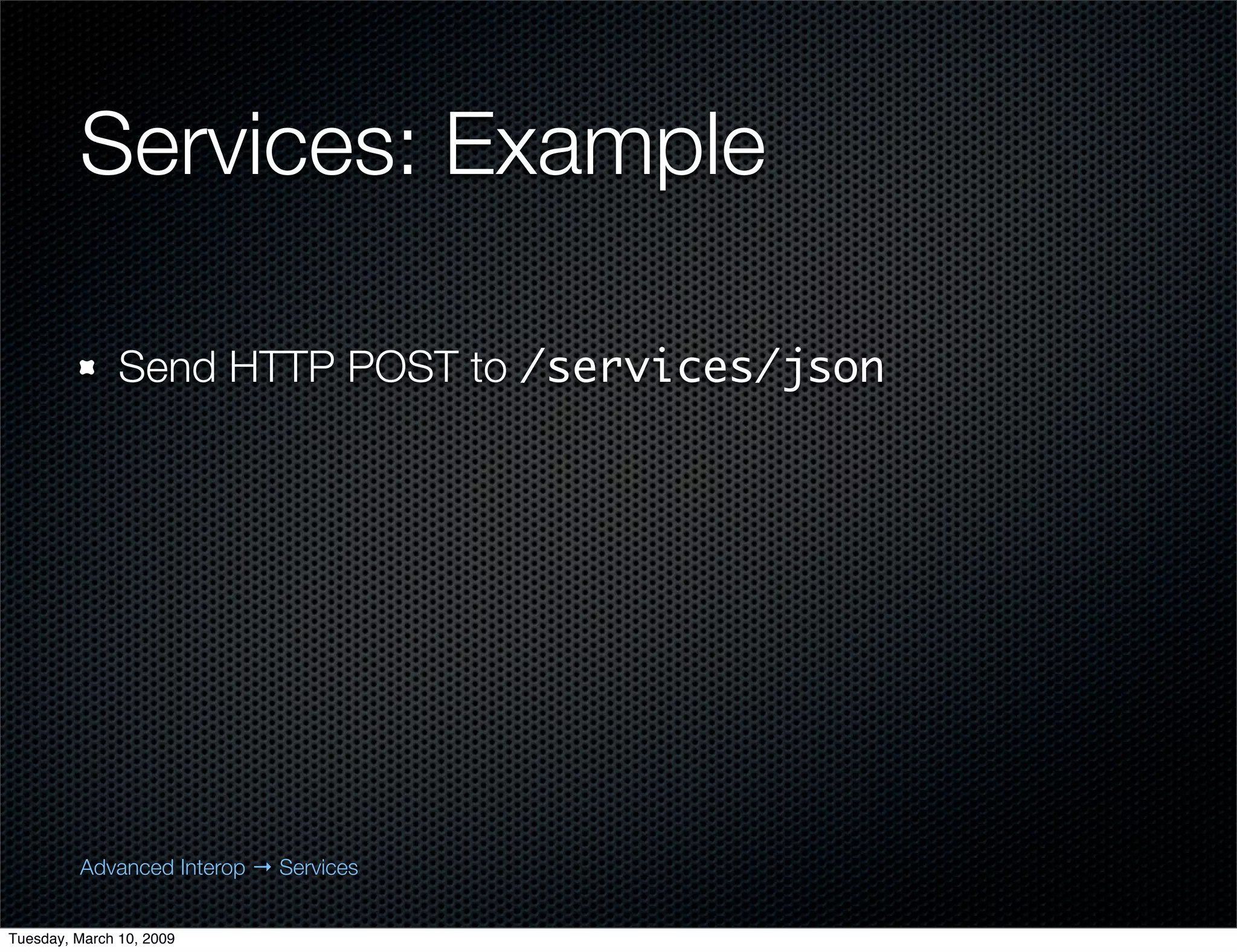
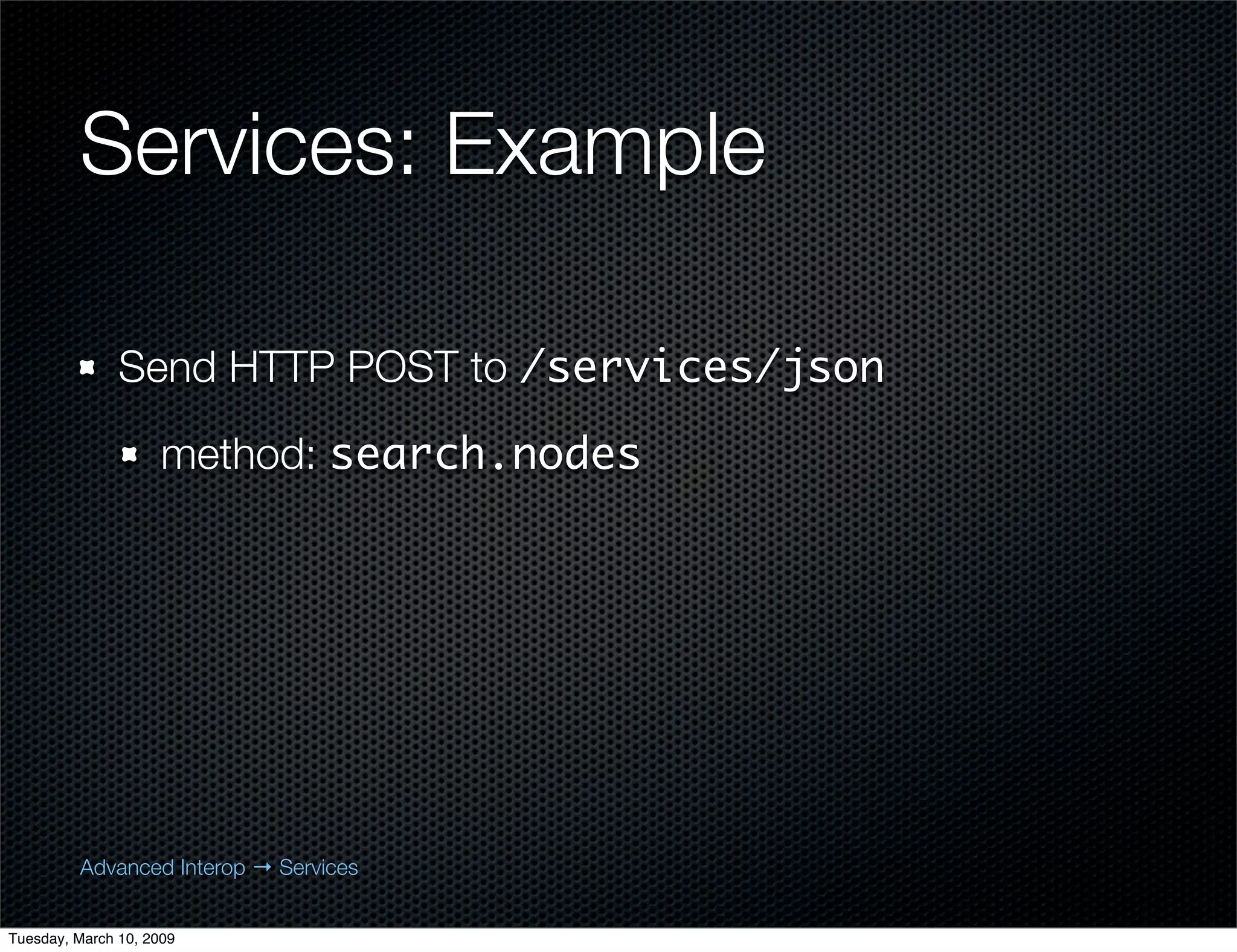
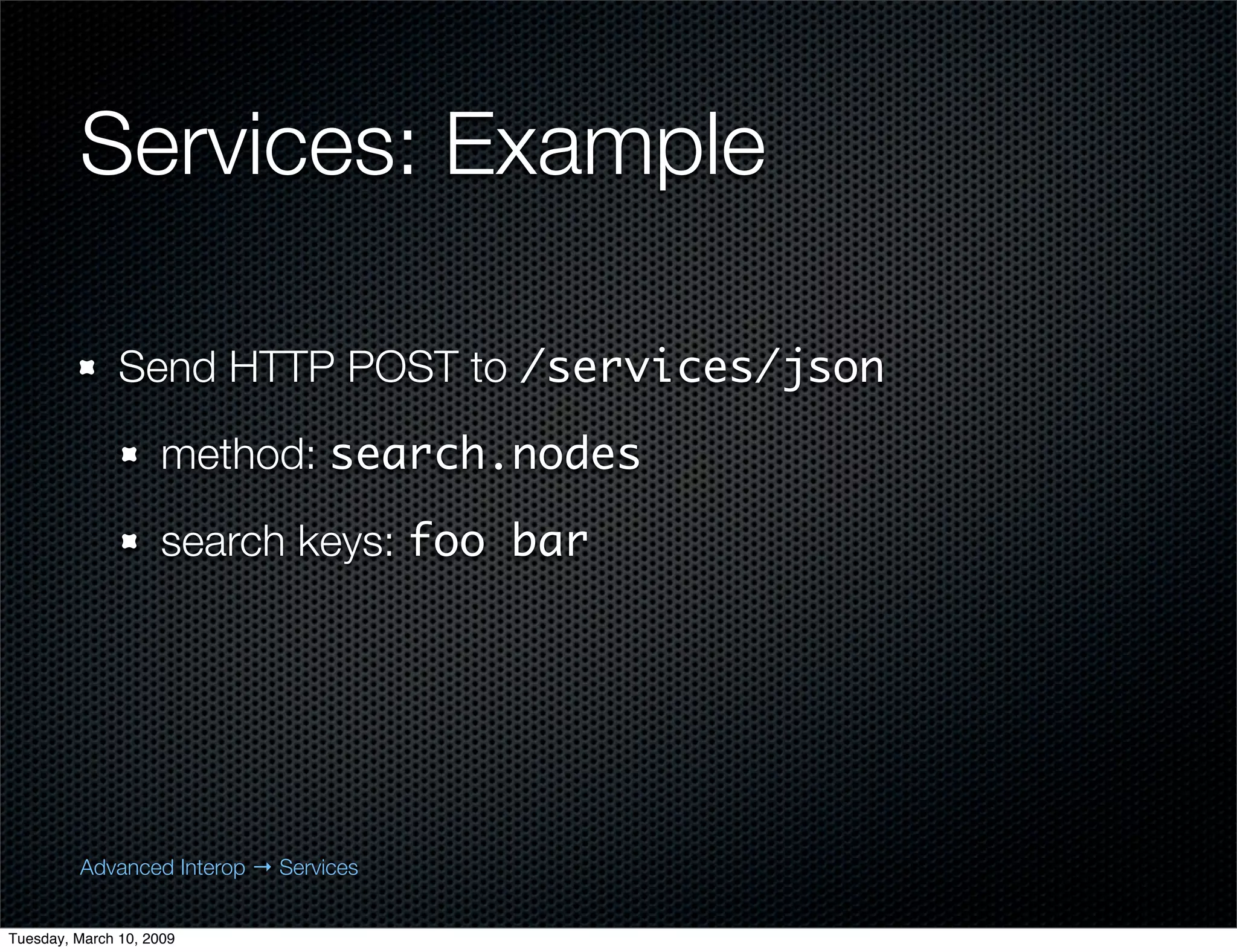
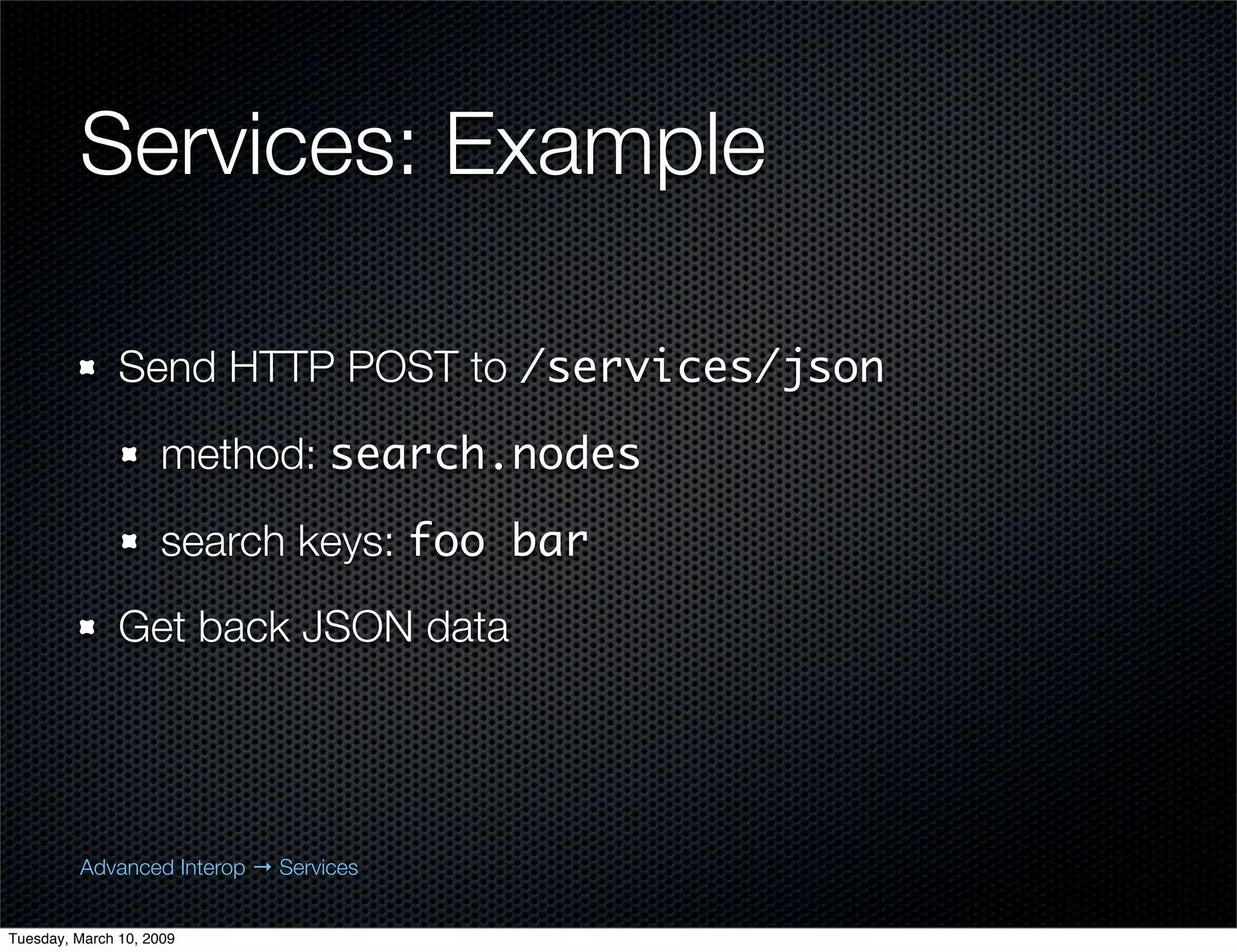
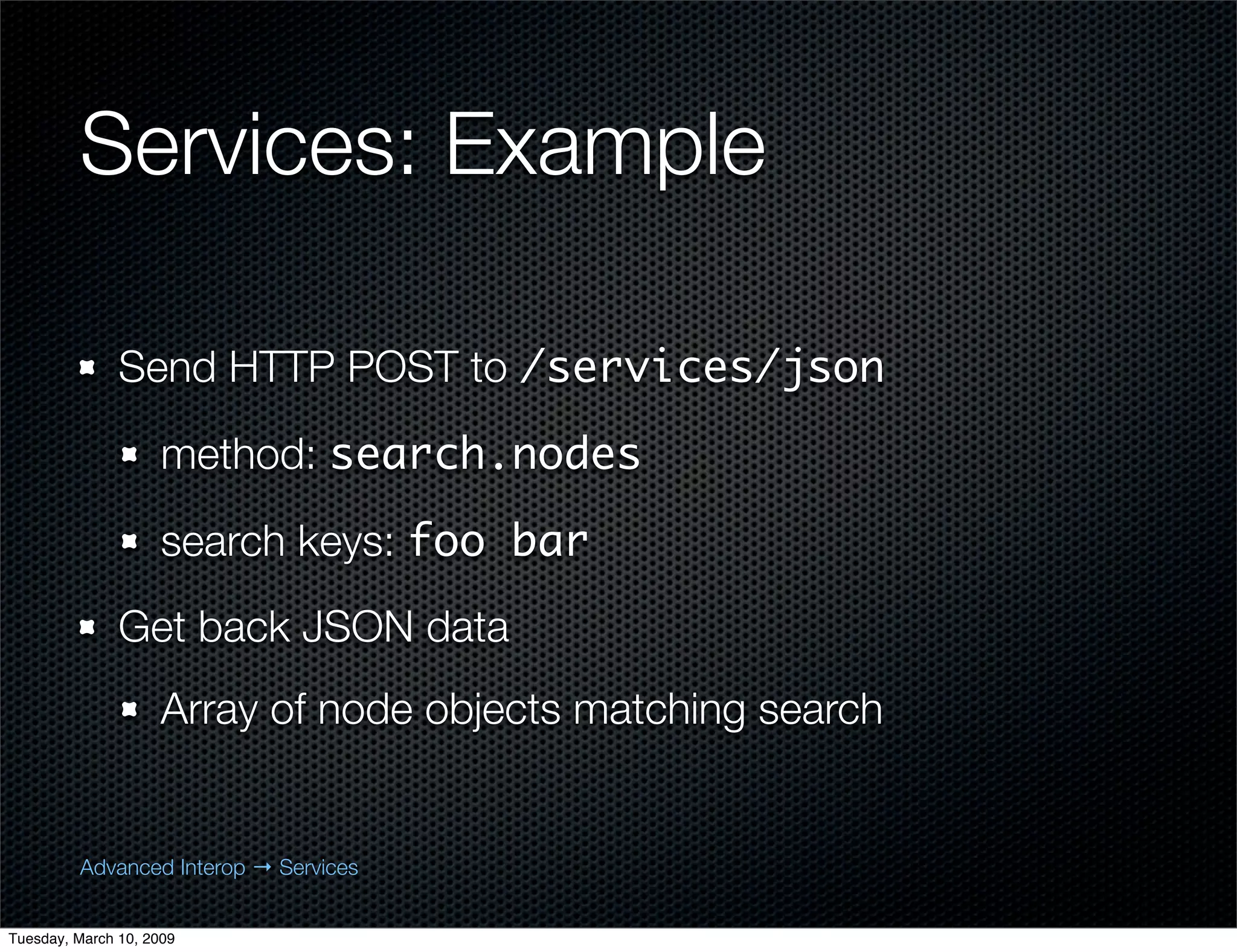
  • #228 - good simple example -- out of the box, search for content on the client side - as i mentioned, services supports json, xml-rpc, rest, soap
  • #229 - good simple example -- out of the box, search for content on the client side - as i mentioned, services supports json, xml-rpc, rest, soap
  • #230 - good simple example -- out of the box, search for content on the client side - as i mentioned, services supports json, xml-rpc, rest, soap
  • #231 - good simple example -- out of the box, search for content on the client side - as i mentioned, services supports json, xml-rpc, rest, soap
  • #232 - good simple example -- out of the box, search for content on the client side - as i mentioned, services supports json, xml-rpc, rest, soap
  • #233 - that about winds it up for me - there is a lot going on this week -- check it out