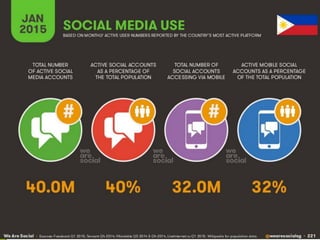
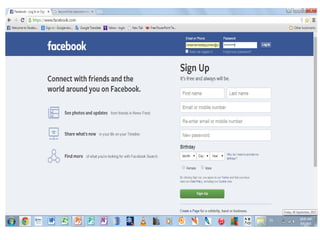
How Many Peopl e Li ve
i n t he Phi l i ppi nes
Ri ght Now?
103,287,300103,287,300
Who uses Facebook?
Who uses Facebook?
Who uses Facebook?
Who uses Facebook?
Who uses Facebook?
Who uses Facebook?
Who uses Facebook?
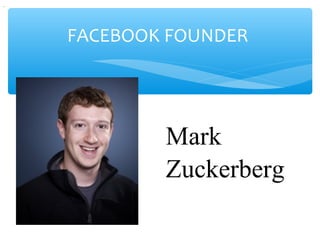
FACEBOOK FOUNDER
Mark Zuckerberg
Mark
Zuckerberg
.
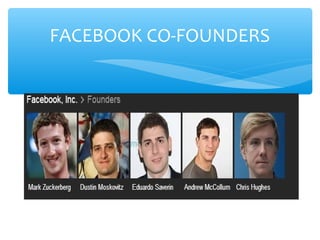
FACEBOOK CO-FOUNDERS
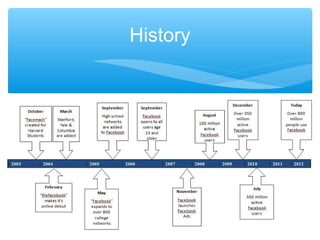
History
∗ A portal for social networking
∗ Interact with friends
∗ Share photos and/or videos
∗ Community organizing
∗ Email and instant messaging
∗ Various forms of interpersonal communication
∗ Operated and privately owned by Facebook, Inc.
What is Facebook?
∗ Facebook is adding 7,246 people every 15
minutes or 8 per second
∗ Every minute there are 150,000 messages sent
∗ Every 15 minutes there are over 49 million
posts. To be precise 49,433,000 or 3 million
posts per minute
Facebook Statistics
∗ There are 100,000 friend requests every 10
minutes
∗ There are 500,000 Facebook “likes” every minute
∗ People share 1.3 million pieces of content on
Facebook every minute of every day
∗ Photo uploads are 350 million per day
Facebook Statistics
∗ Facebook generates $1.4 million in revenue every
hour
∗ Nearly 73% of Facebook’s ad revenue comes from
mobile advertising
∗ Facebook earns $2.5 billion a quarter from mobile
advertising
∗ Facebook generated $12.47 billion in sales in 2014
(a rise of 58% year on year)
Facebook Statistics
Facebook, Inc. held its initial public
offering in February 2012 and began
selling stock to the public three
months later, reaching an original
peak market capitalization of $104
billion. On July 13, 2015, Facebook
became the fastest company in the
Standard & Poor’s 500 Index to
reach a market cap of $250 billion.
Facebook Statistics
Features
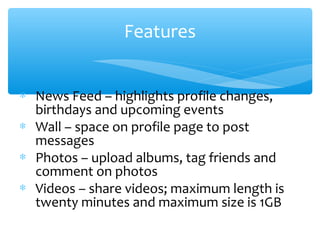
∗ News Feed – highlights profile changes,
birthdays and upcoming events
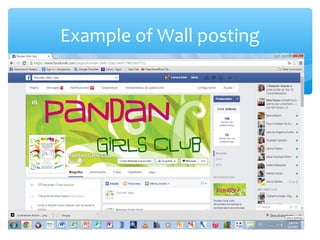
∗ Wall – space on profile page to post
messages
∗ Photos – upload albums, tag friends and
comment on photos
∗ Videos – share videos; maximum length is
twenty minutes and maximum size is 1GB
Features
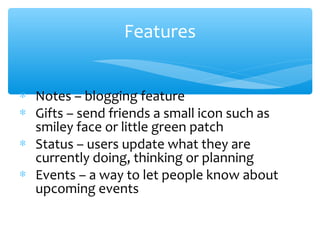
∗ Notes – blogging feature
∗ Gifts – send friends a small icon such as
smiley face or little green patch
∗ Status – users update what they are
currently doing, thinking or planning
∗ Events – a way to let people know about
upcoming events
Features
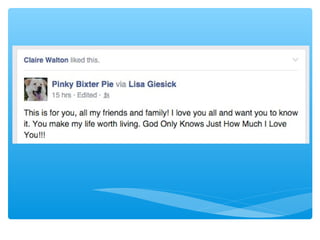
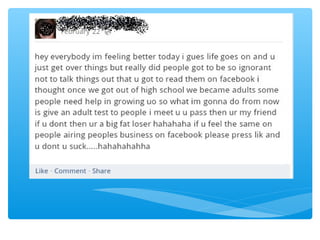
Example of Wall posting
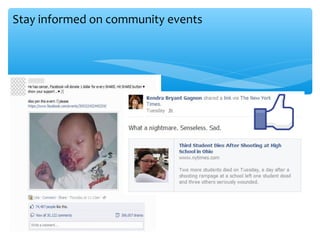
Stay informed on community events
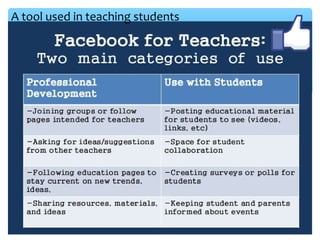
A tool used in teaching students
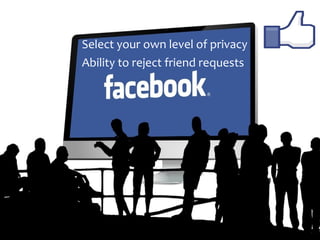
Select your own level of privacy
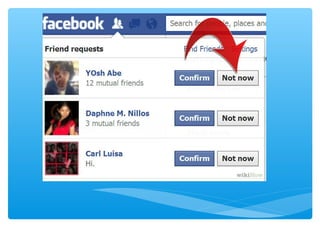
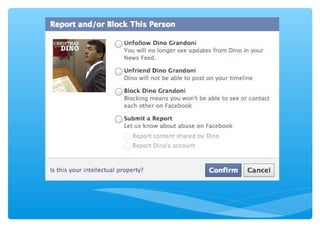
Ability to reject friend requests
“WE DO NOT GUARANTEE THAT FACEBOOK WILL
BE SAFE OR SECURE. FACEBOOK IS NOT
RESPONSIBLE FOR THE ACTIONS OR CONTENT
OF THIRD PARTIES, AND YOU RELEASE US, OUR
DIRECTORS, OFFICERS, EMPLOYEES, AND
AGENTS FROM ANY CLAIMS AND DAMAGES,
KNOWN AND UNKNOWN, ARISING OUT OF OR
IN ANY WAY CONNECTED WITH ANY CLAIM
YOU HAVE AGAINST ANY SUCH THIRD
PARTIES.”
Facebook’s
Statement of Rights and Responsibility
Cons
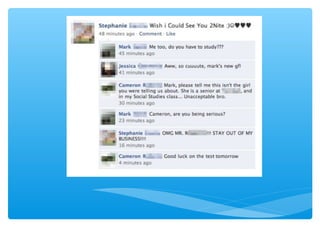
∗The spread of
misinformation
Cons
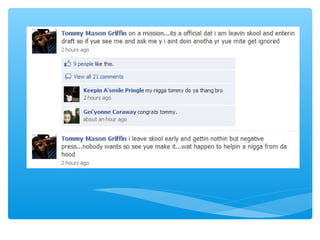
∗Poor command of
English language
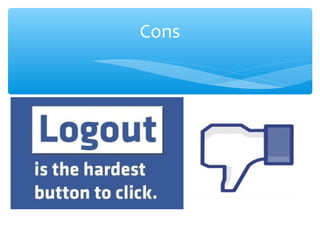
Cons
Cons
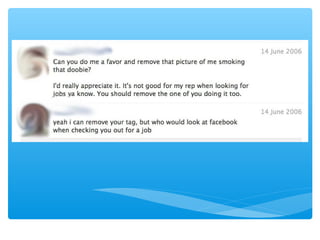
∗Information and
pictures may be
used against a
person
Cons
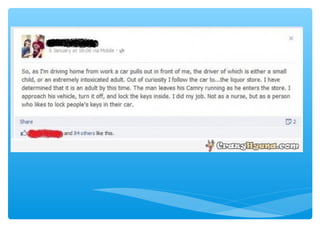
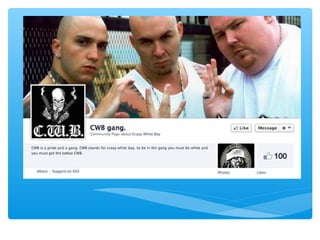
∗Bad contacts
Cons
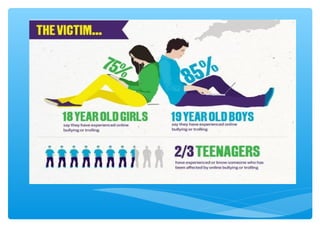
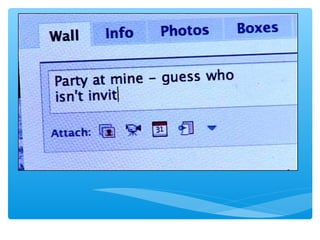
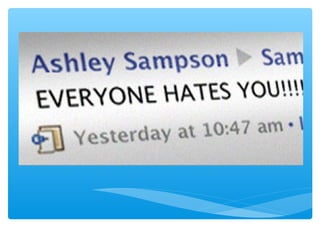
∗Cyber bullying
Cons
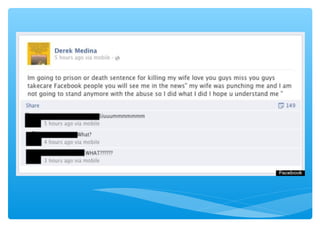
∗Explicit content
Cons
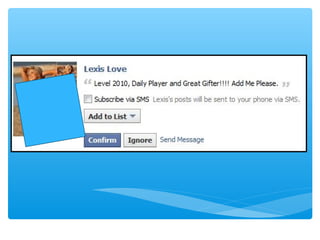
∗Sexual predators
IDENTITY,PERSONALITY,IMAGE
in the digital age
Facebook allows us to connect
not only with loved ones,
but with our
fundamental human needs.
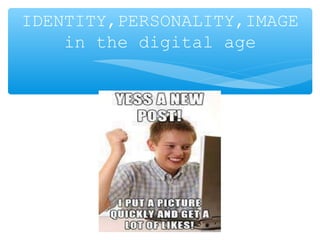
IDENTITY,PERSONALITY,IMAGE
in the digital age
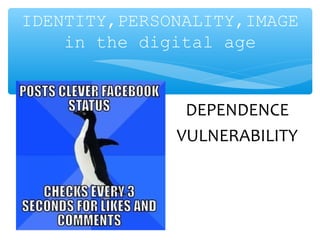
IDENTITY,PERSONALITY,IMAGE
in the digital age
DEPENDENCE
VULNERABILITY
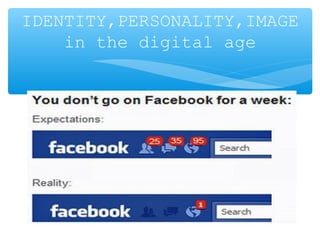
IDENTITY,PERSONALITY,IMAGE
in the digital age
IDENTITY,PERSONALITY,IMAGE
in the digital age
IDENTITY,PERSONALITY,IMAGE
in the digital age
IDENTITY,PERSONALITY,IMAGE
in the digital age
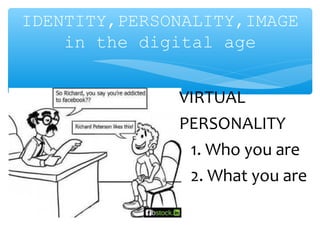
VIRTUAL
PERSONALITY
1. Who you are
2. What you are
Beyond facebook
Beyond facebook
Beyond facebook
Beyond facebook
Beyond facebook
Beyond facebook
Beyond facebook
Beyond facebook
Beyond facebook
Beyond facebook

Beyond facebook

Editor's Notes

  • #10 Facebook is an online social networking service headquartered in Menlo Park, California. Its website was launched on February 4, 2004, by Mark Zuckerberg with his Harvard College roommates and fellow students Eduardo Saverin, Andrew McCollum, Dustin Moskovitz and Chris Hughes.[8] The founders had initially limited the website's membership to Harvard students, but later expanded it to colleges in the Boston area, the Ivy League, and Stanford University. It gradually added support for students at various other universities and later to high-school students. Since 2006, anyone who is at least 13 years old was allowed to become a registered user of the website, though the age requirement may be higher depending on applicable local laws.[9] Its name comes from a colloquialism for the directory given to it by American universities' students.[10]
  • #11 Founder and CEO of Facebook, Zuckerberg, is responsible for setting the overall direction and product strategy for the company. He leads the design of Facebook’s service and development of its core technology and infrastructure. Mark studied computer science at Harvard University before moving the company to Palo Alto, California. Earlier in life, Zuckerberg developed a music recommendation system called Synapse and a peer-to-peer client called Wirehog. However, he abandoned both to pursue new projects.
  • #12 Facebook had over 1.18 billion monthly active users as of August 2015
  • #14 Social networking website connecting people across the street, country and world Focuses on building and relating social relations among people who share common interests, activities and experiences
  • #19 News Feed On September 6, 2006, News Feed was announced, which appears on every user's homepage and highlights information including profile changes, upcoming events, and birthdays of the user's friends. This enabled spammers and other users to manipulate these features by creating illegitimate events or posting fake birthdays to attract attention to their profile or cause. Initially, the News Feed caused dissatisfaction among Facebook users; some complained it was too cluttered and full of undesired information, others were concerned that it made it too easy for others to track individual activities (such as relationship status changes, events, and conversations with other users).   In response, Zuckerberg issued an apology for the site's failure to include appropriate customizable privacy features. Since then, users have been able to control what types of information are shared automatically with friends. Users are now able to prevent user-set categories of friends from seeing updates about certain types of activities, including profile changes, Wall posts, and newly added friends.   The Wall The Wall is the original profile space where Facebook users' content until December 2011 was displayed. It allowed the posting of messages, often short or temporal notes, for the user to see while displaying the time and date the message was written. A user's Wall is visible to anyone with the ability to see his or her full profile, and friends' Wall posts appear in the user's News Feed. The format of individual user pages was revamped in late 2011 and became known as either a profile or personal timeline since that change.[185][186] Users can create profiles with photos and images, lists of personal interests, contact information, memorable life events, and other personal information, such as employment status.[187] Users can communicate with friends and other users through private or public messages, as well as a chat feature, and share content that includes website URLs, images, and video content The concept of tagging in status updates, an attempt to imitate Twitter,[18] began September 14, 2009.[19] This meant putting the name of a user, a brand, an event or a group[19]in a post in such a way that it linked to the wall of the Facebook page being tagged, and made the post appear in news feeds for that page, as well as those of selected friends.[20] This was first done using the "@" symbol followed by the person's name. Later, a numerical ID for the person could be used.[21] Early in 2011, tagging in comments was added.[22] In addition to postings by other users, the Wall also displayed other events that happened to the user's profile. This included when information was changed, when they changed their profile picture, and when they connected with new people, among other things. The Wall has been replaced by the Timeline profile layout, which was introduced in December 2011. Photos[edit] One of the most popular applications on Facebook is the Photos application, where users can upload albums of photos, tag friends helped by facial recognition technology,[59]and comment on photos. On April 11, 2011, Facebook launched a new feature for photo tagging: people can tag photos with a brand, product, company or person's Facebook page, similar to the way they tag their friends in photos.[63] In August 2011, Facebook announced that it would be adding a series of photo filters to its mobile application.[64] Facebook plans to unveil nearly a dozen photo filters, which will be similar to Instagram's grainy images.[64] Per last known numbers, today in the world, highest number of photos are hosted at Facebook. Videos[edit] During the time that Facebook released its platform, it also released an application of its own for sharing videos on Facebook.[65] Users can add their videos with the service by uploading video, adding video through Facebook Mobile, and using a webcam recording feature. Additionally, users can "tag" their friends in videos they add much like the way users can tag their friends in photos, except the location of the friend in the video is not displayed. Users also have the option of video messaging. Videos cannot be placed in categories, whereas photos are sorted by albums. Facebook Video can support up to 1080p format and even 4K resolution. In September 2014, Facebook announced that it delivers 1 billion video views per day and that it would begin showing everyone view counts on publicly posted videos from users, Pages, and public figures. It also confirmed that it is recommending additional videos to users after they have watched a video. Sixty-five percent of Facebook's video views are coming from mobile where Facebook's user base is shifting, and views grew 50 percent from May to July, in part thanks to the viral ALS Ice Bucket Challenge finding a home on Facebook.[181] User can now add all the videos in one playlist like that of You Tube.This facility was started in January 2015.
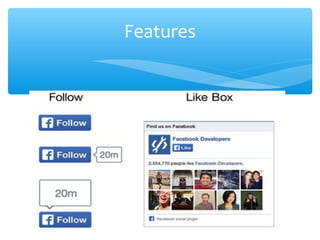
  • #20 Gifts Facebook launched Gifts on February 8, 2007, which allows users to send virtual gifts to their friends that appear on the recipient's profile. Gifts cost $1.00 each to purchase, and a personalized message can be attached to each gift.[171][172] Marketplace On May 14, 2007, Facebook launched Marketplace, which lets users post free classified ads.[173] Marketplace has been compared to Craigslist by CNET, which points out that the major difference between the two is that listings posted by a user on Marketplace are seen only by users in the same network as that user, whereas listings posted on Craigslist can be seen by anyone.[174] Messaging A new Messaging platform, codenamed "Project Titan", was launched on November 15, 2010. Described as a "Gmail killer" by some publications, the system allows users to directly communicate with each other via Facebook using several different methods (including a special email address, text messaging, or through the Facebook website or mobile app)—no matter what method is used to deliver a message, they are contained within single threads in a unified inbox. As with other Facebook features, users can adjust from whom they can receive messages—including just friends, friends of friends, or from anyone.[175][176] Email service was terminated in 2014 because of low uptake.[177] Aside from the Facebook website, messages can also be accessed through the site's mobile apps, or a dedicated Facebook Messenger app.[178] Voice calls Since April 2011, Facebook users have had the ability to make live voice calls via Facebook Chat, allowing users to chat with others from all over the world. This feature, which is provided free through T-Mobile's new Bobsled service, lets the user add voice to the current Facebook Chat as well as leave voice messages on Facebook.[179] Video calling On July 6, 2011, Facebook launched its video calling services using Skype as its technology partner. It allows one-to-one calling using a Skype Rest API.[180] Video viewing In October 2014, Facebook announced[3] that users could now connect to the website through a Tor hidden service using the privacy-protecting Tor browser and encrypted using SSL.[182][183][184] Announcing the feature, Alec Muffett said "Facebook's onion address provides a way to access Facebook through Tor without losing the cryptographic protections provided by the Tor cloud. [...] it provides end-to-end communication, from your browser directly into a Facebook datacentre."[182] Its URL address – facebookcorewwwi.onion is a backronym, which stands for Facebook's Core WWW Infrastructure.[3] User profile/personal timeline   Public profile of a user on Facebook in 2014 showing various social networking features of the site, including music preferences and favorite books In 2007, Facebook launched Facebook Pages (also called "Fan Pages" by users) to allow "users to interact and affiliate with businesses and organizations in the same way they interact with other Facebook user profiles". On November 6, 2007, more than 100,000 Facebook pages were launched.[190]  In July 2012, Facebook added a same-sex marriage icon to its timeline feature.[191] On February 14, 2014, Facebook expanded the options for user's gender setting, adding a custom input field that allows users to choose from a wide range of gender identities. Users can also set which set of gender-specific pronouns are used in reference to them throughout the site.[192][193] The change occurs after Nepal's first openly gay politician Sunil Babu Pant sent a letter to Zuckerberg in early 2012 to request the addition of an "Other" gender option for Facebook users; Facebook's official statement on the issue: "People can already opt out of showing their sex on their profile. We're constantly innovating on our products and features and we welcome input from everyone as we explore ways to improve the Facebook experience."[194]   On June 13, 2009, Facebook introduced a "Usernames" feature, whereby pages can be linked with simpler URLs such as https://www.facebook.com/facebook instead of https://www.facebook.com/profile.php?id=20531316728.[195] Many new smartphones offer access to Facebook services through either their Web browsers or applications. An official Facebook application is available for the operating systems Android, iOS, webOS, and Firefox OS. Nokia and Research In Motion both provide Facebook applications for their own mobile devices. As of January 2015, 745 million active users access Facebook through mobile devices every day. Sherr, Ian (January 28, 2015). "Facebook mobile users hit new highs, revenue jumps". Cnet. Retrieved March 2, 2015. In May 2014, Facebook introduced a feature to allow users to ask for information not disclosed by other users on their profiles. If a user does not provide key information, such as location, hometown, or relationship status, other users can use a new 'ask' button to send a message asking about that item to the user in a single click. On June 7, 2012, Facebook launched its App Center to its users. It will help the users in finding games and other applications with ease.[210] Since the launch of the App Center, Facebook has seen 150M monthly users with 2.4 times the installation of apps.[211]   Like button The like button is a social networking feature, allowing users to express their appreciation of content such as status updates, comments, photos, and advertisements. It is also a social plug-in of the Facebook Platform – launched on April 21, 2010[215][216] – that enables participating Internet websites to display a similar like button. Following On September 14, 2011, Facebook added the ability for users to provide a "Subscribe" button on their page, which allows users to subscribe to public postings by the user without needing to add them as a friend.[218] In conjunction, Facebook also introduced a system in February 2012 to verify the identity of certain accounts. Unlike a similar system used by Twitter, verified accounts do not display a special verification badge, but are given a higher priority in a user's "Subscription Suggestions".[219]   In December 2012, Facebook announced that because of user confusion surrounding its function, the Subscribe button would be re-labeled as a "Follow" button—making it more similar to other social networks with similar functions.[220]  
  • #21 Like button The like button is a social networking feature, allowing users to express their appreciation of content such as status updates, comments, photos, and advertisements. It is also a social plug-in of the Facebook Platform – launched on April 21, 2010[215][216] – that enables participating Internet websites to display a similar like button. Following On September 14, 2011, Facebook added the ability for users to provide a "Subscribe" button on their page, which allows users to subscribe to public postings by the user without needing to add them as a friend.[218] In conjunction, Facebook also introduced a system in February 2012 to verify the identity of certain accounts. Unlike a similar system used by Twitter, verified accounts do not display a special verification badge, but are given a higher priority in a user's "Subscription Suggestions".[219]   In December 2012, Facebook announced that because of user confusion surrounding its function, the Subscribe button would be re-labeled as a "Follow" button—making it more similar to other social networks with similar functions.[220]  
  • #24 Keep in touch with friends and family Connect with old friends, classmates Status Update: Share what you’re doing, feeling or thinking Facebook Chat: Real time communication with friends currently on the facebook website Wall: Write a public message to a friend on their wall Share photos and videos Facebook Message: Send a private message to a friend or someone you would like to be friends with “Like”: Nothing witty to say? Give your friend the thumbs up Comments: Write comments on pictures, friend’s status updates or wall posts We can also use Facebook as social bookmarking site. We can share our article, blogs , photo's etc to thousands of people. Facebook advertising and Fan pages are very helpful for a successful marketing campaign to many business organization. Facebook is best for finding Old friends. When a friend goes away to any other place, we often don't get the chance to communicate with him or her. But now Facebook gives us the opportunity to communicate with our Old friend very easily without any cost.
  • #40 Facebook often brings bad effects on students result.
  • #42 Contribute to others wasting time
  • #49 There are plenty of groups and Fan pages out there which are being created to abuse or violate other religion, personalities, nation etc. This kind of racist disgusting activities decreasing some popularity.
  • #50 There are plenty of groups and Fan pages out there which are being created to abuse or violate other religion, personalities, nation etc. This kind of racist disgusting activities decreasing some popularity.
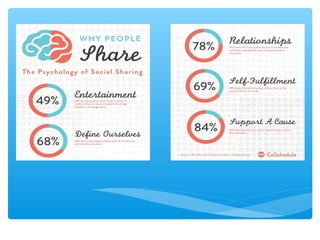
  • #60 Facebook provides its users with an immediate vent for our needs and obsessions. For example, Erica Dawson found that extroverts tend to update their profile photos, status, and information they reveal about themselves much more frequently than other users. Thus, Facebook allows them to act out their hidden desires without the fear of being perceived as arrogant or narcissistic. Imagine a person asking people to look at his photos at a social gathering, or telling everyone how many friends he has; he would immediately be perceived as breaking social codes. On Facebook, however, it is considered a legitimate activity. 
  • #63 Self-esteem  Self-esteem is considered to be one of the determinants that shape our psychological well-being. Self-esteem is in large part based on our self-schema, a model that organizes information about ourselves and reflects what we think about, care about, and spend our time and energy on. If, for example, “being an athlete” is not an important aspect of your self-schema, then arriving last in the school’s running competition wouldn’t influence your self-esteem. However, if “being smart” is an important aspect of your self-schema, then scoring low on an exam would negatively influence your self-esteem. Our Facebook profiles are micro-reflections of our self-schemata. In addition to our appearance, they include information about our hobbies, education level, number of friends, things we care about and so on. Thus, Facebook can unconsciously increase our self-esteem by providing us with the opportunity to reconstruct and control the way we present ourselves to the world. Furthermore, unlike public message boards, Facebook allows us to block any “trolls” whose insults and mean-spirited discourse threaten our self-assurance. 
  • #64 “The Like is the wordless nod of support in a loud room. It’s the easiest of yesses, I-agrees, and me-toos. I actually felt pangs of guilt over not liking some updates, as though the absence of my particular Like would translate as a disapproval or a withholding of affection. I felt as though my ability to communicate had been somehow hobbled. The Like function has saved me so much comment-typing over the years that I likely could have written a very quippy, War-and-Peace-length novel by now.” And sometimes we like in order to show solidarity or unity with a friend or acquaintance and their way of thinking. Social media can be a way of gaining “virtual empathy”—and that empathy can have real-world implications
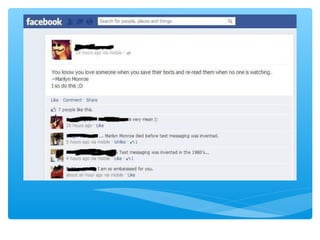
  • #65 Impression management  Impression management is the process through which people attempt to influence others’ perception of their image by regulating and controlling information during social interaction. It is considered a key building block in interpersonal communications, with the goal of enhancing desired traits. Facebook, like most online interactions, allows the user to exercise a great deal of impression management. First of all, unlike face-to-face conversation, Facebook gives users as much time as they need to prepare a thoughtful or witty status update or wall post. Additionally, the influence of nonverbal behavior is entirely eliminated in the online arena. As a result, we have developed a set of explicit and implicit signals to help us form impressions of other Facebook users. The explicit signals consist of clear-cut measurements like number of friends, perceived quality of friends and education level. The implicit signals are more subtle: frequent relationship status updates can imply instability; frequent profile photo changes and new posts can indicate an extroversion tendency, and frequent ‘like’-ing of others’ content can indicate ingratiation attempts. Furthermore, the decision not to share information like relationship status and gender of interest reveals even more about the user than the information shared!  Our initial interpretation of a user’s personality is accurate in most cases, and is revealed within the first few minutes of the interaction. Thus, Facebook can influence our self-esteem by giving us the opportunity to control the way we present ourselves through the process of impression management – it can influence the way other people perceive us but most importantly, it can influence the way we perceive ourselves.  We put a lot of time and effort into this self-customization because, on a subconscious level, we are re-inventing a more positive version of ourselves. This is reflected in the composition of our carefully selected profile elements. We present our most attractive photos; list favorite movies, music and books that we feel will impress others; and send friend requests to not only our friends and family, but to the people we respect and want to be associated with.
  • #68 The need to belong  Roy Baumeister and Mark Leary (1995) argue that “the need to belong is a fundamental human need to form and maintain at least a minimum amount of lasting, positive, and (significant) interpersonal relationships. Satisfying this need requires (a) frequent, positive interactions with the same individuals, and (b) engaging in these interactions within a long-term framework….” In today’s world, social networks like Facebook fill this need.  Facebook gives its users a sense of belonging by co-opting familiar concepts that already hold strong cognitive associations. One such concept is ”friends.” This word is now used to describe a new form of relationship: two people linked through the Facebook platform. By introducing the user to a familiar concept that is already emotionally charged, Facebook ensures that our pre-existing associations with the word are automatically linked to the new concept. It actually takes advantage of everything that the concept of “friend” stands for and blurring the line between real and virtual relationships.   Another example for Facebook reliance on familiar concepts is the term “photo album”. A well-established concept that immediately associates with our closest social groups (mostly family and friends). This concept is emotionally charged and generates a sense of closeness and belongings
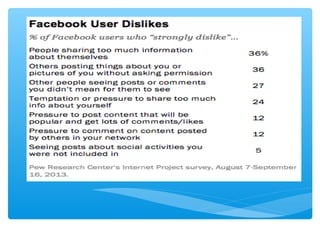
  • #71 DISCRETION A Pew Research study shows that although users “like” their friends’ content and comment on photos relatively frequently, most don’t change their own status that often. 10% of Facebook users change or update their own status on Facebook on a daily basis 4% updating their status several times per day 25% of Facebook users say that they never change or update their own Facebook status This makes sense, given that the same study showed that “oversharing” was one of Facebook’s biggest annoyances for users:
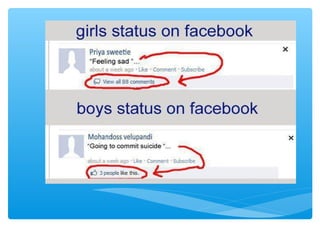
  • #73 Upside down values
  • #76 Curiosity, envy, anger