1
Beyond EPM- Glocal Program
Management System
Theme Emerging Trends in Project Management
Keywords Stakeholders’ satisfaction, Transportal, Cloud Computing, Glocal Program Management
System, citizen engagement
Abstract
Public policy governance and corporate governance have to go beyond the enterprise to embrace all
stakeholders and even the public at large to ensure efficient deliveries of goods, services and
consultancies. Only by doing this, better returns on investments can be ensured. To cite an example, in
order to ensure that Sustainable Development Goals are actually achieved globally by 2030, it is
necessary to bring all stakeholders to the same platform to responsibly share information relating to the
programs aimed at achieving the 17 SDGs. All the stakeholders need to access the same validated data,
to facilitate facts based decisions at each level- global to local. Timely interventions are possible only
when diverse data is processed, collated and analysed and made available in real time, by generation of
appropriate alerts and delegation of tasks. We need to build TEAM one world to achieve success. We
need to focus on public good rather than private gains. How the state of art ICT infrastructure of cloud
computing, mobile apps etc can be fine tuned to deliver complex programs and projects, involving glocal
stakeholders is proposed to be demonstrated live using the in house built TRANSPORTAL.
Table of Contents
Contents
Theme..............................................................................................................................................1
Keywords..........................................................................................................................................1
Abstract............................................................................................................................................1
Table of Contents.............................................................................................................................1
Introduction...................................................................................................................................3
Why Go Beyond the Enterprise ...................................................................................................4
Stakeholder satisfaction...............................................................................................................4
Resource Optimisation problems in complex programs..............................................................4
2
Development as a Public Policy ..................................................................................................5
Citizen engagement as necessary part of Good Governance ....................................................5
Implementation problems with ERP solutions.............................................................................7
ICT for Good Governance............................................................................................................7
Innovative TRANSPORTAL.........................................................................................................8
How the Transportal Functions ................................................................................................8
Case study....................................................................................................................................9
Guidance Note of the World Bank: ..............................................................................................9
Conclusion..................................................................................................................................10
3
Introduction
The concept of a hundred Smart cities emerging in India in the next one decade has caught the
imagination of India and the World in the last two years. Several hundreds of crores worth of projects and
programs are to come up shortly. The increasing urbanization with 40% of the Indian population residing
in the cities is expected to contribute 75% of India’s GDP by 2030. By 2030 the World has also resolved
to attain the seventeen Sustainable Development Goals (SDGs) notwithstanding the fact that the eight
Millennium Development Goals (MDGs) were only partially achieved during the program period of 2000-
2015. It may be noted that SDG 11 refers to sustainable cities and communities being built i.e. Smart
Cities.
In para 117 of his Reporti titled “Progress towards the Sustainable Development Goals”, the Secretary
General of the United Nations Economic and Social Council points out that “Achieving the ambitious
targets of the 2030 Agenda requires a revitalized and enhanced global partnership that brings together
Governments, civil society, the private sector, the United Nations system and other actors and mobilizes
all available resources”. Finance, Information and communications technology, Capacity-building, Trade,
Data, Monitoring and Accountability, were among the determinants that were highlighted in this report as
prerequisites to ensure that no one was left behind in the progress towards sustainable global
development. This was the pledge of the member States when the 2030 Agenda for Sustainable
Development, was adopted in the UN session held on 24 July 2015.
When reforms and transformation take place in developing countries like India, it has been observedii that
these initiatives fail to achieve sustained improvements in performance because they are merely
isomorphic mimicry—that is, governments and organizations pretend to reform by changing what policies
or organizations look like rather than what they actually do. One must move beyond the enterprise and
manage all stakeholders and engage the citizens meaningfully, when managing projects and programs
that extend from local levels to global levels as in the case of SDGs. In this age of Information and
Technology, effective communication between stakeholders and responsible sharing of data becomes
critical. To take real time decisions based on verified facts, we need a robust Information and
Communication Technology (ICT) system.
A public Trust based out of Bengaluru has innovated a cloud based India Citizen Transportal called
Glocal Program Management System (GPMS) that facilitates project/program/portfolio monitoring and
evaluation with active crowd sourcing and citizen engagement. Public Finance Management has been
vastly improved by imbibing the principles of program/project management with the intricacies of
governance to bring more Transparency and Accountability. Based on the experiment that went on in
Bengaluru for the last seven years, the emerging ICT system that can operate beyond an enterprise and
usher in good governance, is sought to be presented in this paper, as a way forward for the future where
4
many stakeholders across geographical boundaries of myriad enterprises and sectors have to work hand
in hand to achieve ambitious global goals such as the SDGs.
Why Go Beyond the Enterprise
To achieve the global goals called the SDGs, not one but several entities and enterprises would have to
work closely with governments around the globe at the National as well as subnational levels. Global
experts would have to pitch in with their experience to help inclusive growth and all round development,
especially in areas where the progress is identified to be retarded. After all it is necessary that the SDGs
have to be achieved universally.
Already concern has been expressed that to achieve the more stringent SDGs, when the MDGs
themselves were only partially achieved, trillions more would be required where as only millions/ billions
are currently available. The World Bank Group (WBG) has therefore conceived a Financing for
Development program whereby trillions can be made from the available billions by involving private
players and corporate sector. This collective effort is expected to find the resources required for the SDGs
and help implement them as planned.
Stakeholder satisfaction
Governance definitely is not a zero-sum game, where one is the winner and other a loser. Key elements
of governance like Accountability, Transparency, Participation, and Inclusion has to provoke political and
civil society to view each other not as adversaries but stakeholders in a participative effort that leads to
sustained relationship for mutual benefits. All stakeholder satisfaction is a prerequisite to ensure the
success of such an ambitious program.
Resource Optimisation problems
Corporates handling large projects have always experienced the pressures of resource jugglery and the
need to show quarterly results to stay on course. That is why Program Management evolved as a
separate discipline from Project Management. In managing a complex Program that keeps going for a
long period, unlike a Project with a fixed time frame, outcomes are dependent upon the ability to ensure
fund flow and resource allocations and solving governance issues like resolution of disagreements
between diverse stakeholders etc. In addition to Budget planning, management and control in a
significantly more complex environ which is subject to market conditions and changing business goals,
program management has to incorporate flexibility and change management requiring greater executive
leadership skillsiii. A good Program Management includes application of common standards, processes,
governance and annual budgets that oversee the successful execution of all component projects which
are part of the larger programiv . This is where the need for facts based decision making assumes
importance. The leadership has to possess the tools and techniques needed for collecting and collating
data on real time for analysis and a decision support system. Living in an information and Technology
Age, one therefore needs to go beyond the enterprise to garner all the information one needs and rely on
5
technologies like big data analytics and cloud computing to have real time alerts and scenario building to
assist in the decision making.
Development as the Public Policy
Moving ahead from the Millennium Development Goals (MDGs), the World Community has embraced the
Sustainable Development Goals (SDGs) that have been evolved through a long inclusive process for
achievement during a fifteen year long period 2016-2030. The SDGs cover 17 goals and 169 related
targets resolved in the UN Summit meet held between 25-27 September 2015, in which India was
represented at the level of Hon’ble Prime Minister. These SDGs are aimed to stimulate, align and
accomplish actions over the 15-year period in areas of critical importance for the humanity and the planet.
NITI Aayog in Indiav has been entrusted with the role to co-ordinate ‘Transforming our world: the 2030
Agenda for Sustainable Development’ (called as SDGs).
When the National Government rolls out a nationwide
program in line with the Global goals, it becomes
imperative for all citizens and private and public
enterprises to align themselves with these national
objectives and Public Policy. Article 51 A of the Indian
Constitution has termed this as Fundamental Duty of
every citizen. A massive countrywide program requiring
stakeholder involvement both in the private and public
sector is needed to achieve the SDGs. Each Goal as
indicated in the Figure 1, will involve multiple programs
and many stakeholders who have to collaborate with
each other during the next 15 years and more.
Citizen engagement as necessary part of Good Governance
The Ford- Firestone controversy involving the US automobile giant, Ford and the Japanese tire
manufacturer, Bridgestone/Firestone, shows the importance of going beyond the enterprise and involving
the customers even as a normal business case. It may be recalled that by 2001, 174 people had been
killed in accidents and crashes involving the Ford Explorer Sport Utility Vehicle which were equipped with
Firestone tires. This led to the recall of tires by Firestone and it stopped supplying to Ford. Firestone had
alleged that the problem was with the Ford Explorer and not Firestone tires. Ford defended the safety of
the Explorer saying its statistics had shown that it is safer than other Sport Utility Vehicles. Ford alleged
that it was the defective tires that led to the accidents and recalled 13 million tires for replacementv i.
However later researches showed that both Ford and Firestone seemed to have known about the flaws in
the tires for almost a year prior to the recall, but it wasn't until the National Highway Traffic Safety
Administration (NHTSA) launched a preliminary investigation that Firestone announced a voluntary recall.
Figure 1 List of stakeholders for SDG 3 as per Niti Aayog
6
The customers were continuously voicing their concerns especially in the social media but these were
being ignored by the corporate giants. The importance of citizen engagement in governance (Corporate
or public policy) and the need for corporate governance to go beyond the enterprise, to embrace all
stakeholders - especially the public at large - to ensure efficient deliveries of goods or achievement of set
goals, requires no further elaboration.
It is to be noted however that the common citizen is forever grappling with problems of daily life, and it is
only through a well thought out process that one can motivate this unconcerned citizen to spend his /her
limited time, effort and money to participate in routine governance activities. Citizen action is therefore
one full of apathy. Ordinarily even if one manages to get the attention of the citizen to matters of public
interest, it is difficult to sustain this interest over a long period of time, in a mutually satisfying relationship.
The Citizen – Governance connect or the Governance – Citizen connect are both important for policy
formulation, public service delivery and achievement of goals such as SDGs in a vibrant democracy.
The interactions between the citizen and the State need to be kept simple, efficient, productive and cost
effective. The State action needs to be Transparent, Accountable and in proven public interest. The
information needs of a citizen- State interaction should flow smoothly in both directions and in real time.
The ICT initiatives that make this happen have to be accessible and affordable and concentrate on open
governance and data aggregation by facilitating reduction in Information asymmetries. State actions
based on responsible information sharing, result in better civil mobilisation and more meaningful
participation.
It is in this context that leveraging of the ICT systems becomes important to engage the citizen
meaningfully in matters of governance. For Governance, normal ERPs would not do and we need to look
for ICT solutions that would be simple, interoperable, based on open data systems, use the state of art
cloud and mobile computing and big data analytics and be available anytime, anywhere and on any
device so that meaningful participation of citizens is ensured.
This paper describes a Made in India Transportal that showcases the utility of innovative e-tool that
facilitates implementation of large global programs by assisting in facts based decision making from the
local levels to global scale seamlessly. Citizen Engagement and all stakeholder satisfaction are key
strengths of this versatile platform that can be a monitoring and evaluation tool to be used from
conception to completion of all complex programs of governance and public finance management. As the
PM said in his address to the UN when the SDGs were being accepted as Global goals, “Technology
Facilitation Mechanism will turn technology and innovation into an effective instrument for global public
good, not just private returns.”
7
Implementation problems with ERP solutions
Initially favoured by large companies, now even small companies use EPM/ ERP solutions as a business
management software for collecting, processing and managing data from different field and staff
functionaries within one unified system or Corporate. This arrangement provides an integrated view of all
core business processes from supply chain management to customer relations and from order processing
to pay roll. Each transaction can be tracked from any part of the company. Business analytical tools could
be integrated and real time data made available for better and informed decision making. ERP systems
assist an organisation in optimization of resources such as money, materials, manpower, machinery etc
within the enterprise and bring together diverse functional fields of Finance, manufacturing, marketing,
distribution, HR etc. It also does ensure smooth data flow between customers and suppliers. However,
ERP implementation has been found to be quite taxing and has to go through many stages, and failed
ERP implementations are not a small number.
ERP implementation does have a bad reputation among managers and executives. CIO.com has
compiled a chronological history of 10 ERP scandals as a warning to those contemplating an upgrade or
implementation. It has to be agreed that failed ERP implementation can't actually take down a Fortune
500 company for good, but it can certainly knock it around a bit.v ii
ICT for Good Governance
If Enterprise wide implementation of software applications can cause many headaches and failures, what
about worldwide programs like SDGs where in several corporates, government agencies and the general
public have to be involved? A truly nightmarish endeavour can be anticipated! As practitioners of
professional project management, many of us are aware of ICT tools that give any project team the ability
to organize, collaborate, and track details and responsibilities of the projects. The Project Management
Software industry is now over $1 billion with hundreds of competitive solutions. The question that needs
to be asked is, what tools one would prefer, when one has to manage stakeholders beyond one’s
enterprise. MS Project is perhaps the most preferred solution for project and project portfolio
management, used by project managers, project teams and decision makers. Why? What do they
achieve by using such an ICT platform? What do they NOT get to achieve by using this popular
application?
The one obvious con highlighted by the users of this system, besides the licensing costs, is the difficulty
of learning this software if a user is not previously proficient in other MS products. Ordinarily, it takes one
a couple of months to implement this softwarev iii for their exact needs and it takes MS naive people a
minimum of 3 months to learn to use it.
Most projects fail because of communication problems. It is therefore necessary for any project team to
use a collaboration software, that keeps all the stakeholders on the same information page without any
time lag.
8
Project management methodologies have to constantly evolve to match today's dynamic world of having
Information at the finger’s tip. In this age of Information, Communication and Technology, it is necessary
for facts based decision making to be facilitated by bringing all stake holders to be in sync with each other
with same validated data, so that when problems arise, they can be countered by data driven decision
making approaches.
Innovative TRANSPORTAL
What is the TRANSPORTAL?
A portal evolved from the web. Vortal came next. It is a Portal for one Vertical such as for the travel and
tourism industry. Transportal is the obvious next step. It is an innovative cloud computing platform that
aims to bring all the stakeholders to the same set of data so that facts based decision making becomes
easier.
 Transportal is a tool for innovative data collection, collation and analysis for generating
actionable intelligence to address myriad issues germane to development and public policy
 Transportal helps to promote eternal vigilance, predictive policing, policy formulations with citizen
engagement and good governance
How the Transportal Functions
Each program and each project in any organization is no doubt unique and a certain degree of
customization constantly takes place at various levels in the hierarchy leading to Information asymmetry;
The Glocal Project Management System, described in this paper, addresses this problem in Program
execution, to integrate data found in silos to be shared responsibly between all the stakeholders in a new
practice of open governance. The system has been developed with the cloud computing and mobile
technology platforms to aid data collection, collation and analysis as part of the decision science
methodologies.
Citizen is motivated to interact constantly with governance at all levels- local to global several times in a
year, by putting the citizen interest foremost through a program called Citizen FIRST. For this pupose, a
single window interface between the citizen and governance at all levels is enabled. Citizen’s interface
includes the delivery of citizen services like the following:-
 For getting the copy of the Birth/ caste Certificate from the local municipal or Panchayat
office or the marks cards and school/college certificate from the local school and college last
attended.
 For renewal of Driving License- This will be done by the Motor Vehicles Department of the
State concerned;
 For address change in a Passport- This will be done by Passport officer in the Central
Government;
 For getting a VISA to enter another country - This will be done by the authorised personnel
of the country concerned;
 For a better quality of life anywhere- Standards laid down in the Sustainable Development
Goals and adopted by the comity of Nations as SDG 2030 program.
9
To have good governance in place in the Smart city, the setting up of a Citizen-Governance-Customer
service (C-G-C) Transportal facilitating a single point access for all citizens for all their Governance
requirement, is needed. By engaging with citizens smartly, the gaps in the achievement of SDGs can be
monitored and addressed appropriately on a real time basis.
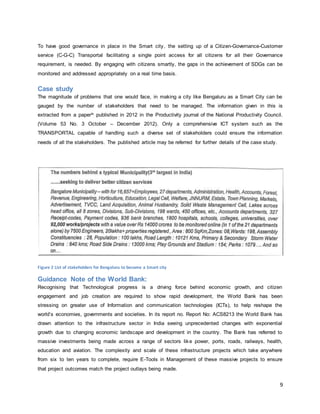
Case study
The magnitude of problems that one would face, in making a city like Bengaluru as a Smart City can be
gauged by the number of stakeholders that need to be managed. The information given in this is
extracted from a paperix published in 2012 in the Productivity journal of the National Productivity Council.
(Volume 53 No. 3 October – December 2012). Only a comprehensive ICT system such as the
TRANSPORTAL capable of handling such a diverse set of stakeholders could ensure the information
needs of all the stakeholders. The published article may be referred for further details of the case study.
Figure 2 List of stakeholders for Bengaluru to become a Smart city
Guidance Note of the World Bank:
Recognising that Technological progress is a driving force behind economic growth, and citizen
engagement and job creation are required to show rapid development, the World Bank has been
stressing on greater use of Information and communication technologies (ICTs), to help reshape the
world’s economies, governments and societies. In its report no. Report No: ACS8213 the World Bank has
drawn attention to the infrastructure sector in India seeing unprecedented changes with exponential
growth due to changing economic landscape and development in the country. The Bank has referred to
massive investments being made across a range of sectors like power, ports, roads, railways, health,
education and aviation. The complexity and scale of these infrastructure projects which take anywhere
from six to ten years to complete, require E-Tools in Management of these massive projects to ensure
that project outcomes match the project outlays being made.
10
The World Bank therefore commissioned a study in early 2013 on introducing and enhancing the use of
ICT based interventions/solutions in the management of construction projects and programs to enhance
efficiency, transparency and governance in delivery, thereby increasing their success and impact
potential. The study concluded with a guidance note which targets implementing agencies and project
managers with practical steps on adopting e-tools and how e-tools can contribute to improve construction
project management and delivery.
The recommendation reads as under:
E-Tools can transform construction managementand operations.For example,following the web -based
projectmanagementsystem,the Karnataka Police Housing Corporation increased its operations to INR 60
million to 2200 million .Similarly in BBMP, revenue doubled once the ICSTsystem was in place. Similarly
efficiency gains are evidentfrom the RFI Application in Odisha Works Departmentwhere 18 steps were
reduced to 4-5 steps such as that in motion,transportation,waiting etc.
Conclusion
Program Management handling complex global programs such as achievement of the Sustainable
Development Goals by 2030 is possible only through active involvement of all stakeholders. Responsible
sharing of data and information through an innovative ICT system helps in effective and monitoring and
evaluation so that outcomes can be matched with outlays by appropriate and timely interventions. A
decision support system such as the Transportal is recommended in such cases.
Social Audit as a monitoring process through which organizational or project information is collected,
analyzed and shared publicly in a participatory fashion is the flavor of the season. ICT systems that
empower citizens and active members of the community to meaningfully participate and share their
observations and views and discussions and debates follow thereafter, leading to better public
understanding of the public policy formulations and public finance management.
i http://www.un.org/ga/search/view_doc.asp?symbol=E/2016/75&Lang=E
ii Andrews Matt, Pritchett Lant and Woolcock Michael ,EscapingCapability Traps through Problem-Driven Iterative
Adaptation(PDIA) in their WorkingPaper 299 June 2012
http://www.cgdev.org/files/1426292_file_Andrews_Pritchett_Woolcock_traps_FINAL.pdf
iiiSpacey John, Program Management vs Project Management: 5 Critical Differences, published on
February 23, 2013 http://management.simplicable.com/management/new/program-management-vs-project-
management
iv Strathearn Janis, Program Management vs. Project Management published on December 2, 2014
https://www.linkedin.com/pulse/20141202192431-1055705-program-management-vs-project-management
v http://niti.gov.in/content/universal-game-changer
vi http://www.icmrindia.org/casestudies/catalogue/Business%20Ethics/BECG005.htm
11
vii
Wailgum Thomas, 10 Famous ERP Disasters, Dustups and Disappointments published on Mar 24, 2009
http://www.cio.com/article/2429865/enterprise-resource-planning/10-famous-erp-disasters--dustups-
and-disappointments.html
viii http://www.capterra.com/project-management-software/spotlight/1419/MS%20Project/Microsoft
ix Raja Seevan, e-governance Implementation of publicly funded projects/portfolio usingGlobal Projects
MonitoringSystem (GPMS) Cloud: Lessons Learnt, Productivity,Volume 53, No. 3 , National Productivity Council,
New Delhi,October- December 2012 PP 252-263

Beyond EPM- Glocal Project Management System

  • 1.
    1 Beyond EPM- GlocalProgram Management System Theme Emerging Trends in Project Management Keywords Stakeholders’ satisfaction, Transportal, Cloud Computing, Glocal Program Management System, citizen engagement Abstract Public policy governance and corporate governance have to go beyond the enterprise to embrace all stakeholders and even the public at large to ensure efficient deliveries of goods, services and consultancies. Only by doing this, better returns on investments can be ensured. To cite an example, in order to ensure that Sustainable Development Goals are actually achieved globally by 2030, it is necessary to bring all stakeholders to the same platform to responsibly share information relating to the programs aimed at achieving the 17 SDGs. All the stakeholders need to access the same validated data, to facilitate facts based decisions at each level- global to local. Timely interventions are possible only when diverse data is processed, collated and analysed and made available in real time, by generation of appropriate alerts and delegation of tasks. We need to build TEAM one world to achieve success. We need to focus on public good rather than private gains. How the state of art ICT infrastructure of cloud computing, mobile apps etc can be fine tuned to deliver complex programs and projects, involving glocal stakeholders is proposed to be demonstrated live using the in house built TRANSPORTAL. Table of Contents Contents Theme..............................................................................................................................................1 Keywords..........................................................................................................................................1 Abstract............................................................................................................................................1 Table of Contents.............................................................................................................................1 Introduction...................................................................................................................................3 Why Go Beyond the Enterprise ...................................................................................................4 Stakeholder satisfaction...............................................................................................................4 Resource Optimisation problems in complex programs..............................................................4
  • 2.
    2 Development as aPublic Policy ..................................................................................................5 Citizen engagement as necessary part of Good Governance ....................................................5 Implementation problems with ERP solutions.............................................................................7 ICT for Good Governance............................................................................................................7 Innovative TRANSPORTAL.........................................................................................................8 How the Transportal Functions ................................................................................................8 Case study....................................................................................................................................9 Guidance Note of the World Bank: ..............................................................................................9 Conclusion..................................................................................................................................10
  • 3.
    3 Introduction The concept ofa hundred Smart cities emerging in India in the next one decade has caught the imagination of India and the World in the last two years. Several hundreds of crores worth of projects and programs are to come up shortly. The increasing urbanization with 40% of the Indian population residing in the cities is expected to contribute 75% of India’s GDP by 2030. By 2030 the World has also resolved to attain the seventeen Sustainable Development Goals (SDGs) notwithstanding the fact that the eight Millennium Development Goals (MDGs) were only partially achieved during the program period of 2000- 2015. It may be noted that SDG 11 refers to sustainable cities and communities being built i.e. Smart Cities. In para 117 of his Reporti titled “Progress towards the Sustainable Development Goals”, the Secretary General of the United Nations Economic and Social Council points out that “Achieving the ambitious targets of the 2030 Agenda requires a revitalized and enhanced global partnership that brings together Governments, civil society, the private sector, the United Nations system and other actors and mobilizes all available resources”. Finance, Information and communications technology, Capacity-building, Trade, Data, Monitoring and Accountability, were among the determinants that were highlighted in this report as prerequisites to ensure that no one was left behind in the progress towards sustainable global development. This was the pledge of the member States when the 2030 Agenda for Sustainable Development, was adopted in the UN session held on 24 July 2015. When reforms and transformation take place in developing countries like India, it has been observedii that these initiatives fail to achieve sustained improvements in performance because they are merely isomorphic mimicry—that is, governments and organizations pretend to reform by changing what policies or organizations look like rather than what they actually do. One must move beyond the enterprise and manage all stakeholders and engage the citizens meaningfully, when managing projects and programs that extend from local levels to global levels as in the case of SDGs. In this age of Information and Technology, effective communication between stakeholders and responsible sharing of data becomes critical. To take real time decisions based on verified facts, we need a robust Information and Communication Technology (ICT) system. A public Trust based out of Bengaluru has innovated a cloud based India Citizen Transportal called Glocal Program Management System (GPMS) that facilitates project/program/portfolio monitoring and evaluation with active crowd sourcing and citizen engagement. Public Finance Management has been vastly improved by imbibing the principles of program/project management with the intricacies of governance to bring more Transparency and Accountability. Based on the experiment that went on in Bengaluru for the last seven years, the emerging ICT system that can operate beyond an enterprise and usher in good governance, is sought to be presented in this paper, as a way forward for the future where
  • 4.
    4 many stakeholders acrossgeographical boundaries of myriad enterprises and sectors have to work hand in hand to achieve ambitious global goals such as the SDGs. Why Go Beyond the Enterprise To achieve the global goals called the SDGs, not one but several entities and enterprises would have to work closely with governments around the globe at the National as well as subnational levels. Global experts would have to pitch in with their experience to help inclusive growth and all round development, especially in areas where the progress is identified to be retarded. After all it is necessary that the SDGs have to be achieved universally. Already concern has been expressed that to achieve the more stringent SDGs, when the MDGs themselves were only partially achieved, trillions more would be required where as only millions/ billions are currently available. The World Bank Group (WBG) has therefore conceived a Financing for Development program whereby trillions can be made from the available billions by involving private players and corporate sector. This collective effort is expected to find the resources required for the SDGs and help implement them as planned. Stakeholder satisfaction Governance definitely is not a zero-sum game, where one is the winner and other a loser. Key elements of governance like Accountability, Transparency, Participation, and Inclusion has to provoke political and civil society to view each other not as adversaries but stakeholders in a participative effort that leads to sustained relationship for mutual benefits. All stakeholder satisfaction is a prerequisite to ensure the success of such an ambitious program. Resource Optimisation problems Corporates handling large projects have always experienced the pressures of resource jugglery and the need to show quarterly results to stay on course. That is why Program Management evolved as a separate discipline from Project Management. In managing a complex Program that keeps going for a long period, unlike a Project with a fixed time frame, outcomes are dependent upon the ability to ensure fund flow and resource allocations and solving governance issues like resolution of disagreements between diverse stakeholders etc. In addition to Budget planning, management and control in a significantly more complex environ which is subject to market conditions and changing business goals, program management has to incorporate flexibility and change management requiring greater executive leadership skillsiii. A good Program Management includes application of common standards, processes, governance and annual budgets that oversee the successful execution of all component projects which are part of the larger programiv . This is where the need for facts based decision making assumes importance. The leadership has to possess the tools and techniques needed for collecting and collating data on real time for analysis and a decision support system. Living in an information and Technology Age, one therefore needs to go beyond the enterprise to garner all the information one needs and rely on
  • 5.
    5 technologies like bigdata analytics and cloud computing to have real time alerts and scenario building to assist in the decision making. Development as the Public Policy Moving ahead from the Millennium Development Goals (MDGs), the World Community has embraced the Sustainable Development Goals (SDGs) that have been evolved through a long inclusive process for achievement during a fifteen year long period 2016-2030. The SDGs cover 17 goals and 169 related targets resolved in the UN Summit meet held between 25-27 September 2015, in which India was represented at the level of Hon’ble Prime Minister. These SDGs are aimed to stimulate, align and accomplish actions over the 15-year period in areas of critical importance for the humanity and the planet. NITI Aayog in Indiav has been entrusted with the role to co-ordinate ‘Transforming our world: the 2030 Agenda for Sustainable Development’ (called as SDGs). When the National Government rolls out a nationwide program in line with the Global goals, it becomes imperative for all citizens and private and public enterprises to align themselves with these national objectives and Public Policy. Article 51 A of the Indian Constitution has termed this as Fundamental Duty of every citizen. A massive countrywide program requiring stakeholder involvement both in the private and public sector is needed to achieve the SDGs. Each Goal as indicated in the Figure 1, will involve multiple programs and many stakeholders who have to collaborate with each other during the next 15 years and more. Citizen engagement as necessary part of Good Governance The Ford- Firestone controversy involving the US automobile giant, Ford and the Japanese tire manufacturer, Bridgestone/Firestone, shows the importance of going beyond the enterprise and involving the customers even as a normal business case. It may be recalled that by 2001, 174 people had been killed in accidents and crashes involving the Ford Explorer Sport Utility Vehicle which were equipped with Firestone tires. This led to the recall of tires by Firestone and it stopped supplying to Ford. Firestone had alleged that the problem was with the Ford Explorer and not Firestone tires. Ford defended the safety of the Explorer saying its statistics had shown that it is safer than other Sport Utility Vehicles. Ford alleged that it was the defective tires that led to the accidents and recalled 13 million tires for replacementv i. However later researches showed that both Ford and Firestone seemed to have known about the flaws in the tires for almost a year prior to the recall, but it wasn't until the National Highway Traffic Safety Administration (NHTSA) launched a preliminary investigation that Firestone announced a voluntary recall. Figure 1 List of stakeholders for SDG 3 as per Niti Aayog
  • 6.
    6 The customers werecontinuously voicing their concerns especially in the social media but these were being ignored by the corporate giants. The importance of citizen engagement in governance (Corporate or public policy) and the need for corporate governance to go beyond the enterprise, to embrace all stakeholders - especially the public at large - to ensure efficient deliveries of goods or achievement of set goals, requires no further elaboration. It is to be noted however that the common citizen is forever grappling with problems of daily life, and it is only through a well thought out process that one can motivate this unconcerned citizen to spend his /her limited time, effort and money to participate in routine governance activities. Citizen action is therefore one full of apathy. Ordinarily even if one manages to get the attention of the citizen to matters of public interest, it is difficult to sustain this interest over a long period of time, in a mutually satisfying relationship. The Citizen – Governance connect or the Governance – Citizen connect are both important for policy formulation, public service delivery and achievement of goals such as SDGs in a vibrant democracy. The interactions between the citizen and the State need to be kept simple, efficient, productive and cost effective. The State action needs to be Transparent, Accountable and in proven public interest. The information needs of a citizen- State interaction should flow smoothly in both directions and in real time. The ICT initiatives that make this happen have to be accessible and affordable and concentrate on open governance and data aggregation by facilitating reduction in Information asymmetries. State actions based on responsible information sharing, result in better civil mobilisation and more meaningful participation. It is in this context that leveraging of the ICT systems becomes important to engage the citizen meaningfully in matters of governance. For Governance, normal ERPs would not do and we need to look for ICT solutions that would be simple, interoperable, based on open data systems, use the state of art cloud and mobile computing and big data analytics and be available anytime, anywhere and on any device so that meaningful participation of citizens is ensured. This paper describes a Made in India Transportal that showcases the utility of innovative e-tool that facilitates implementation of large global programs by assisting in facts based decision making from the local levels to global scale seamlessly. Citizen Engagement and all stakeholder satisfaction are key strengths of this versatile platform that can be a monitoring and evaluation tool to be used from conception to completion of all complex programs of governance and public finance management. As the PM said in his address to the UN when the SDGs were being accepted as Global goals, “Technology Facilitation Mechanism will turn technology and innovation into an effective instrument for global public good, not just private returns.”
  • 7.
    7 Implementation problems withERP solutions Initially favoured by large companies, now even small companies use EPM/ ERP solutions as a business management software for collecting, processing and managing data from different field and staff functionaries within one unified system or Corporate. This arrangement provides an integrated view of all core business processes from supply chain management to customer relations and from order processing to pay roll. Each transaction can be tracked from any part of the company. Business analytical tools could be integrated and real time data made available for better and informed decision making. ERP systems assist an organisation in optimization of resources such as money, materials, manpower, machinery etc within the enterprise and bring together diverse functional fields of Finance, manufacturing, marketing, distribution, HR etc. It also does ensure smooth data flow between customers and suppliers. However, ERP implementation has been found to be quite taxing and has to go through many stages, and failed ERP implementations are not a small number. ERP implementation does have a bad reputation among managers and executives. CIO.com has compiled a chronological history of 10 ERP scandals as a warning to those contemplating an upgrade or implementation. It has to be agreed that failed ERP implementation can't actually take down a Fortune 500 company for good, but it can certainly knock it around a bit.v ii ICT for Good Governance If Enterprise wide implementation of software applications can cause many headaches and failures, what about worldwide programs like SDGs where in several corporates, government agencies and the general public have to be involved? A truly nightmarish endeavour can be anticipated! As practitioners of professional project management, many of us are aware of ICT tools that give any project team the ability to organize, collaborate, and track details and responsibilities of the projects. The Project Management Software industry is now over $1 billion with hundreds of competitive solutions. The question that needs to be asked is, what tools one would prefer, when one has to manage stakeholders beyond one’s enterprise. MS Project is perhaps the most preferred solution for project and project portfolio management, used by project managers, project teams and decision makers. Why? What do they achieve by using such an ICT platform? What do they NOT get to achieve by using this popular application? The one obvious con highlighted by the users of this system, besides the licensing costs, is the difficulty of learning this software if a user is not previously proficient in other MS products. Ordinarily, it takes one a couple of months to implement this softwarev iii for their exact needs and it takes MS naive people a minimum of 3 months to learn to use it. Most projects fail because of communication problems. It is therefore necessary for any project team to use a collaboration software, that keeps all the stakeholders on the same information page without any time lag.
  • 8.
    8 Project management methodologieshave to constantly evolve to match today's dynamic world of having Information at the finger’s tip. In this age of Information, Communication and Technology, it is necessary for facts based decision making to be facilitated by bringing all stake holders to be in sync with each other with same validated data, so that when problems arise, they can be countered by data driven decision making approaches. Innovative TRANSPORTAL What is the TRANSPORTAL? A portal evolved from the web. Vortal came next. It is a Portal for one Vertical such as for the travel and tourism industry. Transportal is the obvious next step. It is an innovative cloud computing platform that aims to bring all the stakeholders to the same set of data so that facts based decision making becomes easier.  Transportal is a tool for innovative data collection, collation and analysis for generating actionable intelligence to address myriad issues germane to development and public policy  Transportal helps to promote eternal vigilance, predictive policing, policy formulations with citizen engagement and good governance How the Transportal Functions Each program and each project in any organization is no doubt unique and a certain degree of customization constantly takes place at various levels in the hierarchy leading to Information asymmetry; The Glocal Project Management System, described in this paper, addresses this problem in Program execution, to integrate data found in silos to be shared responsibly between all the stakeholders in a new practice of open governance. The system has been developed with the cloud computing and mobile technology platforms to aid data collection, collation and analysis as part of the decision science methodologies. Citizen is motivated to interact constantly with governance at all levels- local to global several times in a year, by putting the citizen interest foremost through a program called Citizen FIRST. For this pupose, a single window interface between the citizen and governance at all levels is enabled. Citizen’s interface includes the delivery of citizen services like the following:-  For getting the copy of the Birth/ caste Certificate from the local municipal or Panchayat office or the marks cards and school/college certificate from the local school and college last attended.  For renewal of Driving License- This will be done by the Motor Vehicles Department of the State concerned;  For address change in a Passport- This will be done by Passport officer in the Central Government;  For getting a VISA to enter another country - This will be done by the authorised personnel of the country concerned;  For a better quality of life anywhere- Standards laid down in the Sustainable Development Goals and adopted by the comity of Nations as SDG 2030 program.
  • 9.
    9 To have goodgovernance in place in the Smart city, the setting up of a Citizen-Governance-Customer service (C-G-C) Transportal facilitating a single point access for all citizens for all their Governance requirement, is needed. By engaging with citizens smartly, the gaps in the achievement of SDGs can be monitored and addressed appropriately on a real time basis. Case study The magnitude of problems that one would face, in making a city like Bengaluru as a Smart City can be gauged by the number of stakeholders that need to be managed. The information given in this is extracted from a paperix published in 2012 in the Productivity journal of the National Productivity Council. (Volume 53 No. 3 October – December 2012). Only a comprehensive ICT system such as the TRANSPORTAL capable of handling such a diverse set of stakeholders could ensure the information needs of all the stakeholders. The published article may be referred for further details of the case study. Figure 2 List of stakeholders for Bengaluru to become a Smart city Guidance Note of the World Bank: Recognising that Technological progress is a driving force behind economic growth, and citizen engagement and job creation are required to show rapid development, the World Bank has been stressing on greater use of Information and communication technologies (ICTs), to help reshape the world’s economies, governments and societies. In its report no. Report No: ACS8213 the World Bank has drawn attention to the infrastructure sector in India seeing unprecedented changes with exponential growth due to changing economic landscape and development in the country. The Bank has referred to massive investments being made across a range of sectors like power, ports, roads, railways, health, education and aviation. The complexity and scale of these infrastructure projects which take anywhere from six to ten years to complete, require E-Tools in Management of these massive projects to ensure that project outcomes match the project outlays being made.
  • 10.
    10 The World Banktherefore commissioned a study in early 2013 on introducing and enhancing the use of ICT based interventions/solutions in the management of construction projects and programs to enhance efficiency, transparency and governance in delivery, thereby increasing their success and impact potential. The study concluded with a guidance note which targets implementing agencies and project managers with practical steps on adopting e-tools and how e-tools can contribute to improve construction project management and delivery. The recommendation reads as under: E-Tools can transform construction managementand operations.For example,following the web -based projectmanagementsystem,the Karnataka Police Housing Corporation increased its operations to INR 60 million to 2200 million .Similarly in BBMP, revenue doubled once the ICSTsystem was in place. Similarly efficiency gains are evidentfrom the RFI Application in Odisha Works Departmentwhere 18 steps were reduced to 4-5 steps such as that in motion,transportation,waiting etc. Conclusion Program Management handling complex global programs such as achievement of the Sustainable Development Goals by 2030 is possible only through active involvement of all stakeholders. Responsible sharing of data and information through an innovative ICT system helps in effective and monitoring and evaluation so that outcomes can be matched with outlays by appropriate and timely interventions. A decision support system such as the Transportal is recommended in such cases. Social Audit as a monitoring process through which organizational or project information is collected, analyzed and shared publicly in a participatory fashion is the flavor of the season. ICT systems that empower citizens and active members of the community to meaningfully participate and share their observations and views and discussions and debates follow thereafter, leading to better public understanding of the public policy formulations and public finance management. i http://www.un.org/ga/search/view_doc.asp?symbol=E/2016/75&Lang=E ii Andrews Matt, Pritchett Lant and Woolcock Michael ,EscapingCapability Traps through Problem-Driven Iterative Adaptation(PDIA) in their WorkingPaper 299 June 2012 http://www.cgdev.org/files/1426292_file_Andrews_Pritchett_Woolcock_traps_FINAL.pdf iiiSpacey John, Program Management vs Project Management: 5 Critical Differences, published on February 23, 2013 http://management.simplicable.com/management/new/program-management-vs-project- management iv Strathearn Janis, Program Management vs. Project Management published on December 2, 2014 https://www.linkedin.com/pulse/20141202192431-1055705-program-management-vs-project-management v http://niti.gov.in/content/universal-game-changer vi http://www.icmrindia.org/casestudies/catalogue/Business%20Ethics/BECG005.htm
  • 11.
    11 vii Wailgum Thomas, 10Famous ERP Disasters, Dustups and Disappointments published on Mar 24, 2009 http://www.cio.com/article/2429865/enterprise-resource-planning/10-famous-erp-disasters--dustups- and-disappointments.html viii http://www.capterra.com/project-management-software/spotlight/1419/MS%20Project/Microsoft ix Raja Seevan, e-governance Implementation of publicly funded projects/portfolio usingGlobal Projects MonitoringSystem (GPMS) Cloud: Lessons Learnt, Productivity,Volume 53, No. 3 , National Productivity Council, New Delhi,October- December 2012 PP 252-263