Best Practices www.WIKA-FAST.com 1 
Gauge Your Best Practices 
WIKA - Part of your business
Best Practices www.WIKA-FAST.com 2 
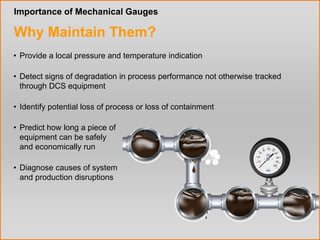
Importance of Mechanical Gauges 
Why Maintain Them? 
• Provide a local pressure and temperature indication 
• Predict how long a piece of 
equipment can be safely 
and economically run 
• Identify potential loss of process or loss of containment 
• Diagnose causes of system 
and production disruptions 
• Detect signs of degradation in process performance not otherwise tracked 
through DCS equipment
FAST Services 
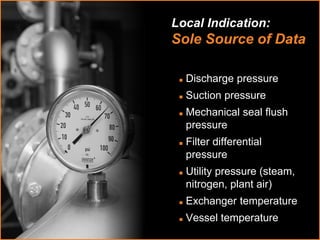
Local Indication: 
Sole Source of Data 
 Discharge pressure 
 Suction pressure 
 Mechanical seal flush 
pressure 
 Filter differential 
pressure 
 Utility pressure (steam, 
nitrogen, plant air) 
 Exchanger temperature 
 Vessel temperature
Best Practices www.WIKA-FAST.com 4 
Rethinking Instrumentation 
What Do Pressure Gauges Have to Do With Reliability & 
Profitability?
Best Practices www.WIKA-FAST.com 5 
Pressure and Temperature Instruments 
 Myth 
 Mechanical pressure gauges do not help 
me increase productivity or reliability 
 Reality 
 Pressure and temperature gauges are 
cost-effective tools that tell you what’s 
happening with your process and critical 
equipment 
 Impact 
 The right gauge will ensure you have the 
data you need to ensure the reliability and 
safety of your operations
Best Practices www.WIKA-FAST.com 6
FAST Services 7 
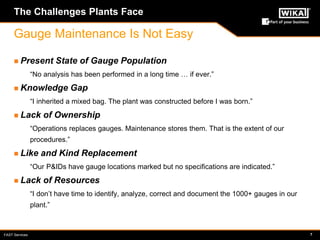
The Challenges Plants Face 
 Present State of Gauge Population 
“No analysis has been performed in a long time … if ever.” 
 Knowledge Gap 
“I inherited a mixed bag. The plant was constructed before I was born.” 
 Lack of Ownership 
“Operations replaces gauges. Maintenance stores them. That is the extent of our 
procedures.” 
 Like and Kind Replacement 
“Our P&IDs have gauge locations marked but no specifications are indicated.” 
 Lack of Resources 
“I don’t have time to identify, analyze, correct and document the 1000+ gauges in our 
plant.” 
Gauge Maintenance Is Not Easy
FAST Services 
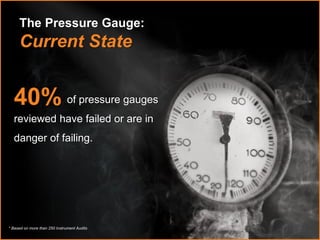
The Pressure Gauge: 
Current State 
of pressure gauges 
reviewed have failed or are in 
danger of failing. 
40% 
* Based on more than 250 Instrument Audits
Best Practices www.WIKA-FAST.com 9 
Why Gauges Fail
Best Practices www.WIKA-FAST.com 10 
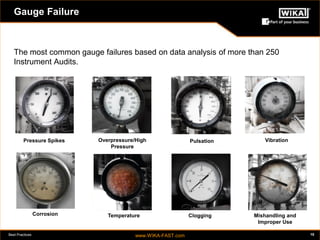
Gauge Failure 
The most common gauge failures based on data analysis of more than 250 
Instrument Audits. 
Pressure Spikes Pulsation Vibration 
Corrosion Temperature Clogging Mishandling and 
Improper Use 
Overpressure/High 
Pressure
Best Practices www.WIKA-FAST.com 11 
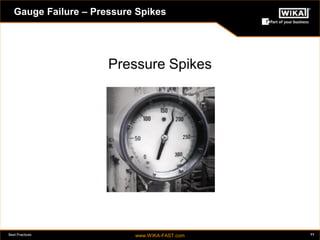
Gauge Failure – Pressure Spikes 
Pressure Spikes
Best Practices www.WIKA-FAST.com 12 
Pressure Spikes 
Main Causes 
■ Opening and closing valves while the system is running 
■ Pressure surges or impulses 
Symptoms 
■ Pointer is bent (Fishtail) from spike in pressure 
Consequences 
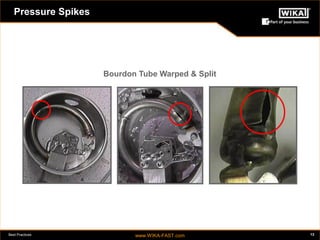
■ Spikes in pressure can cause the Bourdon tube to rupture 
■ May cause movement gears to disengage in gauges that do not have 
underload/overload stops which can cause permanent movement damage
Best Practices www.WIKA-FAST.com 13 
Pressure Spikes 
Bourdon Tube Warped & Split
Best Practices www.WIKA-FAST.com 14 
Pressure Spike: Best Solution 
 At a predetermined pressure, the overpressure 
protector "shuts-off" pressure to the gauge, preventing 
damage to the sensing element and protecting the 
calibration 
 The set-point is externally adjustable 
 WIKA overpressure protectors also feature a piston 
valve that is designed to dampen system pulsation 
 Overpressure safe up to 14,500 psi (1,000 bar) 
 Vacuum safe 
Overpressure Protector
Best Practices www.WIKA-FAST.com 15 
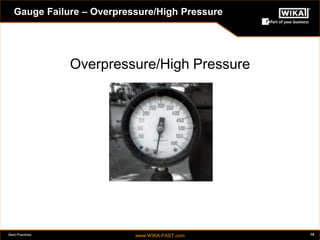
Gauge Failure – Overpressure/High Pressure 
Overpressure/High Pressure
Best Practices www.WIKA-FAST.com 16 
Overpressure/High Pressure 
Main Cause 
■ Caused by system running at full rate of capacity of the pressure gauge 
Symptoms 
■ Pressure gauge is operating at either full scale or past full scale value 
■ Pointer pegged against stop pin 
Consequences 
■ Can cause the Bourdon tube to rupture, which could lead to a media leak 
■ Causing increased wear on movement and internal components, which can cause 
permanent movement damage
Best Practices www.WIKA-FAST.com 17 
Overpressure/High Pressure: Best Solution 
 Gauge with a safety case design and a high 
overpressure safety range – 2X the standard flow 
pressure 
High Overpressure Safety
Best Practices www.WIKA-FAST.com 18 
Gauge Failure - Pulsation 
Pulsation
Best Practices www.WIKA-FAST.com 19 
Pulsation 
Main Causes 
■ Caused by the pump rapidly cycling or large pressure swings 
Symptoms 
■ Difficult to read pressure measurement due to pointer flutter 
■ Broken or loose pointer 
Consequences 
■ Increased wear on Bourdon tube and components 
■ Gauge will not indicate within published accuracy 
■ Overpressure will not be indicated due to compromised gauge accuracy
Best Practices www.WIKA-FAST.com 20 
Pulsation: Good Solution 
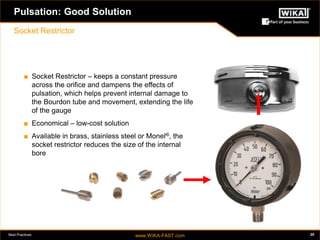
Socket Restrictor 
■ Socket Restrictor – keeps a constant pressure 
across the orifice and dampens the effects of 
pulsation, which helps prevent internal damage to 
the Bourdon tube and movement, extending the life 
of the gauge 
■ Economical – low-cost solution 
■ Available in brass, stainless steel or Monel®, the 
socket restrictor reduces the size of the internal 
bore
Best Practices www.WIKA-FAST.com 21 
Pulsation: Good Solution 
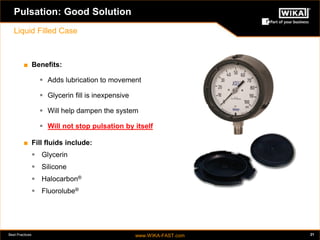
Liquid Filled Case 
■ Benefits: 
 Adds lubrication to movement 
 Glycerin fill is inexpensive 
 Will help dampen the system 
 Will not stop pulsation by itself 
■ Fill fluids include: 
 Glycerin 
 Silicone 
 Halocarbon® 
 Fluorolube®
Best Practices www.WIKA-FAST.com 22 
Pulsation: Better Solution 
Accessories 
Needle Valve 
■ Needle valves isolate a pressure instrument 
from the application 
■ Soft seat versions are ideal for gaseous media 
where a bubble tight seal is required 
Adjustable Snubber 
■ Adjustable needle valve design 
■ Stainless steel & brass construction 
Porous Metal Pressure Snubber 
■ Uses a porous metal disc to provide restriction 
■ Low cost 
■ Effective on clean service 
Needle Valve 
Adjustable 
Snubber 
Porous Metal 
Pressure 
Snubber
Best Practices www.WIKA-FAST.com 23 
Pulsation: Best Solution 
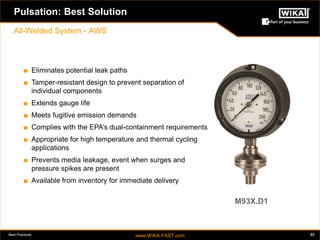
All-Welded System - AWS 
■ Eliminates potential leak paths 
■ Tamper-resistant design to prevent separation of 
individual components 
■ Extends gauge life 
■ Meets fugitive emission demands 
■ Complies with the EPA’s dual-containment requirements 
■ Appropriate for high temperature and thermal cycling 
applications 
■ Prevents media leakage, event when surges and 
pressure spikes are present 
■ Available from inventory for immediate delivery 
M93X.D1
Best Practices www.WIKA-FAST.com 24 
Gauge Failure – Vibration 
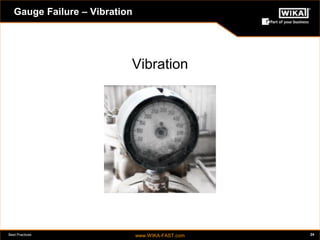
Vibration
Best Practices www.WIKA-FAST.com 25 
Vibration 
MAIN CAUSES 
■ Vibrating equipment near the gauge, usually from pumps or similar type equipment 
SYMPTOMS 
■ Increases wear on movement and components 
■ Damage occurring to internal components may be difficult to determine 
■ As movement wears, the Bourdon tube can vibrate or even crack 
CONSEQUENCES 
■ Difficult to read pressure and failed gauges 
■ Loss of containment (LOC) 
■ Fugitive emissions
Best Practices www.WIKA-FAST.com 26 
Vibration 
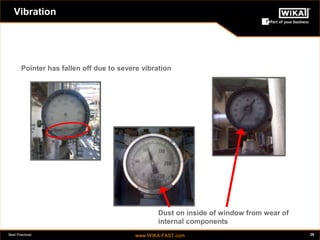
Pointer has fallen off due to severe vibration 
Dust on inside of window from wear of 
internal components
Best Practices www.WIKA-FAST.com 27 
Vibration 
Worn Pinion Gear Worn Segment Gear 
Crack in Tube 
Worn 
Link 
Normal 
Link 
■ Failing gauges don’t always show symptoms 
externally, but they are not giving you proper 
readings 
■ Cracks in tubes lead to the worst scenarios, 
including potential loss of containment
Best Practices www.WIKA-FAST.com 28 
Vibration: Solutions 
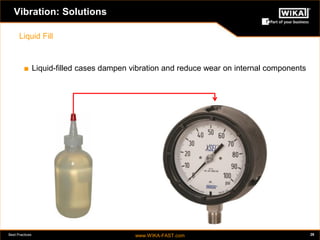
■ Liquid-filled cases dampen vibration and reduce wear on internal components 
Liquid Fill
Best Practices www.WIKA-FAST.com 29 
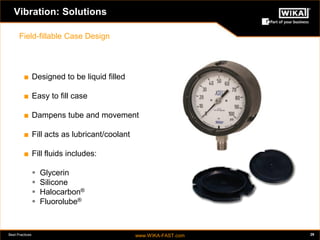
Vibration: Solutions 
■ Designed to be liquid filled 
■ Easy to fill case 
■ Dampens tube and movement 
■ Fill acts as lubricant/coolant 
■ Fill fluids includes: 
 Glycerin 
 Silicone 
 Halocarbon® 
 Fluorolube® 
Field-fillable Case Design
Best Practices www.WIKA-FAST.com 30 
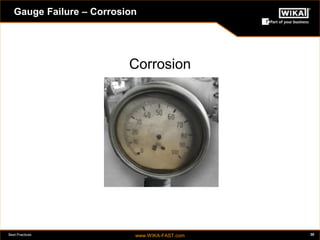
Gauge Failure – Corrosion 
Corrosion
Best Practices www.WIKA-FAST.com 31 
Corrosion 
Main Causes 
■ Pressure gauge materials are not compatible with the media they are 
measuring or the surrounding environment 
■ Media attacking the wetted parts of the pressure gauge 
Symptoms 
■ Case, pointer, lens, connection, or dial erosion or discoloration 
Consequences 
■ Loss of containment 
■ Fugitive emissions
Best Practices www.WIKA-FAST.com 32 
Corrosion 
Case, pointer, dial & lens completely eroded from media corrosion
Best Practices www.WIKA-FAST.com 33 
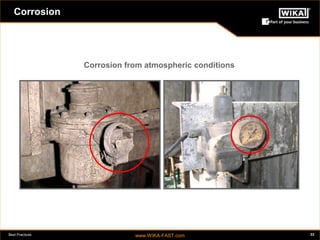
Corrosion 
Corrosion from atmospheric conditions
Best Practices www.WIKA-FAST.com 34 
Corrosion: Best Solution 
Let WIKA gauge experts develop a custom seal depending 
on your system’s media 
■ WIKA offers a variety of custom materials, such as Teflon, precious 
alloys (e.g., gold and silver), or carbon steel 
■ WIKA’s Metal Bonded Diaphragms work for processes requiring 
Hastelloy®, Monel® and Tantalum flush diaphragms
Best Practices www.WIKA-FAST.com 35 
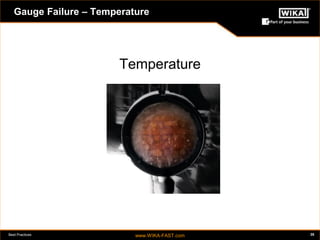
Gauge Failure – Temperature 
Temperature
Best Practices www.WIKA-FAST.com 36 
Temperature 
Main Causes 
■ Ambient & media temperatures that exceed instruments allowable temperature 
limits 
Symptoms 
■ Pressure system joints either sweat or loosen 
■ Pressure system alloy cracks 
■ The dial turns grey, brown, or discolored 
■ In liquid filled gauges, the case fill can turn brown or black in color 
Consequences 
■ Can cause other components to break down or erode 
■ Loss of containment 
■ Fugitive emissions
Best Practices www.WIKA-FAST.com 37 
Temperature 
Melting dial and discolored fill fluid from excessive process media temperatures
Best Practices www.WIKA-FAST.com 38 
Temperature 
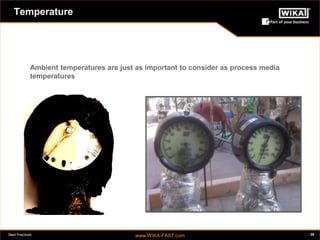
Ambient temperatures are just as important to consider as process media 
temperatures
Best Practices www.WIKA-FAST.com 39 
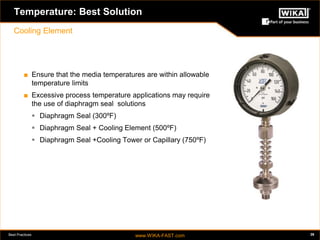
Temperature: Best Solution 
Cooling Element 
■ Ensure that the media temperatures are within allowable 
temperature limits 
■ Excessive process temperature applications may require 
the use of diaphragm seal solutions 
 Diaphragm Seal (300ºF) 
 Diaphragm Seal + Cooling Element (500ºF) 
 Diaphragm Seal +Cooling Tower or Capillary (750ºF)
Best Practices www.WIKA-FAST.com 40 
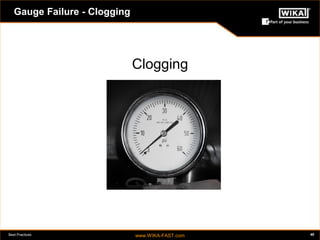
Gauge Failure - Clogging 
Clogging
Best Practices www.WIKA-FAST.com 41 
Clogging 
Main Causes 
■ Measurement instruments are not compatible with the process media 
■ Not using the proper accessories to protect against clogs 
Symptoms 
■ Inoperable gauge 
■ Shows no pressure when the system is operating 
Consequences 
■ No way to measure pressure in the system to avoid overpressure issues 
■ Pressure system to gauge becomes clogged from solids in the process media 
■ Pressure system can be clogged from highly viscous and crystallizing media
Best Practices www.WIKA-FAST.com 42 
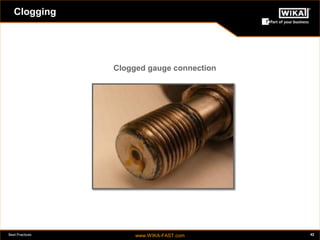
Clogging 
Clogged gauge connection
Best Practices www.WIKA-FAST.com 43 
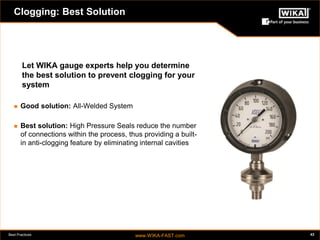
Clogging: Best Solution 
Let WIKA gauge experts help you determine 
the best solution to prevent clogging for your 
system 
 Good solution: All-Welded System 
 Best solution: High Pressure Seals reduce the number 
of connections within the process, thus providing a built-in 
anti-clogging feature by eliminating internal cavities
Best Practices www.WIKA-FAST.com 44 
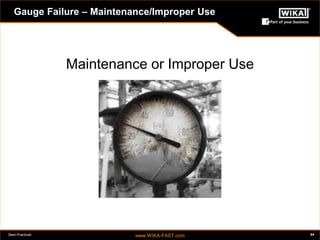
Gauge Failure – Maintenance/Improper Use 
Maintenance or Improper Use
Best Practices www.WIKA-FAST.com 45 
Maintenance/Improper Use 
Main Causes 
■ Gauge is placed on an application it is not designed to handle 
■ Lack of knowledge, improper training 
■ Workers accidentally dropping the gauge 
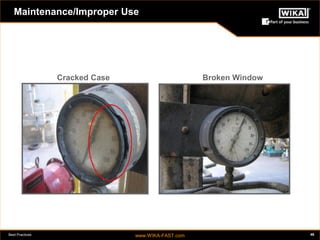
Symptoms 
■ Cracked case 
■ Broken window lens 
■ Crooked/bent gauge 
Consequences 
■ Loss of containment 
■ Fugitive emissions
Best Practices www.WIKA-FAST.com 46 
Maintenance/Improper Use 
Cracked Case Broken Window
Best Practices www.WIKA-FAST.com 47 
Maintenance/Improper Use: Best Solution 
 WIKA’s Instrument Safety Training helps you improve plant safety 
 Use the proper installation methods 
 Do not tighten by grabbing the case & turning 
 Always use the wrench flats to install the gauge properly 
 Install the correct gauge every time
Best Practices www.WIKA-FAST.com 48 
Improving Costs, Reliability of Your Instrumentation
Best Practices www.WIKA-FAST.com 49 
Let us be your gauge experts 
Full Audit Service Team 
 Gauges, if used properly, can help you 
identify an issue before costly problems 
develop 
 Our Full Audit Service Team (FAST) will 
take care of your gauges to help 
o Lower inventory costs 
o Improve reliability 
o Reduce gauge maintenance costs 
 And best of all, FAST is the only solution 
you need—a total care services program 
at no additional cost to you 
WIKA’s FAST engineers helped a large chemical plant 
address 50 years of gauge proliferation. Read the case 
study to learn more.
Best Practices www.WIKA-FAST.com Full Audit Service Team (FAST) 
50 
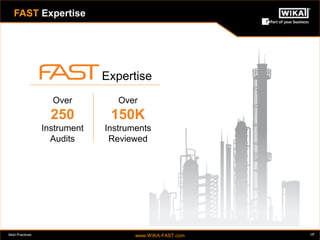
FAST Expertise 
Expertise 
Over 
250 
Instrument 
Audits 
Over 
150K 
Instruments 
Reviewed
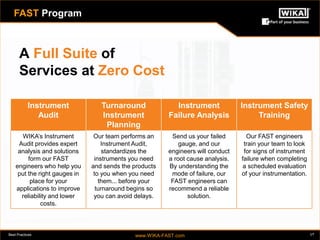
Best Practices www.WIKA-FAST.com A Full Suite of 
Services at Zero Cost 
51 
FAST Program 
Instrument 
Audit 
Turnaround 
Instrument 
Planning 
Instrument 
Failure Analysis 
Instrument Safety 
Training 
WIKA’s Instrument 
Audit provides expert 
analysis and solutions 
form our FAST 
engineers who help you 
put the right gauges in 
place for your 
applications to improve 
reliability and lower 
costs. 
Our team performs an 
Instrument Audit, 
standardizes the 
instruments you need 
and sends the products 
to you when you need 
them... before your 
turnaround begins so 
you can avoid delays. 
Send us your failed 
gauge, and our 
engineers will conduct 
a root cause analysis. 
By understanding the 
mode of failure, our 
FAST engineers can 
recommend a reliable 
solution. 
Our FAST engineers 
train your team to look 
for signs of instrument 
failure when completing 
a scheduled evaluation 
of your instrumentation.
Best Practices www.WIKA-FAST.com 52 
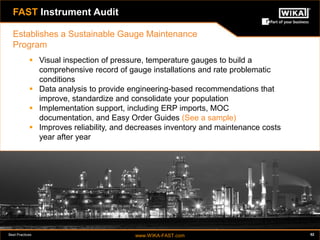
FAST Instrument Audit 
 Visual inspection of pressure, temperature gauges to build a 
comprehensive record of gauge installations and rate problematic 
conditions 
 Data analysis to provide engineering-based recommendations that 
improve, standardize and consolidate your population 
 Implementation support, including ERP imports, MOC 
documentation, and Easy Order Guides (See a sample) 
 Improves reliability, and decreases inventory and maintenance costs 
year after year 
Establishes a Sustainable Gauge Maintenance 
Program
25% 
20% 
30% 
Average FAST Audit Savings 
$51,171Ɨ in first year savings, Ongoing annual savings of $21,073ƗƗ 
Less gauge failures and less time to replace 
Correct gauges for processing conditions 
Standardize on full scale ranges, options for gauges 
Decrease 
Maintenance Costs* 
Reduction in Inventory* 
Increase in Reliability* 
First year savings only includes engineering resources for physical audit, storeroom review, data compilation, and implementation support. Based on average audit of 1,000 installations, requiring two instrumentation engineers for one week 
ƗƗ Ongoing annual savings. Inventory savings based on industry averages for overhead, inventory management, shrinkage, obsolescence, inventory tax, and cost of capital 
*Based on results from more than 250 WIKA instrument audits
Best Practices www.WIKA-FAST.com 54 
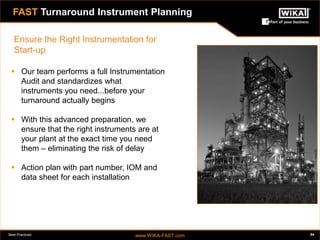
 Our team performs a full Instrumentation 
Audit and standardizes what 
instruments you need...before your 
turnaround actually begins 
 With this advanced preparation, we 
ensure that the right instruments are at 
your plant at the exact time you need 
them – eliminating the risk of delay 
 Action plan with part number, IOM and 
data sheet for each installation 
FAST Turnaround Instrument Planning 
Ensure the Right Instrumentation for 
Start-up
Best Practices www.WIKA-FAST.com 55 
FAST Instrument Failure Analysis 
Getting to the Root of the Problem 
 If you have gauges that are continually 
failing, then send them to us 
 Our FAST engineers will perform a root 
cause analysis 
 Can alert you to problems with more 
expensive equipment 
 Reduces likelihood of downtime and 
decreases maintenance costs 
WIKA’s FAST engineers assessed a recurring gauge 
failure and identified a larger issue before costly repairs 
were required. Learn how.
Best Practices www.WIKA-FAST.com 56 
FAST Instrument Safety Training 
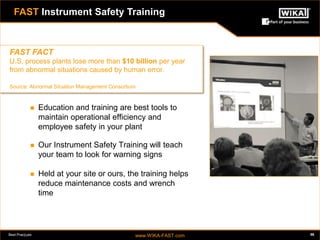
 Education and training are best tools to 
maintain operational efficiency and 
employee safety in your plant 
 Our Instrument Safety Training will teach 
your team to look for warning signs 
 Held at your site or ours, the training helps 
reduce maintenance costs and wrench 
time 
56 
FAST FACT 
U.S. process plants lose more than $10 billion per year 
from abnormal situations caused by human error. 
Source: Abnormal Situation Management Consortium 
FAST Instrument Safety Training
Best Practices www.WIKA-FAST.com 57 
How much could you save with FAST 
Audit? 
Contact us for a Cost Savings Estimate or to 
Learn More about WIKA’s FAST Services. 
1-855-651-FAST 
info@wika-fast.com

Gauge Your Best Practices: Common Reasons for Gauge Failure

  • 1.
    Best Practices www.WIKA-FAST.com1 Gauge Your Best Practices WIKA - Part of your business
  • 2.
    Best Practices www.WIKA-FAST.com2 Importance of Mechanical Gauges Why Maintain Them? • Provide a local pressure and temperature indication • Predict how long a piece of equipment can be safely and economically run • Identify potential loss of process or loss of containment • Diagnose causes of system and production disruptions • Detect signs of degradation in process performance not otherwise tracked through DCS equipment
  • 3.
    FAST Services LocalIndication: Sole Source of Data  Discharge pressure  Suction pressure  Mechanical seal flush pressure  Filter differential pressure  Utility pressure (steam, nitrogen, plant air)  Exchanger temperature  Vessel temperature
  • 4.
    Best Practices www.WIKA-FAST.com4 Rethinking Instrumentation What Do Pressure Gauges Have to Do With Reliability & Profitability?
  • 5.
    Best Practices www.WIKA-FAST.com5 Pressure and Temperature Instruments  Myth  Mechanical pressure gauges do not help me increase productivity or reliability  Reality  Pressure and temperature gauges are cost-effective tools that tell you what’s happening with your process and critical equipment  Impact  The right gauge will ensure you have the data you need to ensure the reliability and safety of your operations
  • 6.
  • 7.
    FAST Services 7 The Challenges Plants Face  Present State of Gauge Population “No analysis has been performed in a long time … if ever.”  Knowledge Gap “I inherited a mixed bag. The plant was constructed before I was born.”  Lack of Ownership “Operations replaces gauges. Maintenance stores them. That is the extent of our procedures.”  Like and Kind Replacement “Our P&IDs have gauge locations marked but no specifications are indicated.”  Lack of Resources “I don’t have time to identify, analyze, correct and document the 1000+ gauges in our plant.” Gauge Maintenance Is Not Easy
  • 8.
    FAST Services ThePressure Gauge: Current State of pressure gauges reviewed have failed or are in danger of failing. 40% * Based on more than 250 Instrument Audits
  • 9.
  • 10.
    Best Practices www.WIKA-FAST.com10 Gauge Failure The most common gauge failures based on data analysis of more than 250 Instrument Audits. Pressure Spikes Pulsation Vibration Corrosion Temperature Clogging Mishandling and Improper Use Overpressure/High Pressure
  • 11.
    Best Practices www.WIKA-FAST.com11 Gauge Failure – Pressure Spikes Pressure Spikes
  • 12.
    Best Practices www.WIKA-FAST.com12 Pressure Spikes Main Causes ■ Opening and closing valves while the system is running ■ Pressure surges or impulses Symptoms ■ Pointer is bent (Fishtail) from spike in pressure Consequences ■ Spikes in pressure can cause the Bourdon tube to rupture ■ May cause movement gears to disengage in gauges that do not have underload/overload stops which can cause permanent movement damage
  • 13.
    Best Practices www.WIKA-FAST.com13 Pressure Spikes Bourdon Tube Warped & Split
  • 14.
    Best Practices www.WIKA-FAST.com14 Pressure Spike: Best Solution  At a predetermined pressure, the overpressure protector "shuts-off" pressure to the gauge, preventing damage to the sensing element and protecting the calibration  The set-point is externally adjustable  WIKA overpressure protectors also feature a piston valve that is designed to dampen system pulsation  Overpressure safe up to 14,500 psi (1,000 bar)  Vacuum safe Overpressure Protector
  • 15.
    Best Practices www.WIKA-FAST.com15 Gauge Failure – Overpressure/High Pressure Overpressure/High Pressure
  • 16.
    Best Practices www.WIKA-FAST.com16 Overpressure/High Pressure Main Cause ■ Caused by system running at full rate of capacity of the pressure gauge Symptoms ■ Pressure gauge is operating at either full scale or past full scale value ■ Pointer pegged against stop pin Consequences ■ Can cause the Bourdon tube to rupture, which could lead to a media leak ■ Causing increased wear on movement and internal components, which can cause permanent movement damage
  • 17.
    Best Practices www.WIKA-FAST.com17 Overpressure/High Pressure: Best Solution  Gauge with a safety case design and a high overpressure safety range – 2X the standard flow pressure High Overpressure Safety
  • 18.
    Best Practices www.WIKA-FAST.com18 Gauge Failure - Pulsation Pulsation
  • 19.
    Best Practices www.WIKA-FAST.com19 Pulsation Main Causes ■ Caused by the pump rapidly cycling or large pressure swings Symptoms ■ Difficult to read pressure measurement due to pointer flutter ■ Broken or loose pointer Consequences ■ Increased wear on Bourdon tube and components ■ Gauge will not indicate within published accuracy ■ Overpressure will not be indicated due to compromised gauge accuracy
  • 20.
    Best Practices www.WIKA-FAST.com20 Pulsation: Good Solution Socket Restrictor ■ Socket Restrictor – keeps a constant pressure across the orifice and dampens the effects of pulsation, which helps prevent internal damage to the Bourdon tube and movement, extending the life of the gauge ■ Economical – low-cost solution ■ Available in brass, stainless steel or Monel®, the socket restrictor reduces the size of the internal bore
  • 21.
    Best Practices www.WIKA-FAST.com21 Pulsation: Good Solution Liquid Filled Case ■ Benefits:  Adds lubrication to movement  Glycerin fill is inexpensive  Will help dampen the system  Will not stop pulsation by itself ■ Fill fluids include:  Glycerin  Silicone  Halocarbon®  Fluorolube®
  • 22.
    Best Practices www.WIKA-FAST.com22 Pulsation: Better Solution Accessories Needle Valve ■ Needle valves isolate a pressure instrument from the application ■ Soft seat versions are ideal for gaseous media where a bubble tight seal is required Adjustable Snubber ■ Adjustable needle valve design ■ Stainless steel & brass construction Porous Metal Pressure Snubber ■ Uses a porous metal disc to provide restriction ■ Low cost ■ Effective on clean service Needle Valve Adjustable Snubber Porous Metal Pressure Snubber
  • 23.
    Best Practices www.WIKA-FAST.com23 Pulsation: Best Solution All-Welded System - AWS ■ Eliminates potential leak paths ■ Tamper-resistant design to prevent separation of individual components ■ Extends gauge life ■ Meets fugitive emission demands ■ Complies with the EPA’s dual-containment requirements ■ Appropriate for high temperature and thermal cycling applications ■ Prevents media leakage, event when surges and pressure spikes are present ■ Available from inventory for immediate delivery M93X.D1
  • 24.
    Best Practices www.WIKA-FAST.com24 Gauge Failure – Vibration Vibration
  • 25.
    Best Practices www.WIKA-FAST.com25 Vibration MAIN CAUSES ■ Vibrating equipment near the gauge, usually from pumps or similar type equipment SYMPTOMS ■ Increases wear on movement and components ■ Damage occurring to internal components may be difficult to determine ■ As movement wears, the Bourdon tube can vibrate or even crack CONSEQUENCES ■ Difficult to read pressure and failed gauges ■ Loss of containment (LOC) ■ Fugitive emissions
  • 26.
    Best Practices www.WIKA-FAST.com26 Vibration Pointer has fallen off due to severe vibration Dust on inside of window from wear of internal components
  • 27.
    Best Practices www.WIKA-FAST.com27 Vibration Worn Pinion Gear Worn Segment Gear Crack in Tube Worn Link Normal Link ■ Failing gauges don’t always show symptoms externally, but they are not giving you proper readings ■ Cracks in tubes lead to the worst scenarios, including potential loss of containment
  • 28.
    Best Practices www.WIKA-FAST.com28 Vibration: Solutions ■ Liquid-filled cases dampen vibration and reduce wear on internal components Liquid Fill
  • 29.
    Best Practices www.WIKA-FAST.com29 Vibration: Solutions ■ Designed to be liquid filled ■ Easy to fill case ■ Dampens tube and movement ■ Fill acts as lubricant/coolant ■ Fill fluids includes:  Glycerin  Silicone  Halocarbon®  Fluorolube® Field-fillable Case Design
  • 30.
    Best Practices www.WIKA-FAST.com30 Gauge Failure – Corrosion Corrosion
  • 31.
    Best Practices www.WIKA-FAST.com31 Corrosion Main Causes ■ Pressure gauge materials are not compatible with the media they are measuring or the surrounding environment ■ Media attacking the wetted parts of the pressure gauge Symptoms ■ Case, pointer, lens, connection, or dial erosion or discoloration Consequences ■ Loss of containment ■ Fugitive emissions
  • 32.
    Best Practices www.WIKA-FAST.com32 Corrosion Case, pointer, dial & lens completely eroded from media corrosion
  • 33.
    Best Practices www.WIKA-FAST.com33 Corrosion Corrosion from atmospheric conditions
  • 34.
    Best Practices www.WIKA-FAST.com34 Corrosion: Best Solution Let WIKA gauge experts develop a custom seal depending on your system’s media ■ WIKA offers a variety of custom materials, such as Teflon, precious alloys (e.g., gold and silver), or carbon steel ■ WIKA’s Metal Bonded Diaphragms work for processes requiring Hastelloy®, Monel® and Tantalum flush diaphragms
  • 35.
    Best Practices www.WIKA-FAST.com35 Gauge Failure – Temperature Temperature
  • 36.
    Best Practices www.WIKA-FAST.com36 Temperature Main Causes ■ Ambient & media temperatures that exceed instruments allowable temperature limits Symptoms ■ Pressure system joints either sweat or loosen ■ Pressure system alloy cracks ■ The dial turns grey, brown, or discolored ■ In liquid filled gauges, the case fill can turn brown or black in color Consequences ■ Can cause other components to break down or erode ■ Loss of containment ■ Fugitive emissions
  • 37.
    Best Practices www.WIKA-FAST.com37 Temperature Melting dial and discolored fill fluid from excessive process media temperatures
  • 38.
    Best Practices www.WIKA-FAST.com38 Temperature Ambient temperatures are just as important to consider as process media temperatures
  • 39.
    Best Practices www.WIKA-FAST.com39 Temperature: Best Solution Cooling Element ■ Ensure that the media temperatures are within allowable temperature limits ■ Excessive process temperature applications may require the use of diaphragm seal solutions  Diaphragm Seal (300ºF)  Diaphragm Seal + Cooling Element (500ºF)  Diaphragm Seal +Cooling Tower or Capillary (750ºF)
  • 40.
    Best Practices www.WIKA-FAST.com40 Gauge Failure - Clogging Clogging
  • 41.
    Best Practices www.WIKA-FAST.com41 Clogging Main Causes ■ Measurement instruments are not compatible with the process media ■ Not using the proper accessories to protect against clogs Symptoms ■ Inoperable gauge ■ Shows no pressure when the system is operating Consequences ■ No way to measure pressure in the system to avoid overpressure issues ■ Pressure system to gauge becomes clogged from solids in the process media ■ Pressure system can be clogged from highly viscous and crystallizing media
  • 42.
    Best Practices www.WIKA-FAST.com42 Clogging Clogged gauge connection
  • 43.
    Best Practices www.WIKA-FAST.com43 Clogging: Best Solution Let WIKA gauge experts help you determine the best solution to prevent clogging for your system  Good solution: All-Welded System  Best solution: High Pressure Seals reduce the number of connections within the process, thus providing a built-in anti-clogging feature by eliminating internal cavities
  • 44.
    Best Practices www.WIKA-FAST.com44 Gauge Failure – Maintenance/Improper Use Maintenance or Improper Use
  • 45.
    Best Practices www.WIKA-FAST.com45 Maintenance/Improper Use Main Causes ■ Gauge is placed on an application it is not designed to handle ■ Lack of knowledge, improper training ■ Workers accidentally dropping the gauge Symptoms ■ Cracked case ■ Broken window lens ■ Crooked/bent gauge Consequences ■ Loss of containment ■ Fugitive emissions
  • 46.
    Best Practices www.WIKA-FAST.com46 Maintenance/Improper Use Cracked Case Broken Window
  • 47.
    Best Practices www.WIKA-FAST.com47 Maintenance/Improper Use: Best Solution  WIKA’s Instrument Safety Training helps you improve plant safety  Use the proper installation methods  Do not tighten by grabbing the case & turning  Always use the wrench flats to install the gauge properly  Install the correct gauge every time
  • 48.
    Best Practices www.WIKA-FAST.com48 Improving Costs, Reliability of Your Instrumentation
  • 49.
    Best Practices www.WIKA-FAST.com49 Let us be your gauge experts Full Audit Service Team  Gauges, if used properly, can help you identify an issue before costly problems develop  Our Full Audit Service Team (FAST) will take care of your gauges to help o Lower inventory costs o Improve reliability o Reduce gauge maintenance costs  And best of all, FAST is the only solution you need—a total care services program at no additional cost to you WIKA’s FAST engineers helped a large chemical plant address 50 years of gauge proliferation. Read the case study to learn more.
  • 50.
    Best Practices www.WIKA-FAST.comFull Audit Service Team (FAST) 50 FAST Expertise Expertise Over 250 Instrument Audits Over 150K Instruments Reviewed
  • 51.
    Best Practices www.WIKA-FAST.comA Full Suite of Services at Zero Cost 51 FAST Program Instrument Audit Turnaround Instrument Planning Instrument Failure Analysis Instrument Safety Training WIKA’s Instrument Audit provides expert analysis and solutions form our FAST engineers who help you put the right gauges in place for your applications to improve reliability and lower costs. Our team performs an Instrument Audit, standardizes the instruments you need and sends the products to you when you need them... before your turnaround begins so you can avoid delays. Send us your failed gauge, and our engineers will conduct a root cause analysis. By understanding the mode of failure, our FAST engineers can recommend a reliable solution. Our FAST engineers train your team to look for signs of instrument failure when completing a scheduled evaluation of your instrumentation.
  • 52.
    Best Practices www.WIKA-FAST.com52 FAST Instrument Audit  Visual inspection of pressure, temperature gauges to build a comprehensive record of gauge installations and rate problematic conditions  Data analysis to provide engineering-based recommendations that improve, standardize and consolidate your population  Implementation support, including ERP imports, MOC documentation, and Easy Order Guides (See a sample)  Improves reliability, and decreases inventory and maintenance costs year after year Establishes a Sustainable Gauge Maintenance Program
  • 53.
    25% 20% 30% Average FAST Audit Savings $51,171Ɨ in first year savings, Ongoing annual savings of $21,073ƗƗ Less gauge failures and less time to replace Correct gauges for processing conditions Standardize on full scale ranges, options for gauges Decrease Maintenance Costs* Reduction in Inventory* Increase in Reliability* First year savings only includes engineering resources for physical audit, storeroom review, data compilation, and implementation support. Based on average audit of 1,000 installations, requiring two instrumentation engineers for one week ƗƗ Ongoing annual savings. Inventory savings based on industry averages for overhead, inventory management, shrinkage, obsolescence, inventory tax, and cost of capital *Based on results from more than 250 WIKA instrument audits
  • 54.
    Best Practices www.WIKA-FAST.com54  Our team performs a full Instrumentation Audit and standardizes what instruments you need...before your turnaround actually begins  With this advanced preparation, we ensure that the right instruments are at your plant at the exact time you need them – eliminating the risk of delay  Action plan with part number, IOM and data sheet for each installation FAST Turnaround Instrument Planning Ensure the Right Instrumentation for Start-up
  • 55.
    Best Practices www.WIKA-FAST.com55 FAST Instrument Failure Analysis Getting to the Root of the Problem  If you have gauges that are continually failing, then send them to us  Our FAST engineers will perform a root cause analysis  Can alert you to problems with more expensive equipment  Reduces likelihood of downtime and decreases maintenance costs WIKA’s FAST engineers assessed a recurring gauge failure and identified a larger issue before costly repairs were required. Learn how.
  • 56.
    Best Practices www.WIKA-FAST.com56 FAST Instrument Safety Training  Education and training are best tools to maintain operational efficiency and employee safety in your plant  Our Instrument Safety Training will teach your team to look for warning signs  Held at your site or ours, the training helps reduce maintenance costs and wrench time 56 FAST FACT U.S. process plants lose more than $10 billion per year from abnormal situations caused by human error. Source: Abnormal Situation Management Consortium FAST Instrument Safety Training
  • 57.
    Best Practices www.WIKA-FAST.com57 How much could you save with FAST Audit? Contact us for a Cost Savings Estimate or to Learn More about WIKA’s FAST Services. 1-855-651-FAST info@wika-fast.com