INVEST IN AUSTRIA:
TAX ASPECTS
compiled by
for AUSTRIAN BUSINESS AGENCY
August 2014
www.investinaustria.at
Invest in Austria
Imprint:
August 2014
Publisher: Austrian Business Agency,
Opernring 3, 1010 Vienna, Austria
Responsible for content: Deloitte Tax
Wirtschaftsprüfungs GmbH
Layout: CREAKTIV.BIZ e.U., Karin Rosner-Joppich
3
www.investinaustria.at
Contents
Preface4
I.	 Corporations5
1.	Company formation ���������������������������������������������������������������������������������������������������������������������������������������������������������� 5
2.	Taxation of corporations�������������������������������������������������������������������������������������������������������������������������������������������������� 7
3.	Special aspects of operating expenses�������������������������������������������������������������������������������������������������������������������� 12
4.	Special international aspects �������������������������������������������������������������������������������������������������������������������������������������� 13
5.	Tax concessions ��������������������������������������������������������������������������������������������������������������������������������������������������������������18
6.	Value-added tax system������������������������������������������������������������������������������������������������������������������������������������������������19
7.	Other taxes������������������������������������������������������������������������������������������������������������������������������������������������������������������������21
II.	 Permanent establishment – Branch office 23
1.	Branch office ��������������������������������������������������������������������������������������������������������������������������������������������������������������������23
2.	Definition of permanent establishment for tax purposes������������������������������������������������������������������������������������23
3.	Taxation of Austrian permanent establishments����������������������������������������������������������������������������������������������������24
4.	Taxation of foreign permanent establishments������������������������������������������������������������������������������������������������������24
5.	VAT liability of a permanent establishment��������������������������������������������������������������������������������������������������������������24
III.	Taxation of natural persons 25
1.	General information��������������������������������������������������������������������������������������������������������������������������������������������������������25
2.	Employment income ������������������������������������������������������������������������������������������������������������������������������������������������������26
3.	Tax concessions for seconded employees��������������������������������������������������������������������������������������������������������������27
4.	Self-employment income ����������������������������������������������������������������������������������������������������������������������������������������������28
5.	Investment income ��������������������������������������������������������������������������������������������������������������������������������������������������������28
6.	Investment funds held as private assets������������������������������������������������������������������������������������������������������������������29
7.	Real estate taxation��������������������������������������������������������������������������������������������������������������������������������������������������������30
8.	Deductions������������������������������������������������������������������������������������������������������������������������������������������������������������������������31
9.	Flat-rate estimates����������������������������������������������������������������������������������������������������������������������������������������������������������33
10.	Assessment procedure��������������������������������������������������������������������������������������������������������������������������������������������������33
11.	Partnerships����������������������������������������������������������������������������������������������������������������������������������������������������������������������33
12.	References ������������������������������������������������������������������������������������������������������������������������������������������������������������������������34
www.investinaustria.at
4
Preface
Many attempts have been made in Austria in previous years to make the tax and subsidy framework more attractive and simplify
complicated procedural provisions. One of the main priorities has been research promotion, which is currently offered in the form of
a ten percent tax credit for research activities that makes Austria an attractive location for innovative companies. Contract research,
which is also promoted by a ten percent credit, is now capped at a tax base of one million Euro instead of the previous 100,000 Euro.
A basic subsidy (Basisförderung) for apprenticeships and a training subsidy in the form of an allowance or credit affect the investment
decisions of personnel-intensive companies, and many other subsidies for fees, capital transaction taxes (Kapitalverkehrsteuer) and
social security contributions are available for start-up companies.
In addition, the recently enacted Austrian Tax Amendment Act 2014 (Abgabenänderungsgesetz 2014) provides tax concessions for the
first ten years after formation of a GmbH. GmbHs can have a reduced level of share capital of only 10,000 Euro during this period,
of which only 5,000 Euro must be contributed in cash.
This brochure is intended to provide a basic overview of the Austrian tax system, summarize changes to the law and provide infor-
mation on possible tax privileges that foreign investors must take into account when deciding where to locate their business. Due to
the complexity of the tax law, however, only the main points are discussed and no claim of completeness is made for the information
provided. In addition, we note that each case must be examined individually based on the particular circumstances that apply. No
liability is assumed in this regard.
5
www.investinaustria.at
2.	 In addition, when the founding privilege is used, the
amount of the equity contribution and the amount that
must be paid in must be specified for each sharehol-
der.	
3.	 Appointment of management: At least one managing direc-
tor (and supervisory board members, if required) must be
appointed by means of a shareholder resolution if this has
not already been done in the articles of association.
4.	 Payment of capital contributions: The shareholders must
pay in their statutory or agreed capital contributions, and
bank confirmation of these payments must be obtained
5.	 A tax-related certificate of non-objection must be obtained
from the tax authorities.
6.	 Company register application: The application for registra-
tion in the company register must be certified and must
include the following annexes:
»» Articles of association in the form of a notarial instrument
»» Certified shareholder resolution for appointment of man-
agement (if management is not already appointed in the
articles of association)
»» List of shareholders, providing shareholder names, dates
of birth and normal place of residence, signed by manage-
ment
»» List of managing directors, providing names, dates of
birth and normal place of residence
»» Bank confirmation
»» Certified sample signatures of managing directors
»» Certificate of non-objection from the tax authorities for
fees and transaction taxes (payment of company tax)
7.	 Business registration: The following annexes are required for
business registration:
»» Extract from the company register
»» Certificate of good conduct from the land of origin for
managing directors under trade law (Gewerberecht) and all
shareholders with significant influence over management
who are not resident in Austria or have been resident in
Austria less than five years
»» Declaration of the non-existence of reasons disallowing
operation of a business from all individuals with signifi-
cant influence (managing directors or shareholders with
management authority)
I.	 Corporations
1.	 Company formation
Austrian company law makes a fundamental distinction
between sole proprietorships, partnerships and corporations.
Corporations include the AG (Aktiengesellschaft – joint stock
corporation), SE (Societas Europea) and GmbH (Gesellschaft mit
beschränkter Haftung – limited liability company).
Corporations are formed under company law when registered in
the company register. Corporations are categorized according
to size as small, medium-sized and large corporations (based on
the three criteria of total assets, revenues and number of emplo-
yees). Assignment to these categories has a number of conse-
quences under commercial law, as in the provisions governing
disclosure of annual financial statements.
1.1.	 GmbH formation
The Austrian Company Law Amendment Act of 2013
(GesRÄG 2013) provides significant relief for the formation of
GmbHs. This relief was, however, largely withdrawn again by
the Austrian Tax Amendment Act of 2014. The legal situa-
tion existing since 1 March 2014 is as follows: As a rule, the
statutory minimum amount of share capital is 35,000 Euro, of
which half must be contributed in cash. The second half can be
contributed in kind. Founding privileges were newly introduced
for the beginning period of business activity (maximum of ten
years). The privilege allows GmbHs to be formed with share
capital of only 10,000 Euro, of which only 5,000 Euro must be
contributed in cash. This limits the business risk of the share-
holders to 10,000 Euro for the first ten years. This also applies
in the case of insolvency. The founding privilege ends ex lege
after ten years, or earlier in the case of an amendment to the
articles of association to this effect. At that time, the statutory
minimum contribution of 17,500 Euro must be provided.
Overview of the steps for formation of a GmbH:
1.	 Articles of association: For formation of a GmbH, the
articles of association must be prepared in the form of a no-
tarial instrument. The notarized articles of association must
contain at least the following: company name, registered
office, company object, amount of share capital and the
capital contribution of each shareholder. To take advantage
of the founding privilege, provisions to this effect must be
included in the original articles of association, i.e. in the
articles of association that are filed for the first time with the
company register.
www.investinaustria.at
6
The following are also required for managing directors under
trade law:
»» Passport
»» Social security confirmation of registration as an employ-
ee, unless the individual is simultaneously a managing
director under commercial law (Handelsrecht)
»» Proof of qualifications (e.g. master examination certifi-
cate)
»» Declaration by tradelaw managing directors on their
employment with the company (form)
8.	 Regional health insurance fund: Employees must be
registered with the appropriate regional health insurance
fund without undue delay before the start of employment.
Trade-law managing directors who are employed must be
registered with the regional health insurance fund before the
business is registered.
9.	 SVA social security: Register managing shareholders with
the SVA social security fund (Sozialversicherungsanstalt der
gewerblichen Wirtschaft) during the first month if they are
not already insured under the Austrian General Social Secu-
rity Act (Allgemeines Sozialversicherungsgesetz – ASVG)
10.	Tax authorities: Notify tax authorities of commercial opera-
tions during the first month and apply for a tax identifica-
tion number
11.	Municipality: Notify municipality or city of employees for
local tax purposes
1.2.	AG formation
The primary difference between the AG and GmbH is that the
AG is subject to a greater degree of statutory supervision. For
example, a supervisory board must be appointed for an AG and
the annual financial statements and management report must be
audited by an independent auditor. In addition, the members of
the managing board and supervisory board must examine and
report on formation of the company. In certain cases, formation
must also be examined by a court-appointed formation auditor.
An AG must have at least 70,000 Euro in share capital, which
can be raised using par value or no-par value shares. Par value
shares must have a par value of at least one euro. No-par value
shares do not have a par value. Each share has the same notional
interest in the share capital of the company. One important
advantage of the AG versus the GmbH is that a notarial instru-
ment is required for transferring GmbH shares, but not for AG
shares.
For formation of an AG, the articles of association must be
prepared in the form of a notarial instrument including at least
the following: company name, registered office, company ob-
ject, amount of share capital, in the case of listed companies an
indication of whether bearer or registered shares were issued, an
indication of whether the share capital is divided into par value
shares or no-par value shares (par value of the individual shares,
number of no-par value shares, class of shares), composition of
the managing board, and the form in which company publica-
tions are made. Appointment of the first supervisory board is
performed by the founders and must be notarized. The supervi-
sory board then appoints the managing board.
1.3.	The European Company
The SE (Societas Europea) is a special form of joint stock cor-
poration. Creating an SE does not necessarily require formation
of a new company. Mergers of joint stock corporations and
changes in legal form are also possible. Either the two-tier sys-
tem (as in Austria, with a supervisory body and a management
body) or the single-tier system (as in Anglo-American countries,
with one administrative body that combines both functions)
can be used when forming an SE. The minimum statutory
share capital for this form of company is 120,000 Euro. This
legal form has many advantages, in particular great flexibility in
terms of location. It is relatively easy to move the registered of-
fice of the company to another country in the EU, and uniform
procedures are available for mergers, holding company formati-
on and restructuring. These uniform procedures result in lower
administrative and legal costs and a uniform legal structure,
management and reporting system.
1.4.	Subsidies
The Austrian Business Start-Up Promotion Act (Neugrün-
dungsförderungsgesetz) facilitates several aspects of business
start-ups and transfers of small and medium-size companies.
For example, a variety of stamp duties and court fees for regis-
tration in the company register and land register can be waived
under certain conditions. If real estate is contributed to a com-
pany in return for shares in the company, no real estate transfer
tax is levied. Under certain conditions, no capital transaction
tax (Gesellschaftsteuer) is levied when participation rights (Gesell­
schaftsrechte) are acquired. The act also provides tax concessions
for non-cash labor costs.
1.5.	Shareholder capital contributions and loans
Shareholder capital contributions to a company are not inclu-
ded when determining corporate income. They are tax-neutral.
This is due to the principle of separation of company and share-
holder taxation (Trennungsprinzip). Capital contributions belong
to the untaxed shareholder sphere and not the income of the
7
www.investinaustria.at
entity itself. These contributions are, however, subject to capital
transaction tax (Gesellschaftsteuer).
In the case of shareholder loans, a distinction must be made
as to whether these are granted at arms-length terms or not.
Arms-length loans are recognized as service agreements, and the
interest paid by the company is deductible as operating expenses
and represents shareholder income. If loans are not provided at
arms-length terms, or there is no intention to repay the loan, the
interest is not deductible as operating expenses and represents
a hidden dividend distribution. Capital transaction tax is
normally not levied when a loan is granted. If, however, the loan
is not granted at arms-length terms, or no loan interest at all is
paid and the loan is therefore classified as a shareholder capital
contribution, then the tax consequences of a shareholder capital
contribution apply.
1.6.	Capital transaction tax
Capital transaction tax (Gesellschaftsteuer) is levied on the first-
time acquisition of participation rights (Gesellschaftsrechte) in
an Austrian corporation and other contractual and voluntary
contributions to domestic companies that can increase the
value of the participation rights. The capital transaction tax
rate is one percent and is payable by the corporation. Capital
transaction tax is also levied on payments made to a company
by the subsidiaries of a domestic corporation, such as additional
contributions, follow-up contributions, etc. As a rule, parent
company contributions to a sub-subsidiary are not subject to
capital transaction tax. Case law does, however, include cases
where parent company contributions to sub-subsidiaries were
subject to capital transaction tax.
The Austrian Tax Amendment Act of 2014 entirely eliminates
the capital transaction tax at the end of 31 December 2015. This
means that legal transactions are only subject to capital transac-
tion tax if the tax liability originates before 1 January 2016.
1.7.	 Other start-up costs
Depending on the scale of the company and articles of associati-
on, notary fees may be incurred for preparation of the articles of
association. In addition, a filing fee is required for registration
in the company register. The Austrian Company Law Amend-
ment Act of 2013 eliminated mandatory publication in the
Official Gazette (Amtsblatt) of the Wiener Zeitung newspaper.
In the future, new companies will only be announced in the
Austrian government edict file (Ediktsdatei), thereby elimina-
ting publication costs.
2.	 Taxation of corporations
Corporations, in particular AGs and GmbHs, are subject to
corporation tax. All (domestic and foreign) income of corpora-
tions that have their management or registered offices in Austria
is taxable.
As a rule, the income is taxable both at the company and share-
holder levels.
The corporation tax rate is 25 percent and is levied at the com-
pany level. A minimum corporation tax equal to five percent of
one quarter of the statutory minimum amount of share capital
must be paid quarterly (437.50 Euro for GmbHs and 875 Euro
for AGs). This means that the annual tax payable by AGs is
3,500 Euro, GmbHs 1,750 Euro, and SEs 6,000 Euro. The
annual minimum corporation tax increases to 5,452 Euro for
financial institutions.
The following relief is provided for a period of ten years for
GmbHs established after 30 June 2013: A minimum corporati-
on tax of only 125 Euro is due for each full quarter (500 Euro
per year) during the first five years after formation of a GmbH
and the start of unlimited tax liability, and 250 Euro per full
quarter (1,000 Euro per year) for the next five years.
As a rule, if corporate profits are distributed to shareholders,
investment income tax (Kapitalertragsteuer) of 25 percent is
withheld from the dividend distribution.
www.investinaustria.at
8
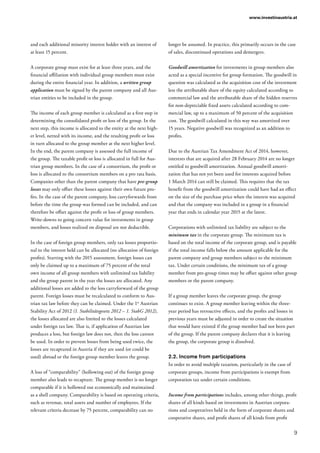
In an international comparison, Austria falls in the middle of
the distribution of corporation tax rates:
Corporation Tax Rates 2014
Slovenia
Czech Republic
Poland
Finland
Great Britain
Sweden
Slovakia
Denmark
Austria
Netherlands
Norway
Spain
Germany
Italy
France
Belgium
USA
17
19
19
20
21
22
22
24,5
25
25
27
30
30
31,4
33,3
34
35
Incl. surcharges and local/state taxes
Source: Deloitte Resources, Corporate Tax Rates 2014 (1 March 2014)
According to the BAK Taxation Index 2013 (published by
BAK Basel1
together with the ZEW2
), the effective average
tax burden in Austria is 22.4 percent. This means that the tax
rate is lower than in the United Kingdom (23.8 percent), Italy
(24.6 percent), Belgium (24.7 percent), France (32.5 percent)
and the United States (41.1 percent).3
2.1.	 Group taxation
The concept of group taxation makes it possible to net the
profits and losses of financially affiliated companies, including
recognition of cross-border losses. The first step is to calculate
the tax profit or loss for each individual member of the group.
These profits and losses are then allocated to the companies at
the next higher level in the group and, in the end, to the parent
company of the group. The profit or loss of the individual com-
1	 An economic research and consulting institute
2	 Centre for European Economic Research (Zentrum für Europäische
Wirtschaftsforschung – ZEW)
3	 The calculation was performed using a profitable investment that pro-
vided a pre-tax return of 20%. A manufacturing corporation was assumed.
Investments were made in a specified combination of assets, using a variety
of funding means. Taxes at the national, regional and local levels were
included.
panies calculated in accordance with commercial law remains
unchanged. No special integration of the individual companies
into the parent company is required to form a group, as was the
case for consolidated tax groups. Profit transfer agreements are
also not required.
Parent companies may be corporations with unlimited tax
liability, trade and industrial cooperatives, financial institutions
and mutual insurance companies, EU companies with limited
tax liability, and companies comparable to corporations that
have their management and registered office in the European
Economic Area. They must have an Austrian branch office (a
largely independent business unit that is at a different location
than the main office and operates under its own management)
that is registered in the company register and the interests in the
group companies must be attributable to this branch office.
Group members may be corporations with unlimited tax liabi-
lity, trade and industrial cooperatives and comparable foreign
corporations that have their registered offices in a member state
of the European Union or a country that offers comprehensive
administrative assistance.4
This restriction to countries offering
comprehensive administrative assistance was introduced in the
Austrian Tax Amendment Act of 2014 and has been effective
since 1 March 2014. Corporate groups existing as of 28 Febru-
ary 2014, continue to exist without change, however, until 31
December 2014. If a group member does not fulfil all require-
ments at that time, it leaves the group ex lege. Foreign group
members may only be subordinate group members (investees),
i.e. only one “foreign level” may exist. Except in the case of a
consortium company, companies may only be members of a
single corporate group.
Formation of a corporate group requires a financial affiliation
of more than 50 percent of the share capital or cooperative
capital and voting rights. In addition to direct interests, indirect
interests are also possible (via a partnership or other group
members). Foreign group members can also be used to create an
indirect financial affiliation. If a company on its own does not
hold an interest of more than 50 percent, it can, under certain
conditions, form a consortium with other companies. This re-
quires one interest holder with an interest of at least 40 percent,
4	 According to information from the Austrian Ministry of Finance
(BMF-010221/0169-VI/8/2014), these are the following countries as of 2
April 2014: all EU member states, Albania, Algeria, Andorra, Armenia,
Australia, Bahrain, Barbados, Belize, Bosnia-Herzegovina, Brazil, Canada,
Egypt, Georgia, Gibraltar, Hong Kong, Indonesia, Israel, Japan, Jersey,
Liechtenstein, Macedonia, Morocco, Mexico, Monaco, New Zealand,
Norway, Philippines, Qatar, San Marino. Saudi Arabia, Serbia, Singapore,
St. Vincent and the Grenadines, South Africa, Switzerland, Thailand,
Tajikistan, Turkey, USA, Venezuela, Vietnam.
9
www.investinaustria.at
and each additional minority interest holder with an interest of
at least 15 percent.
A corporate group must exist for at least three years, and the
financial affiliation with individual group members must exist
during the entire financial year. In addition, a written group
application must be signed by the parent company and all Aus-
trian entities to be included in the group.
The income of each group member is calculated as a first step in
determining the consolidated profit or loss of the group. In the
next step, this income is allocated to the entity at the next high-
er level, netted with its income, and the resulting profit or loss
in turn allocated to the group member at the next higher level.
In the end, the parent company is assessed the full income of
the group. The taxable profit or loss is allocated in full for Aus-
trian group members. In the case of a consortium, the profit or
loss is allocated to the consortium members on a pro rata basis.
Companies other than the parent company that have pre-group
losses may only offset these losses against their own future pro-
fits. In the case of the parent company, loss carryforwards from
before the time the group was formed can be included, and can
therefore be offset against the profit or loss of group members.
Write-downs to going concern value for investments in group
members, and losses realized on disposal are not deductible.
In the case of foreign group members, only tax losses proportio-
nal to the interest held can be allocated (no allocation of foreign
profits). Starting with the 2015 assessment, foreign losses can
only be claimed up to a maximum of 75 percent of the total
own income of all group members with unlimited tax liability
and the group parent in the year the losses are allocated. Any
additional losses are added to the loss carryforward of the group
parent. Foreign losses must be recalculated to conform to Aus-
trian tax law before they can be claimed. Under the 1st
Austrian
Stability Act of 2012 (1. Stabilitätsgesetz 2012 – 1. StabG 2012),
the losses allocated are also limited to the losses calculated
under foreign tax law. That is, if application of Austrian law
produces a loss, but foreign law does not, then the loss cannot
be used. In order to prevent losses from being used twice, the
losses are recaptured in Austria if they are used (or could be
used) abroad or the foreign group member leaves the group.
A loss of “comparability” (hollowing out) of the foreign group
member also leads to recapture. The group member is no longer
comparable if it is hollowed out economically and maintained
as a shell company. Comparability is based on operating criteria,
such as revenue, total assets and number of employees. If the
relevant criteria decrease by 75 percent, comparability can no
longer be assumed. In practice, this primarily occurs in the case
of sales, discontinued operations and demergers.
Goodwill amortization for investments in group members also
acted as a special incentive for group formation. The goodwill in
question was calculated as the acquisition cost of the investment
less the attributable share of the equity calculated according to
commercial law and the attributable share of the hidden reserves
for non-depreciable fixed assets calculated according to com-
mercial law, up to a maximum of 50 percent of the acquisition
cost. The goodwill calculated in this way was amortized over
15 years. Negative goodwill was recognized as an addition to
profits. 	
Due to the Austrian Tax Amendment Act of 2014, however,
interests that are acquired after 28 February 2014 are no longer
entitled to goodwill amortization. Annual goodwill amorti-
zation that has not yet been used for interests acquired before
1 March 2014 can still be claimed. This requires that the tax
benefit from the goodwill amortization could have had an effect
on the size of the purchase price when the interest was acquired
and that the company was included in a group in a financial
year that ends in calendar year 2015 at the latest.
Corporations with unlimited tax liability are subject to the
minimum tax in the corporate group. The minimum tax is
based on the total income of the corporate group, and is payable
if the total income falls below the amount applicable for the
parent company and group members subject to the minimum
tax. Under certain conditions, the minimum tax of a group
member from pre-group times may be offset against other group
members or the parent company.
If a group member leaves the corporate group, the group
continues to exist. A group member leaving within the three-
year period has retroactive effects, and the profits and losses in
previous years must be adjusted in order to create the situation
that would have existed if the group member had not been part
of the group. If the parent company declares that it is leaving
the group, the corporate group is dissolved.
2.2.	Income from participations
In order to avoid multiple taxation, particularly in the case of
corporate groups, income from participations is exempt from
corporation tax under certain conditions.
Income from participations includes, among other things, profit
shares of all kinds based on investments in Austrian corpora-
tions and cooperatives held in the form of corporate shares and
cooperative shares, and profit shares of all kinds from profit
www.investinaustria.at
10
participation rights for Austrian corporations. The exemption is
granted regardless of the size of the participation or how long it
has been held.
An exemption is also provided for income from foreign parti-
cipations. Transposition of the Parent-Subsidiary Directive
makes comparable profit shares from corporations in the EU
listed in Annex 2 of the Austrian Income Tax Act exempt from
corporation tax for the parent company receiving the dividend.
The Austrian Tax Amendment Act of 2011 (Abgabenände-
rungsgesetz 2011) extended the exemption for income from
participations to income from participations in third countries,
provided the third country offers comprehensive administrative
assistance.
In order to prevent abuse, the Austrian Corporation Tax Act
(Körperschaftsteuergesetz – KStG) stipulates a change from
the exemption method to the imputation method if the foreign
income from foreign participations was not previously taxed or
only taxed at a low rate (foreign corporation tax rate less than
15 percent). In order to avoid non-taxation in both countries,
there is no exemption from corporation tax if the profit shares
in question are deductible by the foreign entity.
The tax exemption applies to profit shares of all kinds. Profits
from ordinary business operations with the subsidiary, loan
interest, gains on disposal of the participation and liquidation
proceeds, however, remain taxable.
Notwithstanding the exemption for income from participations,
investment income tax is withheld by the distributing company
if a participation of less than ten percent is held. The tax can be
claimed by means of a deduction or refund.
2.3.	International controlling interests
Similar to the exemption for income from participations, profit
shares of all kinds from international controlling interests are
also exempt. The preferential treatment of profits earned by
foreign affiliated companies requires:
•	 a parent company (corporation) that falls under § 7(3) of the
Austrian Corporation Tax Act
•	 an interest in a foreign subsidiary that is comparable to an
Austrian corporation, or is an EU company as per Annex 2 of
the Austrian Income Tax Act
•	 an interest of at least ten percent held for an uninterrupted
period of at least one year
The international controlling interest takes precedence over the
exemption for income from foreign profit shares. This plays a
particularly important role in the tax neutrality of the invest-
ment and the abuse provisions. The exemption applies not only
to current profits, but also to gains and losses on disposal and
other changes in value.
Taxation option: The taxpayer can elect to make the investment
subject to taxation. The election must be made in the year of ac-
quisition, is irrevocable, and makes gains and losses on disposal
and write-downs to going concern value (must be spread over
seven years if deductible) subject to taxation. Current profits
from the investment remain, however, tax-exempt.
Anti-abuse provisions that cause a change in method also exist
for foreign controlling interests. In particular, a change to the
imputation method takes place if the foreign company focuses
on earning passive income (e.g. interest income, income from
the transfer or use of movable tangible or intangible assets,
disposal of investments) and the foreign tax rate is significantly
lower than in Austria (income tax 15 percent or less).
In order to prevent non-taxation in both countries, the corpora-
tion tax exemption is also unavailable if the profit shares are de-
ductible for the foreign entity (e.g. for hybrid funding vehicles).
2.4.	Loss carryforward
Operating losses that cannot be offset against positive income in
the year they are incurred may be deducted as special expenses
in following years. This requires proper accounting in the year
the loss was incurred. Losses of up to 75 percent of total income
may be deducted each year. If any losses remain, they can be
carried forward to following years. This carryforward limit
does not apply to certain types of income specified by law (e.g.
restructuring gains, gains on the disposal and discontinuation
of businesses, business units and partnership interests).
The right to carry losses forward is lost in the case of a “shell
company acquisition”. The characteristics of a “shell company
acquisition” are:
•	 Change in organizational structure (change in management)
•	 Change in economic structure (economic unit lost)
•	 Change in shareholder structure (assessed on a case-by-case
basis, always assumed for more than 75 percent change)
The evaluation must be based on the overall situation. A shell
company acquisition can exist even if the individual characte-
ristics are present in different degrees. The right to carry losses
forward is not lost if a shell company is acquired for restructu-
ring or rationalisation purposes.
11
www.investinaustria.at
2.5.	Reorganization
Reorganization refers to events that change a company’s legal
entity while leaving its assets generally unchanged. Unlike
reorganization that changes the legal form of a company,
reorganization by transfer (transfer of assets to a receiving
entity) leads to realisation of hidden reserves and therefore to
a tax obligation. The Austrian Reorganization Tax Act (Um-
gründungssteuergesetz) is aimed at permitting reorganization
by transfer to occur with no additional tax burden. It requires
that basis carryover be performed such that the pending nature
of the tax obligation associated with hidden reserves passes
over to the legal successor. The act defines six different types of
reorganization: merger, transformation, demerger, asset transfer,
combination and asset partition.
The EU Merger Directive covers cross-border EU reorganiza-
tion, but only mergers, demergers and asset transfers (as well as
share exchanges) when companies from two or more member
states are involved. Basis carryover and non-taxation of hidden
reserves also apply in this case.
2.6.	Foundations
A foundation is a legal entity formed under civil law that has no
owners or members. The foundation uses assets donated by the
founder for achieving its object. Any natural person and legal
entity can establish a foundation as long as they provide it with
70,000 Euro in capital. A distinction is made between public-
interest, private-interest and business foundations.
Public-interest foundations are exempt as far as possible from
corporation tax. They are subject only to unlimited corporation
tax liability on any businesses held, and limited corporation tax
liability on investment income. Rental income, lease income
and income from participations, on the other hand, are tax-
exempt. Distributions received from a public-interest foundati-
on are not taxed as investment income for the beneficiary.
Private-interest foundations are required to make extensive
disclosures to the tax authorities (foundation charter, supple-
mentary charters). If they fail to do so, their favourable tax con-
ditions lapse and the tax authorities notify the Austrian Money
Laundering Unit (Geldwäschemeldestelle). Business foundations
receive special tax treatment, as they are also exempt as far as
possible from corporation tax. Such foundations are founda-
tions formed under private law that serve solely to fulfil the
business object of the founding entrepreneur. Business object
foundations (Unternehmenszweckförderungsstiftung), employee
development foundations (Arbeitnehmerförderungsstiftung) and
employee share ownership foundations (Belegschaftsbeteiligungs­
stiftung) are business foundations.
Taxation of foundations takes place at three levels:
•	 Taxation of donations (foundation entrance tax)
•	 Regular taxation of the foundation
•	 Exit tax
Donations to a foundation are subject to the foundation entran-
ce tax (Stiftungseingangssteuer). The tax liability applies to the
donor (place of residence or normal residence in Austria) and
the foundation (registered office or management in Austria) and
is normally 2.5 percent. If a private-interest foundation does not
fulfil its disclosure requirements, the foundation entrance tax is
25 percent. When real estate is contributed to a foundation, the
foundation entrance tax is calculated using three times a special
standard tax value, the Einheitswert, and a tax rate of six percent
(real estate transfer tax).
Interim taxation (Zwischenbesteuerung) is a special feature of
the regular taxation of foundations. It is advance taxation for
future distributions to beneficiaries and is credited when future
distributions are made. Interim taxation applies to the following
forms of investment income if they are received by the founda-
tion:
•	 Domestic and foreign investment income from deposits and
securities held by financial institutions
•	 Income from realized increases in the value of investments
•	 Income from derivatives
Income from private real estate transfers is also subject to
interim taxation.
The interim tax rate was raised to the tax rate for investment
income by the Austrian Budget Accompanying Act of 2011
(Budgetbegleitgesetz 2011 – BBG 2011), and equals 25 percent
as of the 2011 assessment.
Foundations receive a special tax concession for the disposal of
equity investments. Hidden reserves that are revealed upon dis-
posal of an investment may be transferred within twelve months
to the acquisition cost of a new investment if the new invest-
ment represents an equity interest of more than ten percent. A
tax-exempt amount can be formed for hidden reserves that are
not transferred in this way during the calendar year.
Distributions by private-interest foundations to beneficiaries
that are natural persons are generally subject to investment in-
come tax (exit tax). Distributions to entities with unlimited tax
liability are not covered by the exemption for income from par-
ticipations and are therefore also subject to investment income
tax. On the other hand, distributions of foundation capital to
beneficiaries are tax exempt, since elimination of the inheritance
www.investinaustria.at
12
and gift tax means the donor could also give his assets as a gift
without taxes being incurred. Distribution amounts that exceed
the sum of the net retained profits at the beginning of the fi-
nancial year, revenue reserves and taxable hidden reserves of the
donated assets of the foundation are eligible for this exemption.
Foundation distributions do not represent tax-exempt capital
distributions until this “threshold value” (maßgeblicher Wert) is
exceeded.
3.	 Special aspects of operating expenses
3.1.	 Depreciation and amortization
Depreciation and amortization are intended to account for the
loss in value of an asset over the course of time due to wear and
tear. Under tax law, depreciation and amortization must be
linear, that is, evenly distributed.
A statutory useful life or depreciation/amortization rate is set
for certain assets. In the case of buildings, the depreciation rate
is three percent if at least 80 percent of the building is directly
used for agricultural, forestry or business operations, 2.5 per-
cent for insurance companies and banks, and two percent in all
other cases. Any goodwill that exists for agricultural and fore-
stry operations and businesses is amortized over 15 years. The
useful life for passenger cars and station wagons is a minimum
of eight years.
Low-value assets, i.e. assets with an acquisition cost of no more
than 400 Euro, may be written off in full in the year of acqui-
sition.
3.2.	Debt financing costs
Debt financing costs for the acquisition of equity interests (that
are held as business assets) are deductible, provided the interest
acquired are not interests in group companies. Entry into force
of the Austrian Budget Accompanying Act of 2014 (Budgetbe-
gleitgesetz 2014) introduces a narrow legal interpretation of the
term interest. Only interest that is direct consideration paid for
borrowed funds is deductible. The costs of procuring funds and
ancillary expenses incurred in connection with borrowing are
no longer deductible.
The interest for debt financed distribution of earnings is deduct-
ible as operating expenses – regardless of whether there is a
direct connection between the borrowing and the distribution.
If the distribution is actually a repayment of capital, the debt
financing interest may not be deducted.
3.3.	Provisions
Provisions are formed for expenses that are not incurred until
later periods, but are attributable to the current financial year.
Tax law only allows the formation of provisions indicated in
the law. Unlike corporate law, neither global provisions or
provisions for internal expenses are allowed. Provisions may
only be formed in the year in which the economic basis for the
liability is created. Provisions cannot be formed in subsequent
years. Provisions that are expected to exist for more than twelve
months after the balance sheet date are referred to as long-
term provisions. Until entry into force of the Austrian Budget
Accompanying Act of 2014, they may only be reported at
80 percent of the going concern value. For financial years that
end after 30 June 2014, long-term provisions are discounted
using a discount rate of 3.5 percent over the expected remaining
term and reported at their present value. The future value of
this present value is calculated for subsequent years. Provisions
that were still reported using the lump-sum value of 80 percent
under the previous legislation must be adjusted appropriately
if the newly calculated value is lower. No adjustment is made
if the newly calculated value is greater than 80 percent of the
going concern value. 	
This amendment only applies to provisions for liabilities and
anticipated losses, not to provisions for severance pay, pensions
and employee anniversary bonuses.
3.4.	Donations
Donations are voluntary gifts and are therefore generally not
deductible. An exception exists for donations of business assets
to eligible organizations for eligible purposes. This includes
donations related to science, research, universities and muse-
ums. Organizations with registered offices in a member state
of the European Union or a country that offers comprehensive
administrative assistance5
are treated the same as eligible Aus-
trian organizations if they are comparable to such organizations
and have a connection with Austria. The Austrian Tax Reform
Act of 2009 (Steuerreformgesetz 2009) extends this concession
to charitable causes in member countries of the EU or EEA, the
fight against poverty and need in developing countries, and di-
saster relief. Since 2013, the deductibility of donations has been
limited to ten percent of profits as calculated before applying a
profit allowance.
3.5.	Taxes
Operating taxes (e.g. property tax, motor vehicle tax) are
operating expenses and can therefore be deducted. Income tax
and other personal taxes are not deductible. The deductibility of
5	 See footnote 4, Page 8
13
www.investinaustria.at
accessory claims (e.g. late filing penalties) is determined based
on the deductibility of the underlying tax.
3.6.	Interest and royalty payments
Until entry into force of the Austrian Budget Accompanying
Act of 2014, interest and royalty payments within a corporate
group could, as a rule, be deducted without limit, as long as
the transactions were arms length in nature. A comprehensive
deduction limit now applies to interest and royalty expenses
starting as of 1 March 2014: Operating expenses for interest
and royalty payments are tax deductible if the income at the
receiving company is subject to sufficient taxation, i.e. taxation
at a rate of at least ten percent.
3.7.	Manager salaries
The Austrian Tax Amendment Act of 2014 introduced a limit
on operating expense deductions for top earners effective as of 1
March 2014. Under this legislation, expenses or outlays paid as
remuneration for work or services are no longer considered tax
deductible operating expenses above and beyond 500,000 Euro
per person per financial year.
4.	 Special international aspects
4.1.	 Double taxation conventions and deduction at
source
In order to avoid the same income from being taxed in two or
more countries, Austria has concluded double taxation con-
ventions with many countries modelled on the OECD Model
Convention. These conventions determine which contracting
country has the right to tax certain income. If one of these
distributive rules (Art. 6 to 22) does not give either country the
sole right of taxation, but instead allows the possibility of ta-
xation in both contracting countries, the contracting countries
mutually stipulate that the applicable country of residence must
avoid double taxation. In such cases, the contracting countries
mutually agree on which tax relief method shall be applied,
namely the credit method or exemption method. The credit
method is primarily used for dividends and royalties, since most
double taxation conventions provide the right to deduction of
tax at source.
Since transposition of the EU Parent-Subsidiary Directive,
dividend distributions between corporations have been exempt
from deduction at source when an interest of ten percent or
more is held. In addition, payments of interest and royalties
between affiliated companies in the EU have been exempt from
deduction at source since 1 January 2004 if a direct interest of
25 percent or more is held.
When the credit method is used, the income from the source
country is included in the tax base in the country of residence,
and the foreign taxes paid are credited against the domestic tax
burden. In most cases, the law provides for a statutory “maxi-
mum tax credit”, i.e. foreign taxes can only be credited against
domestic taxes up to a certain maximum limit, resulting in the
foreign income being taxed at no less than the Austrian tax rate.
The credit method is mainly used for dividends and royalties
when the source country has the right to deduction at source.
When the exemption method is used, on the other hand, the
foreign income is exempt from taxation in the country of resi-
dence in order to avoid double taxation. This method is often
used together with “exemption with progression”, i.e. foreign
income is only used to calculate the tax rate, but not the tax
base. Exemption with progression is only relevant for natural
persons, since the constant corporation tax rate of 25 percent
means that exemption with progression would not increase the
tax rate for corporations.
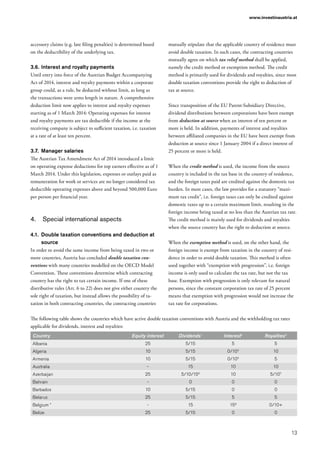
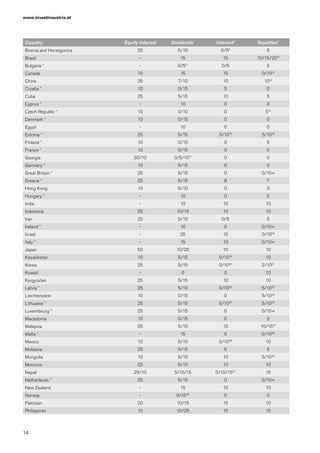
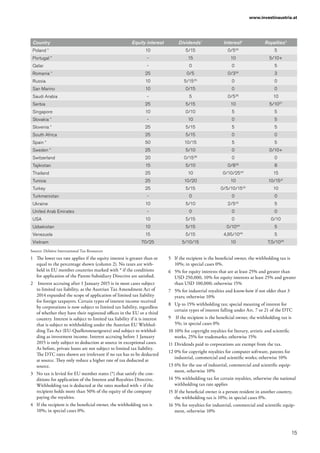
The following table shows the countries which have active double taxation conventions with Austria and the withholding tax rates
applicable for dividends, interest and royalties:
Country Equity interest Dividends1
Interest2
Royalties3
Albania 25 5/15 5 5
Algeria 10 5/15 0/104
10
Armenia 10 5/15 0/105
5
Australia - 15 10 10
Azerbaijan 25 5/10/156
10 5/107
Bahrain - 0 0 0
Barbados 10 5/15 0 0
Belarus 25 5/15 5 5
Belgium * - 15 158
0/10+
Belize 25 5/15 0 0
www.investinaustria.at
14
Country Equity interest Dividends1
Interest2
Royalties3
Bosnia and Herzegovina 25 5/10 0/59
5
Brazil - 15 15 10/15/2510
Bulgaria * - 0/511
0/5 5
Canada 10 15 15 0/1012
China 25 7/10 10 1013
Croatia * 10 0/15 5 0
Cuba 25 5/15 10 5
Cyprus * - 10 0 0
Czech Republic * 10 0/10 0 514
Denmark * 10 0/15 0 0
Egypt - 10 0 0
Estonia * 25 5/15 0/1015
5/1016
Finland * 10 0/10 0 5
France * 10 0/15 0 0
Georgia 50/10 0/5/1017
0 0
Germany * 10 5/15 0 0
Great Britain * 25 5/15 0 0/10+
Greece * 25 5/15 8 7
Hong Kong 10 0/10 0 3
Hungary * - 10 0 0
India - 10 10 10
Indonesia 25 10/15 10 10
Iran 25 5/10 0/5 5
Ireland * - 10 0 0/10+
Israel - 25 15 0/1018
Italy * - 15 10 0/10+
Japan 50 10/20 10 10
Kazakhstan 10 5/15 0/1019
10
Korea 25 5/15 0/1020
2/1021
Kuwait - 0 0 10
Kyrgyzstan 25 5/15 10 10
Latvia * 25 5/10 0/1022
5/1023
Liechtenstein 10 0/15 0 5/1024
Lithuania * 25 5/15 0/1025
5/1026
Luxembourg * 25 5/15 0 0/10+
Macedonia 10 0/15 0 0
Malaysia 25 5/10 15 10/1527
Malta * - 15 5 0/1028
Mexico 10 5/10 0/1029
10
Moldavia 25 5/15 5 5
Mongolia 10 5/10 10 5/1030
Morocco 25 5/10 10 10
Nepal 25/10 5/10/15 0/10/1531
15
Netherlands * 25 5/15 0 0/10+
New Zealand - 15 10 10
Norway - 0/1532
0 0
Pakistan 20 10/15 15 10
Philippines 10 10/25 15 15
15
www.investinaustria.at
Country Equity interest Dividends1
Interest2
Royalties3
Poland * 10 5/15 0/533
5
Portugal * - 15 10 5/10+
Qatar - 0 0 5
Romania * 25 0/5 0/334
3
Russia 10 5/1535
0 0
San Marino 10 0/15 0 0
Saudi Arabia - 5 0/536
10
Serbia 25 5/15 10 5/1037
Singapore 10 0/10 5 5
Slovakia * - 10 0 5
Slovenia * 25 5/15 5 5
South Africa 25 5/15 0 0
Spain * 50 10/15 5 5
Sweden * 25 5/10 0 0/10+
Switzerland 20 0/1538
0 0
Tajikistan 15 5/10 0/839
8
Thailand 25 10 0/10/2540
15
Tunisia 25 10/20 10 10/1541
Turkey 25 5/15 0/5/10/1542
10
Turkmenistan - 0 0 0
Ukraine 10 5/10 2/543
5
United Arab Emirates - 0 0 0
USA 10 5/15 0 0/10
Uzbekistan 10 5/15 0/1044
5
Venezuela 15 5/15 4,95/1045
5
Vietnam 70/25 5/10/15 10 7,5/1046
Source: Deloitte International Tax Resources
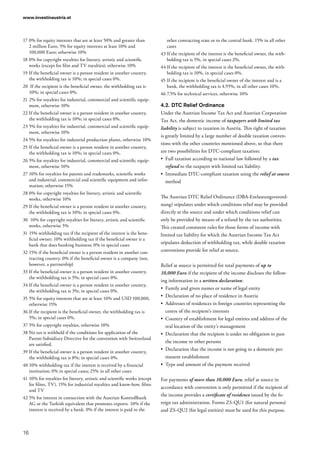
1	 The lower tax rate applies if the equity interest is greater than or
equal to the percentage shown (column 2). No taxes are with-
held in EU member countries marked with * if the conditions
for application of the Parent-Subsidiary Directive are satisfied.
2	 Interest accruing after 1 January 2015 is in most cases subject
to limited tax liability, as the Austrian Tax Amendment Act of
2014 expanded the scope of application of limited tax liability
for foreign taxpayers. Certain types of interest income received
by corporations is now subject to limited tax liability, regardless
of whether they have their registered offices in the EU or a third
country. Interest is subject to limited tax liability if it is interest
that is subject to withholding under the Austrian EU Withhol-
ding Tax Act (EU-Quellensteuergesetz) and subject to withhol-
ding as investment income. Interest accruing before 1 January
2015 is only subject to deduction at source in exceptional cases.
As before, private loans are not subject to limited tax liability.
The DTC rates shown are irrelevant if no tax has to be deducted
at source. They only reduce a higher rate of tax deducted at
source.
3	 No tax is levied for EU member states (*) that satisfy the con-
ditions for application of the Interest and Royalties Directive.
Withholding tax is deducted at the rates marked with + if the
recipient holds more than 50% of the equity of the company
paying the royalties.
4	 If the recipient is the beneficial owner, the withholding tax is
10%; in special cases 0%.
5	 If the recipient is the beneficial owner, the withholding tax is
10%; in special cases 0%.
6	 5% for equity interests that are at least 25% and greater than
USD 250,000, 10% for equity interests at least 25% and greater
than USD 100,000; otherwise 15%
7	 5% for industrial royalties and know-how if not older than 3
years; otherwise 10%
8	 Up to 15% withholding tax; special meaning of interest for
certain types of interest falling under Art. 7 or 21 of the DTC
9	 If the recipient is the beneficial owner, the withholding tax is
5%; in special cases 0%
10	10% for copyright royalties for literary, artistic and scientific
works, 25% for trademarks; otherwise 15%
11	Dividends paid to corporations are exempt from the tax.
12	0% for copyright royalties for computer software, patents for
industrial, commercial and scientific works; otherwise 10%
13	6% for the use of industrial, commercial and scientific equip-
ment, otherwise 10%
14	5% withholding tax for certain royalties, otherwise the national
withholding tax rate applies
15	If the beneficial owner is a person resident in another country,
the withholding tax is 10%; in special cases 0%.
16	5% for royalties for industrial, commercial and scientific equip-
ment, otherwise 10%
www.investinaustria.at
16
17	0% for equity interests that are at least 50% and greater than
2 million Euro, 5% for equity interests at least 10% and
100,000 Euro; otherwise 10%
18	0% for copyright royalties for literary, artistic and scientific
works (except for film and TV royalties); otherwise 10%
19	If the beneficial owner is a person resident in another country,
the withholding tax is 10%; in special cases 0%.
20	 If the recipient is the beneficial owner, the withholding tax is
10%; in special cases 0%.
21	2% for royalties for industrial, commercial and scientific equip-
ment, otherwise 10%
22	If the beneficial owner is a person resident in another country,
the withholding tax is 10%; in special cases 0%.
23	5% for royalties for industrial, commercial and scientific equip-
ment, otherwise 10%
24	5% for royalties for industrial production plants, otherwise 10%
25	If the beneficial owner is a person resident in another country,
the withholding tax is 10%; in special cases 0%.
26	5% for royalties for industrial, commercial and scientific equip-
ment, otherwise 10%
27	10% for royalties for patents and trademarks, scientific works
and industrial, commercial and scientific equipment and infor-
mation; otherwise 15%
28	0% for copyright royalties for literary, artistic and scientific
works, otherwise 10%
29	If the beneficial owner is a person resident in another country,
the withholding tax is 10%; in special cases 0%.
30	 10% for copyright royalties for literary, artistic and scientific
works, otherwise 5%
31	15% withholding tax if the recipient of the interest is the bene-
ficial owner; 10% withholding tax if the beneficial owner is a
bank that does banking business; 0% in special cases
32	15% if the beneficial owner is a person resident in another con-
tracting country. 0% if the beneficial owner is a company (not,
however, a partnership)
33	If the beneficial owner is a person resident in another country,
the withholding tax is 5%; in special cases 0%.
34	If the beneficial owner is a person resident in another country,
the withholding tax is 3%; in special cases 0%.
35	5% for equity interests that are at least 10% and USD 100,000,
otherwise 15%
36	If the recipient is the beneficial owner, the withholding tax is
5%; in special cases 0%.
37	5% for copyright royalties, otherwise 10%
38	No tax is withheld if the conditions for application of the
Parent-Subsidiary Directive for the convention with Switzerland
are satisfied.
39	If the beneficial owner is a person resident in another country,
the withholding tax is 8%; in special cases 0%.
40	10% withholding tax if the interest is received by a financial
institution; 0% in special cases; 25% in all other cases
41	10% for royalties for literary, artistic and scientific works (except
for films, TV), 15% for industrial royalties and know-how, films
and TV
42	5% for interest in connection with the Austrian Kontrollbank
AG or the Turkish equivalent that promotes exports. 10% if the
interest is received by a bank. 0% if the interest is paid to the
other contracting state or to the central bank. 15% in all other
cases
43	If the recipient of the interest is the beneficial owner, the with-
holding tax is 5%, in special cases 2%.
44	If the recipient of the interest is the beneficial owner, the with-
holding tax is 10%, in special cases 0%.
45	If the recipient is the beneficial owner of the interest and is a
bank, the withholding tax is 4.95%, in all other cases 10%.
46	7.5% for technical services, otherwise 10%
4.2.	DTC Relief Ordinance
Under the Austrian Income Tax Act and Austrian Corporation
Tax Act, the domestic income of taxpayers with limited tax
liability is subject to taxation in Austria. This right of taxation
is greatly limited by a large number of double taxation conven-
tions with the other countries mentioned above, so that there
are two possibilities for DTC-compliant taxation:
•	 Full taxation according to national law followed by a tax
refund to the taxpayer with limited tax liability.
•	 Immediate DTC-compliant taxation using the relief at source
method
The Austrian DTC Relief Ordinance (DBA-Entlastungsverord-
nung) stipulates under which conditions relief may be provided
directly at the source and under which conditions relief can
only be provided by means of a refund by the tax authorities.
This created consistent rules for those forms of income with
limited tax liability for which the Austrian Income Tax Act
stipulates deduction of withholding tax, while double taxation
conventions provide for relief at source.
Relief at source is permitted for total payments of up to
10,000 Euro if the recipient of the income discloses the follow-
ing information in a written declaration:
•	 Family and given names or name of legal entity
•	 Declaration of no place of residence in Austria
•	 Addresses of residences in foreign countries representing the
centre of the recipient’s interests
•	 Country of establishment for legal entities and address of the
real location of the entity’s management
•	 Declaration that the recipient is under no obligation to pass
the income to other persons
•	 Declaration that the income is not going to a domestic per-
manent establishment
•	 Type and amount of the payment received
For payments of more than 10,000 Euro, relief at source in
accordance with convention is only permitted if the recipient of
the income provides a certificate of residence issued by the fo-
reign tax administration. Forms ZS-QU1 (for natural persons)
and ZS-QU2 (for legal entities) must be used for this purpose.
17
www.investinaustria.at
If the foreign recipient of the income is a legal entity, the follow-
ing information must be included with the declaration regar-
dless of the size of the payment (unless a decision to provide a
repayment was made in the last three years):
•	 Declaration that the entity’s activities are not limited to asset
management
•	 Declaration that the entity has its own employees
•	 Declaration that the entity has its own business premises
If the recipient is a tax transparent partnership, the require-
ments above apply to each partner and the company name and
address must be indicated. If the total payments of a partner do
not exceed 10,000 Euro, only the name and address of the party
making the payment must be documented.
Relief at source is not permitted in the following cases:
•	 Deficient documentation
•	 It is known or should have been known that the income was
not for the foreign recipient
•	 The payment is not made to the provider of the work (writer,
artist, architect, athlete, etc.), but to a third party and no
precise information on the provider of the service is available
•	 The recipient of the income is a foreign foundation, foreign
trust or investment fund
•	 Investment income is paid out upon maturity or disposal of
securities by financial institutions acting in their capacity as
securities custodian or manager
•	 The income is received by a legal entity and the real location
of the entity’s management is outside the country of establish-
ment
In these cases, the party making the payment must deduct and
pay withholding tax to the tax authorities. If the requirements
are satisfied, the foreign recipient of the payment receives, upon
request, a refund of the difference between the withholding tax
deducted and the withholding tax under the DTC. The Bruck/
Eisenstadt/Oberwart Tax Office is responsible for refunds.
4.3.	Transfer prices
Intercompany payments for goods and services is an important
aspect of tax planning for international groups. For this reason,
regulations for internal group transfer prices are becoming
increasingly important for the tax administration. Both national
and international guidelines are used when examining and
evaluating transfer prices.
In Austria, the provisions of §§ 138, 162 of the Austrian Fe-
deral Tax Code (Bundesabgabenordnung – BAO) allow the tax
administration to examine intercompany payments for goods
and services. § 138 of the Austrian Federal Tax Code stipulates
that taxpayers have an enhanced duty to cooperate for foreign
matters. This includes in particular the duty of precautionary
documentation of evidence (Beweisvorsorgepflicht) and the duty
to provide evidence (Beweismittelbeschaffungspflicht). The tax-
payer is therefore required to explain such matters and provide
proof of their accuracy or make them plausible. If complete
proof cannot be provided, the taxpayer must bear the associa-
ted tax risk. With regard to intercompany payments in parti-
cular, the taxpayer is required to retain all foreign documents
related to payments within the group in its accounting system
(duty of precautionary documentation of evidence) and to pro-
vide all evidence related to intercompany business relationships
to the tax authorities upon request (duty to provide evidence).
Under § 162 of the Austrian Federal Tax Code, the tax autho-
rities can demand that the taxpayer precisely identifies the
creditor or recipient of amounts owed or other expenditures in
order to ensure effective taxation of such deducted payments
(e.g. commissions).
Examination of intercompany transfer prices is aimed at deter-
mining whether goods and services charged to and recharged
by an Austrian company are priced too high and are therefore
unreasonable. This goal is to ensure that intercompany transfer
prices satisfy the arm’s length principle. If intercompany trans-
fer prices do not pass the arm’s length test, an adjustment must
be made to the profits of the companies concerned. This arm’s
length principle is in Art. 9 of the OECD Model Convention
for double taxation conventions. The OECD Transfer Pricing
Guidelines also provide interpretation guidance that is manda-
tory for the tax authorities since standardization of the Austrian
Transfer Pricing Guidelines. The Austrian Transfer Pricing
Guidelines create a uniform legal interpretation that ensures
greater legal certainty.
Under the Austrian Transfer Pricing Guidelines, a risk and
functional analysis of the economically relevant functions of the
companies involved is first performed to check that the value of
the goods and services charged is accurate. The methods used to
check transfer prices are the same as those in the OECD.
Transfer Pricing Guidelines:
•	 Comparable price method
•	 Resale price method
•	 Cost plus method
•	 Profitability based methods
•	 Profit split method
•	 Contribution analysis
•	 Residual analysis
•	 Transactional net margin method
www.investinaustria.at
18
In addition, intercompany transfer prices must be documented
appropriately in order to ensure that values can be verified. This
includes documentation of the allocation of business functions
within the group, and documentation of transfer pricing and
the transfer pricing methods used. If no transfer pricing docu-
mentation can be provided for review by the tax authorities, the
OECD methods are used to estimate transfer prices.
Since transfer pricing is a highly complex area, the Austrian
legal system includes special provisions in §118 of the Federal
Tax Code. These provisions give taxpayers the opportunity to
obtain a binding advance ruling on their transfer pricing from
the tax authorities. This legal ruling gives taxpayers the right to
future tax evaluation in accordance with the ruling. Future de-
viation from the ruling can only take place to the benefit of the
taxpayer. It is important to note that an advance ruling appli-
cation can only concern one specific issue, although more than
one question can be raised on points of law. In return for the
legal certainty provided by this ruling, the taxpayer must pay
an administrative fee of between 1,500 Euro and 20,000 Euro,
depending on revenues.
5.	 Tax concessions
5.1.	 Research tax credit
The Austrian Budget Accompanying Act (2011) and 1st
Austrian
Stability Act (2012) introduce new provisions for the promo-
tion of research in Austria. Starting with the 2011 assessment,
a standard credit of ten percent of expenses can be claimed for
in-house and contract research expenses, with terms defined
based on the OECD Frascati Manual. The research tax credit
for in-house research can be claimed if the research is performed
in an Austrian firm or Austrian permanent establishment.
A tax credit equal to ten percent of expenses can also be
claimed for contract research, but only to a maximum of
1,000,000 Euro in expenses (that is, a maximum research tax
credit of 100,000 Euro for contract research). The contract
research must satisfy the following conditions:
•	 The research must be outsourced by an Austrian firm or Aus-
trian permanent establishment.
•	 The company contracted must have its registered office in the
European Union or European Economic Area.
•	 The company contracted may not be under the control of the
outsourcing company or a member of the same consolidated
tax group.
By law, a report from the Austrian Research Promotion Agency
(Forschungsförderungsgesellschaft – FFG) is required to claim
the research tax credit for in-house research and development.
This applies to financial years beginning after 31 December
2011. As part of the request, the FFG must be provided with
detailed descriptions of the research projects that are subject to
strict formal requirements. The descriptions must include the
following: project name, objective, methodology, innovation,
share of total expenses and start and end dates. The tax autho-
rities have full discretion in evaluating the reports as evidence,
and objections to the FFG assessment can be raised during the
procedure.
To increase legal certainty, a research certification (Forschungs­
bestätigung) or ruling can be requested in advance. Application
for a research certification can be filed with the tax authorities
for each research project to certify that the requirements for
claiming the research tax credits are satisfied – as long as the re-
search project has not yet been completed. The fee is 1,000 Euro
for each project application, or 200 Euro if the application is
rejected. The ruling certifies the size of the tax base for the
research credit in a financial year and requires certification from
an auditor. The research certification and ruling can be reque-
sted at the same time or separately.
5.2.	Training allowance and training credit
A training allowance of 20 percent can be claimed for ex-
penses related to company training and advanced training. The
training or advanced training must be of benefit to the compa-
ny and in the employer’s interest. The training and advanced
training courses must be conducted by outside institutions
or outside instructors. It is also possible to claim the training
allowance for in-house training and advanced training if the
training is provided by an in-house unit comparable to a busi-
ness unit that does not offer training courses to third parties.
The allowance for in-house training and advanced training is
limited to 2,000 Euro per calendar day.
As an alternative to the training allowance, a training tax credit
equal to six percent of expenses incurred for training and ad-
vanced training can be claimed. It is important to note that the
training credit can only be claimed for outside training courses.
5.3.	Apprenticeship subsidy
There is a basic subsidy (Basisförderung) for apprenticeships.
The basic subsidy can be applied for after completion of each
year of apprenticeship, is graduated according to apprenticeship
year, and is equal to between one and three times the gross
collective agreement apprenticeship compensation (Bruttolehr­
lingsentschädigung) per year of apprenticeship. The basic subsidy
is calculated on a pro rata basis in the case of half years, time
credits and reductions of apprenticeship time. The deadline for

19
www.investinaustria.at
application is three months after the end of the apprenticeship
year concerned.
The previous Blum Bonus (subsidy for additional apprenticeship
positions provided by the Public Employment Service Austria
(Arbeitsmarktservice – AMS)) has been replaced by the Blum
Bonus II (for new and returning apprentices). The Blum Bonus
II is a subsidy of 2,000 Euro for apprenticeships having begun
after 27 June 2008. This subsidy is only available for start-up
companies and companies beginning apprenticeship training
for the first time or resuming apprenticeship training. A maxi-
mum limit of ten apprenticeships per company applies.
In addition, another subsidy of 3,000 Euro is available for proof
of training at the mid-point of the apprenticeship, and subsidies
of 200 Euro and 250 Euro are available for good and excellent
apprenticeship test results.
6.	 Value-added tax system
The following transactions are subject to value-added tax (VAT)
in Austria:
•	 Goods and services provided by an entrepreneur in Austria
in return for payment as part of the entrepreneur’s business
activities
•	 Own use in Austria (withdrawal or private use of company
assets)
•	 Austrian imports from third countries (import VAT)
The VAT rate is normally 20 percent of the tax base in Austria.
A reduced rate of ten percent applies, for example, to food,
books, artistic works, drugs and property rental for residential
use.
An international comparison of normal tax rates places Austria
at the low end of the middle-range:
Value-added tax rates 2014
Switzerland
Luxembourg
Cyprus
Malta
Germany
France
Austria
Great Britain
Slovakia
Slovenia
Bulgaria
Estonia
Belgium
Italy
Netherlands
Czech Republic
Latvia
Lithuania
Spain
Poland
Ireland
Portugal
Finland
Romania
Sweden
Denmark
Norway
Hungary
8
15
17
18
19
19,6
20
20
20
20
20
20
21
21
21
21
21
21
21
23
23
23
24
24
25
25
25
27
Source: Deloitte Global Resources, Global Indirect Tax Rates (9 April 2014)
The tax base for goods and services is equal to the price paid,
not including VAT. In the case of private withdrawals, the appli-
cable value is the purchase price including ancillary expenses
at the time of withdrawal. The tax base for goods and services
furnished to parties outside a company is determined by the
costs attributable to provision of the goods and services.
6.1.	 Goods
The place of delivery is where the goods are located at the time
that power of disposal is acquired. The following applies for
international trade:
www.investinaustria.at
20
•	 When goods are shipped to a buyer, the place of delivery is
where the shipment begins.
•	 In the case of imports from third countries, delivery is dee-
med to take place in the country of import if the VAT is due
from the supplier.
•	 Intra-community purchase is deemed to take place in the
member state in which the goods are located at the end of
transport.
•	 Exports, i.e. goods transport or shipment to third countries,
are tax-exempt.
•	 Intra-community deliveries are exempt from VAT. An intra-
community delivery takes place if the goods are transported
from one member state to another in the community and the
buyer is an entrepreneur within the meaning of the Austrian
Value-Added Tax Act (Umsatzsteuergesetz – UStG).
6.2.	Services
The place of performance for services depends primarily on
whether the service is provided to an entrepreneur or non-
entrepreneur.
The place of performance for services provided to an entrepre-
neur is generally the location of the recipient’s company (B2B
General Clause). If services are provided at the permanent
establishment of a company, the location of the permanent
establishment is the place of performance.
Exceptions from the General Clause include for example, pro-
perty services, restaurant and catering services, and passenger
transport services.
The place of performance for services provided to a non-
entrepreneur is normally the location of the company of the
entrepreneur providing the service. If the service is provided
from a permanent establishment, the permanent establishment
is the place of performance.
Exceptions from the general clause include, for example, goods
and passenger transport services, artistic, cultural and scientific
services and events, services listed in the Austrian Value-Added
Tax Act (Katalogleistungen) and electronic services provided by
suppliers in third countries.
6.3.	Input tax deduction
In Austria, amounts paid by end consumers are subject to
VAT. This means that the entire VAT burden is borne by the
end consumer. The VAT charged to an entrepreneur can be
deducted as input tax. As a rule, therefore, it does not represent
a cost factor. Entrepreneurs are only permitted to deduct input
tax, however, if the goods or services are obtained for the busi-
ness and are used at least ten percent for the pursuit of business
objects. Import VAT on third country imports can also be ded-
ucted as input tax. Input tax may not be deducted, however, if
the entrepreneur providing goods or services is exempted from
VAT (e.g. certain financial services, insurance agent services).
All entrepreneurs providing goods and services in Austria are
required to charge VAT, regardless of whether they are resident
in Austria.
The Graz City Tax Office has jurisdiction over entrepreneurs
with no registered office or permanent establishment in Austria.
These entrepreneurs may also obtain input tax refunds from this
tax office if they provide no taxable goods or services in Austria.
Non-EU entrepreneurs must apply to the Graz City Tax Office
for a refund of input tax by 30 June of the following year. EU
entrepreneurs have until 30 September of the following year to
electronically file an application in their respective countries of
residence.
6.4.	Reverse charge
The liability for VAT on services and work and materials con-
tracts passes to the recipient of the services (reverse charge prin-
ciple) if the entrepreneur does not operate a business in Austria
and does not have a permanent establishment in Austria that is
involved in providing the services, and an Austrian entrepreneur
is recipient of the services.
In the case of construction services, the liability also passes to
the recipient of the services if the recipient has been engaged to
provide the construction services or normally provides construc-
tion services itself.
The reverse charge system also applies to:
•	 Delivery of assets assigned as security
•	 Delivery of property with retained title
•	 Foreclosure sales of property, buildings on third-party land
and heritable building rights (Baurecht)
•	 Supply of natural gas, electricity, heating or cooling
•	 Transfer of natural gas and electricity certificates
•	 Transfer of greenhouse gas emission certificates
•	 Delivery of mobile devices
•	 Delivery of video game consoles, laptops and tablet computers
if the amount paid is at least 5,000 Euro
•	 Delivery of certain metals
•	 Taxable delivery of investment gold
6.5.	Tax exemptions
The Austrian Value-Added Tax Act provides many other tax
exemptions in addition to the exemption for exports. These
include a number of banking transactions, property sales,
21
www.investinaustria.at
insurance services and transport services for cross-border
transport of goods. In addition, there is a VAT exemption for
small entrepreneurs whose sales do not exceed 30,000 Euro
per year. However, since this also leads to loss of the input tax
deduction, small entrepreneurs have the option to waive the
VAT exemption.
6.6.	Tax returns and procedure followed
As a rule, companies must submit monthly VAT advance
returns. An advance payment owing in an advance return must
be paid to the tax authorities by the 15th
day of the second
following month. A credit is provided for negative amounts.
Companies with less than 100,000 Euro in sales in the previous
year only need to submit quarterly advance returns.
After the end of the calendar year, the entrepreneur must file a
tax return for the total VAT, input tax and import VAT. As a
rule, the return must be submitted electronically by 30 June of
the following year.
7.	 Other taxes
7.1.	 Real estate transfer tax
Acquisitions of Austrian real estate are subject to real estate
transfer tax in Austria. Such acquisition includes not only trans-
fer of title based on a purchase agreement, but also acquisition
by foreclosure, adverse possession, and acquisition of all of the
shares of a company whose assets include Austrian real estate.
Acquisition of real estate as a gift or by reason of death is also
subject to real estate transfer tax.
As defined in the Austrian Real Estate Transfer Tax Act
(Grunderwerbsteuergesetz), the term real estate means land and
buildings, as well as natural fruits (e.g. plants, animals) and ap-
purtenances (e.g. office furniture and equipment). The Austrian
Real Estate Transfer Tax Act treats heritable building rights
(Baurecht) and structures on third-party land (Superädifikat) as
equivalent to real estate. Real estate does not, however, include
machinery and other operating equipment (e.g. cranes, tanks).
Transactions exempt from real estate transfer tax include the
following:
•	 Acquisition of real estate with a tax base of up to 1,100 Euro
(allowance)
•	 Gratuitous acquisition up to a value of 365,000 Euro (allo-
wance) for transfers to a natural person by a person who is
at least 55 years of age at the time of transfer or is physically
or mentally disabled, if the gift is a business, business unit or
partnership interest
•	 Acquisition of real estate for an official measure aimed at
improving the shape of a building plot
•	 Acquisition as a result of an official intervention or as a result
of a legal transaction performed to avoid such an intervention
that can be shown to have been imminent
•	 Partition of real estate among co-owners, if the value of the
portion acquired equals the co-owner’s share of the real estate
before partition
•	 Acquisitions taking place between spouses or registered part-
ners for the purpose of building a residence with a maximum
of 150 m²
The real estate transfer tax rate is generally 3.5 percent. A
special tax rate of two percent applies, however, for acquisitions
by spouses, registered partners, “life partners” (Lebensgefähr-
te) (provided the life partners have or had a common main
residence), parents or children (including step children, adopted
children, grandchildren and children-in-law), and partition of
marital assets during divorce or dissolution of a civil union.
As a rule, real estate transfer tax is calculated using the value of
the consideration provided, including liabilities assumed. If no
consideration is provided, the calculation is based on the market
value of the real estate. This also applies if the consideration
is less than the market value of the real estate. The following
exceptions apply to this basic rule:
•	 In the case of a transfer for or without consideration between
close family members or acquisition by reason of death
between such family members, the tax base is three times
the Einheitswert (assessed tax value), subject to a maximum of
30 percent of the current value.
•	 A value of three times the Einheitswert, subject to a maximum
of 30 percent of the current value, is also used in the case of a
transfer of all shares in a company that holds real estate, or if
all shares of such a company are acquired.
•	 In the case of reorganizations falling under the Austrian Re-
organization Tax Act, the real estate transfer tax is calculated
on a base of two times the Einheitswert.
•	 The tax base is equal to the Einheitswert for transfers of
agricultural and forestry real estate between close family
members or acquisition by reason of death between such fam-
ily members, and in the case of reorganizations falling under
the Austrian Reorganization Tax Act or the acquisition of all
shares of a company when agricultural and forestry real estate
is concerned.
Liability for real estate transfer tax is incurred at the time
the acquisition is realized (e.g. conclusion of agreement, final
decision on devolution of estate or certification by the probate
court in the case of acquisition by reason of death). In the case
www.investinaustria.at
22
of acquisition by operation of law, the owner and acquirer are
liable for the tax, and in the case of acquisition by reason of de-
ath only the acquirer is liable. If all of the shares of a company
are acquired by a single party, this party is liable for the tax. For
all other forms of acquisition, all of the parties involved in the
acquisition are liable for the real estate transfer tax.
A tax declaration (Abgabenerklärung) must be submitted for
acquisitions subject to real estate transfer tax by the 15th
day of
the second month following the date the liability is incurred.
An assessment notice is issued based on the tax declaration. The
tax liability generally becomes due one month after this notice
is served. When acting as agents, lawyers and notaries have the
right to calculate the real estate transfer tax themselves and pay
it to the tax authorities.
After real estate transfer tax has been paid in full, the tax autho-
rities issue a certificate of non-objection that is required for
registration in the land register. In the case of self-calculation
by an agent of one of the parties, a self-calculation declaration
(Selbstberechnungserklärung) is sufficient.
7.2.	Stamp duties and legal transaction fees
Legal transactions are subject to fees in Austria when executed
by means of a legal instrument that is expressly mentioned in
the Austrian Fees Act (Gebührengesetz). A distinction must be
made between fixed fees (e.g. official copies, excerpts, travel do-
cuments, drivers licences, marriages) and percentage-based fees
(e.g. rental agreements, guarantees, settlements, assignments,
bills of exchange). While a fixed amount is levied for fixed fees,
in the case of percentage-based fees a percentage of the contract
amount must be paid as a fee. In addition, the tax authorities
must be notified of percentage-based fees by the 15th
day of
the second month following the date the liability is incurred
and an assessment notice issued. An assessment notice with a
surcharge of 50 percent can be issued for fixed fees that are not
paid in accordance with requirements. Except for betting fees, a
surcharge up to the amount of the original fee can be levied for
all other fees.
Fees are required only for legal transactions executed by legal
instruments. Written letters of acceptance are also considered
legal instruments. According to a finding issued by the Austrian
Administrative Court, emails must also be considered legal in-
struments that create liability for fees in Austria. Legal transac-
tions that fall under the Austrian Real Estate Transfer Tax Act
(Grunderwerbsteuergesetz), Austrian Capital Transfer Tax Act
(Kapitalverkehrsteuergesetz) and Insurance Act (Versicherungs­
gesetz) are exempt from fees under the Austrian Fees Act. This
also applies to legal transactions that fall under the Austrian
Foundation Entrance Tax Act (Stiftungseingangssteuergesetz).
Liability for fees is incurred for legal instruments executed in
Austria at the time they are signed by all contracting parties. If
an instrument is only signed by one contracting party, liability
is incurred when the instrument is provided to the other con-
tracting party. In the case of legal instruments executed outside
of Austria, liability for fees is incurred if the parties are resident
in Austria and the instrument relates to a matter in Austria or
one of the parties undertakes to provide performance in Austria.
If the parties are not resident in Austria, fees are still required
for instruments executed outside of Austria if the instrument is
brought to Austria and relates to a matter in Austria or one of
the parties undertakes to provide performance in Austria. The
Austrian Fees Act does, however, include exceptions for some
legal instruments in terms of the time when liability for a fee is
incurred (e.g. bills of exchange, betting).
Both contracting parties are liable for the fees, except for legal
transactions that only obligate one party, in which case the par-
ty in whose interest the instrument is issued is liable. As the case
for the time liability is incurred, exceptions also exist here (e.g.
bills of exchange, betting). All parties liable for fees are jointly
and severally liable. In addition to these parties, all other parties
involved in the legal transaction are also liable.
The size of the fee depends on the underlying legal transaction
and whether the fee is a fixed or percentage-based fee. For exa-
mple, the following fee rates apply (in  percent of tax base):
•	 Rental agreements	 1%
•	 Assignments	0.8%
•	 Guarantees	1%
23
www.investinaustria.at
II.	 Permanent establishment –
Branch office
1.	 Branch office
If a legal entity resident outside of Austria establishes a branch
office in Austria, the branch office must be registered in the
company register. A coercive penalty can be imposed if this is
not done. The law does not define at what level of economic
activity a branch office exists. Based on the literal meaning of
the words, however, it can be assumed that a head office exists
outside of Austria.
As a rule, a branch office is independently managed in its
interactions with the outside world, with the manager fre-
quently having independent power of representation in this
area. It generally makes no difference if the manager is bound
to instructions from top management. Established case law
does not require separate assets, but according to European
Court of Justice decisions one can only assume the existence of
a fixed establishment if a minimum level of permanent human
and technical resources6
. The branch office must conclude and
process major transactions for the enterprise as a whole (i.e.
not just ancillary transactions). A company that only concludes
transactions, but does not process them therefore cannot be a
branch office. Although separate accounting is an indicator, it is
not a requirement for the existence of a branch office.7
A branch office does not acquire its own legal capacity upon
registration, which means that the contracting party is always
the foreign entity. As a rule, therefore, the executive bodies of
the foreign company also represent the branch office.
Taxation of a branch office depends on whether it is considered
a permanent establishment for tax purposes. In practice, branch
offices generally satisfy the criteria for a permanent establish-
ment, as the meaning of permanent establishment is broader
than that of branch office.
6	 Straube, Wiener, Commentary on the Austrian Commercial Code,
Accounting, 2012, §12, marg. number 24 et seqq.
7	 Schuhmacher, Gruber, Legal issues concerning the branch office, 1993,
p. 7 et seqq.
2.	 Definition of permanent establishment for
tax purposes
As a rule, the country in which a taxpayer’s place of residence or
registered office is located has the right to tax business profits.
However, if the entrepreneur establishes a permanent establish-
ment in another country, all profits attributable to the perma-
nent establishment have limited tax liability in the permanent
establishment country. The meaning of “permanent establish-
ment” is therefore very important, as the issue of at what point a
permanent establishment exists for tax purposes often arises in
practice.
Under the OECD Master Convention, a permanent establish-
ment is considered a fixed place of business through which the
business of an enterprise is wholly or partly carried on. The term
includes, for example, a place of management, branch, office,
factory and workshop, as well as a building site or construction
or installation project if it lasts more than a certain period. The
term does not include facilities for storage, display, purchasing
or information collection. Multiple spatially separated places
of business are to be evaluated separately for categorization as a
permanent establishment.8
To qualify as a permanent establishment the following condi-
tions must be satisfied:
•	 Fixed element: An owned or rented place of business at the
disposal of the enterprise
•	 Functional element: Business must be carried on through this
place of business
Time element: Not of just a temporary nature; a permanent
establishment does not exist if use is only temporary
The permanent establishment provisions also include building
sites and installation projects. They are only deemed permanent
establishments, however, if they last longer than the period of
time specified in the DTC in question.9
Case law views the term fixed place of business in terms of the
business and requires that the business be wholly or partly car-
ried on there. Assessing whether the scope of business activities
satisfies the requirements of a permanent establishment is less
difficult the more the actual business activities take place out-
side the fixed place of business.
8	 Bertl, Djanani, Kofler, Handbuch der österr. Steuerlehre (Manual of
Austrian Taxation), 1998, p. 570 et seqq.
9	 Bertl, Djanani, Kofler, Handbuch der österr. Steuerlehre (Manual of
Austrian Taxation), 1998, p. 570 et seqq.
www.investinaustria.at
24
An international representative office, for example, that consists
of just a small office with only one or a few employees whose
main responsibility is initiation of business deals and contact
relationship management for potential customers and cannot
process any orders itself will generally not be a permanent esta-
blishment for income tax purposes. In some cases, however, this
depends on the activities of the enterprise and the provisions
of the applicable DTC. The Austria-Japan DTC, for example,
includes the negative constraint that a fixed place of business
maintained exclusively for advertising, providing information,
performing scientific research or carrying out similar activities
that are of a preparatory nature for the enterprise or are ancil-
lary activities does not qualify as a permanent establishment
within the sense of the convention.
3.	 Taxation of Austrian permanent
establishments
If a permanent establishment is present in Austria, it has limited
tax liability in Austria and must register with the Austrian tax
authorities. The tax liability exists for all of the income of the
domestic permanent establishment. The profits it would have
earned if it had carried out similar activities under the same or
similar conditions as an independent enterprise are attributed
to the permanent establishment. In practice, two methods have
developed for this purpose:
Direct attribution of profits: A permanent establishment is
treated as an independent business, and business relationships
it has with third parties are attributed to it. General operating
expenses are attributed, as are general management expenses,
but a profit margin is not. In practice, the earnings of the per-
manent establishment are attributed based on the accounting or,
if unavailable, by estimation.
Indirect attribution of profit: The total earnings of the enterpri-
se are first determined and then divided between the head office
and permanent establishment using appropriate allocation keys.
This method is only used in exceptional cases.
Loss deductions in subsequent years can only be included to
a limited extent. The losses must have been generated in the
domestic permanent establishment and must exceed the other
(global) income of the enterprise. The domestic loss must the-
refore be offset first against positive domestic income. Foreign
income must be determined and disclosed based on Austrian
tax law. Loss deduction can only be secondarily applied to the
country of residence. It is irrelevant whether a loss offset is
possible in the country of residence. In the case of a DTC that
prohibits discrimination (taxpayers may not be put in a poorer
situation than citizens with respect to taxes based solely on their
foreign citizenship), however , a loss carryforward must be gran-
ted if the losses cannot be used in the country of residence.
Please see Part I on corporations for information concerning
special aspects of operating expenses, special international
aspects, tax concessions and other taxes. The discussion of em-
ployee secondment in Part I also applies here.
4.	 Taxation of foreign permanent
establishments
Since corporations with unlimited tax liability in Austria are
liable for tax on their entire global income, losses from fo-
reign permanent establishments can also be deducted from
Austrian income. This is only the case, however, if they have
been calculated according to Austrian law. In addition, for
assessments starting in 2012 the amount of such losses that
can be deducted is limited to the amount calculated according
to foreign law. Losses that have already been deducted abroad
cannot be deducted in Austria. If foreign income is exempt from
domestic taxation (exemption method), foreign losses reported
for domestic tax purposes are fully or partially recaptured in
each calendar year in which they are fully or partially claimed
or could be claimed abroad. Under the Austrian Tax Amend-
ment Act of 2014, recapture is also mandatory for foreign losses
claimed for domestic tax purposes after no later than three years
if the country from which the losses originate does not offer
comprehensive administrative assistance.10
The new provisions apply for the first time for assessments star-
ting in 2015. Losses from countries not offering comprehensive
administrative assistance that have been claimed for the 2014
assessment or earlier and have not yet been recaptured, are to be
recaptured in assessment years 2016 to 2018, one third in each
year.
5.	 VAT liability of a permanent establishment
The definition of entrepreneur in the Austrian Value-Added Tax
Act, and therefore liability for VAT, does not depend on legal
form. The discussion on VAT in Part I therefore also applies to
permanent establishments.
10	 See footnote 4, Page 8
25
www.investinaustria.at
The concept of “permanent establishment”, however, is also of
critical importance in the area of VAT, namely in connection
with the provision of services. If, as is discussed in section 8.2,
a service is provided to the permanent establishment of an
entrepreneur, the location of the permanent establishment is the
place of performance and the service is taxable at this location.
Services provided to an Austrian permanent establishment are
therefore taxable in Austria, and the foreign enterprise of the
permanent establishment can claim a deduction for input tax
charged. Conversely, if a service is provided by a permanent
establishment, the location of the permanent establishment is
considered the place the service is provided. The enterprise of
the permanent establishment must issue an invoice with Austri-
an VAT and pay the VAT to the tax authorities.
The term permanent establishment is interpreted here based on
Community case law. The European Court of Justice Cox refers
in this connection to a “fixed establishment” characterized by
a sufficient minimum level of permanent human and technical
resources necessary to provide a service, and a sufficient degree
of permanence in the sense of permanent interaction of human
and technical resources. One cannot refer to a fixed establish-
ment, however, if neither personnel nor a structure allowing a
service to be provided are present.11
Example: A leasing company without personnel or a structure
allowing autonomous provision of service in the country of
vehicle use does not have a fixed establishment.
11	 Ruppe, Umsatzsteuergesetz Kommentar (Commentary on the Value-
Added Tax Act) 2005, §3a marg. number 107
III.	Taxation of natural persons
1.	 General information
Natural persons with their place of residence or normal
residence in Austria have unlimited tax liability there. This
tax liability applies to all domestic and foreign income (global
income). If natural persons have neither their place of residence
or normal residence in Austria, tax liability is limited to their
Austrian income.
The Austrian Income Tax Act differentiates between seven
different types of income. These seven income types represent
an exhaustive list. Income that does not fall under one of these
income types is not subject to income tax in Austria.
Business income includes:
•	 Income from agriculture and forestry
•	 Self-employment income
•	 Income from business operations
The non-business income types include:
•	 Employment income
•	 Investment income
•	 Rental and lease income
•	 Other income
The first step in determining total income is to add together all
income in each income type. The next step is to offset (where
possible) or add together the different income types. The result
is the total income of the taxpayer for income tax purposes.
Deductions may also be claimed for certain special expenses
(Sonderausgaben), extraordinary expenses (außergewöhnliche
Belastungen) and allowances. Progressive income tax is then
calculated based on the income determined in this way.
Income below 11,000 Euro is exempt from income tax. Progres-
sive tax rates are applied to income above 11,000 Euro. Income
above 60,000 Euro is taxed at a rate of 50 percent. The total tax
due is therefore calculated as follows:
Income (IC) Income tax in Euro
11,000
to 25,000 Euro
x 5,110 
(IC - 11,000)
14,000
25,000
to 60,000 Euro
x 15,125 + 5,110
(IC - 25,000)
35,000
more than 60,000 Euro (IC - 60,000) x 0.5 + 20,235
www.investinaustria.at
26
An international comparison of top tax rates shows the
following:
Country Maximum rate …starting at
Czech Republic 15% flat rate
Hungary 16% flat rate
Slovakia 25% EUR 35,022,31
Poland 32% PLN 85,528
United States 39,6% variabel
Japan 40% JPY 18,000,000
Ireland 41% EUR 32,800
Italy 43% EUR 75,000
Austria 43.71% * EUR 60,000
France 45% EUR 151,200
Germany 45% EUR 250,730
Great Britain 45% GBP 150,000
Belgium 50% EUR 37,750
Slovenia 50% EUR 70,907.20
Netherlands 52% EUR 56,531
Source: IBFD 201412
* If preferential treatment of Christmas pay and vacation pay (13.
und 14. Monatsgehalt) (tax rate 6% up to annual earnings of approx.
500,000 Euro) ) is included, the nominal top tax rate of 50% drops to
43.71%.
2.	 Employment income
In addition to salary and benefits from existing and former
employment (remuneration for active service and company
pensions), employment income also includes payments from sta-
tutory health and casualty insurance funds, pensions funds and
company pension funds. Both cash and non-cash remuneration
(remuneration in kind) is included, e.g. employee housing,
employee provided work clothes, company car and parking at
the place of employment.
Employment income is taxed in the form of payroll tax ded-
ucted from employee pay. Employers must calculate, deduct
and pay this payroll tax to the tax authorities and are liable for
correctly deducting and paying the tax.
Social security
The employee share of statutory social security contributions
is also deducted and paid at the same time that payroll tax is
deducted. Social security contributions are calculated based on
gross pay using the following rates for salaried employees (diffe-
rent rates for wage earners):
12	 International Bureau of Fiscal Documentation
Type of contribution Employee
contribution
Employer
contribution
Health insurance 3.82% 3.83%
Casualty insurance 1.4%
Pension insurance 10.25% 12.55%
Unemployment insu-
rance
3% 3.55%
Other 1% 0.5%
Total 18.07% 21.83%
Source: WKO.at, Beitragswesen Dienstnehmer 2014
(Employee Contributions 2014)
A monthly maximum threshold of 4,530 Euro (maximum
contribution base) applies to regular salary payments. In the
case of special payments (Sonderzahlungen), there is an annual
threshold of 9,060 Euro, an employee contribution of 17.07 per-
cent and an employer contribution of 21.33 percent.
In addition, 1.53 percent of employee salary must be paid into
a corporate pension fund. (Employer) contributions equalling
4.5 percent and 3 percent of gross salary must be made to the
Austrian Family Assistance Fund (Familienlastenausgleichsfonds)
and local government, respectively. The Austrian Economic
Chamber (employer surcharge) Contribution (Wirtschaftskam­
merumlage) is approximately 0.4 percent, depending on state.
If family members are co-insured, the employee must pay a
contribution equal to 3.4 percent of the contribution base. Total
non-wage labor costs are therefore approximately 31 percent for
the employer.
Further deductions in the form of income-related expenses
(Werbungskosten), special expenses (Sonderausgaben), extraordi-
nary expenses (außergewöhnlichen Belastungen) and allowances
(Freibeträge) can be claimed in the employee’s tax assessment.
Non-cash remuneration
Special provisions apply to non-cash remuneration. If special
fixed rates (e.g. for company cars) are not available, these must
be reported using typical average prices at the place of use.
Many forms of non-cash remuneration, such as meal coupons
(4.40 Euro per day) and company outings (up to 365 Euro), are
exempt from payroll tax.
Other remuneration
Other remuneration (e.g. Christmas and vacation pay) receives
preferential tax treatment. 620 Euro is tax-exempt, with the
remainder taxed at a rate of six percent up to a limit of one-
sixth of regular pay. No tax is levied if one-sixth of regular pay
does not exceed 2,100 Euro. The Austrian Stability Act of 2012
(Stabilitätsgesetz 2012) and Austrian Tax Amendment Act of
2014 introduced a solidarity tax starting in 2013. The following
27
www.investinaustria.at
rates apply to other remuneration below the one-sixth of regular
pay limit:
first EUR 620  . . . . . . . . . . . . . . . . . . . . . . . . . . . 0%
EUR 620 to 25,000 . . . . . . . . . . . . . . . . . . . . . . . 6%
EUR 25,000 to 50,000 . . . . . . . . . . . . . . . . . . . 27%
EUR 50,000 to 83,333  . . . . . . . . . . . . . . . .  35.75%
above EUR 83,333 . . . . . . . . . . . . . . . . . . . . . . . 50%
Bonuses for dirty working conditions (Schmutzzulage), difficult
working conditions (Erschwerniszulage) and dangerous working
conditions (Gefahrenzulage), and bonuses for weekend, holiday
and night work are tax-exempt up to 360 Euro per month. The
overtime premium for the first five overtime hours per month,
to a maximum of 50 percent of base salary, is not taxed – the
limit here is 86 Euro per month.
Severance pay due to termination of employment is also con-
sidered employee pay and is therefore included in employment
income. In the case of severance amounts equal to a multiple
(depending on the length of employment) of regular pay, the
payroll tax is calculated as a multiple of the payroll tax on the
regular pay. A preferential tax rate of six percent is applied, ho-
wever, if this reduces the amount of payroll tax. Voluntary seve-
rance pay is also taxed at six percent, provided the total does not
exceed one-quarter of the regular pay for the last twelve months.
The Austrian Tax Amendment Act of 2014 introduced a cap, so
that a maximum of 40,770 Euro is now taxable at six percent.
Employees with limited tax liability are only subject to payroll
tax in Austria if the employer maintains a permanent establish-
ment in Austria. 9,000 Euro is added to the income of emplo-
yees with limited tax liability when income tax is calculated.
3.	 Tax concessions for seconded employees
Individuals that have a place of residence or normal residence in
Austria, i.e. spend more than six months of the year in Austria,
have unlimited tax liability in Austria. Individuals who are
temporarily posted in Austria by a foreign employer to work
for an Austrian employer and did not have a place of residence
in Austria in the last ten years are considered “expatriates”. The
employment in Austria cannot last longer than five years and
the employee’s permanent residence must remain abroad.
In order to simplify payroll accounting for foreign managers
seconded to Austria (“expatriates”), the Austrian Ministry of
Finance issued a decree granting certain deductions to the-
se seconded employees. The deductions can be made by the
employer, in which case they do not need to be claimed in later
assessments.
Deductions can be claimed for actual moving expenses (max.
1/15 of annual gross pay), expenses for maintaining two
households (e.g. rent, operating costs, max. 2,200 Euro per
month), expenses for vocational training of one child outside
of the city of residence (flat rate of 110 Euro per month) and
expenses for trips home (max. 306 Euro per month).
Income-related expenses and extraordinary expenses other than
those indicated in the decree may not be included in this simpli-
fied procedure, but can be claimed on the annual tax return.
The tax authorities must be notified that the simplified proce-
dure will be used at the beginning of the period of employment
and at the beginning of each subsequent calendar year.
The tax liability of employees with no place of residence or
normal residence in Austria is limited to Austrian income for
work that is performed in Austria or intended to directly benefit
the Austrian economy.
To avoid double taxation of income that is taxable in Austria,
double taxation conventions with other countries determine
which country has the right of taxation. These conventions are
based on the OECD Model Convention, which stipulates that
the right to tax self-employment income remains with the state
of residence if
•	 The recipient of the remuneration spends no more than 183
days in the other contracting state during a calendar year and
•	 The remuneration is paid by or for an employer that is not
resident in the other state and
•	 The remuneration is not paid by a permanent establishment
that the employer has in the other state.
In a decree of 12 June 2014, the Austrian Ministry of Finance
made it clear that the term employer is to be interpreted in an
economic sense in this connection and that the employer recei-
ves employer status in accordance with the convention. This me-
ans that employees are also liable to taxation in the country of
employment even if their stay there is less than 183 days. There
are, however, exceptions to this. In individual cases, however,
the provisions of the double taxation convention between the
countries concerned must be clarified.
Social security
As a rule, national statutory provisions apply to individuals em-
ployed in Austria, who are required to make social security con-
tributions. This is in contrast to the “spillover principle”, which
www.investinaustria.at
28
holds that domestic social security should not be interrupted if
a taxpayer is temporarily seconded to another country. Appli-
cation of both of these principles can lead to an obligation to
make social security contributions in two or more countries. To
avoid this, bilateral treaties and EU regulations were adopted
to specify the country where an obligation to make social secu-
rity contributions exists and which benefits can be claimed, and
mutual recognition of claims and coverage periods. In many
cases, these treaties allow employees seconded for a limited peri-
od of time to remain in their current social security systems.
Right of residence
As a rule, citizens of the EEA and Switzerland have an unre-
stricted right of entry and temporary residence in Austria. Ci-
tizens of third countries who would like to work in Austria for
a period of no more than six months must apply to an Austrian
representative office abroad for a visa valid for up to six months.
Application must be made for a residency permit or permanent
residency for longer periods of stay. Citizens of third countries
(and currently also citizens of Bulgaria, Romania and Croatia)
must also obtain an Austrian work permit from the Austrian
Foreign Office.
Other reporting requirements
An entrepreneur who seconds employees from other EU/EEA
states or Switzerland to Austria must report the secondment to
the Central Coordination Office (ZKO) of the Austrian Federal
Ministry of Finance. This must be done no later than one week
before the start of employment.
4.	 Self-employment income
Income in this category includes income from scientific, artistic,
writing, teaching and educational employment, as well as in-
come from professional employment as a doctor, lawyer, notary,
public auditor or tax advisor (Wirtschaftstreuhänder), interpreter,
or journalist (the so-called independent professions). Employ-
ment income in the area of asset management, such as property
manager or supervisory board member, is also included in this
income type. Shareholder directors are given special treatment.
According to recent case law, income received by a sharehol-
der director is employment income if the shareholder holds an
interest of up to 25 percent in the company. If the interest is
greater than 25 percent, then the income of the shareholder
director is self-employment income, even if the shareholder
director performs no management activities in the company.
Shareholder directors who do not hold a material interest earn
employment income, and therefore fall into the category of
employees subject to payroll tax. This means that the company
must deduct payroll tax during payroll accounting. Classifi-
cation as a shareholder director with a non-material interest
means that the shareholder director is entitled to all of the tax
concessions available for employees (e.g. preferential taxation of
special payments and severance pay).
Shareholder directors holding an interest greater than 25 per-
cent earn self-employment income that must be reported for
assessment – even if they are bound by instructions under the
articles of association. They are not entitled to any employee tax
concessions.
5.	 Investment income
The Austrian Budget Accompanying Act of 2011 (Budgetbe­
gleitgesetz 2011) made extensive changes in the taxation of
investment income. In addition to income from the provision of
capital (for example, dividends, interest, income from profit par-
ticipation rights and profit shares from interests held as a silent
partner), investment income now also includes realized increases
in the value of investments and income from derivatives.
Dividends, interest (from bank deposits, savings accounts and
bonds), income from the disposal of investments and income
from securitized derivatives are subject to the “special tax rate”
(besonderer Steuersatz) of 25 percent. These forms of income
coming from a foreign source (foreign paying agent or custo-
dian) are taxed at the “special tax rate” of 25 percent during
assessment. A credit can be claimed for tax deducted at source,
regardless of whether a double taxation convention exists. In the
case of foreign investment income in the form of dividends, the
credit is limited to 15 percent of the income received.
The withholding tax deducted from investment income received
by Austrian residents in the form of bank interest and interest
from securities in Austrian securities accounts definitively
discharges the income tax liability, which means that no as-
sessment is required. This is also the case for Austrian dividend
income received from an Austrian paying agent or custodian.
Investment income tax must be paid for investments held as
private assets as well as those held as business assets.
Taxpayers with a progressive tax rate of less than 25 percent can
report this income for assessment and receive a refund or credit
for the definitive tax paid. It is important to note, however, that
all investment income must be included in the assessment in
29
www.investinaustria.at
this case. It is not possible to continue applying the definitive
withholding tax to part of the investment income.
Investment income in the form of realized increases in the value
of investments is also subject to the 25 percent withholding tax
when received from an Austrian custodian or paying agent.
The income is calculated as the difference between the proceeds
from disposal and acquisition cost. Incidental acquisition costs
may also be included for investments held as business assets.
This is not possible for investments that are not held as business
assets. The tax liability for income from investments held as
private assets is definitively discharged by the withholding tax.
This is not the case for investments held as business assets.
This can be summarized as follows:
Income Dividends Interest
Realized increases
in value
Derivatives
Subject to investment
income tax if
paying agent/debtor is
in Austria
paying agent/debtor is
in Austria
Austrian custodian/
paying agent
Austrian custodian/
paying agent
Definitive discharge of
taxes (private assets)
yes yes yes yes
Definitive discharge of
taxes (business assets)
yes yes no no
Special provisions govern the deduction of losses suffered. As a
rule, investment losses must be reported for assessment to claim
a deduction. They may not, however, be offset against other
income types. Even for income of the same type, losses cannot
be deducted from income that is not subject to the special tax
rate. In addition, disposal losses cannot be offset against interest
income from cash deposits and other receivables from banks.
Private persons may not carry forward any remaining losses.
50 percent of losses can be carried forward for business purpo-
ses. Offsetting losses against investment income for which defi-
nitive withholding tax had been paid previously had to be done
in an income tax return. Since the Austrian Budget Accompa-
nying Act of 2012, as of 1 April 2012 the bank maintaining a
securities account can offset losses directly.
Interest from private loans, non-securitized derivatives and
profit shares of a silent partner is taxed using normal progressive
tax rates.
6.	 Investment funds held as private assets
Investment funds are portfolios of securities, money market
instruments and other liquid financial assets that are divided
into unit certificates in order to provide co-ownership to unit
holders. Because investment funds are not subject to taxation,
income is taxed at the unit holder level based on the pass-
through principle.
Taxation depends on the time that income is realized, and a
distinction must be made between distributed income and de-
emed distribution income. Distributed income is recorded and
taxed at the time of distribution. Deemed distribution income is
primarily income retained (reinvested) by the fund. This income
is deemed distributed and taxed no later than four months after
the end of the financial year of the fund. Distributions of these
retained earnings are tax-exempt if they have previously been
taxed as deemed distribution income.
Since the Austrian Budget Accompanying Act of 2011, a
distinction must be made between reporting funds and non-
reporting funds. Reporting funds have a tax representative that
reports the amount of taxable income and investment income
tax. Non-reporting funds do not have a tax representative. The
amount of taxable income is estimated as 90 percent of the dif-
ference between the first and last redemption prices set during
the calendar year, or ten percent of the final redemption price
for the calendar year, whichever is greater. As a result of new
statutory provisions, Austrian custodians or paying agents must
withhold investment income tax based on this flat-rate estimate
of income, which was previously required to be reported for
assessment. If the investor reports the income himself, the esti-
mation is avoided and an adjustment is made to the investment
tax deducted.
If the coupon paying agent is in Austria, investment income
tax is withheld, which definitively discharges the liability for
taxable fund income. If the paying agent is abroad, the income
is reported for assessment and taxed at the special tax rate of
25 percent. Investment income tax is not levied on Austrian
dividends that were already taxed before being received by the
investment fund (effectively indirect definitive discharge of the
tax liability).
www.investinaustria.at
30
Capital gains distributed up to four months after the end of
the financial year (for fund financial years beginning after 31
December 2012) are fully taxable. If the distribution occurs af-
ter four months, capital gains are tax-exempt as they have alrea-
dy been taken into account in the deemed distribution income.
The Austrian Budget Accompanying Act of 2011 increased the
tax base for retained capital gains. The percentage is 50 percent
for fund financial years beginning as of 31 December 2012 and
increases to 60 percent for fund financial years beginning in
2014 or later.
Upon disposal of fund units, the realized increase in value is
also taxed at the investment income tax rate of 25 percent or
the special tax rate of 25 percent. Deemed distribution income
that is already taxed is added to the acquisition cost, tax-exempt
distributions reduce the acquisition cost. If disposal of the units
results in a loss, the loss can be reported for deduction during
assessment, but cannot be carried forward.
Reporting funds Non-reporting funds
Disposal gains for
fund units acquired
starting 1 January
2011
Reinvested earnings Distribution Reinvested earnings Distribution
Austrian securi-
ties account or
paying agent
25% definitive investment income tax
25% investment
income tax
(definitive ?)
25% definitive investment income tax
Foreign securi-
ties account or
paying agent
Assessment at special tax rate of 25%
7.	 Real estate taxation
The 1st
Austrian Stability Act of 2012 (1. Stabilitätsgesetz 2012)
introduced general taxation of private real estate transfers effec-
tive with 1 April 2012.
Since 1 April 2012, real estate transfers have been taxable
regardless of the time of acquisition or holding period. Income
(capital gain) is subject to a “special tax rate” of 25 percent. This
definitively discharges the income tax liability for real estate
held as private assets.
The special tax rate of 25 percent also applies to real estate fixed
assets held as business assets, but income must be reported on
the tax return and is taxed at 25 percent during assessment. The
special tax rate does not apply when:
•	 The property belongs to current assets
•	 Business activities focus on the transfer or use of real estate
•	 The property has been written down to going concern value
•	 Hidden reserves realized before 1 April 2012 were transferred
to the property
The capital gain is the difference between the disposal proceeds
and acquisition costs (adjusted for construction costs, repair
costs and depreciation). Income-related expenses in connection
with the transfer are not deductible, except for expenses incur-
red for calculation of the real estate tax by the representatives
of the parties or notification of the tax authorities. An annual
two percent deduction for inflation can also be included star-
ting as of the eleventh year after acquisition (max. 50 percent).
Special flat-rate estimates for determining capital gains apply
to properties under the old tax regime, i.e. properties for which
the speculative holding period expired on or before 31 March
2012. For properties converted after 1987, 60 percent of the
disposal proceeds are deemed to be income, corresponding
to an effective tax rate of 15 percent. For all other properties,
taxes are levied at a rate of 3.5 percent of the disposal proceeds.
When this flat-rate estimate is used, no inflation deduction can
be claimed for these properties. Upon request, capital gains can
also be calculated using the method for properties under the
new tax regime.
31
www.investinaustria.at
This can be summarized as follows:
Property under old
tax regime
Property under new
tax regime
Definition
Speculative period
expired, i.e. acquired
before 31 March
2002 held as private
assets or business
assets in the case of
§ 4(1) and § 4(3)
Speculative period
not expired,
i.e. acquired after
31 March 2002
Taxation
as private
assets
25% special tax rate with definitive discharge
of tax liability (general income tax rate upon
request)
Taxation as
business
assets
Assessment with 25% special tax rate
(general income tax rate upon request)
Tax base
flat-rate of 60% of
disposal proceeds if
converted after 1987;
otherwise 14% of
disposal proceeds
Disposal gains
Owner-occupied homes or residential units that have been
used as a primary residence for an uninterrupted period of at
least two years since acquisition or an uninterrupted period of
five years during the last ten years are exempt from taxation.
Owner-constructed buildings are also exempt from taxation if
they have not been used to earn income in the last ten years and
the person disposing of the property is also the “builder” of the
property. The exemption for properties alienated as the result of
an official intervention is also maintained.
Payment of real estate income tax is linked to payment of the
real estate transfer tax.
•	 If the real estate transfer tax is calculated by a representative
of the parties (e.g. notary, lawyer) and transfer of the property
generates income at the same time, then the tax authorities
must be notified and the real estate income tax calculated and
paid by the representative.
•	 If the real estate transfer tax is not calculated, when the
return for real estate transfer tax is filed, the tax authorities
must be informed whether transfer of the property generated
income. The taxpayer must make a “special advance payment”
for this income.
Payment of the real estate income tax by the representatives of
the parties definitively discharges the tax liability. If a special
advance payment is made, the income must be reported in
the income tax return. This also applies to real estate held as
business assets.
Positive and negative income can only be offset during income
tax assessment, and the special tax rate of 25 percent continues
to apply. Half of any remaining loss can be offset against the
total gain from rental and leasing. Losses may not be offset
against business income if the special tax rate applies.
8.	 Deductions
Profit allowance for business income
Natural persons can claim a profit allowance for business
income types. Investment income taxed at the special tax rate
of 25 percent and gains on the disposal of businesses, business
units or partnership shares are, however, excluded from the tax
base for the profit allowance.
The profit allowance is divided into a basic allowance and an
investment-based profit allowance. The basic allowance can be
claimed for 13 percent of profits (max. 3,900 Euro), regardless
of the investments made. In addition, an investment-based
profit allowance of 13 percent can be claimed for investments
in eligible depreciable assets or domestic and foreign residential
construction bonds (Wohnbauanleihen). The profit allowance is:
•	 Up to 175,000 Euro of the tax base 13%
•	 For the next 175,000 Euro of the tax base 7%
•	 For the next 230,000 Euro of the tax base 4.5%
As a result, the maximum profit allowance that can be claimed
each financial year is 45,350 Euro.
The following are eligible assets:
•	 Depreciable fixed assets with a normal usable life of at least
four years that are used in an Austrian permanent establish-
ment or in the territory of the EU/EEA.
Domestic convertible bonds issued by AGs to promote residen-
tial construction (Wohnbauanleihen) and foreign bonds of this
nature that serve to promote residential construction in Austria,
originate in the EU or a third country that offers comprehensive
administrative assistance, and are held as business assets for at
least four years13
.
The investment-based profit allowance is limited by the size of
the investments made in the financial year in question.
No investment-based profit allowance is available for:
•	 Passenger cars and station wagons (except for driving school
vehicles or commercial passenger vehicles)
•	 Aircraft
•	 Low-value assets
•	 Assets acquired by a company controlled by the taxpayer
13	This applies to financial years that end after 30 June 2014 and begin
before 31 December 2016.
www.investinaustria.at
32
•	 Assets for which a research subsidy has been claimed
In the case of partnerships, the entire profit allowance is
available to the partners on a pro rata basis (based on their profit
participation shares). Taxpayers that use flat-rate estimates for
all or part of their profits can only claim the basic allowance,
not the investment-based allowance.
If eligible assets are held as fixed assets for less than four years,
the investment-based profit allowance claimed must, as a rule,
be recognized as an addition to profits in the year of disposal.
Transfer of hidden reserves
Natural persons can transfer hidden reserves that are revealed
at the time an asset is sold (sale price greater than the carrying
amount) to the acquisition cost of newly acquired assets. The
following conditions must be satisfied for this to be possible:
•	 The asset must have belonged to the fixed assets of the com-
pany for at least seven years at the time of disposal (the period
for real estate is 15 years if hidden reserves were previously
transferred to it).
•	 The newly acquired asset to which the hidden reserves are
to be transferred must be used in an Austrian permanent
establishment.
Hidden reserves may also be transferred if the asset leaves the
business assets as a result of force majeure or an official interven-
tion. The holding period of seven or fifteen years does not apply
in this case.
A variety of restrictions apply to the transfer of hidden reserves.
For example, hidden reserves can only be transferred to the
acquisition cost of land if the hidden reserves also come from
the disposal of land.
Hidden reserves cannot be transferred to the acquisition cost
of businesses, business units, partnership interest or finan-
cial assets. In addition, hidden reserves from the disposal of
businesses, business units, or partnership interest may not be
transferred to other assets.
If hidden reserves cannot be transferred to newly acquired assets
in the year of disposal, they can be transferred to a tax-exempt
reserve (transfer reserve). This transfer reserve can be transferred
to the acquisition cost of newly acquired assets within a period
of twelve months (24 months in the case of force majeure or
official intervention) of the date of disposal of the asset. If a
transfer is not possible within this period, the transfer reserve
must be reversed and recognized as an addition to profit.
Income-related expenses are expenses or outlays for acquiring,
securing or preserving income. These include, for example,
expenses for tools, contributions for compulsory insurance,
compulsory contributions to statutory special-interest groups
and expenses for training and advanced training. Income-
related expenses may be deducted from taxable income. An
annual lump-sum deduction of 132 Euro may be claimed for
self-employment income without supporting documentation.
Expenses in excess of this amount can be claimed if supporting
documents are available.
Contributions to voluntary health, accident and pension insu-
rance, voluntary contributions to pension funds and expenses
for the creation or renovation of residential living space are
considered special expenses. An annual flat-rate allowance of
60 Euro can be claimed for these. If proof of higher payments
can be provided, a standard maximum deduction of 2,920 Euro
per year can be claimed. This increases if the taxpayer is entitled
to the sole-earner or single-parent credit or has at least three
children. In each case, however, only a quarter of the special
expenses actually incurred can be deducted.
Church contributions can be claimed as special expenses (Son­
derausgaben) up to a maximum amount of 400 Euro per year.
Expenses for tax advice are fully deductible. Cash donations to
certain eligible organizations pursuing charitable causes may be
claimed up to a maximum of ten percent of the previous year’s
income.
Taxpayers forced to incur extraordinary expenses (außergewöhn­
liche Belastungen) may be able to deduct them in certain cases.
The economic capacity of the taxpayer must be significantly
impaired as a result, with expenses exceeding a minimum
threshold of six to twelve percent of income, depending on the
amount of income. No minimum threshold applies in the case
of catastrophic damages. Childcare expenses may be claimed up
to a maximum amount of 2,300 Euro per child until the age of
ten. The childcare must be provided by a public childcare insti-
tution or individuals with the proper educational qualifications.
A number of credits can be deducted from the income tax
calculated. Employees can claim a commuter credit (Verkehrs­
absetzbetrag) of 291 Euro per year and an employee credit
(Arbeiternehmerabsetzbetrag) of 54 Euro per year. The pensioner
credit is equal to 400 Euro. Taxpayers with at least one child
who have been married or have had a registered partner for
more than six months of the calendar year are entitled to the
sole-earner credit (Alleinverdienerabsetzbetrag) of 494 Euro for
one child and 669 Euro for two children if their partner has an
annual income of no more than 6,000 Euro. The annual single-
33
www.investinaustria.at
parent credit (Alleinerziehendeabsatzbetrag) is 494 Euro for one
child and 669 Euro for two children. In addition, taxpayers
receiving the family allowance (Familienbeihilfe) are entitled to
a monthly child credit (Kinderabsetzungsbetrag) of 58.40 Euro.
Persons providing statutory maintenance for a child who is not a
member of their household are entitled to a maintenance credit
(Unterhaltsabsetzbetrag) of 29.20 Euro per month.
9.	 Flat-rate estimates
There are a variety of options available for making flat-rate esti-
mates of income-related expenses and operating expenses that
allow these expenses to be deducted without records that show
the actual expenses paid.
With respect to income-related expenses, the Austrian Federal
Ministry of Finance issued a regulation with average rates for
income-related expenses of employees in certain occupational
groups, including, for example, artists, journalists, musicians,
forestry workers, building caretakers, and members of city,
municipal and local government councils. The average rate is
applied to gross pay less tax-exempt pay and other remuneration
that is not subject to payroll tax. It must be noted that no other
income-related expenses can be claimed.
In the business area, a distinction is made between the sta-
tutory basic flat-rate deduction and industry-specific flat-rate
deductions. As a rule, flat-rate deductions can only be claimed
if there is no record-keeping requirement and accounts are not
voluntarily maintained. To claim a deduction, a certain sales
limit must not be exceeded and the actual amount of sales must
be determined.
The statutory basic flat-rate deduction can be claimed by all
taxpayers with self-employment income or income from busi-
ness activities whose sales do not exceed 220,000 Euro. Profits
must be determined in accordance with § 4 (3) of the Austrian
Income Tax Act (cash-basis accounting). The average rate is
six percent for income from providing commercial and techni-
cal advice, writing, presenting and scientific activities and for
shareholder directors, and twelve percent in other cases. In addi-
tion, the actual expenses for goods, raw materials and supplies,
salaries (incl. non-wage personnel costs), third party pay and
compulsory third party salary as well as compulsory insurance
may also be claimed.
Separate flat-rate deductions are provided for certain industries.
These can also only be claimed if a certain sales limit is not
exceeded, there is no record-keeping requirement and accounts
are not voluntarily maintained. Industry flat-rates are available
for the restaurant and accommodation industry, food retail and
general stores, druggists sales representatives, artists, writers
and athletes. A regulation also exists for flat-rate deductions for
income from agriculture and forestry and non-record-keeping
businesses.
10.	 Assessment procedure
The calendar year is generally the assessment period for income
tax. For taxpayers with income subject to payroll tax, the law
provides an exhaustive list of situations in which an assess-
ment is required. An assessment can also be performed at the
taxpayer’s request.
An assessment is required, for example, when taxpayers with
income subject to payroll tax also earn more than 730 Euro
in income that is not subject to payroll tax. Up to 22 Euro in in-
vestment income is disregarded in this connection (de minimis
limit). An assessment is also required if two or more incomes
subject to payroll tax are received. An assessment must also
be performed if the sole-earner/single-parent credit is applied
in regular payroll accounting when the requirements are not
satisfied.
An assessment can be requested up to five years after the end
of the assessment period. This is normally done by filing a tax
return. The request allows the deductions for income-related
expenses, special expenses and extraordinary expenses, and the
sole-earner/single-parent credits to be claimed. An assessment
can also be performed if the employee credit leads to negative
income tax or a loss for other income.
Tax returns filed electronically must be submitted by the end of
June the following year. If the official form is used, the deadline
is the end of April.
As a rule, every taxpayer must pay income tax by installments.
In the case of employment income, installment payments are
only required if the 730 Euro limit is exceeded or two or more
incomes subject to payroll tax are received at the same time but
are taxed separately. The tax office sends a notice specifying the
installment payments that must be paid quarterly.
11.	 Partnerships
Partnerships are contractual agreements by two or more persons
to perform economic activities under a common company name
www.investinaustria.at
34
that appears as a single legal entity in legal relations but does
not have its own legal personality. Partnerships include the OG
(offene Gesellschaft – general partnership) and KG (Komman-
ditgesellschaft – limited partnership), with at least one of the
partners having unlimited liability to the company’s creditors.
Partnerships are formed by articles of association without any
formal requirements. OGs and KGs cannot enter into relation-
ships with third parties until registered in the company register.
Partnerships are not subject to income tax themselves. The
profit or loss of a partnership is determined by a single separate
assessment and attributed directly to the partners. A loss can be
offset against other income or carried forward if applicable in
accordance with general provisions. Taxation at the partner level
is performed using progressive tax rates as for natural persons.
Like natural persons, partnerships can earn business or non-
business income (mainly rental and lease income). The informa-
tion provided with respect to natural persons also applies here.
12.	 References
Please refer to the information provided in Part I on corpora-
tions concerning special aspects of operating expenses, special
international aspects, tax concessions, the VAT system and
other taxes.
Deloitte Tax Wirtschaftsprüfungs GmbH
A-1010 Vienna, Renngasse 1/Freyung
Tel: +43 (0)1 537 00-0
E-Mail: office@deloitte.at
www.deloitte.at
AUSTRIAN BUSINESS AGENCY
A-1010 Vienna, Opernring 3
Tel: +43 (0)1 588 58-0
Fax: +43 (0)1 586 86 59
E-Mail: office@aba.gv.at
www.investinaustria.at
Invest in Austria

ABA Tax Aspects in Austria

  • 1.
    INVEST IN AUSTRIA: TAXASPECTS compiled by for AUSTRIAN BUSINESS AGENCY August 2014 www.investinaustria.at Invest in Austria
  • 2.
    Imprint: August 2014 Publisher: AustrianBusiness Agency, Opernring 3, 1010 Vienna, Austria Responsible for content: Deloitte Tax Wirtschaftsprüfungs GmbH Layout: CREAKTIV.BIZ e.U., Karin Rosner-Joppich
  • 3.
    3 www.investinaustria.at Contents Preface4 I. Corporations5 1. Company formation���������������������������������������������������������������������������������������������������������������������������������������������������������� 5 2. Taxation of corporations�������������������������������������������������������������������������������������������������������������������������������������������������� 7 3. Special aspects of operating expenses�������������������������������������������������������������������������������������������������������������������� 12 4. Special international aspects �������������������������������������������������������������������������������������������������������������������������������������� 13 5. Tax concessions ��������������������������������������������������������������������������������������������������������������������������������������������������������������18 6. Value-added tax system������������������������������������������������������������������������������������������������������������������������������������������������19 7. Other taxes������������������������������������������������������������������������������������������������������������������������������������������������������������������������21 II. Permanent establishment – Branch office 23 1. Branch office ��������������������������������������������������������������������������������������������������������������������������������������������������������������������23 2. Definition of permanent establishment for tax purposes������������������������������������������������������������������������������������23 3. Taxation of Austrian permanent establishments����������������������������������������������������������������������������������������������������24 4. Taxation of foreign permanent establishments������������������������������������������������������������������������������������������������������24 5. VAT liability of a permanent establishment��������������������������������������������������������������������������������������������������������������24 III. Taxation of natural persons 25 1. General information��������������������������������������������������������������������������������������������������������������������������������������������������������25 2. Employment income ������������������������������������������������������������������������������������������������������������������������������������������������������26 3. Tax concessions for seconded employees��������������������������������������������������������������������������������������������������������������27 4. Self-employment income ����������������������������������������������������������������������������������������������������������������������������������������������28 5. Investment income ��������������������������������������������������������������������������������������������������������������������������������������������������������28 6. Investment funds held as private assets������������������������������������������������������������������������������������������������������������������29 7. Real estate taxation��������������������������������������������������������������������������������������������������������������������������������������������������������30 8. Deductions������������������������������������������������������������������������������������������������������������������������������������������������������������������������31 9. Flat-rate estimates����������������������������������������������������������������������������������������������������������������������������������������������������������33 10. Assessment procedure��������������������������������������������������������������������������������������������������������������������������������������������������33 11. Partnerships����������������������������������������������������������������������������������������������������������������������������������������������������������������������33 12. References ������������������������������������������������������������������������������������������������������������������������������������������������������������������������34
  • 4.
    www.investinaustria.at 4 Preface Many attempts havebeen made in Austria in previous years to make the tax and subsidy framework more attractive and simplify complicated procedural provisions. One of the main priorities has been research promotion, which is currently offered in the form of a ten percent tax credit for research activities that makes Austria an attractive location for innovative companies. Contract research, which is also promoted by a ten percent credit, is now capped at a tax base of one million Euro instead of the previous 100,000 Euro. A basic subsidy (Basisförderung) for apprenticeships and a training subsidy in the form of an allowance or credit affect the investment decisions of personnel-intensive companies, and many other subsidies for fees, capital transaction taxes (Kapitalverkehrsteuer) and social security contributions are available for start-up companies. In addition, the recently enacted Austrian Tax Amendment Act 2014 (Abgabenänderungsgesetz 2014) provides tax concessions for the first ten years after formation of a GmbH. GmbHs can have a reduced level of share capital of only 10,000 Euro during this period, of which only 5,000 Euro must be contributed in cash. This brochure is intended to provide a basic overview of the Austrian tax system, summarize changes to the law and provide infor- mation on possible tax privileges that foreign investors must take into account when deciding where to locate their business. Due to the complexity of the tax law, however, only the main points are discussed and no claim of completeness is made for the information provided. In addition, we note that each case must be examined individually based on the particular circumstances that apply. No liability is assumed in this regard.
  • 5.
    5 www.investinaustria.at 2. In addition,when the founding privilege is used, the amount of the equity contribution and the amount that must be paid in must be specified for each sharehol- der. 3. Appointment of management: At least one managing direc- tor (and supervisory board members, if required) must be appointed by means of a shareholder resolution if this has not already been done in the articles of association. 4. Payment of capital contributions: The shareholders must pay in their statutory or agreed capital contributions, and bank confirmation of these payments must be obtained 5. A tax-related certificate of non-objection must be obtained from the tax authorities. 6. Company register application: The application for registra- tion in the company register must be certified and must include the following annexes: »» Articles of association in the form of a notarial instrument »» Certified shareholder resolution for appointment of man- agement (if management is not already appointed in the articles of association) »» List of shareholders, providing shareholder names, dates of birth and normal place of residence, signed by manage- ment »» List of managing directors, providing names, dates of birth and normal place of residence »» Bank confirmation »» Certified sample signatures of managing directors »» Certificate of non-objection from the tax authorities for fees and transaction taxes (payment of company tax) 7. Business registration: The following annexes are required for business registration: »» Extract from the company register »» Certificate of good conduct from the land of origin for managing directors under trade law (Gewerberecht) and all shareholders with significant influence over management who are not resident in Austria or have been resident in Austria less than five years »» Declaration of the non-existence of reasons disallowing operation of a business from all individuals with signifi- cant influence (managing directors or shareholders with management authority) I. Corporations 1. Company formation Austrian company law makes a fundamental distinction between sole proprietorships, partnerships and corporations. Corporations include the AG (Aktiengesellschaft – joint stock corporation), SE (Societas Europea) and GmbH (Gesellschaft mit beschränkter Haftung – limited liability company). Corporations are formed under company law when registered in the company register. Corporations are categorized according to size as small, medium-sized and large corporations (based on the three criteria of total assets, revenues and number of emplo- yees). Assignment to these categories has a number of conse- quences under commercial law, as in the provisions governing disclosure of annual financial statements. 1.1. GmbH formation The Austrian Company Law Amendment Act of 2013 (GesRÄG 2013) provides significant relief for the formation of GmbHs. This relief was, however, largely withdrawn again by the Austrian Tax Amendment Act of 2014. The legal situa- tion existing since 1 March 2014 is as follows: As a rule, the statutory minimum amount of share capital is 35,000 Euro, of which half must be contributed in cash. The second half can be contributed in kind. Founding privileges were newly introduced for the beginning period of business activity (maximum of ten years). The privilege allows GmbHs to be formed with share capital of only 10,000 Euro, of which only 5,000 Euro must be contributed in cash. This limits the business risk of the share- holders to 10,000 Euro for the first ten years. This also applies in the case of insolvency. The founding privilege ends ex lege after ten years, or earlier in the case of an amendment to the articles of association to this effect. At that time, the statutory minimum contribution of 17,500 Euro must be provided. Overview of the steps for formation of a GmbH: 1. Articles of association: For formation of a GmbH, the articles of association must be prepared in the form of a no- tarial instrument. The notarized articles of association must contain at least the following: company name, registered office, company object, amount of share capital and the capital contribution of each shareholder. To take advantage of the founding privilege, provisions to this effect must be included in the original articles of association, i.e. in the articles of association that are filed for the first time with the company register.
  • 6.
    www.investinaustria.at 6 The following arealso required for managing directors under trade law: »» Passport »» Social security confirmation of registration as an employ- ee, unless the individual is simultaneously a managing director under commercial law (Handelsrecht) »» Proof of qualifications (e.g. master examination certifi- cate) »» Declaration by tradelaw managing directors on their employment with the company (form) 8. Regional health insurance fund: Employees must be registered with the appropriate regional health insurance fund without undue delay before the start of employment. Trade-law managing directors who are employed must be registered with the regional health insurance fund before the business is registered. 9. SVA social security: Register managing shareholders with the SVA social security fund (Sozialversicherungsanstalt der gewerblichen Wirtschaft) during the first month if they are not already insured under the Austrian General Social Secu- rity Act (Allgemeines Sozialversicherungsgesetz – ASVG) 10. Tax authorities: Notify tax authorities of commercial opera- tions during the first month and apply for a tax identifica- tion number 11. Municipality: Notify municipality or city of employees for local tax purposes 1.2. AG formation The primary difference between the AG and GmbH is that the AG is subject to a greater degree of statutory supervision. For example, a supervisory board must be appointed for an AG and the annual financial statements and management report must be audited by an independent auditor. In addition, the members of the managing board and supervisory board must examine and report on formation of the company. In certain cases, formation must also be examined by a court-appointed formation auditor. An AG must have at least 70,000 Euro in share capital, which can be raised using par value or no-par value shares. Par value shares must have a par value of at least one euro. No-par value shares do not have a par value. Each share has the same notional interest in the share capital of the company. One important advantage of the AG versus the GmbH is that a notarial instru- ment is required for transferring GmbH shares, but not for AG shares. For formation of an AG, the articles of association must be prepared in the form of a notarial instrument including at least the following: company name, registered office, company ob- ject, amount of share capital, in the case of listed companies an indication of whether bearer or registered shares were issued, an indication of whether the share capital is divided into par value shares or no-par value shares (par value of the individual shares, number of no-par value shares, class of shares), composition of the managing board, and the form in which company publica- tions are made. Appointment of the first supervisory board is performed by the founders and must be notarized. The supervi- sory board then appoints the managing board. 1.3. The European Company The SE (Societas Europea) is a special form of joint stock cor- poration. Creating an SE does not necessarily require formation of a new company. Mergers of joint stock corporations and changes in legal form are also possible. Either the two-tier sys- tem (as in Austria, with a supervisory body and a management body) or the single-tier system (as in Anglo-American countries, with one administrative body that combines both functions) can be used when forming an SE. The minimum statutory share capital for this form of company is 120,000 Euro. This legal form has many advantages, in particular great flexibility in terms of location. It is relatively easy to move the registered of- fice of the company to another country in the EU, and uniform procedures are available for mergers, holding company formati- on and restructuring. These uniform procedures result in lower administrative and legal costs and a uniform legal structure, management and reporting system. 1.4. Subsidies The Austrian Business Start-Up Promotion Act (Neugrün- dungsförderungsgesetz) facilitates several aspects of business start-ups and transfers of small and medium-size companies. For example, a variety of stamp duties and court fees for regis- tration in the company register and land register can be waived under certain conditions. If real estate is contributed to a com- pany in return for shares in the company, no real estate transfer tax is levied. Under certain conditions, no capital transaction tax (Gesellschaftsteuer) is levied when participation rights (Gesell­ schaftsrechte) are acquired. The act also provides tax concessions for non-cash labor costs. 1.5. Shareholder capital contributions and loans Shareholder capital contributions to a company are not inclu- ded when determining corporate income. They are tax-neutral. This is due to the principle of separation of company and share- holder taxation (Trennungsprinzip). Capital contributions belong to the untaxed shareholder sphere and not the income of the
  • 7.
    7 www.investinaustria.at entity itself. Thesecontributions are, however, subject to capital transaction tax (Gesellschaftsteuer). In the case of shareholder loans, a distinction must be made as to whether these are granted at arms-length terms or not. Arms-length loans are recognized as service agreements, and the interest paid by the company is deductible as operating expenses and represents shareholder income. If loans are not provided at arms-length terms, or there is no intention to repay the loan, the interest is not deductible as operating expenses and represents a hidden dividend distribution. Capital transaction tax is normally not levied when a loan is granted. If, however, the loan is not granted at arms-length terms, or no loan interest at all is paid and the loan is therefore classified as a shareholder capital contribution, then the tax consequences of a shareholder capital contribution apply. 1.6. Capital transaction tax Capital transaction tax (Gesellschaftsteuer) is levied on the first- time acquisition of participation rights (Gesellschaftsrechte) in an Austrian corporation and other contractual and voluntary contributions to domestic companies that can increase the value of the participation rights. The capital transaction tax rate is one percent and is payable by the corporation. Capital transaction tax is also levied on payments made to a company by the subsidiaries of a domestic corporation, such as additional contributions, follow-up contributions, etc. As a rule, parent company contributions to a sub-subsidiary are not subject to capital transaction tax. Case law does, however, include cases where parent company contributions to sub-subsidiaries were subject to capital transaction tax. The Austrian Tax Amendment Act of 2014 entirely eliminates the capital transaction tax at the end of 31 December 2015. This means that legal transactions are only subject to capital transac- tion tax if the tax liability originates before 1 January 2016. 1.7. Other start-up costs Depending on the scale of the company and articles of associati- on, notary fees may be incurred for preparation of the articles of association. In addition, a filing fee is required for registration in the company register. The Austrian Company Law Amend- ment Act of 2013 eliminated mandatory publication in the Official Gazette (Amtsblatt) of the Wiener Zeitung newspaper. In the future, new companies will only be announced in the Austrian government edict file (Ediktsdatei), thereby elimina- ting publication costs. 2. Taxation of corporations Corporations, in particular AGs and GmbHs, are subject to corporation tax. All (domestic and foreign) income of corpora- tions that have their management or registered offices in Austria is taxable. As a rule, the income is taxable both at the company and share- holder levels. The corporation tax rate is 25 percent and is levied at the com- pany level. A minimum corporation tax equal to five percent of one quarter of the statutory minimum amount of share capital must be paid quarterly (437.50 Euro for GmbHs and 875 Euro for AGs). This means that the annual tax payable by AGs is 3,500 Euro, GmbHs 1,750 Euro, and SEs 6,000 Euro. The annual minimum corporation tax increases to 5,452 Euro for financial institutions. The following relief is provided for a period of ten years for GmbHs established after 30 June 2013: A minimum corporati- on tax of only 125 Euro is due for each full quarter (500 Euro per year) during the first five years after formation of a GmbH and the start of unlimited tax liability, and 250 Euro per full quarter (1,000 Euro per year) for the next five years. As a rule, if corporate profits are distributed to shareholders, investment income tax (Kapitalertragsteuer) of 25 percent is withheld from the dividend distribution.
  • 8.
    www.investinaustria.at 8 In an internationalcomparison, Austria falls in the middle of the distribution of corporation tax rates: Corporation Tax Rates 2014 Slovenia Czech Republic Poland Finland Great Britain Sweden Slovakia Denmark Austria Netherlands Norway Spain Germany Italy France Belgium USA 17 19 19 20 21 22 22 24,5 25 25 27 30 30 31,4 33,3 34 35 Incl. surcharges and local/state taxes Source: Deloitte Resources, Corporate Tax Rates 2014 (1 March 2014) According to the BAK Taxation Index 2013 (published by BAK Basel1 together with the ZEW2 ), the effective average tax burden in Austria is 22.4 percent. This means that the tax rate is lower than in the United Kingdom (23.8 percent), Italy (24.6 percent), Belgium (24.7 percent), France (32.5 percent) and the United States (41.1 percent).3 2.1. Group taxation The concept of group taxation makes it possible to net the profits and losses of financially affiliated companies, including recognition of cross-border losses. The first step is to calculate the tax profit or loss for each individual member of the group. These profits and losses are then allocated to the companies at the next higher level in the group and, in the end, to the parent company of the group. The profit or loss of the individual com- 1 An economic research and consulting institute 2 Centre for European Economic Research (Zentrum für Europäische Wirtschaftsforschung – ZEW) 3 The calculation was performed using a profitable investment that pro- vided a pre-tax return of 20%. A manufacturing corporation was assumed. Investments were made in a specified combination of assets, using a variety of funding means. Taxes at the national, regional and local levels were included. panies calculated in accordance with commercial law remains unchanged. No special integration of the individual companies into the parent company is required to form a group, as was the case for consolidated tax groups. Profit transfer agreements are also not required. Parent companies may be corporations with unlimited tax liability, trade and industrial cooperatives, financial institutions and mutual insurance companies, EU companies with limited tax liability, and companies comparable to corporations that have their management and registered office in the European Economic Area. They must have an Austrian branch office (a largely independent business unit that is at a different location than the main office and operates under its own management) that is registered in the company register and the interests in the group companies must be attributable to this branch office. Group members may be corporations with unlimited tax liabi- lity, trade and industrial cooperatives and comparable foreign corporations that have their registered offices in a member state of the European Union or a country that offers comprehensive administrative assistance.4 This restriction to countries offering comprehensive administrative assistance was introduced in the Austrian Tax Amendment Act of 2014 and has been effective since 1 March 2014. Corporate groups existing as of 28 Febru- ary 2014, continue to exist without change, however, until 31 December 2014. If a group member does not fulfil all require- ments at that time, it leaves the group ex lege. Foreign group members may only be subordinate group members (investees), i.e. only one “foreign level” may exist. Except in the case of a consortium company, companies may only be members of a single corporate group. Formation of a corporate group requires a financial affiliation of more than 50 percent of the share capital or cooperative capital and voting rights. In addition to direct interests, indirect interests are also possible (via a partnership or other group members). Foreign group members can also be used to create an indirect financial affiliation. If a company on its own does not hold an interest of more than 50 percent, it can, under certain conditions, form a consortium with other companies. This re- quires one interest holder with an interest of at least 40 percent, 4 According to information from the Austrian Ministry of Finance (BMF-010221/0169-VI/8/2014), these are the following countries as of 2 April 2014: all EU member states, Albania, Algeria, Andorra, Armenia, Australia, Bahrain, Barbados, Belize, Bosnia-Herzegovina, Brazil, Canada, Egypt, Georgia, Gibraltar, Hong Kong, Indonesia, Israel, Japan, Jersey, Liechtenstein, Macedonia, Morocco, Mexico, Monaco, New Zealand, Norway, Philippines, Qatar, San Marino. Saudi Arabia, Serbia, Singapore, St. Vincent and the Grenadines, South Africa, Switzerland, Thailand, Tajikistan, Turkey, USA, Venezuela, Vietnam.
  • 9.
    9 www.investinaustria.at and each additionalminority interest holder with an interest of at least 15 percent. A corporate group must exist for at least three years, and the financial affiliation with individual group members must exist during the entire financial year. In addition, a written group application must be signed by the parent company and all Aus- trian entities to be included in the group. The income of each group member is calculated as a first step in determining the consolidated profit or loss of the group. In the next step, this income is allocated to the entity at the next high- er level, netted with its income, and the resulting profit or loss in turn allocated to the group member at the next higher level. In the end, the parent company is assessed the full income of the group. The taxable profit or loss is allocated in full for Aus- trian group members. In the case of a consortium, the profit or loss is allocated to the consortium members on a pro rata basis. Companies other than the parent company that have pre-group losses may only offset these losses against their own future pro- fits. In the case of the parent company, loss carryforwards from before the time the group was formed can be included, and can therefore be offset against the profit or loss of group members. Write-downs to going concern value for investments in group members, and losses realized on disposal are not deductible. In the case of foreign group members, only tax losses proportio- nal to the interest held can be allocated (no allocation of foreign profits). Starting with the 2015 assessment, foreign losses can only be claimed up to a maximum of 75 percent of the total own income of all group members with unlimited tax liability and the group parent in the year the losses are allocated. Any additional losses are added to the loss carryforward of the group parent. Foreign losses must be recalculated to conform to Aus- trian tax law before they can be claimed. Under the 1st Austrian Stability Act of 2012 (1. Stabilitätsgesetz 2012 – 1. StabG 2012), the losses allocated are also limited to the losses calculated under foreign tax law. That is, if application of Austrian law produces a loss, but foreign law does not, then the loss cannot be used. In order to prevent losses from being used twice, the losses are recaptured in Austria if they are used (or could be used) abroad or the foreign group member leaves the group. A loss of “comparability” (hollowing out) of the foreign group member also leads to recapture. The group member is no longer comparable if it is hollowed out economically and maintained as a shell company. Comparability is based on operating criteria, such as revenue, total assets and number of employees. If the relevant criteria decrease by 75 percent, comparability can no longer be assumed. In practice, this primarily occurs in the case of sales, discontinued operations and demergers. Goodwill amortization for investments in group members also acted as a special incentive for group formation. The goodwill in question was calculated as the acquisition cost of the investment less the attributable share of the equity calculated according to commercial law and the attributable share of the hidden reserves for non-depreciable fixed assets calculated according to com- mercial law, up to a maximum of 50 percent of the acquisition cost. The goodwill calculated in this way was amortized over 15 years. Negative goodwill was recognized as an addition to profits. Due to the Austrian Tax Amendment Act of 2014, however, interests that are acquired after 28 February 2014 are no longer entitled to goodwill amortization. Annual goodwill amorti- zation that has not yet been used for interests acquired before 1 March 2014 can still be claimed. This requires that the tax benefit from the goodwill amortization could have had an effect on the size of the purchase price when the interest was acquired and that the company was included in a group in a financial year that ends in calendar year 2015 at the latest. Corporations with unlimited tax liability are subject to the minimum tax in the corporate group. The minimum tax is based on the total income of the corporate group, and is payable if the total income falls below the amount applicable for the parent company and group members subject to the minimum tax. Under certain conditions, the minimum tax of a group member from pre-group times may be offset against other group members or the parent company. If a group member leaves the corporate group, the group continues to exist. A group member leaving within the three- year period has retroactive effects, and the profits and losses in previous years must be adjusted in order to create the situation that would have existed if the group member had not been part of the group. If the parent company declares that it is leaving the group, the corporate group is dissolved. 2.2. Income from participations In order to avoid multiple taxation, particularly in the case of corporate groups, income from participations is exempt from corporation tax under certain conditions. Income from participations includes, among other things, profit shares of all kinds based on investments in Austrian corpora- tions and cooperatives held in the form of corporate shares and cooperative shares, and profit shares of all kinds from profit
  • 10.
    www.investinaustria.at 10 participation rights forAustrian corporations. The exemption is granted regardless of the size of the participation or how long it has been held. An exemption is also provided for income from foreign parti- cipations. Transposition of the Parent-Subsidiary Directive makes comparable profit shares from corporations in the EU listed in Annex 2 of the Austrian Income Tax Act exempt from corporation tax for the parent company receiving the dividend. The Austrian Tax Amendment Act of 2011 (Abgabenände- rungsgesetz 2011) extended the exemption for income from participations to income from participations in third countries, provided the third country offers comprehensive administrative assistance. In order to prevent abuse, the Austrian Corporation Tax Act (Körperschaftsteuergesetz – KStG) stipulates a change from the exemption method to the imputation method if the foreign income from foreign participations was not previously taxed or only taxed at a low rate (foreign corporation tax rate less than 15 percent). In order to avoid non-taxation in both countries, there is no exemption from corporation tax if the profit shares in question are deductible by the foreign entity. The tax exemption applies to profit shares of all kinds. Profits from ordinary business operations with the subsidiary, loan interest, gains on disposal of the participation and liquidation proceeds, however, remain taxable. Notwithstanding the exemption for income from participations, investment income tax is withheld by the distributing company if a participation of less than ten percent is held. The tax can be claimed by means of a deduction or refund. 2.3. International controlling interests Similar to the exemption for income from participations, profit shares of all kinds from international controlling interests are also exempt. The preferential treatment of profits earned by foreign affiliated companies requires: • a parent company (corporation) that falls under § 7(3) of the Austrian Corporation Tax Act • an interest in a foreign subsidiary that is comparable to an Austrian corporation, or is an EU company as per Annex 2 of the Austrian Income Tax Act • an interest of at least ten percent held for an uninterrupted period of at least one year The international controlling interest takes precedence over the exemption for income from foreign profit shares. This plays a particularly important role in the tax neutrality of the invest- ment and the abuse provisions. The exemption applies not only to current profits, but also to gains and losses on disposal and other changes in value. Taxation option: The taxpayer can elect to make the investment subject to taxation. The election must be made in the year of ac- quisition, is irrevocable, and makes gains and losses on disposal and write-downs to going concern value (must be spread over seven years if deductible) subject to taxation. Current profits from the investment remain, however, tax-exempt. Anti-abuse provisions that cause a change in method also exist for foreign controlling interests. In particular, a change to the imputation method takes place if the foreign company focuses on earning passive income (e.g. interest income, income from the transfer or use of movable tangible or intangible assets, disposal of investments) and the foreign tax rate is significantly lower than in Austria (income tax 15 percent or less). In order to prevent non-taxation in both countries, the corpora- tion tax exemption is also unavailable if the profit shares are de- ductible for the foreign entity (e.g. for hybrid funding vehicles). 2.4. Loss carryforward Operating losses that cannot be offset against positive income in the year they are incurred may be deducted as special expenses in following years. This requires proper accounting in the year the loss was incurred. Losses of up to 75 percent of total income may be deducted each year. If any losses remain, they can be carried forward to following years. This carryforward limit does not apply to certain types of income specified by law (e.g. restructuring gains, gains on the disposal and discontinuation of businesses, business units and partnership interests). The right to carry losses forward is lost in the case of a “shell company acquisition”. The characteristics of a “shell company acquisition” are: • Change in organizational structure (change in management) • Change in economic structure (economic unit lost) • Change in shareholder structure (assessed on a case-by-case basis, always assumed for more than 75 percent change) The evaluation must be based on the overall situation. A shell company acquisition can exist even if the individual characte- ristics are present in different degrees. The right to carry losses forward is not lost if a shell company is acquired for restructu- ring or rationalisation purposes.
  • 11.
    11 www.investinaustria.at 2.5. Reorganization Reorganization refers toevents that change a company’s legal entity while leaving its assets generally unchanged. Unlike reorganization that changes the legal form of a company, reorganization by transfer (transfer of assets to a receiving entity) leads to realisation of hidden reserves and therefore to a tax obligation. The Austrian Reorganization Tax Act (Um- gründungssteuergesetz) is aimed at permitting reorganization by transfer to occur with no additional tax burden. It requires that basis carryover be performed such that the pending nature of the tax obligation associated with hidden reserves passes over to the legal successor. The act defines six different types of reorganization: merger, transformation, demerger, asset transfer, combination and asset partition. The EU Merger Directive covers cross-border EU reorganiza- tion, but only mergers, demergers and asset transfers (as well as share exchanges) when companies from two or more member states are involved. Basis carryover and non-taxation of hidden reserves also apply in this case. 2.6. Foundations A foundation is a legal entity formed under civil law that has no owners or members. The foundation uses assets donated by the founder for achieving its object. Any natural person and legal entity can establish a foundation as long as they provide it with 70,000 Euro in capital. A distinction is made between public- interest, private-interest and business foundations. Public-interest foundations are exempt as far as possible from corporation tax. They are subject only to unlimited corporation tax liability on any businesses held, and limited corporation tax liability on investment income. Rental income, lease income and income from participations, on the other hand, are tax- exempt. Distributions received from a public-interest foundati- on are not taxed as investment income for the beneficiary. Private-interest foundations are required to make extensive disclosures to the tax authorities (foundation charter, supple- mentary charters). If they fail to do so, their favourable tax con- ditions lapse and the tax authorities notify the Austrian Money Laundering Unit (Geldwäschemeldestelle). Business foundations receive special tax treatment, as they are also exempt as far as possible from corporation tax. Such foundations are founda- tions formed under private law that serve solely to fulfil the business object of the founding entrepreneur. Business object foundations (Unternehmenszweckförderungsstiftung), employee development foundations (Arbeitnehmerförderungsstiftung) and employee share ownership foundations (Belegschaftsbeteiligungs­ stiftung) are business foundations. Taxation of foundations takes place at three levels: • Taxation of donations (foundation entrance tax) • Regular taxation of the foundation • Exit tax Donations to a foundation are subject to the foundation entran- ce tax (Stiftungseingangssteuer). The tax liability applies to the donor (place of residence or normal residence in Austria) and the foundation (registered office or management in Austria) and is normally 2.5 percent. If a private-interest foundation does not fulfil its disclosure requirements, the foundation entrance tax is 25 percent. When real estate is contributed to a foundation, the foundation entrance tax is calculated using three times a special standard tax value, the Einheitswert, and a tax rate of six percent (real estate transfer tax). Interim taxation (Zwischenbesteuerung) is a special feature of the regular taxation of foundations. It is advance taxation for future distributions to beneficiaries and is credited when future distributions are made. Interim taxation applies to the following forms of investment income if they are received by the founda- tion: • Domestic and foreign investment income from deposits and securities held by financial institutions • Income from realized increases in the value of investments • Income from derivatives Income from private real estate transfers is also subject to interim taxation. The interim tax rate was raised to the tax rate for investment income by the Austrian Budget Accompanying Act of 2011 (Budgetbegleitgesetz 2011 – BBG 2011), and equals 25 percent as of the 2011 assessment. Foundations receive a special tax concession for the disposal of equity investments. Hidden reserves that are revealed upon dis- posal of an investment may be transferred within twelve months to the acquisition cost of a new investment if the new invest- ment represents an equity interest of more than ten percent. A tax-exempt amount can be formed for hidden reserves that are not transferred in this way during the calendar year. Distributions by private-interest foundations to beneficiaries that are natural persons are generally subject to investment in- come tax (exit tax). Distributions to entities with unlimited tax liability are not covered by the exemption for income from par- ticipations and are therefore also subject to investment income tax. On the other hand, distributions of foundation capital to beneficiaries are tax exempt, since elimination of the inheritance
  • 12.
    www.investinaustria.at 12 and gift taxmeans the donor could also give his assets as a gift without taxes being incurred. Distribution amounts that exceed the sum of the net retained profits at the beginning of the fi- nancial year, revenue reserves and taxable hidden reserves of the donated assets of the foundation are eligible for this exemption. Foundation distributions do not represent tax-exempt capital distributions until this “threshold value” (maßgeblicher Wert) is exceeded. 3. Special aspects of operating expenses 3.1. Depreciation and amortization Depreciation and amortization are intended to account for the loss in value of an asset over the course of time due to wear and tear. Under tax law, depreciation and amortization must be linear, that is, evenly distributed. A statutory useful life or depreciation/amortization rate is set for certain assets. In the case of buildings, the depreciation rate is three percent if at least 80 percent of the building is directly used for agricultural, forestry or business operations, 2.5 per- cent for insurance companies and banks, and two percent in all other cases. Any goodwill that exists for agricultural and fore- stry operations and businesses is amortized over 15 years. The useful life for passenger cars and station wagons is a minimum of eight years. Low-value assets, i.e. assets with an acquisition cost of no more than 400 Euro, may be written off in full in the year of acqui- sition. 3.2. Debt financing costs Debt financing costs for the acquisition of equity interests (that are held as business assets) are deductible, provided the interest acquired are not interests in group companies. Entry into force of the Austrian Budget Accompanying Act of 2014 (Budgetbe- gleitgesetz 2014) introduces a narrow legal interpretation of the term interest. Only interest that is direct consideration paid for borrowed funds is deductible. The costs of procuring funds and ancillary expenses incurred in connection with borrowing are no longer deductible. The interest for debt financed distribution of earnings is deduct- ible as operating expenses – regardless of whether there is a direct connection between the borrowing and the distribution. If the distribution is actually a repayment of capital, the debt financing interest may not be deducted. 3.3. Provisions Provisions are formed for expenses that are not incurred until later periods, but are attributable to the current financial year. Tax law only allows the formation of provisions indicated in the law. Unlike corporate law, neither global provisions or provisions for internal expenses are allowed. Provisions may only be formed in the year in which the economic basis for the liability is created. Provisions cannot be formed in subsequent years. Provisions that are expected to exist for more than twelve months after the balance sheet date are referred to as long- term provisions. Until entry into force of the Austrian Budget Accompanying Act of 2014, they may only be reported at 80 percent of the going concern value. For financial years that end after 30 June 2014, long-term provisions are discounted using a discount rate of 3.5 percent over the expected remaining term and reported at their present value. The future value of this present value is calculated for subsequent years. Provisions that were still reported using the lump-sum value of 80 percent under the previous legislation must be adjusted appropriately if the newly calculated value is lower. No adjustment is made if the newly calculated value is greater than 80 percent of the going concern value. This amendment only applies to provisions for liabilities and anticipated losses, not to provisions for severance pay, pensions and employee anniversary bonuses. 3.4. Donations Donations are voluntary gifts and are therefore generally not deductible. An exception exists for donations of business assets to eligible organizations for eligible purposes. This includes donations related to science, research, universities and muse- ums. Organizations with registered offices in a member state of the European Union or a country that offers comprehensive administrative assistance5 are treated the same as eligible Aus- trian organizations if they are comparable to such organizations and have a connection with Austria. The Austrian Tax Reform Act of 2009 (Steuerreformgesetz 2009) extends this concession to charitable causes in member countries of the EU or EEA, the fight against poverty and need in developing countries, and di- saster relief. Since 2013, the deductibility of donations has been limited to ten percent of profits as calculated before applying a profit allowance. 3.5. Taxes Operating taxes (e.g. property tax, motor vehicle tax) are operating expenses and can therefore be deducted. Income tax and other personal taxes are not deductible. The deductibility of 5 See footnote 4, Page 8
  • 13.
    13 www.investinaustria.at accessory claims (e.g.late filing penalties) is determined based on the deductibility of the underlying tax. 3.6. Interest and royalty payments Until entry into force of the Austrian Budget Accompanying Act of 2014, interest and royalty payments within a corporate group could, as a rule, be deducted without limit, as long as the transactions were arms length in nature. A comprehensive deduction limit now applies to interest and royalty expenses starting as of 1 March 2014: Operating expenses for interest and royalty payments are tax deductible if the income at the receiving company is subject to sufficient taxation, i.e. taxation at a rate of at least ten percent. 3.7. Manager salaries The Austrian Tax Amendment Act of 2014 introduced a limit on operating expense deductions for top earners effective as of 1 March 2014. Under this legislation, expenses or outlays paid as remuneration for work or services are no longer considered tax deductible operating expenses above and beyond 500,000 Euro per person per financial year. 4. Special international aspects 4.1. Double taxation conventions and deduction at source In order to avoid the same income from being taxed in two or more countries, Austria has concluded double taxation con- ventions with many countries modelled on the OECD Model Convention. These conventions determine which contracting country has the right to tax certain income. If one of these distributive rules (Art. 6 to 22) does not give either country the sole right of taxation, but instead allows the possibility of ta- xation in both contracting countries, the contracting countries mutually stipulate that the applicable country of residence must avoid double taxation. In such cases, the contracting countries mutually agree on which tax relief method shall be applied, namely the credit method or exemption method. The credit method is primarily used for dividends and royalties, since most double taxation conventions provide the right to deduction of tax at source. Since transposition of the EU Parent-Subsidiary Directive, dividend distributions between corporations have been exempt from deduction at source when an interest of ten percent or more is held. In addition, payments of interest and royalties between affiliated companies in the EU have been exempt from deduction at source since 1 January 2004 if a direct interest of 25 percent or more is held. When the credit method is used, the income from the source country is included in the tax base in the country of residence, and the foreign taxes paid are credited against the domestic tax burden. In most cases, the law provides for a statutory “maxi- mum tax credit”, i.e. foreign taxes can only be credited against domestic taxes up to a certain maximum limit, resulting in the foreign income being taxed at no less than the Austrian tax rate. The credit method is mainly used for dividends and royalties when the source country has the right to deduction at source. When the exemption method is used, on the other hand, the foreign income is exempt from taxation in the country of resi- dence in order to avoid double taxation. This method is often used together with “exemption with progression”, i.e. foreign income is only used to calculate the tax rate, but not the tax base. Exemption with progression is only relevant for natural persons, since the constant corporation tax rate of 25 percent means that exemption with progression would not increase the tax rate for corporations. The following table shows the countries which have active double taxation conventions with Austria and the withholding tax rates applicable for dividends, interest and royalties: Country Equity interest Dividends1 Interest2 Royalties3 Albania 25 5/15 5 5 Algeria 10 5/15 0/104 10 Armenia 10 5/15 0/105 5 Australia - 15 10 10 Azerbaijan 25 5/10/156 10 5/107 Bahrain - 0 0 0 Barbados 10 5/15 0 0 Belarus 25 5/15 5 5 Belgium * - 15 158 0/10+ Belize 25 5/15 0 0
  • 14.
    www.investinaustria.at 14 Country Equity interestDividends1 Interest2 Royalties3 Bosnia and Herzegovina 25 5/10 0/59 5 Brazil - 15 15 10/15/2510 Bulgaria * - 0/511 0/5 5 Canada 10 15 15 0/1012 China 25 7/10 10 1013 Croatia * 10 0/15 5 0 Cuba 25 5/15 10 5 Cyprus * - 10 0 0 Czech Republic * 10 0/10 0 514 Denmark * 10 0/15 0 0 Egypt - 10 0 0 Estonia * 25 5/15 0/1015 5/1016 Finland * 10 0/10 0 5 France * 10 0/15 0 0 Georgia 50/10 0/5/1017 0 0 Germany * 10 5/15 0 0 Great Britain * 25 5/15 0 0/10+ Greece * 25 5/15 8 7 Hong Kong 10 0/10 0 3 Hungary * - 10 0 0 India - 10 10 10 Indonesia 25 10/15 10 10 Iran 25 5/10 0/5 5 Ireland * - 10 0 0/10+ Israel - 25 15 0/1018 Italy * - 15 10 0/10+ Japan 50 10/20 10 10 Kazakhstan 10 5/15 0/1019 10 Korea 25 5/15 0/1020 2/1021 Kuwait - 0 0 10 Kyrgyzstan 25 5/15 10 10 Latvia * 25 5/10 0/1022 5/1023 Liechtenstein 10 0/15 0 5/1024 Lithuania * 25 5/15 0/1025 5/1026 Luxembourg * 25 5/15 0 0/10+ Macedonia 10 0/15 0 0 Malaysia 25 5/10 15 10/1527 Malta * - 15 5 0/1028 Mexico 10 5/10 0/1029 10 Moldavia 25 5/15 5 5 Mongolia 10 5/10 10 5/1030 Morocco 25 5/10 10 10 Nepal 25/10 5/10/15 0/10/1531 15 Netherlands * 25 5/15 0 0/10+ New Zealand - 15 10 10 Norway - 0/1532 0 0 Pakistan 20 10/15 15 10 Philippines 10 10/25 15 15
  • 15.
    15 www.investinaustria.at Country Equity interestDividends1 Interest2 Royalties3 Poland * 10 5/15 0/533 5 Portugal * - 15 10 5/10+ Qatar - 0 0 5 Romania * 25 0/5 0/334 3 Russia 10 5/1535 0 0 San Marino 10 0/15 0 0 Saudi Arabia - 5 0/536 10 Serbia 25 5/15 10 5/1037 Singapore 10 0/10 5 5 Slovakia * - 10 0 5 Slovenia * 25 5/15 5 5 South Africa 25 5/15 0 0 Spain * 50 10/15 5 5 Sweden * 25 5/10 0 0/10+ Switzerland 20 0/1538 0 0 Tajikistan 15 5/10 0/839 8 Thailand 25 10 0/10/2540 15 Tunisia 25 10/20 10 10/1541 Turkey 25 5/15 0/5/10/1542 10 Turkmenistan - 0 0 0 Ukraine 10 5/10 2/543 5 United Arab Emirates - 0 0 0 USA 10 5/15 0 0/10 Uzbekistan 10 5/15 0/1044 5 Venezuela 15 5/15 4,95/1045 5 Vietnam 70/25 5/10/15 10 7,5/1046 Source: Deloitte International Tax Resources 1 The lower tax rate applies if the equity interest is greater than or equal to the percentage shown (column 2). No taxes are with- held in EU member countries marked with * if the conditions for application of the Parent-Subsidiary Directive are satisfied. 2 Interest accruing after 1 January 2015 is in most cases subject to limited tax liability, as the Austrian Tax Amendment Act of 2014 expanded the scope of application of limited tax liability for foreign taxpayers. Certain types of interest income received by corporations is now subject to limited tax liability, regardless of whether they have their registered offices in the EU or a third country. Interest is subject to limited tax liability if it is interest that is subject to withholding under the Austrian EU Withhol- ding Tax Act (EU-Quellensteuergesetz) and subject to withhol- ding as investment income. Interest accruing before 1 January 2015 is only subject to deduction at source in exceptional cases. As before, private loans are not subject to limited tax liability. The DTC rates shown are irrelevant if no tax has to be deducted at source. They only reduce a higher rate of tax deducted at source. 3 No tax is levied for EU member states (*) that satisfy the con- ditions for application of the Interest and Royalties Directive. Withholding tax is deducted at the rates marked with + if the recipient holds more than 50% of the equity of the company paying the royalties. 4 If the recipient is the beneficial owner, the withholding tax is 10%; in special cases 0%. 5 If the recipient is the beneficial owner, the withholding tax is 10%; in special cases 0%. 6 5% for equity interests that are at least 25% and greater than USD 250,000, 10% for equity interests at least 25% and greater than USD 100,000; otherwise 15% 7 5% for industrial royalties and know-how if not older than 3 years; otherwise 10% 8 Up to 15% withholding tax; special meaning of interest for certain types of interest falling under Art. 7 or 21 of the DTC 9 If the recipient is the beneficial owner, the withholding tax is 5%; in special cases 0% 10 10% for copyright royalties for literary, artistic and scientific works, 25% for trademarks; otherwise 15% 11 Dividends paid to corporations are exempt from the tax. 12 0% for copyright royalties for computer software, patents for industrial, commercial and scientific works; otherwise 10% 13 6% for the use of industrial, commercial and scientific equip- ment, otherwise 10% 14 5% withholding tax for certain royalties, otherwise the national withholding tax rate applies 15 If the beneficial owner is a person resident in another country, the withholding tax is 10%; in special cases 0%. 16 5% for royalties for industrial, commercial and scientific equip- ment, otherwise 10%
  • 16.
    www.investinaustria.at 16 17 0% for equityinterests that are at least 50% and greater than 2 million Euro, 5% for equity interests at least 10% and 100,000 Euro; otherwise 10% 18 0% for copyright royalties for literary, artistic and scientific works (except for film and TV royalties); otherwise 10% 19 If the beneficial owner is a person resident in another country, the withholding tax is 10%; in special cases 0%. 20 If the recipient is the beneficial owner, the withholding tax is 10%; in special cases 0%. 21 2% for royalties for industrial, commercial and scientific equip- ment, otherwise 10% 22 If the beneficial owner is a person resident in another country, the withholding tax is 10%; in special cases 0%. 23 5% for royalties for industrial, commercial and scientific equip- ment, otherwise 10% 24 5% for royalties for industrial production plants, otherwise 10% 25 If the beneficial owner is a person resident in another country, the withholding tax is 10%; in special cases 0%. 26 5% for royalties for industrial, commercial and scientific equip- ment, otherwise 10% 27 10% for royalties for patents and trademarks, scientific works and industrial, commercial and scientific equipment and infor- mation; otherwise 15% 28 0% for copyright royalties for literary, artistic and scientific works, otherwise 10% 29 If the beneficial owner is a person resident in another country, the withholding tax is 10%; in special cases 0%. 30 10% for copyright royalties for literary, artistic and scientific works, otherwise 5% 31 15% withholding tax if the recipient of the interest is the bene- ficial owner; 10% withholding tax if the beneficial owner is a bank that does banking business; 0% in special cases 32 15% if the beneficial owner is a person resident in another con- tracting country. 0% if the beneficial owner is a company (not, however, a partnership) 33 If the beneficial owner is a person resident in another country, the withholding tax is 5%; in special cases 0%. 34 If the beneficial owner is a person resident in another country, the withholding tax is 3%; in special cases 0%. 35 5% for equity interests that are at least 10% and USD 100,000, otherwise 15% 36 If the recipient is the beneficial owner, the withholding tax is 5%; in special cases 0%. 37 5% for copyright royalties, otherwise 10% 38 No tax is withheld if the conditions for application of the Parent-Subsidiary Directive for the convention with Switzerland are satisfied. 39 If the beneficial owner is a person resident in another country, the withholding tax is 8%; in special cases 0%. 40 10% withholding tax if the interest is received by a financial institution; 0% in special cases; 25% in all other cases 41 10% for royalties for literary, artistic and scientific works (except for films, TV), 15% for industrial royalties and know-how, films and TV 42 5% for interest in connection with the Austrian Kontrollbank AG or the Turkish equivalent that promotes exports. 10% if the interest is received by a bank. 0% if the interest is paid to the other contracting state or to the central bank. 15% in all other cases 43 If the recipient of the interest is the beneficial owner, the with- holding tax is 5%, in special cases 2%. 44 If the recipient of the interest is the beneficial owner, the with- holding tax is 10%, in special cases 0%. 45 If the recipient is the beneficial owner of the interest and is a bank, the withholding tax is 4.95%, in all other cases 10%. 46 7.5% for technical services, otherwise 10% 4.2. DTC Relief Ordinance Under the Austrian Income Tax Act and Austrian Corporation Tax Act, the domestic income of taxpayers with limited tax liability is subject to taxation in Austria. This right of taxation is greatly limited by a large number of double taxation conven- tions with the other countries mentioned above, so that there are two possibilities for DTC-compliant taxation: • Full taxation according to national law followed by a tax refund to the taxpayer with limited tax liability. • Immediate DTC-compliant taxation using the relief at source method The Austrian DTC Relief Ordinance (DBA-Entlastungsverord- nung) stipulates under which conditions relief may be provided directly at the source and under which conditions relief can only be provided by means of a refund by the tax authorities. This created consistent rules for those forms of income with limited tax liability for which the Austrian Income Tax Act stipulates deduction of withholding tax, while double taxation conventions provide for relief at source. Relief at source is permitted for total payments of up to 10,000 Euro if the recipient of the income discloses the follow- ing information in a written declaration: • Family and given names or name of legal entity • Declaration of no place of residence in Austria • Addresses of residences in foreign countries representing the centre of the recipient’s interests • Country of establishment for legal entities and address of the real location of the entity’s management • Declaration that the recipient is under no obligation to pass the income to other persons • Declaration that the income is not going to a domestic per- manent establishment • Type and amount of the payment received For payments of more than 10,000 Euro, relief at source in accordance with convention is only permitted if the recipient of the income provides a certificate of residence issued by the fo- reign tax administration. Forms ZS-QU1 (for natural persons) and ZS-QU2 (for legal entities) must be used for this purpose.
  • 17.
    17 www.investinaustria.at If the foreignrecipient of the income is a legal entity, the follow- ing information must be included with the declaration regar- dless of the size of the payment (unless a decision to provide a repayment was made in the last three years): • Declaration that the entity’s activities are not limited to asset management • Declaration that the entity has its own employees • Declaration that the entity has its own business premises If the recipient is a tax transparent partnership, the require- ments above apply to each partner and the company name and address must be indicated. If the total payments of a partner do not exceed 10,000 Euro, only the name and address of the party making the payment must be documented. Relief at source is not permitted in the following cases: • Deficient documentation • It is known or should have been known that the income was not for the foreign recipient • The payment is not made to the provider of the work (writer, artist, architect, athlete, etc.), but to a third party and no precise information on the provider of the service is available • The recipient of the income is a foreign foundation, foreign trust or investment fund • Investment income is paid out upon maturity or disposal of securities by financial institutions acting in their capacity as securities custodian or manager • The income is received by a legal entity and the real location of the entity’s management is outside the country of establish- ment In these cases, the party making the payment must deduct and pay withholding tax to the tax authorities. If the requirements are satisfied, the foreign recipient of the payment receives, upon request, a refund of the difference between the withholding tax deducted and the withholding tax under the DTC. The Bruck/ Eisenstadt/Oberwart Tax Office is responsible for refunds. 4.3. Transfer prices Intercompany payments for goods and services is an important aspect of tax planning for international groups. For this reason, regulations for internal group transfer prices are becoming increasingly important for the tax administration. Both national and international guidelines are used when examining and evaluating transfer prices. In Austria, the provisions of §§ 138, 162 of the Austrian Fe- deral Tax Code (Bundesabgabenordnung – BAO) allow the tax administration to examine intercompany payments for goods and services. § 138 of the Austrian Federal Tax Code stipulates that taxpayers have an enhanced duty to cooperate for foreign matters. This includes in particular the duty of precautionary documentation of evidence (Beweisvorsorgepflicht) and the duty to provide evidence (Beweismittelbeschaffungspflicht). The tax- payer is therefore required to explain such matters and provide proof of their accuracy or make them plausible. If complete proof cannot be provided, the taxpayer must bear the associa- ted tax risk. With regard to intercompany payments in parti- cular, the taxpayer is required to retain all foreign documents related to payments within the group in its accounting system (duty of precautionary documentation of evidence) and to pro- vide all evidence related to intercompany business relationships to the tax authorities upon request (duty to provide evidence). Under § 162 of the Austrian Federal Tax Code, the tax autho- rities can demand that the taxpayer precisely identifies the creditor or recipient of amounts owed or other expenditures in order to ensure effective taxation of such deducted payments (e.g. commissions). Examination of intercompany transfer prices is aimed at deter- mining whether goods and services charged to and recharged by an Austrian company are priced too high and are therefore unreasonable. This goal is to ensure that intercompany transfer prices satisfy the arm’s length principle. If intercompany trans- fer prices do not pass the arm’s length test, an adjustment must be made to the profits of the companies concerned. This arm’s length principle is in Art. 9 of the OECD Model Convention for double taxation conventions. The OECD Transfer Pricing Guidelines also provide interpretation guidance that is manda- tory for the tax authorities since standardization of the Austrian Transfer Pricing Guidelines. The Austrian Transfer Pricing Guidelines create a uniform legal interpretation that ensures greater legal certainty. Under the Austrian Transfer Pricing Guidelines, a risk and functional analysis of the economically relevant functions of the companies involved is first performed to check that the value of the goods and services charged is accurate. The methods used to check transfer prices are the same as those in the OECD. Transfer Pricing Guidelines: • Comparable price method • Resale price method • Cost plus method • Profitability based methods • Profit split method • Contribution analysis • Residual analysis • Transactional net margin method
  • 18.
    www.investinaustria.at 18 In addition, intercompanytransfer prices must be documented appropriately in order to ensure that values can be verified. This includes documentation of the allocation of business functions within the group, and documentation of transfer pricing and the transfer pricing methods used. If no transfer pricing docu- mentation can be provided for review by the tax authorities, the OECD methods are used to estimate transfer prices. Since transfer pricing is a highly complex area, the Austrian legal system includes special provisions in §118 of the Federal Tax Code. These provisions give taxpayers the opportunity to obtain a binding advance ruling on their transfer pricing from the tax authorities. This legal ruling gives taxpayers the right to future tax evaluation in accordance with the ruling. Future de- viation from the ruling can only take place to the benefit of the taxpayer. It is important to note that an advance ruling appli- cation can only concern one specific issue, although more than one question can be raised on points of law. In return for the legal certainty provided by this ruling, the taxpayer must pay an administrative fee of between 1,500 Euro and 20,000 Euro, depending on revenues. 5. Tax concessions 5.1. Research tax credit The Austrian Budget Accompanying Act (2011) and 1st Austrian Stability Act (2012) introduce new provisions for the promo- tion of research in Austria. Starting with the 2011 assessment, a standard credit of ten percent of expenses can be claimed for in-house and contract research expenses, with terms defined based on the OECD Frascati Manual. The research tax credit for in-house research can be claimed if the research is performed in an Austrian firm or Austrian permanent establishment. A tax credit equal to ten percent of expenses can also be claimed for contract research, but only to a maximum of 1,000,000 Euro in expenses (that is, a maximum research tax credit of 100,000 Euro for contract research). The contract research must satisfy the following conditions: • The research must be outsourced by an Austrian firm or Aus- trian permanent establishment. • The company contracted must have its registered office in the European Union or European Economic Area. • The company contracted may not be under the control of the outsourcing company or a member of the same consolidated tax group. By law, a report from the Austrian Research Promotion Agency (Forschungsförderungsgesellschaft – FFG) is required to claim the research tax credit for in-house research and development. This applies to financial years beginning after 31 December 2011. As part of the request, the FFG must be provided with detailed descriptions of the research projects that are subject to strict formal requirements. The descriptions must include the following: project name, objective, methodology, innovation, share of total expenses and start and end dates. The tax autho- rities have full discretion in evaluating the reports as evidence, and objections to the FFG assessment can be raised during the procedure. To increase legal certainty, a research certification (Forschungs­ bestätigung) or ruling can be requested in advance. Application for a research certification can be filed with the tax authorities for each research project to certify that the requirements for claiming the research tax credits are satisfied – as long as the re- search project has not yet been completed. The fee is 1,000 Euro for each project application, or 200 Euro if the application is rejected. The ruling certifies the size of the tax base for the research credit in a financial year and requires certification from an auditor. The research certification and ruling can be reque- sted at the same time or separately. 5.2. Training allowance and training credit A training allowance of 20 percent can be claimed for ex- penses related to company training and advanced training. The training or advanced training must be of benefit to the compa- ny and in the employer’s interest. The training and advanced training courses must be conducted by outside institutions or outside instructors. It is also possible to claim the training allowance for in-house training and advanced training if the training is provided by an in-house unit comparable to a busi- ness unit that does not offer training courses to third parties. The allowance for in-house training and advanced training is limited to 2,000 Euro per calendar day. As an alternative to the training allowance, a training tax credit equal to six percent of expenses incurred for training and ad- vanced training can be claimed. It is important to note that the training credit can only be claimed for outside training courses. 5.3. Apprenticeship subsidy There is a basic subsidy (Basisförderung) for apprenticeships. The basic subsidy can be applied for after completion of each year of apprenticeship, is graduated according to apprenticeship year, and is equal to between one and three times the gross collective agreement apprenticeship compensation (Bruttolehr­ lingsentschädigung) per year of apprenticeship. The basic subsidy is calculated on a pro rata basis in the case of half years, time credits and reductions of apprenticeship time. The deadline for
  • 19.
    19 www.investinaustria.at application is threemonths after the end of the apprenticeship year concerned. The previous Blum Bonus (subsidy for additional apprenticeship positions provided by the Public Employment Service Austria (Arbeitsmarktservice – AMS)) has been replaced by the Blum Bonus II (for new and returning apprentices). The Blum Bonus II is a subsidy of 2,000 Euro for apprenticeships having begun after 27 June 2008. This subsidy is only available for start-up companies and companies beginning apprenticeship training for the first time or resuming apprenticeship training. A maxi- mum limit of ten apprenticeships per company applies. In addition, another subsidy of 3,000 Euro is available for proof of training at the mid-point of the apprenticeship, and subsidies of 200 Euro and 250 Euro are available for good and excellent apprenticeship test results. 6. Value-added tax system The following transactions are subject to value-added tax (VAT) in Austria: • Goods and services provided by an entrepreneur in Austria in return for payment as part of the entrepreneur’s business activities • Own use in Austria (withdrawal or private use of company assets) • Austrian imports from third countries (import VAT) The VAT rate is normally 20 percent of the tax base in Austria. A reduced rate of ten percent applies, for example, to food, books, artistic works, drugs and property rental for residential use. An international comparison of normal tax rates places Austria at the low end of the middle-range: Value-added tax rates 2014 Switzerland Luxembourg Cyprus Malta Germany France Austria Great Britain Slovakia Slovenia Bulgaria Estonia Belgium Italy Netherlands Czech Republic Latvia Lithuania Spain Poland Ireland Portugal Finland Romania Sweden Denmark Norway Hungary 8 15 17 18 19 19,6 20 20 20 20 20 20 21 21 21 21 21 21 21 23 23 23 24 24 25 25 25 27 Source: Deloitte Global Resources, Global Indirect Tax Rates (9 April 2014) The tax base for goods and services is equal to the price paid, not including VAT. In the case of private withdrawals, the appli- cable value is the purchase price including ancillary expenses at the time of withdrawal. The tax base for goods and services furnished to parties outside a company is determined by the costs attributable to provision of the goods and services. 6.1. Goods The place of delivery is where the goods are located at the time that power of disposal is acquired. The following applies for international trade:
  • 20.
    www.investinaustria.at 20 • When goodsare shipped to a buyer, the place of delivery is where the shipment begins. • In the case of imports from third countries, delivery is dee- med to take place in the country of import if the VAT is due from the supplier. • Intra-community purchase is deemed to take place in the member state in which the goods are located at the end of transport. • Exports, i.e. goods transport or shipment to third countries, are tax-exempt. • Intra-community deliveries are exempt from VAT. An intra- community delivery takes place if the goods are transported from one member state to another in the community and the buyer is an entrepreneur within the meaning of the Austrian Value-Added Tax Act (Umsatzsteuergesetz – UStG). 6.2. Services The place of performance for services depends primarily on whether the service is provided to an entrepreneur or non- entrepreneur. The place of performance for services provided to an entrepre- neur is generally the location of the recipient’s company (B2B General Clause). If services are provided at the permanent establishment of a company, the location of the permanent establishment is the place of performance. Exceptions from the General Clause include for example, pro- perty services, restaurant and catering services, and passenger transport services. The place of performance for services provided to a non- entrepreneur is normally the location of the company of the entrepreneur providing the service. If the service is provided from a permanent establishment, the permanent establishment is the place of performance. Exceptions from the general clause include, for example, goods and passenger transport services, artistic, cultural and scientific services and events, services listed in the Austrian Value-Added Tax Act (Katalogleistungen) and electronic services provided by suppliers in third countries. 6.3. Input tax deduction In Austria, amounts paid by end consumers are subject to VAT. This means that the entire VAT burden is borne by the end consumer. The VAT charged to an entrepreneur can be deducted as input tax. As a rule, therefore, it does not represent a cost factor. Entrepreneurs are only permitted to deduct input tax, however, if the goods or services are obtained for the busi- ness and are used at least ten percent for the pursuit of business objects. Import VAT on third country imports can also be ded- ucted as input tax. Input tax may not be deducted, however, if the entrepreneur providing goods or services is exempted from VAT (e.g. certain financial services, insurance agent services). All entrepreneurs providing goods and services in Austria are required to charge VAT, regardless of whether they are resident in Austria. The Graz City Tax Office has jurisdiction over entrepreneurs with no registered office or permanent establishment in Austria. These entrepreneurs may also obtain input tax refunds from this tax office if they provide no taxable goods or services in Austria. Non-EU entrepreneurs must apply to the Graz City Tax Office for a refund of input tax by 30 June of the following year. EU entrepreneurs have until 30 September of the following year to electronically file an application in their respective countries of residence. 6.4. Reverse charge The liability for VAT on services and work and materials con- tracts passes to the recipient of the services (reverse charge prin- ciple) if the entrepreneur does not operate a business in Austria and does not have a permanent establishment in Austria that is involved in providing the services, and an Austrian entrepreneur is recipient of the services. In the case of construction services, the liability also passes to the recipient of the services if the recipient has been engaged to provide the construction services or normally provides construc- tion services itself. The reverse charge system also applies to: • Delivery of assets assigned as security • Delivery of property with retained title • Foreclosure sales of property, buildings on third-party land and heritable building rights (Baurecht) • Supply of natural gas, electricity, heating or cooling • Transfer of natural gas and electricity certificates • Transfer of greenhouse gas emission certificates • Delivery of mobile devices • Delivery of video game consoles, laptops and tablet computers if the amount paid is at least 5,000 Euro • Delivery of certain metals • Taxable delivery of investment gold 6.5. Tax exemptions The Austrian Value-Added Tax Act provides many other tax exemptions in addition to the exemption for exports. These include a number of banking transactions, property sales,
  • 21.
    21 www.investinaustria.at insurance services andtransport services for cross-border transport of goods. In addition, there is a VAT exemption for small entrepreneurs whose sales do not exceed 30,000 Euro per year. However, since this also leads to loss of the input tax deduction, small entrepreneurs have the option to waive the VAT exemption. 6.6. Tax returns and procedure followed As a rule, companies must submit monthly VAT advance returns. An advance payment owing in an advance return must be paid to the tax authorities by the 15th day of the second following month. A credit is provided for negative amounts. Companies with less than 100,000 Euro in sales in the previous year only need to submit quarterly advance returns. After the end of the calendar year, the entrepreneur must file a tax return for the total VAT, input tax and import VAT. As a rule, the return must be submitted electronically by 30 June of the following year. 7. Other taxes 7.1. Real estate transfer tax Acquisitions of Austrian real estate are subject to real estate transfer tax in Austria. Such acquisition includes not only trans- fer of title based on a purchase agreement, but also acquisition by foreclosure, adverse possession, and acquisition of all of the shares of a company whose assets include Austrian real estate. Acquisition of real estate as a gift or by reason of death is also subject to real estate transfer tax. As defined in the Austrian Real Estate Transfer Tax Act (Grunderwerbsteuergesetz), the term real estate means land and buildings, as well as natural fruits (e.g. plants, animals) and ap- purtenances (e.g. office furniture and equipment). The Austrian Real Estate Transfer Tax Act treats heritable building rights (Baurecht) and structures on third-party land (Superädifikat) as equivalent to real estate. Real estate does not, however, include machinery and other operating equipment (e.g. cranes, tanks). Transactions exempt from real estate transfer tax include the following: • Acquisition of real estate with a tax base of up to 1,100 Euro (allowance) • Gratuitous acquisition up to a value of 365,000 Euro (allo- wance) for transfers to a natural person by a person who is at least 55 years of age at the time of transfer or is physically or mentally disabled, if the gift is a business, business unit or partnership interest • Acquisition of real estate for an official measure aimed at improving the shape of a building plot • Acquisition as a result of an official intervention or as a result of a legal transaction performed to avoid such an intervention that can be shown to have been imminent • Partition of real estate among co-owners, if the value of the portion acquired equals the co-owner’s share of the real estate before partition • Acquisitions taking place between spouses or registered part- ners for the purpose of building a residence with a maximum of 150 m² The real estate transfer tax rate is generally 3.5 percent. A special tax rate of two percent applies, however, for acquisitions by spouses, registered partners, “life partners” (Lebensgefähr- te) (provided the life partners have or had a common main residence), parents or children (including step children, adopted children, grandchildren and children-in-law), and partition of marital assets during divorce or dissolution of a civil union. As a rule, real estate transfer tax is calculated using the value of the consideration provided, including liabilities assumed. If no consideration is provided, the calculation is based on the market value of the real estate. This also applies if the consideration is less than the market value of the real estate. The following exceptions apply to this basic rule: • In the case of a transfer for or without consideration between close family members or acquisition by reason of death between such family members, the tax base is three times the Einheitswert (assessed tax value), subject to a maximum of 30 percent of the current value. • A value of three times the Einheitswert, subject to a maximum of 30 percent of the current value, is also used in the case of a transfer of all shares in a company that holds real estate, or if all shares of such a company are acquired. • In the case of reorganizations falling under the Austrian Re- organization Tax Act, the real estate transfer tax is calculated on a base of two times the Einheitswert. • The tax base is equal to the Einheitswert for transfers of agricultural and forestry real estate between close family members or acquisition by reason of death between such fam- ily members, and in the case of reorganizations falling under the Austrian Reorganization Tax Act or the acquisition of all shares of a company when agricultural and forestry real estate is concerned. Liability for real estate transfer tax is incurred at the time the acquisition is realized (e.g. conclusion of agreement, final decision on devolution of estate or certification by the probate court in the case of acquisition by reason of death). In the case
  • 22.
    www.investinaustria.at 22 of acquisition byoperation of law, the owner and acquirer are liable for the tax, and in the case of acquisition by reason of de- ath only the acquirer is liable. If all of the shares of a company are acquired by a single party, this party is liable for the tax. For all other forms of acquisition, all of the parties involved in the acquisition are liable for the real estate transfer tax. A tax declaration (Abgabenerklärung) must be submitted for acquisitions subject to real estate transfer tax by the 15th day of the second month following the date the liability is incurred. An assessment notice is issued based on the tax declaration. The tax liability generally becomes due one month after this notice is served. When acting as agents, lawyers and notaries have the right to calculate the real estate transfer tax themselves and pay it to the tax authorities. After real estate transfer tax has been paid in full, the tax autho- rities issue a certificate of non-objection that is required for registration in the land register. In the case of self-calculation by an agent of one of the parties, a self-calculation declaration (Selbstberechnungserklärung) is sufficient. 7.2. Stamp duties and legal transaction fees Legal transactions are subject to fees in Austria when executed by means of a legal instrument that is expressly mentioned in the Austrian Fees Act (Gebührengesetz). A distinction must be made between fixed fees (e.g. official copies, excerpts, travel do- cuments, drivers licences, marriages) and percentage-based fees (e.g. rental agreements, guarantees, settlements, assignments, bills of exchange). While a fixed amount is levied for fixed fees, in the case of percentage-based fees a percentage of the contract amount must be paid as a fee. In addition, the tax authorities must be notified of percentage-based fees by the 15th day of the second month following the date the liability is incurred and an assessment notice issued. An assessment notice with a surcharge of 50 percent can be issued for fixed fees that are not paid in accordance with requirements. Except for betting fees, a surcharge up to the amount of the original fee can be levied for all other fees. Fees are required only for legal transactions executed by legal instruments. Written letters of acceptance are also considered legal instruments. According to a finding issued by the Austrian Administrative Court, emails must also be considered legal in- struments that create liability for fees in Austria. Legal transac- tions that fall under the Austrian Real Estate Transfer Tax Act (Grunderwerbsteuergesetz), Austrian Capital Transfer Tax Act (Kapitalverkehrsteuergesetz) and Insurance Act (Versicherungs­ gesetz) are exempt from fees under the Austrian Fees Act. This also applies to legal transactions that fall under the Austrian Foundation Entrance Tax Act (Stiftungseingangssteuergesetz). Liability for fees is incurred for legal instruments executed in Austria at the time they are signed by all contracting parties. If an instrument is only signed by one contracting party, liability is incurred when the instrument is provided to the other con- tracting party. In the case of legal instruments executed outside of Austria, liability for fees is incurred if the parties are resident in Austria and the instrument relates to a matter in Austria or one of the parties undertakes to provide performance in Austria. If the parties are not resident in Austria, fees are still required for instruments executed outside of Austria if the instrument is brought to Austria and relates to a matter in Austria or one of the parties undertakes to provide performance in Austria. The Austrian Fees Act does, however, include exceptions for some legal instruments in terms of the time when liability for a fee is incurred (e.g. bills of exchange, betting). Both contracting parties are liable for the fees, except for legal transactions that only obligate one party, in which case the par- ty in whose interest the instrument is issued is liable. As the case for the time liability is incurred, exceptions also exist here (e.g. bills of exchange, betting). All parties liable for fees are jointly and severally liable. In addition to these parties, all other parties involved in the legal transaction are also liable. The size of the fee depends on the underlying legal transaction and whether the fee is a fixed or percentage-based fee. For exa- mple, the following fee rates apply (in  percent of tax base): • Rental agreements 1% • Assignments 0.8% • Guarantees 1%
  • 23.
    23 www.investinaustria.at II. Permanent establishment– Branch office 1. Branch office If a legal entity resident outside of Austria establishes a branch office in Austria, the branch office must be registered in the company register. A coercive penalty can be imposed if this is not done. The law does not define at what level of economic activity a branch office exists. Based on the literal meaning of the words, however, it can be assumed that a head office exists outside of Austria. As a rule, a branch office is independently managed in its interactions with the outside world, with the manager fre- quently having independent power of representation in this area. It generally makes no difference if the manager is bound to instructions from top management. Established case law does not require separate assets, but according to European Court of Justice decisions one can only assume the existence of a fixed establishment if a minimum level of permanent human and technical resources6 . The branch office must conclude and process major transactions for the enterprise as a whole (i.e. not just ancillary transactions). A company that only concludes transactions, but does not process them therefore cannot be a branch office. Although separate accounting is an indicator, it is not a requirement for the existence of a branch office.7 A branch office does not acquire its own legal capacity upon registration, which means that the contracting party is always the foreign entity. As a rule, therefore, the executive bodies of the foreign company also represent the branch office. Taxation of a branch office depends on whether it is considered a permanent establishment for tax purposes. In practice, branch offices generally satisfy the criteria for a permanent establish- ment, as the meaning of permanent establishment is broader than that of branch office. 6 Straube, Wiener, Commentary on the Austrian Commercial Code, Accounting, 2012, §12, marg. number 24 et seqq. 7 Schuhmacher, Gruber, Legal issues concerning the branch office, 1993, p. 7 et seqq. 2. Definition of permanent establishment for tax purposes As a rule, the country in which a taxpayer’s place of residence or registered office is located has the right to tax business profits. However, if the entrepreneur establishes a permanent establish- ment in another country, all profits attributable to the perma- nent establishment have limited tax liability in the permanent establishment country. The meaning of “permanent establish- ment” is therefore very important, as the issue of at what point a permanent establishment exists for tax purposes often arises in practice. Under the OECD Master Convention, a permanent establish- ment is considered a fixed place of business through which the business of an enterprise is wholly or partly carried on. The term includes, for example, a place of management, branch, office, factory and workshop, as well as a building site or construction or installation project if it lasts more than a certain period. The term does not include facilities for storage, display, purchasing or information collection. Multiple spatially separated places of business are to be evaluated separately for categorization as a permanent establishment.8 To qualify as a permanent establishment the following condi- tions must be satisfied: • Fixed element: An owned or rented place of business at the disposal of the enterprise • Functional element: Business must be carried on through this place of business Time element: Not of just a temporary nature; a permanent establishment does not exist if use is only temporary The permanent establishment provisions also include building sites and installation projects. They are only deemed permanent establishments, however, if they last longer than the period of time specified in the DTC in question.9 Case law views the term fixed place of business in terms of the business and requires that the business be wholly or partly car- ried on there. Assessing whether the scope of business activities satisfies the requirements of a permanent establishment is less difficult the more the actual business activities take place out- side the fixed place of business. 8 Bertl, Djanani, Kofler, Handbuch der österr. Steuerlehre (Manual of Austrian Taxation), 1998, p. 570 et seqq. 9 Bertl, Djanani, Kofler, Handbuch der österr. Steuerlehre (Manual of Austrian Taxation), 1998, p. 570 et seqq.
  • 24.
    www.investinaustria.at 24 An international representativeoffice, for example, that consists of just a small office with only one or a few employees whose main responsibility is initiation of business deals and contact relationship management for potential customers and cannot process any orders itself will generally not be a permanent esta- blishment for income tax purposes. In some cases, however, this depends on the activities of the enterprise and the provisions of the applicable DTC. The Austria-Japan DTC, for example, includes the negative constraint that a fixed place of business maintained exclusively for advertising, providing information, performing scientific research or carrying out similar activities that are of a preparatory nature for the enterprise or are ancil- lary activities does not qualify as a permanent establishment within the sense of the convention. 3. Taxation of Austrian permanent establishments If a permanent establishment is present in Austria, it has limited tax liability in Austria and must register with the Austrian tax authorities. The tax liability exists for all of the income of the domestic permanent establishment. The profits it would have earned if it had carried out similar activities under the same or similar conditions as an independent enterprise are attributed to the permanent establishment. In practice, two methods have developed for this purpose: Direct attribution of profits: A permanent establishment is treated as an independent business, and business relationships it has with third parties are attributed to it. General operating expenses are attributed, as are general management expenses, but a profit margin is not. In practice, the earnings of the per- manent establishment are attributed based on the accounting or, if unavailable, by estimation. Indirect attribution of profit: The total earnings of the enterpri- se are first determined and then divided between the head office and permanent establishment using appropriate allocation keys. This method is only used in exceptional cases. Loss deductions in subsequent years can only be included to a limited extent. The losses must have been generated in the domestic permanent establishment and must exceed the other (global) income of the enterprise. The domestic loss must the- refore be offset first against positive domestic income. Foreign income must be determined and disclosed based on Austrian tax law. Loss deduction can only be secondarily applied to the country of residence. It is irrelevant whether a loss offset is possible in the country of residence. In the case of a DTC that prohibits discrimination (taxpayers may not be put in a poorer situation than citizens with respect to taxes based solely on their foreign citizenship), however , a loss carryforward must be gran- ted if the losses cannot be used in the country of residence. Please see Part I on corporations for information concerning special aspects of operating expenses, special international aspects, tax concessions and other taxes. The discussion of em- ployee secondment in Part I also applies here. 4. Taxation of foreign permanent establishments Since corporations with unlimited tax liability in Austria are liable for tax on their entire global income, losses from fo- reign permanent establishments can also be deducted from Austrian income. This is only the case, however, if they have been calculated according to Austrian law. In addition, for assessments starting in 2012 the amount of such losses that can be deducted is limited to the amount calculated according to foreign law. Losses that have already been deducted abroad cannot be deducted in Austria. If foreign income is exempt from domestic taxation (exemption method), foreign losses reported for domestic tax purposes are fully or partially recaptured in each calendar year in which they are fully or partially claimed or could be claimed abroad. Under the Austrian Tax Amend- ment Act of 2014, recapture is also mandatory for foreign losses claimed for domestic tax purposes after no later than three years if the country from which the losses originate does not offer comprehensive administrative assistance.10 The new provisions apply for the first time for assessments star- ting in 2015. Losses from countries not offering comprehensive administrative assistance that have been claimed for the 2014 assessment or earlier and have not yet been recaptured, are to be recaptured in assessment years 2016 to 2018, one third in each year. 5. VAT liability of a permanent establishment The definition of entrepreneur in the Austrian Value-Added Tax Act, and therefore liability for VAT, does not depend on legal form. The discussion on VAT in Part I therefore also applies to permanent establishments. 10 See footnote 4, Page 8
  • 25.
    25 www.investinaustria.at The concept of“permanent establishment”, however, is also of critical importance in the area of VAT, namely in connection with the provision of services. If, as is discussed in section 8.2, a service is provided to the permanent establishment of an entrepreneur, the location of the permanent establishment is the place of performance and the service is taxable at this location. Services provided to an Austrian permanent establishment are therefore taxable in Austria, and the foreign enterprise of the permanent establishment can claim a deduction for input tax charged. Conversely, if a service is provided by a permanent establishment, the location of the permanent establishment is considered the place the service is provided. The enterprise of the permanent establishment must issue an invoice with Austri- an VAT and pay the VAT to the tax authorities. The term permanent establishment is interpreted here based on Community case law. The European Court of Justice Cox refers in this connection to a “fixed establishment” characterized by a sufficient minimum level of permanent human and technical resources necessary to provide a service, and a sufficient degree of permanence in the sense of permanent interaction of human and technical resources. One cannot refer to a fixed establish- ment, however, if neither personnel nor a structure allowing a service to be provided are present.11 Example: A leasing company without personnel or a structure allowing autonomous provision of service in the country of vehicle use does not have a fixed establishment. 11 Ruppe, Umsatzsteuergesetz Kommentar (Commentary on the Value- Added Tax Act) 2005, §3a marg. number 107 III. Taxation of natural persons 1. General information Natural persons with their place of residence or normal residence in Austria have unlimited tax liability there. This tax liability applies to all domestic and foreign income (global income). If natural persons have neither their place of residence or normal residence in Austria, tax liability is limited to their Austrian income. The Austrian Income Tax Act differentiates between seven different types of income. These seven income types represent an exhaustive list. Income that does not fall under one of these income types is not subject to income tax in Austria. Business income includes: • Income from agriculture and forestry • Self-employment income • Income from business operations The non-business income types include: • Employment income • Investment income • Rental and lease income • Other income The first step in determining total income is to add together all income in each income type. The next step is to offset (where possible) or add together the different income types. The result is the total income of the taxpayer for income tax purposes. Deductions may also be claimed for certain special expenses (Sonderausgaben), extraordinary expenses (außergewöhnliche Belastungen) and allowances. Progressive income tax is then calculated based on the income determined in this way. Income below 11,000 Euro is exempt from income tax. Progres- sive tax rates are applied to income above 11,000 Euro. Income above 60,000 Euro is taxed at a rate of 50 percent. The total tax due is therefore calculated as follows: Income (IC) Income tax in Euro 11,000 to 25,000 Euro x 5,110  (IC - 11,000) 14,000 25,000 to 60,000 Euro x 15,125 + 5,110 (IC - 25,000) 35,000 more than 60,000 Euro (IC - 60,000) x 0.5 + 20,235
  • 26.
    www.investinaustria.at 26 An international comparisonof top tax rates shows the following: Country Maximum rate …starting at Czech Republic 15% flat rate Hungary 16% flat rate Slovakia 25% EUR 35,022,31 Poland 32% PLN 85,528 United States 39,6% variabel Japan 40% JPY 18,000,000 Ireland 41% EUR 32,800 Italy 43% EUR 75,000 Austria 43.71% * EUR 60,000 France 45% EUR 151,200 Germany 45% EUR 250,730 Great Britain 45% GBP 150,000 Belgium 50% EUR 37,750 Slovenia 50% EUR 70,907.20 Netherlands 52% EUR 56,531 Source: IBFD 201412 * If preferential treatment of Christmas pay and vacation pay (13. und 14. Monatsgehalt) (tax rate 6% up to annual earnings of approx. 500,000 Euro) ) is included, the nominal top tax rate of 50% drops to 43.71%. 2. Employment income In addition to salary and benefits from existing and former employment (remuneration for active service and company pensions), employment income also includes payments from sta- tutory health and casualty insurance funds, pensions funds and company pension funds. Both cash and non-cash remuneration (remuneration in kind) is included, e.g. employee housing, employee provided work clothes, company car and parking at the place of employment. Employment income is taxed in the form of payroll tax ded- ucted from employee pay. Employers must calculate, deduct and pay this payroll tax to the tax authorities and are liable for correctly deducting and paying the tax. Social security The employee share of statutory social security contributions is also deducted and paid at the same time that payroll tax is deducted. Social security contributions are calculated based on gross pay using the following rates for salaried employees (diffe- rent rates for wage earners): 12 International Bureau of Fiscal Documentation Type of contribution Employee contribution Employer contribution Health insurance 3.82% 3.83% Casualty insurance 1.4% Pension insurance 10.25% 12.55% Unemployment insu- rance 3% 3.55% Other 1% 0.5% Total 18.07% 21.83% Source: WKO.at, Beitragswesen Dienstnehmer 2014 (Employee Contributions 2014) A monthly maximum threshold of 4,530 Euro (maximum contribution base) applies to regular salary payments. In the case of special payments (Sonderzahlungen), there is an annual threshold of 9,060 Euro, an employee contribution of 17.07 per- cent and an employer contribution of 21.33 percent. In addition, 1.53 percent of employee salary must be paid into a corporate pension fund. (Employer) contributions equalling 4.5 percent and 3 percent of gross salary must be made to the Austrian Family Assistance Fund (Familienlastenausgleichsfonds) and local government, respectively. The Austrian Economic Chamber (employer surcharge) Contribution (Wirtschaftskam­ merumlage) is approximately 0.4 percent, depending on state. If family members are co-insured, the employee must pay a contribution equal to 3.4 percent of the contribution base. Total non-wage labor costs are therefore approximately 31 percent for the employer. Further deductions in the form of income-related expenses (Werbungskosten), special expenses (Sonderausgaben), extraordi- nary expenses (außergewöhnlichen Belastungen) and allowances (Freibeträge) can be claimed in the employee’s tax assessment. Non-cash remuneration Special provisions apply to non-cash remuneration. If special fixed rates (e.g. for company cars) are not available, these must be reported using typical average prices at the place of use. Many forms of non-cash remuneration, such as meal coupons (4.40 Euro per day) and company outings (up to 365 Euro), are exempt from payroll tax. Other remuneration Other remuneration (e.g. Christmas and vacation pay) receives preferential tax treatment. 620 Euro is tax-exempt, with the remainder taxed at a rate of six percent up to a limit of one- sixth of regular pay. No tax is levied if one-sixth of regular pay does not exceed 2,100 Euro. The Austrian Stability Act of 2012 (Stabilitätsgesetz 2012) and Austrian Tax Amendment Act of 2014 introduced a solidarity tax starting in 2013. The following
  • 27.
    27 www.investinaustria.at rates apply toother remuneration below the one-sixth of regular pay limit: first EUR 620 . . . . . . . . . . . . . . . . . . . . . . . . . . . 0% EUR 620 to 25,000 . . . . . . . . . . . . . . . . . . . . . . . 6% EUR 25,000 to 50,000 . . . . . . . . . . . . . . . . . . . 27% EUR 50,000 to 83,333 . . . . . . . . . . . . . . . . 35.75% above EUR 83,333 . . . . . . . . . . . . . . . . . . . . . . . 50% Bonuses for dirty working conditions (Schmutzzulage), difficult working conditions (Erschwerniszulage) and dangerous working conditions (Gefahrenzulage), and bonuses for weekend, holiday and night work are tax-exempt up to 360 Euro per month. The overtime premium for the first five overtime hours per month, to a maximum of 50 percent of base salary, is not taxed – the limit here is 86 Euro per month. Severance pay due to termination of employment is also con- sidered employee pay and is therefore included in employment income. In the case of severance amounts equal to a multiple (depending on the length of employment) of regular pay, the payroll tax is calculated as a multiple of the payroll tax on the regular pay. A preferential tax rate of six percent is applied, ho- wever, if this reduces the amount of payroll tax. Voluntary seve- rance pay is also taxed at six percent, provided the total does not exceed one-quarter of the regular pay for the last twelve months. The Austrian Tax Amendment Act of 2014 introduced a cap, so that a maximum of 40,770 Euro is now taxable at six percent. Employees with limited tax liability are only subject to payroll tax in Austria if the employer maintains a permanent establish- ment in Austria. 9,000 Euro is added to the income of emplo- yees with limited tax liability when income tax is calculated. 3. Tax concessions for seconded employees Individuals that have a place of residence or normal residence in Austria, i.e. spend more than six months of the year in Austria, have unlimited tax liability in Austria. Individuals who are temporarily posted in Austria by a foreign employer to work for an Austrian employer and did not have a place of residence in Austria in the last ten years are considered “expatriates”. The employment in Austria cannot last longer than five years and the employee’s permanent residence must remain abroad. In order to simplify payroll accounting for foreign managers seconded to Austria (“expatriates”), the Austrian Ministry of Finance issued a decree granting certain deductions to the- se seconded employees. The deductions can be made by the employer, in which case they do not need to be claimed in later assessments. Deductions can be claimed for actual moving expenses (max. 1/15 of annual gross pay), expenses for maintaining two households (e.g. rent, operating costs, max. 2,200 Euro per month), expenses for vocational training of one child outside of the city of residence (flat rate of 110 Euro per month) and expenses for trips home (max. 306 Euro per month). Income-related expenses and extraordinary expenses other than those indicated in the decree may not be included in this simpli- fied procedure, but can be claimed on the annual tax return. The tax authorities must be notified that the simplified proce- dure will be used at the beginning of the period of employment and at the beginning of each subsequent calendar year. The tax liability of employees with no place of residence or normal residence in Austria is limited to Austrian income for work that is performed in Austria or intended to directly benefit the Austrian economy. To avoid double taxation of income that is taxable in Austria, double taxation conventions with other countries determine which country has the right of taxation. These conventions are based on the OECD Model Convention, which stipulates that the right to tax self-employment income remains with the state of residence if • The recipient of the remuneration spends no more than 183 days in the other contracting state during a calendar year and • The remuneration is paid by or for an employer that is not resident in the other state and • The remuneration is not paid by a permanent establishment that the employer has in the other state. In a decree of 12 June 2014, the Austrian Ministry of Finance made it clear that the term employer is to be interpreted in an economic sense in this connection and that the employer recei- ves employer status in accordance with the convention. This me- ans that employees are also liable to taxation in the country of employment even if their stay there is less than 183 days. There are, however, exceptions to this. In individual cases, however, the provisions of the double taxation convention between the countries concerned must be clarified. Social security As a rule, national statutory provisions apply to individuals em- ployed in Austria, who are required to make social security con- tributions. This is in contrast to the “spillover principle”, which
  • 28.
    www.investinaustria.at 28 holds that domesticsocial security should not be interrupted if a taxpayer is temporarily seconded to another country. Appli- cation of both of these principles can lead to an obligation to make social security contributions in two or more countries. To avoid this, bilateral treaties and EU regulations were adopted to specify the country where an obligation to make social secu- rity contributions exists and which benefits can be claimed, and mutual recognition of claims and coverage periods. In many cases, these treaties allow employees seconded for a limited peri- od of time to remain in their current social security systems. Right of residence As a rule, citizens of the EEA and Switzerland have an unre- stricted right of entry and temporary residence in Austria. Ci- tizens of third countries who would like to work in Austria for a period of no more than six months must apply to an Austrian representative office abroad for a visa valid for up to six months. Application must be made for a residency permit or permanent residency for longer periods of stay. Citizens of third countries (and currently also citizens of Bulgaria, Romania and Croatia) must also obtain an Austrian work permit from the Austrian Foreign Office. Other reporting requirements An entrepreneur who seconds employees from other EU/EEA states or Switzerland to Austria must report the secondment to the Central Coordination Office (ZKO) of the Austrian Federal Ministry of Finance. This must be done no later than one week before the start of employment. 4. Self-employment income Income in this category includes income from scientific, artistic, writing, teaching and educational employment, as well as in- come from professional employment as a doctor, lawyer, notary, public auditor or tax advisor (Wirtschaftstreuhänder), interpreter, or journalist (the so-called independent professions). Employ- ment income in the area of asset management, such as property manager or supervisory board member, is also included in this income type. Shareholder directors are given special treatment. According to recent case law, income received by a sharehol- der director is employment income if the shareholder holds an interest of up to 25 percent in the company. If the interest is greater than 25 percent, then the income of the shareholder director is self-employment income, even if the shareholder director performs no management activities in the company. Shareholder directors who do not hold a material interest earn employment income, and therefore fall into the category of employees subject to payroll tax. This means that the company must deduct payroll tax during payroll accounting. Classifi- cation as a shareholder director with a non-material interest means that the shareholder director is entitled to all of the tax concessions available for employees (e.g. preferential taxation of special payments and severance pay). Shareholder directors holding an interest greater than 25 per- cent earn self-employment income that must be reported for assessment – even if they are bound by instructions under the articles of association. They are not entitled to any employee tax concessions. 5. Investment income The Austrian Budget Accompanying Act of 2011 (Budgetbe­ gleitgesetz 2011) made extensive changes in the taxation of investment income. In addition to income from the provision of capital (for example, dividends, interest, income from profit par- ticipation rights and profit shares from interests held as a silent partner), investment income now also includes realized increases in the value of investments and income from derivatives. Dividends, interest (from bank deposits, savings accounts and bonds), income from the disposal of investments and income from securitized derivatives are subject to the “special tax rate” (besonderer Steuersatz) of 25 percent. These forms of income coming from a foreign source (foreign paying agent or custo- dian) are taxed at the “special tax rate” of 25 percent during assessment. A credit can be claimed for tax deducted at source, regardless of whether a double taxation convention exists. In the case of foreign investment income in the form of dividends, the credit is limited to 15 percent of the income received. The withholding tax deducted from investment income received by Austrian residents in the form of bank interest and interest from securities in Austrian securities accounts definitively discharges the income tax liability, which means that no as- sessment is required. This is also the case for Austrian dividend income received from an Austrian paying agent or custodian. Investment income tax must be paid for investments held as private assets as well as those held as business assets. Taxpayers with a progressive tax rate of less than 25 percent can report this income for assessment and receive a refund or credit for the definitive tax paid. It is important to note, however, that all investment income must be included in the assessment in
  • 29.
    29 www.investinaustria.at this case. Itis not possible to continue applying the definitive withholding tax to part of the investment income. Investment income in the form of realized increases in the value of investments is also subject to the 25 percent withholding tax when received from an Austrian custodian or paying agent. The income is calculated as the difference between the proceeds from disposal and acquisition cost. Incidental acquisition costs may also be included for investments held as business assets. This is not possible for investments that are not held as business assets. The tax liability for income from investments held as private assets is definitively discharged by the withholding tax. This is not the case for investments held as business assets. This can be summarized as follows: Income Dividends Interest Realized increases in value Derivatives Subject to investment income tax if paying agent/debtor is in Austria paying agent/debtor is in Austria Austrian custodian/ paying agent Austrian custodian/ paying agent Definitive discharge of taxes (private assets) yes yes yes yes Definitive discharge of taxes (business assets) yes yes no no Special provisions govern the deduction of losses suffered. As a rule, investment losses must be reported for assessment to claim a deduction. They may not, however, be offset against other income types. Even for income of the same type, losses cannot be deducted from income that is not subject to the special tax rate. In addition, disposal losses cannot be offset against interest income from cash deposits and other receivables from banks. Private persons may not carry forward any remaining losses. 50 percent of losses can be carried forward for business purpo- ses. Offsetting losses against investment income for which defi- nitive withholding tax had been paid previously had to be done in an income tax return. Since the Austrian Budget Accompa- nying Act of 2012, as of 1 April 2012 the bank maintaining a securities account can offset losses directly. Interest from private loans, non-securitized derivatives and profit shares of a silent partner is taxed using normal progressive tax rates. 6. Investment funds held as private assets Investment funds are portfolios of securities, money market instruments and other liquid financial assets that are divided into unit certificates in order to provide co-ownership to unit holders. Because investment funds are not subject to taxation, income is taxed at the unit holder level based on the pass- through principle. Taxation depends on the time that income is realized, and a distinction must be made between distributed income and de- emed distribution income. Distributed income is recorded and taxed at the time of distribution. Deemed distribution income is primarily income retained (reinvested) by the fund. This income is deemed distributed and taxed no later than four months after the end of the financial year of the fund. Distributions of these retained earnings are tax-exempt if they have previously been taxed as deemed distribution income. Since the Austrian Budget Accompanying Act of 2011, a distinction must be made between reporting funds and non- reporting funds. Reporting funds have a tax representative that reports the amount of taxable income and investment income tax. Non-reporting funds do not have a tax representative. The amount of taxable income is estimated as 90 percent of the dif- ference between the first and last redemption prices set during the calendar year, or ten percent of the final redemption price for the calendar year, whichever is greater. As a result of new statutory provisions, Austrian custodians or paying agents must withhold investment income tax based on this flat-rate estimate of income, which was previously required to be reported for assessment. If the investor reports the income himself, the esti- mation is avoided and an adjustment is made to the investment tax deducted. If the coupon paying agent is in Austria, investment income tax is withheld, which definitively discharges the liability for taxable fund income. If the paying agent is abroad, the income is reported for assessment and taxed at the special tax rate of 25 percent. Investment income tax is not levied on Austrian dividends that were already taxed before being received by the investment fund (effectively indirect definitive discharge of the tax liability).
  • 30.
    www.investinaustria.at 30 Capital gains distributedup to four months after the end of the financial year (for fund financial years beginning after 31 December 2012) are fully taxable. If the distribution occurs af- ter four months, capital gains are tax-exempt as they have alrea- dy been taken into account in the deemed distribution income. The Austrian Budget Accompanying Act of 2011 increased the tax base for retained capital gains. The percentage is 50 percent for fund financial years beginning as of 31 December 2012 and increases to 60 percent for fund financial years beginning in 2014 or later. Upon disposal of fund units, the realized increase in value is also taxed at the investment income tax rate of 25 percent or the special tax rate of 25 percent. Deemed distribution income that is already taxed is added to the acquisition cost, tax-exempt distributions reduce the acquisition cost. If disposal of the units results in a loss, the loss can be reported for deduction during assessment, but cannot be carried forward. Reporting funds Non-reporting funds Disposal gains for fund units acquired starting 1 January 2011 Reinvested earnings Distribution Reinvested earnings Distribution Austrian securi- ties account or paying agent 25% definitive investment income tax 25% investment income tax (definitive ?) 25% definitive investment income tax Foreign securi- ties account or paying agent Assessment at special tax rate of 25% 7. Real estate taxation The 1st Austrian Stability Act of 2012 (1. Stabilitätsgesetz 2012) introduced general taxation of private real estate transfers effec- tive with 1 April 2012. Since 1 April 2012, real estate transfers have been taxable regardless of the time of acquisition or holding period. Income (capital gain) is subject to a “special tax rate” of 25 percent. This definitively discharges the income tax liability for real estate held as private assets. The special tax rate of 25 percent also applies to real estate fixed assets held as business assets, but income must be reported on the tax return and is taxed at 25 percent during assessment. The special tax rate does not apply when: • The property belongs to current assets • Business activities focus on the transfer or use of real estate • The property has been written down to going concern value • Hidden reserves realized before 1 April 2012 were transferred to the property The capital gain is the difference between the disposal proceeds and acquisition costs (adjusted for construction costs, repair costs and depreciation). Income-related expenses in connection with the transfer are not deductible, except for expenses incur- red for calculation of the real estate tax by the representatives of the parties or notification of the tax authorities. An annual two percent deduction for inflation can also be included star- ting as of the eleventh year after acquisition (max. 50 percent). Special flat-rate estimates for determining capital gains apply to properties under the old tax regime, i.e. properties for which the speculative holding period expired on or before 31 March 2012. For properties converted after 1987, 60 percent of the disposal proceeds are deemed to be income, corresponding to an effective tax rate of 15 percent. For all other properties, taxes are levied at a rate of 3.5 percent of the disposal proceeds. When this flat-rate estimate is used, no inflation deduction can be claimed for these properties. Upon request, capital gains can also be calculated using the method for properties under the new tax regime.
  • 31.
    31 www.investinaustria.at This can besummarized as follows: Property under old tax regime Property under new tax regime Definition Speculative period expired, i.e. acquired before 31 March 2002 held as private assets or business assets in the case of § 4(1) and § 4(3) Speculative period not expired, i.e. acquired after 31 March 2002 Taxation as private assets 25% special tax rate with definitive discharge of tax liability (general income tax rate upon request) Taxation as business assets Assessment with 25% special tax rate (general income tax rate upon request) Tax base flat-rate of 60% of disposal proceeds if converted after 1987; otherwise 14% of disposal proceeds Disposal gains Owner-occupied homes or residential units that have been used as a primary residence for an uninterrupted period of at least two years since acquisition or an uninterrupted period of five years during the last ten years are exempt from taxation. Owner-constructed buildings are also exempt from taxation if they have not been used to earn income in the last ten years and the person disposing of the property is also the “builder” of the property. The exemption for properties alienated as the result of an official intervention is also maintained. Payment of real estate income tax is linked to payment of the real estate transfer tax. • If the real estate transfer tax is calculated by a representative of the parties (e.g. notary, lawyer) and transfer of the property generates income at the same time, then the tax authorities must be notified and the real estate income tax calculated and paid by the representative. • If the real estate transfer tax is not calculated, when the return for real estate transfer tax is filed, the tax authorities must be informed whether transfer of the property generated income. The taxpayer must make a “special advance payment” for this income. Payment of the real estate income tax by the representatives of the parties definitively discharges the tax liability. If a special advance payment is made, the income must be reported in the income tax return. This also applies to real estate held as business assets. Positive and negative income can only be offset during income tax assessment, and the special tax rate of 25 percent continues to apply. Half of any remaining loss can be offset against the total gain from rental and leasing. Losses may not be offset against business income if the special tax rate applies. 8. Deductions Profit allowance for business income Natural persons can claim a profit allowance for business income types. Investment income taxed at the special tax rate of 25 percent and gains on the disposal of businesses, business units or partnership shares are, however, excluded from the tax base for the profit allowance. The profit allowance is divided into a basic allowance and an investment-based profit allowance. The basic allowance can be claimed for 13 percent of profits (max. 3,900 Euro), regardless of the investments made. In addition, an investment-based profit allowance of 13 percent can be claimed for investments in eligible depreciable assets or domestic and foreign residential construction bonds (Wohnbauanleihen). The profit allowance is: • Up to 175,000 Euro of the tax base 13% • For the next 175,000 Euro of the tax base 7% • For the next 230,000 Euro of the tax base 4.5% As a result, the maximum profit allowance that can be claimed each financial year is 45,350 Euro. The following are eligible assets: • Depreciable fixed assets with a normal usable life of at least four years that are used in an Austrian permanent establish- ment or in the territory of the EU/EEA. Domestic convertible bonds issued by AGs to promote residen- tial construction (Wohnbauanleihen) and foreign bonds of this nature that serve to promote residential construction in Austria, originate in the EU or a third country that offers comprehensive administrative assistance, and are held as business assets for at least four years13 . The investment-based profit allowance is limited by the size of the investments made in the financial year in question. No investment-based profit allowance is available for: • Passenger cars and station wagons (except for driving school vehicles or commercial passenger vehicles) • Aircraft • Low-value assets • Assets acquired by a company controlled by the taxpayer 13 This applies to financial years that end after 30 June 2014 and begin before 31 December 2016.
  • 32.
    www.investinaustria.at 32 • Assets forwhich a research subsidy has been claimed In the case of partnerships, the entire profit allowance is available to the partners on a pro rata basis (based on their profit participation shares). Taxpayers that use flat-rate estimates for all or part of their profits can only claim the basic allowance, not the investment-based allowance. If eligible assets are held as fixed assets for less than four years, the investment-based profit allowance claimed must, as a rule, be recognized as an addition to profits in the year of disposal. Transfer of hidden reserves Natural persons can transfer hidden reserves that are revealed at the time an asset is sold (sale price greater than the carrying amount) to the acquisition cost of newly acquired assets. The following conditions must be satisfied for this to be possible: • The asset must have belonged to the fixed assets of the com- pany for at least seven years at the time of disposal (the period for real estate is 15 years if hidden reserves were previously transferred to it). • The newly acquired asset to which the hidden reserves are to be transferred must be used in an Austrian permanent establishment. Hidden reserves may also be transferred if the asset leaves the business assets as a result of force majeure or an official interven- tion. The holding period of seven or fifteen years does not apply in this case. A variety of restrictions apply to the transfer of hidden reserves. For example, hidden reserves can only be transferred to the acquisition cost of land if the hidden reserves also come from the disposal of land. Hidden reserves cannot be transferred to the acquisition cost of businesses, business units, partnership interest or finan- cial assets. In addition, hidden reserves from the disposal of businesses, business units, or partnership interest may not be transferred to other assets. If hidden reserves cannot be transferred to newly acquired assets in the year of disposal, they can be transferred to a tax-exempt reserve (transfer reserve). This transfer reserve can be transferred to the acquisition cost of newly acquired assets within a period of twelve months (24 months in the case of force majeure or official intervention) of the date of disposal of the asset. If a transfer is not possible within this period, the transfer reserve must be reversed and recognized as an addition to profit. Income-related expenses are expenses or outlays for acquiring, securing or preserving income. These include, for example, expenses for tools, contributions for compulsory insurance, compulsory contributions to statutory special-interest groups and expenses for training and advanced training. Income- related expenses may be deducted from taxable income. An annual lump-sum deduction of 132 Euro may be claimed for self-employment income without supporting documentation. Expenses in excess of this amount can be claimed if supporting documents are available. Contributions to voluntary health, accident and pension insu- rance, voluntary contributions to pension funds and expenses for the creation or renovation of residential living space are considered special expenses. An annual flat-rate allowance of 60 Euro can be claimed for these. If proof of higher payments can be provided, a standard maximum deduction of 2,920 Euro per year can be claimed. This increases if the taxpayer is entitled to the sole-earner or single-parent credit or has at least three children. In each case, however, only a quarter of the special expenses actually incurred can be deducted. Church contributions can be claimed as special expenses (Son­ derausgaben) up to a maximum amount of 400 Euro per year. Expenses for tax advice are fully deductible. Cash donations to certain eligible organizations pursuing charitable causes may be claimed up to a maximum of ten percent of the previous year’s income. Taxpayers forced to incur extraordinary expenses (außergewöhn­ liche Belastungen) may be able to deduct them in certain cases. The economic capacity of the taxpayer must be significantly impaired as a result, with expenses exceeding a minimum threshold of six to twelve percent of income, depending on the amount of income. No minimum threshold applies in the case of catastrophic damages. Childcare expenses may be claimed up to a maximum amount of 2,300 Euro per child until the age of ten. The childcare must be provided by a public childcare insti- tution or individuals with the proper educational qualifications. A number of credits can be deducted from the income tax calculated. Employees can claim a commuter credit (Verkehrs­ absetzbetrag) of 291 Euro per year and an employee credit (Arbeiternehmerabsetzbetrag) of 54 Euro per year. The pensioner credit is equal to 400 Euro. Taxpayers with at least one child who have been married or have had a registered partner for more than six months of the calendar year are entitled to the sole-earner credit (Alleinverdienerabsetzbetrag) of 494 Euro for one child and 669 Euro for two children if their partner has an annual income of no more than 6,000 Euro. The annual single-
  • 33.
    33 www.investinaustria.at parent credit (Alleinerziehendeabsatzbetrag)is 494 Euro for one child and 669 Euro for two children. In addition, taxpayers receiving the family allowance (Familienbeihilfe) are entitled to a monthly child credit (Kinderabsetzungsbetrag) of 58.40 Euro. Persons providing statutory maintenance for a child who is not a member of their household are entitled to a maintenance credit (Unterhaltsabsetzbetrag) of 29.20 Euro per month. 9. Flat-rate estimates There are a variety of options available for making flat-rate esti- mates of income-related expenses and operating expenses that allow these expenses to be deducted without records that show the actual expenses paid. With respect to income-related expenses, the Austrian Federal Ministry of Finance issued a regulation with average rates for income-related expenses of employees in certain occupational groups, including, for example, artists, journalists, musicians, forestry workers, building caretakers, and members of city, municipal and local government councils. The average rate is applied to gross pay less tax-exempt pay and other remuneration that is not subject to payroll tax. It must be noted that no other income-related expenses can be claimed. In the business area, a distinction is made between the sta- tutory basic flat-rate deduction and industry-specific flat-rate deductions. As a rule, flat-rate deductions can only be claimed if there is no record-keeping requirement and accounts are not voluntarily maintained. To claim a deduction, a certain sales limit must not be exceeded and the actual amount of sales must be determined. The statutory basic flat-rate deduction can be claimed by all taxpayers with self-employment income or income from busi- ness activities whose sales do not exceed 220,000 Euro. Profits must be determined in accordance with § 4 (3) of the Austrian Income Tax Act (cash-basis accounting). The average rate is six percent for income from providing commercial and techni- cal advice, writing, presenting and scientific activities and for shareholder directors, and twelve percent in other cases. In addi- tion, the actual expenses for goods, raw materials and supplies, salaries (incl. non-wage personnel costs), third party pay and compulsory third party salary as well as compulsory insurance may also be claimed. Separate flat-rate deductions are provided for certain industries. These can also only be claimed if a certain sales limit is not exceeded, there is no record-keeping requirement and accounts are not voluntarily maintained. Industry flat-rates are available for the restaurant and accommodation industry, food retail and general stores, druggists sales representatives, artists, writers and athletes. A regulation also exists for flat-rate deductions for income from agriculture and forestry and non-record-keeping businesses. 10. Assessment procedure The calendar year is generally the assessment period for income tax. For taxpayers with income subject to payroll tax, the law provides an exhaustive list of situations in which an assess- ment is required. An assessment can also be performed at the taxpayer’s request. An assessment is required, for example, when taxpayers with income subject to payroll tax also earn more than 730 Euro in income that is not subject to payroll tax. Up to 22 Euro in in- vestment income is disregarded in this connection (de minimis limit). An assessment is also required if two or more incomes subject to payroll tax are received. An assessment must also be performed if the sole-earner/single-parent credit is applied in regular payroll accounting when the requirements are not satisfied. An assessment can be requested up to five years after the end of the assessment period. This is normally done by filing a tax return. The request allows the deductions for income-related expenses, special expenses and extraordinary expenses, and the sole-earner/single-parent credits to be claimed. An assessment can also be performed if the employee credit leads to negative income tax or a loss for other income. Tax returns filed electronically must be submitted by the end of June the following year. If the official form is used, the deadline is the end of April. As a rule, every taxpayer must pay income tax by installments. In the case of employment income, installment payments are only required if the 730 Euro limit is exceeded or two or more incomes subject to payroll tax are received at the same time but are taxed separately. The tax office sends a notice specifying the installment payments that must be paid quarterly. 11. Partnerships Partnerships are contractual agreements by two or more persons to perform economic activities under a common company name
  • 34.
    www.investinaustria.at 34 that appears asa single legal entity in legal relations but does not have its own legal personality. Partnerships include the OG (offene Gesellschaft – general partnership) and KG (Komman- ditgesellschaft – limited partnership), with at least one of the partners having unlimited liability to the company’s creditors. Partnerships are formed by articles of association without any formal requirements. OGs and KGs cannot enter into relation- ships with third parties until registered in the company register. Partnerships are not subject to income tax themselves. The profit or loss of a partnership is determined by a single separate assessment and attributed directly to the partners. A loss can be offset against other income or carried forward if applicable in accordance with general provisions. Taxation at the partner level is performed using progressive tax rates as for natural persons. Like natural persons, partnerships can earn business or non- business income (mainly rental and lease income). The informa- tion provided with respect to natural persons also applies here. 12. References Please refer to the information provided in Part I on corpora- tions concerning special aspects of operating expenses, special international aspects, tax concessions, the VAT system and other taxes.
  • 36.
    Deloitte Tax WirtschaftsprüfungsGmbH A-1010 Vienna, Renngasse 1/Freyung Tel: +43 (0)1 537 00-0 E-Mail: office@deloitte.at www.deloitte.at AUSTRIAN BUSINESS AGENCY A-1010 Vienna, Opernring 3 Tel: +43 (0)1 588 58-0 Fax: +43 (0)1 586 86 59 E-Mail: office@aba.gv.at www.investinaustria.at Invest in Austria