Benchmarking Open Educational Practices in Higher
                          Education
                          Angela Murphy, Australian Digital Futures Institute
                          University of Southern Queensland ● Toowoomba ● Queensland ● Australia


                                           Identify the extent to which higher education institutions around the world are currently
        Project Aim                        implementing open education policies and practices that support the successful implementation
                                           of formal assessment and accreditation services for informal learning based solely on open
                                           educational resources.


   The Promise                              The Reality
      The successful                           A number of studies (e.g.
      implementation of open                   Ehlers, 2011; Bossu, Bull, &
      education practices, which               Brown, 2012) have pointed
      includes OERs, has the                   out that the potential of                                                                                         7
      potential to make                        the OER movement to
      education opportunities                  transform education
      freely available to all                  practices has not been                                     19                                        44                                     15
      students, particularly those             realised, largely because of
      previously excluded from                 a lack of focus on the
      formal learning                          policies and practices
      (Mackintosh, 2012).                      required to promote the                                                                                         5
                                               concept of openness within
                                               higher education
                                               institutions.
                                                                                                                             6                                                                    10
                                                                                                                                                             4
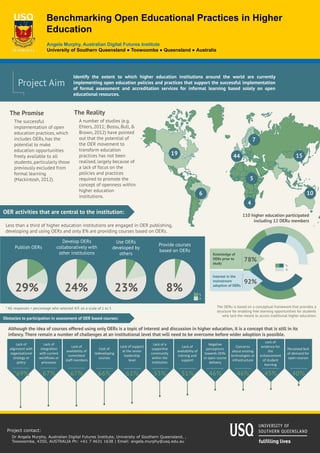
OER activities that are central to the institution:                                                                                                       110 higher education participated
                                                                                                                                                               including 12 OERu members
 Less than a third of higher education institutions are engaged in OER publishing,
 developing and using OERs and only 8% are providing courses based on OERs.

                                   Develop OERs                         Use OERs
                                                                                                Provide courses
      Publish OERs              collaboratively with                  developed by
                                                                                                based on OERs
                                 other institutions                      others                                                        Knowledge of
                                                                                                                                       OERs prior to
                                                                                                                                       study
                                                                                                                                                           78%
                                                                                                                                                                                     *5
                                                                                                                                                                                      4

                                                                                                                                       Interest in the
                                                                                                                                       mainstream          92%
      29%                            24%                                23%                          8%                      *5
                                                                                                                                       adoption of OERs


                                                                                                                              4


 * All responses = percentage who selected 4/5 on a scale of 1 to 5                                                                       The OERu is based on a conceptual framework that provides a
                                                                                                                                          structure for enabling free learning opportunities for students
                                                                                                                                              who lack the means to access traditional higher education.
Obstacles to participation in assessment of OER based courses:

  Although the idea of courses offered using only OERs is a topic of interest and discussion in higher education, it is a concept that is still in its
  infancy. There remain a number of challenges at an institutional level that will need to be overcome before wider adoption is possible.
                                                                                                                                                                         Lack of
        Lack of         Lack of                                                              Lack of a                               Negative
                                          Lack of                        Lack of support                       Lack of                                Concerns        evidence for
   alignment with     integration                           Cost of                        supportive                              perceptions                                        Perceived lack
                                       availability of                    at the senior                    availability of                          about existing         the
   organisational    with current                        redeveloping                      community                              towards OERs                                        of demand for
                                        committed                          leadership                       training and                           technologies or   enhancement
      strategy or    workflows or                           courses                         within the                            or open course                                      open courses
                                      staff members                           level                           support                               infrastructure     of student
         policy        processes                                                            institution                               delivery
                                                                                                                                                                        learning

      *69%              67%              67%               66%              61%             53%                51%                   46%               46%              45%               40%


  Project contact:
    Dr Angela Murphy, Australian Digital Futures Institute, University of Southern Queensland, ,
    Toowoomba, 4350, AUSTRALIA Ph: +61 7 4631 1638 | Email: angela.murphy@usq.edu.au

Benchmarking Open Educational Practices in Higher Education - Ascilite Poster 2012

  • 1.
    Benchmarking Open EducationalPractices in Higher Education Angela Murphy, Australian Digital Futures Institute University of Southern Queensland ● Toowoomba ● Queensland ● Australia Identify the extent to which higher education institutions around the world are currently Project Aim implementing open education policies and practices that support the successful implementation of formal assessment and accreditation services for informal learning based solely on open educational resources. The Promise The Reality The successful A number of studies (e.g. implementation of open Ehlers, 2011; Bossu, Bull, & education practices, which Brown, 2012) have pointed includes OERs, has the out that the potential of 7 potential to make the OER movement to education opportunities transform education freely available to all practices has not been 19 44 15 students, particularly those realised, largely because of previously excluded from a lack of focus on the formal learning policies and practices (Mackintosh, 2012). required to promote the 5 concept of openness within higher education institutions. 6 10 4 OER activities that are central to the institution: 110 higher education participated including 12 OERu members Less than a third of higher education institutions are engaged in OER publishing, developing and using OERs and only 8% are providing courses based on OERs. Develop OERs Use OERs Provide courses Publish OERs collaboratively with developed by based on OERs other institutions others Knowledge of OERs prior to study 78% *5 4 Interest in the mainstream 92% 29% 24% 23% 8% *5 adoption of OERs 4 * All responses = percentage who selected 4/5 on a scale of 1 to 5 The OERu is based on a conceptual framework that provides a structure for enabling free learning opportunities for students who lack the means to access traditional higher education. Obstacles to participation in assessment of OER based courses: Although the idea of courses offered using only OERs is a topic of interest and discussion in higher education, it is a concept that is still in its infancy. There remain a number of challenges at an institutional level that will need to be overcome before wider adoption is possible. Lack of Lack of Lack of Lack of a Negative Lack of Lack of support Lack of Concerns evidence for alignment with integration Cost of supportive perceptions Perceived lack availability of at the senior availability of about existing the organisational with current redeveloping community towards OERs of demand for committed leadership training and technologies or enhancement strategy or workflows or courses within the or open course open courses staff members level support infrastructure of student policy processes institution delivery learning *69% 67% 67% 66% 61% 53% 51% 46% 46% 45% 40% Project contact: Dr Angela Murphy, Australian Digital Futures Institute, University of Southern Queensland, , Toowoomba, 4350, AUSTRALIA Ph: +61 7 4631 1638 | Email: angela.murphy@usq.edu.au