Ben Page Chief Executive Ipsos UK [email_address] Our  Happiness
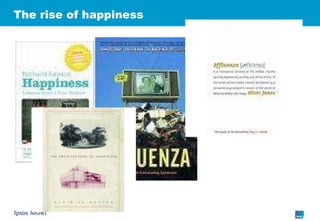
The rise of happiness
Even politicians are in on the act “ Well being can’t be measured by money or traded in markets. It’s about the beauty of our surroundings, the quality of our culture, and above all, the strength of our relationships. Improving our society’s sense of well-being is, I believe, the central political challenge of our lives.” David Cameron, May 2006
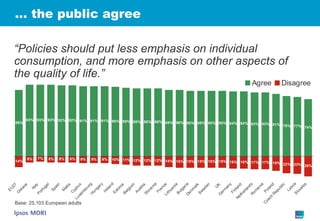
…  the public agree Base: 25,103 European adults  “ Policies should put less emphasis on individual consumption, and more emphasis on other aspects of the quality of life.”
The economy, stupid?
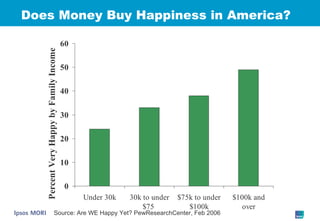
Does Money Buy Happiness in America? Source: Are WE Happy Yet? PewResearchCenter, Feb 2006
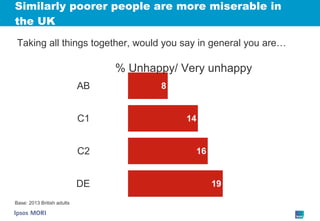
Similarly poorer people are more miserable in the UK Base: 2013 British adults Taking all things together, would you say in general you are… % Unhappy/ Very unhappy
But money isn’t everything…
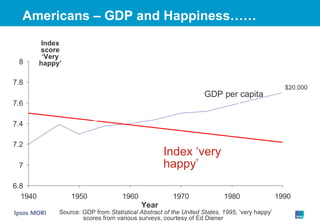
Base: US National Surveys Year Index score ‘Very happy’ Source: GDP from  Statistical Abstract of the United States, 1995,  ‘very happy’ scores from various surveys, courtesy of Ed Diener  GDP per capita Index ‘very happy’ $20,000 Americans – GDP and Happiness……
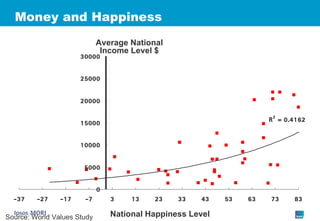
Money and Happiness National Happiness Level Source: World Values Study Average National Income Level $
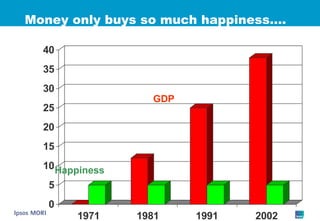
Money only buys so much happiness…. GDP Happiness
 
What do the British think?
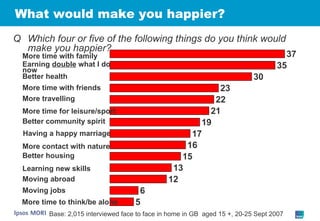
What would make you happier? More time with family Earning  double  what I do now Q Which four or five of the following things do you think would make you happier? More time with friends More travelling More time for leisure/sport Better community spirit Having a happy marriage More contact with nature Moving abroad Learning new skills Better health Better housing Moving jobs More time to think/be alone Base: 2,015 interviewed face to face in home in GB  aged 15 +, 20-25 Sept 2007
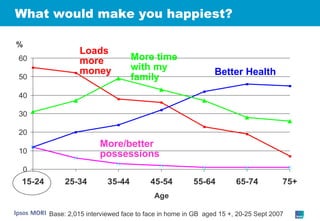
What would make you happiest? % Loads more money Better Health More time with my family More/better possessions Base: 2,015 interviewed face to face in home in GB  aged 15 +, 20-25 Sept 2007
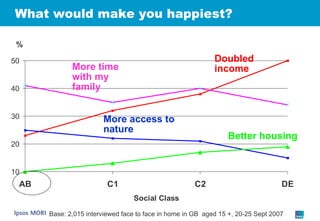
What would make you happiest? % Doubled income More time with my family More access to nature Better housing Base: 2,015 interviewed face to face in home in GB  aged 15 +, 20-25 Sept 2007
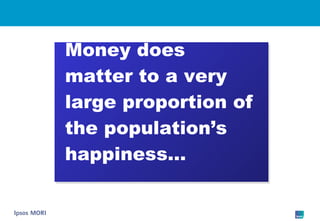
Money does matter to a very large proportion of the population’s happiness…
What else works?
Leisure and relationships…… “ If you want to be happy for a few hours, get drunk. If you want to be happy for a few years, get a wife. If you want to be happy forever, get a garden” Traditional
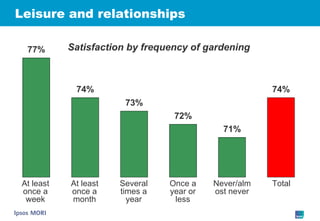
Leisure and relationships At least once a week At least once a month Several times a year Once a year or less Never/almost never Total Satisfaction by frequency of gardening
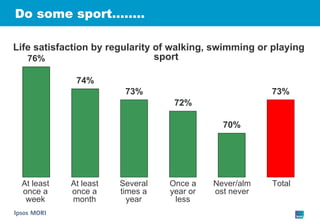
Do some sport…….. At least once a week At least once a month Several times a year Once a year or less Never/almost never Total Life satisfaction by regularity of walking, swimming or playing sport
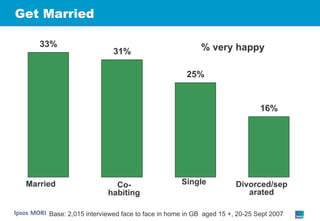
Get Married Married Co-habiting Single Divorced/separated % very happy Base: 2,015 interviewed face to face in home in GB  aged 15 +, 20-25 Sept 2007
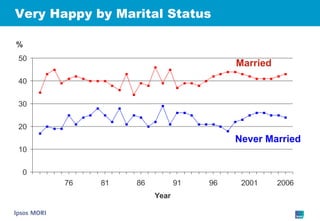
Very Happy by Marital Status % Married Never Married
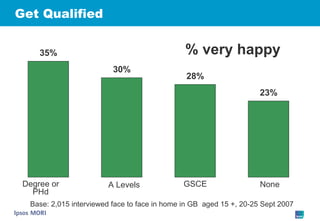
Get Qualified Degree or PHd A Levels GSCE None % very happy Base: 2,015 interviewed face to face in home in GB  aged 15 +, 20-25 Sept 2007
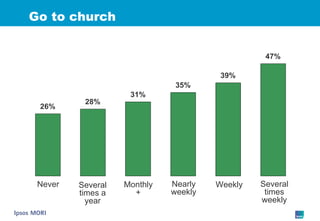
Go to church Never Nearly weekly Monthly + Several times a year Several times weekly Weekly
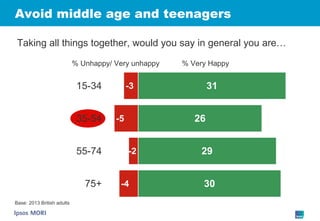
Avoid middle age and teenagers Base: 2013 British adults Taking all things together, would you say in general you are… % Unhappy/ Very unhappy % Very Happy
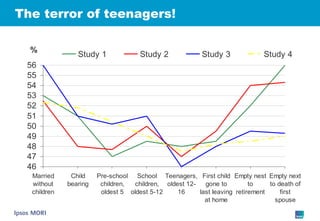
The terror of teenagers! %
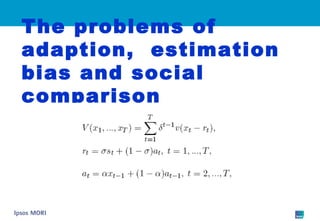
The problems of adaption,  estimation bias and social comparison
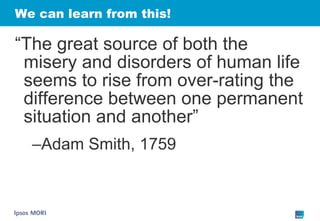
We can learn from this! “ The great source of both the misery and disorders of human life seems to rise from over-rating the difference between one permanent situation and another” Adam Smith, 1759
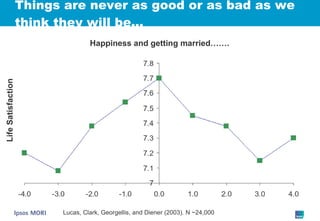
Things are never as good or as bad as we think they will be... Lucas, Clark, Georgellis, and Diener (2003). N ~24,000 Life Satisfaction Happiness and getting married…….
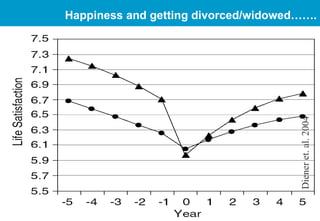
Highest Life Expectancy And disability free years Lowest Life Expectancy And disability free years Life expectancy disparity is 16 years Diener et. al. 2004 Happiness and getting divorced/widowed…….
Social Justice, inequality and happiness “ A house may be large or small; as long as the surrounding houses are equally small it satisfies all social demands for a dwelling. But if a palace arises beside the little house, the little house shrinks to a hovel… [and]… the dweller will feel more and more uncomfortable, dissatisfied and cramped within its four walls.”  (Marx, 1847)
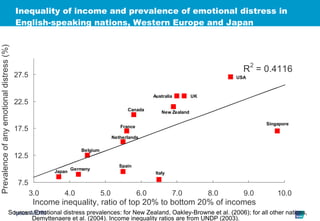
Inequality of income and prevalence of emotional distress in English-speaking nations, Western Europe and Japan  Sources: Emotional distress prevalences: for New Zealand, Oakley-Browne et al. (2006); for all other nations,  Demyttenaere et al. (2004). Income inequality ratios are from UNDP (2003).  Income inequality, ratio of top 20% to bottom 20% of incomes Prevalence of any emotional distress (%)
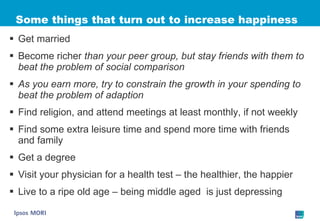
Some things that turn out to increase happiness Get married Become richer  than your peer group, but stay friends with them to beat the problem of social comparison As you earn more, try to constrain the growth in your spending to beat the problem of adaption Find religion, and attend meetings at least monthly, if not weekly Find some extra leisure time and spend more time with friends and family Get a degree Visit your physician for a health test – the healthier, the happier Live to a ripe old age – being middle aged  is just depressing
[email_address]

Ben Page e il concetto di Felicità

  • 1.
    Ben Page ChiefExecutive Ipsos UK [email_address] Our Happiness
  • 2.
    The rise ofhappiness
  • 3.
    Even politicians arein on the act “ Well being can’t be measured by money or traded in markets. It’s about the beauty of our surroundings, the quality of our culture, and above all, the strength of our relationships. Improving our society’s sense of well-being is, I believe, the central political challenge of our lives.” David Cameron, May 2006
  • 4.
    … thepublic agree Base: 25,103 European adults “ Policies should put less emphasis on individual consumption, and more emphasis on other aspects of the quality of life.”
  • 5.
  • 6.
    Does Money BuyHappiness in America? Source: Are WE Happy Yet? PewResearchCenter, Feb 2006
  • 7.
    Similarly poorer peopleare more miserable in the UK Base: 2013 British adults Taking all things together, would you say in general you are… % Unhappy/ Very unhappy
  • 8.
    But money isn’teverything…
  • 9.
    Base: US NationalSurveys Year Index score ‘Very happy’ Source: GDP from Statistical Abstract of the United States, 1995, ‘very happy’ scores from various surveys, courtesy of Ed Diener GDP per capita Index ‘very happy’ $20,000 Americans – GDP and Happiness……
  • 10.
    Money and HappinessNational Happiness Level Source: World Values Study Average National Income Level $
  • 11.
    Money only buysso much happiness…. GDP Happiness
  • 12.
  • 13.
    What do theBritish think?
  • 14.
    What would makeyou happier? More time with family Earning double what I do now Q Which four or five of the following things do you think would make you happier? More time with friends More travelling More time for leisure/sport Better community spirit Having a happy marriage More contact with nature Moving abroad Learning new skills Better health Better housing Moving jobs More time to think/be alone Base: 2,015 interviewed face to face in home in GB aged 15 +, 20-25 Sept 2007
  • 15.
    What would makeyou happiest? % Loads more money Better Health More time with my family More/better possessions Base: 2,015 interviewed face to face in home in GB aged 15 +, 20-25 Sept 2007
  • 16.
    What would makeyou happiest? % Doubled income More time with my family More access to nature Better housing Base: 2,015 interviewed face to face in home in GB aged 15 +, 20-25 Sept 2007
  • 17.
    Money does matterto a very large proportion of the population’s happiness…
  • 18.
  • 19.
    Leisure and relationships……“ If you want to be happy for a few hours, get drunk. If you want to be happy for a few years, get a wife. If you want to be happy forever, get a garden” Traditional
  • 20.
    Leisure and relationshipsAt least once a week At least once a month Several times a year Once a year or less Never/almost never Total Satisfaction by frequency of gardening
  • 21.
    Do some sport……..At least once a week At least once a month Several times a year Once a year or less Never/almost never Total Life satisfaction by regularity of walking, swimming or playing sport
  • 22.
    Get Married MarriedCo-habiting Single Divorced/separated % very happy Base: 2,015 interviewed face to face in home in GB aged 15 +, 20-25 Sept 2007
  • 23.
    Very Happy byMarital Status % Married Never Married
  • 24.
    Get Qualified Degreeor PHd A Levels GSCE None % very happy Base: 2,015 interviewed face to face in home in GB aged 15 +, 20-25 Sept 2007
  • 25.
    Go to churchNever Nearly weekly Monthly + Several times a year Several times weekly Weekly
  • 26.
    Avoid middle ageand teenagers Base: 2013 British adults Taking all things together, would you say in general you are… % Unhappy/ Very unhappy % Very Happy
  • 27.
    The terror ofteenagers! %
  • 28.
    The problems ofadaption, estimation bias and social comparison
  • 29.
    We can learnfrom this! “ The great source of both the misery and disorders of human life seems to rise from over-rating the difference between one permanent situation and another” Adam Smith, 1759
  • 30.
    Things are neveras good or as bad as we think they will be... Lucas, Clark, Georgellis, and Diener (2003). N ~24,000 Life Satisfaction Happiness and getting married…….
  • 31.
    Highest Life ExpectancyAnd disability free years Lowest Life Expectancy And disability free years Life expectancy disparity is 16 years Diener et. al. 2004 Happiness and getting divorced/widowed…….
  • 32.
    Social Justice, inequalityand happiness “ A house may be large or small; as long as the surrounding houses are equally small it satisfies all social demands for a dwelling. But if a palace arises beside the little house, the little house shrinks to a hovel… [and]… the dweller will feel more and more uncomfortable, dissatisfied and cramped within its four walls.” (Marx, 1847)
  • 33.
    Inequality of incomeand prevalence of emotional distress in English-speaking nations, Western Europe and Japan Sources: Emotional distress prevalences: for New Zealand, Oakley-Browne et al. (2006); for all other nations, Demyttenaere et al. (2004). Income inequality ratios are from UNDP (2003). Income inequality, ratio of top 20% to bottom 20% of incomes Prevalence of any emotional distress (%)
  • 34.
    Some things thatturn out to increase happiness Get married Become richer than your peer group, but stay friends with them to beat the problem of social comparison As you earn more, try to constrain the growth in your spending to beat the problem of adaption Find religion, and attend meetings at least monthly, if not weekly Find some extra leisure time and spend more time with friends and family Get a degree Visit your physician for a health test – the healthier, the happier Live to a ripe old age – being middle aged is just depressing
  • 35.

Editor's Notes

  • #32 From http://www.newsbatch.com/econ.htm and economic inequality