Experimental
HISTORY
WHY RUNNING ECONOMIC EXPERIMENTS
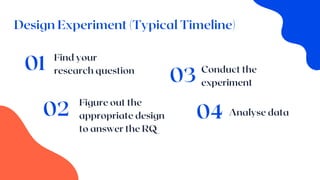
DESIGN EXPERIMENT :
TIMELINE,
QUESTIONS
DESIGN CRITERIA
VALIDITY
FIELD VS. LAB EXPERIMENTS
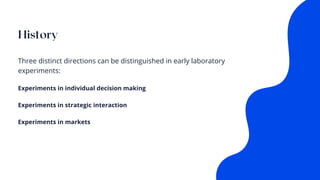
Three distinct directions can be distinguished in early laboratory
experiments:
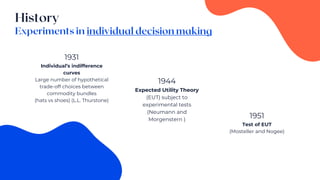
Experiments in individual decision making
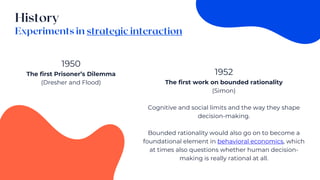
Experiments in strategic interaction
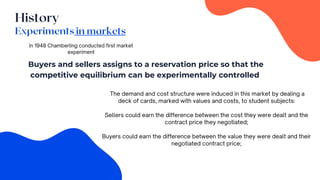
Experiments in markets
1931
Individual’s indifference
curves
Large number of hypothetical
trade-off choices between
commodity bundles
(hats vs shoes) (L.L. Thurstone)
1944
Expected Utility Theory
(EUT) subject to
experimental tests
(Neumann and
Morgenstern )
1951
Test of EUT
(Mosteller and Nogee)
1950
The first Prisoner’s Dilemma
(Dresher and Flood)
1952
The first work on bounded rationality
(Simon)
Cognitive and social limits and the way they shape
decision-making.
Bounded rationality would also go on to become a
foundational element in behavioral economics, which
at times also questions whether human decision-
making is really rational at all.
PRISONER’S DILEMMA
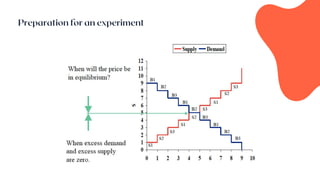
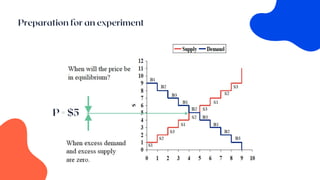
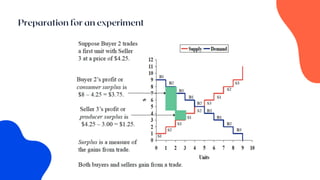
Buyers and sellers assigns to a reservation price so that the
competitive equilibrium can be experimentally controlled
Speaking to Theorists
Testing predictions; Empirical regularities into formal theories
Searching for Facts (Meaning)
The study and accumulation of effects to structure or create new theories
Whispering to the Ears of Princes
The formulation of advices for policy makers
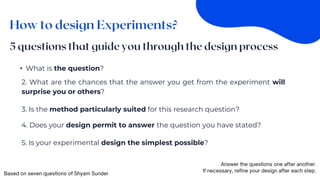
• What is the question?
2. What are the chances that the answer you get from the experiment will
surprise you or others?
3. Is the method particularly suited for this research question?
4. Does your design permit to answer the question you have stated?
5. Is your experimental design the simplest possible?
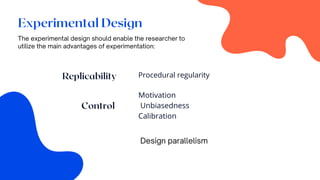
Procedural regularity
Motivation
Unbiasedness
Calibration
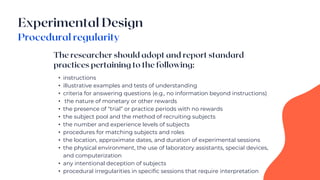
The guiding principle for standardizing and reporting procedures is to permit a
replication that the researcher and outside observers would accept as being valid.
To facilitate replication, it is important that the procedures and environment be
standardized so that only the treatment variables are adjusted.
Moreover, it is important that these procedures (and particularly instructions) be
carefully documented.
• instructions
• illustrative examples and tests of understanding
• criteria for answering questions (e.g., no information beyond instructions)
• the nature of monetary or other rewards
• the presence of “trial” or practice periods with no rewards
• the subject pool and the method of recruiting subjects
• the number and experience levels of subjects
• procedures for matching subjects and roles
• the location, approximate dates, and duration of experimental sessions
• the physical environment, the use of laboratory assistants, special devices,
and computerization
• any intentional deception of subjects
• procedural irregularities in specific sessions that require interpretation
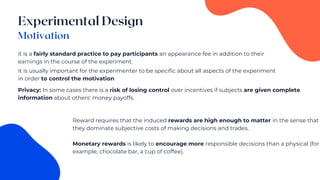
it is a fairly standard practice to pay participants an appearance fee in addition to their
earnings in the course of the experiment.
it is usually important for the experimenter to be specific about all aspects of the experiment
in order to control the motivation
Privacy: In some cases there is a risk of losing control over incentives if subjects are given complete
information about others' money payoffs.
Reward requires that the induced rewards are high enough to matter in the sense that
they dominate subjective costs of making decisions and trades.
Monetary rewards is likely to encourage more responsible decisions than a physical (for
example, chocolate bar, a cup of coffee).
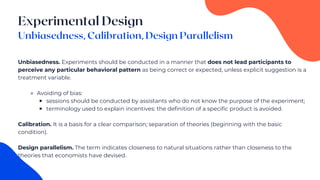
Unbiasedness. Experiments should be conducted in a manner that does not lead participants to
perceive any particular behavioral pattern as being correct or expected, unless explicit suggestion is a
treatment variable.
⚬ Avoiding of bias:
■ sessions should be conducted by assistants who do not know the purpose of the experiment;
■ terminology used to explain incentives: the definition of a specific product is avoided.
Calibration. It is a basis for a clear comparison; separation of theories (beginning with the basic
condition).
Design parallelism. The term indicates closeness to natural situations rather than closeness to the
theories that economists have devised.
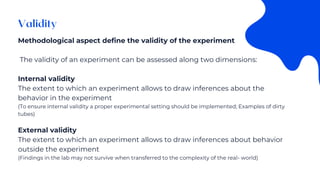
Methodological aspect define the validity of the experiment
The validity of an experiment can be assessed along two dimensions:
Internal validity
The extent to which an experiment allows to draw inferences about the
behavior in the experiment
(To ensure internal validity a proper experimental setting should be implemented; Examples of dirty
tubes)
External validity
The extent to which an experiment allows to draw inferences about behavior
outside the experiment
(Findings in the lab may not survive when transferred to the complexity of the real- world)
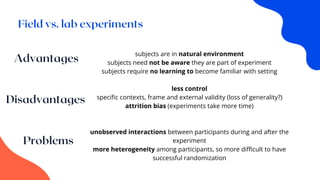
subjects are in natural environment
subjects need not be aware they are part of experiment
subjects require no learning to become familiar with setting
less control
specific contexts, frame and external validity (loss of generality?)
attrition bias (experiments take more time)
unobserved interactions between participants during and after the
experiment
more heterogeneity among participants, so more difficult to have
successful randomization
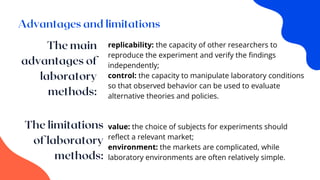
replicability: the capacity of other researchers to
reproduce the experiment and verify the findings
independently;
control: the capacity to manipulate laboratory conditions
so that observed behavior can be used to evaluate
alternative theories and policies.
value: the choice of subjects for experiments should
reflect a relevant market;
environment: the markets are complicated, while
laboratory environments are often relatively simple.
Behavioural Economics on Experimental Ec

Behavioural Economics on Experimental Ec

  • 1.
  • 2.
    HISTORY WHY RUNNING ECONOMICEXPERIMENTS DESIGN EXPERIMENT : TIMELINE, QUESTIONS DESIGN CRITERIA VALIDITY FIELD VS. LAB EXPERIMENTS
  • 4.
    Three distinct directionscan be distinguished in early laboratory experiments: Experiments in individual decision making Experiments in strategic interaction Experiments in markets
  • 5.
    1931 Individual’s indifference curves Large numberof hypothetical trade-off choices between commodity bundles (hats vs shoes) (L.L. Thurstone) 1944 Expected Utility Theory (EUT) subject to experimental tests (Neumann and Morgenstern ) 1951 Test of EUT (Mosteller and Nogee)
  • 6.
    1950 The first Prisoner’sDilemma (Dresher and Flood) 1952 The first work on bounded rationality (Simon) Cognitive and social limits and the way they shape decision-making. Bounded rationality would also go on to become a foundational element in behavioral economics, which at times also questions whether human decision- making is really rational at all.
  • 7.
  • 8.
    Buyers and sellersassigns to a reservation price so that the competitive equilibrium can be experimentally controlled
  • 9.
    Speaking to Theorists Testingpredictions; Empirical regularities into formal theories Searching for Facts (Meaning) The study and accumulation of effects to structure or create new theories Whispering to the Ears of Princes The formulation of advices for policy makers
  • 11.
    • What isthe question? 2. What are the chances that the answer you get from the experiment will surprise you or others? 3. Is the method particularly suited for this research question? 4. Does your design permit to answer the question you have stated? 5. Is your experimental design the simplest possible?
  • 12.
  • 13.
    The guiding principlefor standardizing and reporting procedures is to permit a replication that the researcher and outside observers would accept as being valid. To facilitate replication, it is important that the procedures and environment be standardized so that only the treatment variables are adjusted. Moreover, it is important that these procedures (and particularly instructions) be carefully documented.
  • 14.
    • instructions • illustrativeexamples and tests of understanding • criteria for answering questions (e.g., no information beyond instructions) • the nature of monetary or other rewards • the presence of “trial” or practice periods with no rewards • the subject pool and the method of recruiting subjects • the number and experience levels of subjects • procedures for matching subjects and roles • the location, approximate dates, and duration of experimental sessions • the physical environment, the use of laboratory assistants, special devices, and computerization • any intentional deception of subjects • procedural irregularities in specific sessions that require interpretation
  • 15.
    it is afairly standard practice to pay participants an appearance fee in addition to their earnings in the course of the experiment. it is usually important for the experimenter to be specific about all aspects of the experiment in order to control the motivation Privacy: In some cases there is a risk of losing control over incentives if subjects are given complete information about others' money payoffs. Reward requires that the induced rewards are high enough to matter in the sense that they dominate subjective costs of making decisions and trades. Monetary rewards is likely to encourage more responsible decisions than a physical (for example, chocolate bar, a cup of coffee).
  • 16.
    Unbiasedness. Experiments shouldbe conducted in a manner that does not lead participants to perceive any particular behavioral pattern as being correct or expected, unless explicit suggestion is a treatment variable. ⚬ Avoiding of bias: ■ sessions should be conducted by assistants who do not know the purpose of the experiment; ■ terminology used to explain incentives: the definition of a specific product is avoided. Calibration. It is a basis for a clear comparison; separation of theories (beginning with the basic condition). Design parallelism. The term indicates closeness to natural situations rather than closeness to the theories that economists have devised.
  • 17.
    Methodological aspect definethe validity of the experiment The validity of an experiment can be assessed along two dimensions: Internal validity The extent to which an experiment allows to draw inferences about the behavior in the experiment (To ensure internal validity a proper experimental setting should be implemented; Examples of dirty tubes) External validity The extent to which an experiment allows to draw inferences about behavior outside the experiment (Findings in the lab may not survive when transferred to the complexity of the real- world)
  • 18.
    subjects are innatural environment subjects need not be aware they are part of experiment subjects require no learning to become familiar with setting less control specific contexts, frame and external validity (loss of generality?) attrition bias (experiments take more time) unobserved interactions between participants during and after the experiment more heterogeneity among participants, so more difficult to have successful randomization
  • 19.
    replicability: the capacityof other researchers to reproduce the experiment and verify the findings independently; control: the capacity to manipulate laboratory conditions so that observed behavior can be used to evaluate alternative theories and policies. value: the choice of subjects for experiments should reflect a relevant market; environment: the markets are complicated, while laboratory environments are often relatively simple.