1
Economics 430/530
EXPERIMENTAL ECONOMICS
Spring 2012
Seda Ertac
Koc University
Introduction
This Class:
• What is an experiment?
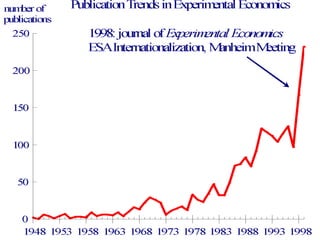
• Brief history of experimental economics
• Behavioral vs. experimental economics
• Main types of topics studied through
experiments
Next Few Classes: The methodology of
experiments.
2
3
Experiments and Econ
• One possible way of figuring out economic
laws ... is by controlled experiments. ...
Economists (unfortunately )... cannot
perform the controlled experiments of
chemists or biologists because they
cannot easily control other important
factors. Like astronomers or
meteorologists, they generally must be
content largely to observe.” (Samuelson
and Nordhaus, Principles of Economics,
1985, p. 8)
4
Experiments and Econ
• Experimental economics is an “exciting
new development”.
-Samuelson and Nordhaus, Principles of
Economics, 14th Edition, 1992, p.5
5
.
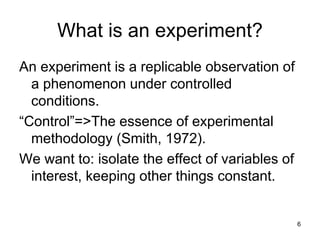
What is an experiment?
An experiment is a replicable observation of
a phenomenon under controlled
conditions.
“Control”=>The essence of experimental
methodology (Smith, 1972).
We want to: isolate the effect of variables of
interest, keeping other things constant.
6
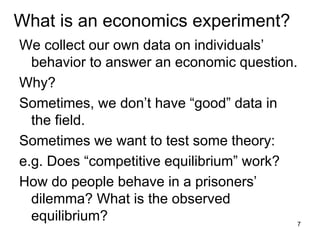
What is an economics experiment?
We collect our own data on individuals’
behavior to answer an economic question.
Why?
Sometimes, we don’t have “good” data in
the field.
Sometimes we want to test some theory:
e.g. Does “competitive equilibrium” work?
How do people behave in a prisoners’
dilemma? What is the observed
equilibrium? 7
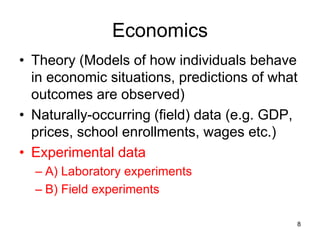
Economics
• Theory (Models of how individuals behave
in economic situations, predictions of what
outcomes are observed)
• Naturally-occurring (field) data (e.g. GDP,
prices, school enrollments, wages etc.)
• Experimental data
– A) Laboratory experiments
– B) Field experiments
8
Types of Experiments
• Laboratory Experiments
-On student subjects
• Field Experiments
-Different subject pool, natural context etc.
9
Behavioral Economics
Incorporates psychological insights into
economic models.
For example, in economics we traditionally
assume that people are rational, selfish,
maximize expected utility.
10
• What if people are overconfident?
• What if people are time-inconsistent?
• What if people’s utility depends on others’
payoffs?
• How do we know=>Experiments
Behavioral economicsExperimental
Economics
11
12
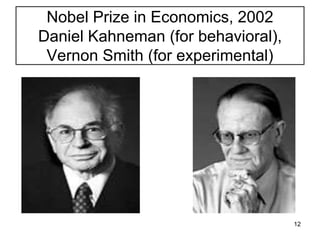
Nobel Prize in Economics, 2002
Daniel Kahneman (for behavioral),
Vernon Smith (for experimental)
13
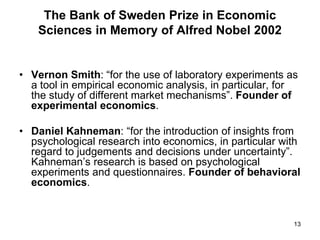
The Bank of Sweden Prize in Economic
Sciences in Memory of Alfred Nobel 2002
• Vernon Smith: “for the use of laboratory experiments as
a tool in empirical economic analysis, in particular, for
the study of different market mechanisms”. Founder of
experimental economics.
• Daniel Kahneman: “for the introduction of insights from
psychological research into economics, in particular with
regard to judgements and decisions under uncertainty”.
Kahneman’s research is based on psychological
experiments and questionnaires. Founder of behavioral
economics.
14
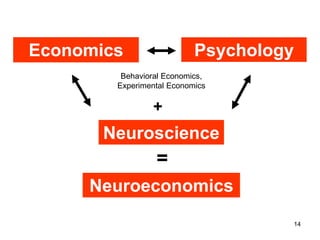
Psychology
Economics
Neuroscience
Behavioral Economics,
Experimental Economics
Neuroeconomics
=
+
15
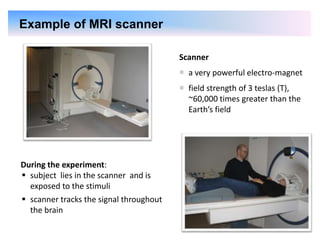
Scanner
 a very powerful electro-magnet
 field strength of 3 teslas (T),
~60,000 times greater than the
Earth’s field
During the experiment:
 subject lies in the scanner and is
exposed to the stimuli
 scanner tracks the signal throughout
the brain
Example of MRI scanner
16
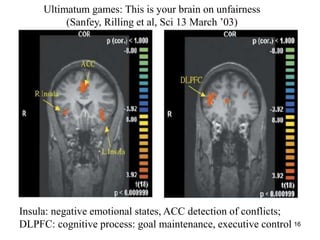
Ultimatum games: This is your brain on unfairness
(Sanfey, Rilling et al, Sci 13 March ’03)
Insula: negative emotional states, ACC detection of conflicts;
DLPFC: cognitive process: goal maintenance, executive control
Topics & History
Chamberlin (1948)—market experiments
Vernon Smith…
Game theoretic experiments (e.g. see if
people cooperate in a prisoners’ dilemma)
Main Topics Studied Through Experiments
• Individual decision-making experiments
• Game theoretic experiments
• Market experiments
17
Why Experiments?
• Field data can be hard to interpret (e.g.
selection bias, many factors change
simultaneously, have to use complicated
econometrics)
e.g. supply/demand data
• Field data may not even exist (e.g. beliefs,
reservation wages/outside options of
workers, valuations that people place on
goods).
18
With experiments, we can:
• Help economic theorists
• Gather new facts
• Help/influence policy-makers
(Examples)
• Simpler statistical analysis
• Replicability and control
23
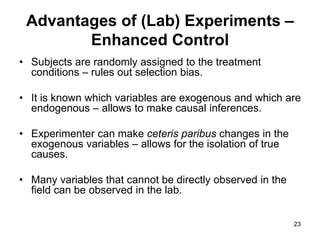
Advantages of (Lab) Experiments –
Enhanced Control
• Subjects are randomly assigned to the treatment
conditions – rules out selection bias.
• It is known which variables are exogenous and which are
endogenous – allows to make causal inferences.
• Experimenter can make ceteris paribus changes in the
exogenous variables – allows for the isolation of true
causes.
• Many variables that cannot be directly observed in the
field can be observed in the lab.
24
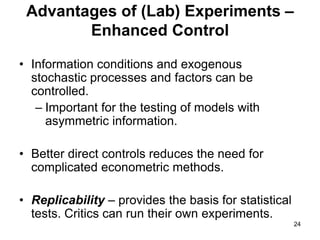
Advantages of (Lab) Experiments –
Enhanced Control
• Information conditions and exogenous
stochastic processes and factors can be
controlled.
– Important for the testing of models with
asymmetric information.
• Better direct controls reduces the need for
complicated econometric methods.
• Replicability – provides the basis for statistical
tests. Critics can run their own experiments.
25
Advantages of (Lab) Experiments –
Enhanced Control
• Enhanced control opportunities often imply that
the experimenter knows the predicted
equilibrium exactly.
– Equilibrium and disequilibrium actions can be
explicitly observed.
– Quick or sticky adjustment can be explicitly
observed
– Example: What are the supply and demand
schedules that underlie observable price &
quantity data? Is the observed price-quantity
combination a competitive equilibrium?
Economics vs. Psychology
Many common areas of interest (e.g.
judgment and decision-making), but very
different methodological practices.
Economics:
1.Salient monetary rewards (vs. participation
fee only).
2.Context-free to the extent possible.(*)
3.No deception!!!

13251211

  • 1.
  • 2.
    Introduction This Class: • Whatis an experiment? • Brief history of experimental economics • Behavioral vs. experimental economics • Main types of topics studied through experiments Next Few Classes: The methodology of experiments. 2
  • 3.
    3 Experiments and Econ •One possible way of figuring out economic laws ... is by controlled experiments. ... Economists (unfortunately )... cannot perform the controlled experiments of chemists or biologists because they cannot easily control other important factors. Like astronomers or meteorologists, they generally must be content largely to observe.” (Samuelson and Nordhaus, Principles of Economics, 1985, p. 8)
  • 4.
    4 Experiments and Econ •Experimental economics is an “exciting new development”. -Samuelson and Nordhaus, Principles of Economics, 14th Edition, 1992, p.5
  • 5.
  • 6.
    What is anexperiment? An experiment is a replicable observation of a phenomenon under controlled conditions. “Control”=>The essence of experimental methodology (Smith, 1972). We want to: isolate the effect of variables of interest, keeping other things constant. 6
  • 7.
    What is aneconomics experiment? We collect our own data on individuals’ behavior to answer an economic question. Why? Sometimes, we don’t have “good” data in the field. Sometimes we want to test some theory: e.g. Does “competitive equilibrium” work? How do people behave in a prisoners’ dilemma? What is the observed equilibrium? 7
  • 8.
    Economics • Theory (Modelsof how individuals behave in economic situations, predictions of what outcomes are observed) • Naturally-occurring (field) data (e.g. GDP, prices, school enrollments, wages etc.) • Experimental data – A) Laboratory experiments – B) Field experiments 8
  • 9.
    Types of Experiments •Laboratory Experiments -On student subjects • Field Experiments -Different subject pool, natural context etc. 9
  • 10.
    Behavioral Economics Incorporates psychologicalinsights into economic models. For example, in economics we traditionally assume that people are rational, selfish, maximize expected utility. 10
  • 11.
    • What ifpeople are overconfident? • What if people are time-inconsistent? • What if people’s utility depends on others’ payoffs? • How do we know=>Experiments Behavioral economicsExperimental Economics 11
  • 12.
    12 Nobel Prize inEconomics, 2002 Daniel Kahneman (for behavioral), Vernon Smith (for experimental)
  • 13.
    13 The Bank ofSweden Prize in Economic Sciences in Memory of Alfred Nobel 2002 • Vernon Smith: “for the use of laboratory experiments as a tool in empirical economic analysis, in particular, for the study of different market mechanisms”. Founder of experimental economics. • Daniel Kahneman: “for the introduction of insights from psychological research into economics, in particular with regard to judgements and decisions under uncertainty”. Kahneman’s research is based on psychological experiments and questionnaires. Founder of behavioral economics.
  • 14.
  • 15.
    15 Scanner  a verypowerful electro-magnet  field strength of 3 teslas (T), ~60,000 times greater than the Earth’s field During the experiment:  subject lies in the scanner and is exposed to the stimuli  scanner tracks the signal throughout the brain Example of MRI scanner
  • 16.
    16 Ultimatum games: Thisis your brain on unfairness (Sanfey, Rilling et al, Sci 13 March ’03) Insula: negative emotional states, ACC detection of conflicts; DLPFC: cognitive process: goal maintenance, executive control
  • 17.
    Topics & History Chamberlin(1948)—market experiments Vernon Smith… Game theoretic experiments (e.g. see if people cooperate in a prisoners’ dilemma) Main Topics Studied Through Experiments • Individual decision-making experiments • Game theoretic experiments • Market experiments 17
  • 18.
    Why Experiments? • Fielddata can be hard to interpret (e.g. selection bias, many factors change simultaneously, have to use complicated econometrics) e.g. supply/demand data • Field data may not even exist (e.g. beliefs, reservation wages/outside options of workers, valuations that people place on goods). 18
  • 19.
    With experiments, wecan: • Help economic theorists • Gather new facts • Help/influence policy-makers (Examples) • Simpler statistical analysis • Replicability and control
  • 23.
    23 Advantages of (Lab)Experiments – Enhanced Control • Subjects are randomly assigned to the treatment conditions – rules out selection bias. • It is known which variables are exogenous and which are endogenous – allows to make causal inferences. • Experimenter can make ceteris paribus changes in the exogenous variables – allows for the isolation of true causes. • Many variables that cannot be directly observed in the field can be observed in the lab.
  • 24.
    24 Advantages of (Lab)Experiments – Enhanced Control • Information conditions and exogenous stochastic processes and factors can be controlled. – Important for the testing of models with asymmetric information. • Better direct controls reduces the need for complicated econometric methods. • Replicability – provides the basis for statistical tests. Critics can run their own experiments.
  • 25.
    25 Advantages of (Lab)Experiments – Enhanced Control • Enhanced control opportunities often imply that the experimenter knows the predicted equilibrium exactly. – Equilibrium and disequilibrium actions can be explicitly observed. – Quick or sticky adjustment can be explicitly observed – Example: What are the supply and demand schedules that underlie observable price & quantity data? Is the observed price-quantity combination a competitive equilibrium?
  • 26.
    Economics vs. Psychology Manycommon areas of interest (e.g. judgment and decision-making), but very different methodological practices. Economics: 1.Salient monetary rewards (vs. participation fee only). 2.Context-free to the extent possible.(*) 3.No deception!!!