Reflection in Pharo5
ESUG 2015
Marcus Denker
http://www.pharo.org
Everything is an Object
Everything?
Classes, yes.
Methods, yes
But Code?
Code is a String!
AST: Abstract Syntax Tree
AST in Pharo5
• AST of the Refactoring browser
• Transformation
• Visitors
• Annotations (properties)
• Deeper integrated:
• Pretty Printing, Syntax Highlight, Suggestions
• Compiler uses RB AST
AST in Pharo5
• Easy access
• #ast
• Demo: method and block
DEMO
(OrderedCollection>>#do:) ast.
[ 1 + 2 ] sourceNode == thisContext method ast blockNodes first
• ASTCache: as twice, get the same answer
(flushed on image save for now)
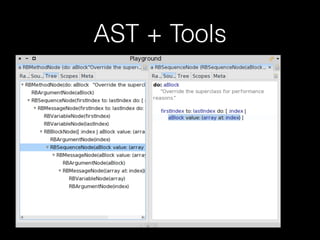
AST + Tools
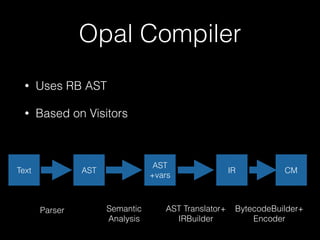
Opal Compiler
• Uses RB AST
• Based on Visitors
Text AST
AST
+vars
IR CM
Parser Semantic
Analysis
AST Translator+
IRBuilder
BytecodeBuilder+
Encoder
Opal: API
• All staged are Pluggable
• e.g Semantic Analyzer or Code Generator can
be changed.
• compiler options
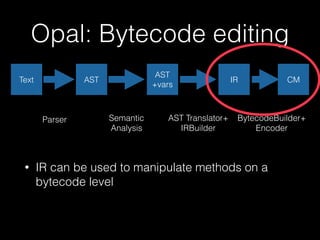
Opal: Bytecode editing
• IR can be used to manipulate methods on a
bytecode level
Text AST
AST
+vars
IR CM
Parser Semantic
Analysis
AST Translator+
IRBuilder
BytecodeBuilder+
Encoder
Too complicated
Too low level
Can we do better?
AST Meta Annotation
• We have an AST with properties
• We have Opal with Pluggable API
Can’t we use that?
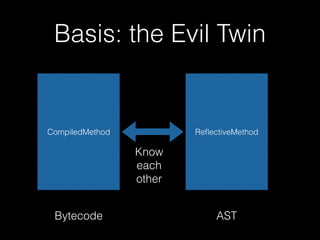
Basis: the Evil Twin
CompiledMethod ReflectiveMethod
Know
each
other
Bytecode AST
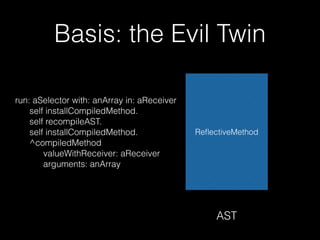
Basis: the Evil Twin
ReflectiveMethod
AST
run: aSelector with: anArray in: aReceiver
self installCompiledMethod.
self recompileAST.
self installCompiledMethod.
^compiledMethod
valueWithReceiver: aReceiver
arguments: anArray
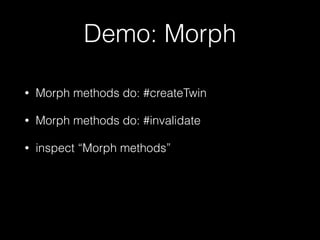
Demo: Morph
• Morph methods do: #createTwin
• Morph methods do: #invalidate
• inspect “Morph methods”
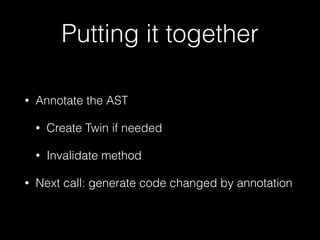
Putting it together
• Annotate the AST
• Create Twin if needed
• Invalidate method
• Next call: generate code changed by annotation
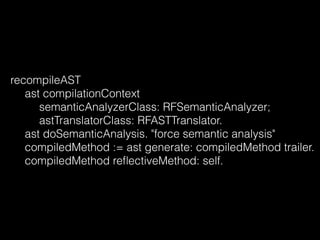
recompileAST
ast compilationContext
semanticAnalyzerClass: RFSemanticAnalyzer;
astTranslatorClass: RFASTTranslator.
ast doSemanticAnalysis. "force semantic analysis"
compiledMethod := ast generate: compiledMethod trailer.
compiledMethod reflectiveMethod: self.
Annotations?
MetaLink
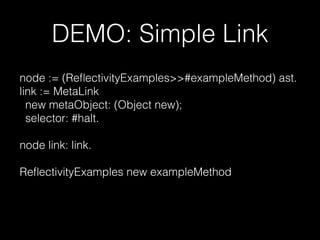
DEMO: Simple Link
node := (ReflectivityExamples>>#exampleMethod) ast.
link := MetaLink
new metaObject: (Object new);
selector: #halt.
node link: link.
ReflectivityExamples new exampleMethod
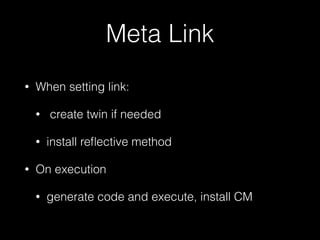
Meta Link
• When setting link:
• create twin if needed
• install reflective method
• On execution
• generate code and execute, install CM
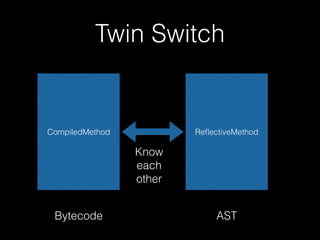
Twin Switch
CompiledMethod ReflectiveMethod
Know
each
other
Bytecode AST
Link: metaobject
The object to send
a message to
link := MetaLink new
metaObject: [self halt]
Link: selector
The selector to send
link := MetaLink new
…..
selector: #value
Link: control
before, after, instead
link := MetaLink new
…..
control: #after
Link: control
after: #ensure: wrap
link := MetaLink new
…..
control: #after
Link: control
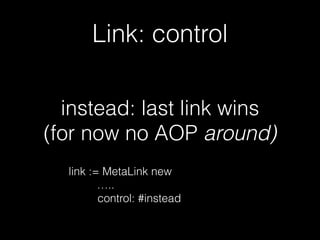
instead: last link wins
(for now no AOP around)
link := MetaLink new
…..
control: #instead
Link: condition
boolean or block
link := MetaLink new
…..
condition: [self someCheck]
Link: arguments
what to pass to the meta?
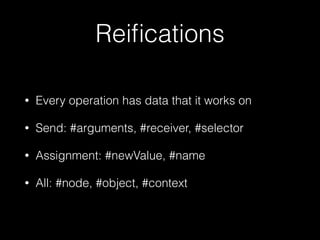
Reifications
• Every operation has data that it works on
• Send: #arguments, #receiver, #selector
• Assignment: #newValue, #name
• All: #node, #object, #context
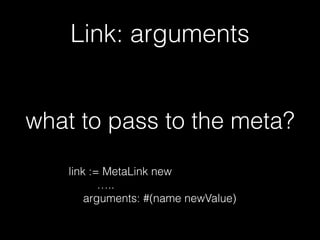
Link: arguments
what to pass to the meta?
link := MetaLink new
…..
arguments: #(name newValue)
Reifications: condition
link := MetaLink new
condition: [: object | object == 1];
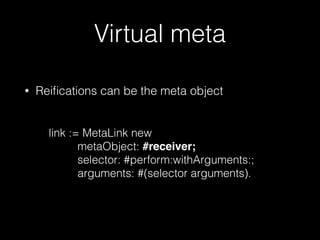
Virtual meta
• Reifications can be the meta object
link := MetaLink new
metaObject: #receiver;
selector: #perform:withArguments:;
arguments: #(selector arguments).
Statement Coverage
link := MetaLink new
metaObject: #node;
selector: #tagExecuted.
“set this link on all the AST nodes"
(ReflectivityExamples>>#exampleMethod) ast
nodesDo: [:node | node link: link].
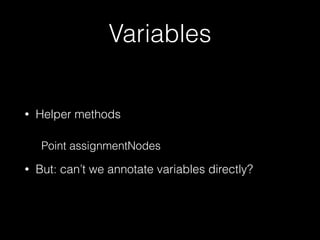
Variables
• Helper methods
• But: can’t we annotate variables directly?
Point assignmentNodes
Friday: Slots+Globals
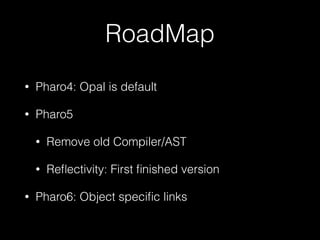
RoadMap
• Pharo4: Opal is default
• Pharo5
• Remove old Compiler/AST
• Reflectivity: First finished version
• Pharo6: Object specific links
Users
• Tools of ObjectProfile are being ported
• BreakPoints Pharo5
• Coverage Kernel by Pavel
• ….
Thanks!
• Work of many people…
• Too many to list here. (And I would forget for
sure someone)
Questions ?

Behavioral Reflection in Pharo