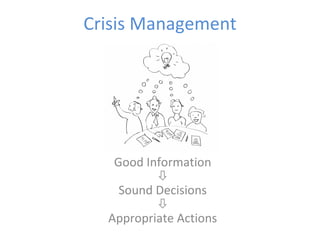
Crisis Management Good Information  Sound Decisions  Appropriate Actions
 
"Plans are nothing - Planning is everything"
 
 
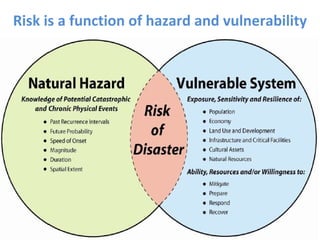
Risk is a function of hazard and vulnerability
 
 
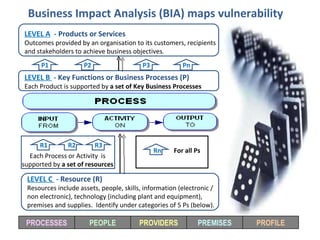
LEVEL C  -  Resource (R) Resources include assets, people, skills, information (electronic / non electronic), technology (including plant and equipment), premises and supplies.  Identify under categories of 5 Ps (below). LEVEL A   -  Products or Services Outcomes provided by an organisation to its customers, recipients and stakeholders to achieve business objectives. LEVEL B  -  Key Functions or Business Processes (P) Each Product is supported by  a set of Key Business Processes P1 P2 Pn P3 R1 R2 Rn R3 For all Ps Each Process or Activity  is supported by  a set of resources Business Impact Analysis (BIA) maps vulnerability   PROCESSES PEOPLE PROVIDERS PREMISES PROFILE
 
 
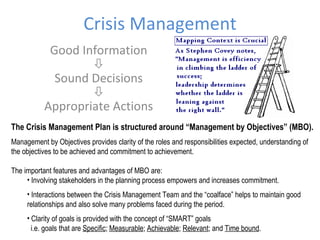
Crisis Management Good Information  Sound Decisions  Appropriate Actions The Crisis Management Plan is structured around “Management by Objectives” (MBO).  Management by Objectives provides clarity of the roles and responsibilities expected, understanding of the objectives to be achieved and commitment to achievement. The important features and advantages of MBO are: Involving stakeholders in the planning process empowers and increases commitment. Interactions between the Crisis Management Team and the “coalface” helps to maintain good relationships and also solve many problems faced during the period. Clarity of goals is provided with the concept of “SMART” goals  i.e. goals that are  Specific ;  Measurable ;  Achievable ;  Relevant ; and  Time bound .


Bcp Approach Presentation

  • 1.
    Crisis Management GoodInformation  Sound Decisions  Appropriate Actions
  • 2.
  • 3.
    "Plans are nothing- Planning is everything"
  • 4.
  • 5.
  • 6.
    Risk is afunction of hazard and vulnerability
  • 7.
  • 8.
  • 9.
    LEVEL C - Resource (R) Resources include assets, people, skills, information (electronic / non electronic), technology (including plant and equipment), premises and supplies. Identify under categories of 5 Ps (below). LEVEL A - Products or Services Outcomes provided by an organisation to its customers, recipients and stakeholders to achieve business objectives. LEVEL B - Key Functions or Business Processes (P) Each Product is supported by a set of Key Business Processes P1 P2 Pn P3 R1 R2 Rn R3 For all Ps Each Process or Activity is supported by a set of resources Business Impact Analysis (BIA) maps vulnerability PROCESSES PEOPLE PROVIDERS PREMISES PROFILE
  • 10.
  • 11.
  • 12.
    Crisis Management GoodInformation  Sound Decisions  Appropriate Actions The Crisis Management Plan is structured around “Management by Objectives” (MBO). Management by Objectives provides clarity of the roles and responsibilities expected, understanding of the objectives to be achieved and commitment to achievement. The important features and advantages of MBO are: Involving stakeholders in the planning process empowers and increases commitment. Interactions between the Crisis Management Team and the “coalface” helps to maintain good relationships and also solve many problems faced during the period. Clarity of goals is provided with the concept of “SMART” goals  i.e. goals that are Specific ; Measurable ; Achievable ; Relevant ; and Time bound .
  • 13.
  • 14.

Editor's Notes

  • #2 The approach being developed is based on a core principle – sound information supports good decision making.
  • #10 The best practice approach to business continuity is NOT based on specific hazard scenarios – it is based on using “resource vulnerability profiles” which support the key business processes. This is a development from BS25999 – the British Standard for Business Continuity – however it harmonises with all Australian requirements eg APRA and is also robust internationally (for potential transfer).
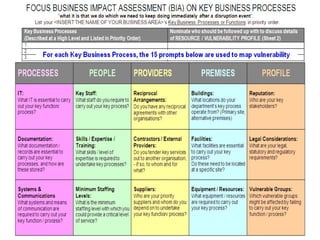
  • #11 The Key Business Processes should be identified by senior management. The owners of each Key Business Process then map their resource vulnerability. The beauty of this approach is the one set of business data is used for any impact scenario – the footprint of the hazard impacts on the resource set will vary, and as such provide an accurate impact assessment to base decisions on.
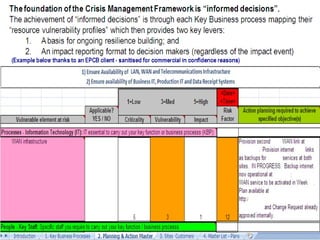
  • #12 Read top lines re “informed decisions” – stress this is one line from the pink “process” area of one Key Business Process depicting a high level of criticality and a medium level of vulnerability for WAN infrastructure. The header below this one line / slice example (in green) illustrates that the profile for this technical (I.T.) area is comprehensive and covers all fifteen prompts (such as “people” in “green lines”). Background to how this data slice was built: Using the prompts from the previous slide, AND A NEW WORKSHEET FOR EACH KEY BUSINESS PROCESS, the manager responsible for this Key Business Process (with his team) has inserted his responses in each coloured cell (of the xls template) as appropriate to each resource configuration. This is based on the fifteen prompts across the five resource areas in the slide above. Attribute a level of criticality by scoring 1 – 5 for each “Vulnerable Element at Risk” <INSERT>. Attribute a level of (current) vulnerability by scoring 1 – 5 for each “Vulnerable Element at Risk” <INSERT>. Leave the Impact column score at 1 (as this will provide the basis of any future impact assessment) The Risk Factor column will auto calculate (in the planning phase, to a maximum of 20 – in the response to impact phase, to a maximum of 100) Note any issues in the “ Action planning required to achieve specified objective(s)” column. In the Planning Phase, this column should note: Contingency actions developed to resume business; and Resilience initiatives being developed, proposed or undertaken which aim to reduce vulnerability. 2. In the Response to Impact Phase, this column should reference the Action Plans being used to achieve objectives endorsed by the Crisis management Team. As such, this column should report: Work-in-progress on contingency plans invoked; and Work-in-progress on Ad Hoc (i.e. for purpose) response and recovery initiatives developed to meet previously unforeseen emerging needs.
  • #13 The approach being developed is based on a core principle – sound information supports good decision making.
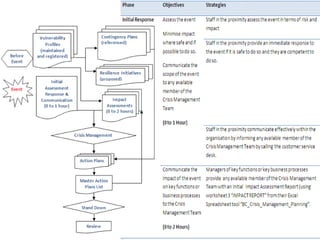
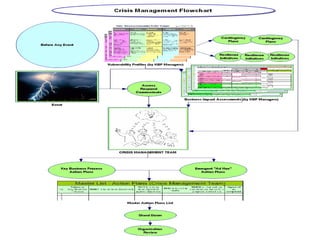
  • #14 The text outlines the detail around the “Initial Response” – which is the two boxes in the flowchart to the right of “Event”. If you want the detail of the “Crisis Management” box, it is in the next slide or you can reference the Word.doc.
  • #15 Overview – can be used at the front or end of the presentation. In Summary – A robust framework for the integrating of information, decision making and action planning.