The bc1 complex and cyt b150: The role of the bc1 complex in the light and oxygen regulation of the expression of the photosynthetic apparatus of R. sphaeroidesorWhy can strain BC-17 grow aerobically and not photosynthetically?Why do ONLY some of the H217 Qi mutations turn green WHEN grown Anaerobically?
R. sphaeroides strain BC-17The bc1 complex is formed by four sub-units: cytF, cytB, and cytC as part of the fbc operon on chromosome I. The fourth sub-unit cytQ, is encoded elsewhere on chromosome I. R .sphaeroides strain BC17 is a kanamycin insertion mutant for the fbc operon
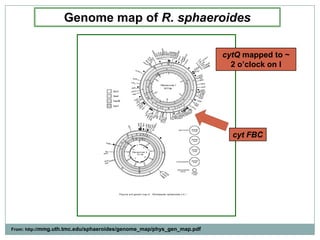
Genome map of R. sphaeroidescytQ mapped to ~ 2 o’clock on I cyt FBCFrom: http://mmg.uth.tmc.edu/sphaeroides/genome_map/phys_gen_map.pdf
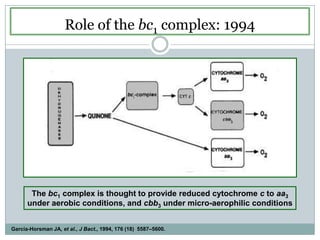
Role of the bc1 complex: 1994The bc1 complex is thought to provide reduced cytochrome c to aa3under aerobic conditions, and cbb3 under micro-aerophilic conditionsGarcía-Horsman JA, et al., J Bact., 1994, 176 (18)  5587–5600.
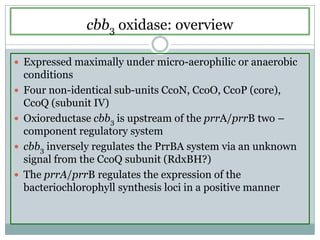
cbb3 oxidase: overviewExpressed maximally under micro-aerophilic or anaerobic conditionsFour non-identical sub-units CcoN, CcoO, CcoP (core), CcoQ (subunit IV)Oxioreductase cbb3 is upstream of the prrA/prrB two – component regulatory systemcbb3 inversely regulates the PrrBA system via an unknown signal from the CcoQ subunit (RdxBH?)The prrA/prrB regulates the expression of the bacteriochlorophyll synthesis loci in a positive manner
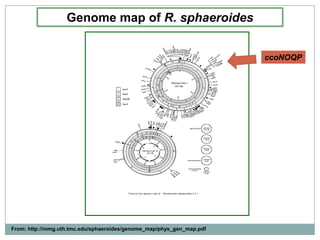
Genome map of R. sphaeroidesccoNOQPFrom: http://mmg.uth.tmc.edu/sphaeroides/genome_map/phys_gen_map.pdf
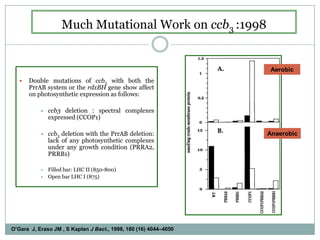
Much Mutational Work on ccb3 :1998AerobicDouble mutations of ccb3 with both the PrrAB system or the rdxBH gene show affect on photosynthetic expression as follows:ccb3 deletion : spectral complexes expressed (CCOP1)ccb3 deletion with the PrrAB deletion: lack of any photosynthetic complexes under any growth condition (PRRA2, PRRB1)Filled bar: LHC II (850-800)Open bar LHC I (875)AnaerobicO’Gara  J, Eraso JM , S Kaplan J Bact., 1998, 180 (16) 4044–4050
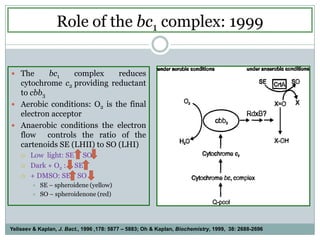
Role of the bc1 complex: 1999The bc1 complex reduces cytochrome c2 providing reductant to cbb3Aerobic conditions: O2 is the final electron acceptorAnaerobic conditions the electron flow  controls the ratio of the cartenoids SE (LHII) to SO (LHI)Low  light: SE     SO Dark + O2 :     SE+ DMSO: SE    SO    SE – spheroidene (yellow)SO – spheroidenone (red)Yeliseev & Kaplan, J. Bact., 1996 ,178: 5877 – 5883; Oh & Kaplan, Biochemistry, 1999,  38: 2688-2696
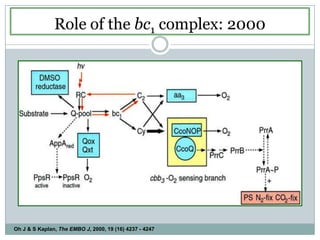
Role of the bc1 complex: 2000Oh J & S Kaplan, The EMBO J, 2000, 19 (16) 4237 - 4247
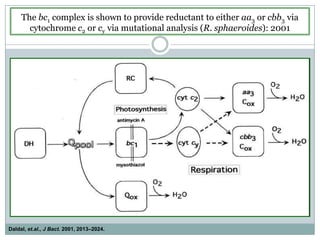
The bc1 complex is shown to provide reductant to either aa3 or cbb3 via cytochrome c2 or cy via mutational analysis (R. sphaeroides): 2001Daldal, et.al., J Bact. 2001, 2013–2024.
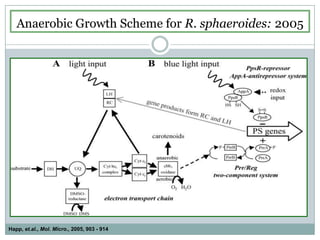
Anaerobic Growth Scheme for R. sphaeroides: 2005Happ, et.al., Mol. Micro., 2005, 903 - 914
H217 Mutants of the QI site of the bc1 complexGray & Daldal (1994) H217D, R, and L in R. capsulatusD and R grow photohetrotrophically with 60% of wild type bc1 levels, L is non-photosynthetically competent with 10% of wt bc1 levelsR. capsulatus was grown on MYPE media (LB for Rhodobacter genus) and authors noted some cases of reversion.                                                         Hacker & Gennis (1993)  H217A, complex assembled, cyt bHoxidation blocked  in R. sphaeroides strain BC-17Grown on sistrom media (defined media), no mention of reversion 	published but personal communication indicates there was a difficulty 	in growing this mutation.
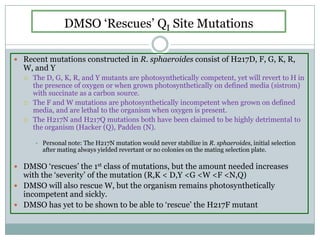
DMSO ‘Rescues’ QI Site MutationsRecent mutations constructed in R. sphaeroides consist of H217D, F, G, K, R, W, and YThe D, G, K, R, and Y mutants are photosynthetically competent, yet will revert to H in the presence of oxygen or when grown photosynthetically on defined media (sistrom) with succinate as a carbon source.The F and W mutations are photosynthetically incompetent when grown on defined media, and are lethal to the organism when oxygen is present.The H217N and H217Q mutations both have been claimed to be highly detrimental to the organism (Hacker (Q), Padden (N). Personal note: The H217N mutation would never stabilize in R. sphaeroides, initial selection after mating always yielded revertant or no colonies on the mating selection plate.DMSO ‘rescues’ the 1st class of mutations, but the amount needed increases with the ‘severity’ of the mutation (R,K < D,Y <G <W <F <N,Q)DMSO will also rescue W, but the organism remains photosynthetically incompetent and sickly.DMSO has yet to be shown to be able to ‘rescue’ the H217F mutant
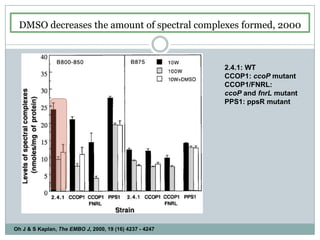
DMSO decreases the amount of spectral complexes formed, 2000   2.4.1: WTCCOP1: ccoP mutantCCOP1/FNRL:ccoP and fnrL mutantPPS1: ppsR mutantOh J & S Kaplan, The EMBO J, 2000, 19 (16) 4237 - 4247
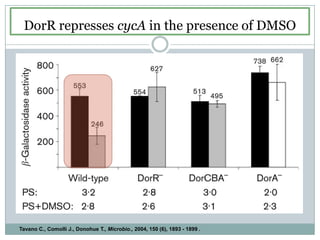
DorR represses cycA in the presence of DMSOTavano C., Comolli J., Donohue T., Microbio., 2004, 150 (6), 1893 - 1899 .
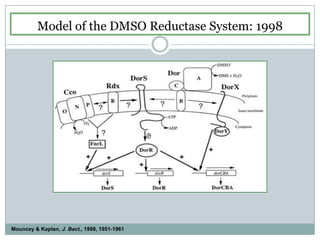
Model of the DMSO Reductase System: 1998Mouncey & Kaplan, J. Bact., 1998, 1951-1961
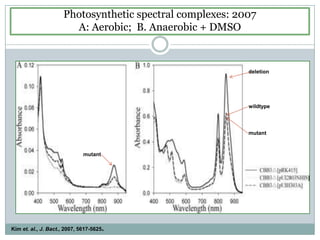
Photosynthetic spectral complexes: 2007A: Aerobic;  B. Anaerobic + DMSOdeletionwildtypemutantmutantKim et. al., J. Bact., 2007, 5617-5625.
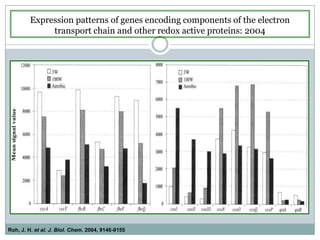
Expression patterns of genes encoding components of the electron transport chain and other redox active proteins: 2004Roh, J. H. et al. J. Biol. Chem. 2004, 9146-9155
R. sphaeroides strain BC-17Can not grow photosynthetically due to loss of reductant being passed to cbb3Can grow aerobically using quinol oxidase (Qxt) in place of the bc1 complexNull mutants for the cbb3 gene turn green in the presence of oxygen
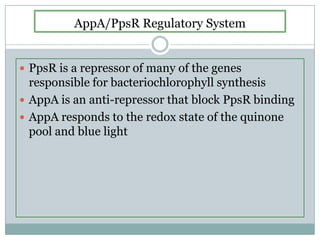
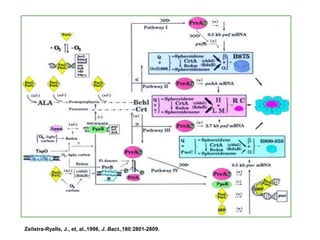
AppA/PpsR Regulatory SystemPpsR is a repressor of many of the genes responsible for bacteriochlorophyll synthesisAppA is an anti-repressor that block PpsR binding AppA responds to the redox state of the quinone pool and blue light
Zeilstra-Ryalls, J., et, al.,1998, J. Bact.,180:2801-2809.
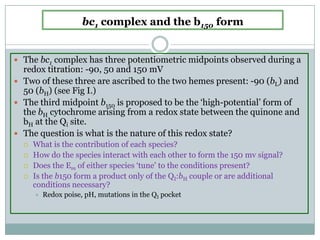
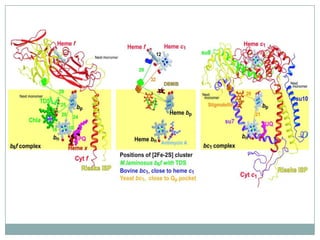
bc1complex and the b150 formThe bc1complex has three potentiometric midpoints observed during a redox titration: -90, 50 and 150 mVTwo of these three are ascribed to the two hemes present: -90 (bL) and 50 (bH) (see Fig I.)The third midpoint b150 is proposed to be the ‘high-potential’ form of the bH cytochrome arising from a redox state between the quinone and bH at the Qi site.The question is what is the nature of this redox state?What is the contribution of each species?How do the species interact with each other to form the 150 mv signal?Does the Em of either species ‘tune’ to the conditions present?Is the b150 form a product only of the QI:bH couple or are additional conditions necessary? Redox poise, pH, mutations in the QI pocket
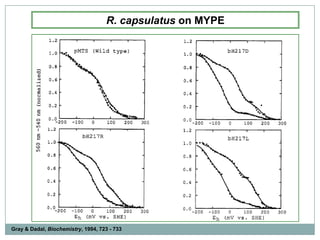
R. capsulatus on MYPE Gray & Dadal, Biochemistry, 1994, 723 - 733
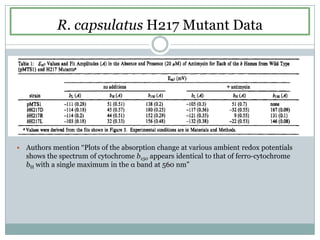
R. capsulatus H217 Mutant DataAuthors mention “Plots of the absorption change at various ambient redox potentials shows the spectrum of cytochrome b150 appears identical to that of ferro-cytochrome bH with a single maximum in the α band at 560 nm”
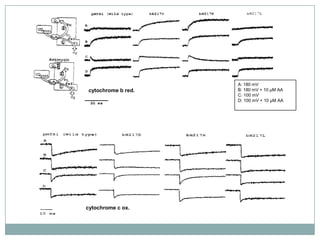
A: 180 mVB: 180 mV + 10 μM AAC: 100 mVD: 100 mV + 10 μM AAcytochrome b red.cytochrome c ox.
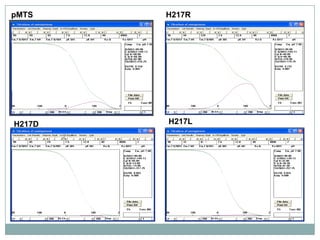
The values from the Table in slide 24 were used in a program provided by Crofts which attempted to model the contribution of each species of the bc1 complex to the spectra observed under experimental conditions seen in slide 27.Conclusion: The program successfully recreated the curves for the WT,H217D and H217R mutants. However, the program failed to reproduce the curves measured for the H217L mutation. (slide 23)
pMTSH217RH217LH217D
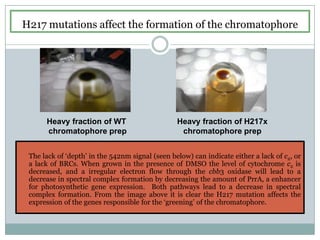
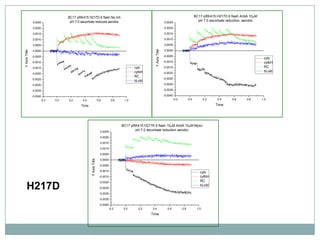
H217 mutations affect the formation of the chromatophoreHeavy fraction of WT chromatophore prepHeavy fraction of H217xchromatophore prepThe lack of ‘depth’ in the 542nm signal (seen below) can indicate either a lack of c2, or a lack of BRCs. When grown in the presence of DMSO the level of cytochrome c2 is decreased, and a irregular electron flow through the cbb3 oxidase will lead to a decrease in spectral complex formation by decreasing the amount of PrrA, a enhancer for photosynthetic gene expression.  Both pathways lead to a decrease in spectral complex formation. From the image above it is clear the H217 mutation affects the expression of the genes responsible for the ‘greening’ of the chromatophore.
ConclusionThe cyt b150 form has never been ‘uncoupled’ from the central physiology of the Rhodobacter species. The intact chromatophore is needed to study the cyt b150 form  and the H217 mutations are difficult to study becausethe amino acid is essential. The cells will revert or die unless DMSO is provided. This has the effect of vastly reducing the spectral complexes of the chromatophore and the amount of cytochrome c2. For these reasons it is not clear if cyt b150 is exclusively due to the interaction of QIand bH, or does the surrounding physiology of the chromatophore play a role?Any and all mutations in the bc1 complex will have the potential to affect the assembly of the chromatophore, by altering the activity of the PrrAB system. The chromatophore is the unit used to study the affect of the mutation, how can any conclusions be readily drawn if the unit of measurement fluxes along with the change? To solve this problem the BC17 strain needs to be re-done in a DorR- / PpsR- background (Donohue 2004, Kaplan 2009). This combination of mutants will remove the repressor for photosynthetic gene expression and cytochrome c2 expression. This will eliminatethe stress on chromatophore formation for originating from the cbb3 complex under anaerobic conditions. This strain (BC 18?) will restore the full complement of photosynthetic complexes to the chromatophore and allow the H217 mutations, and all other bc1 complex mutations, to be studied uncoupled from the central Rhodobacterphysiology.
H217D
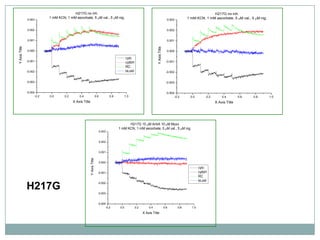
H217G
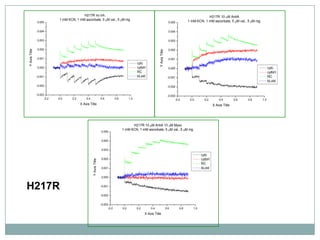
H217R
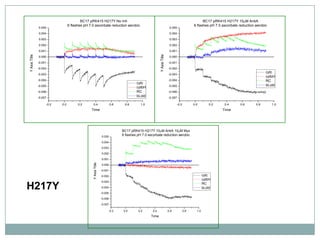
H217Y
Bc17 And Cyt B150 A Fools Game

Bc17 And Cyt B150 A Fools Game

  • 1.
    The bc1 complexand cyt b150: The role of the bc1 complex in the light and oxygen regulation of the expression of the photosynthetic apparatus of R. sphaeroidesorWhy can strain BC-17 grow aerobically and not photosynthetically?Why do ONLY some of the H217 Qi mutations turn green WHEN grown Anaerobically?
  • 2.
    R. sphaeroides strainBC-17The bc1 complex is formed by four sub-units: cytF, cytB, and cytC as part of the fbc operon on chromosome I. The fourth sub-unit cytQ, is encoded elsewhere on chromosome I. R .sphaeroides strain BC17 is a kanamycin insertion mutant for the fbc operon
  • 3.
    Genome map ofR. sphaeroidescytQ mapped to ~ 2 o’clock on I cyt FBCFrom: http://mmg.uth.tmc.edu/sphaeroides/genome_map/phys_gen_map.pdf
  • 4.
    Role of thebc1 complex: 1994The bc1 complex is thought to provide reduced cytochrome c to aa3under aerobic conditions, and cbb3 under micro-aerophilic conditionsGarcía-Horsman JA, et al., J Bact., 1994, 176 (18) 5587–5600.
  • 5.
    cbb3 oxidase: overviewExpressedmaximally under micro-aerophilic or anaerobic conditionsFour non-identical sub-units CcoN, CcoO, CcoP (core), CcoQ (subunit IV)Oxioreductase cbb3 is upstream of the prrA/prrB two – component regulatory systemcbb3 inversely regulates the PrrBA system via an unknown signal from the CcoQ subunit (RdxBH?)The prrA/prrB regulates the expression of the bacteriochlorophyll synthesis loci in a positive manner
  • 6.
    Genome map ofR. sphaeroidesccoNOQPFrom: http://mmg.uth.tmc.edu/sphaeroides/genome_map/phys_gen_map.pdf
  • 7.
    Much Mutational Workon ccb3 :1998AerobicDouble mutations of ccb3 with both the PrrAB system or the rdxBH gene show affect on photosynthetic expression as follows:ccb3 deletion : spectral complexes expressed (CCOP1)ccb3 deletion with the PrrAB deletion: lack of any photosynthetic complexes under any growth condition (PRRA2, PRRB1)Filled bar: LHC II (850-800)Open bar LHC I (875)AnaerobicO’Gara J, Eraso JM , S Kaplan J Bact., 1998, 180 (16) 4044–4050
  • 8.
    Role of thebc1 complex: 1999The bc1 complex reduces cytochrome c2 providing reductant to cbb3Aerobic conditions: O2 is the final electron acceptorAnaerobic conditions the electron flow controls the ratio of the cartenoids SE (LHII) to SO (LHI)Low light: SE SO Dark + O2 : SE+ DMSO: SE SO SE – spheroidene (yellow)SO – spheroidenone (red)Yeliseev & Kaplan, J. Bact., 1996 ,178: 5877 – 5883; Oh & Kaplan, Biochemistry, 1999, 38: 2688-2696
  • 9.
    Role of thebc1 complex: 2000Oh J & S Kaplan, The EMBO J, 2000, 19 (16) 4237 - 4247
  • 10.
    The bc1 complexis shown to provide reductant to either aa3 or cbb3 via cytochrome c2 or cy via mutational analysis (R. sphaeroides): 2001Daldal, et.al., J Bact. 2001, 2013–2024.
  • 11.
    Anaerobic Growth Schemefor R. sphaeroides: 2005Happ, et.al., Mol. Micro., 2005, 903 - 914
  • 12.
    H217 Mutants ofthe QI site of the bc1 complexGray & Daldal (1994) H217D, R, and L in R. capsulatusD and R grow photohetrotrophically with 60% of wild type bc1 levels, L is non-photosynthetically competent with 10% of wt bc1 levelsR. capsulatus was grown on MYPE media (LB for Rhodobacter genus) and authors noted some cases of reversion. Hacker & Gennis (1993) H217A, complex assembled, cyt bHoxidation blocked in R. sphaeroides strain BC-17Grown on sistrom media (defined media), no mention of reversion published but personal communication indicates there was a difficulty in growing this mutation.
  • 13.
    DMSO ‘Rescues’ QISite MutationsRecent mutations constructed in R. sphaeroides consist of H217D, F, G, K, R, W, and YThe D, G, K, R, and Y mutants are photosynthetically competent, yet will revert to H in the presence of oxygen or when grown photosynthetically on defined media (sistrom) with succinate as a carbon source.The F and W mutations are photosynthetically incompetent when grown on defined media, and are lethal to the organism when oxygen is present.The H217N and H217Q mutations both have been claimed to be highly detrimental to the organism (Hacker (Q), Padden (N). Personal note: The H217N mutation would never stabilize in R. sphaeroides, initial selection after mating always yielded revertant or no colonies on the mating selection plate.DMSO ‘rescues’ the 1st class of mutations, but the amount needed increases with the ‘severity’ of the mutation (R,K < D,Y <G <W <F <N,Q)DMSO will also rescue W, but the organism remains photosynthetically incompetent and sickly.DMSO has yet to be shown to be able to ‘rescue’ the H217F mutant
  • 14.
    DMSO decreases theamount of spectral complexes formed, 2000 2.4.1: WTCCOP1: ccoP mutantCCOP1/FNRL:ccoP and fnrL mutantPPS1: ppsR mutantOh J & S Kaplan, The EMBO J, 2000, 19 (16) 4237 - 4247
  • 15.
    DorR represses cycAin the presence of DMSOTavano C., Comolli J., Donohue T., Microbio., 2004, 150 (6), 1893 - 1899 .
  • 16.
    Model of theDMSO Reductase System: 1998Mouncey & Kaplan, J. Bact., 1998, 1951-1961
  • 17.
    Photosynthetic spectral complexes:2007A: Aerobic; B. Anaerobic + DMSOdeletionwildtypemutantmutantKim et. al., J. Bact., 2007, 5617-5625.
  • 18.
    Expression patterns ofgenes encoding components of the electron transport chain and other redox active proteins: 2004Roh, J. H. et al. J. Biol. Chem. 2004, 9146-9155
  • 19.
    R. sphaeroides strainBC-17Can not grow photosynthetically due to loss of reductant being passed to cbb3Can grow aerobically using quinol oxidase (Qxt) in place of the bc1 complexNull mutants for the cbb3 gene turn green in the presence of oxygen
  • 20.
    AppA/PpsR Regulatory SystemPpsRis a repressor of many of the genes responsible for bacteriochlorophyll synthesisAppA is an anti-repressor that block PpsR binding AppA responds to the redox state of the quinone pool and blue light
  • 21.
    Zeilstra-Ryalls, J., et,al.,1998, J. Bact.,180:2801-2809.
  • 22.
    bc1complex and theb150 formThe bc1complex has three potentiometric midpoints observed during a redox titration: -90, 50 and 150 mVTwo of these three are ascribed to the two hemes present: -90 (bL) and 50 (bH) (see Fig I.)The third midpoint b150 is proposed to be the ‘high-potential’ form of the bH cytochrome arising from a redox state between the quinone and bH at the Qi site.The question is what is the nature of this redox state?What is the contribution of each species?How do the species interact with each other to form the 150 mv signal?Does the Em of either species ‘tune’ to the conditions present?Is the b150 form a product only of the QI:bH couple or are additional conditions necessary? Redox poise, pH, mutations in the QI pocket
  • 23.
    R. capsulatus onMYPE Gray & Dadal, Biochemistry, 1994, 723 - 733
  • 24.
    R. capsulatus H217Mutant DataAuthors mention “Plots of the absorption change at various ambient redox potentials shows the spectrum of cytochrome b150 appears identical to that of ferro-cytochrome bH with a single maximum in the α band at 560 nm”
  • 25.
    A: 180 mVB:180 mV + 10 μM AAC: 100 mVD: 100 mV + 10 μM AAcytochrome b red.cytochrome c ox.
  • 26.
    The values fromthe Table in slide 24 were used in a program provided by Crofts which attempted to model the contribution of each species of the bc1 complex to the spectra observed under experimental conditions seen in slide 27.Conclusion: The program successfully recreated the curves for the WT,H217D and H217R mutants. However, the program failed to reproduce the curves measured for the H217L mutation. (slide 23)
  • 27.
  • 28.
    H217 mutations affectthe formation of the chromatophoreHeavy fraction of WT chromatophore prepHeavy fraction of H217xchromatophore prepThe lack of ‘depth’ in the 542nm signal (seen below) can indicate either a lack of c2, or a lack of BRCs. When grown in the presence of DMSO the level of cytochrome c2 is decreased, and a irregular electron flow through the cbb3 oxidase will lead to a decrease in spectral complex formation by decreasing the amount of PrrA, a enhancer for photosynthetic gene expression. Both pathways lead to a decrease in spectral complex formation. From the image above it is clear the H217 mutation affects the expression of the genes responsible for the ‘greening’ of the chromatophore.
  • 29.
    ConclusionThe cyt b150form has never been ‘uncoupled’ from the central physiology of the Rhodobacter species. The intact chromatophore is needed to study the cyt b150 form and the H217 mutations are difficult to study becausethe amino acid is essential. The cells will revert or die unless DMSO is provided. This has the effect of vastly reducing the spectral complexes of the chromatophore and the amount of cytochrome c2. For these reasons it is not clear if cyt b150 is exclusively due to the interaction of QIand bH, or does the surrounding physiology of the chromatophore play a role?Any and all mutations in the bc1 complex will have the potential to affect the assembly of the chromatophore, by altering the activity of the PrrAB system. The chromatophore is the unit used to study the affect of the mutation, how can any conclusions be readily drawn if the unit of measurement fluxes along with the change? To solve this problem the BC17 strain needs to be re-done in a DorR- / PpsR- background (Donohue 2004, Kaplan 2009). This combination of mutants will remove the repressor for photosynthetic gene expression and cytochrome c2 expression. This will eliminatethe stress on chromatophore formation for originating from the cbb3 complex under anaerobic conditions. This strain (BC 18?) will restore the full complement of photosynthetic complexes to the chromatophore and allow the H217 mutations, and all other bc1 complex mutations, to be studied uncoupled from the central Rhodobacterphysiology.
  • 30.
  • 31.
  • 32.
  • 33.