Organization change and Development
Bureacracy,Classical Universal Approach
and Contigency Approach
TOPIC 10& 13
1 9/11/2022
DR.NGARI
ORGANIZATIONALCHANGE &
DEVELOPMENT
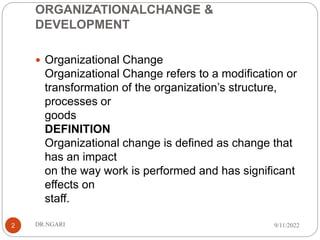
 Organizational Change
Organizational Change refers to a modification or
transformation of the organization’s structure,
processes or
goods
DEFINITION
Organizational change is defined as change that
has an impact
on the way work is performed and has significant
effects on
staff.
9/11/2022
DR.NGARI
2
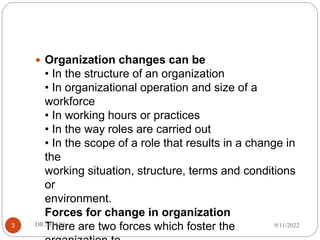
 Organization changes can be
• In the structure of an organization
• In organizational operation and size of a
workforce
• In working hours or practices
• In the way roles are carried out
• In the scope of a role that results in a change in
the
working situation, structure, terms and conditions
or
environment.
Forces for change in organization
There are two forces which foster the 9/11/2022
DR.NGARI
3
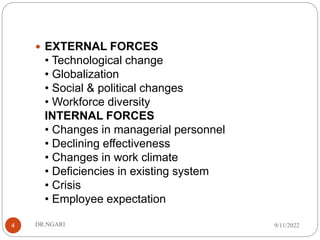
 EXTERNAL FORCES
• Technological change
• Globalization
• Social & political changes
• Workforce diversity
INTERNAL FORCES
• Changes in managerial personnel
• Declining effectiveness
• Changes in work climate
• Deficiencies in existing system
• Crisis
• Employee expectation
9/11/2022
DR.NGARI
4
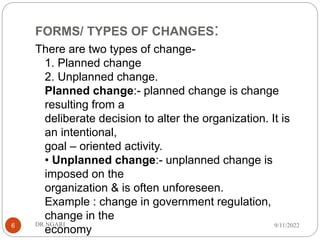
PROCESS OF CHANGE
9/11/2022
DR.NGARI
5
FORMS/ TYPES OF CHANGES:
There are two types of change-
1. Planned change
2. Unplanned change.
Planned change:- planned change is change
resulting from a
deliberate decision to alter the organization. It is
an intentional,
goal – oriented activity.
• Unplanned change:- unplanned change is
imposed on the
organization & is often unforeseen.
Example : change in government regulation,
change in the
economy
9/11/2022
DR.NGARI
6
RESISTANCE TO CHANGE:
There are two sources of resistance to change:
• Individual Resistance.
• Organizational Resistance
INDIVIDUAL RESISTANCE
Individual sources of resistance to change reside
in basic human
characteristics such as perceptions, personalities
& needs.
Reasons of individual resistance:
• Economic Reason –The economic reason of
resistance to
change usually focus on:
• Fear of technological unemployment.
• Fear of reduced work hours & consequently less
9/11/2022
DR.NGARI
7
 Fear of Loss- When a change is impending,
some
employees may fear losing their jobs, status
particularly
when an advanced technology is introduced.
• Security – people with a high need for security
are likely
to resist change because it threatens their feeling
of
safety.
• Status quo- change may pose disturbance to
the existing
comforts of status quo. 9/11/2022
DR.NGARI
8
 Disruption of Interpersonal Relation-
employees may
resist change that threatens to limit meaningful
interpersonal relationships on the job.
• Social Displacement- Introduction of change
often results
in disturbance of the existing social relationships.
Change
may also result in breaking up of work groups.
9/11/2022
DR.NGARI
9
ORGANIZATIONAL RESISTANCE
 ORGANIZATIONAL RESISTANCE
Organizations, by their very nature are
conservative. They
actively resist change. Reason of organizational
resistance
• Resource constraint: resources are major
constraints for
many organizations. The necessary financial ,
material &
human resources may not be available to the
organization to
make the needed changes.
• Structural inertia – some organizational 9/11/2022
DR.NGARI
10
 Sunk cost:- Some organization invest a huge
amount of capital
in fixed assets. If an organization wishes to
introduce
change, then difficulty arise because of the sunk
cost.
Threat to expertise:- Change in organizational
pattern may
threaten the expertise of specialized groups.
Therefore,
specialists usually resist change.
Politics:- Organizational changes may also shift
the existing
balance of power in an organization. Individuals
or groups who hold power under the current
arrangement may fear losing these political
9/11/2022
DR.NGARI
11
MANAGING RESISTANCE TO CHANGE
Some tactics are used to resist the change:
Education & Communication: Communication
about
impending change is essential if employees are
to adjust
effectively. The details of change should be
provided & its
potential consequences. Educating employees on
new work
procedures is often helpful.
Participation:- It is difficult for individuals to
resist a change decision in which they
participated. Prior to making a change, those
opposed can be brought into the decision
process.
9/11/2022
DR.NGARI
12
 Empathy & Support:- Active listening is an
excellent tool for
identifying the reasons behind the resistance. An
expression
of concerns about the change can provide
important feedback
that managers can use to improve the change
process.
Negotiation:- another way to deal with resistance
to change is to
exchange something of value for reduction in
resistance.
Manipulation & Cooptation:- Manipulation
refers to covert influence attempts. Twisting
& distorting facts to make them appear more 9/11/2022
DR.NGARI
13
 Coercion:- Coercion is the application of direct
threats or force
on the resisters. They essentially force people to
accept a
change by explicitly or implicitly threatening them
with the
loss of their jobs, promotion possibilities &
transferring them
9/11/2022
DR.NGARI
14
Organizational Development
Organization Development (OD) is a planned
approach to
improve employee and organizational
effectiveness by
conscious interventions in those processes and
structures that
have an immediate bearing on the human aspect
of the
organization.
Features of OD
• Organizational Development is an educational
strategy that
attempts to bring about a planned change.
9/11/2022
DR.NGARI
15
 • Organizational Development uses sensitivity
training methods
and lay emphasis on the significance of
experiment based
training.
• Its change agents are almost external
consultants outside of
the organization.
• The external change agents and internal
organization executives establish a collaborative
relationship that involves mutual trust, influence
and jointly determined goals.
9/11/2022
DR.NGARI
16
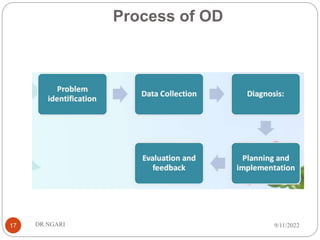
Process of OD
9/11/2022
DR.NGARI
17
BUREACRACY,CLASSICAL UNIVERSAL
APPROACH AND CONTIGENCY APPROACH
9/11/2022
DR.NGARI
18
Historical Views of Management
 We will examine the historical roots of
management theory and practice and attempt to
establish a connection between the theoretical
foundations of modern management and the
concepts advanced in subsequent chapters of
your text.
9/11/2022
DR.NGARI
19
Evolution of Management Thought
20
Effective management played a key role in the
construction of the pyramids, the use of
communication and control of the Roman Empire,
and the legal framework of commerce in 14th
century VENICE.
 The most significant historical point of reference
in the evolution of management was the advent of
the Industrial Revolution.
 By the turn of the 20th century the science and
practices of management were on a rapid and
continuing path of development 9/11/2022
DR.NGARI
Major Schools of Thought
21
 Classical - A focus on developing universal
principles for use in various management
situations.
 Human Resource - A focus on human needs,
the work group, and the role of social factors in
the workplace.
 Quantitative or Management Science
A focus on the use of mathematical
techniques for management problem-
solving.
9/11/2022
DR.NGARI
Major Schools of Thought
22
 Modern Approach
A focus on total systems and contingency
thinking, and an awareness of global
developments in management.
 Continuing Directions
Emphasis on quality and performance
excellence, global awareness, and leadership
roles for a new management.
9/11/2022
DR.NGARI
CLASSICAL APPROACHES
23
 Basic Assumption: People Are Rational
People will rationally consider the
opportunities available to them and do
whatever is necessary to maximize their
economic gain.
 Scientific Management
 Administrative Principles
 Bureaucratic Organization
9/11/2022
DR.NGARI
Scientific Management (Frederick
Taylor)
24
 Develop a science for every job, including
rules of motion, standardized work
implements, and proper working conditions.
 Carefully select workers with the right abilities
for the job.
 Carefully train these workers and provide
proper incentives.
 Provide these workers with the necessary
support.
9/11/2022
DR.NGARI
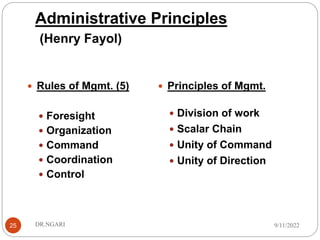
Administrative Principles
(Henry Fayol)
25
 Rules of Mgmt. (5)
 Foresight
 Organization
 Command
 Coordination
 Control
 Principles of Mgmt.
 Division of work
 Scalar Chain
 Unity of Command
 Unity of Direction
9/11/2022
DR.NGARI
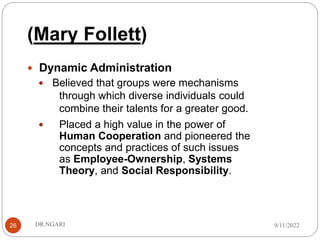
(Mary Follett)
26
 Dynamic Administration
 Believed that groups were mechanisms
through which diverse individuals could
combine their talents for a greater good.
 Placed a high value in the power of
Human Cooperation and pioneered the
concepts and practices of such issues
as Employee-Ownership, Systems
Theory, and Social Responsibility.
9/11/2022
DR.NGARI
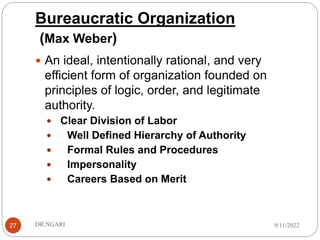
Bureaucratic Organization
(Max Weber)
27
 An ideal, intentionally rational, and very
efficient form of organization founded on
principles of logic, order, and legitimate
authority.
 Clear Division of Labor
 Well Defined Hierarchy of Authority
 Formal Rules and Procedures
 Impersonality
 Careers Based on Merit
9/11/2022
DR.NGARI
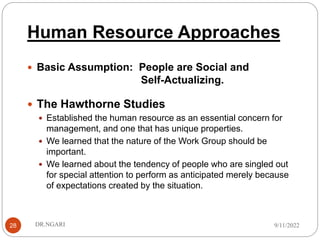
Human Resource Approaches
28
 Basic Assumption: People are Social and
Self-Actualizing.
 The Hawthorne Studies
 Established the human resource as an essential concern for
management, and one that has unique properties.
 We learned that the nature of the Work Group should be
important.
 We learned about the tendency of people who are singled out
for special attention to perform as anticipated merely because
of expectations created by the situation.
9/11/2022
DR.NGARI
Human Resource Approaches
29
 The Human Relations Movement
 Assertion is that managers who use good human
relations in the workplace will achieve productivity.
 This movement has evolved as the field of
Organizational Behavior - the study of
individuals and groups in organizations.
9/11/2022
DR.NGARI
Principle Human Relation Theories
30
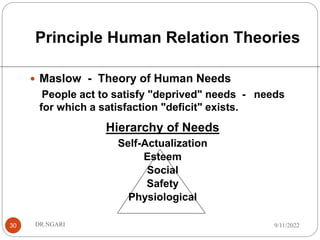
 Maslow - Theory of Human Needs
People act to satisfy "deprived" needs - needs
for which a satisfaction "deficit" exists.
Hierarchy of Needs
Self-Actualization
Esteem
Social
Safety
Physiological
9/11/2022
DR.NGARI
McGregor's
Theory X and Theory Y
31
 Theory X Managers Assume Subordinates
 Dislike Work
 Lack Ambition
 Are Irresponsible
 Resist Change
 Prefer to be Led
9/11/2022
DR.NGARI
McGregor's
Theory X and Theory Y
32
 Theory Y Managers Assume Subordinates
 Willing to Work
 Capable of Self-Control
 Willing to Accept Responsibility
 Capable of Imagination, Ingenuity,
Creativity.
 Capable of Self-Direction
9/11/2022
DR.NGARI
Argyris
Theory of Personality and Organization
33
 Points out that some insights of the Classical
Approach are inconsistent with the mature
adult personality.
 Suggests that managers who treat people
positively and as responsible adults will
achieve productivity.
 Advises the expansion of job responsibilities,
allow for more task variety, and the
adjustment of supervisory styles to include
more participation and better human
relations.
9/11/2022
DR.NGARI
Quantitative Approaches
34
 Assumption: Applied Mathematics Can Solve
Management Problems
Techniques and Applications
Mathematical Forecasting
Linear Programming
Inventory Modeling
Network Models
Queuing Theory
Simulations
9/11/2022
DR.NGARI
Modern Approaches
35
 Assumption: People are Complex
 Modern Approaches to management respect the
Classical, Human Resources, and Quantitative
schools.
 But they recognize that no one approach applies
universally in all situations, or the exclusion of
the others.
 This Course Is Based On The "Modern
Management Approaches"
9/11/2022
DR.NGARI
Modern Approaches
36
 Systems View
The organization is seen as a
collection of interrelated parts that
function together to achieve a
common purpose.
An Open System interacts with its
environment and a Closed one does not.
9/11/2022
DR.NGARI
Contingency Thinking
37
 Contingency Approaches to management assert
that there is no one best way to manage, and that
what is best depends in any given circumstance
on the nature of the situation.
 In short the best way depends upon the situation.
9/11/2022
DR.NGARI
Continuing Management Themes
38
 Quality and Performance Excellence
 Global Awareness
 Political Sensitivity
 Leadership
 Technology
 Life-long Commitment to Learning
9/11/2022
DR.NGARI

BBM 360 TOPIC 10 N 13.ppt

  • 1.
    Organization change andDevelopment Bureacracy,Classical Universal Approach and Contigency Approach TOPIC 10& 13 1 9/11/2022 DR.NGARI
  • 2.
    ORGANIZATIONALCHANGE & DEVELOPMENT  OrganizationalChange Organizational Change refers to a modification or transformation of the organization’s structure, processes or goods DEFINITION Organizational change is defined as change that has an impact on the way work is performed and has significant effects on staff. 9/11/2022 DR.NGARI 2
  • 3.
     Organization changescan be • In the structure of an organization • In organizational operation and size of a workforce • In working hours or practices • In the way roles are carried out • In the scope of a role that results in a change in the working situation, structure, terms and conditions or environment. Forces for change in organization There are two forces which foster the 9/11/2022 DR.NGARI 3
  • 4.
     EXTERNAL FORCES •Technological change • Globalization • Social & political changes • Workforce diversity INTERNAL FORCES • Changes in managerial personnel • Declining effectiveness • Changes in work climate • Deficiencies in existing system • Crisis • Employee expectation 9/11/2022 DR.NGARI 4
  • 5.
  • 6.
    FORMS/ TYPES OFCHANGES: There are two types of change- 1. Planned change 2. Unplanned change. Planned change:- planned change is change resulting from a deliberate decision to alter the organization. It is an intentional, goal – oriented activity. • Unplanned change:- unplanned change is imposed on the organization & is often unforeseen. Example : change in government regulation, change in the economy 9/11/2022 DR.NGARI 6
  • 7.
    RESISTANCE TO CHANGE: Thereare two sources of resistance to change: • Individual Resistance. • Organizational Resistance INDIVIDUAL RESISTANCE Individual sources of resistance to change reside in basic human characteristics such as perceptions, personalities & needs. Reasons of individual resistance: • Economic Reason –The economic reason of resistance to change usually focus on: • Fear of technological unemployment. • Fear of reduced work hours & consequently less 9/11/2022 DR.NGARI 7
  • 8.
     Fear ofLoss- When a change is impending, some employees may fear losing their jobs, status particularly when an advanced technology is introduced. • Security – people with a high need for security are likely to resist change because it threatens their feeling of safety. • Status quo- change may pose disturbance to the existing comforts of status quo. 9/11/2022 DR.NGARI 8
  • 9.
     Disruption ofInterpersonal Relation- employees may resist change that threatens to limit meaningful interpersonal relationships on the job. • Social Displacement- Introduction of change often results in disturbance of the existing social relationships. Change may also result in breaking up of work groups. 9/11/2022 DR.NGARI 9
  • 10.
    ORGANIZATIONAL RESISTANCE  ORGANIZATIONALRESISTANCE Organizations, by their very nature are conservative. They actively resist change. Reason of organizational resistance • Resource constraint: resources are major constraints for many organizations. The necessary financial , material & human resources may not be available to the organization to make the needed changes. • Structural inertia – some organizational 9/11/2022 DR.NGARI 10
  • 11.
     Sunk cost:-Some organization invest a huge amount of capital in fixed assets. If an organization wishes to introduce change, then difficulty arise because of the sunk cost. Threat to expertise:- Change in organizational pattern may threaten the expertise of specialized groups. Therefore, specialists usually resist change. Politics:- Organizational changes may also shift the existing balance of power in an organization. Individuals or groups who hold power under the current arrangement may fear losing these political 9/11/2022 DR.NGARI 11
  • 12.
    MANAGING RESISTANCE TOCHANGE Some tactics are used to resist the change: Education & Communication: Communication about impending change is essential if employees are to adjust effectively. The details of change should be provided & its potential consequences. Educating employees on new work procedures is often helpful. Participation:- It is difficult for individuals to resist a change decision in which they participated. Prior to making a change, those opposed can be brought into the decision process. 9/11/2022 DR.NGARI 12
  • 13.
     Empathy &Support:- Active listening is an excellent tool for identifying the reasons behind the resistance. An expression of concerns about the change can provide important feedback that managers can use to improve the change process. Negotiation:- another way to deal with resistance to change is to exchange something of value for reduction in resistance. Manipulation & Cooptation:- Manipulation refers to covert influence attempts. Twisting & distorting facts to make them appear more 9/11/2022 DR.NGARI 13
  • 14.
     Coercion:- Coercionis the application of direct threats or force on the resisters. They essentially force people to accept a change by explicitly or implicitly threatening them with the loss of their jobs, promotion possibilities & transferring them 9/11/2022 DR.NGARI 14
  • 15.
    Organizational Development Organization Development(OD) is a planned approach to improve employee and organizational effectiveness by conscious interventions in those processes and structures that have an immediate bearing on the human aspect of the organization. Features of OD • Organizational Development is an educational strategy that attempts to bring about a planned change. 9/11/2022 DR.NGARI 15
  • 16.
     • OrganizationalDevelopment uses sensitivity training methods and lay emphasis on the significance of experiment based training. • Its change agents are almost external consultants outside of the organization. • The external change agents and internal organization executives establish a collaborative relationship that involves mutual trust, influence and jointly determined goals. 9/11/2022 DR.NGARI 16
  • 17.
  • 18.
    BUREACRACY,CLASSICAL UNIVERSAL APPROACH ANDCONTIGENCY APPROACH 9/11/2022 DR.NGARI 18
  • 19.
    Historical Views ofManagement  We will examine the historical roots of management theory and practice and attempt to establish a connection between the theoretical foundations of modern management and the concepts advanced in subsequent chapters of your text. 9/11/2022 DR.NGARI 19
  • 20.
    Evolution of ManagementThought 20 Effective management played a key role in the construction of the pyramids, the use of communication and control of the Roman Empire, and the legal framework of commerce in 14th century VENICE.  The most significant historical point of reference in the evolution of management was the advent of the Industrial Revolution.  By the turn of the 20th century the science and practices of management were on a rapid and continuing path of development 9/11/2022 DR.NGARI
  • 21.
    Major Schools ofThought 21  Classical - A focus on developing universal principles for use in various management situations.  Human Resource - A focus on human needs, the work group, and the role of social factors in the workplace.  Quantitative or Management Science A focus on the use of mathematical techniques for management problem- solving. 9/11/2022 DR.NGARI
  • 22.
    Major Schools ofThought 22  Modern Approach A focus on total systems and contingency thinking, and an awareness of global developments in management.  Continuing Directions Emphasis on quality and performance excellence, global awareness, and leadership roles for a new management. 9/11/2022 DR.NGARI
  • 23.
    CLASSICAL APPROACHES 23  BasicAssumption: People Are Rational People will rationally consider the opportunities available to them and do whatever is necessary to maximize their economic gain.  Scientific Management  Administrative Principles  Bureaucratic Organization 9/11/2022 DR.NGARI
  • 24.
    Scientific Management (Frederick Taylor) 24 Develop a science for every job, including rules of motion, standardized work implements, and proper working conditions.  Carefully select workers with the right abilities for the job.  Carefully train these workers and provide proper incentives.  Provide these workers with the necessary support. 9/11/2022 DR.NGARI
  • 25.
    Administrative Principles (Henry Fayol) 25 Rules of Mgmt. (5)  Foresight  Organization  Command  Coordination  Control  Principles of Mgmt.  Division of work  Scalar Chain  Unity of Command  Unity of Direction 9/11/2022 DR.NGARI
  • 26.
    (Mary Follett) 26  DynamicAdministration  Believed that groups were mechanisms through which diverse individuals could combine their talents for a greater good.  Placed a high value in the power of Human Cooperation and pioneered the concepts and practices of such issues as Employee-Ownership, Systems Theory, and Social Responsibility. 9/11/2022 DR.NGARI
  • 27.
    Bureaucratic Organization (Max Weber) 27 An ideal, intentionally rational, and very efficient form of organization founded on principles of logic, order, and legitimate authority.  Clear Division of Labor  Well Defined Hierarchy of Authority  Formal Rules and Procedures  Impersonality  Careers Based on Merit 9/11/2022 DR.NGARI
  • 28.
    Human Resource Approaches 28 Basic Assumption: People are Social and Self-Actualizing.  The Hawthorne Studies  Established the human resource as an essential concern for management, and one that has unique properties.  We learned that the nature of the Work Group should be important.  We learned about the tendency of people who are singled out for special attention to perform as anticipated merely because of expectations created by the situation. 9/11/2022 DR.NGARI
  • 29.
    Human Resource Approaches 29 The Human Relations Movement  Assertion is that managers who use good human relations in the workplace will achieve productivity.  This movement has evolved as the field of Organizational Behavior - the study of individuals and groups in organizations. 9/11/2022 DR.NGARI
  • 30.
    Principle Human RelationTheories 30  Maslow - Theory of Human Needs People act to satisfy "deprived" needs - needs for which a satisfaction "deficit" exists. Hierarchy of Needs Self-Actualization Esteem Social Safety Physiological 9/11/2022 DR.NGARI
  • 31.
    McGregor's Theory X andTheory Y 31  Theory X Managers Assume Subordinates  Dislike Work  Lack Ambition  Are Irresponsible  Resist Change  Prefer to be Led 9/11/2022 DR.NGARI
  • 32.
    McGregor's Theory X andTheory Y 32  Theory Y Managers Assume Subordinates  Willing to Work  Capable of Self-Control  Willing to Accept Responsibility  Capable of Imagination, Ingenuity, Creativity.  Capable of Self-Direction 9/11/2022 DR.NGARI
  • 33.
    Argyris Theory of Personalityand Organization 33  Points out that some insights of the Classical Approach are inconsistent with the mature adult personality.  Suggests that managers who treat people positively and as responsible adults will achieve productivity.  Advises the expansion of job responsibilities, allow for more task variety, and the adjustment of supervisory styles to include more participation and better human relations. 9/11/2022 DR.NGARI
  • 34.
    Quantitative Approaches 34  Assumption:Applied Mathematics Can Solve Management Problems Techniques and Applications Mathematical Forecasting Linear Programming Inventory Modeling Network Models Queuing Theory Simulations 9/11/2022 DR.NGARI
  • 35.
    Modern Approaches 35  Assumption:People are Complex  Modern Approaches to management respect the Classical, Human Resources, and Quantitative schools.  But they recognize that no one approach applies universally in all situations, or the exclusion of the others.  This Course Is Based On The "Modern Management Approaches" 9/11/2022 DR.NGARI
  • 36.
    Modern Approaches 36  SystemsView The organization is seen as a collection of interrelated parts that function together to achieve a common purpose. An Open System interacts with its environment and a Closed one does not. 9/11/2022 DR.NGARI
  • 37.
    Contingency Thinking 37  ContingencyApproaches to management assert that there is no one best way to manage, and that what is best depends in any given circumstance on the nature of the situation.  In short the best way depends upon the situation. 9/11/2022 DR.NGARI
  • 38.
    Continuing Management Themes 38 Quality and Performance Excellence  Global Awareness  Political Sensitivity  Leadership  Technology  Life-long Commitment to Learning 9/11/2022 DR.NGARI