Mudlark, BBC Knowledge &
 Learning and FM Sport

 http://dev5-uxda.bbcconnected.co.uk/
                 uxda
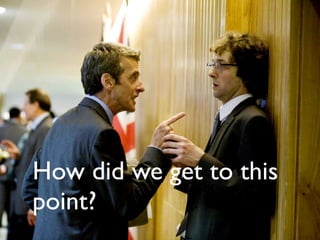
How did we get to this
point?
Making sense of the headlines.
The stories behind the stories as told over
                  time
Design Challenges
How to capture those emotional sparks of
interest and encourage users to explore context

How to make it familiar but new and interesting?

How to make content density approachable?

Not data visualisation, but useful information.
Design Inspirations &
References
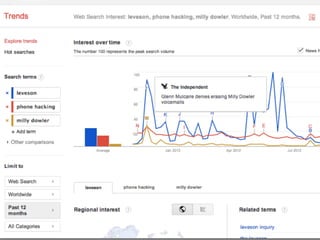
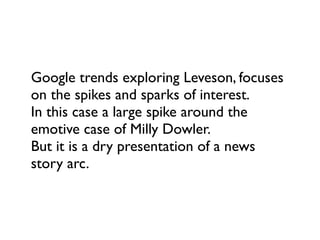
Google trends exploring Leveson, focuses
on the spikes and sparks of interest.
In this case a large spike around the
emotive case of Milly Dowler.
But it is a dry presentation of a news
story arc.
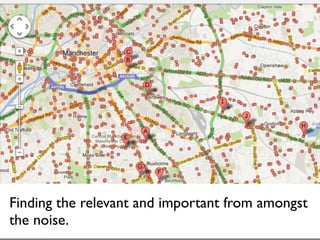
Finding the relevant and important from amongst
the noise.
Indicative Designs
Vision
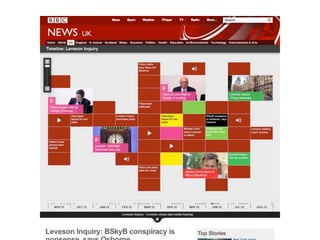
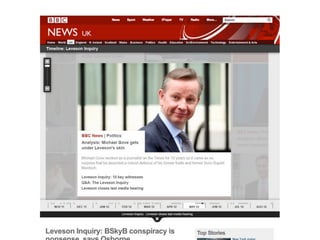
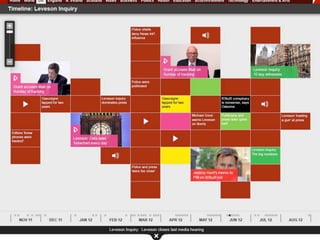
Each article with an associated
timeline would use a visual
cue as a jump off point
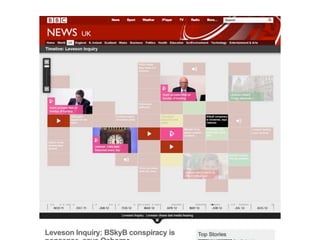
User zooms in/out on the
story and its content, similar
to google maps


Key/important content given
greater visual emphasis


Each product is represented
by its brand colour


Visual aid which shows the
story across time
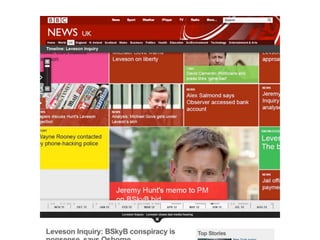
Zoomed out view                    Zooming in                             Zoomed in view
Provides snapshot of full story,   ...on timeline begins to reveal more   Focuses in on a specific piece
highlighting key content and       details about each piece of content,   of content and its summary with
providing a colourful overview     allowing the user to browse clusters   further jump off points.
of each product’s contribution.    of content.
Zooming into timeline begins
to surface more details
around each piece of content
such as photos, headlines, etc
Other content fades back
when one piece is highlighted


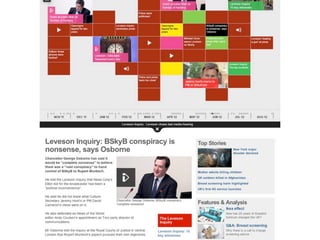
Time period is highlighted and
specific content is noted by
markers
Ability to showcase by media
and type of content
Original remains present as
reference point for timeline
Original remains present as
reference point for timeline
Mobile/Touch Designs
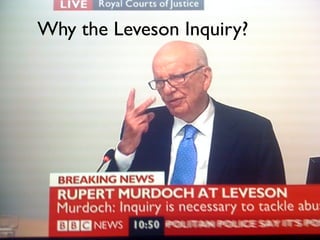
Why the Leveson Inquiry?
Possible Use Cases
Massive, multi-threaded news stories e.g. Leveson

The Narrative of the Premier League season (of a team, of a
player)

Revisiting historical stories e.g. the historiography of the
Hillsborough Disaster, charting 1989 to 2012

Factual & fictional blend - cultural narratives (e.g. HIV stories
with Eastenders HIV storylines; Leveson & Thick of It)
Pilot-Stage Priorities
An editorially driven resource that is navigable
through time

Bespoke interface and improved user experience

Ascertain the quality and quantity of the data available

Engagement with people connected to linked data
across the BBC
Future Features
& Possibilities
‘Bookmarking’ a current news event for future

Concurrent narratives

Plotting other sources’ content vs BBC’s version

A way of journalists creating/compiling stories off of the
wires, to feed into their articles
Known Issues
How far back can you go?

Resisting information overload?

Making data visualisation work for a
broad demographic

BBC UX&D Connected Studio - Time

  • 1.
    Mudlark, BBC Knowledge& Learning and FM Sport http://dev5-uxda.bbcconnected.co.uk/ uxda
  • 2.
    How did weget to this point?
  • 3.
    Making sense ofthe headlines. The stories behind the stories as told over time
  • 4.
    Design Challenges How tocapture those emotional sparks of interest and encourage users to explore context How to make it familiar but new and interesting? How to make content density approachable? Not data visualisation, but useful information.
  • 5.
  • 7.
    Google trends exploringLeveson, focuses on the spikes and sparks of interest. In this case a large spike around the emotive case of Milly Dowler. But it is a dry presentation of a news story arc.
  • 8.
    Finding the relevantand important from amongst the noise.
  • 9.
  • 10.
    Each article withan associated timeline would use a visual cue as a jump off point
  • 11.
    User zooms in/outon the story and its content, similar to google maps Key/important content given greater visual emphasis Each product is represented by its brand colour Visual aid which shows the story across time
  • 12.
    Zoomed out view Zooming in Zoomed in view Provides snapshot of full story, ...on timeline begins to reveal more Focuses in on a specific piece highlighting key content and details about each piece of content, of content and its summary with providing a colourful overview allowing the user to browse clusters further jump off points. of each product’s contribution. of content.
  • 13.
    Zooming into timelinebegins to surface more details around each piece of content such as photos, headlines, etc
  • 14.
    Other content fadesback when one piece is highlighted Time period is highlighted and specific content is noted by markers
  • 15.
    Ability to showcaseby media and type of content
  • 16.
    Original remains presentas reference point for timeline
  • 17.
    Original remains presentas reference point for timeline
  • 18.
  • 20.
  • 21.
    Possible Use Cases Massive,multi-threaded news stories e.g. Leveson The Narrative of the Premier League season (of a team, of a player) Revisiting historical stories e.g. the historiography of the Hillsborough Disaster, charting 1989 to 2012 Factual & fictional blend - cultural narratives (e.g. HIV stories with Eastenders HIV storylines; Leveson & Thick of It)
  • 22.
    Pilot-Stage Priorities An editoriallydriven resource that is navigable through time Bespoke interface and improved user experience Ascertain the quality and quantity of the data available Engagement with people connected to linked data across the BBC
  • 23.
    Future Features & Possibilities ‘Bookmarking’a current news event for future Concurrent narratives Plotting other sources’ content vs BBC’s version A way of journalists creating/compiling stories off of the wires, to feed into their articles
  • 25.
    Known Issues How farback can you go? Resisting information overload? Making data visualisation work for a broad demographic

Editor's Notes

  • #2 \n
  • #3 The problem we wanted to solve\n
  • #4 Making sense of the headlines - the stories behind the stories as told over time\n\nA navigable timeline of BBC online content that aggregates stories into narratives told through time.\n\nGetting your bearings within a story, retracing the steps in order to learn something new.\n\nTime unlocks the power of BBC content across all genres and helps answer: “How did we get to this point?”\n \n
  • #5 How to capture those emotional sparks of interest and encourage users to explore context\n\nHow to make it familiar but new and interesting?\n\nHow to make content density approachable? \n\nNot data visualisation, but useful information.\n
  • #6 \n
  • #7 Google trends exploring Leveson, focuses on the spikes and sparks of interest. In this case a large spike around the emotive case of Milly Dowler\nBut it is a dry presentation of a news story arc\n
  • #8 Google trends exploring Leveson, focuses on the spikes and sparks of interest. In this case a large spike around the emotive case of Milly Dowler\nBut it is a dry presentation of a news story arc\n
  • #9 Finding the relevant and important from amongst the noise.\n\n
  • #10 \n
  • #11 BBC time call to action\n
  • #12 More prominent is focussed\n
  • #13 More prominent is focussed\n
  • #14 \n
  • #15 \n
  • #16 \n
  • #17 The original item is still available\n
  • #18 \n
  • #19 \n
  • #20 We decided to use Leveson as an initial example because it is a wide-ranging, distributed narrative that played out across various different brands.\n\nbbc.co.uk is immensely rich with text, iPlayer, audio content - helping to show the shape and scale of the wider Leveson story\n\nLeveson provides sparks of voyeuristic interest to Steve Coogan’s sex life and emotionally-motivated exploration, like Milly Dowler’s voicemails.\n\n\n\n
  • #21 Massive, multi-threaded news stories e.g. Leveson\nThe Narrative of the Premier League season (of a team, of a player)\nEntertainment stories - \nDocumentaries [product as documentary]\nRevisiting historical stories e.g. the historiography of the Hillsborough Disaster, charting 1989 to 2012\nFactual & fictional blend - cultural narratives (e.g. HIV stories with Eastenders HIV storylines; Leveson & Thick of It)\n\n\n\n
  • #22 Editorially driven resource that is navigavible through time.\nTime as jumping off point as well - “what happened on [x date]?”\nHow can this become more automated over time, algorithmic-based and a richer linked-data resource?\nUser-created timelines for amateur archivists/journalists\nPutting users into their own timelines, i.e. incorporating social content, personal comments with BBC content a la Storify — http://cl.ly/image/2J390G0k0R0t\n
  • #23 ‘Bookmarking’ a current news event for future\nConcurrent narratives \nPlotting other sources’ content vs BBC’s version\nA way of journalists creating/compiling stories off of the wires, to feed into their articles\n
  • #24 \n
  • #25 Managing noise/info overload\nMaking data vis/info representation understandable \nHow far back can we actually go? [radio from ‘50s + scanned Radio Times archive, e.g.]\n