Some Great
Satellite Images
STAND BY FOR
with good
descriptive
information
CLICK TO ADVANCE
Fantastic geography
to view from
hundreds of miles in
space.
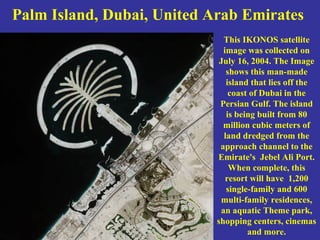
Palm Island, Dubai, United Arab Emirates
This IKONOS satellite
image was collected on
July 16, 2004. The Image
shows this man-made
island that lies off the
coast of Dubai in the
Persian Gulf. The island
is being built from 80
million cubic meters of
land dredged from the
approach channel to the
Emirate's Jebel Ali Port.
When complete, this
resort will have 1,200
single-family and 600
multi-family residences,
an aquatic Theme park,
shopping centers, cinemas
and more.
The Great
Pyramid,
Giza, Egypt
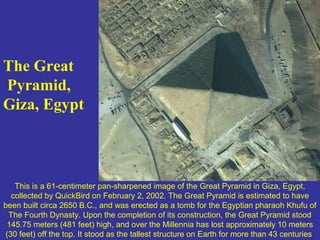
This is a 61-centimeter pan-sharpened image of the Great Pyramid in Giza, Egypt,
collected by QuickBird on February 2, 2002. The Great Pyramid is estimated to have
been built circa 2650 B.C., and was erected as a tomb for the Egyptian pharaoh Khufu of
The Fourth Dynasty. Upon the completion of its construction, the Great Pyramid stood
145.75 meters (481 feet) high, and over the Millennia has lost approximately 10 meters
(30 feet) off the top. It stood as the tallest structure on Earth for more than 43 centuries
Niagara
Falls
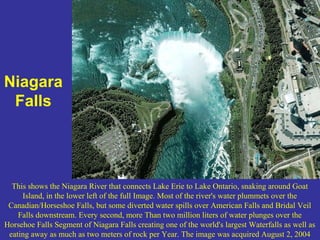
This shows the Niagara River that connects Lake Erie to Lake Ontario, snaking around Goat
Island, in the lower left of the full Image. Most of the river's water plummets over the
Canadian/Horseshoe Falls, but some diverted water spills over American Falls and Bridal Veil
Falls downstream. Every second, more Than two million liters of water plunges over the
Horsehoe Falls Segment of Niagara Falls creating one of the world's largest Waterfalls as well as
eating away as much as two meters of rock per Year. The image was acquired August 2, 2004
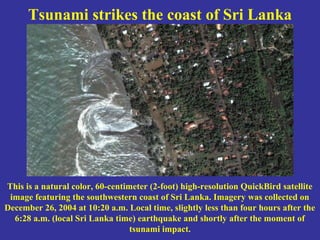
Tsunami strikes the coast of Sri Lanka
This is a natural color, 60-centimeter (2-foot) high-resolution QuickBird satellite
image featuring the southwestern coast of Sri Lanka. Imagery was collected on
December 26, 2004 at 10:20 a.m. Local time, slightly less than four hours after the
6:28 a.m. (local Sri Lanka time) earthquake and shortly after the moment of
tsunami impact.
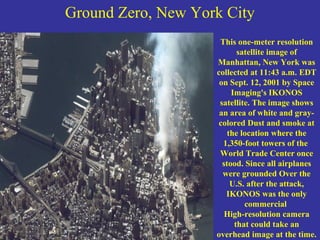
Ground Zero, New York City
This one-meter resolution
satellite image of
Manhattan, New York was
collected at 11:43 a.m. EDT
on Sept. 12, 2001 by Space
Imaging's IKONOS
satellite. The image shows
an area of white and gray-
colored Dust and smoke at
the location where the
1,350-foot towers of the
World Trade Center once
stood. Since all airplanes
were grounded Over the
U.S. after the attack,
IKONOS was the only
commercial
High-resolution camera
that could take an
overhead image at the time.
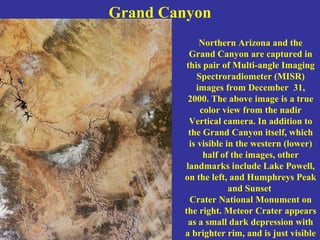
Grand Canyon
Northern Arizona and the
Grand Canyon are captured in
this pair of Multi-angle Imaging
Spectroradiometer (MISR)
images from December 31,
2000. The above image is a true
color view from the nadir
Vertical camera. In addition to
the Grand Canyon itself, which
is visible in the western (lower)
half of the images, other
landmarks include Lake Powell,
on the left, and Humphreys Peak
and Sunset
Crater National Monument on
the right. Meteor Crater appears
as a small dark depression with
a brighter rim, and is just visible
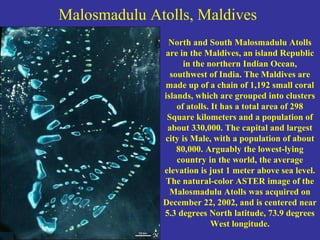
Malosmadulu Atolls, Maldives
North and South Malosmadulu Atolls
are in the Maldives, an island Republic
in the northern Indian Ocean,
southwest of India. The Maldives are
made up of a chain of 1,192 small coral
islands, which are grouped into clusters
of atolls. It has a total area of 298
Square kilometers and a population of
about 330,000. The capital and largest
city is Male, with a population of about
80,000. Arguably the lowest-lying
country in the world, the average
elevation is just 1 meter above sea level.
The natural-color ASTER image of the
Malosmadulu Atolls was acquired on
December 22, 2002, and is centered near
5.3 degrees North latitude, 73.9 degrees
West longitude.
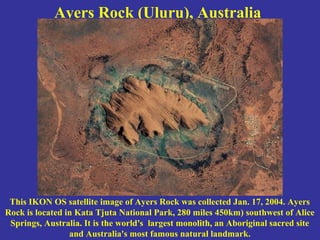
Ayers Rock (Uluru), Australia
This IKON OS satellite image of Ayers Rock was collected Jan. 17, 2004. Ayers
Rock is located in Kata Tjuta National Park, 280 miles 450km) southwest of Alice
Springs, Australia. It is the world's largest monolith, an Aboriginal sacred site
and Australia's most famous natural landmark.
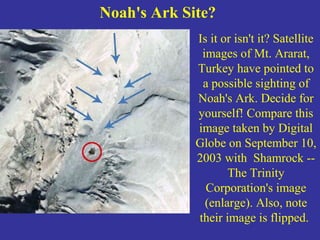
Noah's Ark Site?
Is it or isn't it? Satellite
images of Mt. Ararat,
Turkey have pointed to
a possible sighting of
Noah's Ark. Decide for
yourself! Compare this
image taken by Digital
Globe on September 10,
2003 with Shamrock --
The Trinity
Corporation's image
(enlarge). Also, note
their image is flipped.
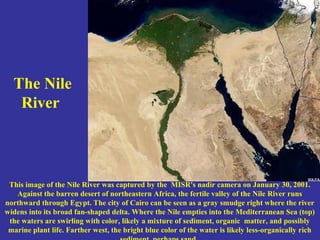
The Nile
River
This image of the Nile River was captured by the MISR's nadir camera on January 30, 2001.
Against the barren desert of northeastern Africa, the fertile valley of the Nile River runs
northward through Egypt. The city of Cairo can be seen as a gray smudge right where the river
widens into its broad fan-shaped delta. Where the Nile empties into the Mediterranean Sea (top)
the waters are swirling with color, likely a mixture of sediment, organic matter, and possibly
marine plant life. Farther west, the bright blue color of the water is likely less-organically rich
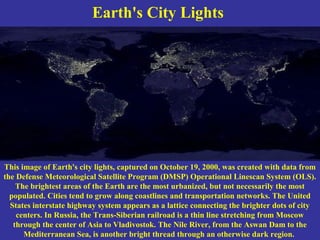
Earth's City Lights
This image of Earth's city lights, captured on October 19, 2000, was created with data from
the Defense Meteorological Satellite Program (DMSP) Operational Linescan System (OLS).
The brightest areas of the Earth are the most urbanized, but not necessarily the most
populated. Cities tend to grow along coastlines and transportation networks. The United
States interstate highway system appears as a lattice connecting the brighter dots of city
centers. In Russia, the Trans-Siberian railroad is a thin line stretching from Moscow
through the center of Asia to Vladivostok. The Nile River, from the Aswan Dam to the
Mediterranean Sea, is another bright thread through an otherwise dark region.
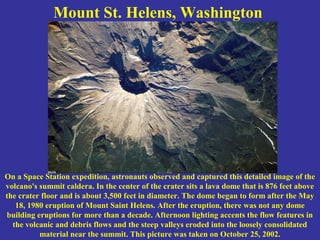
Mount St. Helens, Washington
On a Space Station expedition, astronauts observed and captured this detailed image of the
volcano's summit caldera. In the center of the crater sits a lava dome that is 876 feet above
the crater floor and is about 3,500 feet in diameter. The dome began to form after the May
18, 1980 eruption of Mount Saint Helens. After the eruption, there was not any dome
building eruptions for more than a decade. Afternoon lighting accents the flow features in
the volcanic and debris flows and the steep valleys eroded into the loosely consolidated
material near the summit. This picture was taken on October 25, 2002.
Hope you enjoyed
those classic views
from Outer Space!
HAVE A HIGH-FLYING DAY!
Regards from
Captain Pugwash

Bb space

  • 1.
    Some Great Satellite Images STANDBY FOR with good descriptive information CLICK TO ADVANCE
  • 2.
    Fantastic geography to viewfrom hundreds of miles in space.
  • 3.
    Palm Island, Dubai,United Arab Emirates This IKONOS satellite image was collected on July 16, 2004. The Image shows this man-made island that lies off the coast of Dubai in the Persian Gulf. The island is being built from 80 million cubic meters of land dredged from the approach channel to the Emirate's Jebel Ali Port. When complete, this resort will have 1,200 single-family and 600 multi-family residences, an aquatic Theme park, shopping centers, cinemas and more.
  • 4.
    The Great Pyramid, Giza, Egypt Thisis a 61-centimeter pan-sharpened image of the Great Pyramid in Giza, Egypt, collected by QuickBird on February 2, 2002. The Great Pyramid is estimated to have been built circa 2650 B.C., and was erected as a tomb for the Egyptian pharaoh Khufu of The Fourth Dynasty. Upon the completion of its construction, the Great Pyramid stood 145.75 meters (481 feet) high, and over the Millennia has lost approximately 10 meters (30 feet) off the top. It stood as the tallest structure on Earth for more than 43 centuries
  • 5.
    Niagara Falls This shows theNiagara River that connects Lake Erie to Lake Ontario, snaking around Goat Island, in the lower left of the full Image. Most of the river's water plummets over the Canadian/Horseshoe Falls, but some diverted water spills over American Falls and Bridal Veil Falls downstream. Every second, more Than two million liters of water plunges over the Horsehoe Falls Segment of Niagara Falls creating one of the world's largest Waterfalls as well as eating away as much as two meters of rock per Year. The image was acquired August 2, 2004
  • 6.
    Tsunami strikes thecoast of Sri Lanka This is a natural color, 60-centimeter (2-foot) high-resolution QuickBird satellite image featuring the southwestern coast of Sri Lanka. Imagery was collected on December 26, 2004 at 10:20 a.m. Local time, slightly less than four hours after the 6:28 a.m. (local Sri Lanka time) earthquake and shortly after the moment of tsunami impact.
  • 7.
    Ground Zero, NewYork City This one-meter resolution satellite image of Manhattan, New York was collected at 11:43 a.m. EDT on Sept. 12, 2001 by Space Imaging's IKONOS satellite. The image shows an area of white and gray- colored Dust and smoke at the location where the 1,350-foot towers of the World Trade Center once stood. Since all airplanes were grounded Over the U.S. after the attack, IKONOS was the only commercial High-resolution camera that could take an overhead image at the time.
  • 8.
    Grand Canyon Northern Arizonaand the Grand Canyon are captured in this pair of Multi-angle Imaging Spectroradiometer (MISR) images from December 31, 2000. The above image is a true color view from the nadir Vertical camera. In addition to the Grand Canyon itself, which is visible in the western (lower) half of the images, other landmarks include Lake Powell, on the left, and Humphreys Peak and Sunset Crater National Monument on the right. Meteor Crater appears as a small dark depression with a brighter rim, and is just visible
  • 9.
    Malosmadulu Atolls, Maldives Northand South Malosmadulu Atolls are in the Maldives, an island Republic in the northern Indian Ocean, southwest of India. The Maldives are made up of a chain of 1,192 small coral islands, which are grouped into clusters of atolls. It has a total area of 298 Square kilometers and a population of about 330,000. The capital and largest city is Male, with a population of about 80,000. Arguably the lowest-lying country in the world, the average elevation is just 1 meter above sea level. The natural-color ASTER image of the Malosmadulu Atolls was acquired on December 22, 2002, and is centered near 5.3 degrees North latitude, 73.9 degrees West longitude.
  • 10.
    Ayers Rock (Uluru),Australia This IKON OS satellite image of Ayers Rock was collected Jan. 17, 2004. Ayers Rock is located in Kata Tjuta National Park, 280 miles 450km) southwest of Alice Springs, Australia. It is the world's largest monolith, an Aboriginal sacred site and Australia's most famous natural landmark.
  • 11.
    Noah's Ark Site? Isit or isn't it? Satellite images of Mt. Ararat, Turkey have pointed to a possible sighting of Noah's Ark. Decide for yourself! Compare this image taken by Digital Globe on September 10, 2003 with Shamrock -- The Trinity Corporation's image (enlarge). Also, note their image is flipped.
  • 12.
    The Nile River This imageof the Nile River was captured by the MISR's nadir camera on January 30, 2001. Against the barren desert of northeastern Africa, the fertile valley of the Nile River runs northward through Egypt. The city of Cairo can be seen as a gray smudge right where the river widens into its broad fan-shaped delta. Where the Nile empties into the Mediterranean Sea (top) the waters are swirling with color, likely a mixture of sediment, organic matter, and possibly marine plant life. Farther west, the bright blue color of the water is likely less-organically rich
  • 13.
    Earth's City Lights Thisimage of Earth's city lights, captured on October 19, 2000, was created with data from the Defense Meteorological Satellite Program (DMSP) Operational Linescan System (OLS). The brightest areas of the Earth are the most urbanized, but not necessarily the most populated. Cities tend to grow along coastlines and transportation networks. The United States interstate highway system appears as a lattice connecting the brighter dots of city centers. In Russia, the Trans-Siberian railroad is a thin line stretching from Moscow through the center of Asia to Vladivostok. The Nile River, from the Aswan Dam to the Mediterranean Sea, is another bright thread through an otherwise dark region.
  • 14.
    Mount St. Helens,Washington On a Space Station expedition, astronauts observed and captured this detailed image of the volcano's summit caldera. In the center of the crater sits a lava dome that is 876 feet above the crater floor and is about 3,500 feet in diameter. The dome began to form after the May 18, 1980 eruption of Mount Saint Helens. After the eruption, there was not any dome building eruptions for more than a decade. Afternoon lighting accents the flow features in the volcanic and debris flows and the steep valleys eroded into the loosely consolidated material near the summit. This picture was taken on October 25, 2002.
  • 15.
    Hope you enjoyed thoseclassic views from Outer Space! HAVE A HIGH-FLYING DAY! Regards from Captain Pugwash