Reimagining Urban
Mobility &Public
Spaces for a
Sustainable Future
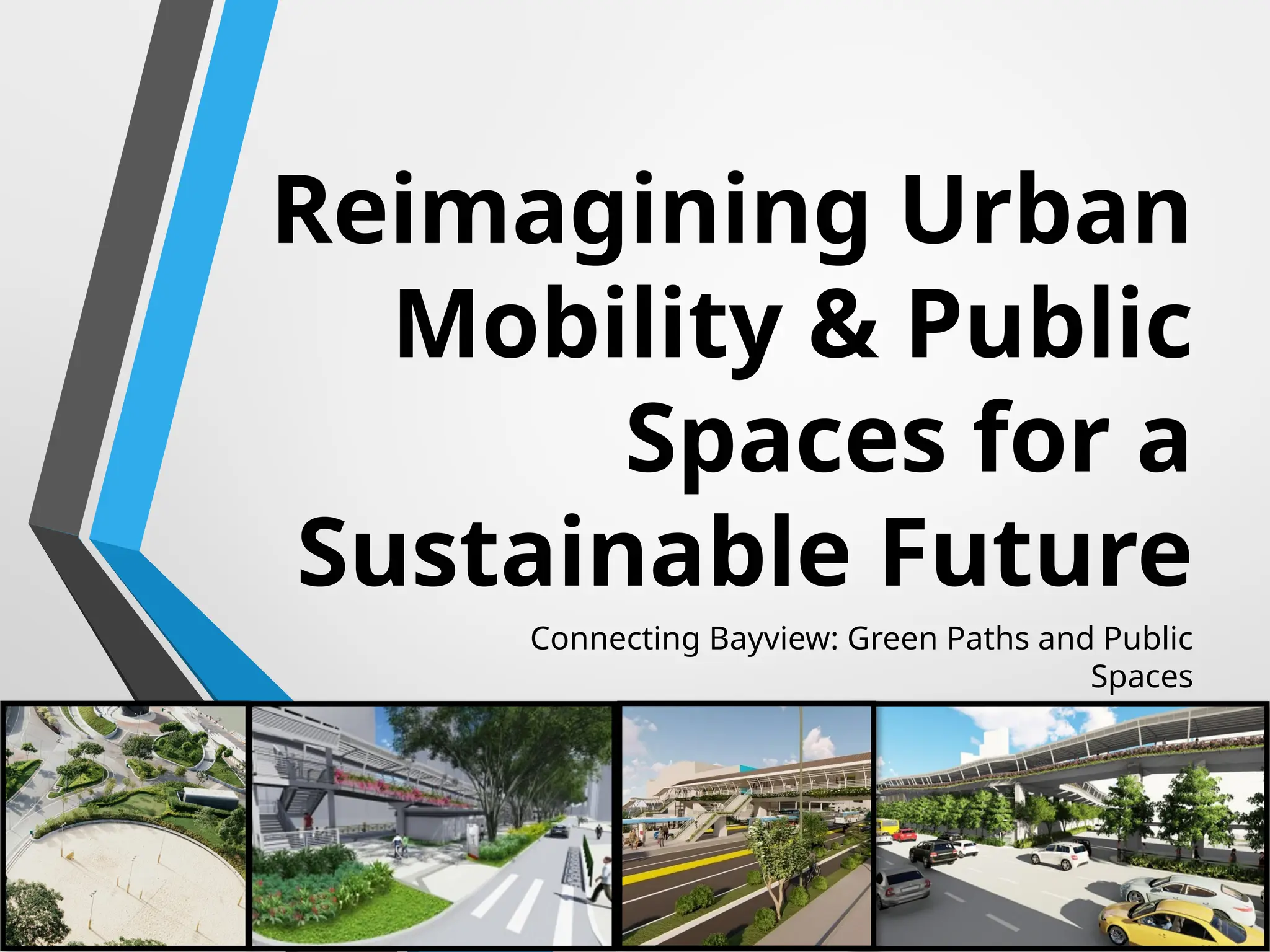
Connecting Bayview: Green Paths and Public
Spaces
2.
Introduction
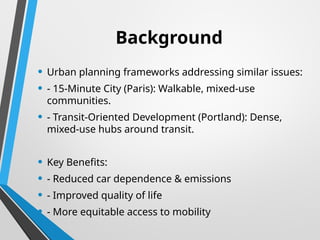
• Bayview, afast-growing seaside city, faces challenges from
rapid expansion:
• - Traffic congestion & car dependence
• - Poor public transportation
• - Unsafe pedestrian & bicycle routes
• - Air pollution & environmental degradation
• - Inequitable access for low-income residents
• Goal: Create sustainable, inclusive, and connected
transportation & public spaces.
3.
Background
• Urban planningframeworks addressing similar issues:
• - 15-Minute City (Paris): Walkable, mixed-use
communities.
• - Transit-Oriented Development (Portland): Dense,
mixed-use hubs around transit.
• Key Benefits:
• - Reduced car dependence & emissions
• - Improved quality of life
• - More equitable access to mobility
4.
How I Lookedat the Problem
• Analysis focused on:
• - Urban sprawl impacts: environment, equity,
transport.
• - Case studies: Complete Streets, TOD, 15-Minute City.
• - Scenario analysis to integrate social, environmental,
and economic factors.
5.
What I Found
•Key Findings:
• 1. Car dependence congestion, pollution, poor
→
land use.
• 2. Inadequate public transport limited access.
→
• 3. Unsafe roads for pedestrians & cyclists.
• 4. Lack of compact, connected neighborhoods.
• 5. Environmental & health risks from emissions.
• 6. Equity concerns for low-income communities.
6.
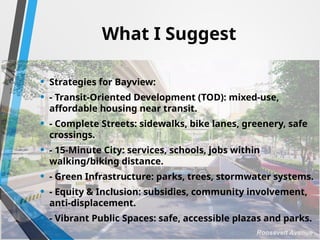
What I Suggest
•Strategies for Bayview:
• - Transit-Oriented Development (TOD): mixed-use,
affordable housing near transit.
• - Complete Streets: sidewalks, bike lanes, greenery, safe
crossings.
• - 15-Minute City: services, schools, jobs within
walking/biking distance.
• - Green Infrastructure: parks, trees, stormwater systems.
• - Equity & Inclusion: subsidies, community involvement,
anti-displacement.
• - Vibrant Public Spaces: safe, accessible plazas and parks.
7.
Conclusion
• Bayview’s currentcar-centric growth
is unsustainable and inequitable.
• By implementing:
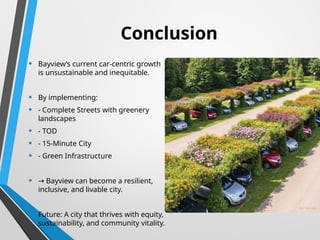
• - Complete Streets with greenery
landscapes
• - TOD
• - 15-Minute City
• - Green Infrastructure
• → Bayview can become a resilient,
inclusive, and livable city.
• Future: A city that thrives with equity,
sustainability, and community vitality.
8.
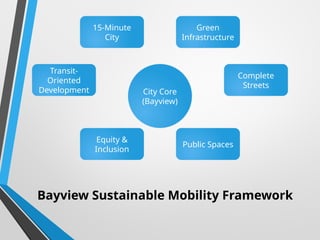
Bayview Sustainable MobilityFramework
City Core
(Bayview)
Transit-
Oriented
Development
Complete
Streets
15-Minute
City
Green
Infrastructure
Equity &
Inclusion
Public Spaces