Bayesian updating using SAAM data
September 2016, SAAM Consortium Meeting
Graeme Keith, Maersk Oil
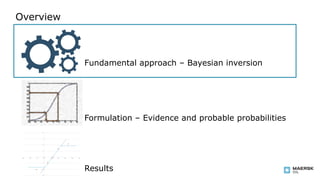
Overview
Fundamental approach – Bayesian inversion
Formulation – Evidence and probable probabilities
Results
Overview
Fundamental approach – Bayesian inversion
Formulation – Evidence and probable probabilities
Results
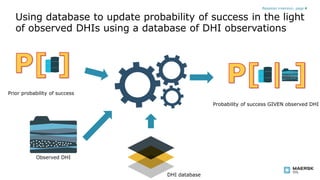
Using database to update probability of success in the light
of observed DHIs using a database of DHI observations
Bayesian inversion, page 4
Prior probability of success
Observed DHI
DHI database
Probability of success GIVEN observed DHI
Using database to update probability of success in the light
of observed DHIs using a database of DHI observations
Bayesian inversion,
page 5
Prior probability of success
Observed DHI
DHI database
Probability of success GIVEN observed DHI
Probability of observed DHI GIVEN success
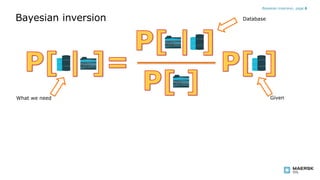
Bayesian inversion
Bayesian inversion, page 6
What we need Given
Database
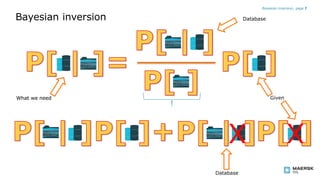
Bayesian inversion
Bayesian inversion, page 7
What we need
X X
What we need Given
Database
Database
What is the probability we see the observed DHI if
there is [not] oil in the ground
Bayesian inversion, page 8
Success
Victory
Triumph
Sensation
Glory
Riches
Fortune
Fortuity
Serendipity
Fluke
Failure
Loser
Write-off
Defeat
Fiasco
Debacle
Blunder
Catastrophe
Turnip
Washout
X
X
X
X
X
X
X
X
X
X
X
What is the probability we see the observed DHI if
there is [not] oil in the ground
Bayesian inversion, page 9
Success Flat spot=“4”
Victory Flat spot=“3”
Triumph Flat spot=“5”
Sensation Flat spot=“2”
Glory Flat spot=“4”
Riches Flat spot=“1”
Fortune Flat spot=“5”
Fortuity Flat spot=“3”
Serendipity Flat spot=“2”
Fluke Flat spot=“1”
Failure Flat spot=“4”
Loser Flat spot=“2”
Write-off Flat spot=“3”
Defeat Flat spot=“4”
Fiasco Flat spot=“2”
Debacle Flat spot=“1”
Blunder Flat spot=“3”
Catastrophe Flat spot=“2”
Turnip Flat spot=“3”
Washout Flat spot=“1”
X
X
X
X
X
X
X
X
X
X
X
Condition on single DHI score, say flat spot
𝑃(flat spot = "3"|𝑆) 𝑃(flat spot = "3"|𝐹)
Use the incidence of 3s amongst the success (failure
cases) to establish these probabilities
What is the probability we see the observed DHI if
there is [not] oil in the ground
Bayesian inversion, page 10
Success Index=14% bin 3
Victory Index=21% bin 4
Triumph Index=11% bin 3
Sensation Index=16% bin 4
Glory Index=12% bin 3
Riches Index=14% bin 3
Fortune Index=18% bin 4
Fortuity Index=25% bin 5
Serendipity Index=10% bin 3
Fluke Index=7% bin 2
Failure Index=14% bin 3
Loser Index=11% bin 3
Write-off Index=3% bin 2
Defeat Index=6% bin 2
Fiasco Index=30% bin 5
Debacle Index=3% bin 2
Blunder Index=2% bin 2
Catastrophe Index=12% bin 3
Turnip Index=-5% bin 1
Washout Index=1% bin 2
X
X
X
X
X
X
X
X
X
X
X
Condition on DHI index: Bins
𝑃(bin 3|𝑆) 𝑃(bin 3|𝐹)
-23%  index < 1% Bin 1
1%  index < 9% Bin 2
9%  index < 16% Bin 3
16%  index < 24% Bin 4
24%  index < 45% Bin 5
Use incidence rate.
Choice on how many bins and where to set transitions
What is the probability we see the observed DHI if
there is [not] oil in the ground
Bayesian inversion, page 11
Success Index=14%
Victory Index=21%
Triumph Index=11%
Sensation Index=16%
Glory Index=12%
Riches Index=14%
Fortune Index=18%
Fortuity Index=25%
Serendipity Index=10%
Fluke Index=7%
Failure Index=14%
Loser Index=11%
Write-off Index=3%
Defeat Index=6%
Fiasco Index=30%
Debacle Index=3%
Blunder Index=2%
Catastrophe Index=12%
Turnip Index=-5%
Washout Index=1%
X
X
X
X
X
X
X
X
X
X
X
Condition on DHI index: Model
𝑃(index = 14%|𝑆) 𝑃(index = 14%|𝐹)
Overview
Fundamental approach – Bayesian inversion
Formulation – Evidence and probable probabilities
Results
Evidence: A mathematical sleight of hand
• Probability
• 0 certain failure
• 1 certain success
• Bayes’ theorem
𝑃 𝑆|𝐷 =
𝑃 𝐷|𝑆
𝑃 𝐷|𝑆 𝑷 𝑺 + 𝑃 𝐷|𝐹 1 − 𝑷 𝑺
𝑷 𝑺
• Complicated function of prior
• Requires two numbers from database
• Evidence
• 𝑒 𝑆 = 10 log
𝑃 𝑆
1−𝑃 𝑆
• −∞ certain failure
• ∞ certain success
• Bayes’ theorem
𝑒 𝑆|𝐷 = 𝑒 𝑆 + 10log
𝑃 𝐷|𝑆
𝑃 𝐷|𝐹
• Simple, additive function of prior
• Single number captures effect of DHI data
Bayesian inversion, page 13
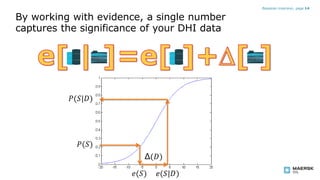
By working with evidence, a single number
captures the significance of your DHI data
Bayesian inversion, page 14
𝑃(𝑆)
𝑒(𝑆)
Δ(𝐷)
𝑒(𝑆|𝐷)
𝑃(𝑆|𝐷)
Probable probabilities
Bayesian inversion, page 15
Success Flat spot=“4”
Victory Flat spot=“3”
Triumph Flat spot=“5”
Sensation Flat spot=“2”
Glory Flat spot=“4”
Riches Flat spot=“1”
Fortune Flat spot=“5”
Fortuity Flat spot=“3”
Serendipity Flat spot=“2”
Fluke Flat spot=“1”
Failure Flat spot=“4”
Loser Flat spot=“2”
Write-off Flat spot=“3”
Defeat Flat spot=“4”
Fiasco Flat spot=“2”
Debacle Flat spot=“1”
Blunder Flat spot=“3”
Catastrophe Flat spot=“2”
Turnip Flat spot=“3”
Washout Flat spot=“1”
X
X
X
X
X
X
X
X
X
X
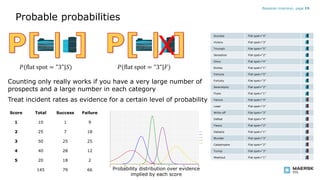
Counting only really works if you have a very large number of
prospects and a large number in each category
Treat incident rates as evidence for a certain level of probability
𝑃(flat spot = "3"|𝑆)
X
𝑃(flat spot = "3"|𝐹)
Score Total Success Failure
1 10 1 9
2 25 7 18
3 50 25 25
4 40 28 12
5 20 18 2
145 79 66 Probability distribution over evidence
implied by each score
Overview
Fundamental approach – Bayesian inversion
Formulation – Evidence and probable probabilities
Results
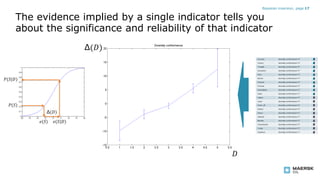
The evidence implied by a single indicator tells you
about the significance and reliability of that indicator
Bayesian inversion, page 17
Δ(𝐷)
𝐷
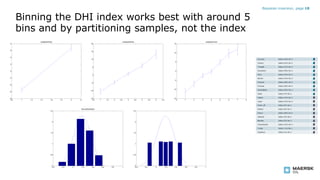
Binning the DHI index works best with around 5
bins and by partitioning samples, not the index
Bayesian inversion, page 18
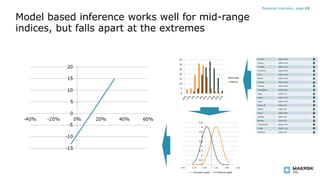
Model based inference works well for mid-range
indices, but falls apart at the extremes
Bayesian inversion, page 19
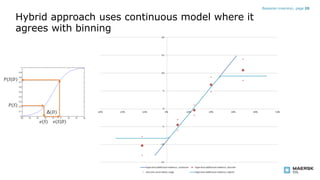
Hybrid approach uses continuous model where it
agrees with binning
Bayesian inversion, page 20

Bayesian updating using saam data

  • 1.
    Bayesian updating usingSAAM data September 2016, SAAM Consortium Meeting Graeme Keith, Maersk Oil
  • 2.
    Overview Fundamental approach –Bayesian inversion Formulation – Evidence and probable probabilities Results
  • 3.
    Overview Fundamental approach –Bayesian inversion Formulation – Evidence and probable probabilities Results
  • 4.
    Using database toupdate probability of success in the light of observed DHIs using a database of DHI observations Bayesian inversion, page 4 Prior probability of success Observed DHI DHI database Probability of success GIVEN observed DHI
  • 5.
    Using database toupdate probability of success in the light of observed DHIs using a database of DHI observations Bayesian inversion, page 5 Prior probability of success Observed DHI DHI database Probability of success GIVEN observed DHI Probability of observed DHI GIVEN success
  • 6.
    Bayesian inversion Bayesian inversion,page 6 What we need Given Database
  • 7.
    Bayesian inversion Bayesian inversion,page 7 What we need X X What we need Given Database Database
  • 8.
    What is theprobability we see the observed DHI if there is [not] oil in the ground Bayesian inversion, page 8 Success Victory Triumph Sensation Glory Riches Fortune Fortuity Serendipity Fluke Failure Loser Write-off Defeat Fiasco Debacle Blunder Catastrophe Turnip Washout X X X X X X X X X X X
  • 9.
    What is theprobability we see the observed DHI if there is [not] oil in the ground Bayesian inversion, page 9 Success Flat spot=“4” Victory Flat spot=“3” Triumph Flat spot=“5” Sensation Flat spot=“2” Glory Flat spot=“4” Riches Flat spot=“1” Fortune Flat spot=“5” Fortuity Flat spot=“3” Serendipity Flat spot=“2” Fluke Flat spot=“1” Failure Flat spot=“4” Loser Flat spot=“2” Write-off Flat spot=“3” Defeat Flat spot=“4” Fiasco Flat spot=“2” Debacle Flat spot=“1” Blunder Flat spot=“3” Catastrophe Flat spot=“2” Turnip Flat spot=“3” Washout Flat spot=“1” X X X X X X X X X X X Condition on single DHI score, say flat spot 𝑃(flat spot = "3"|𝑆) 𝑃(flat spot = "3"|𝐹) Use the incidence of 3s amongst the success (failure cases) to establish these probabilities
  • 10.
    What is theprobability we see the observed DHI if there is [not] oil in the ground Bayesian inversion, page 10 Success Index=14% bin 3 Victory Index=21% bin 4 Triumph Index=11% bin 3 Sensation Index=16% bin 4 Glory Index=12% bin 3 Riches Index=14% bin 3 Fortune Index=18% bin 4 Fortuity Index=25% bin 5 Serendipity Index=10% bin 3 Fluke Index=7% bin 2 Failure Index=14% bin 3 Loser Index=11% bin 3 Write-off Index=3% bin 2 Defeat Index=6% bin 2 Fiasco Index=30% bin 5 Debacle Index=3% bin 2 Blunder Index=2% bin 2 Catastrophe Index=12% bin 3 Turnip Index=-5% bin 1 Washout Index=1% bin 2 X X X X X X X X X X X Condition on DHI index: Bins 𝑃(bin 3|𝑆) 𝑃(bin 3|𝐹) -23%  index < 1% Bin 1 1%  index < 9% Bin 2 9%  index < 16% Bin 3 16%  index < 24% Bin 4 24%  index < 45% Bin 5 Use incidence rate. Choice on how many bins and where to set transitions
  • 11.
    What is theprobability we see the observed DHI if there is [not] oil in the ground Bayesian inversion, page 11 Success Index=14% Victory Index=21% Triumph Index=11% Sensation Index=16% Glory Index=12% Riches Index=14% Fortune Index=18% Fortuity Index=25% Serendipity Index=10% Fluke Index=7% Failure Index=14% Loser Index=11% Write-off Index=3% Defeat Index=6% Fiasco Index=30% Debacle Index=3% Blunder Index=2% Catastrophe Index=12% Turnip Index=-5% Washout Index=1% X X X X X X X X X X X Condition on DHI index: Model 𝑃(index = 14%|𝑆) 𝑃(index = 14%|𝐹)
  • 12.
    Overview Fundamental approach –Bayesian inversion Formulation – Evidence and probable probabilities Results
  • 13.
    Evidence: A mathematicalsleight of hand • Probability • 0 certain failure • 1 certain success • Bayes’ theorem 𝑃 𝑆|𝐷 = 𝑃 𝐷|𝑆 𝑃 𝐷|𝑆 𝑷 𝑺 + 𝑃 𝐷|𝐹 1 − 𝑷 𝑺 𝑷 𝑺 • Complicated function of prior • Requires two numbers from database • Evidence • 𝑒 𝑆 = 10 log 𝑃 𝑆 1−𝑃 𝑆 • −∞ certain failure • ∞ certain success • Bayes’ theorem 𝑒 𝑆|𝐷 = 𝑒 𝑆 + 10log 𝑃 𝐷|𝑆 𝑃 𝐷|𝐹 • Simple, additive function of prior • Single number captures effect of DHI data Bayesian inversion, page 13
  • 14.
    By working withevidence, a single number captures the significance of your DHI data Bayesian inversion, page 14 𝑃(𝑆) 𝑒(𝑆) Δ(𝐷) 𝑒(𝑆|𝐷) 𝑃(𝑆|𝐷)
  • 15.
    Probable probabilities Bayesian inversion,page 15 Success Flat spot=“4” Victory Flat spot=“3” Triumph Flat spot=“5” Sensation Flat spot=“2” Glory Flat spot=“4” Riches Flat spot=“1” Fortune Flat spot=“5” Fortuity Flat spot=“3” Serendipity Flat spot=“2” Fluke Flat spot=“1” Failure Flat spot=“4” Loser Flat spot=“2” Write-off Flat spot=“3” Defeat Flat spot=“4” Fiasco Flat spot=“2” Debacle Flat spot=“1” Blunder Flat spot=“3” Catastrophe Flat spot=“2” Turnip Flat spot=“3” Washout Flat spot=“1” X X X X X X X X X X Counting only really works if you have a very large number of prospects and a large number in each category Treat incident rates as evidence for a certain level of probability 𝑃(flat spot = "3"|𝑆) X 𝑃(flat spot = "3"|𝐹) Score Total Success Failure 1 10 1 9 2 25 7 18 3 50 25 25 4 40 28 12 5 20 18 2 145 79 66 Probability distribution over evidence implied by each score
  • 16.
    Overview Fundamental approach –Bayesian inversion Formulation – Evidence and probable probabilities Results
  • 17.
    The evidence impliedby a single indicator tells you about the significance and reliability of that indicator Bayesian inversion, page 17 Δ(𝐷) 𝐷
  • 18.
    Binning the DHIindex works best with around 5 bins and by partitioning samples, not the index Bayesian inversion, page 18
  • 19.
    Model based inferenceworks well for mid-range indices, but falls apart at the extremes Bayesian inversion, page 19
  • 20.
    Hybrid approach usescontinuous model where it agrees with binning Bayesian inversion, page 20