Movies for Mental Health
Bay Path University
April 27, 2017
@artwithimpact
#Movies4MentalHealth
Here’s the Plan
I. Quick Introduction
II. Set the Stage Together
III. Watch Short Films & Discuss Them
IV. Make it Personal with Our Panel
Brought to you by
• Monthly Short Film
Competition
• Campus Workshops
• Global Community
(blog, IG, Twitter,
FB)
Psychology Program
Heads Up
• Mental health is personal - YOU are the
expert of your own experience.
• This is a public space - not therapy.
• We’re here for connection, questions and
creating change!
• Films might trigger big emotions - that’s OK!
• Please ask for help if you need support.
Some Movies that Show Mental Illness:
Rain man
Sybill
Girl interrupted
A beautiful mind
Reign over me
13 reasons why
Split
What’s eating gilbert grape
Butterfly Effect
Psycho
American Psycho
Silver linings playbook
Analyze This
Girl with a dragon tattoo
Me myself and irene
One flew over the coo coos nest
Kissed
What about bob
K-Pax
Side effects
Characters with Mental Illness Are Portrayed as:
Crazy
Unstable
Dramatic
Eccentric
Antisocial
Sociopath
Dangerous
Violent
Freak
Criminals
Unpredictable
Lonely
Genius
Paranoid
Dependent
Savant
Mental Health
What is mental illness?
Mental hiccup in daily functioning
Experienced internally, negatively affecting what the individual is able to do
Pervasive
The health of your mind
Poor quality of life
Emotional regulation becomes difficult
What is mental wellness?
Clear concise thinking
Mindfulness
Being able to accurately define what is comforting
and self care to you
Being resilient
Knowing your boundaries and that they’re ok
Being able to use “no” as a part of your vocab
Reasonable balance among emotions
About surroundings and support system
FINE
By Saida Saetgareeva
AWI Winner, January 2017
What is stigma?
Preconceived notions based on stereotypes
Judgment
Negative view on a topic
miscommunication
How does stigma feel?
Become a social norm, and result in negative feelings
Very limiting
Feels isolating
Shameful, embarrassing
Prevent people from openly talking about a topic
Can make you hyper visible, or invisible
Three
By Karen Hua
AWI Winner, June 2015
In Groups of Three
• What did you think?
• What did you feel?
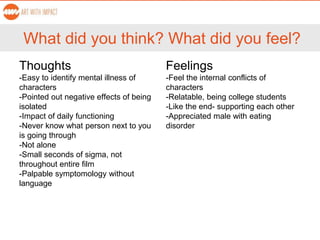
What did you think? What did you feel?
Thoughts
-Easy to identify mental illness of
characters
-Pointed out negative effects of being
isolated
-Impact of daily functioning
-Never know what person next to you
is going through
-Not alone
-Small seconds of sigma, not
throughout entire film
-Palpable symptomology without
language
Feelings
-Feel the internal conflicts of
characters
-Relatable, being college students
-Like the end- supporting each other
-Appreciated male with eating
disorder
Crooked Beauty
By Ken Paul Rosenthal
AWI Winner, June 2012
In Groups of Three
• What did you think?
• What did you feel?
• What have you learned?
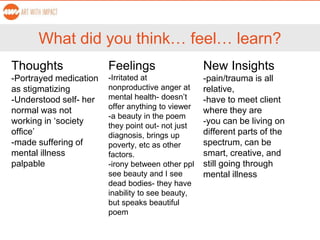
What did you think… feel… learn?
Thoughts
-Portrayed medication
as stigmatizing
-Understood self- her
normal was not
working in ‘society
office’
-made suffering of
mental illness
palpable
Feelings
-Irritated at
nonproductive anger at
mental health- doesn’t
offer anything to viewer
-a beauty in the poem
they point out- not just
diagnosis, brings up
poverty, etc as other
factors.
-irony between other ppl
see beauty and I see
dead bodies- they have
inability to see beauty,
but speaks beautiful
poem
New Insights
-pain/trauma is all
relative,
-have to meet client
where they are
-you can be living on
different parts of the
spectrum, can be
smart, creative, and
still going through
mental illness
Chained
By Dustin Lowman
AWI Winner, September 2016
General Audience
• What did you think?
• What did you feel?
• What have you learned?
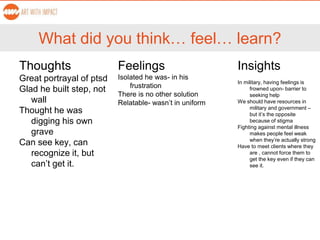
What did you think… feel… learn?
Thoughts
Great portrayal of ptsd
Glad he built step, not
wall
Thought he was
digging his own
grave
Can see key, can
recognize it, but
can’t get it.
Insights
In military, having feelings is
frowned upon- barrier to
seeking help
We should have resources in
military and government –
but it’s the opposite
because of stigma
Fighting against mental illness
makes people feel weak
when they’re actually strong
Have to meet clients where they
are , cannot force them to
get the key even if they can
see it.
Feelings
Isolated he was- in his
frustration
There is no other solution
Relatable- wasn’t in uniform
What can I do?
Meet the Panel
• Leona Francis - Bay Path Graduate Student
• Kenna Tyrrell - Bay Path Alum, Lesley Graduate
Student
• Prof. Henry Alicea, MEd - Clinical Coordinator,
Baystate Medical Emergency Services - Adjunct
Professor, BPU
• Eliana Ward, LICSW - Campus Counselor, Bay Path
University Counseling Center
• Robert Roose, MD, MPH, FASAM - VP, Behavioral
Health, Mercy Medical Center - a Member of Trinity
Health – New England
AWI Ambassadors
• You’re invited! Continue the conversation, be
a leader!
• Join the AWI Ambassadors FB group and
connect with students across North America:
www.facebook.com/groups/awiambassadors/
• Blog, be a juror for the film competition, run
campaigns, and much more!
Thank you for coming!
• Contact us: info@artwithimpact.org
• Follow us!
• Submit a film!
https://www.artwithimpact.org/films/submit-a-film/

Bay path april 27, 2017 - powerpoint (1)

  • 1.
    Movies for MentalHealth Bay Path University April 27, 2017 @artwithimpact #Movies4MentalHealth
  • 2.
    Here’s the Plan I.Quick Introduction II. Set the Stage Together III. Watch Short Films & Discuss Them IV. Make it Personal with Our Panel
  • 3.
    Brought to youby • Monthly Short Film Competition • Campus Workshops • Global Community (blog, IG, Twitter, FB) Psychology Program
  • 4.
    Heads Up • Mentalhealth is personal - YOU are the expert of your own experience. • This is a public space - not therapy. • We’re here for connection, questions and creating change! • Films might trigger big emotions - that’s OK! • Please ask for help if you need support.
  • 5.
    Some Movies thatShow Mental Illness: Rain man Sybill Girl interrupted A beautiful mind Reign over me 13 reasons why Split What’s eating gilbert grape Butterfly Effect Psycho American Psycho Silver linings playbook Analyze This Girl with a dragon tattoo Me myself and irene One flew over the coo coos nest Kissed What about bob K-Pax Side effects
  • 6.
    Characters with MentalIllness Are Portrayed as: Crazy Unstable Dramatic Eccentric Antisocial Sociopath Dangerous Violent Freak Criminals Unpredictable Lonely Genius Paranoid Dependent Savant
  • 7.
  • 8.
    What is mentalillness? Mental hiccup in daily functioning Experienced internally, negatively affecting what the individual is able to do Pervasive The health of your mind Poor quality of life Emotional regulation becomes difficult
  • 9.
    What is mentalwellness? Clear concise thinking Mindfulness Being able to accurately define what is comforting and self care to you Being resilient Knowing your boundaries and that they’re ok Being able to use “no” as a part of your vocab Reasonable balance among emotions About surroundings and support system
  • 10.
    FINE By Saida Saetgareeva AWIWinner, January 2017
  • 11.
    What is stigma? Preconceivednotions based on stereotypes Judgment Negative view on a topic miscommunication
  • 12.
    How does stigmafeel? Become a social norm, and result in negative feelings Very limiting Feels isolating Shameful, embarrassing Prevent people from openly talking about a topic Can make you hyper visible, or invisible
  • 13.
    Three By Karen Hua AWIWinner, June 2015
  • 14.
    In Groups ofThree • What did you think? • What did you feel?
  • 15.
    What did youthink? What did you feel? Thoughts -Easy to identify mental illness of characters -Pointed out negative effects of being isolated -Impact of daily functioning -Never know what person next to you is going through -Not alone -Small seconds of sigma, not throughout entire film -Palpable symptomology without language Feelings -Feel the internal conflicts of characters -Relatable, being college students -Like the end- supporting each other -Appreciated male with eating disorder
  • 16.
    Crooked Beauty By KenPaul Rosenthal AWI Winner, June 2012
  • 17.
    In Groups ofThree • What did you think? • What did you feel? • What have you learned?
  • 18.
    What did youthink… feel… learn? Thoughts -Portrayed medication as stigmatizing -Understood self- her normal was not working in ‘society office’ -made suffering of mental illness palpable Feelings -Irritated at nonproductive anger at mental health- doesn’t offer anything to viewer -a beauty in the poem they point out- not just diagnosis, brings up poverty, etc as other factors. -irony between other ppl see beauty and I see dead bodies- they have inability to see beauty, but speaks beautiful poem New Insights -pain/trauma is all relative, -have to meet client where they are -you can be living on different parts of the spectrum, can be smart, creative, and still going through mental illness
  • 19.
    Chained By Dustin Lowman AWIWinner, September 2016
  • 20.
    General Audience • Whatdid you think? • What did you feel? • What have you learned?
  • 21.
    What did youthink… feel… learn? Thoughts Great portrayal of ptsd Glad he built step, not wall Thought he was digging his own grave Can see key, can recognize it, but can’t get it. Insights In military, having feelings is frowned upon- barrier to seeking help We should have resources in military and government – but it’s the opposite because of stigma Fighting against mental illness makes people feel weak when they’re actually strong Have to meet clients where they are , cannot force them to get the key even if they can see it. Feelings Isolated he was- in his frustration There is no other solution Relatable- wasn’t in uniform
  • 22.
  • 23.
    Meet the Panel •Leona Francis - Bay Path Graduate Student • Kenna Tyrrell - Bay Path Alum, Lesley Graduate Student • Prof. Henry Alicea, MEd - Clinical Coordinator, Baystate Medical Emergency Services - Adjunct Professor, BPU • Eliana Ward, LICSW - Campus Counselor, Bay Path University Counseling Center • Robert Roose, MD, MPH, FASAM - VP, Behavioral Health, Mercy Medical Center - a Member of Trinity Health – New England
  • 24.
    AWI Ambassadors • You’reinvited! Continue the conversation, be a leader! • Join the AWI Ambassadors FB group and connect with students across North America: www.facebook.com/groups/awiambassadors/ • Blog, be a juror for the film competition, run campaigns, and much more!
  • 25.
    Thank you forcoming! • Contact us: info@artwithimpact.org • Follow us! • Submit a film! https://www.artwithimpact.org/films/submit-a-film/

Editor's Notes

  • #2 Campus organizer (might) introduce facilitator Brief introduction – welcome, name Encourage people to come closer Connect with us on Instagram, Facebook or Twitter and document this event - we’d love to see your photos!
  • #3 Brief agenda review: - will give you a brief summary of AWI - set the stage together, which really means that as a group we’ll have a discussion and provide a context for the topics - we have four short films from our library to show you, together we’ll discuss the themes - Make it personal with a panel of campus and community resources to connect you with - You’ll be doing most of the talking today! Mention photos - if you would prefer not to have your face in photos please inform us after the event
  • #4 Who is AWI? - we are a charity dedicated to reducing the stigma of mental illness with transition-aged youth, work in regions throughout North America - we have been working primarily in California since 2011 and in the last year and a half expanded to three areas of Canada, as well as the New England area in the U.S. (if applicable) - We host an ongoing monthly short film competition where filmmakers anywhere in the world can submit a film on the topic of mental health, these are juried and monthly winners receive $1,000 cash prize (will tell you more about that at the end of our time together) - We then take these winning films and facilitate discussions in our postsecondary Movies for Mental Health program (you’ll see what this is all about today) and run a high school program that teaches media literacy to youth and allows them to make their own short films on mental health - Also a part of a larger global community, release blogs twice a week on feature length films, or film festivals related to themes of mental illness Brought to you by: - mention any nonprofit partners or corporate sponsors
  • #5 Want to explain what I mean about this statement… Mental health is personal and our experiences are different, we all come from different backgrounds and cultures – you are the experts on YOU and know yourself better than anyone else We don’t often talk about mental health; as a society we don’t tend to talk about issues/experiences related to this theme, so sometimes we don’t know HOW to talk about these topics. First and foremost keep yourself safe today, don’t feel compelled to share anything you’re not comfortable with. This is a new space and you might feel ready to share but might not know what responses you’ll have, and it is a public space with no guaranteed confidentially so be mindful of the space that we are in before you disclose. Some of the films might be triggering, meaning they might elicit an emotional reaction. The films are very powerful and it’s completely normal to feel overwhelmed, so take the time you need to re-group and be present here. I encourage you to take note of how you’re feeling and investigate that / nurture that after the workshop. We have counsellors in the room today that are here to help you if you need to step out (say names of counsellors, have them raise their hands in the audience).
  • #6 Pre-slide: With that in mind, let’s get started by providing a context and setting the stage for the messages we receive in the media. Ask Q
  • #7 Think about the characters in the films you shared, what are some adjectives you’d use to describe those characters, how have the characters been portrayed? We see a lot of extremes here, ie. Really special, really problematic 1 in 5 of us, 20% of us have a diagnosable mental illness each year (1 in 3 or even 1 in 2 have a MI in our lifetime), consider how these labels influence us. (Optional to save until next slides)
  • #8 Mental Health is a big topic, and can include so many different things. We all have mental health, the same way that we all have physical health. Today, we’ll be exploring two topics that fall under the umbrella of Mental Health.
  • #9 We use the term often, let’s work together to craft definitions according to your thoughts For us in this room at this workshop it doesn’t matter what anyone says, we don’t need clinical definitions but how do we define and what does it feel like for us.
  • #10 This is a term that we might not hear as often. What might it mean? What are some mental wellness practices? How does mental wellness relate to mental illness? Can you have a mental illness and still be mentally well? Helping think about themselves as more than a disease. 5 in 5 of us have mental health, it is a universal experience, something we can agree we need to nourish and take care of, influences all aspects of our lives.
  • #11 Mention brief blurb about the film – won our competition in <YEAR>, sentence about the filmmaker Segue theme of film – stigma- into next slide
  • #12 What the film really addressed here is stigma. We know stigma exists and we talk a lot about it in relation to mental illness, but how would you really define it? Discuss stereotypes v. stigma - stereotypes can be negative or positive, stigma is always negative Stigma is false Stigma easily internalized and we believe them about ourselves Ie. all girls are bad at sports v. all boys are good at sports (neither is true but one is positive) Stigma can be experienced in a number of ways, and not solely related to mental illness…
  • #13 Knowing that this is something we have all experienced in some shape or form, how does stigma feel? Comments/ Questions that can be added about stigma specifically: - stigma creates barriers to understanding - stigma defines someone as only one aspect of who they are, when this label doesn’t fit who you are it’s a frustrating feeling - If someone mentions stereotypes; difference between stereotypes and stigma is stereotypes can be positive or negative, sometimes funny, however stigma is always negative and feels awful, dehumanizing - There are various types of stigma – cultural and self-stigma; this can snowball and create really negative experiences - Believing the self-stigma (and it’s completely human to do so) can be dangerous when we internalize, become very hard on ourselves. - It’s not a true/false, it’s a societal construct - Impact of stigma in accessing resources (what is?) Segue into films: We are here today taking the first step by talking about these experiences, learning through films to combat stigma and learn from one another. These feelings, these byproducts of being stigmatized is why it’s so important to have these supportive and compassionate conversations / listening to one another is an incredibly powerful way to battle stigma We’re fighting the feelings that stigma brings out in humans that makes people feel they can’t reach out, can’t get help...really hard to break through. This is something that we can work together to fight. So, on that note, let’s watch the first film!
  • #14 Show here: More Than A Mental Illness, Anosognosia, OR Destigmatize Mental Illness Mention brief blurb about the film – won our competition in <YEAR>, sentence about the filmmaker (can be based on acceptance videos on website) Segue theme of film – stigma- into next slide
  • #15 In an academic environment it can be challenging to discuss feelings and emotions where thoughts are more abstract, but encourage students to challenge themselves Feelings represent important feedback and it’s important to listen to them. Turn to your neighbours in small groups and discuss these questions, we will come back together in a few minutes. Communicate a signal for getting students’ attention?
  • #16 Can provide an example of a thought and/or feeling to get the group started. Live document responses, paraphrasing and summarizing
  • #18 Invite audience to divide into groups again (maybe encourage new groups?), allow 5 minutes for discussion before coming back together.
  • #19 Live document responses, paraphrasing and summarizing
  • #20 Mention when film came into library, brief note about filmmaker
  • #21 Invite audience to divide into groups again (maybe encourage new groups?), allow 5 minutes for discussion before coming back together.
  • #22 Transition directly into large group responses, no small group discussions
  • #23 Thank audience for participation. After having these conversations and processing new and/or complicated information we can feel a little lost, and here is when we want to provide concrete opportunities to engage and continue this discussion. We don’t often talk this in-depth, we have people here for you to help digest this information and provide information about services. Fortunate enough to have students sharing stories, panelist experts from your campus, and mental health professionals/ resources in your community here today to inform you of ways you can support your mental health. Will tell you about ways you can engage with us (AWI) just before we break for good.
  • #24 Now will invite our panelists to come up, and in the meantime will hand out evaluations which are really valuable to us for improving our programming and keeping it relevant. Will also assist your school in knowing how to better serve you. Moderate the panel discussion – Introduce all panelists when inviting them up. Students typically speaking first (check in with them to ensure this is okay for them), indicate which panelist will speak next throughout. Q&A Invite students to ask questions to panelists while monitoring time. Encourage students to view booths or resource tables before leaving Close out the panel and give (or have volunteer hand-out) panelist thank you gifts
  • #25 AWI exists to create a community of students, artists, advocates, who want to have these conversations...if you’re interested in staying in touch with us and becoming a part of a larger community of students across N. America who believe in the power of art to subvert stigma
  • #26 Mention ways students can reach out, contact us with feedback or comments. Encourage film submissions – we’d love to see your films, competition is ongoing We are on many forms of social media, reach out! We have a sign-up list here if you’re interested in learning about other events and workshops, reading our blogs, etc. I’ll be here if you have any questions for me specifically. Thank the group again and close out discussion