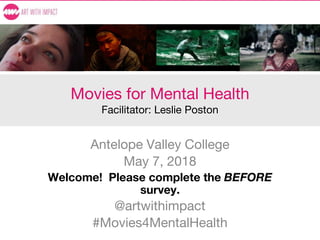
Movies for Mental Health
Facilitator: Leslie Poston
Antelope Valley College
May 7, 2018
Welcome! Please complete the BEFORE
survey.
@artwithimpact
#Movies4MentalHealth
Here’s the Plan
I. Quick Introduction: The Facilitator
II. Quick Overview: Art With Impact
III. Set the Stage Together
IV. Watch Short Films & Discuss Them
V. Make it Personal with Our Panel
Brought to you by
• Monthly Short Film
Competition
• Campus Workshops
• Global Community
(blog, IG, Twitter, FB)
• Mental Health Services Act (2004)
• 1% tax on people earning >$1m/year
• 25% to prevention and early intervention
Heads Up
★ Mental health is personal - YOU are the
expert of your own experience.
★ This is a public space - not therapy.
★ We’re here for connection, questions and
creating change!
★ Films might trigger big emotions - that’s OK!
★ Please ask for help if you need support.
Stigma
What is a stereotype?
Stigma is a judgment or stereotype that is:
1. Always negative
2. Always untrue
3. Can be internalized
Gladys
By Jessica Jones
AWI Winner, November 2013
What did you notice about stigma?
Hispanic Community: Do not talk about mental health. Taboo and kept within
the family circle. Reaching out/vocalizing is frowned upon. Family bond –
would rather fix it, than seek professional help. Negativity of judgment. As
display of weakness.
Gladys was stigmatized even by her family and caused her to stigmatize
others.
Her characteristics of crazy or mental health (stigmatizing visible signs).
Stigma on oneself leads to not reaching out, which makes things worse –
leading up to suicide.
Stating that there is a “type” of mental illness. There isn’t a particular
look/looks can be deceiving.
How does stigma feel?
Stressful
Isolated
Depressed
Like you’re being watched
Fearful
Like you’re not a part of society
Like you’re taking time off
Hated
Labeled
Less than
Lonely
Feel chronic – never-ending/relentless
Defensive
Stuck in quicksand
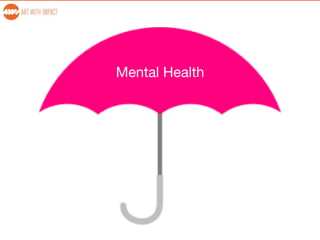
Mental Health
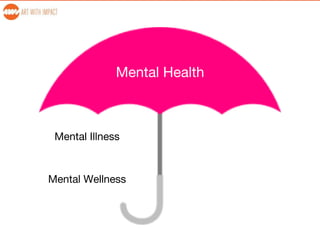
Mental Health
Mental Illness
Mental Wellness
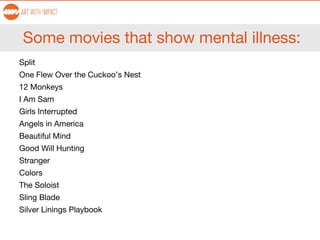
Some movies that show mental illness:
Split
One Flew Over the Cuckoo’s Nest
12 Monkeys
I Am Sam
Girls Interrupted
Angels in America
Beautiful Mind
Good Will Hunting
Stranger
Colors
The Soloist
Sling Blade
Silver Linings Playbook
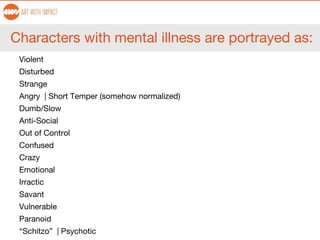
Characters with mental illness are portrayed as:
Violent
Disturbed
Strange
Angry | Short Temper (somehow normalized)
Dumb/Slow
Anti-Social
Out of Control
Confused
Crazy
Emotional
Irractic
Savant
Vulnerable
Paranoid
“Schitzo” | Psychotic
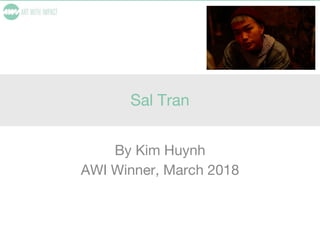
Sal Tran
By Kim Huynh
AWI Winner, March 2018
Discuss
• What did you think?
• What did you feel?
What did you think? What did you feel?
Thoughts
”That was me” – different skin color
(shared experience)
Culture had a large role to play (not
wanting to talk about it)
Courage to step out of her culture –
seeking help she needed (healing
with people that understand)
People you surround yourself with
just don’t hear your cry – until that
one person (Seek help)
Embraced her narrative
Used her creativity to control her
narrative – autonomy through chosen
medium
Stopped living up to society’s
expectations led to her breakthrough
Feelings
Captured emotions that Kim went
through – portrayed well enough for
viewer to relate to it
When she came out – she came out
boldly and was able to be the young
person she wanted to be. Face her
fears – head on. That she likes who
she is.
Feeling about the word “culture” –
words – individual thing or
embarrassing
From initial sadness to her rebirth
What did you think? What did you feel?
Thoughts
She began stigmatizing (parents,
officers, authority figures) – but they
were able to help her.
This often happens until they
intervene and lead to help.
Some things can be race based –
labeled within household negatively
(specific to individual) different
customs.
Feelings
Can’t tell everything to everybody
Difficult to see and recognize someone is
in pain – especially when you see them
everyday
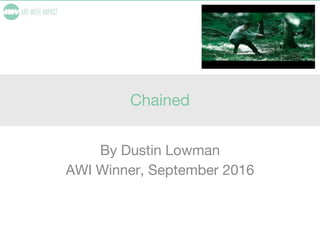
Chained
By Dustin Lowman
AWI Winner, September 2016
Discuss
• What did you think?
• What did you feel?
What did you think? What did you feel?
Thoughts
Marine improvising, adapting and
overcoming (in himself)
First tried to solve problem by pulling
on tree – occurred to him to start
digging
Marine in suit and tie – gave
impression he is no longer active
duty – transition from being active
duty (difficulty of transitioning with
PTSD)
With PTSD – we’re all in a fight some
kind of way – war within a war (going
to school and other obligations)
Keep going forward – winning battle
– keep going.
Feelings
Impact – struggling to get free of his
PTSD. (Dirt as counselor/people
around to help him out) – to break
Marine with lived experience – was
fighting and had to stop fighting and
think outside the box. Once he was
fatigued his mind went someone else
– extremely powerful.
PTSD – anchor around her leg and
every now and then getting air
(swimming) – constant fight for
survival.
Find ending – key getting him out,
not completely accurate – but in life
it’s always with you and he was able
to get out
What did you think? What did you feel?
Thoughts
Likened to school
If we’re not free of some things of
warrior culture (there are good things
as well) – sometimes have to weave
into one’s life (society more like
warrior) Doesn’t have to apply to
war. Living better with it – because
of, not in spite of.
Metaphor of the tree – PTSD with
many different symptoms (branches)
– they are varied – some free, some
hook you – dependent on the trigger
Feelings
Why don’t people get help?
Don’t want to be judged. JUDGMENT
(with chronic issues) This is not going to help/fail me again. This is who I am
forever.
Lack of knowledge.
Into sense of – going to one therapist (one poor/bad experience). There are
options.
Don’t have support system that they not.
Resources (access to care).
Perceived access vs. literal access (support services) My culture says I
can/not access this.
Unaware of problem.
Feel like no one else can relate to them.
Embarrassed
Don’t want to be labeled as being crazy.
Why don’t people get help?
Too much anxiety about getting out and talking.
Fear change that can happen.
Indicates weakness – not tough to pull it together.
Afraid employer might find out.
Cost.
Question: What is talking going to help?
What does they know about their life?
Scared to admit it.
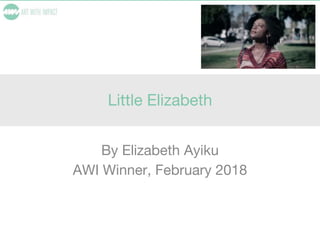
Little Elizabeth
By Elizabeth Ayiku
AWI Winner, February 2018
Initial Reactions?
What can we do?
Writing/journaling
Surround yourself with supportive people
Find outlet that will support you (outlet)
Self-help books
Exercise
Smile – movement
Working on being more compassionate for yourself and to yourself
Give back – contribute to others
Being honest with yourself and listening to your gut/intuition
The Panel is up next!
If you can stay, please don’t miss out on the
panelists’ personal experiences and incredible
mental wellness resources!
If not, please complete both sides of the
AFTER survey and we’ll collect it!
Panelists, please come to the front of
the room.
Meet the Panel
• Kendall Wallace - Antelope Valley College Student
• Rachel Garcia - Antelope Valley College Student
• Zina Crosby - Antelope Valley College Student
• Karen Coy, Ph.D. - CSUB-AV Counseling Center Psychologist
• Jacob Marciel, LCSW, CATC IV - CSUB-AV Licensed Clinical
Social Worker
• Angelina Alvarez - Sexual Assault Crisis Counselor
• John Glover, LCSW - Mental Health of America
• Harriet Wilson - Readjustment Counseling Therapist, Antelope
Valley Vet Center
• Gerry Rice, MA, LMFT - Marriage and Family Therapist
AWI Ambassadors
• You’re invited! Continue the conversation, be
a leader!
• Join the AWI Ambassadors FB group and
connect with students across North America:
www.facebook.com/groups/awiambassadors/
• Blog, be a juror for the film competition, run
campaigns, and much more!
Thank you for coming!
• Contact us: info@artwithimpact.org
• Follow us!
• Submit a film!
https://www.artwithimpact.org/films/submit-a-film/

Antelope valley may 2018 - powerpoint

  • 1.
    Movies for MentalHealth Facilitator: Leslie Poston Antelope Valley College May 7, 2018 Welcome! Please complete the BEFORE survey. @artwithimpact #Movies4MentalHealth
  • 2.
    Here’s the Plan I.Quick Introduction: The Facilitator II. Quick Overview: Art With Impact III. Set the Stage Together IV. Watch Short Films & Discuss Them V. Make it Personal with Our Panel
  • 3.
    Brought to youby • Monthly Short Film Competition • Campus Workshops • Global Community (blog, IG, Twitter, FB) • Mental Health Services Act (2004) • 1% tax on people earning >$1m/year • 25% to prevention and early intervention
  • 4.
    Heads Up ★ Mentalhealth is personal - YOU are the expert of your own experience. ★ This is a public space - not therapy. ★ We’re here for connection, questions and creating change! ★ Films might trigger big emotions - that’s OK! ★ Please ask for help if you need support.
  • 5.
    Stigma What is astereotype? Stigma is a judgment or stereotype that is: 1. Always negative 2. Always untrue 3. Can be internalized
  • 6.
    Gladys By Jessica Jones AWIWinner, November 2013
  • 7.
    What did younotice about stigma? Hispanic Community: Do not talk about mental health. Taboo and kept within the family circle. Reaching out/vocalizing is frowned upon. Family bond – would rather fix it, than seek professional help. Negativity of judgment. As display of weakness. Gladys was stigmatized even by her family and caused her to stigmatize others. Her characteristics of crazy or mental health (stigmatizing visible signs). Stigma on oneself leads to not reaching out, which makes things worse – leading up to suicide. Stating that there is a “type” of mental illness. There isn’t a particular look/looks can be deceiving.
  • 8.
    How does stigmafeel? Stressful Isolated Depressed Like you’re being watched Fearful Like you’re not a part of society Like you’re taking time off Hated Labeled Less than Lonely Feel chronic – never-ending/relentless Defensive Stuck in quicksand
  • 9.
  • 10.
  • 11.
    Some movies thatshow mental illness: Split One Flew Over the Cuckoo’s Nest 12 Monkeys I Am Sam Girls Interrupted Angels in America Beautiful Mind Good Will Hunting Stranger Colors The Soloist Sling Blade Silver Linings Playbook
  • 12.
    Characters with mentalillness are portrayed as: Violent Disturbed Strange Angry | Short Temper (somehow normalized) Dumb/Slow Anti-Social Out of Control Confused Crazy Emotional Irractic Savant Vulnerable Paranoid “Schitzo” | Psychotic
  • 13.
    Sal Tran By KimHuynh AWI Winner, March 2018
  • 14.
    Discuss • What didyou think? • What did you feel?
  • 15.
    What did youthink? What did you feel? Thoughts ”That was me” – different skin color (shared experience) Culture had a large role to play (not wanting to talk about it) Courage to step out of her culture – seeking help she needed (healing with people that understand) People you surround yourself with just don’t hear your cry – until that one person (Seek help) Embraced her narrative Used her creativity to control her narrative – autonomy through chosen medium Stopped living up to society’s expectations led to her breakthrough Feelings Captured emotions that Kim went through – portrayed well enough for viewer to relate to it When she came out – she came out boldly and was able to be the young person she wanted to be. Face her fears – head on. That she likes who she is. Feeling about the word “culture” – words – individual thing or embarrassing From initial sadness to her rebirth
  • 16.
    What did youthink? What did you feel? Thoughts She began stigmatizing (parents, officers, authority figures) – but they were able to help her. This often happens until they intervene and lead to help. Some things can be race based – labeled within household negatively (specific to individual) different customs. Feelings Can’t tell everything to everybody Difficult to see and recognize someone is in pain – especially when you see them everyday
  • 17.
    Chained By Dustin Lowman AWIWinner, September 2016
  • 18.
    Discuss • What didyou think? • What did you feel?
  • 19.
    What did youthink? What did you feel? Thoughts Marine improvising, adapting and overcoming (in himself) First tried to solve problem by pulling on tree – occurred to him to start digging Marine in suit and tie – gave impression he is no longer active duty – transition from being active duty (difficulty of transitioning with PTSD) With PTSD – we’re all in a fight some kind of way – war within a war (going to school and other obligations) Keep going forward – winning battle – keep going. Feelings Impact – struggling to get free of his PTSD. (Dirt as counselor/people around to help him out) – to break Marine with lived experience – was fighting and had to stop fighting and think outside the box. Once he was fatigued his mind went someone else – extremely powerful. PTSD – anchor around her leg and every now and then getting air (swimming) – constant fight for survival. Find ending – key getting him out, not completely accurate – but in life it’s always with you and he was able to get out
  • 20.
    What did youthink? What did you feel? Thoughts Likened to school If we’re not free of some things of warrior culture (there are good things as well) – sometimes have to weave into one’s life (society more like warrior) Doesn’t have to apply to war. Living better with it – because of, not in spite of. Metaphor of the tree – PTSD with many different symptoms (branches) – they are varied – some free, some hook you – dependent on the trigger Feelings
  • 21.
    Why don’t peopleget help? Don’t want to be judged. JUDGMENT (with chronic issues) This is not going to help/fail me again. This is who I am forever. Lack of knowledge. Into sense of – going to one therapist (one poor/bad experience). There are options. Don’t have support system that they not. Resources (access to care). Perceived access vs. literal access (support services) My culture says I can/not access this. Unaware of problem. Feel like no one else can relate to them. Embarrassed Don’t want to be labeled as being crazy.
  • 22.
    Why don’t peopleget help? Too much anxiety about getting out and talking. Fear change that can happen. Indicates weakness – not tough to pull it together. Afraid employer might find out. Cost. Question: What is talking going to help? What does they know about their life? Scared to admit it.
  • 23.
    Little Elizabeth By ElizabethAyiku AWI Winner, February 2018
  • 24.
  • 25.
    What can wedo? Writing/journaling Surround yourself with supportive people Find outlet that will support you (outlet) Self-help books Exercise Smile – movement Working on being more compassionate for yourself and to yourself Give back – contribute to others Being honest with yourself and listening to your gut/intuition
  • 26.
    The Panel isup next! If you can stay, please don’t miss out on the panelists’ personal experiences and incredible mental wellness resources! If not, please complete both sides of the AFTER survey and we’ll collect it! Panelists, please come to the front of the room.
  • 27.
    Meet the Panel •Kendall Wallace - Antelope Valley College Student • Rachel Garcia - Antelope Valley College Student • Zina Crosby - Antelope Valley College Student • Karen Coy, Ph.D. - CSUB-AV Counseling Center Psychologist • Jacob Marciel, LCSW, CATC IV - CSUB-AV Licensed Clinical Social Worker • Angelina Alvarez - Sexual Assault Crisis Counselor • John Glover, LCSW - Mental Health of America • Harriet Wilson - Readjustment Counseling Therapist, Antelope Valley Vet Center • Gerry Rice, MA, LMFT - Marriage and Family Therapist
  • 28.
    AWI Ambassadors • You’reinvited! Continue the conversation, be a leader! • Join the AWI Ambassadors FB group and connect with students across North America: www.facebook.com/groups/awiambassadors/ • Blog, be a juror for the film competition, run campaigns, and much more!
  • 29.
    Thank you forcoming! • Contact us: info@artwithimpact.org • Follow us! • Submit a film! https://www.artwithimpact.org/films/submit-a-film/

Editor's Notes

  • #2 Campus organizer (may) introduce facilitator Brief introduction – welcome, name Encourage people to come closer Connect with us on Instagram, Facebook or Twitter and document this event - we’d love to see your photos!
  • #3 Brief agenda review: - will give you a brief summary of AWI - set the stage together, which really means that as a group we’ll have a discussion and provide a context for the topics - we have four short films from our library to show you, together we’ll discuss the themes - Make it personal with a panel of campus and community resources to connect you with - You’ll be doing most of the talking today! Mention photos - if you would prefer not to have your face in photos please inform us after the event
  • #4 Who is AWI? - we are a charity dedicated to reducing the stigma of mental illness with transition-aged youth, work in regions throughout North America - we have been working in the US and Canada since 2011 - We host an ongoing monthly short film competition where filmmakers anywhere in the world can submit a film on the topic of mental health, these are juried and monthly winners receive $1,000 cash prize (will tell you more about that at the end of our time together) - We then take these winning films and facilitate discussions in our postsecondary Movies for Mental Health program (you’ll see what this is all about today) and run a high school program that teaches media literacy to youth and allows them to make their own short films on mental health - Also a part of a larger global community, release blogs twice a week on feature length films, or film festivals related to themes of mental illness Brought to you by: - mention any nonprofit partners or corporate sponsors
  • #5 Want to explain what I mean about this statement… Mental health is personal and our experiences are different, we all come from different backgrounds and cultures – you are the experts on YOU and know yourself better than anyone else. We don’t often talk about mental health; as a society we don’t tend to talk about issues/experiences related to this theme, so sometimes we don’t know HOW to talk about these topics. First and foremost keep yourself safe today, don’t feel compelled to share anything you’re not comfortable with. This is a new space and you might feel ready to share but might not know what responses you’ll have, and it is a public space with no guaranteed confidentiality so be mindful of the space that we are in before you disclose. Some of the films might be triggering, meaning they might elicit an emotional reaction. It’s ok to feel! But if you ever feel that you are not OK, or unsafe, please do what you need to do to take care of yourself. We have counsellors in the room today that are here to help you if you need to step out (say names of counsellors, have them raise their hands in the audience).
  • #6 FIRST - ask for one or two people to define “stereotype.” Really just one or two - NOT a big discussion. THEN, name that stigma and stereotype are often used interchangeably, but stigma has a few distinct qualities. Quick definition. Provide a little explanation of the third point - we can take in these judgments and believe them about ourselves, even though they’re untrue. For example, if everyone tells me that having depression is just being lazy, it’s possible that I could start to believe that myself, that I’m just lazy and don’t need to seek support. Do a quick check to see if everyone gets it and is on board - again, not a big discussion, but a “thumbs up” check or see if they’re generally nodding
  • #7 15 minutes into the workshop
  • #9 Can close this slide by naming that yes, stigma can be a huge negative aspect of our experience, but it’s not permanent. Through conversations like these, and by sharing our truths, we can change stigma, and reduce it, and ultimately, get rid of it entirely.
  • #10 25 minutes into the workshop Introduce ways that AWI holds some concepts around MH - these may change over time, terms are evolving. Quick slide: We see mental health as an umbrella in that it is something that we are all existing under, and experiencing. Mental health can include many aspects of life. It’s our internal way of seeing the world, and something we all have and experience. Like physical health, we all have mental health, and things within and outside of ourselves can affect our mental health. Things outside of the MH umbrella, like culture, spirituality, physical health, support systems, etc. can affect our MH. There’s lots of intersectionality and influences when it comes to MH. There can be embedded and systemic influences (such as histories of oppression, privilege, access to services) and other components that influence the way we as individuals experience MH.
  • #11 MI and MW are concepts that fall under the umbrella of MH. MI can be defined as when uncontrollable things happening within you and/or influenced by other things get in the way of you living the life you want to live. This can arise from trauma or be circumstantial, and can also be influenced by genetics and biology. Mental illness diagnoses are helpful for some, and for others provide more of a shared language. MI may differ between how society defines it and how we define it for ourselves. MW means feeling “well” - however you define it - in your mind and spirit. It can include practices and behaviors that support you and help you feel and be your best self. Like physical health, it requires maintenance. We don’t hold these as opposites - you can have symptoms of a mental illness, and engage in mental wellness practices. You can also not have symptoms of a MI, but still not be mentally well, if you don’t have ways of supporting your internal (and external) self.
  • #13 Can close up this slide by saying yes, media portrayals are overall negative, but there are artists and filmmakers out there making films that can change this. Many of our films are made by people with lived experience, and share their genuine truths.
  • #14 35 minutes into the workshop
  • #18 50 minutes into the workshop
  • #22 ***CAN SKIP SLIDE IF RUNNING LOW ON TIME*** Ideally, you will be able to use this slide, as it can lead to a great discussion about stigma, and how different stigmas (and other factors) can keep people from seeking support. If you think you’re running out of time, try to prompt this question in the previous “thoughts / feelings” slide so it’s at least touched on, even if you don’t use this slide.
  • #23 ***CAN SKIP SLIDE IF RUNNING LOW ON TIME*** Ideally, you will be able to use this slide, as it can lead to a great discussion about stigma, and how different stigmas (and other factors) can keep people from seeking support. If you think you’re running out of time, try to prompt this question in the previous “thoughts / feelings” slide so it’s at least touched on, even if you don’t use this slide.
  • #24 1 hour and 5 minutes into the workshop
  • #25 This slide is to give space to discussing the last film, but isn’t an in-depth thoughts/feelings slide. It should be a group conversation (not small groups), and just take a few people’s reactions to the film. Depending on time, you might need to move on quickly, but if you have time, feel free to let this be an open discussion about the film.
  • #26 From what we’ve learned - actions we may be drawn to take. Be sure to encourage responses that relate to what we can do as friends, family members, and community members of people with MI, AND ALSO make sure they address what we can do for ourselves, i.e. mental wellness practices.
  • #27 1 hour and 20 minutes into the workshop “Now will invite our panelists to come up. We will hear from the students, sharing their personal stories. We’re so grateful for their courage in sharing their stories! We will also hear from resources on-campus and in the community. After the panelists all speak, you will have a chance to ask the panel any questions you have. If you need to leave early, please do so respectfully, and please make sure to fill out an evaluation before you leave. This information is super helpful for us in making sure we and your school are serving your needs as well as we can. We will also pass these out at the end of the workshop.” **Applause for panelists!** They will then speak in order of how they are in the slide. At the end, you will invite questions from the audience.
  • #28 1 hour and 20 minutes into the workshop “Now will invite our panelists to come up. We will hear from the students, sharing their personal stories. We’re so grateful for their courage in sharing their stories! We will also hear from resources on-campus and in the community. After the panelists all speak, you will have a chance to ask the panel any questions you have. If you need to leave early, please do so respectfully, and please make sure to fill out an evaluation before you leave. This information is super helpful for us in making sure we and your school are serving your needs as well as we can. We will also pass these out at the end of the workshop.” **Applause for panelists!** They will then speak in order of how they are in the slide. At the end, you will invite questions from the audience.
  • #29 1 hour and 55 minutes into the workshop AWI exists to create a community of students, artists, advocates, who want to have these conversations...if you’re interested in staying in touch with us and becoming a part of a larger community of students across N. America who believe in the power of art to subvert stigma