AIR FORCE Magazine / April 200654
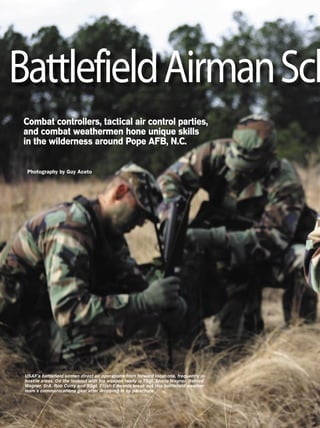
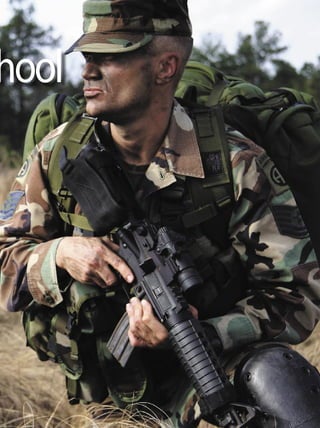
USAF’s battlefield airmen direct air operations from forward locations, frequently in
hostile areas. On the lookout with his weapon ready is TSgt. Shane Wagner. Behind
Wagner, SrA. Rob Curry and SSgt. Elijah Edwards break out this battlefield weather
team’s communications gear after dropping in by parachute.
Photography by Guy Aceto
Combat controllers, tactical air control parties,
and combat weathermen hone unique skills
in the wilderness around Pope AFB, N.C.
BattlefieldAirmanSch
AIR FORCE Magazine / April 2006 55
hool
AIR FORCE Magazine / April 200656
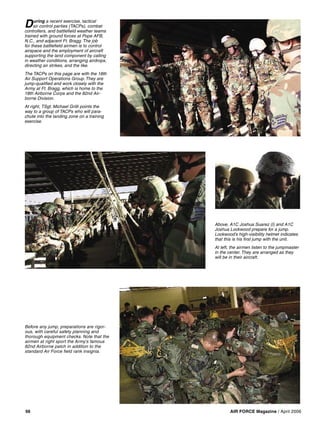
Before any jump, preparations are rigor-
ous, with careful safety planning and
thorough equipment checks. Note that the
airmen at right sport the Army’s famous
82nd Airborne patch in addition to the
standard Air Force field rank insignia.
Above, A1C Joshua Suarez (l) and A1C
Joshua Lockwood prepare for a jump.
Lockwood’s high-visibility helmet indicates
that this is his first jump with the unit.
At left, the airmen listen to the jumpmaster
in the center. They are arranged as they
will be in their aircraft.
During a recent exercise, tactical
air control parties (TACPs), combat
controllers, and battlefield weather teams
trained with ground forces at Pope AFB,
N.C., and adjacent Ft. Bragg. The job
for these battlefield airmen is to control
airspace and the employment of aircraft
supporting the land component by calling
in weather conditions, arranging airdrops,
directing air strikes, and the like.
The TACPs on this page are with the 18th
Air Support Operations Group. They are
jump-qualified and work closely with the
Army at Ft. Bragg, which is home to the
18th Airborne Corps and the 82nd Air-
borne Division.
At right, TSgt. Michael Grilli points the
way to a group of TACPs who will para-
chute into the landing zone on a training
exercise.
AIR FORCE Magazine / April 2006 57
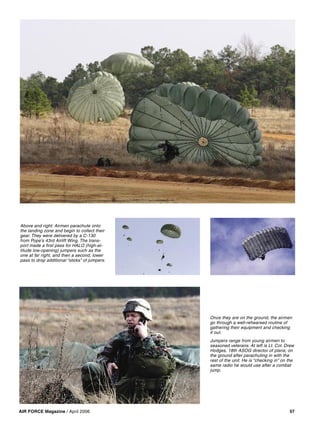
Above and right: Airmen parachute onto
the landing zone and begin to collect their
gear. They were delivered by a C-130
from Pope’s 43rd Airlift Wing. The trans-
port made a first pass for HALO (high-al-
titude low-opening) jumpers such as the
one at far right, and then a second, lower
pass to drop additional “sticks” of jumpers.
Once they are on the ground, the airmen
go through a well-rehearsed routine of
gathering their equipment and checking
it out.
Jumpers range from young airmen to
seasoned veterans. At left is Lt. Col. Drew
Hodges, 18th ASOG director of plans, on
the ground after parachuting in with the
rest of the unit. He is “checking in” on the
same radio he would use after a combat
jump.
AIR FORCE Magazine / April 200658
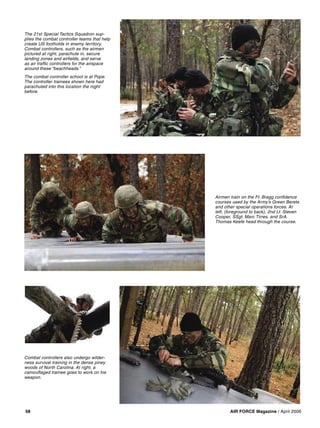
The 21st Special Tactics Squadron sup-
plies the combat controller teams that help
create US footholds in enemy territory.
Combat controllers, such as the airmen
pictured at right, parachute in, secure
landing zones and airfields, and serve
as air traffic controllers for the airspace
around these “beachheads.”
The combat controller school is at Pope.
The controller trainees shown here had
parachuted into this location the night
before.
Combat controllers also undergo wilder-
ness survival training in the dense piney
woods of North Carolina. At right, a
camouflaged trainee goes to work on his
weapon.
Airmen train on the Ft. Bragg confidence
courses used by the Army’s Green Berets
and other special operations forces. At
left, (foreground to back), 2nd Lt. Steven
Cooper, SSgt. Marc Tirres, and SrA.
Thomas Keefe head through the course.
AIR FORCE Magazine / April 2006 59
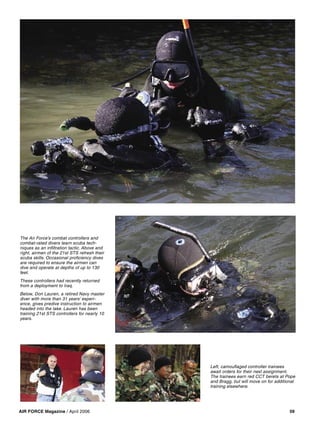
The Air Force’s combat controllers and
combat-rated divers learn scuba tech-
niques as an infiltration tactic. Above and
right, airmen of the 21st STS refresh their
scuba skills. Occasional proficiency dives
are required to ensure the airmen can
dive and operate at depths of up to 130
feet.
These controllers had recently returned
from a deployment to Iraq.
Below, Don Lauren, a retired Navy master
diver with more than 31 years’ experi-
ence, gives predive instruction to airmen
headed into the lake. Lauren has been
training 21st STS controllers for nearly 10
years.
Left, camouflaged controller trainees
await orders for their next assignment.
The trainees earn red CCT berets at Pope
and Bragg, but will move on for additional
training elsewhere.
AIR FORCE Magazine / April 200660
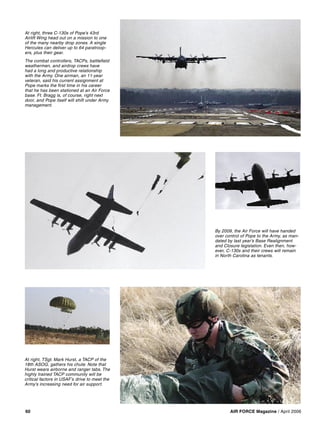
At right, TSgt. Mark Hurst, a TACP of the
18th ASOG, gathers his chute. Note that
Hurst wears airborne and ranger tabs. The
highly trained TACP community will be
critical factors in USAF’s drive to meet the
Army’s increasing need for air support.
At right, three C-130s of Pope’s 43rd
Airlift Wing head out on a mission to one
of the many nearby drop zones. A single
Hercules can deliver up to 64 paratroop-
ers, plus their gear.
The combat controllers, TACPs, battlefield
weathermen, and airdrop crews have
had a long and productive relationship
with the Army. One airman, an 11-year
veteran, said his current assignment at
Pope marks the first time in his career
that he has been stationed at an Air Force
base. Ft. Bragg is, of course, right next
door, and Pope itself will shift under Army
management.
By 2009, the Air Force will have handed
over control of Pope to the Army, as man-
dated by last year’s Base Realignment
and Closure legislation. Even then, how-
ever, C-130s and their crews will remain
in North Carolina as tenants.
AIR FORCE Magazine / April 2006 61
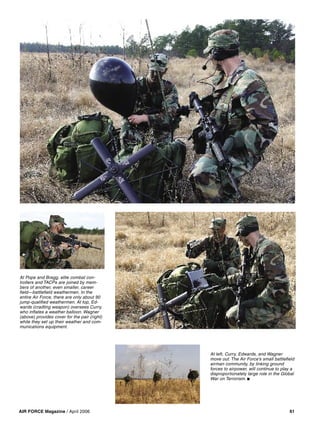
At left, Curry, Edwards, and Wagner
move out. The Air Force’s small battlefield
airman community, by linking ground
forces to airpower, will continue to play a
disproportionately large role in the Global
War on Terrorism. ■
At Pope and Bragg, elite combat con-
trollers and TACPs are joined by mem-
bers of another, even smaller, career
field—battlefield weathermen. In the
entire Air Force, there are only about 90
jump-qualified weathermen. At top, Ed-
wards (cradling weapon) oversees Curry,
who inflates a weather balloon. Wagner
(above) provides cover for the pair (right)
while they set up their weather and com-
munications equipment.

BattlefieldAirmen April 2006

  • 2.
    AIR FORCE Magazine/ April 200654 USAF’s battlefield airmen direct air operations from forward locations, frequently in hostile areas. On the lookout with his weapon ready is TSgt. Shane Wagner. Behind Wagner, SrA. Rob Curry and SSgt. Elijah Edwards break out this battlefield weather team’s communications gear after dropping in by parachute. Photography by Guy Aceto Combat controllers, tactical air control parties, and combat weathermen hone unique skills in the wilderness around Pope AFB, N.C. BattlefieldAirmanSch
  • 3.
    AIR FORCE Magazine/ April 2006 55 hool
  • 4.
    AIR FORCE Magazine/ April 200656 Before any jump, preparations are rigor- ous, with careful safety planning and thorough equipment checks. Note that the airmen at right sport the Army’s famous 82nd Airborne patch in addition to the standard Air Force field rank insignia. Above, A1C Joshua Suarez (l) and A1C Joshua Lockwood prepare for a jump. Lockwood’s high-visibility helmet indicates that this is his first jump with the unit. At left, the airmen listen to the jumpmaster in the center. They are arranged as they will be in their aircraft. During a recent exercise, tactical air control parties (TACPs), combat controllers, and battlefield weather teams trained with ground forces at Pope AFB, N.C., and adjacent Ft. Bragg. The job for these battlefield airmen is to control airspace and the employment of aircraft supporting the land component by calling in weather conditions, arranging airdrops, directing air strikes, and the like. The TACPs on this page are with the 18th Air Support Operations Group. They are jump-qualified and work closely with the Army at Ft. Bragg, which is home to the 18th Airborne Corps and the 82nd Air- borne Division. At right, TSgt. Michael Grilli points the way to a group of TACPs who will para- chute into the landing zone on a training exercise.
  • 5.
    AIR FORCE Magazine/ April 2006 57 Above and right: Airmen parachute onto the landing zone and begin to collect their gear. They were delivered by a C-130 from Pope’s 43rd Airlift Wing. The trans- port made a first pass for HALO (high-al- titude low-opening) jumpers such as the one at far right, and then a second, lower pass to drop additional “sticks” of jumpers. Once they are on the ground, the airmen go through a well-rehearsed routine of gathering their equipment and checking it out. Jumpers range from young airmen to seasoned veterans. At left is Lt. Col. Drew Hodges, 18th ASOG director of plans, on the ground after parachuting in with the rest of the unit. He is “checking in” on the same radio he would use after a combat jump.
  • 6.
    AIR FORCE Magazine/ April 200658 The 21st Special Tactics Squadron sup- plies the combat controller teams that help create US footholds in enemy territory. Combat controllers, such as the airmen pictured at right, parachute in, secure landing zones and airfields, and serve as air traffic controllers for the airspace around these “beachheads.” The combat controller school is at Pope. The controller trainees shown here had parachuted into this location the night before. Combat controllers also undergo wilder- ness survival training in the dense piney woods of North Carolina. At right, a camouflaged trainee goes to work on his weapon. Airmen train on the Ft. Bragg confidence courses used by the Army’s Green Berets and other special operations forces. At left, (foreground to back), 2nd Lt. Steven Cooper, SSgt. Marc Tirres, and SrA. Thomas Keefe head through the course.
  • 7.
    AIR FORCE Magazine/ April 2006 59 The Air Force’s combat controllers and combat-rated divers learn scuba tech- niques as an infiltration tactic. Above and right, airmen of the 21st STS refresh their scuba skills. Occasional proficiency dives are required to ensure the airmen can dive and operate at depths of up to 130 feet. These controllers had recently returned from a deployment to Iraq. Below, Don Lauren, a retired Navy master diver with more than 31 years’ experi- ence, gives predive instruction to airmen headed into the lake. Lauren has been training 21st STS controllers for nearly 10 years. Left, camouflaged controller trainees await orders for their next assignment. The trainees earn red CCT berets at Pope and Bragg, but will move on for additional training elsewhere.
  • 8.
    AIR FORCE Magazine/ April 200660 At right, TSgt. Mark Hurst, a TACP of the 18th ASOG, gathers his chute. Note that Hurst wears airborne and ranger tabs. The highly trained TACP community will be critical factors in USAF’s drive to meet the Army’s increasing need for air support. At right, three C-130s of Pope’s 43rd Airlift Wing head out on a mission to one of the many nearby drop zones. A single Hercules can deliver up to 64 paratroop- ers, plus their gear. The combat controllers, TACPs, battlefield weathermen, and airdrop crews have had a long and productive relationship with the Army. One airman, an 11-year veteran, said his current assignment at Pope marks the first time in his career that he has been stationed at an Air Force base. Ft. Bragg is, of course, right next door, and Pope itself will shift under Army management. By 2009, the Air Force will have handed over control of Pope to the Army, as man- dated by last year’s Base Realignment and Closure legislation. Even then, how- ever, C-130s and their crews will remain in North Carolina as tenants.
  • 9.
    AIR FORCE Magazine/ April 2006 61 At left, Curry, Edwards, and Wagner move out. The Air Force’s small battlefield airman community, by linking ground forces to airpower, will continue to play a disproportionately large role in the Global War on Terrorism. ■ At Pope and Bragg, elite combat con- trollers and TACPs are joined by mem- bers of another, even smaller, career field—battlefield weathermen. In the entire Air Force, there are only about 90 jump-qualified weathermen. At top, Ed- wards (cradling weapon) oversees Curry, who inflates a weather balloon. Wagner (above) provides cover for the pair (right) while they set up their weather and com- munications equipment.