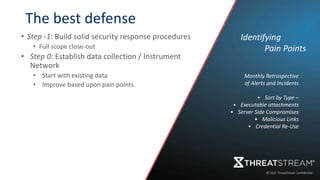
• Step -1: Build solid security response procedures
• Full scope close-out
• Step 0: Establish data collection / Instrument
Network
• Start with existing data
• Improve based upon pain points
The best defense
Monthly Retrospective
of Alerts and Incidents
• Sort by Type –
• Executable attachments
• Server Side Compromises
• Malicious Links
• Credential Re-Use
Identifying
Pain Points
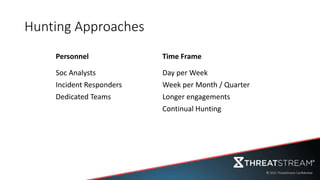
Hunting Approaches
Personnel Time Frame
Soc Analysts Day per Week
Incident Responders Week per Month / Quarter
Dedicated Teams Longer engagements
Continual Hunting
Approach 1: Day per week
• Staff: SoC analysts and/or IR staff
• Tactics:
• Indicator sweeps
• Basic heuristic approaches
• Benefits:
• Improve SoC staff proficiency
• Identifying the “simple” stuff
Approach 2: Week per month / quarter
• Staff: SoC Staff and/or IR teams
• Tactics:
• Improving and tuning data sources
• Heuristics
• General tactics in threat reports
• Benefits:
• Improved posture against a Pain Point
• New detection scripts
• Improved skillsets and situational awareness
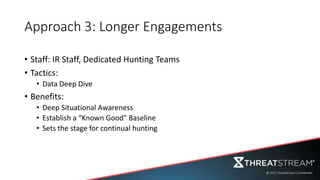
Approach 3: Longer Engagements
• Staff: IR Staff, Dedicated Hunting Teams
• Tactics:
• Data Deep Dive
• Benefits:
• Deep Situational Awareness
• Establish a “Known Good” Baseline
• Sets the stage for continual hunting
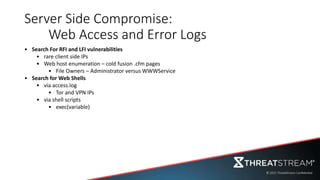
Server Side Compromise:
Web Access and Error Logs
• Search For RFI and LFI vulnerabilities
• rare client side IPs
• Web host enumeration – cold fusion .cfm pages
• File Owners – Administrator versus WWWService
• Search for Web Shells
• via access.log
• Tor and VPN IPs
• via shell scripts
• exec(variable)
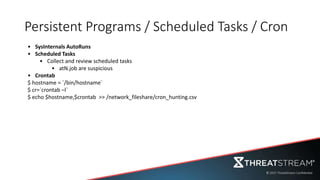
Persistent Programs / Scheduled Tasks / Cron
• SysInternals AutoRuns
• Scheduled Tasks
• Collect and review scheduled tasks
• atN.job are suspicious
• Crontab
$ hostname = `/bin/hostname`
$ cr=`crontab –l`
$ echo $hostname,$crontab >> /network_fileshare/cron_hunting.csv
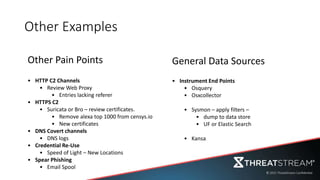
Other Examples
• HTTP C2 Channels
• Review Web Proxy
• Entries lacking referer
• HTTPS C2
• Suricata or Bro – review certificates.
• Remove alexa top 1000 from censys.io
• New certificates
• DNS Covert channels
• DNS logs
• Credential Re-Use
• Speed of Light – New Locations
• Spear Phishing
• Email Spool
• Instrument End Points
• Osquery
• Osxcollector
• Sysmon – apply filters –
• dump to data store
• UF or Elastic Search
• Kansa
Other Pain Points General Data Sources
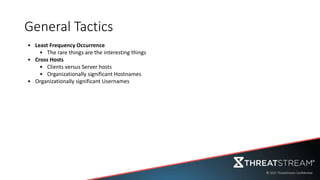
General Tactics
• Least Frequency Occurrence
• The rare things are the interesting things
• Cross Hosts
• Clients versus Server hosts
• Organizationally significant Hostnames
• Organizationally significant Usernames
Aaron Shelmire | Sr. Security Researcher
2317 Broadway, 3rd Floor| Redwood City, CA 94063
Twitter: @ashelmire
Happy Hunting

Battlefield Network

  • 1.
    • Step -1:Build solid security response procedures • Full scope close-out • Step 0: Establish data collection / Instrument Network • Start with existing data • Improve based upon pain points The best defense Monthly Retrospective of Alerts and Incidents • Sort by Type – • Executable attachments • Server Side Compromises • Malicious Links • Credential Re-Use Identifying Pain Points
  • 2.
    Hunting Approaches Personnel TimeFrame Soc Analysts Day per Week Incident Responders Week per Month / Quarter Dedicated Teams Longer engagements Continual Hunting
  • 3.
    Approach 1: Dayper week • Staff: SoC analysts and/or IR staff • Tactics: • Indicator sweeps • Basic heuristic approaches • Benefits: • Improve SoC staff proficiency • Identifying the “simple” stuff
  • 4.
    Approach 2: Weekper month / quarter • Staff: SoC Staff and/or IR teams • Tactics: • Improving and tuning data sources • Heuristics • General tactics in threat reports • Benefits: • Improved posture against a Pain Point • New detection scripts • Improved skillsets and situational awareness
  • 5.
    Approach 3: LongerEngagements • Staff: IR Staff, Dedicated Hunting Teams • Tactics: • Data Deep Dive • Benefits: • Deep Situational Awareness • Establish a “Known Good” Baseline • Sets the stage for continual hunting
  • 6.
    Server Side Compromise: WebAccess and Error Logs • Search For RFI and LFI vulnerabilities • rare client side IPs • Web host enumeration – cold fusion .cfm pages • File Owners – Administrator versus WWWService • Search for Web Shells • via access.log • Tor and VPN IPs • via shell scripts • exec(variable)
  • 7.
    Persistent Programs /Scheduled Tasks / Cron • SysInternals AutoRuns • Scheduled Tasks • Collect and review scheduled tasks • atN.job are suspicious • Crontab $ hostname = `/bin/hostname` $ cr=`crontab –l` $ echo $hostname,$crontab >> /network_fileshare/cron_hunting.csv
  • 8.
    Other Examples • HTTPC2 Channels • Review Web Proxy • Entries lacking referer • HTTPS C2 • Suricata or Bro – review certificates. • Remove alexa top 1000 from censys.io • New certificates • DNS Covert channels • DNS logs • Credential Re-Use • Speed of Light – New Locations • Spear Phishing • Email Spool • Instrument End Points • Osquery • Osxcollector • Sysmon – apply filters – • dump to data store • UF or Elastic Search • Kansa Other Pain Points General Data Sources
  • 9.
    General Tactics • LeastFrequency Occurrence • The rare things are the interesting things • Cross Hosts • Clients versus Server hosts • Organizationally significant Hostnames • Organizationally significant Usernames
  • 10.
    Aaron Shelmire |Sr. Security Researcher 2317 Broadway, 3rd Floor| Redwood City, CA 94063 Twitter: @ashelmire Happy Hunting