BATTERY HEALTH
DETECTION TESTING IN
BATTERY SWAPPING SYSTEM
- BY CHAITYA GALA AND TEJAS PANDYA FROM SHRI BHAGUBHAI
MAFATLAL POLYTECHNIC
• Battery swapping systems have become increasingly
popular in recent years as a means of quickly and
efficiently exchanging depleted batteries for fully charged
ones. However, it is essential to regularly assess the health
of the batteries in the system to ensure that they are
functioning optimally and to minimize the risk of
downtime. In this paper, we review the various tests that
can be used for battery health detection in battery
swapping systems, including both invasive and non-
invasive methods.
BATTERY SWAPPING SYSTEM
• Battery swapping technology is a new approach to
charging electric vehicles (EVs) that aims to overcome
some of the challenges associated with traditional
charging methods. The concept involves exchanging a
depleted battery for a fully charged one, eliminating
the need for time-consuming charging.
ADVANTAGES OF BATTERY SWAPPING
SYSTEM
1. Convenience: Battery swapping offers a more convenient and efficient
solution for EV owners, allowing them to quickly swap their depleted
battery for a fully charged one and get back on the road.
2. Faster Charging: Battery swapping is much faster than traditional charging
methods, allowing EV owners to get back on the road in a matter of
minutes rather than hours.
3. Increased Range: Battery swapping technology allows EV owners to extend
the range of their vehicle, eliminating range anxiety and making longer
trips more feasible.
4. Standardization: By using standardized battery packs, battery swapping
technology simplifies the charging process and makes it easier for EV
BATTERY HEALTH DETECTION
• Battery health detection tests are an essential component
of battery swapping policy, as they ensure that only high-
quality batteries are used in the swapping process. These
tests help to prevent the use of batteries that are
damaged, worn out, or have lost their ability to store and
release energy effectively.
BATTERY HEALTH DETECTION TESTS
Here are some of the common battery health detection tests that
are used in battery swapping policy:
1. Capacity Test: This test measures the capacity of the battery,
which is a measure of the amount of energy it can store.
2. Voltage Test: This test measures the voltage of the battery,
which is a measure of the amount of energy stored in the
battery.
3. Resistance Test: This test measures the resistance of the
battery, which is a measure of the internal impedance of the
4. Cycle Life Test: This test measures the number of charging and
discharging cycles a battery can undergo before it fails.
5. Age Test: This test measures the age of the battery, which is a
measure of the amount of time that has passed since the battery was
manufactured. An age test is used to determine the state of health of
the battery and whether it is suitable for use in a battery swapping
system.
6. Thermography Test: A thermography test measures the
temperature of a battery, which is an indicator of its health and
performance. Batteries that are overheating are considered to be less
CYCLE LIFE TEST
The cycle life test measures the number of cycles a battery
can undergo before its capacity drops to a predetermined
level. The test involves repeatedly charging and discharging
the battery to simulate real-world use and to determine
how the battery performs over time.
PROCEDURE
The procedure for conducting a cycle life test typically involves the
following steps:
1. Charge the battery to its maximum capacity
2. Discharge the battery to a predetermined cut-off voltage
3. Recharge the battery to its maximum capacity
4. Repeat steps 2 and 3 for a specified number of cycles
5. Measure the capacity of the battery after each cycle
6. Plot the capacity versus cycle number to determine the battery's
cycle life
CAPACITY TEST
• The capacity test is performed to determine the battery's ability
to store and release energy, providing a measure of its overall
performance. The capacity test can also be used to determine
the extent of performance degradation over time, as well as the
effects of various conditions, such as temperature, on battery
performance.
The capacity test is performed by discharging the battery under controlled
conditions.
1. Prepare the battery: The battery is prepared for testing by fully charging
it to its maximum capacity.
2. Load the battery: A load is applied to the battery, typically using a
constant current load. The load is maintained for a specified period of
time, usually between 1 and 4 hours.
3. Measure the voltage: The voltage of the battery is measured during the
discharge process. The voltage is typically plotted against time, providing
a graphical representation of the battery's performance.
4. Calculate the capacity: The capacity of the battery is calculated by
multiplying the discharge current by the time it took to discharge the
battery. The capacity is expressed in units of Ampere-hours (Ah).
5. Compare the results: The results of the capacity test are compared
against the manufacturer's specifications to determine the battery's
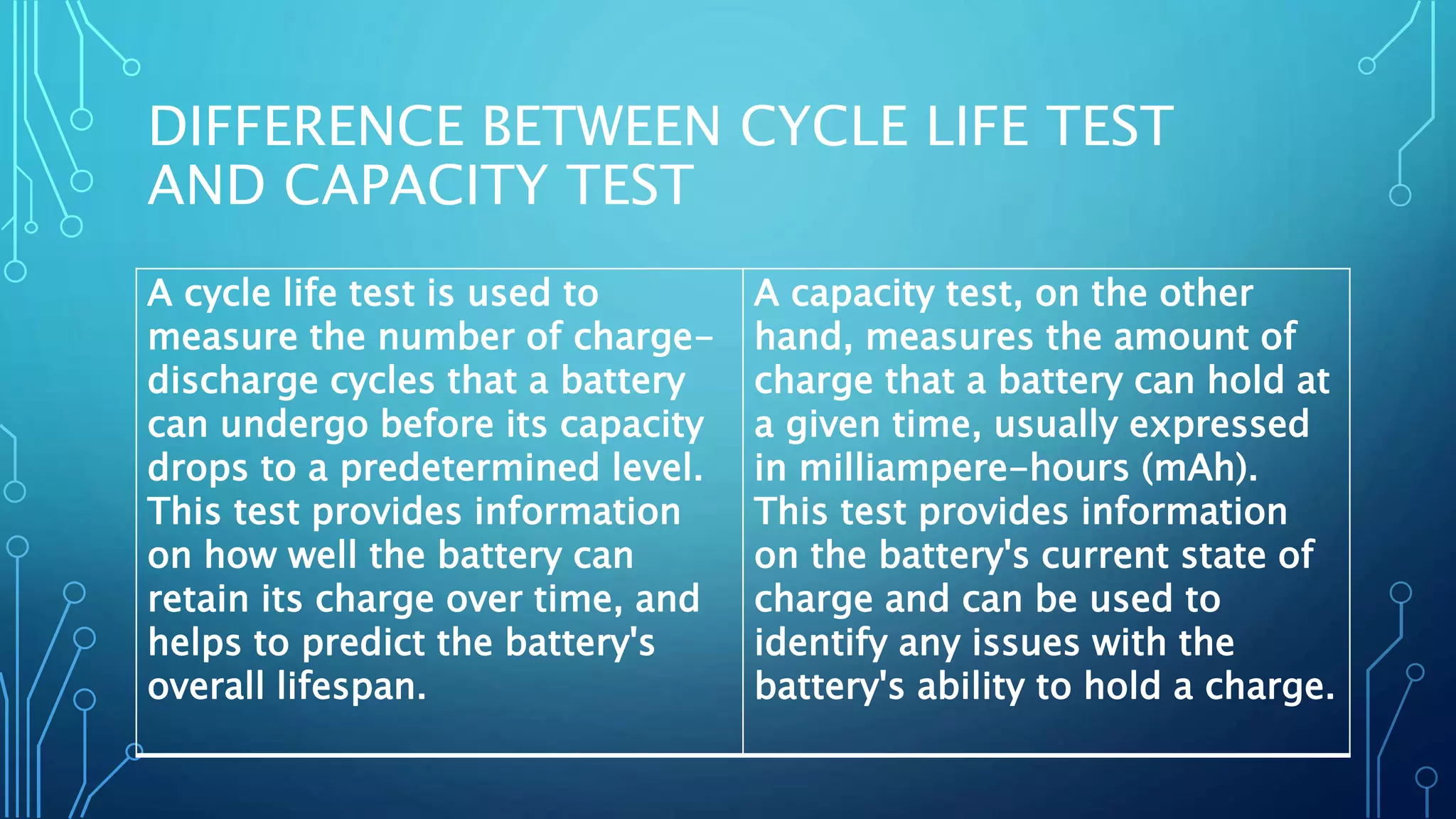
DIFFERENCE BETWEEN CYCLE LIFE TEST
AND CAPACITY TEST
A cycle life test is used to
measure the number of charge-
discharge cycles that a battery
can undergo before its capacity
drops to a predetermined level.
This test provides information
on how well the battery can
retain its charge over time, and
helps to predict the battery's
overall lifespan.
A capacity test, on the other
hand, measures the amount of
charge that a battery can hold at
a given time, usually expressed
in milliampere-hours (mAh).
This test provides information
on the battery's current state of
charge and can be used to
identify any issues with the
battery's ability to hold a charge.
NON INVASIVE METHODS OF CAPACITY
TESTING
• Non-invasive optical testing is a method of evaluating the
capacity and health of batteries in a battery swapping
system without physically opening the battery or
disrupting its operation. The testing process typically
involves shining light through the battery and measuring
the amount of light that is absorbed or scattered by the
battery's internal components. This information is then
used to determine the battery's state of charge (SOC),
state of health (SOH), and internal resistance.
Here is a detailed explanation of the steps involved in non-
invasive optical testing:
• Preparation: The battery is prepared for testing by ensuring
that it is properly connected to the testing equipment and that
the battery's voltage is stabilized.
• Light source setup: A light source, such as a laser or LED, is
positioned near the battery. The light source is usually
positioned at an angle to the battery to minimize reflection and
ensure that the light penetrates the battery's casing.
• Light measurement: The light source is activated and the
amount of light that is absorbed or scattered by the
battery's internal components is measured using a
photodetector or similar device.
• Data analysis: The data collected from the light
measurement is analysed to determine the battery's SOC,
SOH, and internal resistance. This information can be used
to determine the battery's capacity and overall health.
• Results interpretation: The results of the testing are
interpreted to determine the battery's capacity and health.
If the results indicate that the battery is not operating
optimally, it can be flagged for replacement in the battery
• Overall, non-invasive optical testing is a quick and
accurate method of evaluating the capacity and health of
batteries in a battery swapping system. The non-invasive
nature of the testing ensures that the battery is not
damaged or disrupted during the testing process, allowing
it to continue to operate normally.
CONCLUSION
• In the context of battery swapping, the capacity test is used
to assess the health of batteries before they are swapped
into an EV, helping to ensure safe and reliable operation.
The capacity test involves discharging the battery under
controlled conditions, measuring the voltage and calculating
the capacity, and comparing the results against the
manufacturer's specifications. Also, non-invasive testing is
an important tool for capacity testing and battery health
detection in battery swapping systems, as it allows for quick
and efficient evaluation of a battery's capacity and health
THANK YOU!!

Battery health dectection tests in battery swapping system .pptx

  • 1.
    BATTERY HEALTH DETECTION TESTINGIN BATTERY SWAPPING SYSTEM - BY CHAITYA GALA AND TEJAS PANDYA FROM SHRI BHAGUBHAI MAFATLAL POLYTECHNIC
  • 2.
    • Battery swappingsystems have become increasingly popular in recent years as a means of quickly and efficiently exchanging depleted batteries for fully charged ones. However, it is essential to regularly assess the health of the batteries in the system to ensure that they are functioning optimally and to minimize the risk of downtime. In this paper, we review the various tests that can be used for battery health detection in battery swapping systems, including both invasive and non- invasive methods.
  • 3.
    BATTERY SWAPPING SYSTEM •Battery swapping technology is a new approach to charging electric vehicles (EVs) that aims to overcome some of the challenges associated with traditional charging methods. The concept involves exchanging a depleted battery for a fully charged one, eliminating the need for time-consuming charging.
  • 4.
    ADVANTAGES OF BATTERYSWAPPING SYSTEM 1. Convenience: Battery swapping offers a more convenient and efficient solution for EV owners, allowing them to quickly swap their depleted battery for a fully charged one and get back on the road. 2. Faster Charging: Battery swapping is much faster than traditional charging methods, allowing EV owners to get back on the road in a matter of minutes rather than hours. 3. Increased Range: Battery swapping technology allows EV owners to extend the range of their vehicle, eliminating range anxiety and making longer trips more feasible. 4. Standardization: By using standardized battery packs, battery swapping technology simplifies the charging process and makes it easier for EV
  • 5.
    BATTERY HEALTH DETECTION •Battery health detection tests are an essential component of battery swapping policy, as they ensure that only high- quality batteries are used in the swapping process. These tests help to prevent the use of batteries that are damaged, worn out, or have lost their ability to store and release energy effectively.
  • 6.
    BATTERY HEALTH DETECTIONTESTS Here are some of the common battery health detection tests that are used in battery swapping policy: 1. Capacity Test: This test measures the capacity of the battery, which is a measure of the amount of energy it can store. 2. Voltage Test: This test measures the voltage of the battery, which is a measure of the amount of energy stored in the battery. 3. Resistance Test: This test measures the resistance of the battery, which is a measure of the internal impedance of the
  • 7.
    4. Cycle LifeTest: This test measures the number of charging and discharging cycles a battery can undergo before it fails. 5. Age Test: This test measures the age of the battery, which is a measure of the amount of time that has passed since the battery was manufactured. An age test is used to determine the state of health of the battery and whether it is suitable for use in a battery swapping system. 6. Thermography Test: A thermography test measures the temperature of a battery, which is an indicator of its health and performance. Batteries that are overheating are considered to be less
  • 8.
    CYCLE LIFE TEST Thecycle life test measures the number of cycles a battery can undergo before its capacity drops to a predetermined level. The test involves repeatedly charging and discharging the battery to simulate real-world use and to determine how the battery performs over time.
  • 9.
    PROCEDURE The procedure forconducting a cycle life test typically involves the following steps: 1. Charge the battery to its maximum capacity 2. Discharge the battery to a predetermined cut-off voltage 3. Recharge the battery to its maximum capacity 4. Repeat steps 2 and 3 for a specified number of cycles 5. Measure the capacity of the battery after each cycle 6. Plot the capacity versus cycle number to determine the battery's cycle life
  • 10.
    CAPACITY TEST • Thecapacity test is performed to determine the battery's ability to store and release energy, providing a measure of its overall performance. The capacity test can also be used to determine the extent of performance degradation over time, as well as the effects of various conditions, such as temperature, on battery performance.
  • 11.
    The capacity testis performed by discharging the battery under controlled conditions. 1. Prepare the battery: The battery is prepared for testing by fully charging it to its maximum capacity. 2. Load the battery: A load is applied to the battery, typically using a constant current load. The load is maintained for a specified period of time, usually between 1 and 4 hours. 3. Measure the voltage: The voltage of the battery is measured during the discharge process. The voltage is typically plotted against time, providing a graphical representation of the battery's performance. 4. Calculate the capacity: The capacity of the battery is calculated by multiplying the discharge current by the time it took to discharge the battery. The capacity is expressed in units of Ampere-hours (Ah). 5. Compare the results: The results of the capacity test are compared against the manufacturer's specifications to determine the battery's
  • 12.
    DIFFERENCE BETWEEN CYCLELIFE TEST AND CAPACITY TEST A cycle life test is used to measure the number of charge- discharge cycles that a battery can undergo before its capacity drops to a predetermined level. This test provides information on how well the battery can retain its charge over time, and helps to predict the battery's overall lifespan. A capacity test, on the other hand, measures the amount of charge that a battery can hold at a given time, usually expressed in milliampere-hours (mAh). This test provides information on the battery's current state of charge and can be used to identify any issues with the battery's ability to hold a charge.
  • 13.
    NON INVASIVE METHODSOF CAPACITY TESTING • Non-invasive optical testing is a method of evaluating the capacity and health of batteries in a battery swapping system without physically opening the battery or disrupting its operation. The testing process typically involves shining light through the battery and measuring the amount of light that is absorbed or scattered by the battery's internal components. This information is then used to determine the battery's state of charge (SOC), state of health (SOH), and internal resistance.
  • 14.
    Here is adetailed explanation of the steps involved in non- invasive optical testing: • Preparation: The battery is prepared for testing by ensuring that it is properly connected to the testing equipment and that the battery's voltage is stabilized. • Light source setup: A light source, such as a laser or LED, is positioned near the battery. The light source is usually positioned at an angle to the battery to minimize reflection and ensure that the light penetrates the battery's casing.
  • 15.
    • Light measurement:The light source is activated and the amount of light that is absorbed or scattered by the battery's internal components is measured using a photodetector or similar device. • Data analysis: The data collected from the light measurement is analysed to determine the battery's SOC, SOH, and internal resistance. This information can be used to determine the battery's capacity and overall health. • Results interpretation: The results of the testing are interpreted to determine the battery's capacity and health. If the results indicate that the battery is not operating optimally, it can be flagged for replacement in the battery
  • 16.
    • Overall, non-invasiveoptical testing is a quick and accurate method of evaluating the capacity and health of batteries in a battery swapping system. The non-invasive nature of the testing ensures that the battery is not damaged or disrupted during the testing process, allowing it to continue to operate normally.
  • 17.
    CONCLUSION • In thecontext of battery swapping, the capacity test is used to assess the health of batteries before they are swapped into an EV, helping to ensure safe and reliable operation. The capacity test involves discharging the battery under controlled conditions, measuring the voltage and calculating the capacity, and comparing the results against the manufacturer's specifications. Also, non-invasive testing is an important tool for capacity testing and battery health detection in battery swapping systems, as it allows for quick and efficient evaluation of a battery's capacity and health
  • 18.