Bataan Death March By: Alyssa Yoder and Devin Glunt
When and Where It began in Mariveles. April 10, 1942.
~ March 1942, Homma began his plans for the American and Filipino troops. ~ They would become Prisoners of War.  ~ He planned on moving them to Camp O'Donnell ~ It was around 70 miles away.  ~ The Japanese military said that wasn’t a long distance.  ~ They believed and their could get there in a few days
- The soldiers at Bataan were in bad health.  - They had been  on half-rations or less since January.  - They weren’t in good enough health to be able to make the march to Camp O’Donnell.
Homma and King King told Homma that he had more men than the Japanese planned for.  And he told him that they were ill and undernourished.  However, Homma ignored those facts. He also ignored King's offer to drive the troops to the prison camps.  Once the POWs were in their captivity, they could do with them as they wished, according to the Japanese.
The Surrender.  The Americans were all starving and diseased.  They decided they couldn’t survive much longer, so they surrendered to the Japanese. More than 70,000 men surrendered to the Japanese. Some refused to be prisoners and tried to flee.  The soldiers were robbed of their possessions when the surrendered.
The March. Japanese led their prisoners on a forced march out of Bataan. Marched for 7- 14 days. Intense heat. Given almost no water or food. Between 5,000 and 11,000 never made it to Camp O’Donnell, where even more horrors awaited.
Treatment. The Japanese would commit random beatings. It the soldiers fell behind, even a few yards, they were shot. 30 POW’s tried to get water from a stream, they were shot on the spot by machine guns. The only water the others were allowed was filled with maggots.
 
Many of the POW’s were shot and beaten. The POW’s marched around 70 miles to Camp O’Donnell.
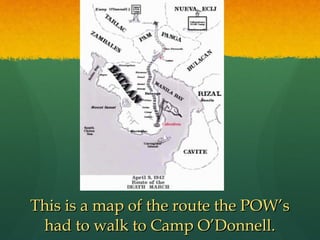
This is a map of the route the POW’s had to walk to Camp O’Donnell.
Bibliography. American Experience . MacArthur . Capture and Death March |.&quot;  PBS . Web. 25 Mar. 2010.  <http://www.pbs.org/wgbh/amex/macarthur/sfeature/bataan_capture.html>. This website helped us because it gave us information on POW's that tried to flee. Also,  how many surrendered. “ Bataan Death March.”  History Web Pages . Web. 24 Mar. 2010.  <http://history.sandiego.edu/GEN/st/~ehimchak/death_march.html>. This website helped us in understanding what went on between Homma and King.  “ Bataan Death March.&quot;  United States History . Web. 24 Mar. 2010. <http://www.u-s- history.com/pages/h1737.html>. This website gave us information on the surrender. It also gave us details of  the torture the POW's faced. &quot;Bataan Death March Photos and Text Related to The Edge by First Lieutenant George Francis,  USMC, Retired.&quot;  Fourth Marines Band: Last China Band of United States Marine Corps during  World War II . Web. 24 Mar. 2010. <http://www.fourthmarinesband.com/march.htm>. This website expressed the health of the POW's and how long the march took.

Bataan Death March

  • 1.
    Bataan Death MarchBy: Alyssa Yoder and Devin Glunt
  • 2.
    When and WhereIt began in Mariveles. April 10, 1942.
  • 3.
    ~ March 1942,Homma began his plans for the American and Filipino troops. ~ They would become Prisoners of War. ~ He planned on moving them to Camp O'Donnell ~ It was around 70 miles away. ~ The Japanese military said that wasn’t a long distance. ~ They believed and their could get there in a few days
  • 4.
    - The soldiersat Bataan were in bad health. - They had been on half-rations or less since January. - They weren’t in good enough health to be able to make the march to Camp O’Donnell.
  • 5.
    Homma and KingKing told Homma that he had more men than the Japanese planned for. And he told him that they were ill and undernourished. However, Homma ignored those facts. He also ignored King's offer to drive the troops to the prison camps. Once the POWs were in their captivity, they could do with them as they wished, according to the Japanese.
  • 6.
    The Surrender. The Americans were all starving and diseased. They decided they couldn’t survive much longer, so they surrendered to the Japanese. More than 70,000 men surrendered to the Japanese. Some refused to be prisoners and tried to flee. The soldiers were robbed of their possessions when the surrendered.
  • 7.
    The March. Japaneseled their prisoners on a forced march out of Bataan. Marched for 7- 14 days. Intense heat. Given almost no water or food. Between 5,000 and 11,000 never made it to Camp O’Donnell, where even more horrors awaited.
  • 8.
    Treatment. The Japanesewould commit random beatings. It the soldiers fell behind, even a few yards, they were shot. 30 POW’s tried to get water from a stream, they were shot on the spot by machine guns. The only water the others were allowed was filled with maggots.
  • 9.
  • 10.
    Many of thePOW’s were shot and beaten. The POW’s marched around 70 miles to Camp O’Donnell.
  • 11.
    This is amap of the route the POW’s had to walk to Camp O’Donnell.
  • 12.
    Bibliography. American Experience. MacArthur . Capture and Death March |.&quot; PBS . Web. 25 Mar. 2010. <http://www.pbs.org/wgbh/amex/macarthur/sfeature/bataan_capture.html>. This website helped us because it gave us information on POW's that tried to flee. Also, how many surrendered. “ Bataan Death March.” History Web Pages . Web. 24 Mar. 2010. <http://history.sandiego.edu/GEN/st/~ehimchak/death_march.html>. This website helped us in understanding what went on between Homma and King. “ Bataan Death March.&quot; United States History . Web. 24 Mar. 2010. <http://www.u-s- history.com/pages/h1737.html>. This website gave us information on the surrender. It also gave us details of the torture the POW's faced. &quot;Bataan Death March Photos and Text Related to The Edge by First Lieutenant George Francis, USMC, Retired.&quot; Fourth Marines Band: Last China Band of United States Marine Corps during World War II . Web. 24 Mar. 2010. <http://www.fourthmarinesband.com/march.htm>. This website expressed the health of the POW's and how long the march took.