PubMed Health and consumer summaries of systematic reviews Hilda BastianConsumers United forEvidence-based Healthcare (CUE)2011 Annual General Meeting, Washington DC12 August 2011
3 topics todayContext – PubMed Health and review summariesWhat is a good consumer summary of a systematic review?PubMed Health’s focus and development
Context: PubMed HealthCurrently largely a consumer medical encyclopediaRe-development: becoming a website specializing in clinical effectiveness research
Context: summaries“Knowledge translation”:Patient info based on reviews (eg AHRQ)   ORConsumer summaries of reviews (eg Cochrane)Some do both (eg Informed Health Online 	from IQWiG in Germany)
Elements in commonAim to be plain languageInclude contextual information which may not be in the review(Relatively) short
Cochrane plain language summaries (PLS)Free accessOften written by, and/or reviewed by, consumers2 components: title and textHighly variable content, style and quality
A good summary: contentFidelity to the review when reporting on itCovers basic issues people need to knowCertainty of statements corresponds to certainty of evidence:When is it a true effect?How strong is the evidence for each effect?
A good summary: stylePatient-centered (eg “use” not “management”)Non-directive and neutral (avoid “should”)Well-crafted (logical order, interesting, jargon explained)Readable (and for short summaries, easy to scan)
ReadabilityShort words, short sentences, short paragraphsSMOG calculator can help:http://en.wikipedia.org/wiki/Smog_calculatorRule of thumb: “Good” for a review summary is roughly the SMOG rating for Time magazine (12*) but similar to NY Times is probably acceptable (around 13 to 15**)* High school graduate             ** Some college
Cochrane PLS with SMOG of less than 12  Steroids applied directly to polyps in the nose in people with cystic fibrosisPeople with cystic fibrosis often have polyps in their nose which can cause discharge from the nose and block it up. We know that people with cystic fibrosis who have polyps in their nose also have more of some types of bacteria in their lungs. This can lead to serious chest complications later on. If we treat the polyps effectively at an early stage, this may prevent such chest complications.Steroid sprays or drops are often applied directly to polyps in the nose. These drugs have some minor side effects but have been shown to be useful in patients who do not have cystic fibrosis.Our search found one randomised controlled trial that investigated the use of directly applied steroids in 46 people with cystic fibrosis who had polyps in their nose. Twenty-two participants received the drug and 24 received a placebo only. The results show that patients did not find the treatment made a difference to their symptoms. However, the authors of this review found that the treatment does reduce the size of the polyps and does not cause significant side effects.The small number of participants in this study means the calculations and results should be regarded with some caution. More studies are needed to confirm the findings.http://onlinelibrary.wiley.com/doi/10.1002/14651858.CD008253.pub2/abstract;jsessionid=DBBB8C76F1AD0C5F27B537262199B488.d01t01
Improving Cochrane summaries: content Fidelity to the review’s findings*Certainty of statements when effects are from single or few trials within larger reviewsContext & explanation: usually need at least 300 words* Recent Cochrane analysis found 28% discordancehttp://www.editorial-unit.cochrane.org/sites/editorial-unit.cochrane.org/files/uploads/Abstract%20audit%20report.pdf
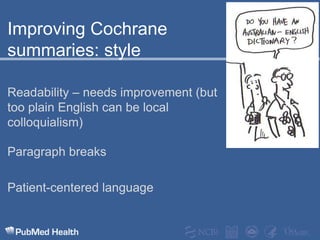
Improving Cochrane summaries: style Readability – needs improvement (but too plain English can be local colloquialism)Paragraph breaksPatient-centered language
PubMed Health: focus and developmentChanging focus to systematic reviews, summaries of reviews, and consumer information based on reviews(by Fall 2011)Growing list of invited contributors, including Cochrane, AHRQ, IQWiG, NICE and more
Educational resourcesComing soon: online books(egTesting Treatments) and more
Thanks!http://www.ncbi.nlm.nih.gov/pubmedhealth/

**Bastian - PubMed Health and Consumer Summaries of Systematic Reviews

  • 1.
    PubMed Health andconsumer summaries of systematic reviews Hilda BastianConsumers United forEvidence-based Healthcare (CUE)2011 Annual General Meeting, Washington DC12 August 2011
  • 2.
    3 topics todayContext– PubMed Health and review summariesWhat is a good consumer summary of a systematic review?PubMed Health’s focus and development
  • 3.
    Context: PubMed HealthCurrentlylargely a consumer medical encyclopediaRe-development: becoming a website specializing in clinical effectiveness research
  • 4.
    Context: summaries“Knowledge translation”:Patientinfo based on reviews (eg AHRQ) ORConsumer summaries of reviews (eg Cochrane)Some do both (eg Informed Health Online from IQWiG in Germany)
  • 5.
    Elements in commonAimto be plain languageInclude contextual information which may not be in the review(Relatively) short
  • 6.
    Cochrane plain languagesummaries (PLS)Free accessOften written by, and/or reviewed by, consumers2 components: title and textHighly variable content, style and quality
  • 7.
    A good summary:contentFidelity to the review when reporting on itCovers basic issues people need to knowCertainty of statements corresponds to certainty of evidence:When is it a true effect?How strong is the evidence for each effect?
  • 8.
    A good summary:stylePatient-centered (eg “use” not “management”)Non-directive and neutral (avoid “should”)Well-crafted (logical order, interesting, jargon explained)Readable (and for short summaries, easy to scan)
  • 9.
    ReadabilityShort words, shortsentences, short paragraphsSMOG calculator can help:http://en.wikipedia.org/wiki/Smog_calculatorRule of thumb: “Good” for a review summary is roughly the SMOG rating for Time magazine (12*) but similar to NY Times is probably acceptable (around 13 to 15**)* High school graduate ** Some college
  • 10.
    Cochrane PLS withSMOG of less than 12 Steroids applied directly to polyps in the nose in people with cystic fibrosisPeople with cystic fibrosis often have polyps in their nose which can cause discharge from the nose and block it up. We know that people with cystic fibrosis who have polyps in their nose also have more of some types of bacteria in their lungs. This can lead to serious chest complications later on. If we treat the polyps effectively at an early stage, this may prevent such chest complications.Steroid sprays or drops are often applied directly to polyps in the nose. These drugs have some minor side effects but have been shown to be useful in patients who do not have cystic fibrosis.Our search found one randomised controlled trial that investigated the use of directly applied steroids in 46 people with cystic fibrosis who had polyps in their nose. Twenty-two participants received the drug and 24 received a placebo only. The results show that patients did not find the treatment made a difference to their symptoms. However, the authors of this review found that the treatment does reduce the size of the polyps and does not cause significant side effects.The small number of participants in this study means the calculations and results should be regarded with some caution. More studies are needed to confirm the findings.http://onlinelibrary.wiley.com/doi/10.1002/14651858.CD008253.pub2/abstract;jsessionid=DBBB8C76F1AD0C5F27B537262199B488.d01t01
  • 11.
    Improving Cochrane summaries:content Fidelity to the review’s findings*Certainty of statements when effects are from single or few trials within larger reviewsContext & explanation: usually need at least 300 words* Recent Cochrane analysis found 28% discordancehttp://www.editorial-unit.cochrane.org/sites/editorial-unit.cochrane.org/files/uploads/Abstract%20audit%20report.pdf
  • 12.
    Improving Cochrane summaries:style Readability – needs improvement (but too plain English can be local colloquialism)Paragraph breaksPatient-centered language
  • 13.
    PubMed Health: focusand developmentChanging focus to systematic reviews, summaries of reviews, and consumer information based on reviews(by Fall 2011)Growing list of invited contributors, including Cochrane, AHRQ, IQWiG, NICE and more
  • 14.
    Educational resourcesComing soon:online books(egTesting Treatments) and more
  • 15.