BASKETRY WEAVING
PATTERN
(HARD AND SOFT STRING)
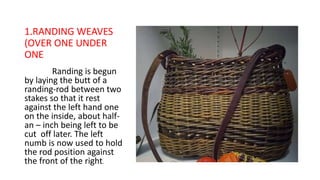
1.RANDING WEAVES
(OVER ONE UNDER
ONE
Randing is begun
by laying the butt of a
randing-rod between two
stakes so that it rest
against the left hand one
on the inside, about half-
an – inch being left to be
cut off later. The left
numb is now used to hold
the rod position against
the front of the right.
2.CLOSE WEAVES
(UNDER TWO OVER
TWO)
A closed basket base is the
bottom of a basket that is
woven tightly together so that
there are no gaps between
stakes. This is done by lying
out the horizontal stakes.
Then adding a shorter length
of stake between each of the
longer stakes to form a solid
base.
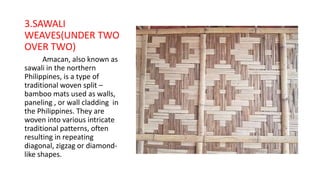
3.SAWALI
WEAVES(UNDER TWO
OVER TWO)
Amacan, also known as
sawali in the northern
Philippines, is a type of
traditional woven split –
bamboo mats used as walls,
paneling , or wall cladding in
the Philippines. They are
woven into various intricate
traditional patterns, often
resulting in repeating
diagonal, zigzag or diamond-
like shapes.
4.Over three
under three
All the same technique with
different terms attached.
Three weavers behind three
consecutive stakes all coming
out in your direction not in
towards the center of the
basket. The weave always
done with the weaver all the
way to the left,in front of
two,behind one,and out (for
right handed weavers).
5.Over four
under four
Different term same
technique. Four
consecutive stakes all
coming out in your
direction not in
towards the center of
the basket. The weave
is always done with
the weaver all the way
to the left.
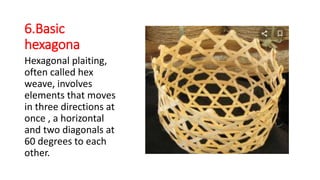
6.Basic
hexagona
Hexagonal plaiting,
often called hex
weave, involves
elements that moves
in three directions at
once , a horizontal
and two diagonals at
60 degrees to each
other.
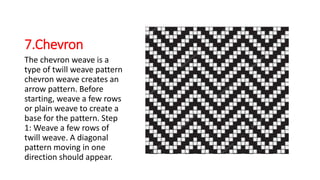
7.Chevron
The chevron weave is a
type of twill weave pattern
chevron weave creates an
arrow pattern. Before
starting, weave a few rows
or plain weave to create a
base for the pattern. Step
1: Weave a few rows of
twill weave. A diagonal
pattern moving in one
direction should appear.
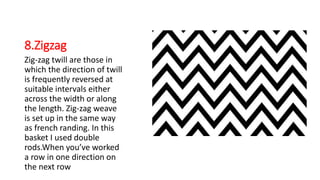
8.Zigzag
Zig-zag twill are those in
which the direction of twill
is frequently reversed at
suitable intervals either
across the width or along
the length. Zig-zag weave
is set up in the same way
as french randing. In this
basket I used double
rods.When you’ve worked
a row in one direction on
the next row
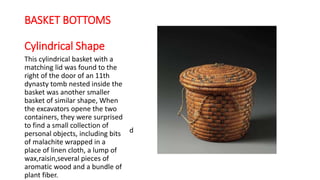
BASKET BOTTOMS
Cylindrical Shape
This cylindrical basket with a
matching lid was found to the
right of the door of an 11th
dynasty tomb nested inside the
basket was another smaller
basket of similar shape, When
the excavators opene the two
containers, they were surprised
to find a small collection of
personal objects, including bits
of malachite wrapped in a
place of linen cloth, a lump of
wax,raisin,several pieces of
aromatic wood and a bundle of
plant fiber.
d
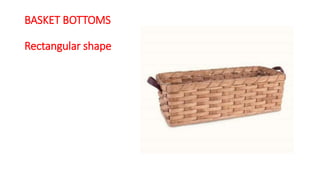
BASKET BOTTOMS
Rectangular shape
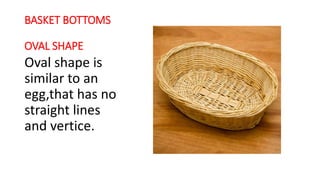
BASKET BOTTOMS
OVAL SHAPE
Oval shape is
similar to an
egg,that has no
straight lines
and vertice.

BASKETRY-WEAVING-PATTERN.pptx

  • 1.
  • 2.
    1.RANDING WEAVES (OVER ONEUNDER ONE Randing is begun by laying the butt of a randing-rod between two stakes so that it rest against the left hand one on the inside, about half- an – inch being left to be cut off later. The left numb is now used to hold the rod position against the front of the right.
  • 3.
    2.CLOSE WEAVES (UNDER TWOOVER TWO) A closed basket base is the bottom of a basket that is woven tightly together so that there are no gaps between stakes. This is done by lying out the horizontal stakes. Then adding a shorter length of stake between each of the longer stakes to form a solid base.
  • 4.
    3.SAWALI WEAVES(UNDER TWO OVER TWO) Amacan,also known as sawali in the northern Philippines, is a type of traditional woven split – bamboo mats used as walls, paneling , or wall cladding in the Philippines. They are woven into various intricate traditional patterns, often resulting in repeating diagonal, zigzag or diamond- like shapes.
  • 5.
    4.Over three under three Allthe same technique with different terms attached. Three weavers behind three consecutive stakes all coming out in your direction not in towards the center of the basket. The weave always done with the weaver all the way to the left,in front of two,behind one,and out (for right handed weavers).
  • 6.
    5.Over four under four Differentterm same technique. Four consecutive stakes all coming out in your direction not in towards the center of the basket. The weave is always done with the weaver all the way to the left.
  • 7.
    6.Basic hexagona Hexagonal plaiting, often calledhex weave, involves elements that moves in three directions at once , a horizontal and two diagonals at 60 degrees to each other.
  • 8.
    7.Chevron The chevron weaveis a type of twill weave pattern chevron weave creates an arrow pattern. Before starting, weave a few rows or plain weave to create a base for the pattern. Step 1: Weave a few rows of twill weave. A diagonal pattern moving in one direction should appear.
  • 9.
    8.Zigzag Zig-zag twill arethose in which the direction of twill is frequently reversed at suitable intervals either across the width or along the length. Zig-zag weave is set up in the same way as french randing. In this basket I used double rods.When you’ve worked a row in one direction on the next row
  • 10.
    BASKET BOTTOMS Cylindrical Shape Thiscylindrical basket with a matching lid was found to the right of the door of an 11th dynasty tomb nested inside the basket was another smaller basket of similar shape, When the excavators opene the two containers, they were surprised to find a small collection of personal objects, including bits of malachite wrapped in a place of linen cloth, a lump of wax,raisin,several pieces of aromatic wood and a bundle of plant fiber. d
  • 11.
  • 12.
    BASKET BOTTOMS OVAL SHAPE Ovalshape is similar to an egg,that has no straight lines and vertice.