Basics of Social Research Qualitative and
Quantitative Approaches Canadian 1st Edition
Neuman Test Bank download
https://testbankdeal.com/product/basics-of-social-research-
qualitative-and-quantitative-approaches-canadian-1st-edition-
neuman-test-bank/
Find test banks or solution manuals at testbankdeal.com today!
We have selected some products that you may be interested in
Click the link to download now or visit testbankdeal.com
for more options!.
Social Research Methods Qualitative And Quantitative
Approaches 7th Edition Neuman Test Bank
https://testbankdeal.com/product/social-research-methods-qualitative-
and-quantitative-approaches-7th-edition-neuman-test-bank/
Basics of Social Research Canadian 3rd Edition Neuman Test
Bank
https://testbankdeal.com/product/basics-of-social-research-
canadian-3rd-edition-neuman-test-bank/
Basics of Social Research Canadian 4th Edition Neuman Test
Bank
https://testbankdeal.com/product/basics-of-social-research-
canadian-4th-edition-neuman-test-bank/
Genetics A Conceptual Approach 5th Edition Pierce
Solutions Manual
https://testbankdeal.com/product/genetics-a-conceptual-approach-5th-
edition-pierce-solutions-manual/
Auditing Cases An Interactive Learning Approach 7th
Edition Beasley Solutions Manual
https://testbankdeal.com/product/auditing-cases-an-interactive-
learning-approach-7th-edition-beasley-solutions-manual/
Canadian Advertising in Action Canadian 10th Edition
Tuckwell Test Bank
https://testbankdeal.com/product/canadian-advertising-in-action-
canadian-10th-edition-tuckwell-test-bank/
Financial Reporting 1st Edition Loftus Solutions Manual
https://testbankdeal.com/product/financial-reporting-1st-edition-
loftus-solutions-manual/
Genetics Analysis and Principles 5th Edition Brooker
Solutions Manual
https://testbankdeal.com/product/genetics-analysis-and-principles-5th-
edition-brooker-solutions-manual/
Business Ethics Ethical Decision Making and Cases 10th
Edition Ferrell Test Bank
https://testbankdeal.com/product/business-ethics-ethical-decision-
making-and-cases-10th-edition-ferrell-test-bank/
Taxation of Individuals 2019 Edition 10th Edition Spilker
Test Bank
https://testbankdeal.com/product/taxation-of-
individuals-2019-edition-10th-edition-spilker-test-bank/
Chapter 10 Non-Reactive Research and Secondary Analysis
10.1 Essay Questions
1) What reliability problems can arise in existing statistics research?
Answer:
Diff: 5 Page Ref: 237
Topic: Existing Statistics & Documents, Secondary Analysis
Skill: 06. Explain reasons for using a specific process/procedure
Objective: 10.01 Understand reliability & validity in nonreactive res.
2) What is secondary data analysis? What are its advantages and disadvantages?
Answer:
Diff: 5 Page Ref: 232-237
Topic: Existing Statistics & Documents, Secondary Analysis
Skill: 04. Express familiarity with the range of techniques/methods
Objective: 10.02 Recognize strengths/limits of exist stats & secondary
3) What is the purpose of multiple coders in content analysis? What possible problem can this create? How
might one deal with the problem?
Answer:
Diff: 6 Page Ref: 223-225
Topic: Content Analysis
Skill: 06. Explain reasons for using a specific process/procedure
Objective: 10.03 Distinguish types of coding in content analysis/issues
4) Describe the aggregation problem in existing statistics.
Answer:
Diff: 7 Page Ref: 233-237
Topic: Existing Statistics & Documents, Secondary Analysis
Skill: 39. Identify strengths/weakness of second data & existing st
Objective: 10.02 Recognize strengths/limits of exist stats & secondary
5) Explain problems with inferences and validity in content analysis research?
Answer:
Diff: 6 Page Ref: 228-229, 237
Topic: Content Analysis
Skill: 38. Explain coding in content analysis and know limitations
Objective: 10.01 Understand reliability & validity in nonreactive res.
6) Give an example of the fallacy of misplaced concreteness and explain why it is deceptive.
Answer:
Diff: 4 Page Ref: 233-234
Topic: Existing Statistics & Documents, Secondary Analysis
Skill: 08. Provide examples of abstract ideas/principles
Objective: 10.02 Recognize strengths/limits of exist stats & secondary
10.2 Multiple Choice Questions
Refer to the following paragraph to answer the questions below.
Undergraduate student Stanley Sleuth conducted a content analysis study of the Toronto Star newspaper
between 1915 and 2005. He first identified relevant articles involving government regulation of business.
After finding 20,000 such articles, he systematically sampled articles with a sampling interval of 50. He
then coded each sampled article based on the subjective meaning it expressed, as pro- or anti-government
regulation using a 1 to 10 scale (1 = very anti-regulation, 10 = very pro-regulation).
1 ) In this study, Stanley used
A. latent coding.
B. manifest coding.
C. generic coding.
D. intervention strategy coding.
E. contingency coding.
Answer: A
Diff: 4 Page Ref: 223-224
Topic: Content Analysis
Skill: 01. Apply abstract learning to realistic situations
Objective:10.03 Distinguish types of coding in content analysis/issues
2) Which of the following is FALSE about secondary data analysis?
A. A gap may exist between a researcher's conceptualization of a variable and how it is
measured in available data.
B. Locating data with specific variables of interest can be time consuming and sometimes a
researcher may not make data available.
C. Information about how data was collected may be insufficient to determine whether there
is bias.
D. It is very expensive compared to equivalent primary data collection.
E. It facilitates replication.
Answer: D
Diff: 4 Page Ref: 232-233
Topic: Existing Statistics & Documents, Secondary Analysis
Skill: 39. Identify strengths/weakness of second data & existing st
Objective: 10.02 Recognize strengths/limits of exist stats & secondary
3) The most valuable general source of existing statistics for studying the United States is
A. Gallup polls.
B. Demographic Yearbook.
C. World Book Encyclopedia.
D. Superintendent of Documents.
E. Statistical Abstract of the United States.
Answer: E
Diff: 2 Page Ref: 231-232
Topic: Existing Statistics & Documents, Secondary Analysis
Skill: 15. Understand types & strengths/weaknesses of sources
Objective: 10.02 Recognize strengths/limits of exist stats & secondary
4) Professor John Juniper was interested in using Statistics Canada data to examine the trend in
Canadian unemployment rates for the last forty years. Yet, he found that unemployment was not
recorded accurately in each year. This is an issue of
A. reliability.
B. validity.
C. ecological fallacy.
D. ideal types.
E. verstehen.
Answer: A
Diff: 5 Page Ref: 237
Topic: Existing Statistics & Documents, Secondary Analysis
Skill: 39. Identify strengths/weakness of second data & existing st
Objective: 10.02 Recognize strengths/limits of exist stats & secondary
5) Professor Ernie Easter has a list of measures on the French influence in the Moncton, New
Brunswick area. He asked you to identify the one that is NOT an Unobtrusive Measure. Which
one is it?
A. the wear on novels in Moncton public libraries written in French
B. walking down a street in Moncton and noticing that most of the signs in stores in a
neighborhood are in French
C. a list of votes supporting bills on bilingual education in the New Brunswick legislature
with the area represented by each legislator noted on the list
D. a box of 300 letters written by people living in Moncton to relatives living in French
speaking areas outside the province (e.g., Quebec) between 1980 and 1985
E. a survey using a three-page questionnaire partly written in French that was distributed to
residents of a neighbourhood
Answer: E
Diff: 6 Page Ref: 219
Topic: Non-Reactive Measures
Skill: 01. Apply abstract learning to realistic situations
Objective: 10.01 Understand reliability & validity in nonreactive res.
6) Which of the following is an example of an Unobtrusive Measure?
A. a telephone interview with voters asking them how they intend to vote
B. a three-week laboratory experiment to see whether students who participate in an exercise
program lose more weight than those who follow a special diet
C. a mailed questionnaire to mayors asking whether their town has an evacuation plan in
case of a nuclear
D. power plant disaster
E. all of the above
F. none of the above
Answer: E
Diff: 4 Page Ref: 219
Topic: Non-Reactive Measures
Skill: 35. Recognize reactivity & external validity problems
Objective: 10.01 Understand reliability & validity in nonreactive res.
7) In content analysis, researchers usually use what type of sampling?
A. snowball
B. quota
C. probabilistic or random
D. judgmental
E. none, sampling does not occur
Answer: C
Diff: 4 Page Ref: 225-226
Topic: Content Analysis
Skill: 28. Recognize situations for various types of random samples
Objective: 10.03 Distinguish types of coding in content analysis/issues
8) Professor Aaron Acorn counts the number of total people and percentage who are Asian in a
sample of 400 TV commercials shown during a one month period on two Vancouver area stations.
He wants to see whether the percentage of Asians in commercials equals, is greater than, or is less
than the percentage of Asians in the area population. He is using
A. latent structure measurement.
B. generic content coding.
C. manifest content coding.
D. corroborative coding.
E. latent content coding.
Answer: C
Diff: 3 Page Ref: 223-224
Topic: Content Analysis
Skill: 01. Apply abstract learning to realistic situations
Objective: 10.03 Distinguish types of coding in content analysis/issues
9) Which is a major ADVANTAGE of content analysis?
A. It is time consuming and requires a large staff with specialized equipment.
B. It is unobtrusive.
C. It cannot measure how people experience the "text" or how the text affects them.
D. It cannot be used to study materials which are not written or recorded.
E. None of the above.
Answer: B
Diff: 3 Page Ref: 221-223
Topic: Content Analysis
Skill: 38. Explain coding in content analysis and know limitations
Objective: 10.03 Distinguish types of coding in content analysis/issues
10) Compared to latent coding in content analysis, manifest coding seems to have
A. greater reliability than latent coding.
B. lower validity than latent coding.
C. greater validity than latent coding.
D. lower reliability than latent coding.
E. A and B.
Answer: E
Diff: 5 Page Ref: 223-224
Topic: Content Analysis
Skill: 38. Explain coding in content analysis and know limitations
Objective: 10.03 Distinguish types of coding in content analysis/issues
11) Professor Lorna Lovebird codes the number of times the word "sex" is used in commercials. She
is examining
A. lateral structure.
B. ecological content.
C. manifest content.
D. corroboration.
E. latent content.
Answer: C
Diff: 2 Page Ref: 223
Topic: Content Analysis
Skill: 01. Apply abstract learning to realistic situations
Objective: 09.03 Distinguish types of coding in content analysis/issues
12) What is found in garbage dumps or the trash left over after a movie are examples of
A. traces.
B. erosion.
C. accretion.
D. hash marks.
E. vital statistics.
Answer: C
Diff: 4 Page Ref: 219
Topic: Non-Reactive Measures
Skill: 01. Apply abstract learning to realistic situations
Objective: 10.01 Understand reliability & validity in nonreactive res.
13) Graduate student Karen Koolray compared two textbooks. She counted the word "he" 80 times in
book A and 20 times in book B. She also found book A contained the word "chairman" 40 times
while it only appeared 10 times in book B. She can conclude
A. book A is four-times more sexist than book B.
B. the words "he" and "chairman" appeared four times more often in book A than in book B.
C. students using book A will become more sexist than those using book B.
D. a teacher who chooses book A is more sexist than one who chooses book B.
E. C and D.
Answer: B
Diff: 6 Page Ref: 223-224, 228-229
Topic: Content Analysis
Skill: 01. Apply abstract learning to realistic situations
Objective: 10.02 Recognize strengths/limits of exist stats & secondary
14) An example of a problem with existing statistics can occur when a researcher defines a concept,
such a unemployment, in one way but the available statistical information gathered by a
government agency uses a different definition. This can create what type of problem?
A. A problem of validity
B. A problem of misplaced concreteness
C. A problem of missing data
D. A problem of reliability
E. E) A problem of inference
Answer: A
Diff: 6 Page Ref: 234
Topic: Existing Statistics & Documents, Secondary Analysis
Skill: 01. Apply abstract learning to realistic situations
Objective: 10.02 Recognize strengths/limits of exist stats & secondary
10.3 Key Terms Vocabulary Questions
1) accretion measures
Answer: Nonreactive measures of the residue of the activity of people or what they leave behind.
Diff: 4 Page Ref: 219
Topic: Non-Reactive Measures
Skill: 50. Ability to Define Key Terms
Objective: 10.01 Understand reliability & validity in nonreactive res.
2) coding
Answer: The process of converting raw information or data into another form for analysis. In
content analysis, it is a means for determining how to convert symbolic meanings in the text into
another form, usually numbers.
Diff: 4 Page Ref: 222
Topic: Content Analysis
Skill: 50. Ability to Define Key Terms
Objective: 10.03 Distinguish types of coding in content analysis/issues
3) coding frame
Answer: An exhaustive list of all possible values that codes may take in content analysis
Diff: 4 Page Ref: 223
Topic: Content Analysis
Skill: 50. Ability to Define Key Terms
Objective: 10.03 Distinguish types of coding in content analysis/issues
4) coding system
Answer: A set of instructions or rules used in content analysis to explain how to systematically
convert the symbolic content from text into quantitative data.
Diff: 4 Page Ref: 223
Topic: Content Analysis
Skill: 50. Ability to Define Key Terms
Objective: 09.03 Distinguish types of coding in content analysis/issues
5) content
Answer: Refers to words, meanings, pictures, symbols, ideas, themes, or any message that can be
communicated.
Diff: 4 Page Ref: 221
Topic: Content Analysis
Skill: 50. Ability to Define Key Terms
Objective: 10.03 Distinguish types of coding in content analysis/issues
6) content analysis
Answer: Research in which one examine patterns of symbolic meaning within text that may be
written, audio, visual, or other mediums of communication.
Diff: 4 Page Ref: 221-228
Topic: Content Analysis
Skill: 50. Ability to Define Key Terms
Objective: 10.03 Distinguish types of coding in content analysis/issues
7) erosion measures
Answer: Nonreactive measures of the wear or deterioration on surfaces due to the activity of
people.
Diff: 4 Page Ref: 220
Topic: Non-Reactive Measures
Skill: 50. Ability to Define Key Terms
Objective: 10.01 Understand reliability & validity in nonreactive res.
8) fallacy of misplaced concreteness
Answer: When a person uses too many digits in quantitative measure in an attempt to create the
impression that the data are accurate or the researcher is highly capable.
Diff: 4 Page Ref: 233-234
Topic: Existing Statistics & Documents, Secondary Analysis
Skill: 50. Ability to Define Key Terms
Objective: 10.02 Recognize strengths/limits of exist stats & secondary
9) Latent coding
Answer: A type of content analysis coding in which a researcher identifies subjective meaning
such as general themes or motifs in a communication medium.
Diff: 4 Page Ref: 223-224
Topic: Content Analysis
Skill: 50. Ability to Define Key Terms
Objective: 10.03 Distinguish types of coding in content analysis/issues
10) Manifest coding
Answer: A type of content analysis coding in which a researcher identifies first develops a list of
specifics words, phases, or symbols, then find them in a communication medium.
Diff: 4 Page Ref: 223
Topic: Content Analysis
Skill: 50. Ability to Define Key Terms
Objective: 10.03 Distinguish types of coding in content analysis/issues
11) nonreactive
Answer: Measures in which the people being studied are unaware that they are in a study.
Diff: 4 Page Ref: 219
Topic: Non-Reactive Measures
Skill: 50. Ability to Define Key Terms
Objective: 10.01 Understand reliability & validity in nonreactive res.
12) reactive
Answer: Measures in which the people being studied are aware that they are in the study.
Diff: 4 Page Ref: 219
Topic: Non-Reactive Measures
Skill: 50. Ability to Define Key Terms
Objective: 10.01 Understand reliability & validity in nonreactive res.
13) recording sheet
Answer: One or more pages on which a researcher writes down systematically what has coded
been coded from text in content analysis.
Diff: 4 Page Ref: 227-228
Topic: Content Analysis
Skill: 50. Ability to Define Key Terms
Objective: 10.03 Distinguish types of coding in content analysis/issues
14) structured observation
Answer: A method of watching what is happening in a social setting or noticing information in
communication that is highly organized and that follows systematic rules for careful observation
and documentation.
Diff: 4 Page Ref: 222
Topic: Non-Reactive Measures
Skill: 50. Ability to Define Key Terms
Objective: 10.01 Understand reliability & validity in nonreactive res.
15) text
Answer: A general name for symbolic meaning expressed within a communication medium and
measured in content analysis.
Diff: 4 Page Ref: 221
Topic: Content Analysis
Skill: 50. Ability to Define Key Terms
Objective: 10.03 Distinguish types of coding in content analysis/issues
16) unobtrusive measure
Answer: Another name for nonreactive measures. It emphasizes that the people being studied are
not aware of it because the measures are not obvious and do not intrude.
Diff: 4 Page Ref: 219-221
Topic: Non-Reactive Measures
Skill: 50. Ability to Define Key Terms
Objective: 10.01 Understand reliability & validity in nonreactive res.
Random documents with unrelated
content Scribd suggests to you:
beautiful for its foliage!” “Then there were bright masses of Dianthus
neglectus and alpinus, with their dense tufts of lovely pink flowers;
and turn which way you will, gems of rarity or beauty met the eye.”
“One likes to linger on these slopes; and as one stands on the upper
portion of it, and looks down on the carpet of lovely green backed by
the feathery and elegant foliage of the birch, it is indeed hard to be
obliged to tear one’s self away from it.”
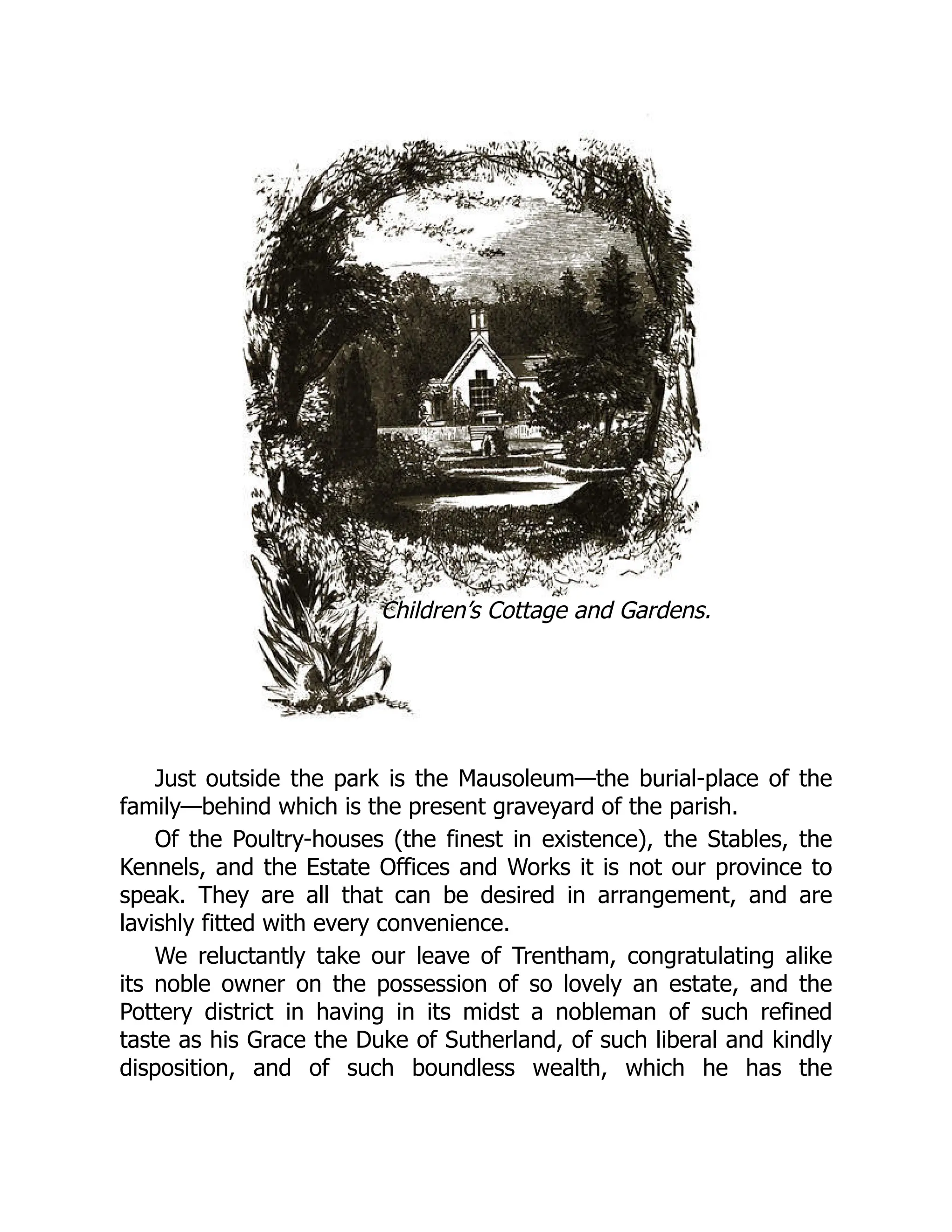
Belvoir Castle, from the Stables, showing the Covered Exercise-
ground.
The Statue Garden, one of the most striking “bits” in the
grounds, is so called from a number of statues by Cibber which
adorn it. This garden, when viewed from the terrace, entirely
screened from observation from the castle, is one of marvellous and
old-world beauty; the majestic and venerable silver firs—remarkable
for their gigantic growth and their hoary age—the grounds, half
garden, half wood (a strange combination of natural wildness with
artificial planting), adding much to the effect of the scene.
The Dairy, the Kennels, the Stables with the covered Exercise-
ground, and the Farm, as well as the magnificent Lake of ninety
acres in extent, are all objects of special interest, but to them we
can only thus allude.
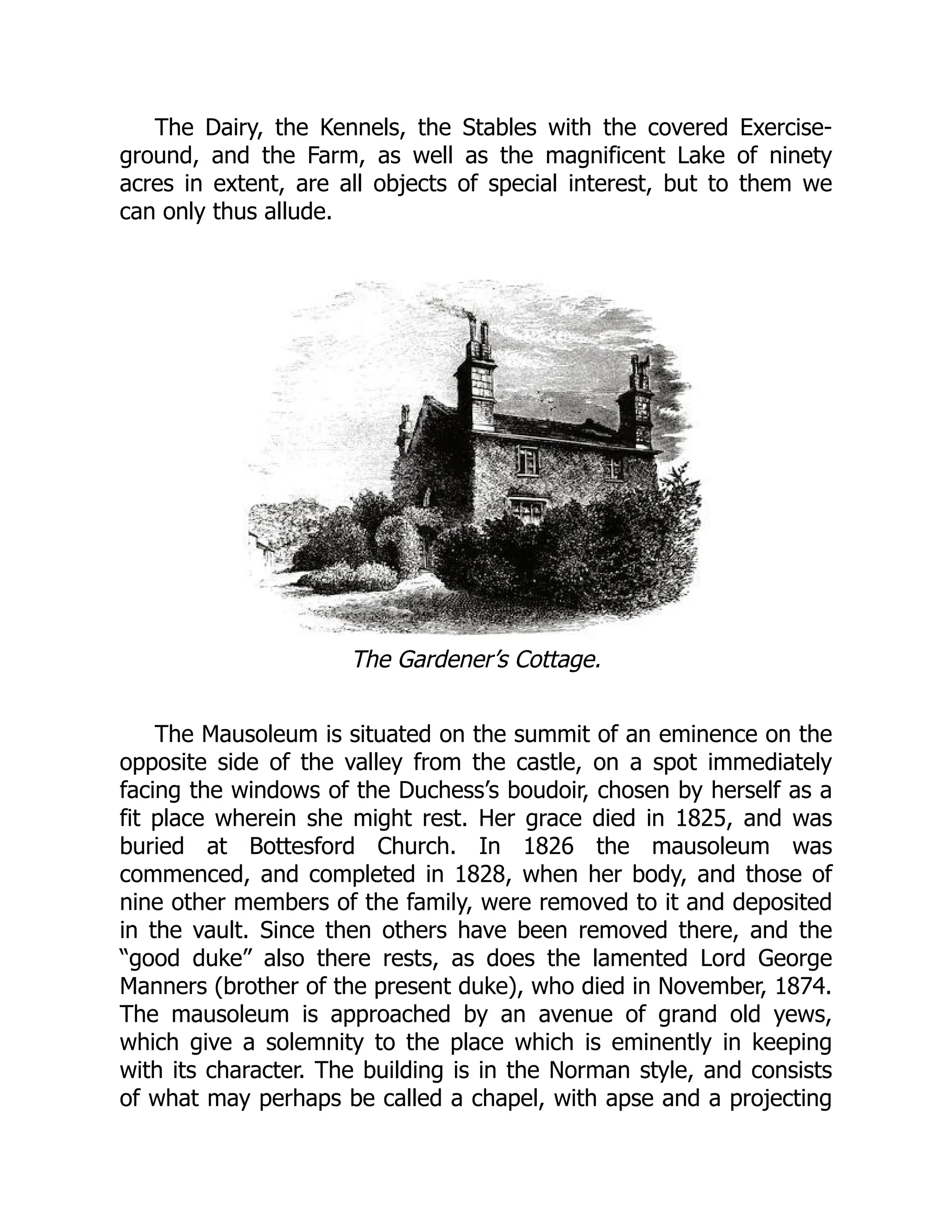
The Gardener’s Cottage.
The Mausoleum is situated on the summit of an eminence on the
opposite side of the valley from the castle, on a spot immediately
facing the windows of the Duchess’s boudoir, chosen by herself as a
fit place wherein she might rest. Her grace died in 1825, and was
buried at Bottesford Church. In 1826 the mausoleum was
commenced, and completed in 1828, when her body, and those of
nine other members of the family, were removed to it and deposited
in the vault. Since then others have been removed there, and the
“good duke” also there rests, as does the lamented Lord George
Manners (brother of the present duke), who died in November, 1874.
The mausoleum is approached by an avenue of grand old yews,
which give a solemnity to the place which is eminently in keeping
with its character. The building is in the Norman style, and consists
of what may perhaps be called a chapel, with apse and a projecting
porch, and vaults beneath. Within the apse, lit with a flood of golden
light from above, is one of the most exquisitely beautiful pieces of
sculpture it has been our good fortune to see. On it the Duchess is
represented as rising from the admirably sculptured tomb with
expanded arms, and her face elevated towards the clouds, in which
are seen four cherubs—the children who preceded her to the grave
—one of whom is holding over her a crown of glory. It is by Wyatt,
and is considered to be his masterpiece.
The Kitchen and Fruit Gardens are about eight acres in extent
within the walls, and more than that outside. They are arranged in
the most effective, convenient, and admirable manner, and managed
with that care and judgment which are the distinguishing
characteristics of the head gardener’s skill. His charming cottage
forms one of our vignettes; it is overgrown with clematis and other
climbing plants, which grow with natural luxuriance over its porch
and hedgerows. Nature, indeed, in the grounds and gardens of
Belvoir, is the first, the main, and the ultimate study; and thus at all
points, and in every direction, natural instead of artificial beauties
present themselves to the eye, and give the greatest charm of all to
whatever the visitor sees. Wild flowers are especially cultivated and
bedded out in all their native simplicity, while numbers of Alpine and
other plants are also acclimatised, and mingle their beauties with
those of our own country. Belvoir is indeed well named, not only for
its “beautiful prospect” from the building itself, but its hundreds of
beautiful prospects within its own boundaries.
Well might a gifted authoress thus write on leaving so lovely a
place as Belvoir Castle and its surroundings:—
“Farewell, fair castle, on thy lordly hill
Firm be thy seat, and proud thy station still:
Soft rise the breezes from the vale below—
Bright be the clouds that wander o’er thy brow:
O’er the fair lands that form thy broad domain,
Short be the winter—long the summer reign.
Pilgrim of pleasure to thy stately towers,
Fain would I leave among thy friendly bowers
Some votive offering—and, ere on my way
With many a backward glance I turn to stray,
Bid virtue, strength, and honour crown thy walls;
Joy, love, and peace abide within thy halls;
While grateful mirth and noble courtesy,
As now, for ever, hold their seat in thee;
And still upon thy lordly turrets rest
The grateful blessing of each parting guest.”
The neighbourhood of Belvoir Castle is one of great beauty, and
it is rich in objects of interest both to the botanist, the naturalist,
and the geologist; while to the lover of Nature it presents charms of
unusual attraction. In the hills and vales surrounding the castle,
nearly the whole series of lower oolitic rocks may be traced, from
the white limestone down to the black liassic shales. Capping the
hills to the south, which are of greater elevation than the castle, is
the inferior oolite, or rather a variety of it called “Lincolnshire
limestone,” a hard, light rock, very rich in fossil remains. On these
hills the growth of trees is stunted, but the ground is covered with a
profusion of lovely flowers. Underlying the oolite is the upper lias
clay, rich in fossils and shells. Belvoir Castle itself stands on the
extremity of a long northern spur of these hills, upon the middle lias,
or marlstone, which caps all the neighbouring heights, and gives
their soil a remarkably red tinge. It is very rich in iron, both in veins
and in lump ore. The vale of Belvoir, below the castle, towards the
north, lies mostly upon the lower lias, which is celebrated for its
richness in fossil remains, some of the ammonites here found being
of gigantic size. The vale is, however, best known to geologists on
account of its sauria, which are both numerous and well preserved.
In the old river-ways and hollows of the vale, in the drift, are also
found traces of the mammoth, gigantic antlers, and other remains of
extinct races of animals, which through untold ages have been
hidden from sight.
Our views of Belvoir, we may add, are engraved from
photographs, taken specially for the purpose, by Mr. R. Keene, and
by Mr. George Green.
Bottesford Church, a fine structure of the Perpendicular period,
with a lofty crocketed spire, is mainly interesting as being the
resting-place for several of the old monuments of the successive
owners of Belvoir, removed hither from the priories of Belvoir and
Croxton, and as the burial-place of several generations of the family
of Manners. The earliest of the monuments is one which has been
variously ascribed to Robert de Todeni and the third William de
Albini: if to either, it most probably commemorates the latter of
these. Other early monuments are to members of the De Ros family.
Among these are William de Ros, 1414; Margaret, his wife; and
John, Lord Ros. Among the monuments of the Manners family are
those of Thomas, first Earl of Rutland, and his countess, 1543;
Henry, Earl of Rutland, and Margaret, his countess, 1563; Edward,
third Earl of Rutland, 1587; John, fourth Earl of Rutland, 1588;
Roger, fifth Earl of Rutland, 1612; Francis, sixth Earl of Rutland (and
his “two sonnes, both which dyed in their infancy, by wicked practice
and sorcerye”), 1632; George, seventh Earl of Rutland, 1641; John,
eighth Earl of Rutland, and his countess, 1670; and others.
TRENTHAM.
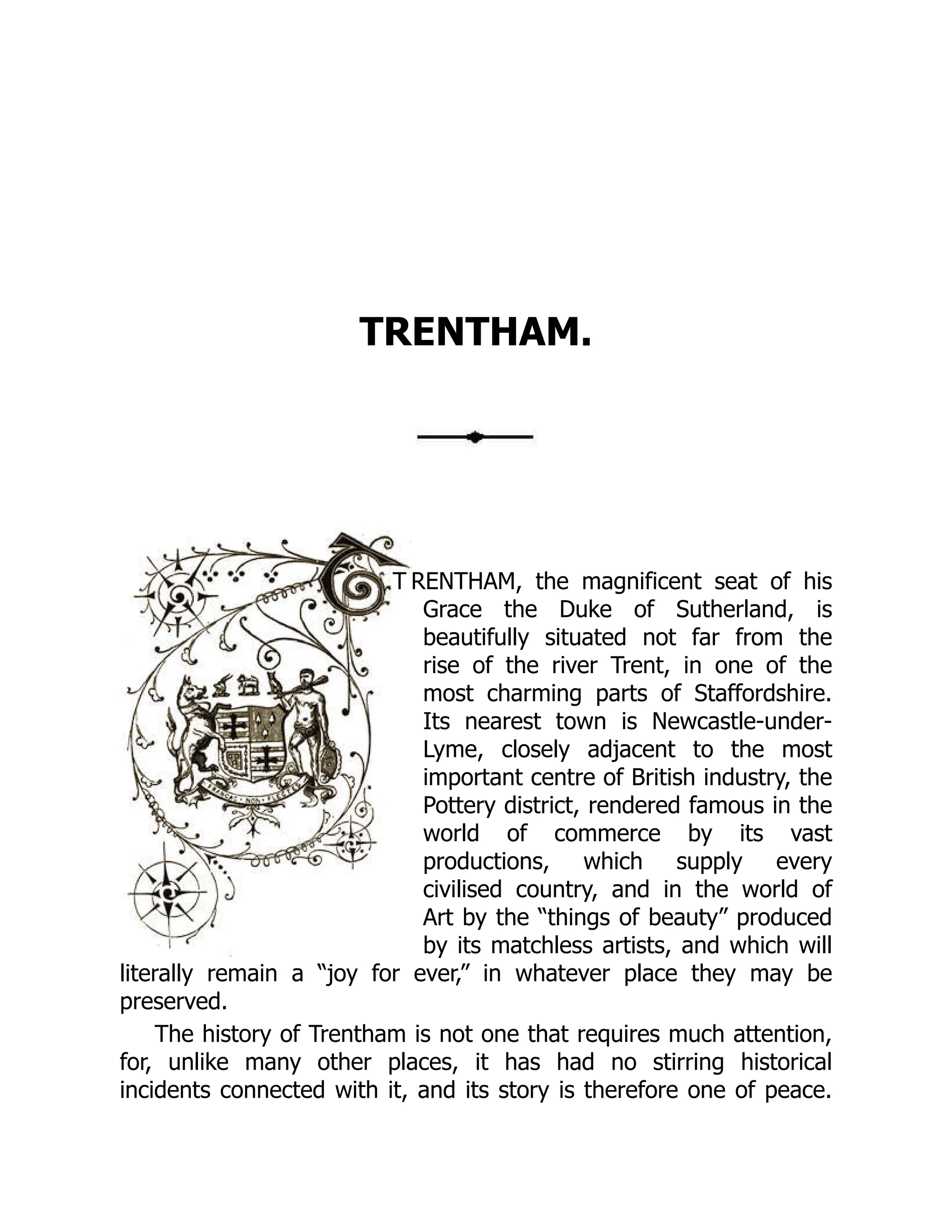
T RENTHAM, the magnificent seat of his
Grace the Duke of Sutherland, is
beautifully situated not far from the
rise of the river Trent, in one of the
most charming parts of Staffordshire.
Its nearest town is Newcastle-under-
Lyme, closely adjacent to the most
important centre of British industry, the
Pottery district, rendered famous in the
world of commerce by its vast
productions, which supply every
civilised country, and in the world of
Art by the “things of beauty” produced
by its matchless artists, and which will
literally remain a “joy for ever,” in whatever place they may be
preserved.
The history of Trentham is not one that requires much attention,
for, unlike many other places, it has had no stirring historical
incidents connected with it, and its story is therefore one of peace.
Its vicissitudes have not been unpleasant ones, not one scene of
rapine or war or murder being recorded in its annals; and it has
become the “home”—literally the most charming and comfortable of
English homes—of one of our greatest nobles, where domestic
comforts take the place of state and ceremony, and homelike
surroundings supplant unmeaning grandeur.
Trentham Monastery was, it is stated, founded by Ethelred, who
succeeded his brother Wulphere as King of Mercia in 675, and who
induced his niece Werburgh (daughter of Wulphere) “to leave the
religious house at Ely, where she was abbess, to superintend the
nunnery he had built at Trentham, as well as other similar religious
foundations in Mercia—viz. Hanbury, near Burton-on-Trent; Repton
(the capital of the Mercian kingdom), in Derbyshire; and Weedon, in
Northamptonshire. Werburgh died at Trentham, after leading a long
and pious and eminently useful life, and, being shortly afterwards
canonised, became one of the most celebrated of Anglo-Saxon
saints. It is supposed that the original site of St. Werburgh’s Nunnery
was at Hanchurch, about a mile from Trentham, the spot being
marked by some venerable yews of great antiquity, which still form
three sides of a square. It was called Tricengham, and is by that
name described by Tanner, Dugdale, and others.
There is no record for the next four hundred years; but in the
Domesday survey a priest is mentioned as being there. In the time
of William Rufus (1027 to 1100), the priory having been restored or
rebuilt by the Earl of Chester, “the prior and canons entered upon
Trentham by a deed of gift from Hugh, first Earl of Chester; and a
deed of institution by Roger de Clinton, Bishop of Lichfield (1139),
describes John, the prior, as instituted to the priory of Trentham and
its appendages, on the presentation of the Empress Maude, at a
synod held at Lichfield.” The building appears to have been
continued by the fourth Earl of Chester, as the charter, commonly
known as the deed of “Restoration,” is that of Randle, the fourth earl
(about 1152). It is the remains of this building which have furnished
the fine Norman pillars of the present church. In 1162 the church of
Sutton-en-le-Felde, in Derbyshire, was given to Trentham by Ralph
de Boscherville. The chapelries of Whitmore and Newcastle also
belonged to it; and soon after this date Hugh Kyveliok, Earl of
Chester, gave to it the church of Bettesford. In the next century
Clayton Griffith became an appanage of the priory, as did Over-
Elkiston. In 1321 the advowson was claimed by the Earl of
Lancaster, who instituted a prior (Richard of Dilhorne), whose
election was afterwards confirmed by the King.
Early in the reign of Henry VI. the priory obtained from the King
in very express terms a confirmation and enlargement of former
grants. After reciting the original deeds of gift of Henry II. and
Randolph, Earl of Chester, the King bestows on “my Canons of
Trentham” “Crofts for cultivation, and all other lands belonging to
the manor (in malo territoris), and the two moores on either side of
the village between the wood and the river of Trentham for the
purpose of being made into meadow land for the maintenance of the
brotherhood and of the hospitalities of the house.... And forbid any
man to sue them at law in opposition to this deed, except in my own
court.” Given at Dover, 23rd of May, 6th Henry VI. In the latter part
of this deed the prior is described as abbot. The territorium which
was to be taken into cultivation appears to have been the land
extending from the King’s Wood and the High Greaves, and North
Wood down to the river. The field lying on the sloping ground
between the farmhouse of North Wood and the river is still called the
Prior’s More, or Moor.
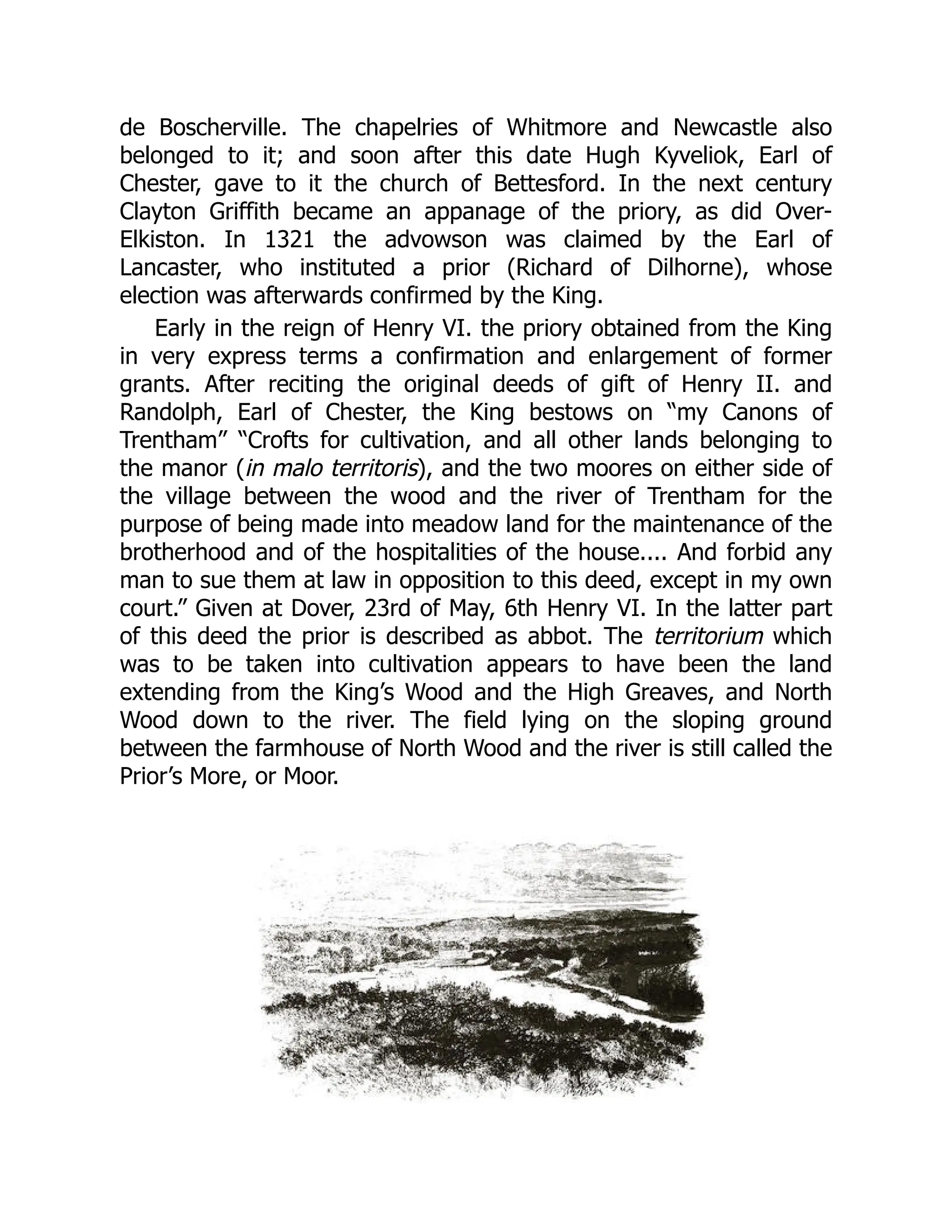
Trentham, from Monument Hill, Tittensor.
After the dissolution of the monasteries in 1531, the priory of
Trentham (whose last prior was Thomas Bradwell, who, elected 22nd
Henry VIII., held office at the time), whose annual value was
returned at £106 2s. 9d. clear, was granted, in 1539, to Charles
Brandon, Duke of Suffolk, brother-in-law to Henry VIII., and
afterwards came into the possession of the Levesons, a Staffordshire
family of great antiquity seated at Willenhall. Nicholas Leveson, Lord
Mayor of London, died in the year that Trentham was granted to the
Duke of Suffolk. His great-grandson, Sir John Leveson, left two
daughters only, his co-heiresses, one of whom, Frances, by marrying
Sir Thomas Gower of Sittenham, carried Trentham and other
extensive possessions into this ancient Yorkshire family, which dates
from the Conquest.
Sir Richard Leveson was distinguished as a naval commander. He
is considered to be the subject of the fine old plaintive ballad “The
Spanish Lady’s Love,” although the same honour has been ascribed
to Sir John Bolle, for he accompanied the Earl of Nottingham in his
expedition against Cadiz when he was twenty-seven years of age.
The ballad, one of the best in our language, tells the story of a
“Spanish lady” “by birth and parentage of high degree,” who, being
detained as a prisoner by the English captain, was so overcome with
his kindness that she conceived a violent attachment towards him;
so much so, indeed, that when—
“... At last there came commandment
For to set the ladies free,
With all their jewels still adornéd,
None to do them injury;
Then said this lady gay, ‘Full woe is me!
O, let me still sustain this kind captivity!
* * * * *
Thou hast set this present day my body free,
But my heart in prison strong remains with thee.’”
The captain urged many objections, each one of which in turn she
argued away and removed, even when he said—
“I have neither gold nor silver
To maintain thee in this case,
And to travel is great charges
As you know in every place.”
She answered—
“My chains and jewels every one shall be thine own,
And the five hundred pounds in gold that lies unknown.”
At length, finding all other argument useless, he is made boldly to
declare—
“I in England have already
A sweet woman to my wife;
I will not falsify my vow for gold or gain,
Nor yet for all the fairest dames that live in Spain.”
To which she makes him the magnanimous answer—
“Oh! how happy is that woman
That enjoys so true a friend!
Many happy days God send her!
Of my suit I’ll make an end:
On my knees I pardon crave for this offence,
Which love and true affection did first commence.
Commend me to thy loving lady,
Bear to her this chain of gold
And these bracelets for a token,
Grieving that I was so bold:
All my jewels in like sort bear thou with thee,
For they are fitting for thy wife, and not for me.”
And she, taking an affecting leave of him, declares her intention of
spending her days in prayer in a nunnery. Sir Richard married the
daughter of the famous Earl of Nottingham, who was Lord High
Admiral and Commander-in-chief of the fleet which defeated the
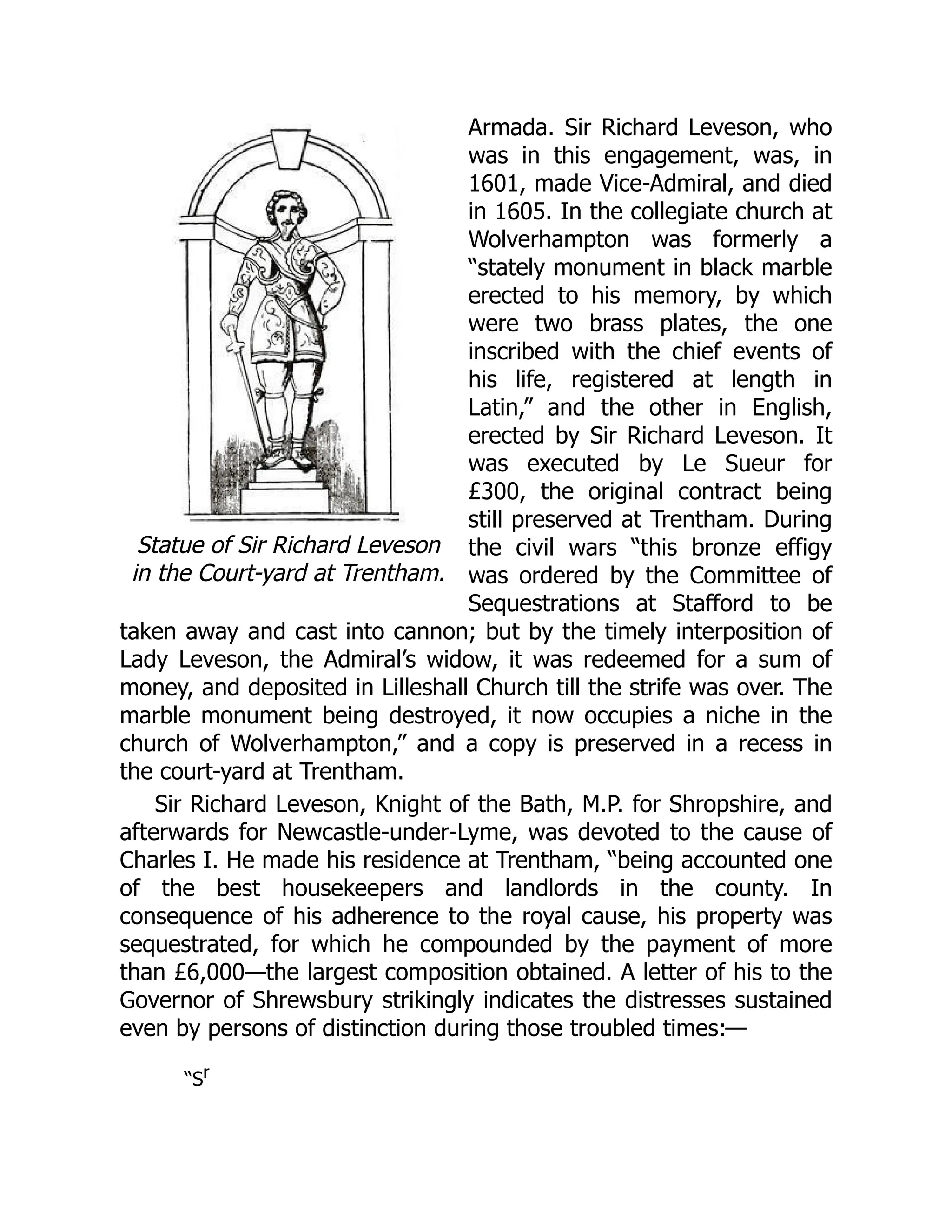
Statue of Sir Richard Leveson
in the Court-yard at Trentham.
Armada. Sir Richard Leveson, who
was in this engagement, was, in
1601, made Vice-Admiral, and died
in 1605. In the collegiate church at
Wolverhampton was formerly a
“stately monument in black marble
erected to his memory, by which
were two brass plates, the one
inscribed with the chief events of
his life, registered at length in
Latin,” and the other in English,
erected by Sir Richard Leveson. It
was executed by Le Sueur for
£300, the original contract being
still preserved at Trentham. During
the civil wars “this bronze effigy
was ordered by the Committee of
Sequestrations at Stafford to be
taken away and cast into cannon; but by the timely interposition of
Lady Leveson, the Admiral’s widow, it was redeemed for a sum of
money, and deposited in Lilleshall Church till the strife was over. The
marble monument being destroyed, it now occupies a niche in the
church of Wolverhampton,” and a copy is preserved in a recess in
the court-yard at Trentham.
Sir Richard Leveson, Knight of the Bath, M.P. for Shropshire, and
afterwards for Newcastle-under-Lyme, was devoted to the cause of
Charles I. He made his residence at Trentham, “being accounted one
of the best housekeepers and landlords in the county. In
consequence of his adherence to the royal cause, his property was
sequestrated, for which he compounded by the payment of more
than £6,000—the largest composition obtained. A letter of his to the
Governor of Shrewsbury strikingly indicates the distresses sustained
even by persons of distinction during those troubled times:—
“Sr
“Since the unhappy surprise of Stafford by the rebelles, the place
where I am is not safe, either for myselfe or my goodes, and therefore I
have sent 2 wagons loaded with some household stuffe, which I desire,
with your dispensacon, may be received into your towne of Shrewsbury,
into a roome which I have longe reserved in myne owne handes for this
purpose against a tyme of neede; and that to this effecte you will please
to give order unto your watch for free passage to and fro, whereby you
will oblige mee more and more to remayne
“Yor ever affectionate frende
“R. Leveson.”
“Lilleshall Lodge, 16 May, 1643.
“To my much respected frende
“Sr
Francis Oteley, Kt
“Governour of Shrewsbury—Haste these.”
The Sir Richard Leveson who built the old hall at Trentham in
1633 (two views of which are given in Plot) died in 1661. His widow,
Lady Katharine Leveson (daughter of Robert, Duke of
Northumberland, and Lady Alice Dudley), was a great benefactress
to the parish. She died at Trentham in 1674, and was buried at
Lilleshall. Her charities were almost boundless. Sir Richard Leveson
dying without issue, the Trentham estates passed to his sister and
co-heiress, who had married Sir Thomas Gower, and in the Gower
family they have remained to this day. Sir William Leveson-Gower,
his second son, who inherited the estates on the deaths of his elder
brother and nephew, married Lady Jane Granville, eldest daughter of
the Earl of Bath, by whom he had issue, with others, Sir John
Leveson-Gower, who in 1703 was created Baron Gower of
Sittenham. He married Catherine, daughter of the first Duke of
Rutland, by whom he had four sons and two daughters. The eldest
of these sons, John, was in 1746 advanced to the dignity of Viscount
Trentham and Earl Gower. He was married three times: first, to
Evelyn, daughter of the Duke of Kingston, by whom he had four
sons and seven daughters; secondly, to Penelope, daughter of Sir
John Stonehouse, by whom he had one daughter; and, thirdly, to
Lady Mary Tufton, daughter of the Earl of Thanet, by whom he had
three sons and one daughter, one of whom was the famed Admiral
John Leveson-Gower. His lordship was succeeded by his third son by
his first wife, Granville Leveson Gower, who in 1786 was raised to
the dignity of Marquis of Stafford. He married three times: first,
Elizabeth Fazakerly, by whom he had a son, who died in infancy;
second, Lady Louisa Egerton, daughter of the first Duke of
Bridgewater, by whom he had issue a son, George Granville, who
succeeded him, and three daughters (Lady Louisa, married to Sir
Archibald Macdonald; Lady Caroline, married to Frederick, Earl of
Carlisle; and Lady Anne, married to Edward Vernon Harcourt,
Archbishop of York); third, Lady Susan Stewart, daughter of the Earl
of Galloway, by whom he had issue one son, Granville Leveson-
Gower, created Baron Leveson of Stone, and Viscount and Earl
Granville (who married Lady Harriet Elizabeth Cavendish, daughter
of the fifth Duke of Devonshire, and was father of the present
eminent statesman, Earl Granville), and three daughters—viz. Lady
Georgiana Augusta, married to the Earl of St. Germains; Lady
Charlotte Sophia, married to the Duke of Beaufort; and Lady
Susanna, married to the Earl of Harrowby. The Marquis, who held
many important public offices, died in 1803, and was succeeded by
his eldest son—
George Granville Leveson-Gower, as second Marquis of Stafford.
This nobleman married, in 1785, Elizabeth, Countess of Sutherland
and Baroness Strathnaver (a title dating from 1228), and was, in
1833, advanced to the dignity of Duke of Sutherland. His grace, who
had been called to the Upper House during his father’s lifetime as
Baron Gower, became heir to the Duke of Bridgewater, and thus
added immense wealth to the family property. He had surviving
issue two sons—viz. George Granville, by whom he was succeeded,
and Lord Francis, who took the name and arms of Egerton, by sign-
manual, in 1833, and was raised to the peerage as Earl of Ellesmere
in 1846 (he married Harriet Catherine, eldest daughter of Charles
Greville, Esq., by whom he had issue, with others, the second Earl of
Ellesmere, and Admiral Egerton, who married Lady Louisa
Cavendish, daughter of the present Duke of Devonshire)—and two
daughters, viz. Lady Charlotte Sophia, married to the Duke of
Norfolk; and Lady Elizabeth Mary, married to Richard, Marquis of
Westminster, father of the present Duke of Westminster.
A noble colossal bronze statue of the Duke (who died in 1833),
the figure being sixteen feet in height, and placed on a lofty column
on Tittensor Hill (called “Monument Hill”), forms a conspicuous
object against the sky from the house and gardens of Trentham. It is
one of Chantrey’s masterpieces of Art. The column, base, and steps
were designed by Barry. The entire height is fifty-nine feet, including
the figure. It bears the following appropriate inscription:—
IN LASTING MEMORIAL OF
GEORGE GRANVILLE,
DUKE OF SUTHERLAND, MARQUIS OF STAFFORD, K.G.
AN UPRIGHT AND PATRIOTIC NOBLEMAN,
A JUDICIOUS, KIND, AND LIBERAL LANDLORD;
WHO IDENTIFIED THE IMPROVEMENT OF HIS VAST ESTATES WITH
THE PROSPERITY OF ALL WHO CULTIVATED THEM;
A PUBLIC YET UNOSTENTATIOUS BENEFACTOR,
WHO, WHILE HE PROVIDED USEFUL EMPLOYMENT
FOR THE ACTIVE LABOURER,
OPENED WIDE HIS HAND TO THE DISTRESSES OF THE WIDOW
THE SICK, AND THE TRAVELLER;
A MOURNING AND GRATEFUL TENANTRY,
UNITING WITH THE INHABITANTS OF THE NEIGHBOURHOOD,
ERECTED THIS PILLAR A.D. MDCCCXXXIV.
George Granville Leveson-Gower, second Duke of Sutherland,
was called to the Upper House during his father’s lifetime as Baron
Gower. He was born in 1786, and married, in 1823, the Lady Harriet
Elizabeth Georgiana Howard, daughter of the Earl of Carlisle. By this
happy union his grace had issue four sons and seven daughters.
Among these were—the present Duke of Sutherland, of whom more
presently; Lord Albert Sutherland Leveson-Gower, who married, in
1872, a daughter of Sir Thomas Nevill Abdy, Bart., and died in 1874,
leaving issue one infant; Lord Ronald Charles Leveson-Gower, late
M.P. for Sutherland; Lady Elizabeth Georgiana, married, in 1844, to
the present Duke of Argyll, and is mother of the Marquis of Lorne;
Lady Evelyn, married to Lord Blantyre; Lady Caroline, married to the
Duke of Leinster; and Lady Constance Gertrude, married to the
present Duke of Westminster. His Grace the Duke of Sutherland died
in 1861, aged seventy-four, and was buried in the Mausoleum at
Trentham. He was a man of liberal, kindly, gentle, and benevolent
disposition, and was beloved by people of every class; indeed, such
was the affectionate attachment of his tenants, that after his death
they erected statues to his memory on most of his estates.
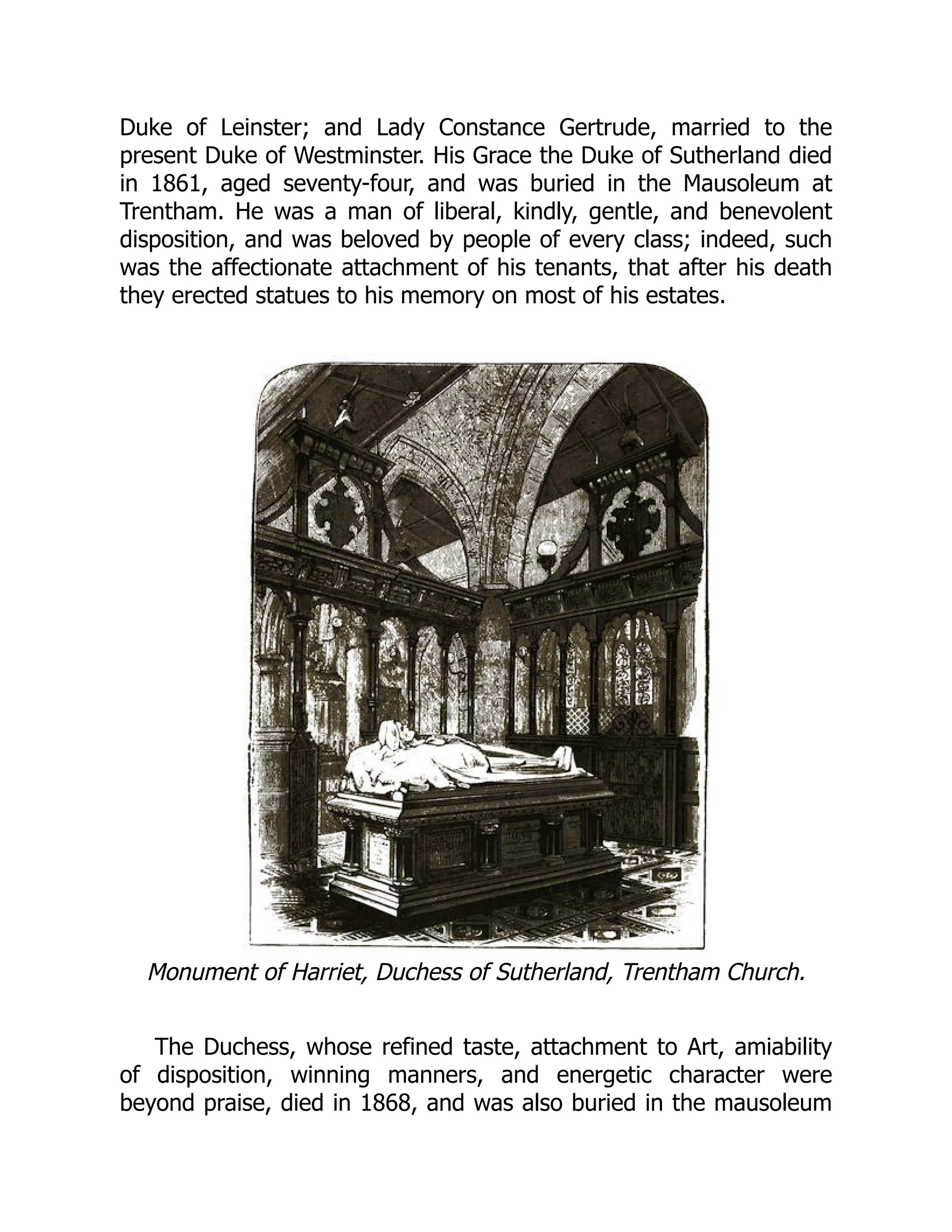
Monument of Harriet, Duchess of Sutherland, Trentham Church.
The Duchess, whose refined taste, attachment to Art, amiability
of disposition, winning manners, and energetic character were
beyond praise, died in 1868, and was also buried in the mausoleum
at Trentham. She was Mistress of the Robes to the Queen, by whom
she was esteemed as a beloved friend. To her pure taste Trentham
owes many of its most attractive features, and had she lived to carry
out the full bent of her inclination, much more would have been
accomplished. A chastely beautiful altar-tomb, with a recumbent
effigy of the Duchess, by Noble, has been erected in Trentham
Church, and is one of the highest and purest achievements of
sculptural Art. “Recurring to the monument in Trentham Church,”
says the Rev. Prebendary Edwards, “it tells us, though in silence, of
a rare combination of affection, thought, and artistic skill in all who
have been engaged upon it. It could not have been confided to
better hands than Mr. Noble’s, who, as sculptor, has had his heart in
his work. Resting in calm and the deepest repose, as between life
and death, the figure recalls with wonderful truth the beauty of
feature and gentleness of expression of her whom it represents.”
The monument is placed at the east end of the south aisle, and the
sculptor has been happy in finding a spot for his marble where the
light of a south window falls on the countenance of the figure on the
tomb beneath. The floor is laid with encaustic tiles, bearing the arms
of the family and the initials of the deceased. The monument
contains the following inscription, written by Mr. Gladstone:—
HENRIETTÆ DUCISSÆ DE SUTHERLAND
FIDO MARMORE DESCRIPTA EFFIGIES
EJUS CARISSIMA IMAGO
NUNQUAM NON VIDEBITUR INTER SUOS MORARI
QUIPPE QUÆ ET MULTUM ET A MULTIS AMATA
HAUD SCIAS AN NON MAGIS IPSA AMAVERIT
EGREGIA MENTIS ET FORMÆ DOTIBUS
GNATA SOROR UXOR MATER PARENS
ABSOLUTISSIMA
HABUIT INSUPER E CORDIS BENEVOLENTIA
QUOD IN AMICOS LARGE DIMANARET
DULCEDINUM ET DELICIARUM OMNIA
QUEIS FRUI DATUM EST HOMINIBUS
ILLI CARPERE DIUTIUS LICUIT
ILLI QUOD RIRIUS CIRCA SE DIFFUNDERE
SUB EXTREMUM VITÆ SPATIUM
ETIAM IN DOLORIBUS SPECTATA
NUSQUAM MEDIOCREM SE PRÆBUIT
DENIQUE DEI OPT. MAX. CONSILIUM LIBENTER AMPLEXA
ET USQUE AD FINEM SINE MOLLITIE TENERRIMA
TRANQUILLE IN CHRISTO OBDORMIVIT
LONDONI XXVII DIE OCTOBRIS
ANNO REDEMPTORIS MDCCCLXVIII
Besides this and other inscriptions, at the head of the tomb we
read—
IN TE MISERICORDIÆ IN TE PIETADE
IN TE BENEFICENZA IN TE S’ADUNDA
QUANTUNQUE IN CREATURA É DI BONTADE;
and at the base, “In memoriam Matris,” the following:—“This
monument to the beloved memory of Harriet, Duchess of
Sutherland, wife of George Granville, 2nd Duke of Sutherland, is
erected, in the church which they rebuilt, as a loving tribute to her
spotless life, a.d. mdccclxxi.” It was erected by her son, Lord Ronald
Charles Sutherland Leveson-Gower, and a brass plate near it thus
records the fact:—“The erection of the monument to our mother has
been the thought and the act of my brother Ronald. I only share
with him in the love and reverence which prompted it. Sutherland,
1871.”
The present noble peer, George Granville William Sutherland
Leveson-Gower, third Duke of Sutherland, Marquis of Stafford, Earl
Gower, Viscount Trentham, Baron Gower of Sittenham, in the
peerage of the United Kingdom; Earl of Sutherland and Lord
Strathnaver in the peerage of Scotland; Knight of the Garter and a
Baronet; Lord-Lieutenant of Cromartie and of Sutherland, was born
December 19th, 1828, and succeeded his father in his titles and
estates in 1861, having previously sat (as Marquis of Stafford) as
M.P. for Sutherland from 1852 to 1861. He married in 1849 Anne
(born 1829), daughter and only child of John Hay Mackenzie, Esq.,
created in her own right, in 1861, Countess of Cromartie,
Viscountess Tarbat, Baroness Castle-Avon, and Baroness McLeod, all
in the peerage of the United Kingdom, with remainder to her eldest
surviving son. By this lady (who has held the appointment of
Mistress of the Robes to the Queen) the Duke has issue, living, two
sons and two daughters. These are—Cromartie Sutherland Leveson-
Gower, Marquis Stafford, M.P. for Sutherlandshire (heir to the
dukedom), who was born in 1851, educated at Eton, and is in the
Life Guards; Francis Sutherland Leveson-Gower, Viscount Tarbat
(heir to the earldom of Cromartie), born in 1852; the Lady Florence,
born in 1855; and the Lady Alexandra, born in 1866. His grace (who
accompanied H.R.H. the Prince of Wales to India in 1875-6) is
patron of thirteen livings—viz. Trentham, Blurton, Sheriff Hales,
Hanford, Barlaston, and Normacott, in Staffordshire; and Donnington
Wood, Pains Lane, Kinnersley, Lilleshall, Longdon-upon-Terne, Ketley,
and Donington, in Shropshire.
The arms of the Duke of Sutherland are—quarterly, 1 and 4,
barry of eight, argent and gules, a cross fleury, sable, for Gower; 2,
azure, three laurel-leaves, or, for Leveson; 3, gules, three mullets,
or, within a bordure, or, charged with a double tressure flory
counter-flory, gules, for Sutherland. Crests—1st, a goat’s head
erased, ermine, for Leveson; 2nd, a wolf passant, argent, collared
and lined, or, for Gower; 3rd, a cat-a-mountain, proper, for
Sutherland. Supporters—dexter, a wolf (locally called a “gower”),
argent, collared and lined, or; sinister, a savage, wreathed about the
temples and loins with laurels, holding in his dexter hand a club,
resting on his shoulder, all proper, and supporting with his sinister
hand an antique shield, charged with the arms of the ancient family
of Sutherland in proper blazonry. Motto—“Frangas non flectes” (You
may break, but shall not bend me). The arms of the Duke are
engraved on our initial letter (page 32). The principal seats of the
Duke are—Trentham, Staffordshire; Dunrobin Castle, Golspie,
Scotland; Lilleshall, Shropshire; Loch Inver House, Sutherland;
House of Tongue, Sutherland; Tarbat House, Ross-shire; Castle Leod,
Dingwall; and Stafford House, St. James’s, London.
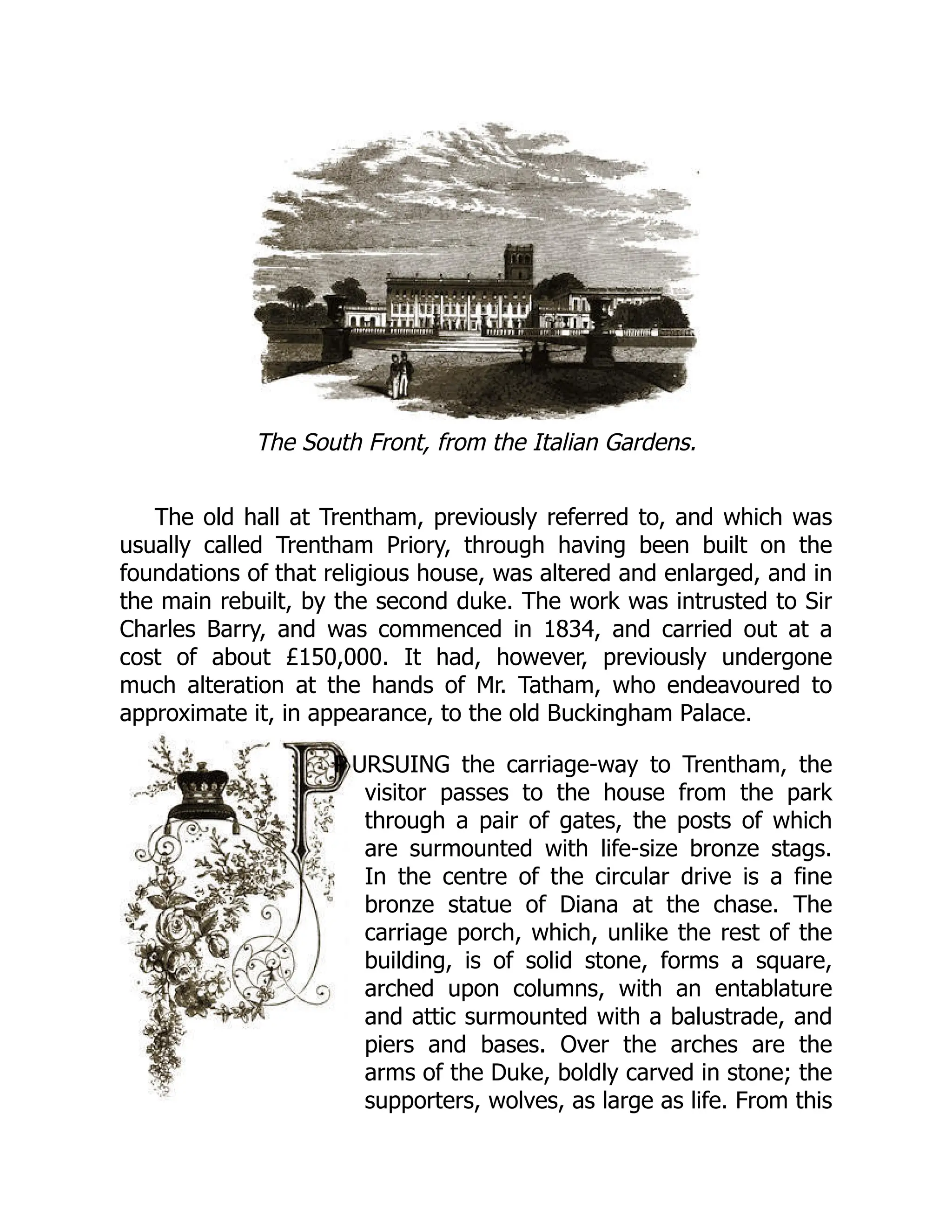
The South Front, from the Italian Gardens.
The old hall at Trentham, previously referred to, and which was
usually called Trentham Priory, through having been built on the
foundations of that religious house, was altered and enlarged, and in
the main rebuilt, by the second duke. The work was intrusted to Sir
Charles Barry, and was commenced in 1834, and carried out at a
cost of about £150,000. It had, however, previously undergone
much alteration at the hands of Mr. Tatham, who endeavoured to
approximate it, in appearance, to the old Buckingham Palace.
P URSUING the carriage-way to Trentham, the
visitor passes to the house from the park
through a pair of gates, the posts of which
are surmounted with life-size bronze stags.
In the centre of the circular drive is a fine
bronze statue of Diana at the chase. The
carriage porch, which, unlike the rest of the
building, is of solid stone, forms a square,
arched upon columns, with an entablature
and attic surmounted with a balustrade, and
piers and bases. Over the arches are the
arms of the Duke, boldly carved in stone; the
supporters, wolves, as large as life. From this
porch the entrance door opens into an elegant semicircular corridor,
which is one of the prettiest features of the place. To the left, on
entering, the corridor leads to the Entrance Hall, Grand Staircase,
Billiard, and other rooms; and, on the right, to the Private
Conservatory, Drawing-room, the private rooms, &c.; while in front it
encloses the West Court, with its shell-fountain, statue of “Venus
rising from the Bath,” and other attractions.
It is not necessary to minutely describe the various rooms of this
charming and purely domestic “Home,” nor to observe any
consecutive arrangement regarding those upon which we may
remark. All we need do is to briefly allude to some of the
apartments, and then pass on to the charming grounds—the glory of
Trentham.
Among the more notable rooms are the following:—The Venetian
Room, or the Duchess’s Boudoir, is, without exception, the most
perfect gem of a room which any mansion can boast. It, as well as
the Duke’s Room and Private Dining-room, opens from the corridor
to the private rooms, lined with presses of books, and is lighted by
three windows in the south front. The walls are divided into five
large panels, painted by Clarkson Stanfield, in his best and most
brilliant style, with scenes in Venice; the panels being separated
from each other, and surrounded by gilt reticulated work on a
crimson velvet ground. Of the furnishing and decorations of this
exquisite apartment it is enough to say that it is arranged with that
refined and faultlessly pure taste, which can nowhere be expected to
be better shown than in the surroundings of so good and amiable
and accomplished a woman as the Duchess of Sutherland.
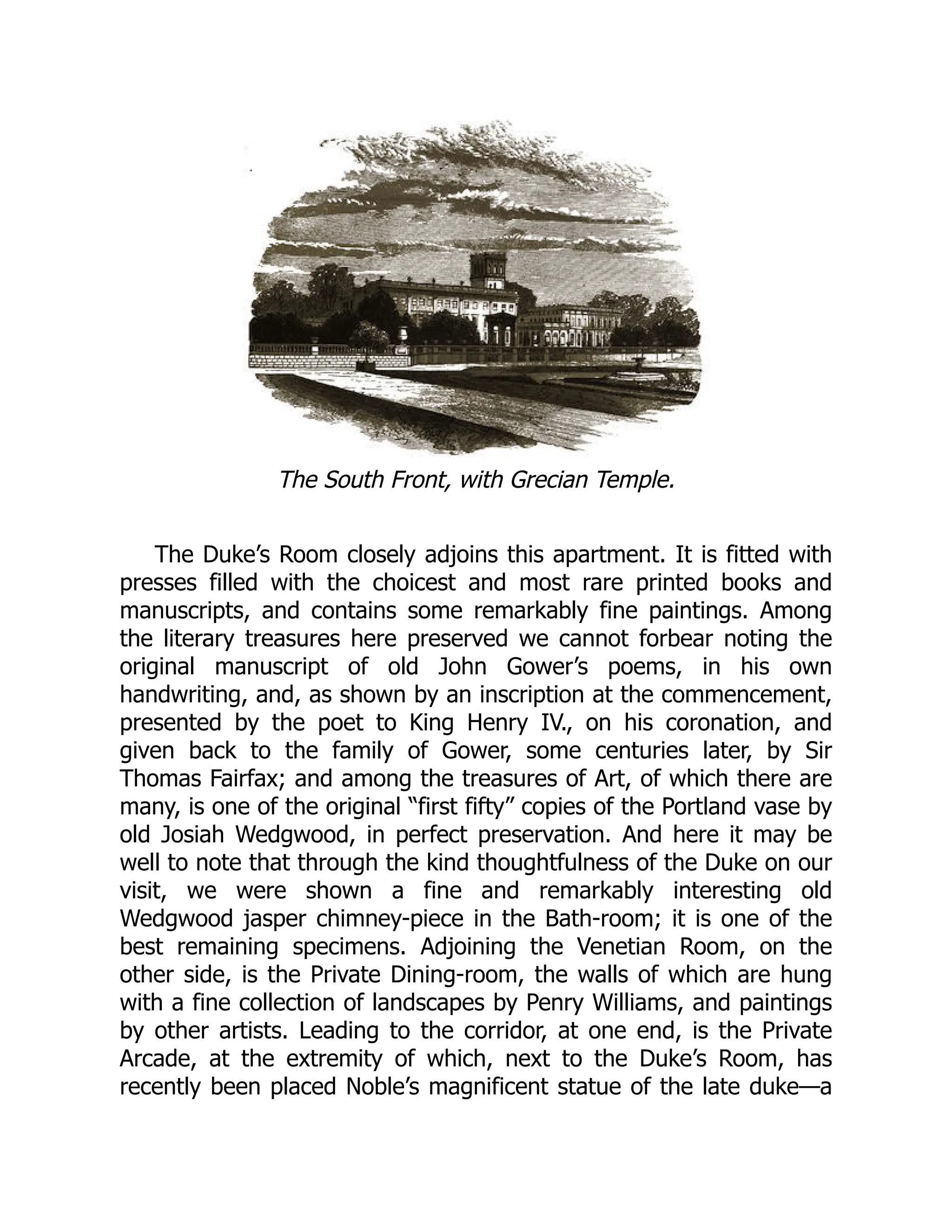
The South Front, with Grecian Temple.
The Duke’s Room closely adjoins this apartment. It is fitted with
presses filled with the choicest and most rare printed books and
manuscripts, and contains some remarkably fine paintings. Among
the literary treasures here preserved we cannot forbear noting the
original manuscript of old John Gower’s poems, in his own
handwriting, and, as shown by an inscription at the commencement,
presented by the poet to King Henry IV., on his coronation, and
given back to the family of Gower, some centuries later, by Sir
Thomas Fairfax; and among the treasures of Art, of which there are
many, is one of the original “first fifty” copies of the Portland vase by
old Josiah Wedgwood, in perfect preservation. And here it may be
well to note that through the kind thoughtfulness of the Duke on our
visit, we were shown a fine and remarkably interesting old
Wedgwood jasper chimney-piece in the Bath-room; it is one of the
best remaining specimens. Adjoining the Venetian Room, on the
other side, is the Private Dining-room, the walls of which are hung
with a fine collection of landscapes by Penry Williams, and paintings
by other artists. Leading to the corridor, at one end, is the Private
Arcade, at the extremity of which, next to the Duke’s Room, has
recently been placed Noble’s magnificent statue of the late duke—a
work of Art which takes rank with any of that eminent sculptor’s
productions.
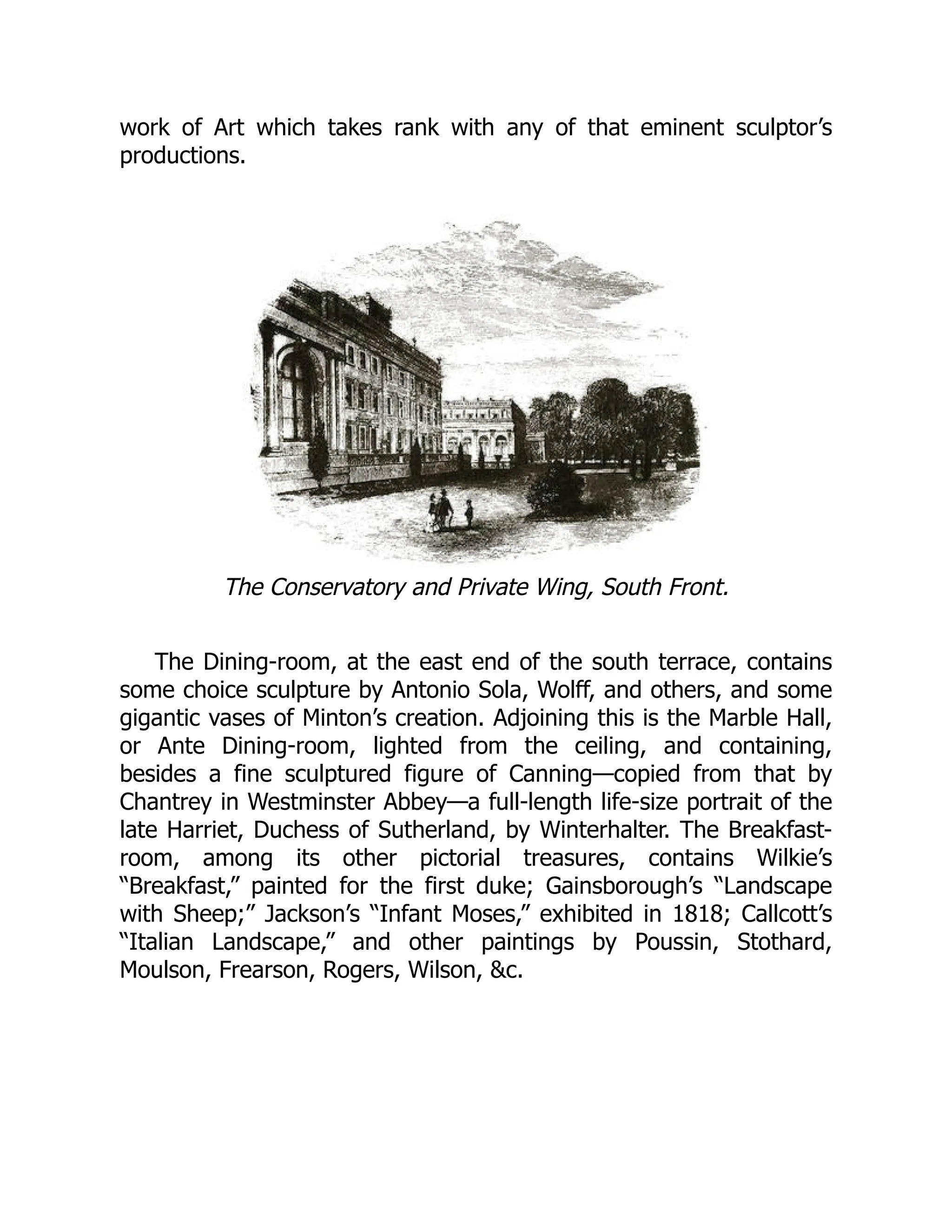
The Conservatory and Private Wing, South Front.
The Dining-room, at the east end of the south terrace, contains
some choice sculpture by Antonio Sola, Wolff, and others, and some
gigantic vases of Minton’s creation. Adjoining this is the Marble Hall,
or Ante Dining-room, lighted from the ceiling, and containing,
besides a fine sculptured figure of Canning—copied from that by
Chantrey in Westminster Abbey—a full-length life-size portrait of the
late Harriet, Duchess of Sutherland, by Winterhalter. The Breakfast-
room, among its other pictorial treasures, contains Wilkie’s
“Breakfast,” painted for the first duke; Gainsborough’s “Landscape
with Sheep;” Jackson’s “Infant Moses,” exhibited in 1818; Callcott’s
“Italian Landscape,” and other paintings by Poussin, Stothard,
Moulson, Frearson, Rogers, Wilson, &c.
The Private Conservatory.
The Library, which contains a marvellous collection of choice and
valuable books, is enriched by a frieze from the Elgin and Phigalean
marbles, and is a charming and highly interesting room. In the
Saloon, or Music-room, a pretty apartment whose ceiling is
supported on pilasters, are some exquisite family busts, a charming
bust of the late duchess by Noble, and other attractions. The carpet
is characterized by the same pattern as the terrace garden. The
Drawing-room, with its sweetly pretty painted ceiling, contains many
good pictures: among these are Hofland’s “Storm off the Coast at
Scarborough;” Sir Thomas Lawrence’s portraits of Lord Francis
Leveson-Gower (Egerton), and of the second Duke of Sutherland;
Vandyke’s “Children of Charles I.;” Charles Landseer’s “Benediction,”
and others. The Billiard-room has a lofty coved ceiling, and was the
Great Hall of the old mansion. In it are Winterhalter’s grand full-
length figure of Queen Victoria, presented by her Majesty to the late
duchess; a copy of Reynolds’s portrait of George III.; Romney’s
portrait of Queen Charlotte, Lord Chancellor Thurlow, and the first
Marquis of Stafford, and others.
In the Entrance Hall is a copy of Michael Angelo’s statue of
“Thought;” and on the Grand Staircase is a rich assemblage of family
and other portraits. In the various bed-rooms and other apartments,
too, are contained a vast number of valuable paintings and works of
Art.
The Private Conservatory, however, is one of the “gems” of
Trentham, and is as elegant in its arrangements and decorations as
the most fastidious taste can desire or Art accomplish. Of this
miniature “world of flowers” we give an engraving, from a special
photograph taken by Harrison, but of its Eastern splendour of rich
colours we can offer no idea. It is a square apartment, with Italian
windows and trellised walls, and is also trellised between the lights
of the ceiling. In the centre is a fine figure of “Venus at the Bath.”
The noble ferns and the exotic and other plants are of the choicest
kinds, and the arrangement of colour, especially when all are lighted
from the number of lamps suspended from the roof, is exquisitely
beautiful.
A pleasant feature of Trentham is the Bowling Alley—formerly the
Orangery Arcade—which affords an almost unique and very pleasing
indoor pastime for the family and friends. This feature, we believe,
was much enjoyed by the Shah on his visit to Trentham, which was
rendered lavishly enjoyable to him in every conceivable way.
From the Entrance Hall a doorway opens into the Church, which
thus becomes not only the parish church, but the private chapel of
the Duke. The Church thus forms a part of, or at all events is
attached to, the house; and the transition from the elegances of
modern life to the grand old house of prayer is very striking and
solemn. The Church, which was restored in 1842 at the cost of the
Duke, by Sir Charles Barry, is the nave of the old abbey of Trentham,
the chancel having extended considerably beyond the present east
wall of the churchyard. The Church, as it now exists, consists of a
nave with clerestory, north and south aisles, and chancel, with a
mortuary chapel at the east end of the south aisle. The pillars which
divide the aisles from the nave are Norman, and are the original
pillars, carefully replaced and restored, of the old priory; from them
now spring acutely pointed arches of a later, and consequently
incongruous, character. The chancel is divided from the nave by an
elaborate oak screen of late but good character, the altar-piece, by
Hilton, being the “Taking down from the Cross.” There is an eagle
lectern at the east end of the nave; and the pulpit is hung with a
fine Moorish horsecloth, elaborately worked in silver on crimson
velvet. At the west end is a gallery forming the family pew. At the
back of this, beneath the window, is a bust of the late duke; on the
south side, a bust, by Noble, of a son of the present duke, who died
young; and, on the north side, a tablet to Lord Frederick Leveson-
Gower, who lost his life during the Crimean war. At the same end of
the Church is a poor’s box, bearing date 1698. The font, the gift of
the parishioners, is also at the west end.
Trentham Church.
In the Memorial Chapel, besides the exquisitely beautiful altar-
tomb to the late duchess by Noble, to which we have already
referred, are monuments and tablets to the Levesons and Gowers;
and here, too, is placed a memorial bust to Lord Albert, recently
deceased. Of the beautiful monument to the late duchess we have
given an engraving on page 40, copied from a clever photograph by
M. De Tejada, taken from the admirable picture by Mr. John
O’Connor, painted, we believe, for Lord Ronald Gower, and in his
lordship’s possession. In the north wall of the Church is a recessed
arched tomb, on which lie the fragments of a highly interesting
effigy in chain-mail, dug up in the churchyard a few years ago; and
over the north door are the royal arms, dated 1663, pierced with
Parliamentarian bullets.[40]
One feature yet remains to be noted; it is the introduction on the
north wall of encaustic wall-tiles, each one of which, enclosed in a
reticulated pattern, bears a memorial of some departed parishioner,
in manner following:—
These, which are many in number, are arranged above the oak
lining on the seats, and have appropriate texts, &c., also in tiles,
running above and below the series. It is a pretty and very lasting,
as well as inexpensive, kind of memorial, and one that might with
advantage be adopted in many churches. In the churchyard are the
remains of a cross, and some other interesting matters.
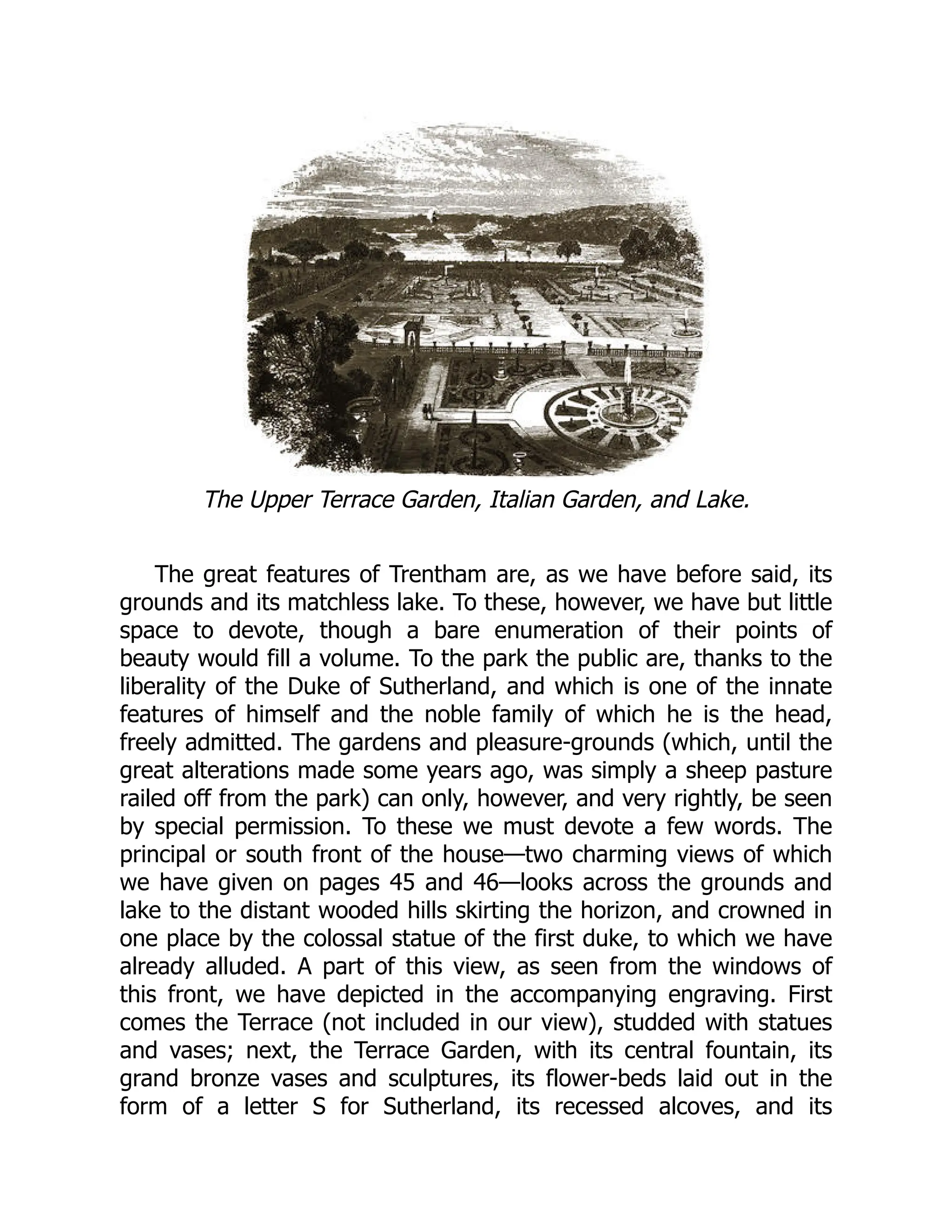
The Upper Terrace Garden, Italian Garden, and Lake.
The great features of Trentham are, as we have before said, its
grounds and its matchless lake. To these, however, we have but little
space to devote, though a bare enumeration of their points of
beauty would fill a volume. To the park the public are, thanks to the
liberality of the Duke of Sutherland, and which is one of the innate
features of himself and the noble family of which he is the head,
freely admitted. The gardens and pleasure-grounds (which, until the
great alterations made some years ago, was simply a sheep pasture
railed off from the park) can only, however, and very rightly, be seen
by special permission. To these we must devote a few words. The
principal or south front of the house—two charming views of which
we have given on pages 45 and 46—looks across the grounds and
lake to the distant wooded hills skirting the horizon, and crowned in
one place by the colossal statue of the first duke, to which we have
already alluded. A part of this view, as seen from the windows of
this front, we have depicted in the accompanying engraving. First
comes the Terrace (not included in our view), studded with statues
and vases; next, the Terrace Garden, with its central fountain, its
grand bronze vases and sculptures, its flower-beds laid out in the
form of a letter S for Sutherland, its recessed alcoves, and its
Grecian temples, containing marvellous examples of antique
sculpture; next, beyond, come the Italian Gardens (approached by a
fine semicircular flight of steps), about ten acres in extent, with their
parterres and borders and sunk beds, their statues, fountain, and
busts, and their thousand and one other attractions; then the Lake
Terrace, with its balustrade, its line of vases, its magnificent colossal
statue of “Perseus and Medusa” (which cost its noble owner £1,600),
its descending steps for landing, its boat-houses, and other
appliances; then, next beyond, the Lake, eighty-three acres in
extent, on which sailing and rowing boats and canoes find ample
space for aquatic exercise; then the Islands—one of which alone is
four acres in extent, and the other a single acre—beautifully planted
with trees and shrubs; and, beyond this again, the woods of
Tittensor, with the crowning monument. To the left are the grand
wooded heights of King’s Wood Bank, a part of the ancient forest of
Needwood, and consequently the remains of the old hunting-
grounds of the Kings of Mercia; and, to the right, the American
Grounds, planted with a profusion of rhododendrons and other
appropriate shrubs and plants; while the Italian Garden is skirted on
its east side by a deliciously cool and shady trellised walk—a floral
tunnel, so to speak, some two hundred yards long, formed of
trellised arches the whole of its length, overgrown with creeping
plants and flowers, and decorated with busts, ornamental baskets,
&c., forming a vista of extreme loveliness.
Near this is a pleasant glade, having the Orangery, now the
Bowling Alley, at its extremity; and near here is the iron bridge—one
hundred and thirty years old, and one of the chefs-d’œuvre of the
old Coalbrookdale Works—crossing the river Trent, which flows
through the grounds. Standing on this bridge, the view both up and
down the Trent is strikingly beautiful. Looking up the stream, the
“solemn Trent” is seen crossed by the old stone bridge, while, to the
left, a view of the house is partially obtained through the trees, the
original course of the river, before it was altered, being distinctly
traceable, and presenting a broader surface and a more graceful
sweep than at present. Looking down the stream, the view is more
charming still, and embraces the river, the lake (into which, until a
few years back, the Trent flowed), the islands, the American and
other gardens, and the wooded heights that skirt the domain.
Crossing the bridge, a little to the right is the Conservatory, filled
with the choicest trees and flowering plants, and kept, as all the rest
of the gardens and grounds are, in the most perfect order. In front
of this Conservatory is a pretty feature—the poetical idea of the late
duchess—consisting of the names of her daughters (the sisters of
the present Duke of Sutherland) planted in box on a ground of white
spar. The words as they appear are—
ELIZABETH LORNE.
EVELYN BLANTYRE.
CAROLINE KILDARE.
CONSTANCE GROSVENOR.
VIRET MEMORIA.
Thus the “memory” of the four daughters of the late duchess—viz.
the present Duchess of Argyll, the Lady Blantyre, the Duchess of
Leinster, and the Duchess of Westminster—is kept “ever green.”
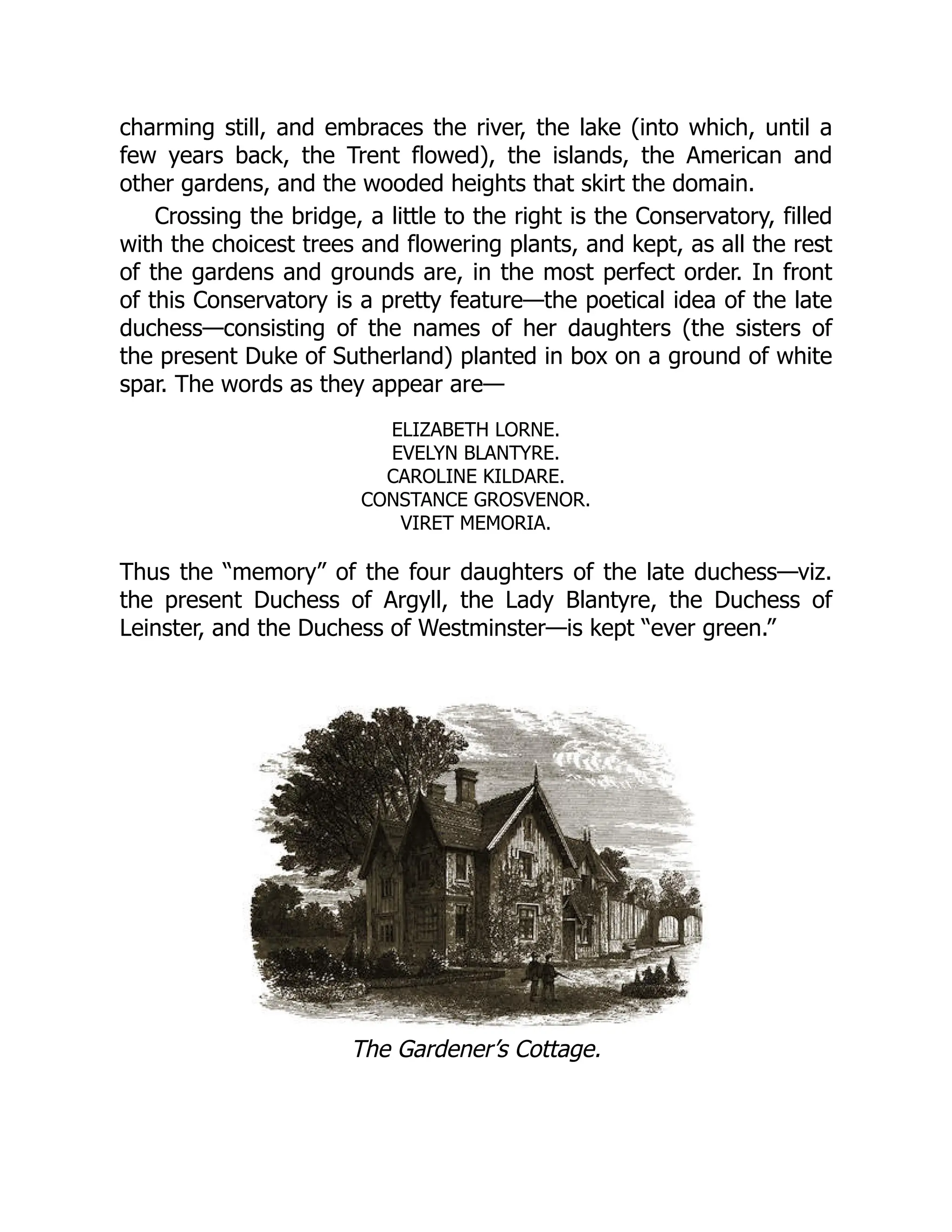
The Gardener’s Cottage.
Near by are the Kitchen Gardens, Conservatories, Vineries,
Peach-houses, Pine-houses, Orchid-houses, and all the usual
appliances of a large and well-devised establishment; and it is a
notable feature that all round the Kitchen Gardens, some thirteen
acres in extent, is carried what is known as the Trentham Wall-Case
—a glass-sided and covered passage, filled with peaches and
nectarines, and forming an enclosed walk all round the place. Near
the garden entrance is the pleasant residence of the head-gardener,
shown in the preceding engraving. It was erected from the designs
of Sir Charles Barry; and near it is another excellent building, a
“bothie” for the young gardeners, erected from the designs of Mr.
Roberts, the Duke’s architect and surveyor at Trentham. In this
cottage the young gardeners, several in number, board and lodge,
and have a reading-room, healthful and amusing games, and other
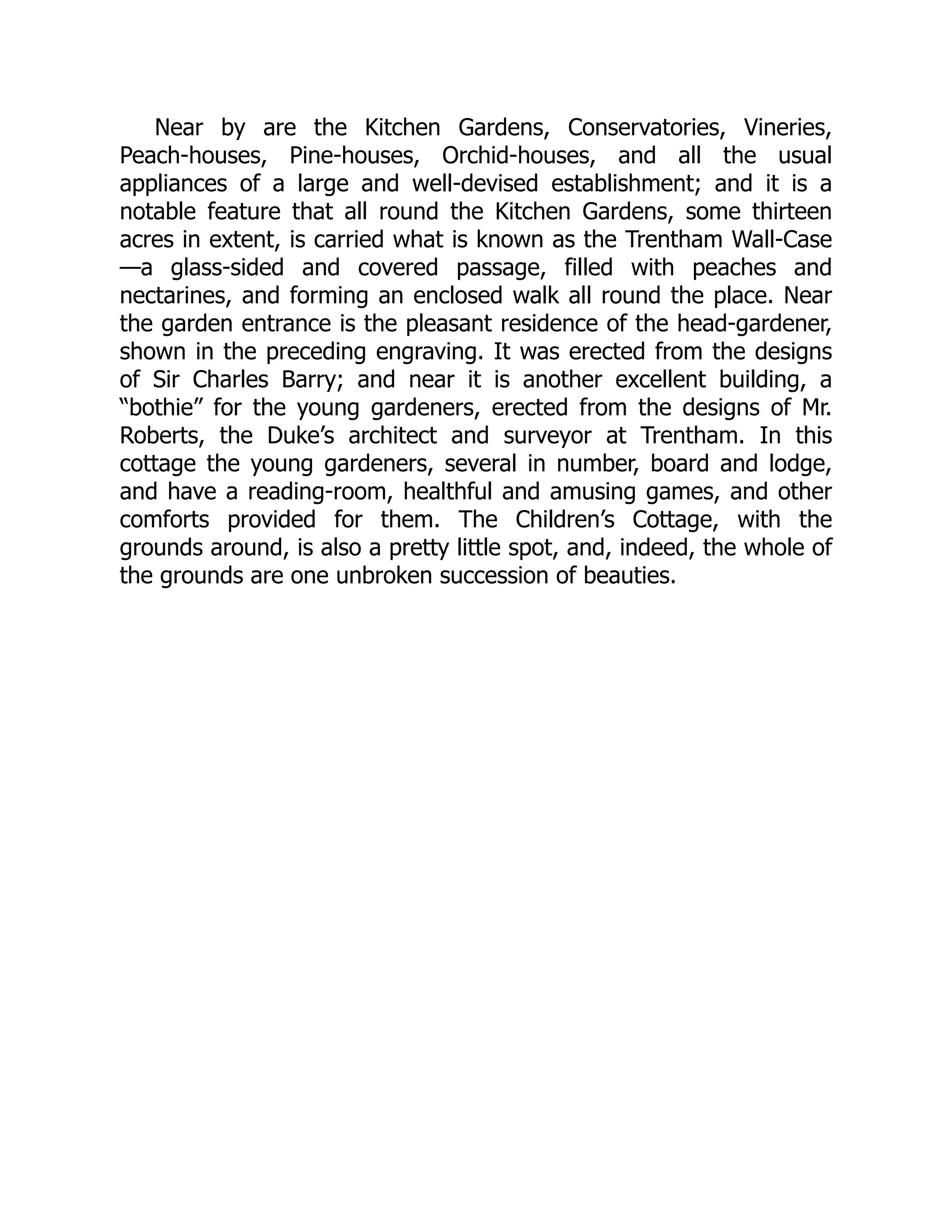
comforts provided for them. The Children’s Cottage, with the
grounds around, is also a pretty little spot, and, indeed, the whole of
the grounds are one unbroken succession of beauties.
Children’s Cottage and Gardens.
Just outside the park is the Mausoleum—the burial-place of the
family—behind which is the present graveyard of the parish.
Of the Poultry-houses (the finest in existence), the Stables, the
Kennels, and the Estate Offices and Works it is not our province to
speak. They are all that can be desired in arrangement, and are
lavishly fitted with every convenience.
We reluctantly take our leave of Trentham, congratulating alike
its noble owner on the possession of so lovely an estate, and the
Pottery district in having in its midst a nobleman of such refined
taste as his Grace the Duke of Sutherland, of such liberal and kindly
disposition, and of such boundless wealth, which he has the
Welcome to our website – the perfect destination for book lovers and
knowledge seekers. We believe that every book holds a new world,
offering opportunities for learning, discovery, and personal growth.
That’s why we are dedicated to bringing you a diverse collection of
books, ranging from classic literature and specialized publications to
self-development guides and children's books.
More than just a book-buying platform, we strive to be a bridge
connecting you with timeless cultural and intellectual values. With an
elegant, user-friendly interface and a smart search system, you can
quickly find the books that best suit your interests. Additionally,
our special promotions and home delivery services help you save time
and fully enjoy the joy of reading.
Join us on a journey of knowledge exploration, passion nurturing, and
personal growth every day!
testbankdeal.com

Basics of Social Research Qualitative and Quantitative Approaches Canadian 1st Edition Neuman Test Bank


  • 1.
    Basics of SocialResearch Qualitative and Quantitative Approaches Canadian 1st Edition Neuman Test Bank download https://testbankdeal.com/product/basics-of-social-research- qualitative-and-quantitative-approaches-canadian-1st-edition- neuman-test-bank/ Find test banks or solution manuals at testbankdeal.com today!

  • 2.
    We have selectedsome products that you may be interested in Click the link to download now or visit testbankdeal.com for more options!. Social Research Methods Qualitative And Quantitative Approaches 7th Edition Neuman Test Bank https://testbankdeal.com/product/social-research-methods-qualitative- and-quantitative-approaches-7th-edition-neuman-test-bank/ Basics of Social Research Canadian 3rd Edition Neuman Test Bank https://testbankdeal.com/product/basics-of-social-research- canadian-3rd-edition-neuman-test-bank/ Basics of Social Research Canadian 4th Edition Neuman Test Bank https://testbankdeal.com/product/basics-of-social-research- canadian-4th-edition-neuman-test-bank/ Genetics A Conceptual Approach 5th Edition Pierce Solutions Manual https://testbankdeal.com/product/genetics-a-conceptual-approach-5th- edition-pierce-solutions-manual/
  • 3.
    Auditing Cases AnInteractive Learning Approach 7th Edition Beasley Solutions Manual https://testbankdeal.com/product/auditing-cases-an-interactive- learning-approach-7th-edition-beasley-solutions-manual/ Canadian Advertising in Action Canadian 10th Edition Tuckwell Test Bank https://testbankdeal.com/product/canadian-advertising-in-action- canadian-10th-edition-tuckwell-test-bank/ Financial Reporting 1st Edition Loftus Solutions Manual https://testbankdeal.com/product/financial-reporting-1st-edition- loftus-solutions-manual/ Genetics Analysis and Principles 5th Edition Brooker Solutions Manual https://testbankdeal.com/product/genetics-analysis-and-principles-5th- edition-brooker-solutions-manual/ Business Ethics Ethical Decision Making and Cases 10th Edition Ferrell Test Bank https://testbankdeal.com/product/business-ethics-ethical-decision- making-and-cases-10th-edition-ferrell-test-bank/
  • 4.
    Taxation of Individuals2019 Edition 10th Edition Spilker Test Bank https://testbankdeal.com/product/taxation-of- individuals-2019-edition-10th-edition-spilker-test-bank/
  • 5.
    Chapter 10 Non-ReactiveResearch and Secondary Analysis 10.1 Essay Questions 1) What reliability problems can arise in existing statistics research? Answer: Diff: 5 Page Ref: 237 Topic: Existing Statistics & Documents, Secondary Analysis Skill: 06. Explain reasons for using a specific process/procedure Objective: 10.01 Understand reliability & validity in nonreactive res. 2) What is secondary data analysis? What are its advantages and disadvantages? Answer: Diff: 5 Page Ref: 232-237 Topic: Existing Statistics & Documents, Secondary Analysis Skill: 04. Express familiarity with the range of techniques/methods Objective: 10.02 Recognize strengths/limits of exist stats & secondary 3) What is the purpose of multiple coders in content analysis? What possible problem can this create? How might one deal with the problem? Answer: Diff: 6 Page Ref: 223-225 Topic: Content Analysis Skill: 06. Explain reasons for using a specific process/procedure Objective: 10.03 Distinguish types of coding in content analysis/issues 4) Describe the aggregation problem in existing statistics. Answer: Diff: 7 Page Ref: 233-237 Topic: Existing Statistics & Documents, Secondary Analysis Skill: 39. Identify strengths/weakness of second data & existing st Objective: 10.02 Recognize strengths/limits of exist stats & secondary 5) Explain problems with inferences and validity in content analysis research? Answer: Diff: 6 Page Ref: 228-229, 237 Topic: Content Analysis Skill: 38. Explain coding in content analysis and know limitations Objective: 10.01 Understand reliability & validity in nonreactive res. 6) Give an example of the fallacy of misplaced concreteness and explain why it is deceptive. Answer: Diff: 4 Page Ref: 233-234 Topic: Existing Statistics & Documents, Secondary Analysis Skill: 08. Provide examples of abstract ideas/principles
  • 6.
    Objective: 10.02 Recognizestrengths/limits of exist stats & secondary 10.2 Multiple Choice Questions Refer to the following paragraph to answer the questions below. Undergraduate student Stanley Sleuth conducted a content analysis study of the Toronto Star newspaper between 1915 and 2005. He first identified relevant articles involving government regulation of business. After finding 20,000 such articles, he systematically sampled articles with a sampling interval of 50. He then coded each sampled article based on the subjective meaning it expressed, as pro- or anti-government regulation using a 1 to 10 scale (1 = very anti-regulation, 10 = very pro-regulation). 1 ) In this study, Stanley used A. latent coding. B. manifest coding. C. generic coding. D. intervention strategy coding. E. contingency coding. Answer: A Diff: 4 Page Ref: 223-224 Topic: Content Analysis Skill: 01. Apply abstract learning to realistic situations Objective:10.03 Distinguish types of coding in content analysis/issues 2) Which of the following is FALSE about secondary data analysis? A. A gap may exist between a researcher's conceptualization of a variable and how it is measured in available data. B. Locating data with specific variables of interest can be time consuming and sometimes a researcher may not make data available. C. Information about how data was collected may be insufficient to determine whether there is bias. D. It is very expensive compared to equivalent primary data collection. E. It facilitates replication. Answer: D Diff: 4 Page Ref: 232-233 Topic: Existing Statistics & Documents, Secondary Analysis Skill: 39. Identify strengths/weakness of second data & existing st Objective: 10.02 Recognize strengths/limits of exist stats & secondary 3) The most valuable general source of existing statistics for studying the United States is A. Gallup polls. B. Demographic Yearbook. C. World Book Encyclopedia. D. Superintendent of Documents. E. Statistical Abstract of the United States. Answer: E Diff: 2 Page Ref: 231-232 Topic: Existing Statistics & Documents, Secondary Analysis Skill: 15. Understand types & strengths/weaknesses of sources Objective: 10.02 Recognize strengths/limits of exist stats & secondary
  • 7.
    4) Professor JohnJuniper was interested in using Statistics Canada data to examine the trend in Canadian unemployment rates for the last forty years. Yet, he found that unemployment was not recorded accurately in each year. This is an issue of A. reliability. B. validity. C. ecological fallacy. D. ideal types. E. verstehen. Answer: A Diff: 5 Page Ref: 237 Topic: Existing Statistics & Documents, Secondary Analysis Skill: 39. Identify strengths/weakness of second data & existing st Objective: 10.02 Recognize strengths/limits of exist stats & secondary 5) Professor Ernie Easter has a list of measures on the French influence in the Moncton, New Brunswick area. He asked you to identify the one that is NOT an Unobtrusive Measure. Which one is it? A. the wear on novels in Moncton public libraries written in French B. walking down a street in Moncton and noticing that most of the signs in stores in a neighborhood are in French C. a list of votes supporting bills on bilingual education in the New Brunswick legislature with the area represented by each legislator noted on the list D. a box of 300 letters written by people living in Moncton to relatives living in French speaking areas outside the province (e.g., Quebec) between 1980 and 1985 E. a survey using a three-page questionnaire partly written in French that was distributed to residents of a neighbourhood Answer: E Diff: 6 Page Ref: 219 Topic: Non-Reactive Measures Skill: 01. Apply abstract learning to realistic situations Objective: 10.01 Understand reliability & validity in nonreactive res. 6) Which of the following is an example of an Unobtrusive Measure? A. a telephone interview with voters asking them how they intend to vote B. a three-week laboratory experiment to see whether students who participate in an exercise program lose more weight than those who follow a special diet C. a mailed questionnaire to mayors asking whether their town has an evacuation plan in case of a nuclear D. power plant disaster E. all of the above F. none of the above Answer: E Diff: 4 Page Ref: 219 Topic: Non-Reactive Measures Skill: 35. Recognize reactivity & external validity problems Objective: 10.01 Understand reliability & validity in nonreactive res. 7) In content analysis, researchers usually use what type of sampling? A. snowball B. quota
  • 8.
    C. probabilistic orrandom D. judgmental E. none, sampling does not occur Answer: C Diff: 4 Page Ref: 225-226 Topic: Content Analysis Skill: 28. Recognize situations for various types of random samples Objective: 10.03 Distinguish types of coding in content analysis/issues 8) Professor Aaron Acorn counts the number of total people and percentage who are Asian in a sample of 400 TV commercials shown during a one month period on two Vancouver area stations. He wants to see whether the percentage of Asians in commercials equals, is greater than, or is less than the percentage of Asians in the area population. He is using A. latent structure measurement. B. generic content coding. C. manifest content coding. D. corroborative coding. E. latent content coding. Answer: C Diff: 3 Page Ref: 223-224 Topic: Content Analysis Skill: 01. Apply abstract learning to realistic situations Objective: 10.03 Distinguish types of coding in content analysis/issues 9) Which is a major ADVANTAGE of content analysis? A. It is time consuming and requires a large staff with specialized equipment. B. It is unobtrusive. C. It cannot measure how people experience the "text" or how the text affects them. D. It cannot be used to study materials which are not written or recorded. E. None of the above. Answer: B Diff: 3 Page Ref: 221-223 Topic: Content Analysis Skill: 38. Explain coding in content analysis and know limitations Objective: 10.03 Distinguish types of coding in content analysis/issues 10) Compared to latent coding in content analysis, manifest coding seems to have A. greater reliability than latent coding. B. lower validity than latent coding. C. greater validity than latent coding. D. lower reliability than latent coding. E. A and B. Answer: E Diff: 5 Page Ref: 223-224 Topic: Content Analysis Skill: 38. Explain coding in content analysis and know limitations Objective: 10.03 Distinguish types of coding in content analysis/issues
  • 9.
    11) Professor LornaLovebird codes the number of times the word "sex" is used in commercials. She is examining A. lateral structure. B. ecological content. C. manifest content. D. corroboration. E. latent content. Answer: C Diff: 2 Page Ref: 223 Topic: Content Analysis Skill: 01. Apply abstract learning to realistic situations Objective: 09.03 Distinguish types of coding in content analysis/issues 12) What is found in garbage dumps or the trash left over after a movie are examples of A. traces. B. erosion. C. accretion. D. hash marks. E. vital statistics. Answer: C Diff: 4 Page Ref: 219 Topic: Non-Reactive Measures Skill: 01. Apply abstract learning to realistic situations Objective: 10.01 Understand reliability & validity in nonreactive res. 13) Graduate student Karen Koolray compared two textbooks. She counted the word "he" 80 times in book A and 20 times in book B. She also found book A contained the word "chairman" 40 times while it only appeared 10 times in book B. She can conclude A. book A is four-times more sexist than book B. B. the words "he" and "chairman" appeared four times more often in book A than in book B. C. students using book A will become more sexist than those using book B. D. a teacher who chooses book A is more sexist than one who chooses book B. E. C and D. Answer: B Diff: 6 Page Ref: 223-224, 228-229 Topic: Content Analysis Skill: 01. Apply abstract learning to realistic situations Objective: 10.02 Recognize strengths/limits of exist stats & secondary 14) An example of a problem with existing statistics can occur when a researcher defines a concept, such a unemployment, in one way but the available statistical information gathered by a government agency uses a different definition. This can create what type of problem? A. A problem of validity B. A problem of misplaced concreteness C. A problem of missing data D. A problem of reliability E. E) A problem of inference Answer: A Diff: 6 Page Ref: 234 Topic: Existing Statistics & Documents, Secondary Analysis
  • 10.
    Skill: 01. Applyabstract learning to realistic situations Objective: 10.02 Recognize strengths/limits of exist stats & secondary 10.3 Key Terms Vocabulary Questions 1) accretion measures Answer: Nonreactive measures of the residue of the activity of people or what they leave behind. Diff: 4 Page Ref: 219 Topic: Non-Reactive Measures Skill: 50. Ability to Define Key Terms Objective: 10.01 Understand reliability & validity in nonreactive res. 2) coding Answer: The process of converting raw information or data into another form for analysis. In content analysis, it is a means for determining how to convert symbolic meanings in the text into another form, usually numbers. Diff: 4 Page Ref: 222 Topic: Content Analysis Skill: 50. Ability to Define Key Terms Objective: 10.03 Distinguish types of coding in content analysis/issues 3) coding frame Answer: An exhaustive list of all possible values that codes may take in content analysis Diff: 4 Page Ref: 223 Topic: Content Analysis Skill: 50. Ability to Define Key Terms Objective: 10.03 Distinguish types of coding in content analysis/issues 4) coding system Answer: A set of instructions or rules used in content analysis to explain how to systematically convert the symbolic content from text into quantitative data. Diff: 4 Page Ref: 223 Topic: Content Analysis Skill: 50. Ability to Define Key Terms Objective: 09.03 Distinguish types of coding in content analysis/issues 5) content Answer: Refers to words, meanings, pictures, symbols, ideas, themes, or any message that can be communicated. Diff: 4 Page Ref: 221 Topic: Content Analysis
  • 11.
    Skill: 50. Abilityto Define Key Terms Objective: 10.03 Distinguish types of coding in content analysis/issues 6) content analysis Answer: Research in which one examine patterns of symbolic meaning within text that may be written, audio, visual, or other mediums of communication. Diff: 4 Page Ref: 221-228 Topic: Content Analysis Skill: 50. Ability to Define Key Terms Objective: 10.03 Distinguish types of coding in content analysis/issues 7) erosion measures Answer: Nonreactive measures of the wear or deterioration on surfaces due to the activity of people. Diff: 4 Page Ref: 220 Topic: Non-Reactive Measures Skill: 50. Ability to Define Key Terms Objective: 10.01 Understand reliability & validity in nonreactive res. 8) fallacy of misplaced concreteness Answer: When a person uses too many digits in quantitative measure in an attempt to create the impression that the data are accurate or the researcher is highly capable. Diff: 4 Page Ref: 233-234 Topic: Existing Statistics & Documents, Secondary Analysis Skill: 50. Ability to Define Key Terms Objective: 10.02 Recognize strengths/limits of exist stats & secondary 9) Latent coding Answer: A type of content analysis coding in which a researcher identifies subjective meaning such as general themes or motifs in a communication medium. Diff: 4 Page Ref: 223-224 Topic: Content Analysis Skill: 50. Ability to Define Key Terms Objective: 10.03 Distinguish types of coding in content analysis/issues 10) Manifest coding Answer: A type of content analysis coding in which a researcher identifies first develops a list of specifics words, phases, or symbols, then find them in a communication medium. Diff: 4 Page Ref: 223 Topic: Content Analysis Skill: 50. Ability to Define Key Terms
  • 12.
    Objective: 10.03 Distinguishtypes of coding in content analysis/issues 11) nonreactive Answer: Measures in which the people being studied are unaware that they are in a study. Diff: 4 Page Ref: 219 Topic: Non-Reactive Measures Skill: 50. Ability to Define Key Terms Objective: 10.01 Understand reliability & validity in nonreactive res. 12) reactive Answer: Measures in which the people being studied are aware that they are in the study. Diff: 4 Page Ref: 219 Topic: Non-Reactive Measures Skill: 50. Ability to Define Key Terms Objective: 10.01 Understand reliability & validity in nonreactive res. 13) recording sheet Answer: One or more pages on which a researcher writes down systematically what has coded been coded from text in content analysis. Diff: 4 Page Ref: 227-228 Topic: Content Analysis Skill: 50. Ability to Define Key Terms Objective: 10.03 Distinguish types of coding in content analysis/issues 14) structured observation Answer: A method of watching what is happening in a social setting or noticing information in communication that is highly organized and that follows systematic rules for careful observation and documentation. Diff: 4 Page Ref: 222 Topic: Non-Reactive Measures Skill: 50. Ability to Define Key Terms Objective: 10.01 Understand reliability & validity in nonreactive res. 15) text Answer: A general name for symbolic meaning expressed within a communication medium and measured in content analysis. Diff: 4 Page Ref: 221 Topic: Content Analysis Skill: 50. Ability to Define Key Terms Objective: 10.03 Distinguish types of coding in content analysis/issues
  • 13.
    16) unobtrusive measure Answer:Another name for nonreactive measures. It emphasizes that the people being studied are not aware of it because the measures are not obvious and do not intrude. Diff: 4 Page Ref: 219-221 Topic: Non-Reactive Measures Skill: 50. Ability to Define Key Terms Objective: 10.01 Understand reliability & validity in nonreactive res.
  • 14.
    Random documents withunrelated content Scribd suggests to you:
  • 15.
    beautiful for itsfoliage!” “Then there were bright masses of Dianthus neglectus and alpinus, with their dense tufts of lovely pink flowers; and turn which way you will, gems of rarity or beauty met the eye.” “One likes to linger on these slopes; and as one stands on the upper portion of it, and looks down on the carpet of lovely green backed by the feathery and elegant foliage of the birch, it is indeed hard to be obliged to tear one’s self away from it.” Belvoir Castle, from the Stables, showing the Covered Exercise- ground. The Statue Garden, one of the most striking “bits” in the grounds, is so called from a number of statues by Cibber which adorn it. This garden, when viewed from the terrace, entirely screened from observation from the castle, is one of marvellous and old-world beauty; the majestic and venerable silver firs—remarkable for their gigantic growth and their hoary age—the grounds, half garden, half wood (a strange combination of natural wildness with artificial planting), adding much to the effect of the scene.
  • 16.
    The Dairy, theKennels, the Stables with the covered Exercise- ground, and the Farm, as well as the magnificent Lake of ninety acres in extent, are all objects of special interest, but to them we can only thus allude. The Gardener’s Cottage. The Mausoleum is situated on the summit of an eminence on the opposite side of the valley from the castle, on a spot immediately facing the windows of the Duchess’s boudoir, chosen by herself as a fit place wherein she might rest. Her grace died in 1825, and was buried at Bottesford Church. In 1826 the mausoleum was commenced, and completed in 1828, when her body, and those of nine other members of the family, were removed to it and deposited in the vault. Since then others have been removed there, and the “good duke” also there rests, as does the lamented Lord George Manners (brother of the present duke), who died in November, 1874. The mausoleum is approached by an avenue of grand old yews, which give a solemnity to the place which is eminently in keeping with its character. The building is in the Norman style, and consists of what may perhaps be called a chapel, with apse and a projecting
  • 17.
    porch, and vaultsbeneath. Within the apse, lit with a flood of golden light from above, is one of the most exquisitely beautiful pieces of sculpture it has been our good fortune to see. On it the Duchess is represented as rising from the admirably sculptured tomb with expanded arms, and her face elevated towards the clouds, in which are seen four cherubs—the children who preceded her to the grave —one of whom is holding over her a crown of glory. It is by Wyatt, and is considered to be his masterpiece. The Kitchen and Fruit Gardens are about eight acres in extent within the walls, and more than that outside. They are arranged in the most effective, convenient, and admirable manner, and managed with that care and judgment which are the distinguishing characteristics of the head gardener’s skill. His charming cottage forms one of our vignettes; it is overgrown with clematis and other climbing plants, which grow with natural luxuriance over its porch and hedgerows. Nature, indeed, in the grounds and gardens of Belvoir, is the first, the main, and the ultimate study; and thus at all points, and in every direction, natural instead of artificial beauties present themselves to the eye, and give the greatest charm of all to whatever the visitor sees. Wild flowers are especially cultivated and bedded out in all their native simplicity, while numbers of Alpine and other plants are also acclimatised, and mingle their beauties with those of our own country. Belvoir is indeed well named, not only for its “beautiful prospect” from the building itself, but its hundreds of beautiful prospects within its own boundaries. Well might a gifted authoress thus write on leaving so lovely a place as Belvoir Castle and its surroundings:— “Farewell, fair castle, on thy lordly hill Firm be thy seat, and proud thy station still: Soft rise the breezes from the vale below— Bright be the clouds that wander o’er thy brow: O’er the fair lands that form thy broad domain, Short be the winter—long the summer reign. Pilgrim of pleasure to thy stately towers, Fain would I leave among thy friendly bowers Some votive offering—and, ere on my way
  • 18.
    With many abackward glance I turn to stray, Bid virtue, strength, and honour crown thy walls; Joy, love, and peace abide within thy halls; While grateful mirth and noble courtesy, As now, for ever, hold their seat in thee; And still upon thy lordly turrets rest The grateful blessing of each parting guest.” The neighbourhood of Belvoir Castle is one of great beauty, and it is rich in objects of interest both to the botanist, the naturalist, and the geologist; while to the lover of Nature it presents charms of unusual attraction. In the hills and vales surrounding the castle, nearly the whole series of lower oolitic rocks may be traced, from the white limestone down to the black liassic shales. Capping the hills to the south, which are of greater elevation than the castle, is the inferior oolite, or rather a variety of it called “Lincolnshire limestone,” a hard, light rock, very rich in fossil remains. On these hills the growth of trees is stunted, but the ground is covered with a profusion of lovely flowers. Underlying the oolite is the upper lias clay, rich in fossils and shells. Belvoir Castle itself stands on the extremity of a long northern spur of these hills, upon the middle lias, or marlstone, which caps all the neighbouring heights, and gives their soil a remarkably red tinge. It is very rich in iron, both in veins and in lump ore. The vale of Belvoir, below the castle, towards the north, lies mostly upon the lower lias, which is celebrated for its richness in fossil remains, some of the ammonites here found being of gigantic size. The vale is, however, best known to geologists on account of its sauria, which are both numerous and well preserved. In the old river-ways and hollows of the vale, in the drift, are also found traces of the mammoth, gigantic antlers, and other remains of extinct races of animals, which through untold ages have been hidden from sight. Our views of Belvoir, we may add, are engraved from photographs, taken specially for the purpose, by Mr. R. Keene, and by Mr. George Green. Bottesford Church, a fine structure of the Perpendicular period, with a lofty crocketed spire, is mainly interesting as being the
  • 19.
    resting-place for severalof the old monuments of the successive owners of Belvoir, removed hither from the priories of Belvoir and Croxton, and as the burial-place of several generations of the family of Manners. The earliest of the monuments is one which has been variously ascribed to Robert de Todeni and the third William de Albini: if to either, it most probably commemorates the latter of these. Other early monuments are to members of the De Ros family. Among these are William de Ros, 1414; Margaret, his wife; and John, Lord Ros. Among the monuments of the Manners family are those of Thomas, first Earl of Rutland, and his countess, 1543; Henry, Earl of Rutland, and Margaret, his countess, 1563; Edward, third Earl of Rutland, 1587; John, fourth Earl of Rutland, 1588; Roger, fifth Earl of Rutland, 1612; Francis, sixth Earl of Rutland (and his “two sonnes, both which dyed in their infancy, by wicked practice and sorcerye”), 1632; George, seventh Earl of Rutland, 1641; John, eighth Earl of Rutland, and his countess, 1670; and others.
  • 20.
    TRENTHAM. T RENTHAM, themagnificent seat of his Grace the Duke of Sutherland, is beautifully situated not far from the rise of the river Trent, in one of the most charming parts of Staffordshire. Its nearest town is Newcastle-under- Lyme, closely adjacent to the most important centre of British industry, the Pottery district, rendered famous in the world of commerce by its vast productions, which supply every civilised country, and in the world of Art by the “things of beauty” produced by its matchless artists, and which will literally remain a “joy for ever,” in whatever place they may be preserved. The history of Trentham is not one that requires much attention, for, unlike many other places, it has had no stirring historical incidents connected with it, and its story is therefore one of peace.
  • 21.
    Its vicissitudes havenot been unpleasant ones, not one scene of rapine or war or murder being recorded in its annals; and it has become the “home”—literally the most charming and comfortable of English homes—of one of our greatest nobles, where domestic comforts take the place of state and ceremony, and homelike surroundings supplant unmeaning grandeur. Trentham Monastery was, it is stated, founded by Ethelred, who succeeded his brother Wulphere as King of Mercia in 675, and who induced his niece Werburgh (daughter of Wulphere) “to leave the religious house at Ely, where she was abbess, to superintend the nunnery he had built at Trentham, as well as other similar religious foundations in Mercia—viz. Hanbury, near Burton-on-Trent; Repton (the capital of the Mercian kingdom), in Derbyshire; and Weedon, in Northamptonshire. Werburgh died at Trentham, after leading a long and pious and eminently useful life, and, being shortly afterwards canonised, became one of the most celebrated of Anglo-Saxon saints. It is supposed that the original site of St. Werburgh’s Nunnery was at Hanchurch, about a mile from Trentham, the spot being marked by some venerable yews of great antiquity, which still form three sides of a square. It was called Tricengham, and is by that name described by Tanner, Dugdale, and others. There is no record for the next four hundred years; but in the Domesday survey a priest is mentioned as being there. In the time of William Rufus (1027 to 1100), the priory having been restored or rebuilt by the Earl of Chester, “the prior and canons entered upon Trentham by a deed of gift from Hugh, first Earl of Chester; and a deed of institution by Roger de Clinton, Bishop of Lichfield (1139), describes John, the prior, as instituted to the priory of Trentham and its appendages, on the presentation of the Empress Maude, at a synod held at Lichfield.” The building appears to have been continued by the fourth Earl of Chester, as the charter, commonly known as the deed of “Restoration,” is that of Randle, the fourth earl (about 1152). It is the remains of this building which have furnished the fine Norman pillars of the present church. In 1162 the church of Sutton-en-le-Felde, in Derbyshire, was given to Trentham by Ralph
  • 22.
    de Boscherville. Thechapelries of Whitmore and Newcastle also belonged to it; and soon after this date Hugh Kyveliok, Earl of Chester, gave to it the church of Bettesford. In the next century Clayton Griffith became an appanage of the priory, as did Over- Elkiston. In 1321 the advowson was claimed by the Earl of Lancaster, who instituted a prior (Richard of Dilhorne), whose election was afterwards confirmed by the King. Early in the reign of Henry VI. the priory obtained from the King in very express terms a confirmation and enlargement of former grants. After reciting the original deeds of gift of Henry II. and Randolph, Earl of Chester, the King bestows on “my Canons of Trentham” “Crofts for cultivation, and all other lands belonging to the manor (in malo territoris), and the two moores on either side of the village between the wood and the river of Trentham for the purpose of being made into meadow land for the maintenance of the brotherhood and of the hospitalities of the house.... And forbid any man to sue them at law in opposition to this deed, except in my own court.” Given at Dover, 23rd of May, 6th Henry VI. In the latter part of this deed the prior is described as abbot. The territorium which was to be taken into cultivation appears to have been the land extending from the King’s Wood and the High Greaves, and North Wood down to the river. The field lying on the sloping ground between the farmhouse of North Wood and the river is still called the Prior’s More, or Moor.
  • 23.
    Trentham, from MonumentHill, Tittensor. After the dissolution of the monasteries in 1531, the priory of Trentham (whose last prior was Thomas Bradwell, who, elected 22nd Henry VIII., held office at the time), whose annual value was returned at £106 2s. 9d. clear, was granted, in 1539, to Charles Brandon, Duke of Suffolk, brother-in-law to Henry VIII., and afterwards came into the possession of the Levesons, a Staffordshire family of great antiquity seated at Willenhall. Nicholas Leveson, Lord Mayor of London, died in the year that Trentham was granted to the Duke of Suffolk. His great-grandson, Sir John Leveson, left two daughters only, his co-heiresses, one of whom, Frances, by marrying Sir Thomas Gower of Sittenham, carried Trentham and other extensive possessions into this ancient Yorkshire family, which dates from the Conquest. Sir Richard Leveson was distinguished as a naval commander. He is considered to be the subject of the fine old plaintive ballad “The Spanish Lady’s Love,” although the same honour has been ascribed to Sir John Bolle, for he accompanied the Earl of Nottingham in his expedition against Cadiz when he was twenty-seven years of age. The ballad, one of the best in our language, tells the story of a “Spanish lady” “by birth and parentage of high degree,” who, being detained as a prisoner by the English captain, was so overcome with his kindness that she conceived a violent attachment towards him; so much so, indeed, that when— “... At last there came commandment For to set the ladies free, With all their jewels still adornéd, None to do them injury; Then said this lady gay, ‘Full woe is me! O, let me still sustain this kind captivity! * * * * * Thou hast set this present day my body free, But my heart in prison strong remains with thee.’”
  • 24.
    The captain urgedmany objections, each one of which in turn she argued away and removed, even when he said— “I have neither gold nor silver To maintain thee in this case, And to travel is great charges As you know in every place.” She answered— “My chains and jewels every one shall be thine own, And the five hundred pounds in gold that lies unknown.” At length, finding all other argument useless, he is made boldly to declare— “I in England have already A sweet woman to my wife; I will not falsify my vow for gold or gain, Nor yet for all the fairest dames that live in Spain.” To which she makes him the magnanimous answer— “Oh! how happy is that woman That enjoys so true a friend! Many happy days God send her! Of my suit I’ll make an end: On my knees I pardon crave for this offence, Which love and true affection did first commence. Commend me to thy loving lady, Bear to her this chain of gold And these bracelets for a token, Grieving that I was so bold: All my jewels in like sort bear thou with thee, For they are fitting for thy wife, and not for me.” And she, taking an affecting leave of him, declares her intention of spending her days in prayer in a nunnery. Sir Richard married the daughter of the famous Earl of Nottingham, who was Lord High Admiral and Commander-in-chief of the fleet which defeated the
  • 25.
    Statue of SirRichard Leveson in the Court-yard at Trentham. Armada. Sir Richard Leveson, who was in this engagement, was, in 1601, made Vice-Admiral, and died in 1605. In the collegiate church at Wolverhampton was formerly a “stately monument in black marble erected to his memory, by which were two brass plates, the one inscribed with the chief events of his life, registered at length in Latin,” and the other in English, erected by Sir Richard Leveson. It was executed by Le Sueur for £300, the original contract being still preserved at Trentham. During the civil wars “this bronze effigy was ordered by the Committee of Sequestrations at Stafford to be taken away and cast into cannon; but by the timely interposition of Lady Leveson, the Admiral’s widow, it was redeemed for a sum of money, and deposited in Lilleshall Church till the strife was over. The marble monument being destroyed, it now occupies a niche in the church of Wolverhampton,” and a copy is preserved in a recess in the court-yard at Trentham. Sir Richard Leveson, Knight of the Bath, M.P. for Shropshire, and afterwards for Newcastle-under-Lyme, was devoted to the cause of Charles I. He made his residence at Trentham, “being accounted one of the best housekeepers and landlords in the county. In consequence of his adherence to the royal cause, his property was sequestrated, for which he compounded by the payment of more than £6,000—the largest composition obtained. A letter of his to the Governor of Shrewsbury strikingly indicates the distresses sustained even by persons of distinction during those troubled times:— “Sr
  • 26.
    “Since the unhappysurprise of Stafford by the rebelles, the place where I am is not safe, either for myselfe or my goodes, and therefore I have sent 2 wagons loaded with some household stuffe, which I desire, with your dispensacon, may be received into your towne of Shrewsbury, into a roome which I have longe reserved in myne owne handes for this purpose against a tyme of neede; and that to this effecte you will please to give order unto your watch for free passage to and fro, whereby you will oblige mee more and more to remayne “Yor ever affectionate frende “R. Leveson.” “Lilleshall Lodge, 16 May, 1643. “To my much respected frende “Sr Francis Oteley, Kt “Governour of Shrewsbury—Haste these.” The Sir Richard Leveson who built the old hall at Trentham in 1633 (two views of which are given in Plot) died in 1661. His widow, Lady Katharine Leveson (daughter of Robert, Duke of Northumberland, and Lady Alice Dudley), was a great benefactress to the parish. She died at Trentham in 1674, and was buried at Lilleshall. Her charities were almost boundless. Sir Richard Leveson dying without issue, the Trentham estates passed to his sister and co-heiress, who had married Sir Thomas Gower, and in the Gower family they have remained to this day. Sir William Leveson-Gower, his second son, who inherited the estates on the deaths of his elder brother and nephew, married Lady Jane Granville, eldest daughter of the Earl of Bath, by whom he had issue, with others, Sir John Leveson-Gower, who in 1703 was created Baron Gower of Sittenham. He married Catherine, daughter of the first Duke of Rutland, by whom he had four sons and two daughters. The eldest of these sons, John, was in 1746 advanced to the dignity of Viscount Trentham and Earl Gower. He was married three times: first, to Evelyn, daughter of the Duke of Kingston, by whom he had four sons and seven daughters; secondly, to Penelope, daughter of Sir John Stonehouse, by whom he had one daughter; and, thirdly, to Lady Mary Tufton, daughter of the Earl of Thanet, by whom he had three sons and one daughter, one of whom was the famed Admiral
  • 27.
    John Leveson-Gower. Hislordship was succeeded by his third son by his first wife, Granville Leveson Gower, who in 1786 was raised to the dignity of Marquis of Stafford. He married three times: first, Elizabeth Fazakerly, by whom he had a son, who died in infancy; second, Lady Louisa Egerton, daughter of the first Duke of Bridgewater, by whom he had issue a son, George Granville, who succeeded him, and three daughters (Lady Louisa, married to Sir Archibald Macdonald; Lady Caroline, married to Frederick, Earl of Carlisle; and Lady Anne, married to Edward Vernon Harcourt, Archbishop of York); third, Lady Susan Stewart, daughter of the Earl of Galloway, by whom he had issue one son, Granville Leveson- Gower, created Baron Leveson of Stone, and Viscount and Earl Granville (who married Lady Harriet Elizabeth Cavendish, daughter of the fifth Duke of Devonshire, and was father of the present eminent statesman, Earl Granville), and three daughters—viz. Lady Georgiana Augusta, married to the Earl of St. Germains; Lady Charlotte Sophia, married to the Duke of Beaufort; and Lady Susanna, married to the Earl of Harrowby. The Marquis, who held many important public offices, died in 1803, and was succeeded by his eldest son— George Granville Leveson-Gower, as second Marquis of Stafford. This nobleman married, in 1785, Elizabeth, Countess of Sutherland and Baroness Strathnaver (a title dating from 1228), and was, in 1833, advanced to the dignity of Duke of Sutherland. His grace, who had been called to the Upper House during his father’s lifetime as Baron Gower, became heir to the Duke of Bridgewater, and thus added immense wealth to the family property. He had surviving issue two sons—viz. George Granville, by whom he was succeeded, and Lord Francis, who took the name and arms of Egerton, by sign- manual, in 1833, and was raised to the peerage as Earl of Ellesmere in 1846 (he married Harriet Catherine, eldest daughter of Charles Greville, Esq., by whom he had issue, with others, the second Earl of Ellesmere, and Admiral Egerton, who married Lady Louisa Cavendish, daughter of the present Duke of Devonshire)—and two daughters, viz. Lady Charlotte Sophia, married to the Duke of
  • 28.
    Norfolk; and LadyElizabeth Mary, married to Richard, Marquis of Westminster, father of the present Duke of Westminster. A noble colossal bronze statue of the Duke (who died in 1833), the figure being sixteen feet in height, and placed on a lofty column on Tittensor Hill (called “Monument Hill”), forms a conspicuous object against the sky from the house and gardens of Trentham. It is one of Chantrey’s masterpieces of Art. The column, base, and steps were designed by Barry. The entire height is fifty-nine feet, including the figure. It bears the following appropriate inscription:— IN LASTING MEMORIAL OF GEORGE GRANVILLE, DUKE OF SUTHERLAND, MARQUIS OF STAFFORD, K.G. AN UPRIGHT AND PATRIOTIC NOBLEMAN, A JUDICIOUS, KIND, AND LIBERAL LANDLORD; WHO IDENTIFIED THE IMPROVEMENT OF HIS VAST ESTATES WITH THE PROSPERITY OF ALL WHO CULTIVATED THEM; A PUBLIC YET UNOSTENTATIOUS BENEFACTOR, WHO, WHILE HE PROVIDED USEFUL EMPLOYMENT FOR THE ACTIVE LABOURER, OPENED WIDE HIS HAND TO THE DISTRESSES OF THE WIDOW THE SICK, AND THE TRAVELLER; A MOURNING AND GRATEFUL TENANTRY, UNITING WITH THE INHABITANTS OF THE NEIGHBOURHOOD, ERECTED THIS PILLAR A.D. MDCCCXXXIV. George Granville Leveson-Gower, second Duke of Sutherland, was called to the Upper House during his father’s lifetime as Baron Gower. He was born in 1786, and married, in 1823, the Lady Harriet Elizabeth Georgiana Howard, daughter of the Earl of Carlisle. By this happy union his grace had issue four sons and seven daughters. Among these were—the present Duke of Sutherland, of whom more presently; Lord Albert Sutherland Leveson-Gower, who married, in 1872, a daughter of Sir Thomas Nevill Abdy, Bart., and died in 1874, leaving issue one infant; Lord Ronald Charles Leveson-Gower, late M.P. for Sutherland; Lady Elizabeth Georgiana, married, in 1844, to the present Duke of Argyll, and is mother of the Marquis of Lorne; Lady Evelyn, married to Lord Blantyre; Lady Caroline, married to the
  • 29.
    Duke of Leinster;and Lady Constance Gertrude, married to the present Duke of Westminster. His Grace the Duke of Sutherland died in 1861, aged seventy-four, and was buried in the Mausoleum at Trentham. He was a man of liberal, kindly, gentle, and benevolent disposition, and was beloved by people of every class; indeed, such was the affectionate attachment of his tenants, that after his death they erected statues to his memory on most of his estates. Monument of Harriet, Duchess of Sutherland, Trentham Church. The Duchess, whose refined taste, attachment to Art, amiability of disposition, winning manners, and energetic character were beyond praise, died in 1868, and was also buried in the mausoleum
  • 30.
    at Trentham. Shewas Mistress of the Robes to the Queen, by whom she was esteemed as a beloved friend. To her pure taste Trentham owes many of its most attractive features, and had she lived to carry out the full bent of her inclination, much more would have been accomplished. A chastely beautiful altar-tomb, with a recumbent effigy of the Duchess, by Noble, has been erected in Trentham Church, and is one of the highest and purest achievements of sculptural Art. “Recurring to the monument in Trentham Church,” says the Rev. Prebendary Edwards, “it tells us, though in silence, of a rare combination of affection, thought, and artistic skill in all who have been engaged upon it. It could not have been confided to better hands than Mr. Noble’s, who, as sculptor, has had his heart in his work. Resting in calm and the deepest repose, as between life and death, the figure recalls with wonderful truth the beauty of feature and gentleness of expression of her whom it represents.” The monument is placed at the east end of the south aisle, and the sculptor has been happy in finding a spot for his marble where the light of a south window falls on the countenance of the figure on the tomb beneath. The floor is laid with encaustic tiles, bearing the arms of the family and the initials of the deceased. The monument contains the following inscription, written by Mr. Gladstone:— HENRIETTÆ DUCISSÆ DE SUTHERLAND FIDO MARMORE DESCRIPTA EFFIGIES EJUS CARISSIMA IMAGO NUNQUAM NON VIDEBITUR INTER SUOS MORARI QUIPPE QUÆ ET MULTUM ET A MULTIS AMATA HAUD SCIAS AN NON MAGIS IPSA AMAVERIT EGREGIA MENTIS ET FORMÆ DOTIBUS GNATA SOROR UXOR MATER PARENS ABSOLUTISSIMA HABUIT INSUPER E CORDIS BENEVOLENTIA QUOD IN AMICOS LARGE DIMANARET DULCEDINUM ET DELICIARUM OMNIA QUEIS FRUI DATUM EST HOMINIBUS ILLI CARPERE DIUTIUS LICUIT ILLI QUOD RIRIUS CIRCA SE DIFFUNDERE SUB EXTREMUM VITÆ SPATIUM
  • 31.
    ETIAM IN DOLORIBUSSPECTATA NUSQUAM MEDIOCREM SE PRÆBUIT DENIQUE DEI OPT. MAX. CONSILIUM LIBENTER AMPLEXA ET USQUE AD FINEM SINE MOLLITIE TENERRIMA TRANQUILLE IN CHRISTO OBDORMIVIT LONDONI XXVII DIE OCTOBRIS ANNO REDEMPTORIS MDCCCLXVIII Besides this and other inscriptions, at the head of the tomb we read— IN TE MISERICORDIÆ IN TE PIETADE IN TE BENEFICENZA IN TE S’ADUNDA QUANTUNQUE IN CREATURA É DI BONTADE; and at the base, “In memoriam Matris,” the following:—“This monument to the beloved memory of Harriet, Duchess of Sutherland, wife of George Granville, 2nd Duke of Sutherland, is erected, in the church which they rebuilt, as a loving tribute to her spotless life, a.d. mdccclxxi.” It was erected by her son, Lord Ronald Charles Sutherland Leveson-Gower, and a brass plate near it thus records the fact:—“The erection of the monument to our mother has been the thought and the act of my brother Ronald. I only share with him in the love and reverence which prompted it. Sutherland, 1871.” The present noble peer, George Granville William Sutherland Leveson-Gower, third Duke of Sutherland, Marquis of Stafford, Earl Gower, Viscount Trentham, Baron Gower of Sittenham, in the peerage of the United Kingdom; Earl of Sutherland and Lord Strathnaver in the peerage of Scotland; Knight of the Garter and a Baronet; Lord-Lieutenant of Cromartie and of Sutherland, was born December 19th, 1828, and succeeded his father in his titles and estates in 1861, having previously sat (as Marquis of Stafford) as M.P. for Sutherland from 1852 to 1861. He married in 1849 Anne (born 1829), daughter and only child of John Hay Mackenzie, Esq., created in her own right, in 1861, Countess of Cromartie, Viscountess Tarbat, Baroness Castle-Avon, and Baroness McLeod, all in the peerage of the United Kingdom, with remainder to her eldest
  • 32.
    surviving son. Bythis lady (who has held the appointment of Mistress of the Robes to the Queen) the Duke has issue, living, two sons and two daughters. These are—Cromartie Sutherland Leveson- Gower, Marquis Stafford, M.P. for Sutherlandshire (heir to the dukedom), who was born in 1851, educated at Eton, and is in the Life Guards; Francis Sutherland Leveson-Gower, Viscount Tarbat (heir to the earldom of Cromartie), born in 1852; the Lady Florence, born in 1855; and the Lady Alexandra, born in 1866. His grace (who accompanied H.R.H. the Prince of Wales to India in 1875-6) is patron of thirteen livings—viz. Trentham, Blurton, Sheriff Hales, Hanford, Barlaston, and Normacott, in Staffordshire; and Donnington Wood, Pains Lane, Kinnersley, Lilleshall, Longdon-upon-Terne, Ketley, and Donington, in Shropshire. The arms of the Duke of Sutherland are—quarterly, 1 and 4, barry of eight, argent and gules, a cross fleury, sable, for Gower; 2, azure, three laurel-leaves, or, for Leveson; 3, gules, three mullets, or, within a bordure, or, charged with a double tressure flory counter-flory, gules, for Sutherland. Crests—1st, a goat’s head erased, ermine, for Leveson; 2nd, a wolf passant, argent, collared and lined, or, for Gower; 3rd, a cat-a-mountain, proper, for Sutherland. Supporters—dexter, a wolf (locally called a “gower”), argent, collared and lined, or; sinister, a savage, wreathed about the temples and loins with laurels, holding in his dexter hand a club, resting on his shoulder, all proper, and supporting with his sinister hand an antique shield, charged with the arms of the ancient family of Sutherland in proper blazonry. Motto—“Frangas non flectes” (You may break, but shall not bend me). The arms of the Duke are engraved on our initial letter (page 32). The principal seats of the Duke are—Trentham, Staffordshire; Dunrobin Castle, Golspie, Scotland; Lilleshall, Shropshire; Loch Inver House, Sutherland; House of Tongue, Sutherland; Tarbat House, Ross-shire; Castle Leod, Dingwall; and Stafford House, St. James’s, London.
  • 33.
    The South Front,from the Italian Gardens. The old hall at Trentham, previously referred to, and which was usually called Trentham Priory, through having been built on the foundations of that religious house, was altered and enlarged, and in the main rebuilt, by the second duke. The work was intrusted to Sir Charles Barry, and was commenced in 1834, and carried out at a cost of about £150,000. It had, however, previously undergone much alteration at the hands of Mr. Tatham, who endeavoured to approximate it, in appearance, to the old Buckingham Palace. P URSUING the carriage-way to Trentham, the visitor passes to the house from the park through a pair of gates, the posts of which are surmounted with life-size bronze stags. In the centre of the circular drive is a fine bronze statue of Diana at the chase. The carriage porch, which, unlike the rest of the building, is of solid stone, forms a square, arched upon columns, with an entablature and attic surmounted with a balustrade, and piers and bases. Over the arches are the arms of the Duke, boldly carved in stone; the supporters, wolves, as large as life. From this
  • 34.
    porch the entrancedoor opens into an elegant semicircular corridor, which is one of the prettiest features of the place. To the left, on entering, the corridor leads to the Entrance Hall, Grand Staircase, Billiard, and other rooms; and, on the right, to the Private Conservatory, Drawing-room, the private rooms, &c.; while in front it encloses the West Court, with its shell-fountain, statue of “Venus rising from the Bath,” and other attractions. It is not necessary to minutely describe the various rooms of this charming and purely domestic “Home,” nor to observe any consecutive arrangement regarding those upon which we may remark. All we need do is to briefly allude to some of the apartments, and then pass on to the charming grounds—the glory of Trentham. Among the more notable rooms are the following:—The Venetian Room, or the Duchess’s Boudoir, is, without exception, the most perfect gem of a room which any mansion can boast. It, as well as the Duke’s Room and Private Dining-room, opens from the corridor to the private rooms, lined with presses of books, and is lighted by three windows in the south front. The walls are divided into five large panels, painted by Clarkson Stanfield, in his best and most brilliant style, with scenes in Venice; the panels being separated from each other, and surrounded by gilt reticulated work on a crimson velvet ground. Of the furnishing and decorations of this exquisite apartment it is enough to say that it is arranged with that refined and faultlessly pure taste, which can nowhere be expected to be better shown than in the surroundings of so good and amiable and accomplished a woman as the Duchess of Sutherland.
  • 35.
    The South Front,with Grecian Temple. The Duke’s Room closely adjoins this apartment. It is fitted with presses filled with the choicest and most rare printed books and manuscripts, and contains some remarkably fine paintings. Among the literary treasures here preserved we cannot forbear noting the original manuscript of old John Gower’s poems, in his own handwriting, and, as shown by an inscription at the commencement, presented by the poet to King Henry IV., on his coronation, and given back to the family of Gower, some centuries later, by Sir Thomas Fairfax; and among the treasures of Art, of which there are many, is one of the original “first fifty” copies of the Portland vase by old Josiah Wedgwood, in perfect preservation. And here it may be well to note that through the kind thoughtfulness of the Duke on our visit, we were shown a fine and remarkably interesting old Wedgwood jasper chimney-piece in the Bath-room; it is one of the best remaining specimens. Adjoining the Venetian Room, on the other side, is the Private Dining-room, the walls of which are hung with a fine collection of landscapes by Penry Williams, and paintings by other artists. Leading to the corridor, at one end, is the Private Arcade, at the extremity of which, next to the Duke’s Room, has recently been placed Noble’s magnificent statue of the late duke—a
  • 36.
    work of Artwhich takes rank with any of that eminent sculptor’s productions. The Conservatory and Private Wing, South Front. The Dining-room, at the east end of the south terrace, contains some choice sculpture by Antonio Sola, Wolff, and others, and some gigantic vases of Minton’s creation. Adjoining this is the Marble Hall, or Ante Dining-room, lighted from the ceiling, and containing, besides a fine sculptured figure of Canning—copied from that by Chantrey in Westminster Abbey—a full-length life-size portrait of the late Harriet, Duchess of Sutherland, by Winterhalter. The Breakfast- room, among its other pictorial treasures, contains Wilkie’s “Breakfast,” painted for the first duke; Gainsborough’s “Landscape with Sheep;” Jackson’s “Infant Moses,” exhibited in 1818; Callcott’s “Italian Landscape,” and other paintings by Poussin, Stothard, Moulson, Frearson, Rogers, Wilson, &c.
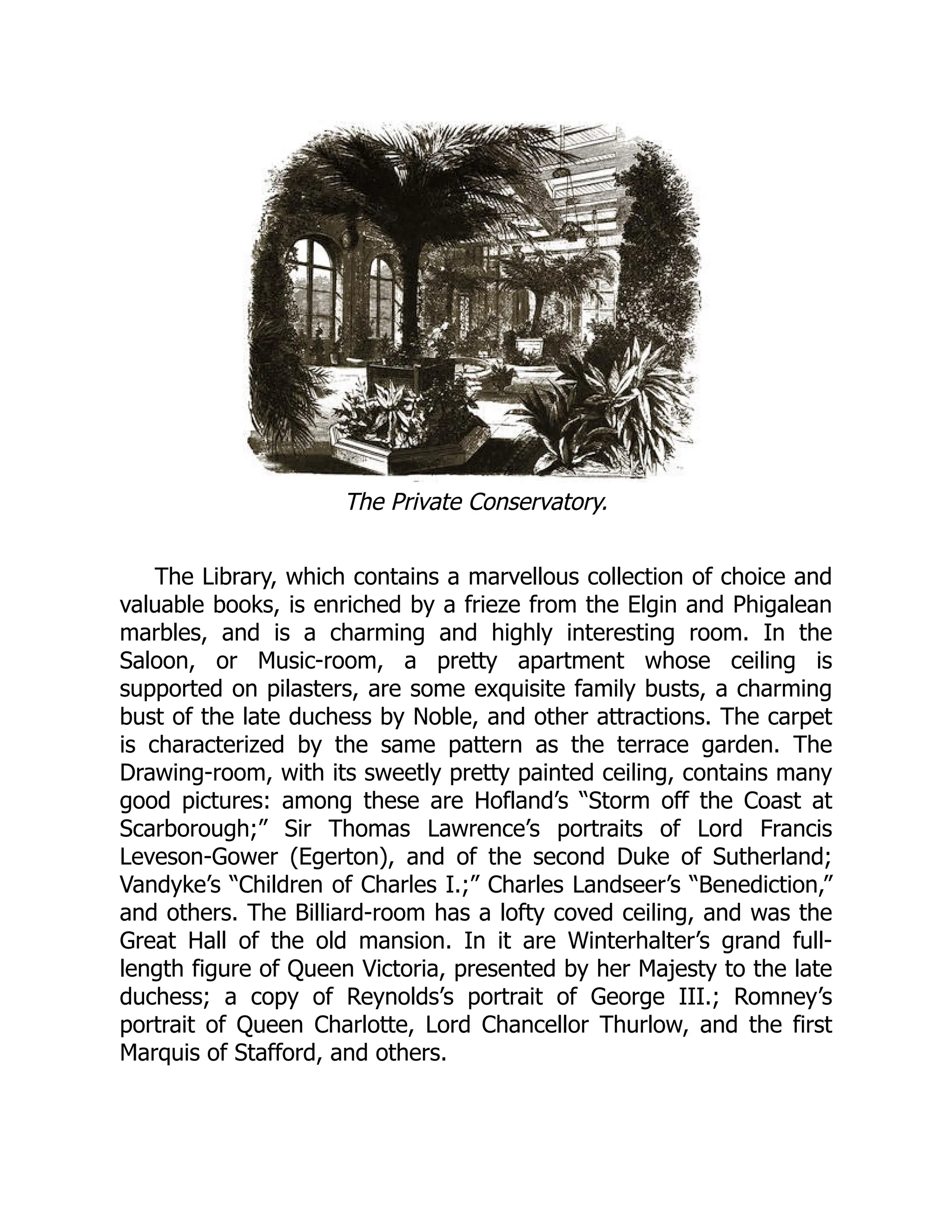
  • 37.
    The Private Conservatory. TheLibrary, which contains a marvellous collection of choice and valuable books, is enriched by a frieze from the Elgin and Phigalean marbles, and is a charming and highly interesting room. In the Saloon, or Music-room, a pretty apartment whose ceiling is supported on pilasters, are some exquisite family busts, a charming bust of the late duchess by Noble, and other attractions. The carpet is characterized by the same pattern as the terrace garden. The Drawing-room, with its sweetly pretty painted ceiling, contains many good pictures: among these are Hofland’s “Storm off the Coast at Scarborough;” Sir Thomas Lawrence’s portraits of Lord Francis Leveson-Gower (Egerton), and of the second Duke of Sutherland; Vandyke’s “Children of Charles I.;” Charles Landseer’s “Benediction,” and others. The Billiard-room has a lofty coved ceiling, and was the Great Hall of the old mansion. In it are Winterhalter’s grand full- length figure of Queen Victoria, presented by her Majesty to the late duchess; a copy of Reynolds’s portrait of George III.; Romney’s portrait of Queen Charlotte, Lord Chancellor Thurlow, and the first Marquis of Stafford, and others.
  • 38.
    In the EntranceHall is a copy of Michael Angelo’s statue of “Thought;” and on the Grand Staircase is a rich assemblage of family and other portraits. In the various bed-rooms and other apartments, too, are contained a vast number of valuable paintings and works of Art. The Private Conservatory, however, is one of the “gems” of Trentham, and is as elegant in its arrangements and decorations as the most fastidious taste can desire or Art accomplish. Of this miniature “world of flowers” we give an engraving, from a special photograph taken by Harrison, but of its Eastern splendour of rich colours we can offer no idea. It is a square apartment, with Italian windows and trellised walls, and is also trellised between the lights of the ceiling. In the centre is a fine figure of “Venus at the Bath.” The noble ferns and the exotic and other plants are of the choicest kinds, and the arrangement of colour, especially when all are lighted from the number of lamps suspended from the roof, is exquisitely beautiful. A pleasant feature of Trentham is the Bowling Alley—formerly the Orangery Arcade—which affords an almost unique and very pleasing indoor pastime for the family and friends. This feature, we believe, was much enjoyed by the Shah on his visit to Trentham, which was rendered lavishly enjoyable to him in every conceivable way. From the Entrance Hall a doorway opens into the Church, which thus becomes not only the parish church, but the private chapel of the Duke. The Church thus forms a part of, or at all events is attached to, the house; and the transition from the elegances of modern life to the grand old house of prayer is very striking and solemn. The Church, which was restored in 1842 at the cost of the Duke, by Sir Charles Barry, is the nave of the old abbey of Trentham, the chancel having extended considerably beyond the present east wall of the churchyard. The Church, as it now exists, consists of a nave with clerestory, north and south aisles, and chancel, with a mortuary chapel at the east end of the south aisle. The pillars which divide the aisles from the nave are Norman, and are the original pillars, carefully replaced and restored, of the old priory; from them
  • 39.
    now spring acutelypointed arches of a later, and consequently incongruous, character. The chancel is divided from the nave by an elaborate oak screen of late but good character, the altar-piece, by Hilton, being the “Taking down from the Cross.” There is an eagle lectern at the east end of the nave; and the pulpit is hung with a fine Moorish horsecloth, elaborately worked in silver on crimson velvet. At the west end is a gallery forming the family pew. At the back of this, beneath the window, is a bust of the late duke; on the south side, a bust, by Noble, of a son of the present duke, who died young; and, on the north side, a tablet to Lord Frederick Leveson- Gower, who lost his life during the Crimean war. At the same end of the Church is a poor’s box, bearing date 1698. The font, the gift of the parishioners, is also at the west end. Trentham Church. In the Memorial Chapel, besides the exquisitely beautiful altar- tomb to the late duchess by Noble, to which we have already referred, are monuments and tablets to the Levesons and Gowers; and here, too, is placed a memorial bust to Lord Albert, recently
  • 40.
    deceased. Of thebeautiful monument to the late duchess we have given an engraving on page 40, copied from a clever photograph by M. De Tejada, taken from the admirable picture by Mr. John O’Connor, painted, we believe, for Lord Ronald Gower, and in his lordship’s possession. In the north wall of the Church is a recessed arched tomb, on which lie the fragments of a highly interesting effigy in chain-mail, dug up in the churchyard a few years ago; and over the north door are the royal arms, dated 1663, pierced with Parliamentarian bullets.[40] One feature yet remains to be noted; it is the introduction on the north wall of encaustic wall-tiles, each one of which, enclosed in a reticulated pattern, bears a memorial of some departed parishioner, in manner following:— These, which are many in number, are arranged above the oak lining on the seats, and have appropriate texts, &c., also in tiles, running above and below the series. It is a pretty and very lasting, as well as inexpensive, kind of memorial, and one that might with advantage be adopted in many churches. In the churchyard are the remains of a cross, and some other interesting matters.
  • 41.
    The Upper TerraceGarden, Italian Garden, and Lake. The great features of Trentham are, as we have before said, its grounds and its matchless lake. To these, however, we have but little space to devote, though a bare enumeration of their points of beauty would fill a volume. To the park the public are, thanks to the liberality of the Duke of Sutherland, and which is one of the innate features of himself and the noble family of which he is the head, freely admitted. The gardens and pleasure-grounds (which, until the great alterations made some years ago, was simply a sheep pasture railed off from the park) can only, however, and very rightly, be seen by special permission. To these we must devote a few words. The principal or south front of the house—two charming views of which we have given on pages 45 and 46—looks across the grounds and lake to the distant wooded hills skirting the horizon, and crowned in one place by the colossal statue of the first duke, to which we have already alluded. A part of this view, as seen from the windows of this front, we have depicted in the accompanying engraving. First comes the Terrace (not included in our view), studded with statues and vases; next, the Terrace Garden, with its central fountain, its grand bronze vases and sculptures, its flower-beds laid out in the form of a letter S for Sutherland, its recessed alcoves, and its
  • 42.
    Grecian temples, containingmarvellous examples of antique sculpture; next, beyond, come the Italian Gardens (approached by a fine semicircular flight of steps), about ten acres in extent, with their parterres and borders and sunk beds, their statues, fountain, and busts, and their thousand and one other attractions; then the Lake Terrace, with its balustrade, its line of vases, its magnificent colossal statue of “Perseus and Medusa” (which cost its noble owner £1,600), its descending steps for landing, its boat-houses, and other appliances; then, next beyond, the Lake, eighty-three acres in extent, on which sailing and rowing boats and canoes find ample space for aquatic exercise; then the Islands—one of which alone is four acres in extent, and the other a single acre—beautifully planted with trees and shrubs; and, beyond this again, the woods of Tittensor, with the crowning monument. To the left are the grand wooded heights of King’s Wood Bank, a part of the ancient forest of Needwood, and consequently the remains of the old hunting- grounds of the Kings of Mercia; and, to the right, the American Grounds, planted with a profusion of rhododendrons and other appropriate shrubs and plants; while the Italian Garden is skirted on its east side by a deliciously cool and shady trellised walk—a floral tunnel, so to speak, some two hundred yards long, formed of trellised arches the whole of its length, overgrown with creeping plants and flowers, and decorated with busts, ornamental baskets, &c., forming a vista of extreme loveliness. Near this is a pleasant glade, having the Orangery, now the Bowling Alley, at its extremity; and near here is the iron bridge—one hundred and thirty years old, and one of the chefs-d’œuvre of the old Coalbrookdale Works—crossing the river Trent, which flows through the grounds. Standing on this bridge, the view both up and down the Trent is strikingly beautiful. Looking up the stream, the “solemn Trent” is seen crossed by the old stone bridge, while, to the left, a view of the house is partially obtained through the trees, the original course of the river, before it was altered, being distinctly traceable, and presenting a broader surface and a more graceful sweep than at present. Looking down the stream, the view is more
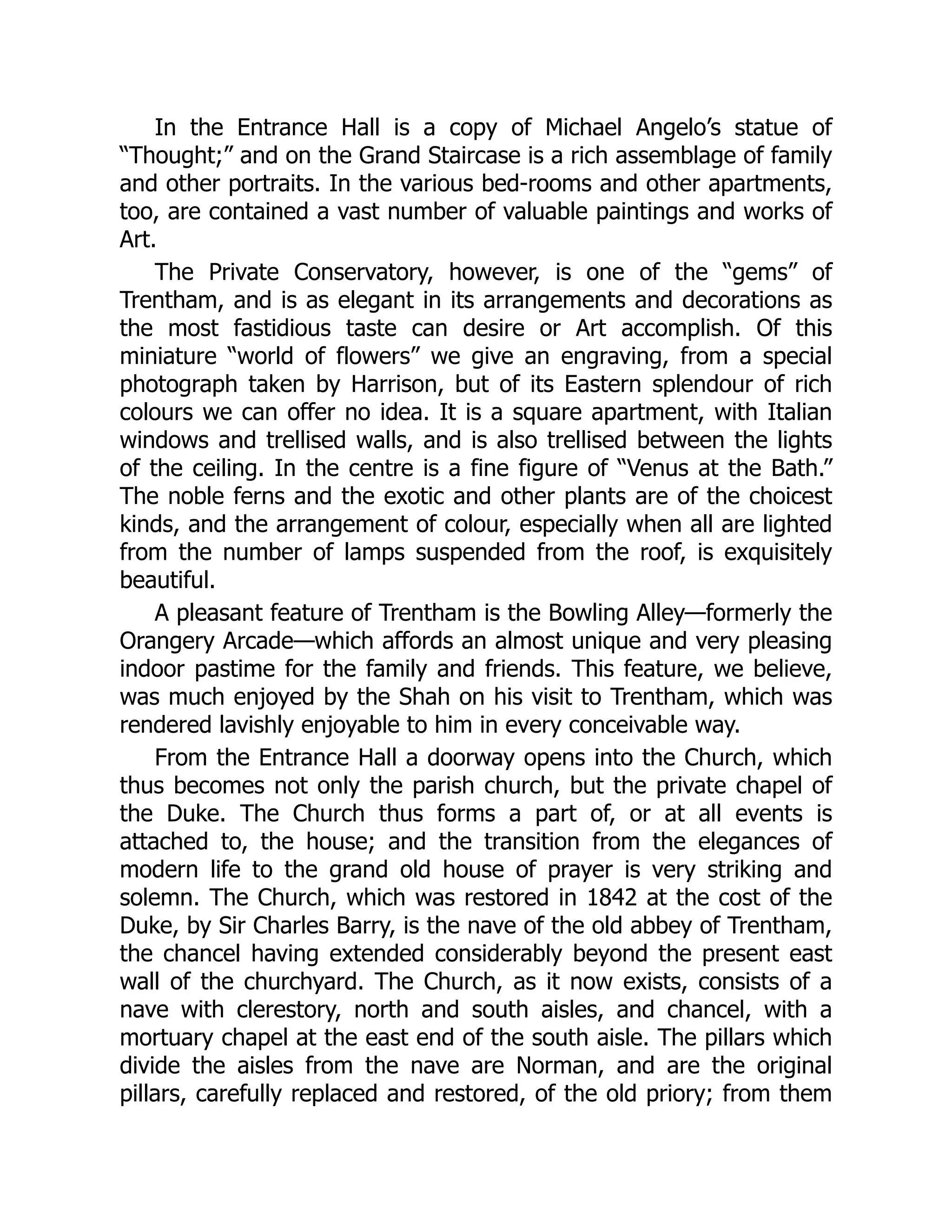
  • 43.
    charming still, andembraces the river, the lake (into which, until a few years back, the Trent flowed), the islands, the American and other gardens, and the wooded heights that skirt the domain. Crossing the bridge, a little to the right is the Conservatory, filled with the choicest trees and flowering plants, and kept, as all the rest of the gardens and grounds are, in the most perfect order. In front of this Conservatory is a pretty feature—the poetical idea of the late duchess—consisting of the names of her daughters (the sisters of the present Duke of Sutherland) planted in box on a ground of white spar. The words as they appear are— ELIZABETH LORNE. EVELYN BLANTYRE. CAROLINE KILDARE. CONSTANCE GROSVENOR. VIRET MEMORIA. Thus the “memory” of the four daughters of the late duchess—viz. the present Duchess of Argyll, the Lady Blantyre, the Duchess of Leinster, and the Duchess of Westminster—is kept “ever green.” The Gardener’s Cottage.
  • 44.
    Near by arethe Kitchen Gardens, Conservatories, Vineries, Peach-houses, Pine-houses, Orchid-houses, and all the usual appliances of a large and well-devised establishment; and it is a notable feature that all round the Kitchen Gardens, some thirteen acres in extent, is carried what is known as the Trentham Wall-Case —a glass-sided and covered passage, filled with peaches and nectarines, and forming an enclosed walk all round the place. Near the garden entrance is the pleasant residence of the head-gardener, shown in the preceding engraving. It was erected from the designs of Sir Charles Barry; and near it is another excellent building, a “bothie” for the young gardeners, erected from the designs of Mr. Roberts, the Duke’s architect and surveyor at Trentham. In this cottage the young gardeners, several in number, board and lodge, and have a reading-room, healthful and amusing games, and other comforts provided for them. The Children’s Cottage, with the grounds around, is also a pretty little spot, and, indeed, the whole of the grounds are one unbroken succession of beauties.
  • 45.
    Children’s Cottage andGardens. Just outside the park is the Mausoleum—the burial-place of the family—behind which is the present graveyard of the parish. Of the Poultry-houses (the finest in existence), the Stables, the Kennels, and the Estate Offices and Works it is not our province to speak. They are all that can be desired in arrangement, and are lavishly fitted with every convenience. We reluctantly take our leave of Trentham, congratulating alike its noble owner on the possession of so lovely an estate, and the Pottery district in having in its midst a nobleman of such refined taste as his Grace the Duke of Sutherland, of such liberal and kindly disposition, and of such boundless wealth, which he has the
  • 46.
    Welcome to ourwebsite – the perfect destination for book lovers and knowledge seekers. We believe that every book holds a new world, offering opportunities for learning, discovery, and personal growth. That’s why we are dedicated to bringing you a diverse collection of books, ranging from classic literature and specialized publications to self-development guides and children's books. More than just a book-buying platform, we strive to be a bridge connecting you with timeless cultural and intellectual values. With an elegant, user-friendly interface and a smart search system, you can quickly find the books that best suit your interests. Additionally, our special promotions and home delivery services help you save time and fully enjoy the joy of reading. Join us on a journey of knowledge exploration, passion nurturing, and personal growth every day! testbankdeal.com