BASIC NUTRITION & DIETETRICS
PRESENTED BY: MR. ALLAN,RN /OR
THE AGA KHAN UNIVERSITY HOSPITAL,NAIROBI
TRAINER OF TRAINEES LIFE BOX /SMILE TRAIN.
CONTENTS
▪Definition & introduction
▪Importance of good nutrition
▪The 7 elements of nutrition
▪The 10 principles of nutrition
▪The pyramid of nutrition
▪Types of diet
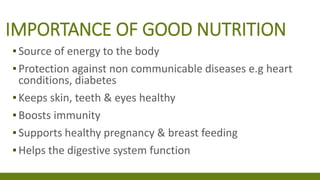
INTRODUCTION
▪The food we eat has a significant impact on our health,
according to a number of scientific studies. Changes in diet
can help prevent or control many health problems, including
obesity, diabetes and certain risk factors for cancer and heart
disease.
▪Dietetics is the science of how food and nutrition affects
human health.
▪Dietitian nutritionists use nutrition and food science to help
people improve their health.
IMPORTANCE OF GOOD NUTRITION
▪Source of energy to the body
▪Protection against non communicable diseases e.g heart
conditions, diabetes
▪Keeps skin, teeth & eyes healthy
▪Boosts immunity
▪Supports healthy pregnancy & breast feeding
▪Helps the digestive system function
ELEMENTS OF NUTRITION
▪ Based on the amount of the nutrients that each person
needs to consume on a daily basis, these nutrients are
categorized into two groups. These are macronutrients,
which should be consumed in fairly large amounts, and
micronutrients, which are only required in small amounts.
▪ Macronutrients
▪ ‘Macro’ means large; as their name suggests these are
nutrients which people need to eat regularly and in a fairly
large amount. They include carbohydrates, fats, proteins,
fibre and water. These substances are needed for the supply
of energy and growth, for metabolism and other body
functions.
▪Micronutrients
▪As their name indicates (‘micro’ means
small) micronutrients are substances
which people need in their diet in only
small amounts. These include minerals
and vitamins.
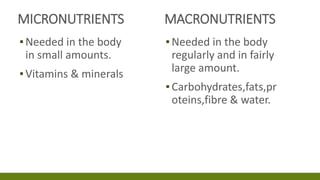
MICRONUTRIENTS
▪Needed in the body
in small amounts.
▪Vitamins & minerals
MACRONUTRIENTS
▪Needed in the body
regularly and in fairly
large amount.
▪Carbohydrates,fats,pr
oteins,fibre & water.
MACRONUTRIENTS
a) Carbohydrates - are referred to as energy-giving
foods. They provide energy in the form of calories
that the body needs to be able to work, and to
support other functions. The main sources of
carbohydrates are bread, wheat, potatoes of all
kinds, maize, rice, cassava, ‘shiro’, pasta, macaroni,
‘kocho’, banana, sweets, sugar cane, sweet fruits, and
honey. Other foods like vegetables, beans, nuts and
seeds contain carbohydrates, but in lesser amounts.
b) Proteins - are needed in our diets for growth
(especially important for children, teens and pregnant
women) and to improve immune functions. They also
play an important role in making essential hormones
and enzymes, in tissue repair, preserving lean muscle
mass, and supplying energy in times when
carbohydrates are not available. The main sources of
proteins are meats, chicken, eggs, breastmilk, beans,
ground nuts, lentils, fish, cheese and milk.
C ) Fats & Oils - Fats and oils are concentrated sources of
energy and so are important nutrients for young children
who need a lot of energy-rich food. Fats can also make meals
more tasty and satisfying. Fat is found in meat, chicken, milk
products, butters, creams, avocado, cooking oils and fats,
cheese, fish and ground nuts.
▪ Saturated fats are usually solid at cool temperatures. Eating
too much saturated fat is not good for a person’s health, as
it can cause heart and blood vessel problems.
▪ Unsaturated fats are usually liquid at room temperature.
These types of fats are healthy fats. Examples include fats
from fish, oil seeds (sesame and sunflower), maize oil and
ground nut oil and breastmilk.
d ) Water - Almost every part of the body contains large amounts of
water. An adult needs about 2–3 litres of water each day. That is why
giving drinks are so important when people lose a lot of water, such
as when they have diarrhea.
▪ Water is essential for life. We need water for a number of reasons:
• For the body to make cells and fluids such as tears, digestive juices
and breastmilk
• For the body to make sweat for cooling itself
• For essential body processes — most take place in water
• For keeping the lining of the mouth, intestine, eyelids and lungs
wet and healthy
• For the production of urine, which carries waste from the body.
e) Fibre - is a mixture of different
carbohydrates which are not digested like other
nutrients but pass through the gut nearly
unchanged. Foods rich in fibre are ‘kocho’;
vegetables like cabbage, ‘kosta’, carrots,
cassava; fruits like banana and avocado; peas
and beans; whole-grain cereals like wheat flour
and refined maize or sorghum.
MICRONUTRIENTS
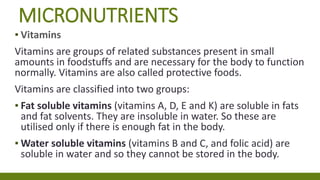
▪ Vitamins
Vitamins are groups of related substances present in small
amounts in foodstuffs and are necessary for the body to function
normally. Vitamins are also called protective foods.
Vitamins are classified into two groups:
▪ Fat soluble vitamins (vitamins A, D, E and K) are soluble in fats
and fat solvents. They are insoluble in water. So these are
utilised only if there is enough fat in the body.
▪ Water soluble vitamins (vitamins B and C, and folic acid) are
soluble in water and so they cannot be stored in the body.
The best sources of micronutrients in our diets are
fruits and vegetables. These two food groups contain
essential vitamins and minerals. Animal sources of
foods are also both good sources of micronutrients.
However, an adequate micronutrient intake can only
be achieved through sufficient intake of a balanced
diet that includes plenty of fruits and vegetables.
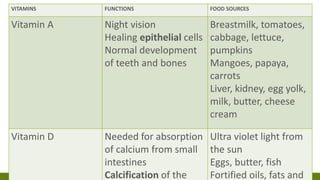
VITAMINS FUNCTIONS FOOD SOURCES
Vitamin A Night vision
Healing epithelial cells
Normal development
of teeth and bones
Breastmilk, tomatoes,
cabbage, lettuce,
pumpkins
Mangoes, papaya,
carrots
Liver, kidney, egg yolk,
milk, butter, cheese
cream
Vitamin D Needed for absorption
of calcium from small
intestines
Calcification of the
Ultra violet light from
the sun
Eggs, butter, fish
Fortified oils, fats and
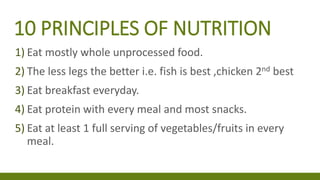
10 PRINCIPLES OF NUTRITION
1) Eat mostly whole unprocessed food.
2) The less legs the better i.e. fish is best ,chicken 2nd best
3) Eat breakfast everyday.
4) Eat protein with every meal and most snacks.
5) Eat at least 1 full serving of vegetables/fruits in every
meal.
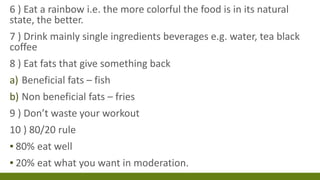
6 ) Eat a rainbow i.e. the more colorful the food is in its natural
state, the better.
7 ) Drink mainly single ingredients beverages e.g. water, tea black
coffee
8 ) Eat fats that give something back
a) Beneficial fats – fish
b) Non beneficial fats – fries
9 ) Don’t waste your workout
10 ) 80/20 rule
▪ 80% eat well
▪ 20% eat what you want in moderation.
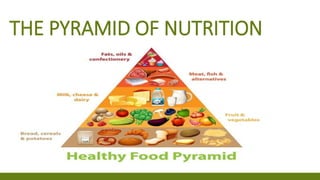
THE PYRAMID OF NUTRITION
TYPES OF SPECIAL DIET
1. High Protein Vegetarian Diet
This a diet which concentrates on sourcing more and more
proteins from vegetarian sources only. Many vegetarians find
it hard to fulfil their daily recommended protein levels from
their food. Fulfilling the body demands of protein is especially
tough for people who follow regular fitness and workout
schedules, growing children and sports persons.
2. High Protein Non-Vegetarian Diet
This is also a high protein diet that is popular mostly among
non-vegetarians. High protein non vegetarian diet
concentrates on popular form of meat with good and healthy
source of protein in them. Though the high protein
vegetarian ingredients can be included in the recipes that are
prepared with high protein non vegetarian foods, seared,
sautéed, baked forms of non-vegetarian meat is most
popular.
Foods like turkey breast, chicken breast, halibut, salmon
fish, tuna fish, pork loins, and lean beef are very good in
overall proteins and serve most of the body requirement for
sports persons, teenagers and gym enthusiasts. Choose only
healthy lean meats and protein rich tuna or salmon among
the other non vegetarian recipes.
3. Diabetic Diet
Diabetic foods is much needed for people prone to lifestyle
diabetes and for those who have diabetes due to family
heredity. This diet mainly concentrates on low – no sugars
and minimum calories per serving of food.
Diabetic diet mainly consists of fresh, stir fried or cooked
vegetables, a serving of millets and millet based porridges,
little or no fruits (specifically which are low in sugars, like
apples, guava, papaya), beans, legumes, flax seeds, Greek
yogurt and fewer meats like chicken breasts and tuna.
4. Low Fat Diet
Low fat diet is majorly needed by people who have
borderline or high cholesterol levels in blood. We need to
concentrate on getting the good cholesterol (HDL) in to
mitigate the accumulative cholesterol (oats, garlic and
cranberries) and keep a check on foods containing fats.
Sticking to this diet can be achieved more by avoiding fried
foods, oily foods and high fat foods like red meat, egg yolks,
full fat milk, cheese, desserts based on milk and any such
foods with more saturated fats in them.
THANK YOU
EAT RIGHT!! STAY HEALTHY!!
MR.ALLAN K. TRAINER OF TRAINEES(TOT)LIFEBOX/SMILE TRAIN
RN,OR

BASIC NUTRITION & DIETETRICS.pptx fpr begginners

  • 1.
    BASIC NUTRITION &DIETETRICS PRESENTED BY: MR. ALLAN,RN /OR THE AGA KHAN UNIVERSITY HOSPITAL,NAIROBI TRAINER OF TRAINEES LIFE BOX /SMILE TRAIN.
  • 2.
    CONTENTS ▪Definition & introduction ▪Importanceof good nutrition ▪The 7 elements of nutrition ▪The 10 principles of nutrition ▪The pyramid of nutrition ▪Types of diet
  • 3.
    INTRODUCTION ▪The food weeat has a significant impact on our health, according to a number of scientific studies. Changes in diet can help prevent or control many health problems, including obesity, diabetes and certain risk factors for cancer and heart disease. ▪Dietetics is the science of how food and nutrition affects human health. ▪Dietitian nutritionists use nutrition and food science to help people improve their health.
  • 4.
    IMPORTANCE OF GOODNUTRITION ▪Source of energy to the body ▪Protection against non communicable diseases e.g heart conditions, diabetes ▪Keeps skin, teeth & eyes healthy ▪Boosts immunity ▪Supports healthy pregnancy & breast feeding ▪Helps the digestive system function
  • 5.
    ELEMENTS OF NUTRITION ▪Based on the amount of the nutrients that each person needs to consume on a daily basis, these nutrients are categorized into two groups. These are macronutrients, which should be consumed in fairly large amounts, and micronutrients, which are only required in small amounts. ▪ Macronutrients ▪ ‘Macro’ means large; as their name suggests these are nutrients which people need to eat regularly and in a fairly large amount. They include carbohydrates, fats, proteins, fibre and water. These substances are needed for the supply of energy and growth, for metabolism and other body functions.
  • 6.
    ▪Micronutrients ▪As their nameindicates (‘micro’ means small) micronutrients are substances which people need in their diet in only small amounts. These include minerals and vitamins.
  • 7.
    MICRONUTRIENTS ▪Needed in thebody in small amounts. ▪Vitamins & minerals MACRONUTRIENTS ▪Needed in the body regularly and in fairly large amount. ▪Carbohydrates,fats,pr oteins,fibre & water.
  • 8.
    MACRONUTRIENTS a) Carbohydrates -are referred to as energy-giving foods. They provide energy in the form of calories that the body needs to be able to work, and to support other functions. The main sources of carbohydrates are bread, wheat, potatoes of all kinds, maize, rice, cassava, ‘shiro’, pasta, macaroni, ‘kocho’, banana, sweets, sugar cane, sweet fruits, and honey. Other foods like vegetables, beans, nuts and seeds contain carbohydrates, but in lesser amounts.
  • 9.
    b) Proteins -are needed in our diets for growth (especially important for children, teens and pregnant women) and to improve immune functions. They also play an important role in making essential hormones and enzymes, in tissue repair, preserving lean muscle mass, and supplying energy in times when carbohydrates are not available. The main sources of proteins are meats, chicken, eggs, breastmilk, beans, ground nuts, lentils, fish, cheese and milk.
  • 10.
    C ) Fats& Oils - Fats and oils are concentrated sources of energy and so are important nutrients for young children who need a lot of energy-rich food. Fats can also make meals more tasty and satisfying. Fat is found in meat, chicken, milk products, butters, creams, avocado, cooking oils and fats, cheese, fish and ground nuts. ▪ Saturated fats are usually solid at cool temperatures. Eating too much saturated fat is not good for a person’s health, as it can cause heart and blood vessel problems. ▪ Unsaturated fats are usually liquid at room temperature. These types of fats are healthy fats. Examples include fats from fish, oil seeds (sesame and sunflower), maize oil and ground nut oil and breastmilk.
  • 11.
    d ) Water- Almost every part of the body contains large amounts of water. An adult needs about 2–3 litres of water each day. That is why giving drinks are so important when people lose a lot of water, such as when they have diarrhea. ▪ Water is essential for life. We need water for a number of reasons: • For the body to make cells and fluids such as tears, digestive juices and breastmilk • For the body to make sweat for cooling itself • For essential body processes — most take place in water • For keeping the lining of the mouth, intestine, eyelids and lungs wet and healthy • For the production of urine, which carries waste from the body.
  • 12.
    e) Fibre -is a mixture of different carbohydrates which are not digested like other nutrients but pass through the gut nearly unchanged. Foods rich in fibre are ‘kocho’; vegetables like cabbage, ‘kosta’, carrots, cassava; fruits like banana and avocado; peas and beans; whole-grain cereals like wheat flour and refined maize or sorghum.
  • 13.
    MICRONUTRIENTS ▪ Vitamins Vitamins aregroups of related substances present in small amounts in foodstuffs and are necessary for the body to function normally. Vitamins are also called protective foods. Vitamins are classified into two groups: ▪ Fat soluble vitamins (vitamins A, D, E and K) are soluble in fats and fat solvents. They are insoluble in water. So these are utilised only if there is enough fat in the body. ▪ Water soluble vitamins (vitamins B and C, and folic acid) are soluble in water and so they cannot be stored in the body.
  • 14.
    The best sourcesof micronutrients in our diets are fruits and vegetables. These two food groups contain essential vitamins and minerals. Animal sources of foods are also both good sources of micronutrients. However, an adequate micronutrient intake can only be achieved through sufficient intake of a balanced diet that includes plenty of fruits and vegetables.
  • 15.
    VITAMINS FUNCTIONS FOODSOURCES Vitamin A Night vision Healing epithelial cells Normal development of teeth and bones Breastmilk, tomatoes, cabbage, lettuce, pumpkins Mangoes, papaya, carrots Liver, kidney, egg yolk, milk, butter, cheese cream Vitamin D Needed for absorption of calcium from small intestines Calcification of the Ultra violet light from the sun Eggs, butter, fish Fortified oils, fats and
  • 16.
    10 PRINCIPLES OFNUTRITION 1) Eat mostly whole unprocessed food. 2) The less legs the better i.e. fish is best ,chicken 2nd best 3) Eat breakfast everyday. 4) Eat protein with every meal and most snacks. 5) Eat at least 1 full serving of vegetables/fruits in every meal.
  • 17.
    6 ) Eata rainbow i.e. the more colorful the food is in its natural state, the better. 7 ) Drink mainly single ingredients beverages e.g. water, tea black coffee 8 ) Eat fats that give something back a) Beneficial fats – fish b) Non beneficial fats – fries 9 ) Don’t waste your workout 10 ) 80/20 rule ▪ 80% eat well ▪ 20% eat what you want in moderation.
  • 18.
    THE PYRAMID OFNUTRITION
  • 19.
    TYPES OF SPECIALDIET 1. High Protein Vegetarian Diet This a diet which concentrates on sourcing more and more proteins from vegetarian sources only. Many vegetarians find it hard to fulfil their daily recommended protein levels from their food. Fulfilling the body demands of protein is especially tough for people who follow regular fitness and workout schedules, growing children and sports persons.
  • 20.
    2. High ProteinNon-Vegetarian Diet This is also a high protein diet that is popular mostly among non-vegetarians. High protein non vegetarian diet concentrates on popular form of meat with good and healthy source of protein in them. Though the high protein vegetarian ingredients can be included in the recipes that are prepared with high protein non vegetarian foods, seared, sautéed, baked forms of non-vegetarian meat is most popular. Foods like turkey breast, chicken breast, halibut, salmon fish, tuna fish, pork loins, and lean beef are very good in overall proteins and serve most of the body requirement for sports persons, teenagers and gym enthusiasts. Choose only healthy lean meats and protein rich tuna or salmon among the other non vegetarian recipes.
  • 21.
    3. Diabetic Diet Diabeticfoods is much needed for people prone to lifestyle diabetes and for those who have diabetes due to family heredity. This diet mainly concentrates on low – no sugars and minimum calories per serving of food. Diabetic diet mainly consists of fresh, stir fried or cooked vegetables, a serving of millets and millet based porridges, little or no fruits (specifically which are low in sugars, like apples, guava, papaya), beans, legumes, flax seeds, Greek yogurt and fewer meats like chicken breasts and tuna.
  • 22.
    4. Low FatDiet Low fat diet is majorly needed by people who have borderline or high cholesterol levels in blood. We need to concentrate on getting the good cholesterol (HDL) in to mitigate the accumulative cholesterol (oats, garlic and cranberries) and keep a check on foods containing fats. Sticking to this diet can be achieved more by avoiding fried foods, oily foods and high fat foods like red meat, egg yolks, full fat milk, cheese, desserts based on milk and any such foods with more saturated fats in them.
  • 23.
    THANK YOU EAT RIGHT!!STAY HEALTHY!! MR.ALLAN K. TRAINER OF TRAINEES(TOT)LIFEBOX/SMILE TRAIN RN,OR