Basic Nutrition
Carbohydrates
Lecture 6 & 7
Dr. Fouad A Hassan
2
Introduction
 High basis food
 Middle east, Mexico
 Asia
 China
 Italy
 Greatest calories
 Promoting health
 Carbohydrate at risk
3
Definition of carbohydrates
 Carbohydrates are organic compounds containing carbon,
hydrogen, and oxygen, and they may be simple OR
complex molecules.
 The term “carbohydrate” has been used to classify all
compounds with the general formula Cn(H2O)n.
 Type of Carbohydrates
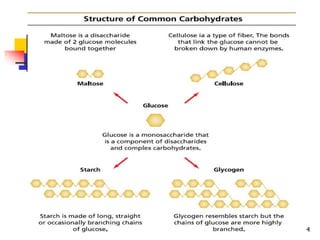
 Monosaccharaides such as Glu, Gal, Fru …
 Disaccharides such as Suc, Lac, Mal …
 Oligosaccharides such as FOS, Stacu, Ruff …
 Polysaccharides such as Starch, DF, Pec ….
4
5
Carbohydrates in Human Diet
 Refined foods have undergone processing to remove
certain parts of the original food.
 Recommendations for a healthy diet suggest that we
eat more natural unrefined sources of carbohydrates
and limit our consumption of refined grains and added
sugars.
6
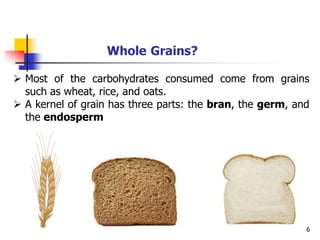
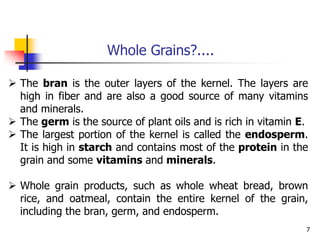
Whole Grains?
 Most of the carbohydrates consumed come from grains
such as wheat, rice, and oats.
 A kernel of grain has three parts: the bran, the germ, and
the endosperm
7
 The bran is the outer layers of the kernel. The layers are
high in fiber and are also a good source of many vitamins
and minerals.
 The germ is the source of plant oils and is rich in vitamin E.
 The largest portion of the kernel is called the endosperm.
It is high in starch and contains most of the protein in the
grain and some vitamins and minerals.
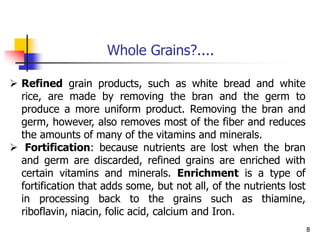
 Whole grain products, such as whole wheat bread, brown
rice, and oatmeal, contain the entire kernel of the grain,
including the bran, germ, and endosperm.
Whole Grains?....
8
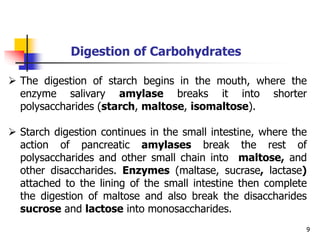
 Refined grain products, such as white bread and white
rice, are made by removing the bran and the germ to
produce a more uniform product. Removing the bran and
germ, however, also removes most of the fiber and reduces
the amounts of many of the vitamins and minerals.
 Fortification: because nutrients are lost when the bran
and germ are discarded, refined grains are enriched with
certain vitamins and minerals. Enrichment is a type of
fortification that adds some, but not all, of the nutrients lost
in processing back to the grains such as thiamine,
riboflavin, niacin, folic acid, calcium and Iron.
Whole Grains?....
9
Digestion of Carbohydrates
 The digestion of starch begins in the mouth, where the
enzyme salivary amylase breaks it into shorter
polysaccharides (starch, maltose, isomaltose).
 Starch digestion continues in the small intestine, where the
action of pancreatic amylases break the rest of
polysaccharides and other small chain into maltose, and
other disaccharides. Enzymes (maltase, sucrase, lactase)
attached to the lining of the small intestine then complete
the digestion of maltose and also break the disaccharides
sucrose and lactose into monosaccharides.
10
 The resulting monosaccharides, glucose, galactose,
and fructose, are then absorbed into the blood and
transported to the liver.
 Fiber is the most abundant indigestible carbohydrate in our
food. Beans are a good source of fiber, but also contain
other indigestible carbohydrates called oligosaccharides.
 These short polysaccharides cannot be completely digested
by human enzymes and, thus, pass into the large
intestine where they are broken down by bacteria.
11
Lactose Intolerance
 Lactose intolerance occurs when someone with low level
of lactase, the intestinal enzyme that breaks down lactose,
drink milk or other dairy products that contain lactose, the
lactose is not digested and passes into the large intestine.
Here, it draws in water and is metabolized by bacteria
to produce acids and gas.
 The result is symptoms such as abdominal distension,
cramping, and diarrhea. Those who cannot tolerate any
lactose can choose nondairy sources of calcium such as
legumes, leafy green vegetables, and fish consumed with
bones or soybean milk as source of protein or choose
Lactose-free milk or lactase tablets.
12
Functions of carbohydrates
 Carbohydrates serve a number of functions in the body:
 Galactose is needed in nervous tissue and to make lactose
in breast milk.
 Monosaccharides deoxyribose and ribose are needed to
make DNA and RNA, which contain genetic information
and are needed for the synthesis of proteins.
 Glucose, is an energy source: it provides about 4 calories
per gram. Certain body cells, including brain cells and red
blood cells, rely almost exclusively on glucose for
energy. For example, 120 g/day is required for brain.
13
Simple and complex sugars
 Refined sugars and starches cause a quicker, greater
rise in blood glucose than do unrefined sources of
carbohydrate that contain fiber. This is because refined
sugars and starches are digested and absorbed quickly,
causing a rapid rise in blood glucose. Fiber slows the
absorption of glucose, so sources of unrefined
carbohydrate, such as oatmeal, legumes, and whole
grain bread cause a slower, lower rise in blood glucose.
Including protein and fat with carbohydrates also slows
glucose absorption.
 Fructose is slowly metabolised than that of glucose.
14
Healthy and Unhealthy
Carbohydrates
 A diet high in carbohydrates can be either good or bad for
you, depending on the types of carbohydrates.
 Diets that are high in unrefined sources of carbohydrate,
such as whole grains, fruits, and vegetables, are
considered healthy because they are associated with a
lower incidence of a variety of bowel disorders, heart
disease, diabetes, and certain cancers.
 Unrefined carbohydrate sources, such as brown rice,
beans, and bananas, are high in nutrient density because
they provide many nutrients per calorie.
15
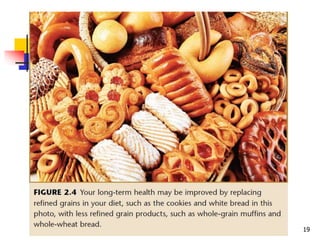
 Refined products that are high in added sugar, such as
donuts, cakes, and cookies, are low in nutrient density
because they contain few nutrients relative to the calories
they provide.
 Diets high in added sugars and refined grains are
generally considered unhealthy. This is because refined
sources of carbohydrates are lower in nutrient density than
unrefined sources.
 Sugar consumption has implicated as a cause of
hyperactivity in children.
Healthy and unhealthy carbohydrates…
16
Sugar and Cavities?
 Dental caries are formed when bacteria that live in the
mouth metabolize sugar from the diet and produce acid.
The acid can then dissolve the enamel and underlying
structure of the teeth.
 Simple carbohydrates, particularly sucrose, cause cavities
because they are easily broken down by these bacteria, but
starch can also be metabolized by bacteria to produce acids
that contribute to tooth decay. Preventing cavities
requires proper dental hygiene, even when the diet is low in
sugar.
17
Do Sweets and Starchy Foods
Make You Fat?
Diets high in carbohydrates may increase both hunger and
the storage of body fat.
Low carbohydrate diets cause less insulin release and also
cause the production of molecules called ketones. Ketones
are made when fat is broken down, and carbohydrate levels
are low. Low blood insulin levels and elevated blood ketone
levels suppress appetite.
The type of carbohydrate is as important as the amount
when it comes to insulin levels and weight loss.
18
Do Refined Carbohydrates Cause
Diabetes?
 Refined starches and added sugars rise blood glucose
and, subsequently, insulin levels in the blood more
sharply than when unrefined carbohydrates are eaten.
 Long-term consumption of a diet that is high in refined
starches and added sugars may increase the risk of
developing type 2 diabetes.
19
20
How Much and What Kind of Carbohydrates
Do You Need?
 To meet the need of carbohydrates, the DRIs recommend
the consumption of at least 150 grams of carbohydrates
per day.
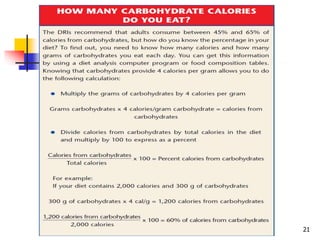
 However, in order to meet the body’s energy needs without
providing too much fat or protein, the diet should contain
more than this—between 45% and 65% of calories from
carbohydrates. This is equivalent to 225 to 325 grams of
carbohydrates for someone who eats 2,000 calories a day.
 It is recommended that half our grains be whole
grains.
21
22
 We can cut out added sugar by having fruit instead of
baked goods for dessert, drinking water instead of soda,
and switching to unsweetened breakfast cereal. Whole grain
consumption can be increased by switching to whole-grain
breads, brown rice, and whole-grain breakfast cereals.
 Sugar
 People who love sweets but don’t like the calories these
foods add to their diet might try artificial sweeteners.
 There are five artificial sweeteners commonly used in foods
sold in the United States: saccharine, aspartame,
Acesulfame K, sucralose, and stevia. They are generally safe
for healthy people.
How Much and What Kind of Carbohydrates Do
You Need?.....
23
Dietary Fiber
24
 Dietary fiber is the edible parts of plants or analogous
carbohydrates that are resistant to digestion and absorption
in the human small intestine with complete or partial
fermentation in the large intestine.
 The term “dietary fiber” refers to the indigestible parts of
plants.
Definition of dietary fiber
25
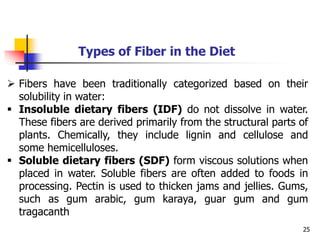
Types of Fiber in the Diet
 Fibers have been traditionally categorized based on their
solubility in water:
 Insoluble dietary fibers (IDF) do not dissolve in water.
These fibers are derived primarily from the structural parts of
plants. Chemically, they include lignin and cellulose and
some hemicelluloses.
 Soluble dietary fibers (SDF) form viscous solutions when
placed in water. Soluble fibers are often added to foods in
processing. Pectin is used to thicken jams and jellies. Gums,
such as gum arabic, gum karaya, guar gum and gum
tragacanth
26
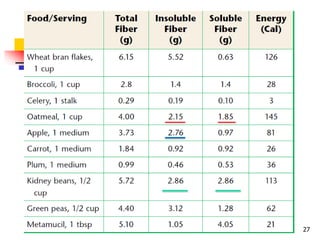
Dietary Sources of Soluble
and Insoluble Fiber
27
28
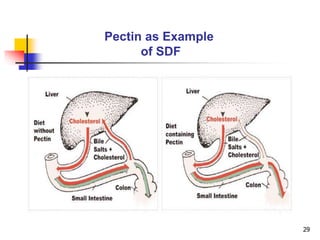
 SDF helps increase the feeling of fullness, thereby helping
to eat less without feeling hungry. It has also been shown to
help the lowering of LDL in blood. In addition, it can lower
the risk of developing diabetes by regulating blood sugar
levels and lower glycaemic index. The beneficial effect of
SDF may be mediated through slow absorption and
digestion of carbohydrates leading to a reduced insulin
demand.
 IDF can help reduce the risk of colon cancer, and
constipation by speeding up the passage of food through
the intestine. IDF shortens the intestinal transit time, and
therefore allows less time for carbohydrates to be absorbed.
Beneficial effects of dietary fiber
29
Pectin as Example
of SDF
30
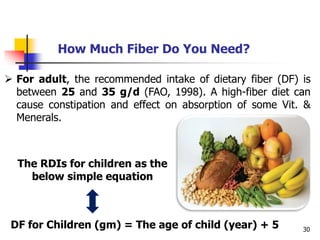
 For adult, the recommended intake of dietary fiber (DF) is
between 25 and 35 g/d (FAO, 1998). A high-fiber diet can
cause constipation and effect on absorption of some Vit. &
Menerals.
How Much Fiber Do You Need?
The RDIs for children as the
below simple equation
DF for Children (gm) = The age of child (year) + 5

Basic Nuييييييييييييييييييييييt. 6& 7.ppt

  • 1.
  • 2.
    2 Introduction  High basisfood  Middle east, Mexico  Asia  China  Italy  Greatest calories  Promoting health  Carbohydrate at risk
  • 3.
    3 Definition of carbohydrates Carbohydrates are organic compounds containing carbon, hydrogen, and oxygen, and they may be simple OR complex molecules.  The term “carbohydrate” has been used to classify all compounds with the general formula Cn(H2O)n.  Type of Carbohydrates  Monosaccharaides such as Glu, Gal, Fru …  Disaccharides such as Suc, Lac, Mal …  Oligosaccharides such as FOS, Stacu, Ruff …  Polysaccharides such as Starch, DF, Pec ….
  • 4.
  • 5.
    5 Carbohydrates in HumanDiet  Refined foods have undergone processing to remove certain parts of the original food.  Recommendations for a healthy diet suggest that we eat more natural unrefined sources of carbohydrates and limit our consumption of refined grains and added sugars.
  • 6.
    6 Whole Grains?  Mostof the carbohydrates consumed come from grains such as wheat, rice, and oats.  A kernel of grain has three parts: the bran, the germ, and the endosperm
  • 7.
    7  The branis the outer layers of the kernel. The layers are high in fiber and are also a good source of many vitamins and minerals.  The germ is the source of plant oils and is rich in vitamin E.  The largest portion of the kernel is called the endosperm. It is high in starch and contains most of the protein in the grain and some vitamins and minerals.  Whole grain products, such as whole wheat bread, brown rice, and oatmeal, contain the entire kernel of the grain, including the bran, germ, and endosperm. Whole Grains?....
  • 8.
    8  Refined grainproducts, such as white bread and white rice, are made by removing the bran and the germ to produce a more uniform product. Removing the bran and germ, however, also removes most of the fiber and reduces the amounts of many of the vitamins and minerals.  Fortification: because nutrients are lost when the bran and germ are discarded, refined grains are enriched with certain vitamins and minerals. Enrichment is a type of fortification that adds some, but not all, of the nutrients lost in processing back to the grains such as thiamine, riboflavin, niacin, folic acid, calcium and Iron. Whole Grains?....
  • 9.
    9 Digestion of Carbohydrates The digestion of starch begins in the mouth, where the enzyme salivary amylase breaks it into shorter polysaccharides (starch, maltose, isomaltose).  Starch digestion continues in the small intestine, where the action of pancreatic amylases break the rest of polysaccharides and other small chain into maltose, and other disaccharides. Enzymes (maltase, sucrase, lactase) attached to the lining of the small intestine then complete the digestion of maltose and also break the disaccharides sucrose and lactose into monosaccharides.
  • 10.
    10  The resultingmonosaccharides, glucose, galactose, and fructose, are then absorbed into the blood and transported to the liver.  Fiber is the most abundant indigestible carbohydrate in our food. Beans are a good source of fiber, but also contain other indigestible carbohydrates called oligosaccharides.  These short polysaccharides cannot be completely digested by human enzymes and, thus, pass into the large intestine where they are broken down by bacteria.
  • 11.
    11 Lactose Intolerance  Lactoseintolerance occurs when someone with low level of lactase, the intestinal enzyme that breaks down lactose, drink milk or other dairy products that contain lactose, the lactose is not digested and passes into the large intestine. Here, it draws in water and is metabolized by bacteria to produce acids and gas.  The result is symptoms such as abdominal distension, cramping, and diarrhea. Those who cannot tolerate any lactose can choose nondairy sources of calcium such as legumes, leafy green vegetables, and fish consumed with bones or soybean milk as source of protein or choose Lactose-free milk or lactase tablets.
  • 12.
    12 Functions of carbohydrates Carbohydrates serve a number of functions in the body:  Galactose is needed in nervous tissue and to make lactose in breast milk.  Monosaccharides deoxyribose and ribose are needed to make DNA and RNA, which contain genetic information and are needed for the synthesis of proteins.  Glucose, is an energy source: it provides about 4 calories per gram. Certain body cells, including brain cells and red blood cells, rely almost exclusively on glucose for energy. For example, 120 g/day is required for brain.
  • 13.
    13 Simple and complexsugars  Refined sugars and starches cause a quicker, greater rise in blood glucose than do unrefined sources of carbohydrate that contain fiber. This is because refined sugars and starches are digested and absorbed quickly, causing a rapid rise in blood glucose. Fiber slows the absorption of glucose, so sources of unrefined carbohydrate, such as oatmeal, legumes, and whole grain bread cause a slower, lower rise in blood glucose. Including protein and fat with carbohydrates also slows glucose absorption.  Fructose is slowly metabolised than that of glucose.
  • 14.
    14 Healthy and Unhealthy Carbohydrates A diet high in carbohydrates can be either good or bad for you, depending on the types of carbohydrates.  Diets that are high in unrefined sources of carbohydrate, such as whole grains, fruits, and vegetables, are considered healthy because they are associated with a lower incidence of a variety of bowel disorders, heart disease, diabetes, and certain cancers.  Unrefined carbohydrate sources, such as brown rice, beans, and bananas, are high in nutrient density because they provide many nutrients per calorie.
  • 15.
    15  Refined productsthat are high in added sugar, such as donuts, cakes, and cookies, are low in nutrient density because they contain few nutrients relative to the calories they provide.  Diets high in added sugars and refined grains are generally considered unhealthy. This is because refined sources of carbohydrates are lower in nutrient density than unrefined sources.  Sugar consumption has implicated as a cause of hyperactivity in children. Healthy and unhealthy carbohydrates…
  • 16.
    16 Sugar and Cavities? Dental caries are formed when bacteria that live in the mouth metabolize sugar from the diet and produce acid. The acid can then dissolve the enamel and underlying structure of the teeth.  Simple carbohydrates, particularly sucrose, cause cavities because they are easily broken down by these bacteria, but starch can also be metabolized by bacteria to produce acids that contribute to tooth decay. Preventing cavities requires proper dental hygiene, even when the diet is low in sugar.
  • 17.
    17 Do Sweets andStarchy Foods Make You Fat? Diets high in carbohydrates may increase both hunger and the storage of body fat. Low carbohydrate diets cause less insulin release and also cause the production of molecules called ketones. Ketones are made when fat is broken down, and carbohydrate levels are low. Low blood insulin levels and elevated blood ketone levels suppress appetite. The type of carbohydrate is as important as the amount when it comes to insulin levels and weight loss.
  • 18.
    18 Do Refined CarbohydratesCause Diabetes?  Refined starches and added sugars rise blood glucose and, subsequently, insulin levels in the blood more sharply than when unrefined carbohydrates are eaten.  Long-term consumption of a diet that is high in refined starches and added sugars may increase the risk of developing type 2 diabetes.
  • 19.
  • 20.
    20 How Much andWhat Kind of Carbohydrates Do You Need?  To meet the need of carbohydrates, the DRIs recommend the consumption of at least 150 grams of carbohydrates per day.  However, in order to meet the body’s energy needs without providing too much fat or protein, the diet should contain more than this—between 45% and 65% of calories from carbohydrates. This is equivalent to 225 to 325 grams of carbohydrates for someone who eats 2,000 calories a day.  It is recommended that half our grains be whole grains.
  • 21.
  • 22.
    22  We cancut out added sugar by having fruit instead of baked goods for dessert, drinking water instead of soda, and switching to unsweetened breakfast cereal. Whole grain consumption can be increased by switching to whole-grain breads, brown rice, and whole-grain breakfast cereals.  Sugar  People who love sweets but don’t like the calories these foods add to their diet might try artificial sweeteners.  There are five artificial sweeteners commonly used in foods sold in the United States: saccharine, aspartame, Acesulfame K, sucralose, and stevia. They are generally safe for healthy people. How Much and What Kind of Carbohydrates Do You Need?.....
  • 23.
  • 24.
    24  Dietary fiberis the edible parts of plants or analogous carbohydrates that are resistant to digestion and absorption in the human small intestine with complete or partial fermentation in the large intestine.  The term “dietary fiber” refers to the indigestible parts of plants. Definition of dietary fiber
  • 25.
    25 Types of Fiberin the Diet  Fibers have been traditionally categorized based on their solubility in water:  Insoluble dietary fibers (IDF) do not dissolve in water. These fibers are derived primarily from the structural parts of plants. Chemically, they include lignin and cellulose and some hemicelluloses.  Soluble dietary fibers (SDF) form viscous solutions when placed in water. Soluble fibers are often added to foods in processing. Pectin is used to thicken jams and jellies. Gums, such as gum arabic, gum karaya, guar gum and gum tragacanth
  • 26.
    26 Dietary Sources ofSoluble and Insoluble Fiber
  • 27.
  • 28.
    28  SDF helpsincrease the feeling of fullness, thereby helping to eat less without feeling hungry. It has also been shown to help the lowering of LDL in blood. In addition, it can lower the risk of developing diabetes by regulating blood sugar levels and lower glycaemic index. The beneficial effect of SDF may be mediated through slow absorption and digestion of carbohydrates leading to a reduced insulin demand.  IDF can help reduce the risk of colon cancer, and constipation by speeding up the passage of food through the intestine. IDF shortens the intestinal transit time, and therefore allows less time for carbohydrates to be absorbed. Beneficial effects of dietary fiber
  • 29.
  • 30.
    30  For adult,the recommended intake of dietary fiber (DF) is between 25 and 35 g/d (FAO, 1998). A high-fiber diet can cause constipation and effect on absorption of some Vit. & Menerals. How Much Fiber Do You Need? The RDIs for children as the below simple equation DF for Children (gm) = The age of child (year) + 5