WHAT IS CARDIACARREST
Cardiac arrest is the cessation of all cardiac mechanical activity.
Its clinical activity is confirmed by
Unresponsiveness
Absence of detectable pulse
Apnea or agonal respiration(gasping type of breathing)
WHAT IS BLS
Itis a stepwise Protocol for cardiopulmonary cerebral
resuscitation(CPCR) that is performed without equipment or medication
to assist with the immediate survival of patient who is in
cardiopulmonary arrest.
6.
CARDIOPULMONARY CEREBRAL RESUSCITATION(CPCR)
To maintain vital organ perfusion and tissue oxygenation until return of
spontaneous circulation.
To restrore effective circulation and ventilation
To prevent IRREVERSIBLE CEREBRAL DAMAGE due to anoxia
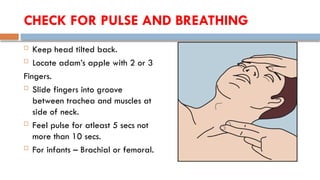
CHECK FOR PULSEAND BREATHING
Keep head tilted back.
Locate adam’s apple with 2 or 3
Fingers.
Slide fingers into groove
between trachea and muscles at
side of neck.
Feel pulse for atleast 5 secs not
more than 10 secs.
For infants – Brachial or femoral.
13.
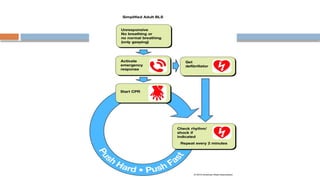
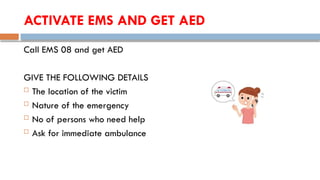
ACTIVATE EMS ANDGET AED
Call EMS 08 and get AED
GIVE THE FOLLOWING DETAILS
The location of the victim
Nature of the emergency
No of persons who need help
Ask for immediate ambulance
14.
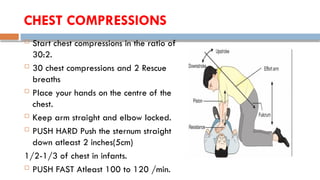
CHEST COMPRESSIONS
Startchest compressions in the ratio of
30:2.
30 chest compressions and 2 Rescue
breaths
Place your hands on the centre of the
chest.
Keep arm straight and elbow locked.
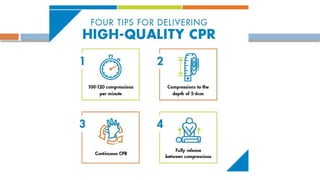
PUSH HARD Push the sternum straight
down atleast 2 inches(5cm)
1/2-1/3 of chest in infants.
PUSH FAST Atleast 100 to 120 /min.
15.
CHEST COMPRESSIONS
Allowcomplete recoil of chest after each compression
Minimize interruption in chest compressions.
Rescuers should ideally change positions every 2 minutes to maintain
high-quality chest compressions and prevent fatigue.
17.
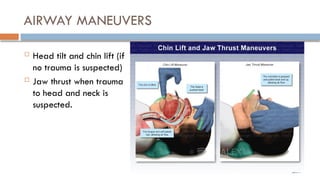
AIRWAY MANEUVERS
Headtilt and chin lift (if
no trauma is suspected)
Jaw thrust when trauma
to head and neck is
suspected.
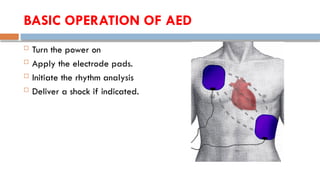
BASIC OPERATION OFAED
Turn the power on
Apply the electrode pads.
Initiate the rhythm analysis
Deliver a shock if indicated.
21.
STEPS
Attach thepads to the victims bare chest
While analysing the rhythm do not touch the victim
If shock is indicated -stand clear
- Deliver shock
If victim starts to breathe normally place him in recovery position.
22.
WHEN TO STOPCPR
CPR should be continued till
Qualified help arrives and takes over
Return of spontaneous circulation(ROSC)
The patient recovers
An authorised person pronounces life extinct
Rescuer becomes exhausted
23.
SPECIAL SCENARIOS
PREGNANCY
Fullleft lateral decubitus position to relieve aortocaval compression.
100% oxygen by face mask to treat hypoxemia
Manual left uterine displacement
24.
DROWNING
Most importantcause of death is asphyxiation and hypoxia.
Prompt initiation of rescue breathing is vital .
Recovery from water.
Clear airway and give 2 rescue breaths.
No delay is starting chest compressions.
Attempts to remove water from the breathing passages should not be
attempted.