Basic Kanji
1-10
What is Kanji?
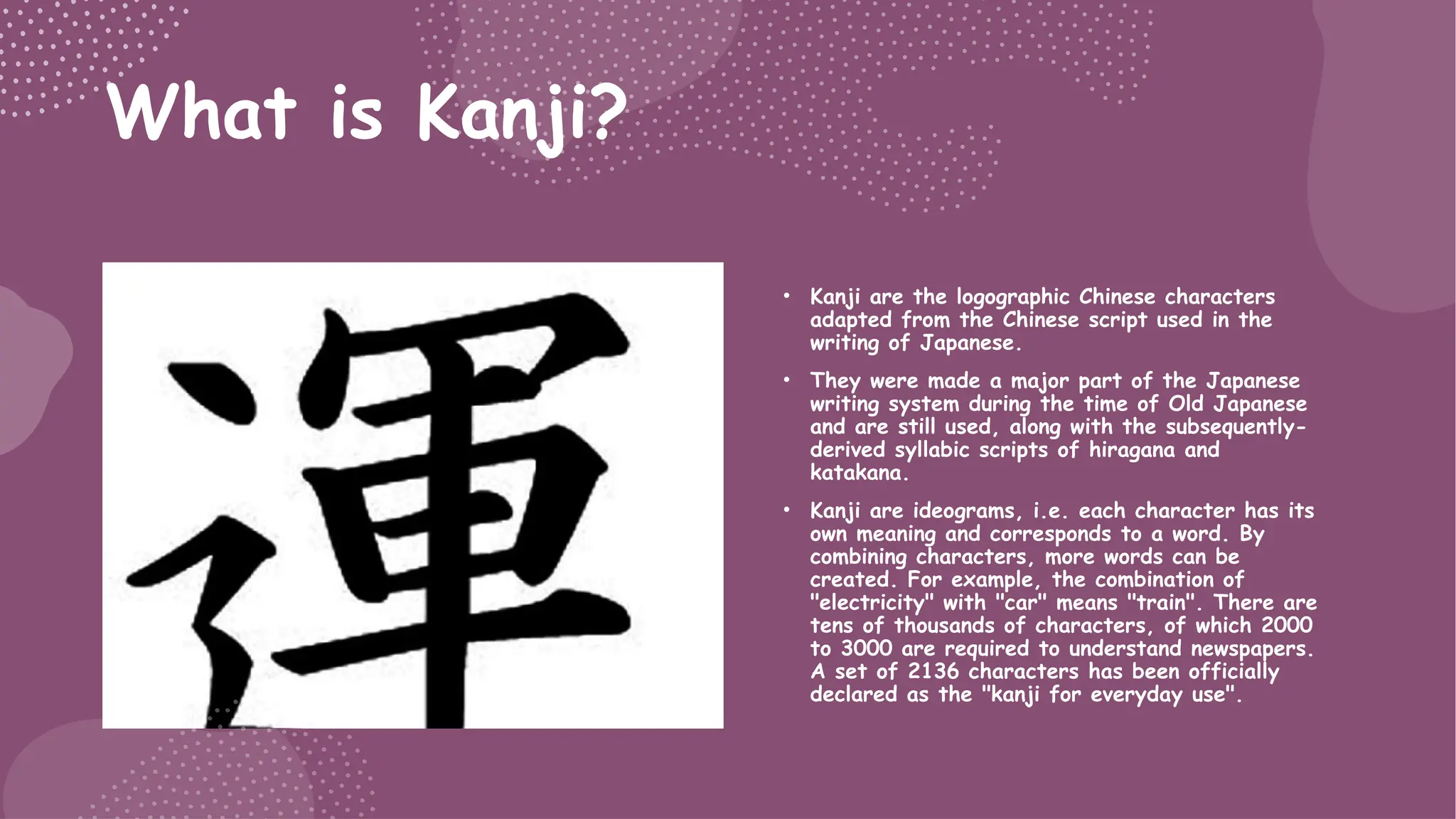
• Kanji are the logographic Chinese characters
adapted from the Chinese script used in the
writing of Japanese.
• They were made a major part of the Japanese
writing system during the time of Old Japanese
and are still used, along with the subsequently-
derived syllabic scripts of hiragana and
katakana.
• Kanji are ideograms, i.e. each character has its
own meaning and corresponds to a word. By
combining characters, more words can be
created. For example, the combination of
"electricity" with "car" means "train". There are
tens of thousands of characters, of which 2000
to 3000 are required to understand newspapers.
A set of 2136 characters has been officially
declared as the "kanji for everyday use".
Japanese Characters
• Before the introduction of Chinese
characters, no Japanese writing system
existed.
• When adopting the characters, the
Japanese did not only introduce the
characters' original Chinese
pronunciations, but also associated them
with the corresponding, native Japanese
words and their pronunciations.
• Consequently, most kanji can still be
pronounced in at least two ways, a
Chinese (on-yomi) and a Japanese (kun-
yomi) way, which considerably further
complicates the
study of the Japanese language.
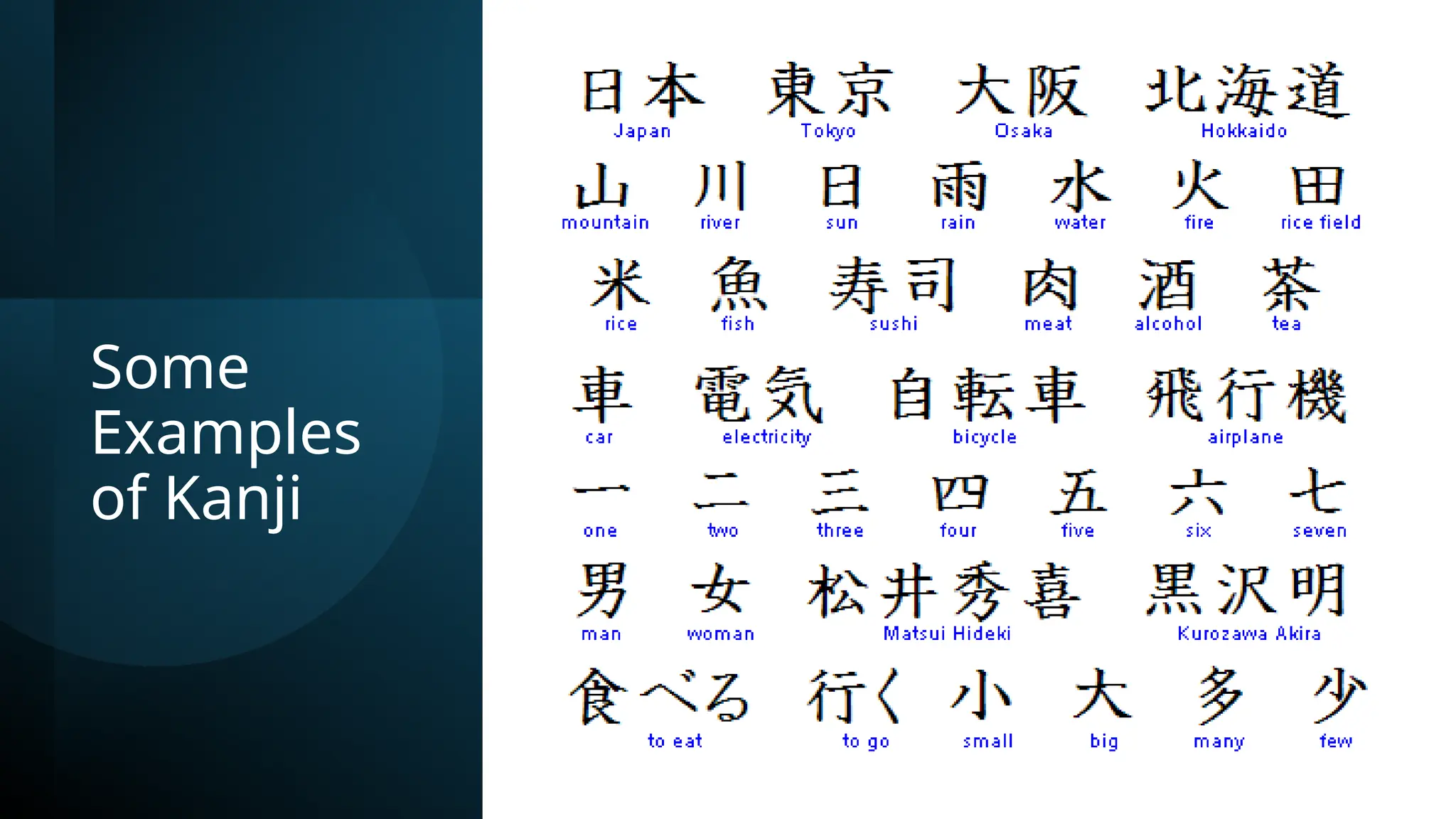
Some
Examples
of Kanji
Kanji Symbol for
Sun
• The Japanese kanji for "sun" is 日 . It
also means "day" and is the third most
common kanji in the Japanese language.
• The kanji for "sun" is more than just a
symbol for time, it also has deep
cultural significance.
• In Japanese mythology, Amaterasu
Ōmikami is the goddess of the sun. She
is also known as Amaterasu for short,
and Ōhirume no Muchi no Kami.
• The Japanese word for sunlight that is
filtered through tree leaves is komorebi
( 木漏れ日 )
Kanji Symbol for
Tree 木
• 木
• The Japanese kanji for
“tree” is 木 . The Kunyomi
or the Japanese
pronunciation of the Kanji
木 is “ki” ( き ) or “ko” ( こ ),
and the Onyomi (Chinese)
pronunciation is “boku” ( ボ
ク ) or “moku” ( モク ).Feb
23, 202
Kanji Symbol for
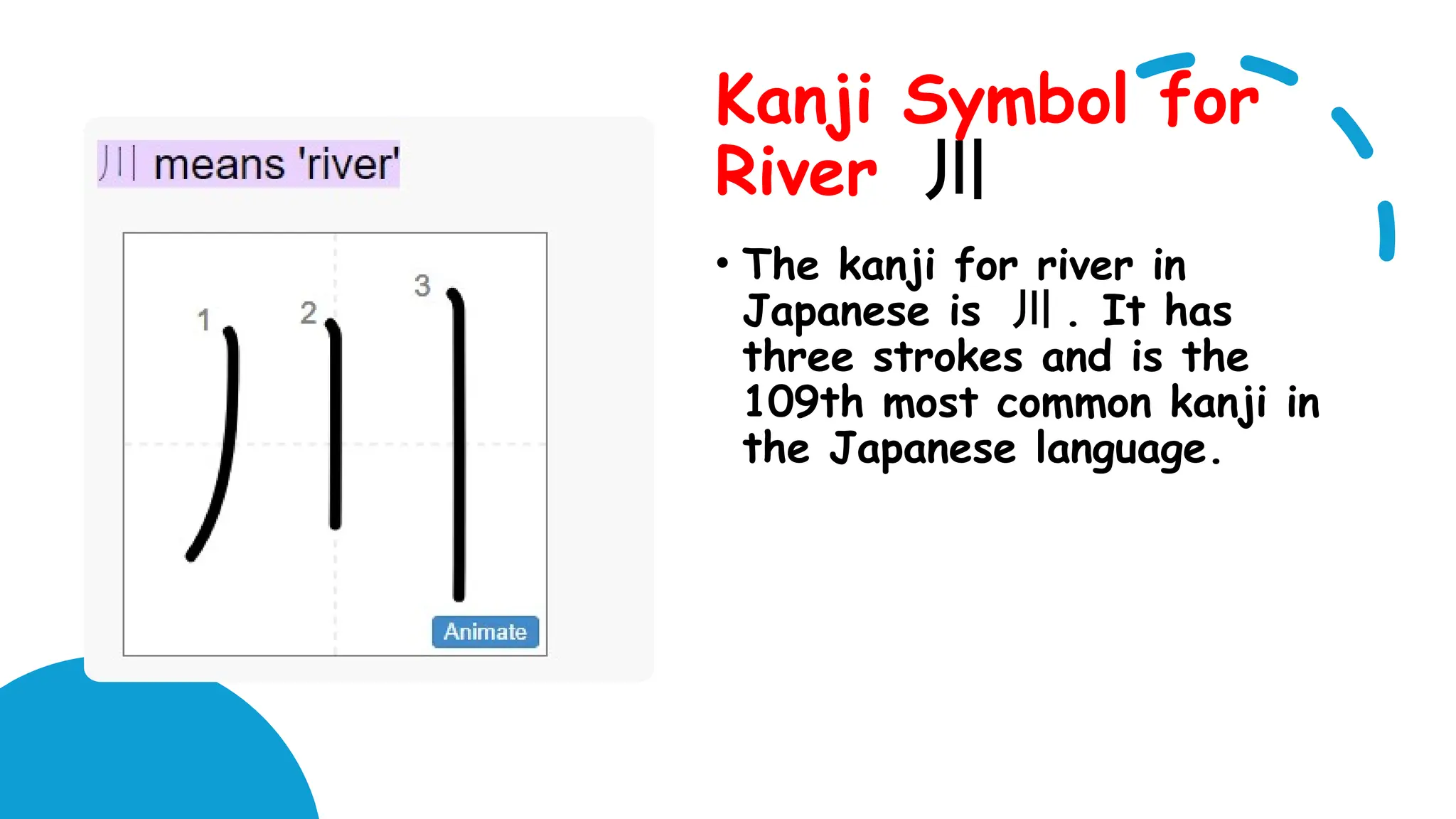
River 川
• The kanji for river in
Japanese is 川 . It has
three strokes and is the
109th most common kanji in
the Japanese language.
Kanji Symbol for
Mountain 山
• The Japanese kanji for "mountain"
is 山 , which is read as "yama". It
is the 60th most common kanji in
Japanese and has three strokes.
• When the mountain radical is part
of another kanji, it can be squished
vertically or horizontally. For
example, when it is in the top
position, it connects with another
radical below it and shrinks in
size. When it is in the left position,
it is squished vertically
Kanji Symbol for
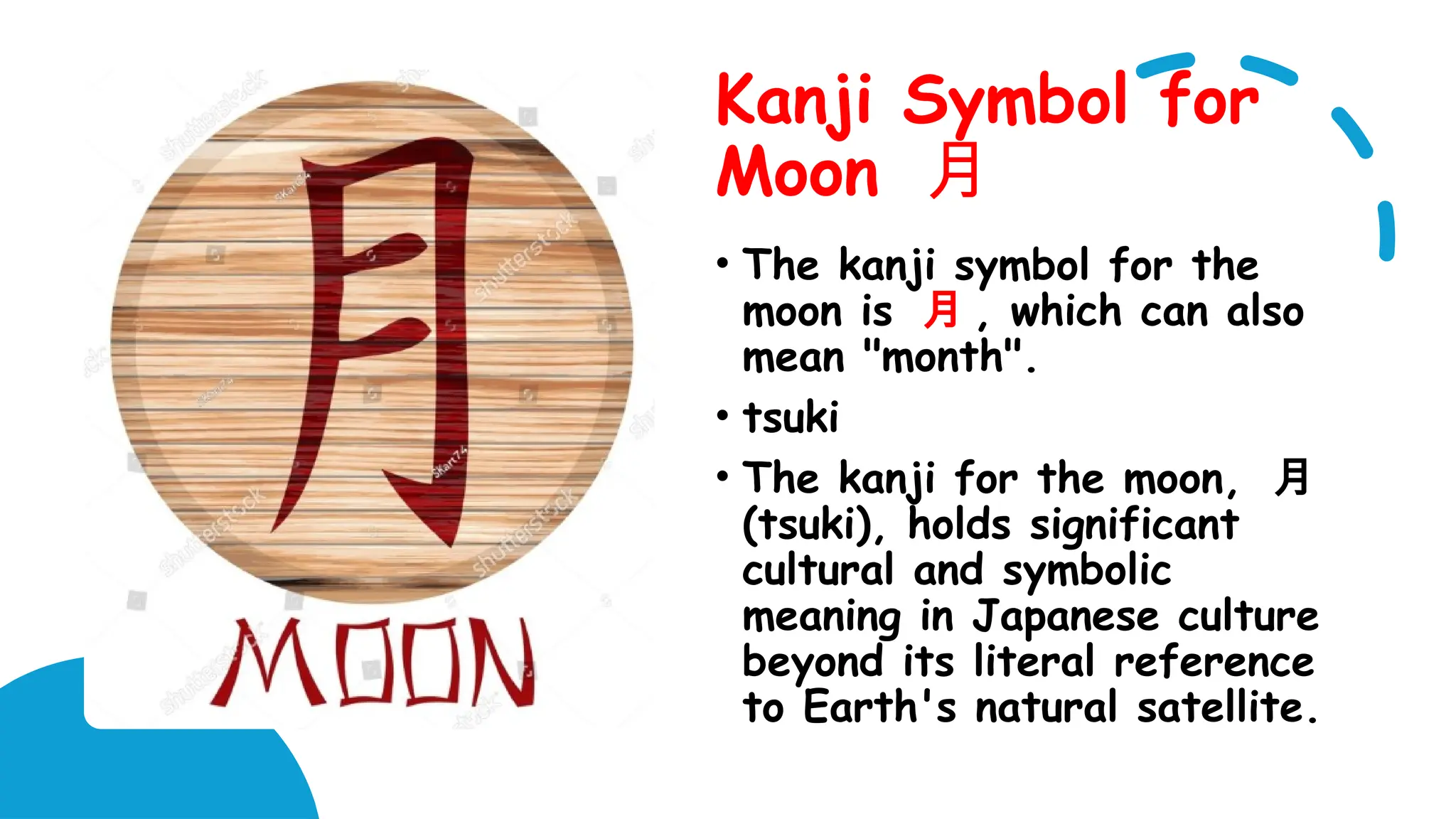
Moon 月
• The kanji symbol for the
moon is 月 , which can also
mean "month".
• tsuki
• The kanji for the moon, 月
(tsuki), holds significant
cultural and symbolic
meaning in Japanese culture
beyond its literal reference
to Earth's natural satellite.
Kanji Symbol for
Rice Field 田
• The kanji for “rice
field,” 田 (ta), is also
a radical in Japanese kanji.
When it appears as a
radical, it's known as “ たで
ん” (taden) and is often
associated with fields,
farming, or concepts related
to land and agriculture.
Kanji Symbol for
Person
• The kanji for "person" is 人 ,
which is read as "hi-to" when
it appears by itself. When
used in combination with other
words, it's usually read as "ji-
n" or "ni-n". For example, 人
口 ("population") is read as
"ji-n-ko-u" and 三人 ("three
people") is read as "sa-n-ni-n"
Kanji Symbol for
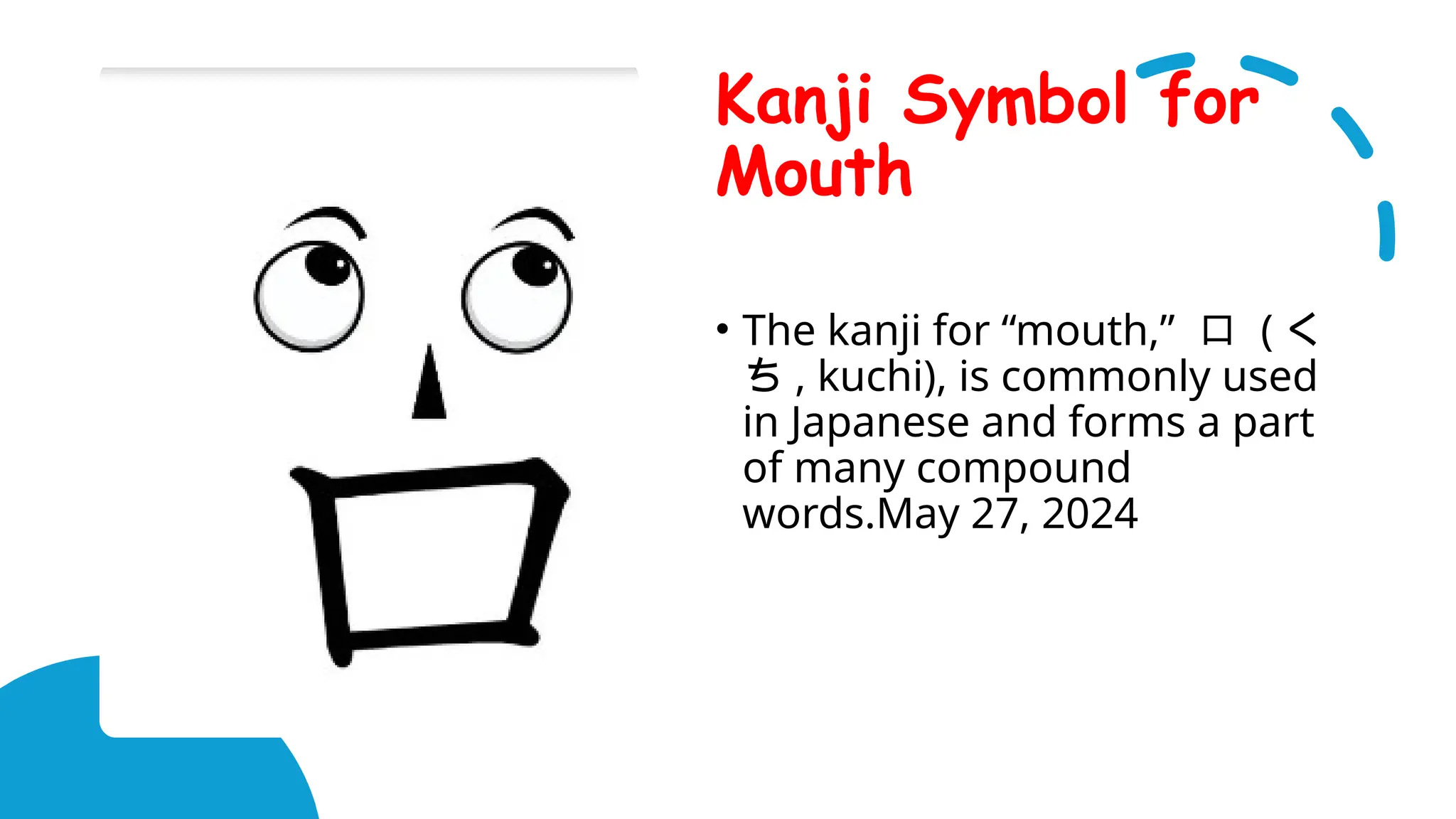
Mouth
• The kanji for “mouth,” 口 ( く
ち , kuchi), is commonly used
in Japanese and forms a part
of many compound
words.May 27, 2024
Kanji Symbol for
Car
• The Japanese Kanji for the
“car” or “vehicle” is 車 . As a
standalone Kanji, it is
pronounced as “Kuruma” but
when it appears in combination
with other Kanji, the
pronunciation is “Sha” – for
example, Densha ( 電車 ),
meaning Train or Jitensha ( 自
転車 ), meaning Bicycle
Kanji Symbol for
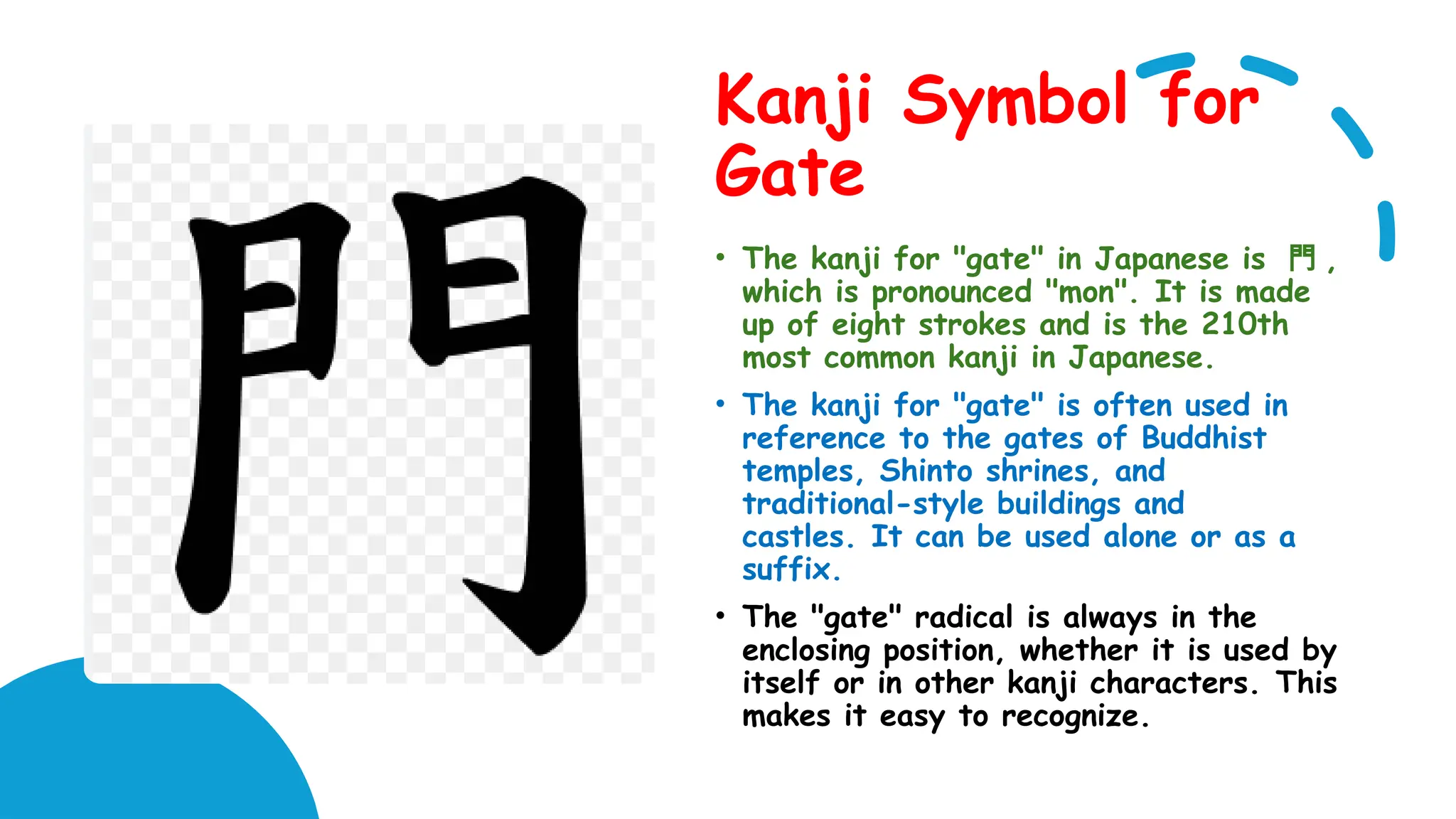
Gate
• The kanji for "gate" in Japanese is 門 ,
which is pronounced "mon". It is made
up of eight strokes and is the 210th
most common kanji in Japanese.
• The kanji for "gate" is often used in
reference to the gates of Buddhist
temples, Shinto shrines, and
traditional-style buildings and
castles. It can be used alone or as a
suffix.
• The "gate" radical is always in the
enclosing position, whether it is used by
itself or in other kanji characters. This
makes it easy to recognize.
Yomi Reading
• In Japanese, a yomi is a way to
pronounce a character or
word. There are two main types of
yomi readings: on'yomi and
kun'yomi:
• On'yomi
• The Sino-Japanese reading, which is
a Japanese approximation of the
Chinese pronunciation of a character
when it was introduced. On'yomi
readings are often used for
technical or compound words.
Kun Yomi Reading
• The Japanese reading of a kanji, which
uses the native Japanese word that
matches the meaning of the Chinese
character. Kun'yomi readings are often
used for singular or simpler words.
• Kanji can have multiple on'yomi readings
because some kanji were introduced
from different parts of China at
different times.
• On'yomi pronunciations are often
classified into go-on, kan-on, tō-on,
and kan'yō-on, based on when they
were borrowed from China
https://youtu.be/QdmR6B5EoII
FAQ (Frequently
Asked Questions
1. What is Kanji?
2. Why are we studying Kanji?3
3. Is Kanji a writing system? Explain
4. How do you write the symbol for tree?
5. How do you write the symbol for person?
6. What is the difference between yomi and
kun yomi?
7. Give an example of a vocabulary word for
yomi.
8. Give an example of a vocabulary word for
kun yomi.

Basic Kanji the history and first 10 kanji

  • 1.
  • 2.
    What is Kanji? •Kanji are the logographic Chinese characters adapted from the Chinese script used in the writing of Japanese. • They were made a major part of the Japanese writing system during the time of Old Japanese and are still used, along with the subsequently- derived syllabic scripts of hiragana and katakana. • Kanji are ideograms, i.e. each character has its own meaning and corresponds to a word. By combining characters, more words can be created. For example, the combination of "electricity" with "car" means "train". There are tens of thousands of characters, of which 2000 to 3000 are required to understand newspapers. A set of 2136 characters has been officially declared as the "kanji for everyday use".
  • 3.
    Japanese Characters • Beforethe introduction of Chinese characters, no Japanese writing system existed. • When adopting the characters, the Japanese did not only introduce the characters' original Chinese pronunciations, but also associated them with the corresponding, native Japanese words and their pronunciations. • Consequently, most kanji can still be pronounced in at least two ways, a Chinese (on-yomi) and a Japanese (kun- yomi) way, which considerably further complicates the study of the Japanese language.
  • 4.
  • 5.
    Kanji Symbol for Sun •The Japanese kanji for "sun" is 日 . It also means "day" and is the third most common kanji in the Japanese language. • The kanji for "sun" is more than just a symbol for time, it also has deep cultural significance. • In Japanese mythology, Amaterasu Ōmikami is the goddess of the sun. She is also known as Amaterasu for short, and Ōhirume no Muchi no Kami. • The Japanese word for sunlight that is filtered through tree leaves is komorebi ( 木漏れ日 )
  • 6.
    Kanji Symbol for Tree木 • 木 • The Japanese kanji for “tree” is 木 . The Kunyomi or the Japanese pronunciation of the Kanji 木 is “ki” ( き ) or “ko” ( こ ), and the Onyomi (Chinese) pronunciation is “boku” ( ボ ク ) or “moku” ( モク ).Feb 23, 202
  • 7.
    Kanji Symbol for River川 • The kanji for river in Japanese is 川 . It has three strokes and is the 109th most common kanji in the Japanese language.
  • 8.
    Kanji Symbol for Mountain山 • The Japanese kanji for "mountain" is 山 , which is read as "yama". It is the 60th most common kanji in Japanese and has three strokes. • When the mountain radical is part of another kanji, it can be squished vertically or horizontally. For example, when it is in the top position, it connects with another radical below it and shrinks in size. When it is in the left position, it is squished vertically
  • 9.
    Kanji Symbol for Moon月 • The kanji symbol for the moon is 月 , which can also mean "month". • tsuki • The kanji for the moon, 月 (tsuki), holds significant cultural and symbolic meaning in Japanese culture beyond its literal reference to Earth's natural satellite.
  • 10.
    Kanji Symbol for RiceField 田 • The kanji for “rice field,” 田 (ta), is also a radical in Japanese kanji. When it appears as a radical, it's known as “ たで ん” (taden) and is often associated with fields, farming, or concepts related to land and agriculture.
  • 11.
    Kanji Symbol for Person •The kanji for "person" is 人 , which is read as "hi-to" when it appears by itself. When used in combination with other words, it's usually read as "ji- n" or "ni-n". For example, 人 口 ("population") is read as "ji-n-ko-u" and 三人 ("three people") is read as "sa-n-ni-n"
  • 12.
    Kanji Symbol for Mouth •The kanji for “mouth,” 口 ( く ち , kuchi), is commonly used in Japanese and forms a part of many compound words.May 27, 2024
  • 13.
    Kanji Symbol for Car •The Japanese Kanji for the “car” or “vehicle” is 車 . As a standalone Kanji, it is pronounced as “Kuruma” but when it appears in combination with other Kanji, the pronunciation is “Sha” – for example, Densha ( 電車 ), meaning Train or Jitensha ( 自 転車 ), meaning Bicycle
  • 14.
    Kanji Symbol for Gate •The kanji for "gate" in Japanese is 門 , which is pronounced "mon". It is made up of eight strokes and is the 210th most common kanji in Japanese. • The kanji for "gate" is often used in reference to the gates of Buddhist temples, Shinto shrines, and traditional-style buildings and castles. It can be used alone or as a suffix. • The "gate" radical is always in the enclosing position, whether it is used by itself or in other kanji characters. This makes it easy to recognize.
  • 15.
    Yomi Reading • InJapanese, a yomi is a way to pronounce a character or word. There are two main types of yomi readings: on'yomi and kun'yomi: • On'yomi • The Sino-Japanese reading, which is a Japanese approximation of the Chinese pronunciation of a character when it was introduced. On'yomi readings are often used for technical or compound words.
  • 16.
    Kun Yomi Reading •The Japanese reading of a kanji, which uses the native Japanese word that matches the meaning of the Chinese character. Kun'yomi readings are often used for singular or simpler words. • Kanji can have multiple on'yomi readings because some kanji were introduced from different parts of China at different times. • On'yomi pronunciations are often classified into go-on, kan-on, tō-on, and kan'yō-on, based on when they were borrowed from China
  • 17.
  • 18.
    FAQ (Frequently Asked Questions 1.What is Kanji? 2. Why are we studying Kanji?3 3. Is Kanji a writing system? Explain 4. How do you write the symbol for tree? 5. How do you write the symbol for person? 6. What is the difference between yomi and kun yomi? 7. Give an example of a vocabulary word for yomi. 8. Give an example of a vocabulary word for kun yomi.