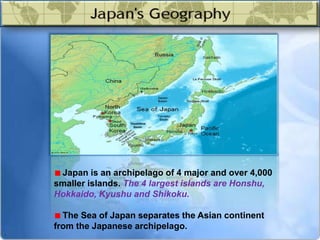
Japan is an archipelago of 4 major and over 4,000
smaller islands. The 4 largest islands are Honshu,
Hokkaido, Kyushu and Shikoku.
The Sea of Japan separates the Asian continent
from the Japanese archipelago.
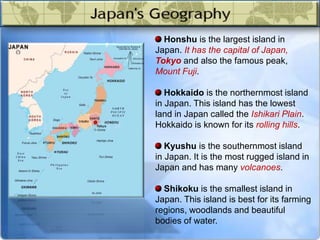
Honshu is the largest island in
Japan. It has the capital of Japan,
Tokyo and also the famous peak,
Mount Fuji.
Hokkaido is the northernmost island
in Japan. This island has the lowest
land in Japan called the Ishikari Plain.
Hokkaido is known for its rolling hills.
Kyushu is the southernmost island
in Japan. It is the most rugged island in
Japan and has many volcanoes.
Shikoku is the smallest island in
Japan. This island is best for its farming
regions, woodlands and beautiful
bodies of water.
Japanese is the official language of
Japan.
Many Japanese also have some ability
in writing and speaking English as it is a
mandatory part of the curriculum in the
Japanese educational system.
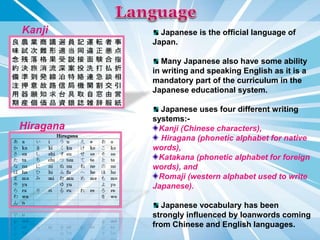
Japanese uses four different writing
systems:-
Kanji (Chinese characters),
Hiragana (phonetic alphabet for native
words),
Katakana (phonetic alphabet for foreign
words), and
Romaji (western alphabet used to write
Japanese).
Japanese vocabulary has been
strongly influenced by loanwords coming
from Chinese and English languages.
Kanji
Hiragana
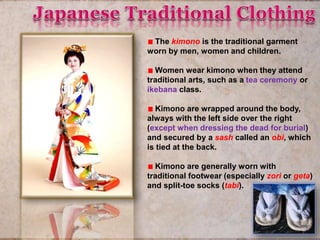
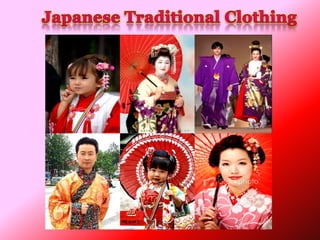
The kimono is the traditional garment
worn by men, women and children.
Women wear kimono when they attend
traditional arts, such as a tea ceremony or
ikebana class.
Kimono are wrapped around the body,
always with the left side over the right
(except when dressing the dead for burial)
and secured by a sash called an obi, which
is tied at the back.
Kimono are generally worn with
traditional footwear (especially zori or geta)
and split-toe socks (tabi).
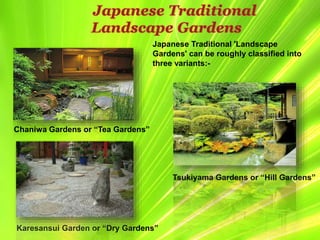
Japanese Traditional 'Landscape
Gardens' can be roughly classified into
three variants:-
Chaniwa Gardens or “Tea Gardens”
Japanese Traditional
Landscape Gardens
Karesansui Garden or “Dry Gardens”
Tsukiyama Gardens or “Hill Gardens”
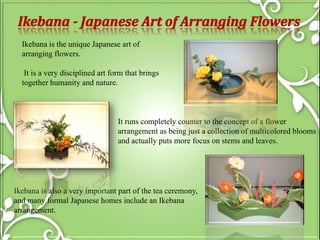
Ikebana is the unique Japanese art of
arranging flowers.
It is a very disciplined art form that brings
together humanity and nature.
It runs completely counter to the concept of a flower
arrangement as being just a collection of multicolored blooms
and actually puts more focus on stems and leaves.
Ikebana is also a very important part of the tea ceremony,
and many formal Japanese homes include an Ikebana
arrangement.
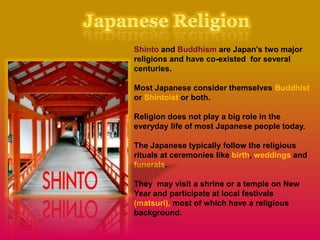
Shinto and Buddhism are Japan's two major
religions and have co-existed for several
centuries.
Most Japanese consider themselves Buddhist
or Shintoist or both.
Religion does not play a big role in the
everyday life of most Japanese people today.
The Japanese typically follow the religious
rituals at ceremonies like birth, weddings and
funerals.
They may visit a shrine or a temple on New
Year and participate at local festivals
(matsuri), most of which have a religious
background.
Shinto ("the way of the gods") is the
indigenous faith of the Japanese people and is
as old as Japan itself.
“Shinto gods" are called kami. They are sacred
spirits which take the form of things such as
wind, rain, mountains, trees, rivers and fertility.
Humans become kami after they die and are
revered by their families as ancestral kami.
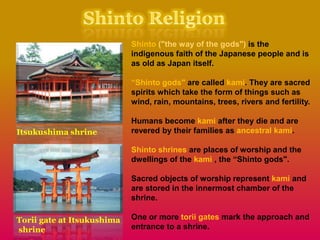
Shinto shrines are places of worship and the
dwellings of the kami , the “Shinto gods".
Sacred objects of worship represent kami and
are stored in the innermost chamber of the
shrine.
One or more torii gates mark the approach and
entrance to a shrine.
Torii gate at Itsukushima
shrine
Itsukushima shrine
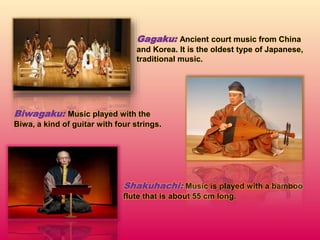
Gagaku: Ancient court music from China
and Korea. It is the oldest type of Japanese,
traditional music.
Biwagaku: Music played with the
Biwa, a kind of guitar with four strings.
Shakuhachi: Music is played with a bamboo
flute that is about 55 cm long.
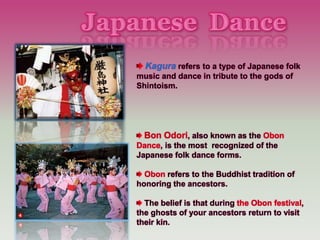
Kagura refers to a type of Japanese folk
music and dance in tribute to the gods of
Shintoism.
Bon Odori, also known as the Obon
Dance, is the most recognized of the
Japanese folk dance forms.
Obon refers to the Buddhist tradition of
honoring the ancestors.
The belief is that during the Obon festival,
the ghosts of your ancestors return to visit
their kin.
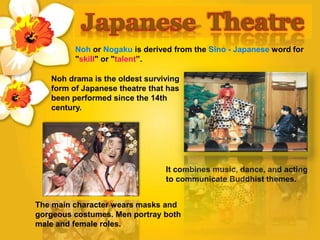
Noh or Nogaku is derived from the Sino - Japanese word for
"skill" or "talent”.
Noh drama is the oldest surviving
form of Japanese theatre that has
been performed since the 14th
century.
The main character wears masks and
gorgeous costumes. Men portray both
male and female roles.
It combines music, dance, and acting
to communicate Buddhist themes.
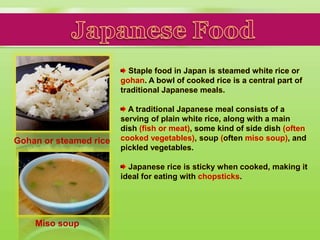
Staple food in Japan is steamed white rice or
gohan. A bowl of cooked rice is a central part of
traditional Japanese meals.
A traditional Japanese meal consists of a
serving of plain white rice, along with a main
dish (fish or meat), some kind of side dish (often
cooked vegetables), soup (often miso soup), and
pickled vegetables.
Japanese rice is sticky when cooked, making it
ideal for eating with chopsticks.
Gohan or steamed rice
Miso soup
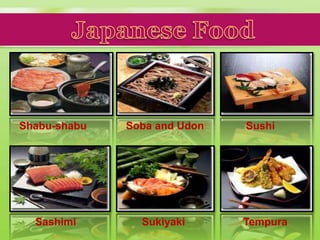
Sashimi
Shabu-shabu Soba and Udon
Sukiyaki Tempura
Sushi
Mystical Japan
Mystical Japan

Mystical Japan

  • 2.
    Japan is anarchipelago of 4 major and over 4,000 smaller islands. The 4 largest islands are Honshu, Hokkaido, Kyushu and Shikoku. The Sea of Japan separates the Asian continent from the Japanese archipelago.
  • 3.
    Honshu is thelargest island in Japan. It has the capital of Japan, Tokyo and also the famous peak, Mount Fuji. Hokkaido is the northernmost island in Japan. This island has the lowest land in Japan called the Ishikari Plain. Hokkaido is known for its rolling hills. Kyushu is the southernmost island in Japan. It is the most rugged island in Japan and has many volcanoes. Shikoku is the smallest island in Japan. This island is best for its farming regions, woodlands and beautiful bodies of water.
  • 4.
    Japanese is theofficial language of Japan. Many Japanese also have some ability in writing and speaking English as it is a mandatory part of the curriculum in the Japanese educational system. Japanese uses four different writing systems:- Kanji (Chinese characters), Hiragana (phonetic alphabet for native words), Katakana (phonetic alphabet for foreign words), and Romaji (western alphabet used to write Japanese). Japanese vocabulary has been strongly influenced by loanwords coming from Chinese and English languages. Kanji Hiragana
  • 5.
    The kimono isthe traditional garment worn by men, women and children. Women wear kimono when they attend traditional arts, such as a tea ceremony or ikebana class. Kimono are wrapped around the body, always with the left side over the right (except when dressing the dead for burial) and secured by a sash called an obi, which is tied at the back. Kimono are generally worn with traditional footwear (especially zori or geta) and split-toe socks (tabi).
  • 7.
    Japanese Traditional 'Landscape Gardens'can be roughly classified into three variants:- Chaniwa Gardens or “Tea Gardens” Japanese Traditional Landscape Gardens Karesansui Garden or “Dry Gardens” Tsukiyama Gardens or “Hill Gardens”
  • 8.
    Ikebana is theunique Japanese art of arranging flowers. It is a very disciplined art form that brings together humanity and nature. It runs completely counter to the concept of a flower arrangement as being just a collection of multicolored blooms and actually puts more focus on stems and leaves. Ikebana is also a very important part of the tea ceremony, and many formal Japanese homes include an Ikebana arrangement.
  • 9.
    Shinto and Buddhismare Japan's two major religions and have co-existed for several centuries. Most Japanese consider themselves Buddhist or Shintoist or both. Religion does not play a big role in the everyday life of most Japanese people today. The Japanese typically follow the religious rituals at ceremonies like birth, weddings and funerals. They may visit a shrine or a temple on New Year and participate at local festivals (matsuri), most of which have a religious background.
  • 10.
    Shinto ("the wayof the gods") is the indigenous faith of the Japanese people and is as old as Japan itself. “Shinto gods" are called kami. They are sacred spirits which take the form of things such as wind, rain, mountains, trees, rivers and fertility. Humans become kami after they die and are revered by their families as ancestral kami. Shinto shrines are places of worship and the dwellings of the kami , the “Shinto gods". Sacred objects of worship represent kami and are stored in the innermost chamber of the shrine. One or more torii gates mark the approach and entrance to a shrine. Torii gate at Itsukushima shrine Itsukushima shrine
  • 12.
    Gagaku: Ancient courtmusic from China and Korea. It is the oldest type of Japanese, traditional music. Biwagaku: Music played with the Biwa, a kind of guitar with four strings. Shakuhachi: Music is played with a bamboo flute that is about 55 cm long.
  • 13.
    Kagura refers toa type of Japanese folk music and dance in tribute to the gods of Shintoism. Bon Odori, also known as the Obon Dance, is the most recognized of the Japanese folk dance forms. Obon refers to the Buddhist tradition of honoring the ancestors. The belief is that during the Obon festival, the ghosts of your ancestors return to visit their kin.
  • 14.
    Noh or Nogakuis derived from the Sino - Japanese word for "skill" or "talent”. Noh drama is the oldest surviving form of Japanese theatre that has been performed since the 14th century. The main character wears masks and gorgeous costumes. Men portray both male and female roles. It combines music, dance, and acting to communicate Buddhist themes.
  • 15.
    Staple food inJapan is steamed white rice or gohan. A bowl of cooked rice is a central part of traditional Japanese meals. A traditional Japanese meal consists of a serving of plain white rice, along with a main dish (fish or meat), some kind of side dish (often cooked vegetables), soup (often miso soup), and pickled vegetables. Japanese rice is sticky when cooked, making it ideal for eating with chopsticks. Gohan or steamed rice Miso soup
  • 16.
    Sashimi Shabu-shabu Soba andUdon Sukiyaki Tempura Sushi