

June 2013, Volume 5 Issue 2
CONTENTS

Raj Kalady

Priya Awasare

Panchalee Thakur

Arjun A.
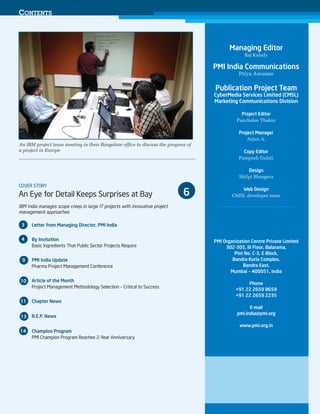
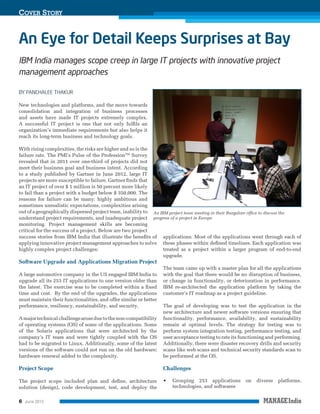
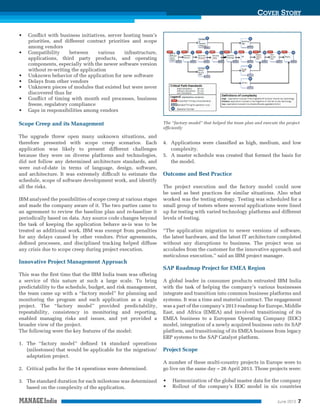
An IBM project team meeting in their Bangalore office to discuss the progress of
a project in Europe
Pamposh Gulati

Shilpi Bhargava

CMSL developer team

2

June 2013
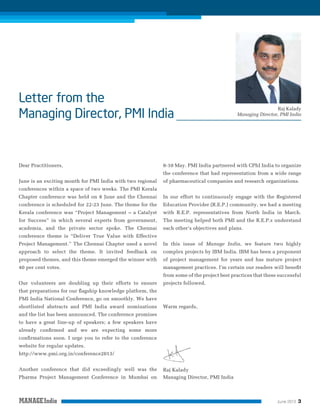
Raj Kalady
Managing Director, PMI India

Dear Practitioners,

8-10 May. PMI India partnered with CPhI India to organize
the conference that had representation from a wide range

June is an exciting month for PMI India with two regional

of pharmaceutical companies and research organizations.

conferences within a space of two weeks. The PMI Kerala
Chapter conference was held on 8 June and the Chennai

In our effort to continuously engage with the Registered

conference is scheduled for 22-23 June. The theme for the

Education Provider (R.E.P.) community, we had a meeting

Kerala conference was “Project Management – a Catalyst

with R.E.P. representatives from North India in March.

for Success” in which several experts from government,

The meeting helped both PMI and the R.E.P.s understand

academia, and the private sector spoke. The Chennai

each other’s objectives and plans.

conference theme is “Deliver True Value with Effective
Project Management.” The Chennai Chapter used a novel

In this issue of Manage India, we feature two highly

approach to select the theme. It invited feedback on

complex projects by IBM India. IBM has been a proponent

proposed themes, and this theme emerged the winner with

of project management for years and has mature project

40 per cent votes.

management practices. I’m certain our readers will benefit
from some of the project best practices that these successful

Our volunteers are doubling up their efforts to ensure

projects followed.

that preparations for our flagship knowledge platform, the
PMI India National Conference, go on smoothly. We have
shortlisted abstracts and PMI India award nominations

Warm regards,

and the list has been announced. The conference promises
to have a great line-up of speakers; a few speakers have
already confirmed and we are expecting some more
confirmations soon. I urge you to refer to the conference
website for regular updates.
http://www.pmi.org.in/conference2013/
Another conference that did exceedingly well was the
Pharma Project Management Conference in Mumbai on

Raj Kalady
Managing Director, PMI India

June 2013

3
BY INVITATION

There is a great need for project management in the public
domain. There’s a perception that the government deals
mainly with “soft” sectors in the public domain such as
healthcare and education and that there is no need for project
management practices. But that is not true. The government
deals with “hard” sectors like infrastructure. Even in the
“soft” sectors, project management practices are required for
effective implementation. In fact, project management is the
heart of implementation.
I have used project management in major infrastructure
projects like in the power sector. I was managing director of
Karnataka Power Corporation Limited where we worked on
the Rs 15,000 crore, 450 mega watt expansion of the power
project. It was financed by the private sector at an interest
rate of 16.5 percent. But we managed to execute it well with
no time and cost overruns. In fact, it created a record in the
power sector, with its completion nine months ahead of time.
We also saved a considerable amount of money.
The following are some project management practices for
work in the public domain:
1. A project must be well researched and well designed,
and put together within a consistent framework. Once the
project is designed, there should be minimal rework. In the
public domain, rework is a bane: the scope of the project, the
design is changed many times due to faulty planning. In the
power project at Raichur, Units 5 and 6, in Karnataka, we
froze the design and scope of the project once it was in place.
We allowed no changes. The iron discipline helped in the
specifications being firmed up. Thus there was scrupulous
implementation. That’s the advantage of definiteness in a
project.
2. The project should be well-funded. If it is semi-funded,
the money gets dried up midstream and the project stops.
Even on resumption, the momentum must be built up again.
Cash gives a certain ‘certainty’ to a project. That certainty is
critical.
3. Agencies which execute the project must possess the
competence to execute it. Raichur 5 and 6 was gigantic in
nature - there were 65 contracts in all. It called for an agency
with competence of a high order. You must select the agency
based on objective criteria such as quality, market record,
track record, engineering expertise, and so on. Those of a high
order perform well. But in the public sector, selection could
be based on sweetheart deals. (These are undue favors shown
by the procurer to the seller. For example, the procurer might
enter into a deal with the seller either in terms of fixing the
quality or hiking the price; he accepts substandard quality
or asks for a higher price). So projects sputter away and
enormous time and money are lost.

4

June 2013

4. Today, we need a partnership
approach to project execution. The
owner is not the boss, the agent
not the serf. The owner cannot pretend to call the shots;
the contractor or agent cannot be treated like a daily wages
worker. All the stakeholders must be equally involved.
5. Today, there is a need for incentives for performance. I
introduced it in my projects. If the design was ready 10
percent ahead of the time frame, the person responsible for
it was rewarded, he would get a bonus. If it was completed
even earlier, he would get a bigger bonus. In the said project,
even a public sector unit like Bharat Heavy Electrical Limited
earned a bonus of Rs 70 crore, on a total project worth Rs 700
crore. Even the mechanical and electrical units got a bonus.
So incentives must be a part of project management practices;
however, make sure that the targets are not low.
6. Another commendable practice is good communication
at all levels and all spheres – between management and
agencies, at the field site, with the outside world, with
finance agencies. Good communication, both external and
internal, creates a performance ethic all around. It increases
performance and productivity.
7. Any good project must emphasize wins and celebrate
successes. A project must have milestones, and each time
a milestone is reached, it must be celebrated. For example,
when a milestone is reached on schedule or ahead of
schedule, you must celebrate: throw a party, have a bonfire
night, hold a recognition function, have it written about in
the media. It may sound trivial, but what it does to the morale
is critical.
At the end of the day, you must also be lucky. Because a
bad politician, an incompetent bureaucrat, acts of nature, or
disasters can mess up a project. But even with politicians, it
can be a matter of circumstance. The bigger the project, the
bigger the sense of ownership on the part of the politician.
It is the astuteness of the manager that can save the day.
The golden rule is that you must make the politician feel
responsible for the success of the project. It is about managing
the expectations of the politician.
(Mr. K Jairaj, IAS, retired recently as additional chief
secretary to the Government of Karnataka. He has held
diverse assignments in infrastructure, energy, transport, and
urban development. He was principal secretary to the chief
minister of Karnataka, and commissioner, Bangalore City
Corporation for two terms. He helped establish the Bangalore
International Airport Limited on a public private partnership
basis. Currently, he is the trustee and secretary of Bangalore
Political Action Committee.)
—As told to Geetha Rao
ADVERTISEMENT

June 2013

5
Cover Story

An Eye for Detail Keeps Surprises at Bay
IBM India manages scope creep in large IT projects with innovative project
management approaches
BY PANCHALEE THAKUR
New technologies and platforms, and the move towards
consolidation and integration of business processes
and assets have made IT projects extremely complex.
A successful IT project is one that not only fulfils an
organization’s immediate requirements but also helps it
reach its long-term business and technology goals.
With rising complexities, the risks are higher and so is the
failure rate. The PMI’s Pulse of the ProfessionTM Survey
revealed that in 2011 over one-third of projects did not
meet their business goal and business intent. According
to a study published by Gartner in June 2012, large IT
projects are more susceptible to failure. Gartner finds that
an IT project of over $ 1 million is 50 percent more likely
to fail than a project with a budget below $ 350,000. The
reasons for failure can be many: highly ambitious and
sometimes unrealistic expectations, complexities arising
out of a geographically dispersed project team, inability to An IBM project team meeting in their Bangalore office to discuss the
understand project requirements, and inadequate project progress of a project in Europe
monitoring. Project management skills are becoming
critical for the success of a project. Below are two project
success stories from IBM India that illustrate the benefits of applications. Most of the applications went through each of
applying innovative project management approaches to solve these phases within defined timelines. Each application was
highly complex project challenges:
treated as a project within a larger program of end-to-end
upgrade.

Software Upgrade and Applications Migration Project

A large automotive company in the US engaged IBM India to
upgrade all its 253 IT applications to one version older than
the latest. The exercise was to be completed within a fixed
time and cost. By the end of the upgrades, the applications
must maintain their functionalities, and offer similar or better
performance, resiliency, sustainability, and security.

The team came up with a master plan for all the applications
with the goal that there would be no disruption of business,
or change in functionality, or deterioration in performance.
IBM re-architected the application platform by taking the
customer’s IT roadmap as a project guideline.

A major technical challenge arose due to the non-compatibility
of operating systems (OS) of some of the applications. Some
of the Solaris applications that were architected by the
company’s IT team and were tightly coupled with the OS
had to be migrated to Linux. Additionally, some of the latest
versions of the software could not run on the old hardware;
hardware renewal added to the complexity.

The goal of developing was to test the application in the
new architecture and newer software versions ensuring that
functionality, performance, availability, and sustainability
remain at optimal levels. The strategy for testing was to
perform system integration testing, performance testing, and
user acceptance testing to rate its functioning and performing.
Additionally, there were disaster recovery drills and security
scans like web scans and technical security standards scan to
be performed at the OS.

Project Scope

Challenges

The project scope included plan and define, architecture
solution (design), code development, test, and deploy the

•	

6

June 2013

Grouping 253 applications
technologies, and softwares

on

diverse

platforms,
COVER STORY
•
•

•
•
•
•
•

Conflict with business initiatives, server hosting team’s
priorities, and different contract priorities and scope
among vendors
Compatibility
between
various
infrastructure,
applications, third party products, and operating
components, especially with the newer software version
without re-writing the application
Unknown behavior of the application for new software
Delays from other vendors
Unknown pieces of modules that existed but were never
discovered thus far
Conflict of timing with month end processes, business
freeze, regulatory compliance
Gaps in responsibilities among vendors

Scope Creep and its Management
The upgrade threw open many unknown situations, and
therefore presented with scope creep scenarios. Each
application was likely to present different challenges
because they were on diverse platforms and technologies,
did not follow any determined architecture standards, and
were out-of-date in terms of language, design, software,
and architecture. It was extremely difficult to estimate the
schedule, scope of software development work, and identify
all the risks.
IBM analysed the possibilities of scope creep at various stages
and made the company aware of it. The two parties came to
an agreement to review the baseline plan and re-baseline it
periodically based on data. Any source code changes beyond
the task of keeping the application behave as-is was to be
treated as additional work. IBM was exempt from penalties
for any delays caused by other vendors. Prior agreements,
defined processes, and disciplined tracking helped diffuse
any crisis due to scope creep during project execution.

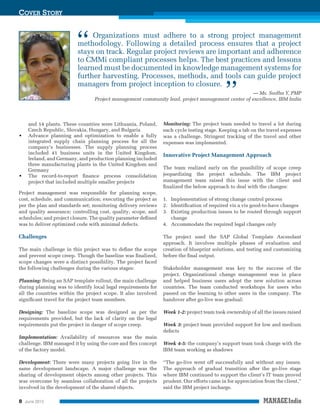
The “factory model” that helped the team plan and execute the project
efficiently

4. Applications were classified as high, medium, and low
complexity.
5. A master schedule was created that formed the basis for
the model.

Outcome and Best Practice
The project execution and the factory model could now
be used as best practices for similar situations. Also what
worked was the testing strategy. Testing was scheduled for a
small group of testers where several applications were lined
up for testing with varied technology platforms and different
levels of testing.
“The application migration to newer versions of software,
the latest hardware, and the latest IT architecture completed
without any disruptions to business. The project won us
accolades from the customer for the innovative approach and
meticulous execution,” said an IBM project manager.

Innovative Project Management Approach
SAP Roadmap Project for EMEA Region
This was the first time that the IBM India team was offering
a service of this nature at such a large scale. To bring
predictability to the schedule, budget, and risk management,
the team came up with a “factory model” for planning and
monitoring the program and each application as a single
project. The “factory model” provided predictability,
repeatability, consistency in monitoring and reporting,
enabled managing risks and issues, and yet provided a
broader view of the project.
The following were the key features of the model:
1. The “factory model” defined 14 standard operations
(milestones) that would be applicable for the migration/
adaptation project.

A global leader in consumer products entrusted IBM India
with the task of helping the company’s various businesses
integrate and transition into common business platforms and
systems. It was a time and material contract. The engagement
was a part of the company’s 2013 roadmap for Europe, Middle
East, and Africa (EMEA) and involved transitioning of its
EMEA business to a European Operating Company (EOC)
model, integration of a newly acquired business onto its SAP
platform, and transitioning of its EMEA business from legacy
ERP systems to the SAP Catalyst platform.

Project Scope

2. Critical paths for the 14 operations were determined.

A number of these multi-country projects in Europe were to
go live on the same day – 26 April 2013. Those projects were:

3. The standard duration for each milestone was determined
based on the complexity of the application.

•
•

Harmonization of the global master data for the company
Rollout of the company’s EOC model in six countries
June 2013

7
COVER STORY

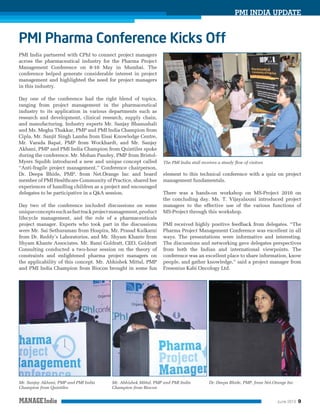
“

Organizations must adhere to a strong project management
methodology. Following a detailed process ensures that a project
stays on track. Regular project reviews are important and adherence
to CMMi compliant processes helps. The best practices and lessons
learned must be documented in knowledge management systems for
further harvesting. Processes, methods, and tools can guide project
managers from project inception to closure.

”

— Ms. Sudha Y, PMP
Project management community lead, project management center of excellence, IBM India

•

•

and 14 plants. These countries were Lithuania, Poland,
Czech Republic, Slovakia, Hungary, and Bulgaria
Advance planning and optimization to enable a fully
integrated supply chain planning process for all the
company’s businesses. The supply planning process
included 41 business units in the United Kingdom,
Ireland, and Germany, and production planning included
three manufacturing plants in the United Kingdom and
Germany
The record-to-report finance process consolidation
project that included multiple smaller projects

Project management was responsible for planning scope,
cost, schedule, and communication; executing the project as
per the plan and standards set; monitoring delivery reviews
and quality assurance; controlling cost, quality, scope, and
schedules; and project closure. The quality parameter defined
was to deliver optimized code with minimal defects.

Challenges
The main challenge in this project was to define the scope
and prevent scope creep. Though the baseline was finalized,
scope changes were a distinct possibility. The project faced
the following challenges during the various stages:

Planning: Being an SAP template rollout, the main challenge
during planning was to identify local legal requirements for
all the countries within the project scope. It also involved
significant travel for the project team members.
Designing: The baseline scope was designed as per the
requirements provided, but the lack of clarity on the legal
requirements put the project in danger of scope creep.

Monitoring: The project team needed to travel a lot during
each cycle testing stage. Keeping a tab on the travel expenses
was a challenge. Stringent tracking of the travel and other
expenses was implemented.

Innovative Project Management Approach
The team realized early on the possibility of scope creep
jeopardizing the project schedule. The IBM project
management team raised this issue with the client and
finalized the below approach to deal with the changes:
1. Implementation of strong change control process
2. Identification of required vis a vis good-to-have changes
3. Existing production issues to be routed through support
change
4. Accommodate the required legal changes only
The project used the SAP Global Template Ascendant
approach. It involves multiple phases of evaluation and
creation of blueprint solutions, and testing and customizing
before the final output.
Stakeholder management was key to the success of the
project. Organizational change management was in place
and helped business users adopt the new solution across
countries. The team conducted workshops for users who
passed on the learning to other users in the company. The
handover after go-live was gradual:

Week 1-2: project team took ownership of all the issues raised
Week 3: project team provided support for low and medium
defects

Implementation: Availability of resources was the main
challenge. IBM managed it by using the core and flex concept
of the factory model.

Week 4-5: the company’s support team took charge with the
IBM team working as shadows

Development: There were many projects going live in the
same development landscape. A major challenge was the
sharing of development objects among other projects. This
was overcome by seamless collaboration of all the projects
involved in the development of the shared objects.

“The go-live went off successfully and without any issues.
The approach of gradual transition after the go-live stage
where IBM continued to support the client’s IT team proved
prudent. Our efforts came in for appreciation from the client,”
said the IBM project incharge.

8

June 2013
PMI INDIA UPDATE

PMI India partnered with CPhI to connect project managers
across the pharmaceutical industry for the Pharma Project
Management Conference on 8-10 May in Mumbai. The
conference helped generate considerable interest in project
management and highlighted the need for project managers
in this industry.
Day one of the conference had the right blend of topics,
ranging from project management in the pharmaceutical
industry to its application in various departments such as
research and development, clinical research, supply chain,
and manufacturing. Industry experts Mr. Sanjay Bhanushali
and Ms. Megha Thakkar, PMP and PMI India Champion from
Cipla, Mr. Sanjit Singh Lamba from Eisai Knowledge Centre,
Mr. Varada Bapat, PMP from Wockhardt, and Mr. Sanjay
Akhani, PMP and PMI India Champion from Quintiles spoke
during the conference. Mr. Mohan Pandey, PMP from BristolMyers Squibb introduced a new and unique concept called
“Anti-fragile project management.” Conference chairperson,
Dr. Deepa Bhide, PMP, from Net.Orange Inc and board
member of PMI Healthcare Community of Practice, shared her
experiences of handling children as a project and encouraged
delegates to be participative in a Q&A session.
Day two of the conference included discussions on some
unique concepts such as fast track project management, product
lifecycle management, and the role of a pharmaceuticals
project manager. Experts who took part in the discussions
were Mr. Sai Sethuraman from Hospira, Mr. Prasad Kulkarni
from Dr. Reddy’s Laboratories, and Mr. Shyam Khante from
Shyam Khante Associates. Mr. Rami Goldratt, CEO, Goldratt
Consulting conducted a two-hour session on the theory of
constraints and enlightened pharma project managers on
the applicability of this concept. Mr. Abhishek Mittal, PMP
and PMI India Champion from Biocon brought in some fun

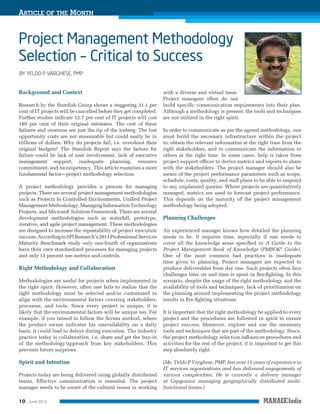
Mr. Sanjay Akhani, PMP and PMI India
Champion from Quintiles

The PMI India stall receives a steady flow of visitors

element to this technical conference with a quiz on project
management fundamentals.
There was a hands-on workshop on MS-Project 2010 on
the concluding day. Ms. T. Vijayalaxmi introduced project
managers to the effective use of the various functions of
MS-Project through this workshop.
PMI received highly positive feedback from delegates. “The
Pharma Project Management Conference was excellent in all
ways. The presentations were informative and interesting.
The discussions and networking gave delegates perspectives
from both the Indian and international viewpoints. The
conference was an excellent place to share information, know
people, and gather knowledge,” said a project manager from
Fresenius Kabi Oncology Ltd.

Mr. Abhishek Mittal, PMP and PMI India
Champion from Biocon

Dr. Deepa Bhide, PMP, from Net.Orange Inc

June 2013

9
ARTICLE OF THE MONTH

Background and Context
Research by the Standish Group shows a staggering 31.1 per
cent of IT projects will be cancelled before they get completed.
Further studies indicate 52.7 per cent of IT projects will cost
189 per cent of their original estimates. The cost of these
failures and overruns are just the tip of the iceberg. The lost
opportunity costs are not measurable but could easily be in
trillions of dollars. Why do projects fail, i.e. overshoot their
original budgets? The Standish Report says the factors for
failure could be lack of user involvement, lack of executive
management support, inadequate planning, resource
commitment, and incompetency. This article examines a more
fundamental factor—project methodology selection.
A project methodology provides a process for managing
projects. There are several project management methodologies
such as Projects In Controlled Environments, Unified Project
Management Methodology, Managing Information Technology
Projects, and Microsoft Solution Framework. There are several
development methodologies such as waterfall, prototype,
iterative, and agile project management. These methodologies
are designed to increase the repeatability of project execution
success. According to SPI Research’s 2011 Professional Services
Maturity Benchmark study only one-fourth of organizations
have their own standardized processes for managing projects
and only 15 percent use metrics and controls.

Right Methodology and Collaboration
Methodologies are useful for projects when implemented in
the right spirit. However, often one fails to realize that the
right methodology must be selected and/or customized to
align with the environmental factors covering stakeholders,
processes, and tools. Since every project is unique, it is
likely that the environmental factors will be unique too. For
example, if you intend to follow the Scrum method, where
the product owner indicates his unavailability on a daily
basis, it could lead to delays during execution. The industry
practice today is collaboration, i.e. share and get the buy-in
of the methodology/approach from key stakeholders. This
prevents future surprises.

Spirit and Intention
Projects today are being delivered using globally distributed
teams. Effective communication is essential. The project
manager needs to be aware of the cultural issues in working

10

June 2013

with a diverse and virtual team.
Project managers often do not
build specific communication requirements into their plan.
Although a methodology is present, the tools and techniques
are not utilized in the right spirit.
In order to communicate as per the agreed methodology, one
must build the necessary infrastructure within the project
to: obtain the relevant information at the right time from the
right stakeholders, and to communicate the information to
others at the right time. In some cases, help is taken from
project support offices to derive metrics and reports to share
with the stakeholders. The project manager should also be
aware of the project performance parameters such as scope,
schedule, costs, quality, and staff plans to be able to respond
to any unplanned queries. Where projects are quantitatively
managed, metrics are used to forecast project performance.
This depends on the maturity of the project management
methodology being adopted.

Planning Challenges
An experienced manager knows how detailed the planning
needs to be. It requires time, especially if one needs to
cover all the knowledge areas specified in A Guide to the
Project Management Book of Knowledge (PMBOK® Guide).
One of the most common bad practices is inadequate
time given to planning. Project managers are expected to
produce deliverables from day one. Such projects often face
challenges later on and time is spent in fire-fighting. In this
scenario, despite the usage of the right methodology and the
availability of tools and techniques, lack of prioritization on
the planning around implementing the project methodology
results in fire-fighting situations.
It is important that the right methodology be applied to every
project and the procedures are followed in spirit to ensure
project success. Moreover, explore and use the necessary
tools and techniques that are part of the methodology. Since,
the project methodology selection influences procedures and
activities for the rest of the project, it is important to get this
step absolutely right.
(Mr. Yeldo P Varghese, PMP, has over 15 years of experience in
IT services organizations and has delivered engagements of
various complexities. He is currently a delivery manager
at Capgemini managing geographically distributed multifunctional teams.)
CHAPTER NEWS

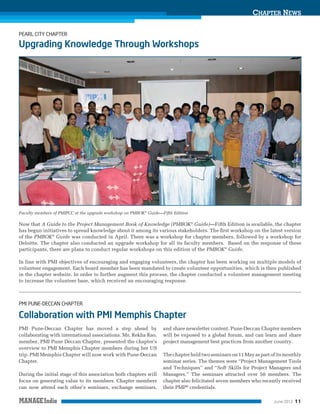
Faculty members of PMIPCC at the upgrade workshop on PMBOK® Guide—Fifth Edition

Now that A Guide to the Project Management Book of Knowledge (PMBOK® Guide)—Fifth Edition is available, the chapter
has begun initiatives to spread knowledge about it among its various stakeholders. The first workshop on the latest version
of the PMBOK® Guide was conducted in April. There was a workshop for chapter members, followed by a workshop for
Deloitte. The chapter also conducted an upgrade workshop for all its faculty members. Based on the response of these
participants, there are plans to conduct regular workshops on this edition of the PMBOK® Guide.
In line with PMI objectives of encouraging and engaging volunteers, the chapter has been working on multiple models of
volunteer engagement. Each board member has been mandated to create volunteer opportunities, which is then published
in the chapter website. In order to further augment this process, the chapter conducted a volunteer management meeting
to increase the volunteer base, which received an encouraging response.

PMI Pune-Deccan Chapter has moved a step ahead by
collaborating with international associations. Ms. Rekha Rao,
member, PMI Pune Deccan Chapter, presented the chapter’s
overview to PMI Memphis Chapter members during her US
trip. PMI Memphis Chapter will now work with Pune-Deccan
Chapter.
During the initial stage of this association both chapters will
focus on generating value to its members. Chapter members
can now attend each other’s seminars, exchange seminars,

and share newsletter content. Pune-Deccan Chapter members
will be exposed to a global forum, and can learn and share
project management best practices from another country.
The chapter held two seminars on 11 May as part of its monthly
seminar series. The themes were “Project Management Tools
and Techniques” and “Soft Skills for Project Managers and
Managers.” The seminars attracted over 50 members. The
chapter also felicitated seven members who recently received
their PMP® credentials.
June 2013

11
CHAPTER NEWS

In continuing with its pursuit of promoting project
management knowledge, PMI Bangalore Chapter has taken
steps to revise its training material as per A Guide to the
Project Management Book of Knowledge (PMBOK® Guide)—
Fifth Edition for its PMP Quest training program. The training
based on the new curriculum is expected to start in June.
Members can download the e-book version of the same from
the PMI website for their use.
The chapter hosted the 200th session of PM Footprints on
14 March. It is a milestone in the chapter’s history. Mr.
T.R.Anand, management consultant and advisor, spoke
on “Customer Centric Project Management – Business
Perspectives” and it was attended by nearly 80 practitioners.
PM Footprints was launched in October 2006 to provide
a platform for sharing the experience and knowledge of
project managers. It is held every alternate Thursday at Royal
Orchid Central Hotel on Dickenson Road in Bangalore. The
popularity of the program can be gauged by the number of
participants who attend these sessions regularly.
The chapter recently concluded elections to fill vacancies for
three positions in the chapter’s executive committee (EC).

PMI West Bengal Chapter holds one-day workshops as part
of its continuing education initiative. The first such work-

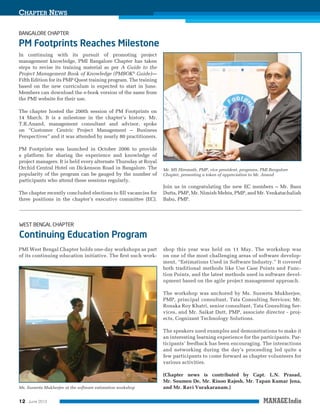
Mr. MS Hiremath, PMP, vice president, programs, PMI Bangalore
Chapter, presenting a token of appreciation to Mr. Anand

Join us in congratulating the new EC members – Mr. Basu
Dutta, PMP, Mr. Nimish Mehta, PMP, and Mr. Venkatachaliah
Babu, PMP.

shop this year was held on 11 May. The workshop was
on one of the most challenging areas of software development, “Estimations Used in Software Industry.” It covered
both traditional methods like Use Case Points and Function Points, and the latest methods used in software development based on the agile project management approach.
The workshop was anchored by Ms. Susweta Mukherjee,
PMP, principal consultant, Tata Consulting Services; Mr.
Ronaka Roy Khatri, senior consultant, Tata Consulting Services, and Mr. Saikat Dutt, PMP, associate director - projects, Cognizant Technology Solutions.
The speakers used examples and demonstrations to make it
an interesting learning experience for the participants. Participants’ feedback has been encouraging. The interactions
and networking during the day’s proceeding led quite a
few participants to come forward as chapter volunteers for
various activities.

Ms. Susweta Mukherjee at the software estimation workshop

12

June 2013

(Chapter news is contributed by Capt. L.N. Prasad,
Mr. Soumen De, Mr. Rinoo Rajesh, Mr. Tapan Kumar Jena,
and Mr. Ravi Vurakaranam.)
R.E.P NEWS

PMI India conducted an awareness session with the practitioner
community in Gurgaon and Noidaon 12 April. The meeting,
held at the Ericsson Gwal Pahari premises, was hosted by
the Gurgaon Project Management Community.Members from
Noida joined the session through video conference.
Mr. Shine Sahadevan, head – organizational market, PMI
India, spoke about PMI India initiatives during the session.
Mr. Sahadevan is responsible for advocating the project
management profession within the organizational market
with a focus on IT/ITES and telecom companies.
The session saw free-flowing discussions on various
topics, such as the PMI Agile Certified Practitioner
(PMI-ACP)® certification, PMI India chapters, and current
project management trends. There was special emphasis
on the telecom sector with deliberations on competencies
needed for success in this sector, current skill gaps, and the
high level objectives articulated in the National Telecom
Policy 2012. Participants also took part in a quiz on PMI
designed by PMI India Champion Vinay Agarwal, PMP.

The Internal Registered
Education
Providers
(I.R.E.P.), which is a
part of the PMI India
community,
setup
a
platform
for
project
managers to collaborate
and share ideas. This
platform serves as an
information bridge for
different
participating
organizations in Internal
R.E.P. to share new
best practices in the
areas of research and
development,
global
customer delivery, and
third party management.

Mr. Karthick Rajapandiyan,
senior project manager,
Alcatel-Lucent

As a part of this initiative,
Internal R.E.P. organized its third talk on 5 April 2013. It
was a virtual talking, which practitioners from AlcatelLucent, Sasken, and Datamatics Technology attended.
The speaker, Mr. Karthick Rajapandiyan, senior project
manager, Alcatel-Lucent, presented on “Quality
Improvement Practice for Third Party.”The session
started with an introduction of the speaker by Mr.
Vineet Chandra, engineering manager- quality, AlcatelLucent. Mr. Rajapandiyan elaborated on common pain
points and ways to solve them by following certain
quality improvement practices.
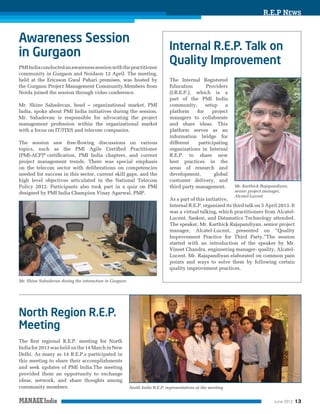
Mr. Shine Sahadevan during the interaction in Gurgaon

The first regional R.E.P. meeting for North
India for 2013 was held on the 14 March in New
Delhi. As many as 14 R.E.P.s participated in
this meeting to share their accomplishments
and seek updates of PMI India.The meeting
provided them an opportunity to exchange
ideas, network, and share thoughts among
community members.

North India R.E.P. representatives at the meeting
June 2013

13
CHAMPION PROGRAM

As the PMI India Champion program completed
two years this April, the Champion Advisory
Committee (CAC) met with Mr. Raj Kalady,
managing director, PMI India, on 20 April in
Mumbai. The meeting provided an opportunity
to review the program’s progress in the past two
years and decide the future plans. Mr. Ketharinath
Kamalanathan, PMP, chairperson, CAC, received
an emotional adieu as he completed his twoyear tenure at CAC. The CAC acknowledged
his contributions to the program. Mr. Ganesh
Puthucode, PMP, member, CAC, who has left
CAC after two years for personal commitments,
was also given a farewell.
Mr. Kalady announced the names of the new
chairperson and co-chairperson for CAC for the
next one year – April 2013 to March 2014. Ms.
Shagufta Inamdar, PMP, is the new chairperson
and Mr. Vivek Sonar is the new co-chairperson.
The CAC team reviewed the program’s progress
and discussed key action points for the year
ahead.

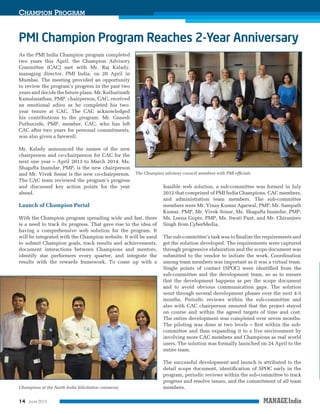
The Champion advisory council members with PMI officials

Launch of Champion Portal
With the Champion program spreading wide and fast, there
is a need to track its progress. That gave rise to the idea of
having a comprehensive web solution for the program. It
will be integrated with the Champion website. It will be used
to submit Champion goals, track results and achievements,
document interactions between Champions and mentors,
identify star performers every quarter, and integrate the
results with the rewards framework. To come up with a

Champions at the North India felicitation ceremony

14

June 2013

feasible web solution, a sub-committee was formed in July
2012 that comprised of PMI India Champions, CAC members,
and administration team members. The sub-committee
members were Mr. Vinay Kumar Agarwal, PMP, Mr. Sampath
Kumar, PMP, Mr. Vivek Sonar, Ms. Shagufta Inamdar, PMP,
Ms. Leena Gupte, PMP, Ms. Swati Pant, and Mr. Chiranjeev
Singh from CyberMedia.
The sub-committee’s task was to finalize the requirements and
get the solution developed. The requirements were captured
through progressive elaboration and the scope document was
submitted to the vendor to initiate the work. Coordination
among team members was important as it was a virtual team.
Single points of contact (SPOC) were identified from the
sub-committee and the development team, so as to ensure
that the development happens as per the scope document
and to avoid obvious communication gaps. The solution
went through several development phases over the next 4-5
months. Periodic reviews within the sub-committee and
also with CAC chairperson ensured that the project stayed
on course and within the agreed targets of time and cost.
The entire development was completed over seven months.
The piloting was done at two levels – first within the subcommittee and then expanding it to a live environment by
involving more CAC members and Champions as real world
users. The solution was formally launched on 24 April to the
entire team.
The successful development and launch is attributed to the
detail scope document, identification of SPOC early in the
program, periodic reviews within the sub-committee to track
progress and resolve issues, and the commitment of all team
members.
CHAMPION PROGRAM
PMI India Champions Felicitation
This year PMI India recognized Champions for their
contributions in the third and fourth quarters of 2012 through
events held at different cities.
The Chennai event was held on 4 May in which Champions
networked, shared their experiences, and received
felicitations for their contributions for the region. They
received Champion badges from Mr. Kamalanathan, PMP.
A similar event was organized in Delhi at TCIL Bhawan on
8 May. Mr. Vimal Wakhlu, PMP, chairman and managing
director, TCIL, felicitated the Champions from the North
India region for the third and fourth quarters of 2012. He
handed over Champion badges. The Champions got an
opportunity to interact with the widely experienced project
management team at TCIL.

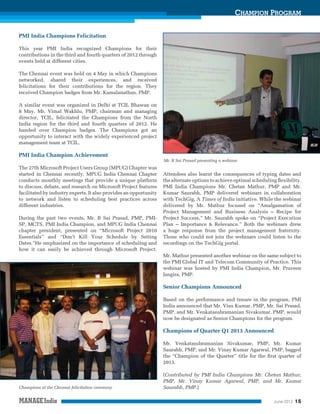
PMI India Champion Achievement
Mr. B Sai Prasad presenting a webinar

The 27th Microsoft Project Users Group (MPUG) Chapter was
started in Chennai recently. MPUG India Chennai Chapter
conducts monthly meetings that provide a unique platform
to discuss, debate, and research on Microsoft Project features
facilitated by industry experts. It also provides an opportunity
to network and listen to scheduling best practices across
different industries.
During the past two events, Mr. B Sai Prasad, PMP, PMISP, MCTS, PMI India Champion, and MPUG India Chennai
chapter president, presented on “Microsoft Project 2010
Essentials” and “Don’t Kill Your Schedule by Setting
Dates.”He emphasized on the importance of scheduling and
how it can easily be achieved through Microsoft Project.

Attendees also learnt the consequences of typing dates and
the alternate options to achieve optimal scheduling flexibility.
PMI India Champions Mr. Chetan Mathur, PMP and Mr.
Kumar Saurabh, PMP delivered webinars in collaboration
with TechGig, A Times of India initiative. While the webinar
delivered by Mr. Mathur focused on “Amalgamation of
Project Management and Business Analysis – Recipe for
Project Success,” Mr. Saurabh spoke on “Project Execution
Plan – Importance & Relevance.” Both the webinars drew
a huge response from the project management fraternity.
Those who could not join the webinars could listen to the
recordings on the TechGig portal.
Mr. Mathur presented another webinar on the same subject to
the PMI Global IT and Telecom Community of Practice. This
webinar was hosted by PMI India Champion, Mr. Praveen
Jangira, PMP.

Senior Champions Announced
Based on the performance and tenure in the program, PMI
India announced that Mr. Visu Kumar, PMP, Mr. Sai Prasad,
PMP, and Mr. Venkatasubramanian Sivakumar, PMP, would
now be designated as Senior Champions for the program.

Champions of Quarter Q1 2013 Announced
Mr. Venkatasubramanian Sivakumar, PMP, Mr. Kumar
Saurabh, PMP, and Mr. Vinay Kumar Agarwal, PMP, bagged
the “Champion of the Quarter” title for the first quarter of
2013.

Champions at the Chennai felicitation ceremony

(Contributed by PMI India Champions Mr. Chetan Mathur,
PMP, Mr. Vinay Kumar Agarwal, PMP, and Mr. Kumar
Saurabh, PMP.)
June 2013

15
© 2013 Project Management Institute, Inc. All rights reserved.
“PMI,” the PMI logo, “Making project management indispensable for business results,” “PMI Today,” “PM Network,” “Project Management Journal,” “PMBOK,” “CAPM,”
“Certified Associate in Project Management (CAPM),” “PMP,” “Project Management Professional (PMP),” the PMP logo, “PgMP,” “Program Management Professional
(PgMP),” “PMI-RMP,” “PMI Risk Management Professional (PMI-RMP),” “PMI-SP,” “PMI Scheduling Professional (PMI-SP),” “OPM3,” “PMI-ACP,” “PMI Agile Certified
Practitioner (PMI-ACP),” the PMI Educational Foundation logo and “Empowering the future of project management” are marks of Project Management Institute, Inc.
For a comprehensive list of PMI marks, contact the PMI Legal Department.

16

June 2013

For Private Circulation Only

Basic Ingredients That Public Sector Projects Require - Manage India

  • 1.
  • 2.
    CONTENTS Raj Kalady Priya Awasare PanchaleeThakur Arjun A. An IBM project team meeting in their Bangalore office to discuss the progress of a project in Europe Pamposh Gulati Shilpi Bhargava CMSL developer team 2 June 2013
  • 3.
    Raj Kalady Managing Director,PMI India Dear Practitioners, 8-10 May. PMI India partnered with CPhI India to organize the conference that had representation from a wide range June is an exciting month for PMI India with two regional of pharmaceutical companies and research organizations. conferences within a space of two weeks. The PMI Kerala Chapter conference was held on 8 June and the Chennai In our effort to continuously engage with the Registered conference is scheduled for 22-23 June. The theme for the Education Provider (R.E.P.) community, we had a meeting Kerala conference was “Project Management – a Catalyst with R.E.P. representatives from North India in March. for Success” in which several experts from government, The meeting helped both PMI and the R.E.P.s understand academia, and the private sector spoke. The Chennai each other’s objectives and plans. conference theme is “Deliver True Value with Effective Project Management.” The Chennai Chapter used a novel In this issue of Manage India, we feature two highly approach to select the theme. It invited feedback on complex projects by IBM India. IBM has been a proponent proposed themes, and this theme emerged the winner with of project management for years and has mature project 40 per cent votes. management practices. I’m certain our readers will benefit from some of the project best practices that these successful Our volunteers are doubling up their efforts to ensure projects followed. that preparations for our flagship knowledge platform, the PMI India National Conference, go on smoothly. We have shortlisted abstracts and PMI India award nominations Warm regards, and the list has been announced. The conference promises to have a great line-up of speakers; a few speakers have already confirmed and we are expecting some more confirmations soon. I urge you to refer to the conference website for regular updates. http://www.pmi.org.in/conference2013/ Another conference that did exceedingly well was the Pharma Project Management Conference in Mumbai on Raj Kalady Managing Director, PMI India June 2013 3
  • 4.
    BY INVITATION There isa great need for project management in the public domain. There’s a perception that the government deals mainly with “soft” sectors in the public domain such as healthcare and education and that there is no need for project management practices. But that is not true. The government deals with “hard” sectors like infrastructure. Even in the “soft” sectors, project management practices are required for effective implementation. In fact, project management is the heart of implementation. I have used project management in major infrastructure projects like in the power sector. I was managing director of Karnataka Power Corporation Limited where we worked on the Rs 15,000 crore, 450 mega watt expansion of the power project. It was financed by the private sector at an interest rate of 16.5 percent. But we managed to execute it well with no time and cost overruns. In fact, it created a record in the power sector, with its completion nine months ahead of time. We also saved a considerable amount of money. The following are some project management practices for work in the public domain: 1. A project must be well researched and well designed, and put together within a consistent framework. Once the project is designed, there should be minimal rework. In the public domain, rework is a bane: the scope of the project, the design is changed many times due to faulty planning. In the power project at Raichur, Units 5 and 6, in Karnataka, we froze the design and scope of the project once it was in place. We allowed no changes. The iron discipline helped in the specifications being firmed up. Thus there was scrupulous implementation. That’s the advantage of definiteness in a project. 2. The project should be well-funded. If it is semi-funded, the money gets dried up midstream and the project stops. Even on resumption, the momentum must be built up again. Cash gives a certain ‘certainty’ to a project. That certainty is critical. 3. Agencies which execute the project must possess the competence to execute it. Raichur 5 and 6 was gigantic in nature - there were 65 contracts in all. It called for an agency with competence of a high order. You must select the agency based on objective criteria such as quality, market record, track record, engineering expertise, and so on. Those of a high order perform well. But in the public sector, selection could be based on sweetheart deals. (These are undue favors shown by the procurer to the seller. For example, the procurer might enter into a deal with the seller either in terms of fixing the quality or hiking the price; he accepts substandard quality or asks for a higher price). So projects sputter away and enormous time and money are lost. 4 June 2013 4. Today, we need a partnership approach to project execution. The owner is not the boss, the agent not the serf. The owner cannot pretend to call the shots; the contractor or agent cannot be treated like a daily wages worker. All the stakeholders must be equally involved. 5. Today, there is a need for incentives for performance. I introduced it in my projects. If the design was ready 10 percent ahead of the time frame, the person responsible for it was rewarded, he would get a bonus. If it was completed even earlier, he would get a bigger bonus. In the said project, even a public sector unit like Bharat Heavy Electrical Limited earned a bonus of Rs 70 crore, on a total project worth Rs 700 crore. Even the mechanical and electrical units got a bonus. So incentives must be a part of project management practices; however, make sure that the targets are not low. 6. Another commendable practice is good communication at all levels and all spheres – between management and agencies, at the field site, with the outside world, with finance agencies. Good communication, both external and internal, creates a performance ethic all around. It increases performance and productivity. 7. Any good project must emphasize wins and celebrate successes. A project must have milestones, and each time a milestone is reached, it must be celebrated. For example, when a milestone is reached on schedule or ahead of schedule, you must celebrate: throw a party, have a bonfire night, hold a recognition function, have it written about in the media. It may sound trivial, but what it does to the morale is critical. At the end of the day, you must also be lucky. Because a bad politician, an incompetent bureaucrat, acts of nature, or disasters can mess up a project. But even with politicians, it can be a matter of circumstance. The bigger the project, the bigger the sense of ownership on the part of the politician. It is the astuteness of the manager that can save the day. The golden rule is that you must make the politician feel responsible for the success of the project. It is about managing the expectations of the politician. (Mr. K Jairaj, IAS, retired recently as additional chief secretary to the Government of Karnataka. He has held diverse assignments in infrastructure, energy, transport, and urban development. He was principal secretary to the chief minister of Karnataka, and commissioner, Bangalore City Corporation for two terms. He helped establish the Bangalore International Airport Limited on a public private partnership basis. Currently, he is the trustee and secretary of Bangalore Political Action Committee.) —As told to Geetha Rao
  • 5.
  • 6.
    Cover Story An Eyefor Detail Keeps Surprises at Bay IBM India manages scope creep in large IT projects with innovative project management approaches BY PANCHALEE THAKUR New technologies and platforms, and the move towards consolidation and integration of business processes and assets have made IT projects extremely complex. A successful IT project is one that not only fulfils an organization’s immediate requirements but also helps it reach its long-term business and technology goals. With rising complexities, the risks are higher and so is the failure rate. The PMI’s Pulse of the ProfessionTM Survey revealed that in 2011 over one-third of projects did not meet their business goal and business intent. According to a study published by Gartner in June 2012, large IT projects are more susceptible to failure. Gartner finds that an IT project of over $ 1 million is 50 percent more likely to fail than a project with a budget below $ 350,000. The reasons for failure can be many: highly ambitious and sometimes unrealistic expectations, complexities arising out of a geographically dispersed project team, inability to An IBM project team meeting in their Bangalore office to discuss the understand project requirements, and inadequate project progress of a project in Europe monitoring. Project management skills are becoming critical for the success of a project. Below are two project success stories from IBM India that illustrate the benefits of applications. Most of the applications went through each of applying innovative project management approaches to solve these phases within defined timelines. Each application was highly complex project challenges: treated as a project within a larger program of end-to-end upgrade. Software Upgrade and Applications Migration Project A large automotive company in the US engaged IBM India to upgrade all its 253 IT applications to one version older than the latest. The exercise was to be completed within a fixed time and cost. By the end of the upgrades, the applications must maintain their functionalities, and offer similar or better performance, resiliency, sustainability, and security. The team came up with a master plan for all the applications with the goal that there would be no disruption of business, or change in functionality, or deterioration in performance. IBM re-architected the application platform by taking the customer’s IT roadmap as a project guideline. A major technical challenge arose due to the non-compatibility of operating systems (OS) of some of the applications. Some of the Solaris applications that were architected by the company’s IT team and were tightly coupled with the OS had to be migrated to Linux. Additionally, some of the latest versions of the software could not run on the old hardware; hardware renewal added to the complexity. The goal of developing was to test the application in the new architecture and newer software versions ensuring that functionality, performance, availability, and sustainability remain at optimal levels. The strategy for testing was to perform system integration testing, performance testing, and user acceptance testing to rate its functioning and performing. Additionally, there were disaster recovery drills and security scans like web scans and technical security standards scan to be performed at the OS. Project Scope Challenges The project scope included plan and define, architecture solution (design), code development, test, and deploy the • 6 June 2013 Grouping 253 applications technologies, and softwares on diverse platforms,
  • 7.
    COVER STORY • • • • • • • Conflict withbusiness initiatives, server hosting team’s priorities, and different contract priorities and scope among vendors Compatibility between various infrastructure, applications, third party products, and operating components, especially with the newer software version without re-writing the application Unknown behavior of the application for new software Delays from other vendors Unknown pieces of modules that existed but were never discovered thus far Conflict of timing with month end processes, business freeze, regulatory compliance Gaps in responsibilities among vendors Scope Creep and its Management The upgrade threw open many unknown situations, and therefore presented with scope creep scenarios. Each application was likely to present different challenges because they were on diverse platforms and technologies, did not follow any determined architecture standards, and were out-of-date in terms of language, design, software, and architecture. It was extremely difficult to estimate the schedule, scope of software development work, and identify all the risks. IBM analysed the possibilities of scope creep at various stages and made the company aware of it. The two parties came to an agreement to review the baseline plan and re-baseline it periodically based on data. Any source code changes beyond the task of keeping the application behave as-is was to be treated as additional work. IBM was exempt from penalties for any delays caused by other vendors. Prior agreements, defined processes, and disciplined tracking helped diffuse any crisis due to scope creep during project execution. The “factory model” that helped the team plan and execute the project efficiently 4. Applications were classified as high, medium, and low complexity. 5. A master schedule was created that formed the basis for the model. Outcome and Best Practice The project execution and the factory model could now be used as best practices for similar situations. Also what worked was the testing strategy. Testing was scheduled for a small group of testers where several applications were lined up for testing with varied technology platforms and different levels of testing. “The application migration to newer versions of software, the latest hardware, and the latest IT architecture completed without any disruptions to business. The project won us accolades from the customer for the innovative approach and meticulous execution,” said an IBM project manager. Innovative Project Management Approach SAP Roadmap Project for EMEA Region This was the first time that the IBM India team was offering a service of this nature at such a large scale. To bring predictability to the schedule, budget, and risk management, the team came up with a “factory model” for planning and monitoring the program and each application as a single project. The “factory model” provided predictability, repeatability, consistency in monitoring and reporting, enabled managing risks and issues, and yet provided a broader view of the project. The following were the key features of the model: 1. The “factory model” defined 14 standard operations (milestones) that would be applicable for the migration/ adaptation project. A global leader in consumer products entrusted IBM India with the task of helping the company’s various businesses integrate and transition into common business platforms and systems. It was a time and material contract. The engagement was a part of the company’s 2013 roadmap for Europe, Middle East, and Africa (EMEA) and involved transitioning of its EMEA business to a European Operating Company (EOC) model, integration of a newly acquired business onto its SAP platform, and transitioning of its EMEA business from legacy ERP systems to the SAP Catalyst platform. Project Scope 2. Critical paths for the 14 operations were determined. A number of these multi-country projects in Europe were to go live on the same day – 26 April 2013. Those projects were: 3. The standard duration for each milestone was determined based on the complexity of the application. • • Harmonization of the global master data for the company Rollout of the company’s EOC model in six countries June 2013 7
  • 8.
    COVER STORY “ Organizations mustadhere to a strong project management methodology. Following a detailed process ensures that a project stays on track. Regular project reviews are important and adherence to CMMi compliant processes helps. The best practices and lessons learned must be documented in knowledge management systems for further harvesting. Processes, methods, and tools can guide project managers from project inception to closure. ” — Ms. Sudha Y, PMP Project management community lead, project management center of excellence, IBM India • • and 14 plants. These countries were Lithuania, Poland, Czech Republic, Slovakia, Hungary, and Bulgaria Advance planning and optimization to enable a fully integrated supply chain planning process for all the company’s businesses. The supply planning process included 41 business units in the United Kingdom, Ireland, and Germany, and production planning included three manufacturing plants in the United Kingdom and Germany The record-to-report finance process consolidation project that included multiple smaller projects Project management was responsible for planning scope, cost, schedule, and communication; executing the project as per the plan and standards set; monitoring delivery reviews and quality assurance; controlling cost, quality, scope, and schedules; and project closure. The quality parameter defined was to deliver optimized code with minimal defects. Challenges The main challenge in this project was to define the scope and prevent scope creep. Though the baseline was finalized, scope changes were a distinct possibility. The project faced the following challenges during the various stages: Planning: Being an SAP template rollout, the main challenge during planning was to identify local legal requirements for all the countries within the project scope. It also involved significant travel for the project team members. Designing: The baseline scope was designed as per the requirements provided, but the lack of clarity on the legal requirements put the project in danger of scope creep. Monitoring: The project team needed to travel a lot during each cycle testing stage. Keeping a tab on the travel expenses was a challenge. Stringent tracking of the travel and other expenses was implemented. Innovative Project Management Approach The team realized early on the possibility of scope creep jeopardizing the project schedule. The IBM project management team raised this issue with the client and finalized the below approach to deal with the changes: 1. Implementation of strong change control process 2. Identification of required vis a vis good-to-have changes 3. Existing production issues to be routed through support change 4. Accommodate the required legal changes only The project used the SAP Global Template Ascendant approach. It involves multiple phases of evaluation and creation of blueprint solutions, and testing and customizing before the final output. Stakeholder management was key to the success of the project. Organizational change management was in place and helped business users adopt the new solution across countries. The team conducted workshops for users who passed on the learning to other users in the company. The handover after go-live was gradual: Week 1-2: project team took ownership of all the issues raised Week 3: project team provided support for low and medium defects Implementation: Availability of resources was the main challenge. IBM managed it by using the core and flex concept of the factory model. Week 4-5: the company’s support team took charge with the IBM team working as shadows Development: There were many projects going live in the same development landscape. A major challenge was the sharing of development objects among other projects. This was overcome by seamless collaboration of all the projects involved in the development of the shared objects. “The go-live went off successfully and without any issues. The approach of gradual transition after the go-live stage where IBM continued to support the client’s IT team proved prudent. Our efforts came in for appreciation from the client,” said the IBM project incharge. 8 June 2013
  • 9.
    PMI INDIA UPDATE PMIIndia partnered with CPhI to connect project managers across the pharmaceutical industry for the Pharma Project Management Conference on 8-10 May in Mumbai. The conference helped generate considerable interest in project management and highlighted the need for project managers in this industry. Day one of the conference had the right blend of topics, ranging from project management in the pharmaceutical industry to its application in various departments such as research and development, clinical research, supply chain, and manufacturing. Industry experts Mr. Sanjay Bhanushali and Ms. Megha Thakkar, PMP and PMI India Champion from Cipla, Mr. Sanjit Singh Lamba from Eisai Knowledge Centre, Mr. Varada Bapat, PMP from Wockhardt, and Mr. Sanjay Akhani, PMP and PMI India Champion from Quintiles spoke during the conference. Mr. Mohan Pandey, PMP from BristolMyers Squibb introduced a new and unique concept called “Anti-fragile project management.” Conference chairperson, Dr. Deepa Bhide, PMP, from Net.Orange Inc and board member of PMI Healthcare Community of Practice, shared her experiences of handling children as a project and encouraged delegates to be participative in a Q&A session. Day two of the conference included discussions on some unique concepts such as fast track project management, product lifecycle management, and the role of a pharmaceuticals project manager. Experts who took part in the discussions were Mr. Sai Sethuraman from Hospira, Mr. Prasad Kulkarni from Dr. Reddy’s Laboratories, and Mr. Shyam Khante from Shyam Khante Associates. Mr. Rami Goldratt, CEO, Goldratt Consulting conducted a two-hour session on the theory of constraints and enlightened pharma project managers on the applicability of this concept. Mr. Abhishek Mittal, PMP and PMI India Champion from Biocon brought in some fun Mr. Sanjay Akhani, PMP and PMI India Champion from Quintiles The PMI India stall receives a steady flow of visitors element to this technical conference with a quiz on project management fundamentals. There was a hands-on workshop on MS-Project 2010 on the concluding day. Ms. T. Vijayalaxmi introduced project managers to the effective use of the various functions of MS-Project through this workshop. PMI received highly positive feedback from delegates. “The Pharma Project Management Conference was excellent in all ways. The presentations were informative and interesting. The discussions and networking gave delegates perspectives from both the Indian and international viewpoints. The conference was an excellent place to share information, know people, and gather knowledge,” said a project manager from Fresenius Kabi Oncology Ltd. Mr. Abhishek Mittal, PMP and PMI India Champion from Biocon Dr. Deepa Bhide, PMP, from Net.Orange Inc June 2013 9
  • 10.
    ARTICLE OF THEMONTH Background and Context Research by the Standish Group shows a staggering 31.1 per cent of IT projects will be cancelled before they get completed. Further studies indicate 52.7 per cent of IT projects will cost 189 per cent of their original estimates. The cost of these failures and overruns are just the tip of the iceberg. The lost opportunity costs are not measurable but could easily be in trillions of dollars. Why do projects fail, i.e. overshoot their original budgets? The Standish Report says the factors for failure could be lack of user involvement, lack of executive management support, inadequate planning, resource commitment, and incompetency. This article examines a more fundamental factor—project methodology selection. A project methodology provides a process for managing projects. There are several project management methodologies such as Projects In Controlled Environments, Unified Project Management Methodology, Managing Information Technology Projects, and Microsoft Solution Framework. There are several development methodologies such as waterfall, prototype, iterative, and agile project management. These methodologies are designed to increase the repeatability of project execution success. According to SPI Research’s 2011 Professional Services Maturity Benchmark study only one-fourth of organizations have their own standardized processes for managing projects and only 15 percent use metrics and controls. Right Methodology and Collaboration Methodologies are useful for projects when implemented in the right spirit. However, often one fails to realize that the right methodology must be selected and/or customized to align with the environmental factors covering stakeholders, processes, and tools. Since every project is unique, it is likely that the environmental factors will be unique too. For example, if you intend to follow the Scrum method, where the product owner indicates his unavailability on a daily basis, it could lead to delays during execution. The industry practice today is collaboration, i.e. share and get the buy-in of the methodology/approach from key stakeholders. This prevents future surprises. Spirit and Intention Projects today are being delivered using globally distributed teams. Effective communication is essential. The project manager needs to be aware of the cultural issues in working 10 June 2013 with a diverse and virtual team. Project managers often do not build specific communication requirements into their plan. Although a methodology is present, the tools and techniques are not utilized in the right spirit. In order to communicate as per the agreed methodology, one must build the necessary infrastructure within the project to: obtain the relevant information at the right time from the right stakeholders, and to communicate the information to others at the right time. In some cases, help is taken from project support offices to derive metrics and reports to share with the stakeholders. The project manager should also be aware of the project performance parameters such as scope, schedule, costs, quality, and staff plans to be able to respond to any unplanned queries. Where projects are quantitatively managed, metrics are used to forecast project performance. This depends on the maturity of the project management methodology being adopted. Planning Challenges An experienced manager knows how detailed the planning needs to be. It requires time, especially if one needs to cover all the knowledge areas specified in A Guide to the Project Management Book of Knowledge (PMBOK® Guide). One of the most common bad practices is inadequate time given to planning. Project managers are expected to produce deliverables from day one. Such projects often face challenges later on and time is spent in fire-fighting. In this scenario, despite the usage of the right methodology and the availability of tools and techniques, lack of prioritization on the planning around implementing the project methodology results in fire-fighting situations. It is important that the right methodology be applied to every project and the procedures are followed in spirit to ensure project success. Moreover, explore and use the necessary tools and techniques that are part of the methodology. Since, the project methodology selection influences procedures and activities for the rest of the project, it is important to get this step absolutely right. (Mr. Yeldo P Varghese, PMP, has over 15 years of experience in IT services organizations and has delivered engagements of various complexities. He is currently a delivery manager at Capgemini managing geographically distributed multifunctional teams.)
  • 11.
    CHAPTER NEWS Faculty membersof PMIPCC at the upgrade workshop on PMBOK® Guide—Fifth Edition Now that A Guide to the Project Management Book of Knowledge (PMBOK® Guide)—Fifth Edition is available, the chapter has begun initiatives to spread knowledge about it among its various stakeholders. The first workshop on the latest version of the PMBOK® Guide was conducted in April. There was a workshop for chapter members, followed by a workshop for Deloitte. The chapter also conducted an upgrade workshop for all its faculty members. Based on the response of these participants, there are plans to conduct regular workshops on this edition of the PMBOK® Guide. In line with PMI objectives of encouraging and engaging volunteers, the chapter has been working on multiple models of volunteer engagement. Each board member has been mandated to create volunteer opportunities, which is then published in the chapter website. In order to further augment this process, the chapter conducted a volunteer management meeting to increase the volunteer base, which received an encouraging response. PMI Pune-Deccan Chapter has moved a step ahead by collaborating with international associations. Ms. Rekha Rao, member, PMI Pune Deccan Chapter, presented the chapter’s overview to PMI Memphis Chapter members during her US trip. PMI Memphis Chapter will now work with Pune-Deccan Chapter. During the initial stage of this association both chapters will focus on generating value to its members. Chapter members can now attend each other’s seminars, exchange seminars, and share newsletter content. Pune-Deccan Chapter members will be exposed to a global forum, and can learn and share project management best practices from another country. The chapter held two seminars on 11 May as part of its monthly seminar series. The themes were “Project Management Tools and Techniques” and “Soft Skills for Project Managers and Managers.” The seminars attracted over 50 members. The chapter also felicitated seven members who recently received their PMP® credentials. June 2013 11
  • 12.
    CHAPTER NEWS In continuingwith its pursuit of promoting project management knowledge, PMI Bangalore Chapter has taken steps to revise its training material as per A Guide to the Project Management Book of Knowledge (PMBOK® Guide)— Fifth Edition for its PMP Quest training program. The training based on the new curriculum is expected to start in June. Members can download the e-book version of the same from the PMI website for their use. The chapter hosted the 200th session of PM Footprints on 14 March. It is a milestone in the chapter’s history. Mr. T.R.Anand, management consultant and advisor, spoke on “Customer Centric Project Management – Business Perspectives” and it was attended by nearly 80 practitioners. PM Footprints was launched in October 2006 to provide a platform for sharing the experience and knowledge of project managers. It is held every alternate Thursday at Royal Orchid Central Hotel on Dickenson Road in Bangalore. The popularity of the program can be gauged by the number of participants who attend these sessions regularly. The chapter recently concluded elections to fill vacancies for three positions in the chapter’s executive committee (EC). PMI West Bengal Chapter holds one-day workshops as part of its continuing education initiative. The first such work- Mr. MS Hiremath, PMP, vice president, programs, PMI Bangalore Chapter, presenting a token of appreciation to Mr. Anand Join us in congratulating the new EC members – Mr. Basu Dutta, PMP, Mr. Nimish Mehta, PMP, and Mr. Venkatachaliah Babu, PMP. shop this year was held on 11 May. The workshop was on one of the most challenging areas of software development, “Estimations Used in Software Industry.” It covered both traditional methods like Use Case Points and Function Points, and the latest methods used in software development based on the agile project management approach. The workshop was anchored by Ms. Susweta Mukherjee, PMP, principal consultant, Tata Consulting Services; Mr. Ronaka Roy Khatri, senior consultant, Tata Consulting Services, and Mr. Saikat Dutt, PMP, associate director - projects, Cognizant Technology Solutions. The speakers used examples and demonstrations to make it an interesting learning experience for the participants. Participants’ feedback has been encouraging. The interactions and networking during the day’s proceeding led quite a few participants to come forward as chapter volunteers for various activities. Ms. Susweta Mukherjee at the software estimation workshop 12 June 2013 (Chapter news is contributed by Capt. L.N. Prasad, Mr. Soumen De, Mr. Rinoo Rajesh, Mr. Tapan Kumar Jena, and Mr. Ravi Vurakaranam.)
  • 13.
    R.E.P NEWS PMI Indiaconducted an awareness session with the practitioner community in Gurgaon and Noidaon 12 April. The meeting, held at the Ericsson Gwal Pahari premises, was hosted by the Gurgaon Project Management Community.Members from Noida joined the session through video conference. Mr. Shine Sahadevan, head – organizational market, PMI India, spoke about PMI India initiatives during the session. Mr. Sahadevan is responsible for advocating the project management profession within the organizational market with a focus on IT/ITES and telecom companies. The session saw free-flowing discussions on various topics, such as the PMI Agile Certified Practitioner (PMI-ACP)® certification, PMI India chapters, and current project management trends. There was special emphasis on the telecom sector with deliberations on competencies needed for success in this sector, current skill gaps, and the high level objectives articulated in the National Telecom Policy 2012. Participants also took part in a quiz on PMI designed by PMI India Champion Vinay Agarwal, PMP. The Internal Registered Education Providers (I.R.E.P.), which is a part of the PMI India community, setup a platform for project managers to collaborate and share ideas. This platform serves as an information bridge for different participating organizations in Internal R.E.P. to share new best practices in the areas of research and development, global customer delivery, and third party management. Mr. Karthick Rajapandiyan, senior project manager, Alcatel-Lucent As a part of this initiative, Internal R.E.P. organized its third talk on 5 April 2013. It was a virtual talking, which practitioners from AlcatelLucent, Sasken, and Datamatics Technology attended. The speaker, Mr. Karthick Rajapandiyan, senior project manager, Alcatel-Lucent, presented on “Quality Improvement Practice for Third Party.”The session started with an introduction of the speaker by Mr. Vineet Chandra, engineering manager- quality, AlcatelLucent. Mr. Rajapandiyan elaborated on common pain points and ways to solve them by following certain quality improvement practices. Mr. Shine Sahadevan during the interaction in Gurgaon The first regional R.E.P. meeting for North India for 2013 was held on the 14 March in New Delhi. As many as 14 R.E.P.s participated in this meeting to share their accomplishments and seek updates of PMI India.The meeting provided them an opportunity to exchange ideas, network, and share thoughts among community members. North India R.E.P. representatives at the meeting June 2013 13
  • 14.
    CHAMPION PROGRAM As thePMI India Champion program completed two years this April, the Champion Advisory Committee (CAC) met with Mr. Raj Kalady, managing director, PMI India, on 20 April in Mumbai. The meeting provided an opportunity to review the program’s progress in the past two years and decide the future plans. Mr. Ketharinath Kamalanathan, PMP, chairperson, CAC, received an emotional adieu as he completed his twoyear tenure at CAC. The CAC acknowledged his contributions to the program. Mr. Ganesh Puthucode, PMP, member, CAC, who has left CAC after two years for personal commitments, was also given a farewell. Mr. Kalady announced the names of the new chairperson and co-chairperson for CAC for the next one year – April 2013 to March 2014. Ms. Shagufta Inamdar, PMP, is the new chairperson and Mr. Vivek Sonar is the new co-chairperson. The CAC team reviewed the program’s progress and discussed key action points for the year ahead. The Champion advisory council members with PMI officials Launch of Champion Portal With the Champion program spreading wide and fast, there is a need to track its progress. That gave rise to the idea of having a comprehensive web solution for the program. It will be integrated with the Champion website. It will be used to submit Champion goals, track results and achievements, document interactions between Champions and mentors, identify star performers every quarter, and integrate the results with the rewards framework. To come up with a Champions at the North India felicitation ceremony 14 June 2013 feasible web solution, a sub-committee was formed in July 2012 that comprised of PMI India Champions, CAC members, and administration team members. The sub-committee members were Mr. Vinay Kumar Agarwal, PMP, Mr. Sampath Kumar, PMP, Mr. Vivek Sonar, Ms. Shagufta Inamdar, PMP, Ms. Leena Gupte, PMP, Ms. Swati Pant, and Mr. Chiranjeev Singh from CyberMedia. The sub-committee’s task was to finalize the requirements and get the solution developed. The requirements were captured through progressive elaboration and the scope document was submitted to the vendor to initiate the work. Coordination among team members was important as it was a virtual team. Single points of contact (SPOC) were identified from the sub-committee and the development team, so as to ensure that the development happens as per the scope document and to avoid obvious communication gaps. The solution went through several development phases over the next 4-5 months. Periodic reviews within the sub-committee and also with CAC chairperson ensured that the project stayed on course and within the agreed targets of time and cost. The entire development was completed over seven months. The piloting was done at two levels – first within the subcommittee and then expanding it to a live environment by involving more CAC members and Champions as real world users. The solution was formally launched on 24 April to the entire team. The successful development and launch is attributed to the detail scope document, identification of SPOC early in the program, periodic reviews within the sub-committee to track progress and resolve issues, and the commitment of all team members.
  • 15.
    CHAMPION PROGRAM PMI IndiaChampions Felicitation This year PMI India recognized Champions for their contributions in the third and fourth quarters of 2012 through events held at different cities. The Chennai event was held on 4 May in which Champions networked, shared their experiences, and received felicitations for their contributions for the region. They received Champion badges from Mr. Kamalanathan, PMP. A similar event was organized in Delhi at TCIL Bhawan on 8 May. Mr. Vimal Wakhlu, PMP, chairman and managing director, TCIL, felicitated the Champions from the North India region for the third and fourth quarters of 2012. He handed over Champion badges. The Champions got an opportunity to interact with the widely experienced project management team at TCIL. PMI India Champion Achievement Mr. B Sai Prasad presenting a webinar The 27th Microsoft Project Users Group (MPUG) Chapter was started in Chennai recently. MPUG India Chennai Chapter conducts monthly meetings that provide a unique platform to discuss, debate, and research on Microsoft Project features facilitated by industry experts. It also provides an opportunity to network and listen to scheduling best practices across different industries. During the past two events, Mr. B Sai Prasad, PMP, PMISP, MCTS, PMI India Champion, and MPUG India Chennai chapter president, presented on “Microsoft Project 2010 Essentials” and “Don’t Kill Your Schedule by Setting Dates.”He emphasized on the importance of scheduling and how it can easily be achieved through Microsoft Project. Attendees also learnt the consequences of typing dates and the alternate options to achieve optimal scheduling flexibility. PMI India Champions Mr. Chetan Mathur, PMP and Mr. Kumar Saurabh, PMP delivered webinars in collaboration with TechGig, A Times of India initiative. While the webinar delivered by Mr. Mathur focused on “Amalgamation of Project Management and Business Analysis – Recipe for Project Success,” Mr. Saurabh spoke on “Project Execution Plan – Importance & Relevance.” Both the webinars drew a huge response from the project management fraternity. Those who could not join the webinars could listen to the recordings on the TechGig portal. Mr. Mathur presented another webinar on the same subject to the PMI Global IT and Telecom Community of Practice. This webinar was hosted by PMI India Champion, Mr. Praveen Jangira, PMP. Senior Champions Announced Based on the performance and tenure in the program, PMI India announced that Mr. Visu Kumar, PMP, Mr. Sai Prasad, PMP, and Mr. Venkatasubramanian Sivakumar, PMP, would now be designated as Senior Champions for the program. Champions of Quarter Q1 2013 Announced Mr. Venkatasubramanian Sivakumar, PMP, Mr. Kumar Saurabh, PMP, and Mr. Vinay Kumar Agarwal, PMP, bagged the “Champion of the Quarter” title for the first quarter of 2013. Champions at the Chennai felicitation ceremony (Contributed by PMI India Champions Mr. Chetan Mathur, PMP, Mr. Vinay Kumar Agarwal, PMP, and Mr. Kumar Saurabh, PMP.) June 2013 15
  • 16.
    © 2013 ProjectManagement Institute, Inc. All rights reserved. “PMI,” the PMI logo, “Making project management indispensable for business results,” “PMI Today,” “PM Network,” “Project Management Journal,” “PMBOK,” “CAPM,” “Certified Associate in Project Management (CAPM),” “PMP,” “Project Management Professional (PMP),” the PMP logo, “PgMP,” “Program Management Professional (PgMP),” “PMI-RMP,” “PMI Risk Management Professional (PMI-RMP),” “PMI-SP,” “PMI Scheduling Professional (PMI-SP),” “OPM3,” “PMI-ACP,” “PMI Agile Certified Practitioner (PMI-ACP),” the PMI Educational Foundation logo and “Empowering the future of project management” are marks of Project Management Institute, Inc. For a comprehensive list of PMI marks, contact the PMI Legal Department. For a comprehensive list of PMI marks, contact the PMI Legal Department. 16 June 2013 For Private Circulation Only